Dostoevsky: The Grand Inquisitor and the Church That Sends Christ Away
In The Brothers Karamazov, Christ returns to earth and is arrested by the Church itself. The Inquisitor explains why he must stay silent — and Christ answers only with a kiss.
Perhaps no literary critique of religious power is as forceful as The Grand Inquisitor, the chapter in Book V of The Brothers Karamazov in which Ivan Karamazov tells his brother Alyosha a story he has invented. Dostoevsky does not write a pamphlet against Jesus. He does something far more unsettling: he imagines Jesus returning to earth in the middle of the Spanish Inquisition — and being arrested precisely by those who claim to govern in his name.
The scene, in Ivan's telling, takes place in Seville, in the sixteenth century, the day after a burning in which roughly a hundred heretics were put to the flame for the glory of God, under the eyes of the Grand Inquisitor himself. It is into this setting that Christ reappears, quietly, among the people. He announces nothing. But the crowd recognizes him at once: he heals a blind man, raises a child who was being carried toward her coffin. It is at that moment of popular commotion that the old Cardinal Inquisitor, passing by, orders the guard to arrest him. The same crowd that had acclaimed him minutes earlier bows, obedient, before the Church's command.
The accusation is terrible: religion can go on using the name of Christ after concluding that Christ himself gets in the system's way.
That night, in the cell, the Inquisitor visits the prisoner alone and delivers what Ivan calls a long monologue — because Christ, from beginning to end, does not speak a single word. The old man explains, with unsettling clarity, why the Church corrected Christ's work. It took what he had refused to do in the desert and turned it into a method of government. And it is precisely here that the parable reveals its theological precision: the Inquisitor's entire speech is a temptation-by-temptation rereading of the episode in which Jesus is tempted in the desert, recorded in Matthew 4:1-11 and Luke 4:1-13.
The three temptations become a theory of power
In the biblical account, after fasting forty days, Jesus is tempted three times. First, to turn stones into bread to satisfy his own hunger. Then, to throw himself from the highest point of the temple so that angels would save him before everyone, a spectacular proof that he is the Son of God. Finally, to receive all the kingdoms of the world and their glory, in exchange for a single act of worship to the tempter. Jesus refuses all three — quoting Scripture in each response, establishing neither guaranteed provision, nor public proof, nor political dominion.
The Grand Inquisitor reads these three refusals not as virtue, but as the founding error of Christianity. In his view, Christ held in his hands the three instruments that would have subdued humanity once and for all — and he set them aside in the name of a freedom that, the Inquisitor argues, almost no one is able to bear. The Church, the old man says, corrected the founder's own work: it took the bread, the miracle, and the sword of Caesar, and gave them back to the people. That is why the institution can go on speaking in Christ's name even after deciding, long ago, that it no longer needs him — and that his return now would only get in the way.
| The temptation (Matthew 4) | What the Inquisitor says Christ should have done | What is at stake |
|---|---|---|
| Turning stones into bread | Feed the crowd without demanding faith — trade freedom of conscience for guaranteed bread | Material security versus freedom: the Inquisitor bets that the stomach always wins |
| Throwing himself from the temple for angels to save him | Offer an undeniable, public miracle that would remove all doubt | Spectacular certainty versus risky faith: without proof, faith demands a leap few dare to take |
| Receiving the kingdoms of the world in exchange for worship | Accept the sword of Caesar — unite political power and religious authority under one command | Forced unity versus free conscience: only universal power, for the Inquisitor, prevents the chaos of millions of diverging choices |
The full text of the chapter can be read at Project Gutenberg, in Constance Garnett's classic translation. An academic study published in 2017 examines the chapter as a confrontation between freedom, nihilism, suffering, and faith — an axis that runs through Dostoevsky's entire late work.
It is worth noting that the parable does not stand alone in the novel. It is Ivan's answer to an earlier discussion, in the chapter "Rebellion," where he lays out for Alyosha a list of the sufferings of innocent children and asks whether any final harmony, any kingdom of God, could justify that price. Ivan says he "returns his ticket" — he refuses to accept a universe in which the suffering of a single innocent is the cost of a greater plan. It is only after this moral rebellion that he tells the story of the Inquisitor, as though the parable were the living proof of his thesis: that even religion itself, when confronted with the very freedom it claims to defend, prefers control to the risk of human suffering.
The silence of Christ
The strongest literary element in the scene is that Jesus barely argues at all. The Inquisitor speaks for pages, builds a dense argument, one whose internal logic is almost irrefutable — and, at the end, asks for a response. Christ does not give one in words. He approaches the old man in silence and kisses his bloodless lips. That is all. The Inquisitor shudders, opens the cell door, and tells him to go, and never come back.
Dostoevsky places on one side a sophisticated theory about why controlling people would be necessary for their own good; on the other, a silent gesture that refuses to enter the game of power — one that does not refute the argument point by point, because refuting it would mean accepting to fight on the same ground. The kiss does not defeat the Inquisitor through reason. It simply does not participate in the logic the Inquisitor built, and that, in the novel, is more unsettling than any rebuttal.
This makes the chapter useful far beyond its critique of the sixteenth-century Catholicism Ivan uses as a backdrop. It works as a lens for any institution that, in the name of preserving the truth, replaces conscience with obedience and love with administration — including institutions that today speak in the name of the very Christ the parable describes being sent away.
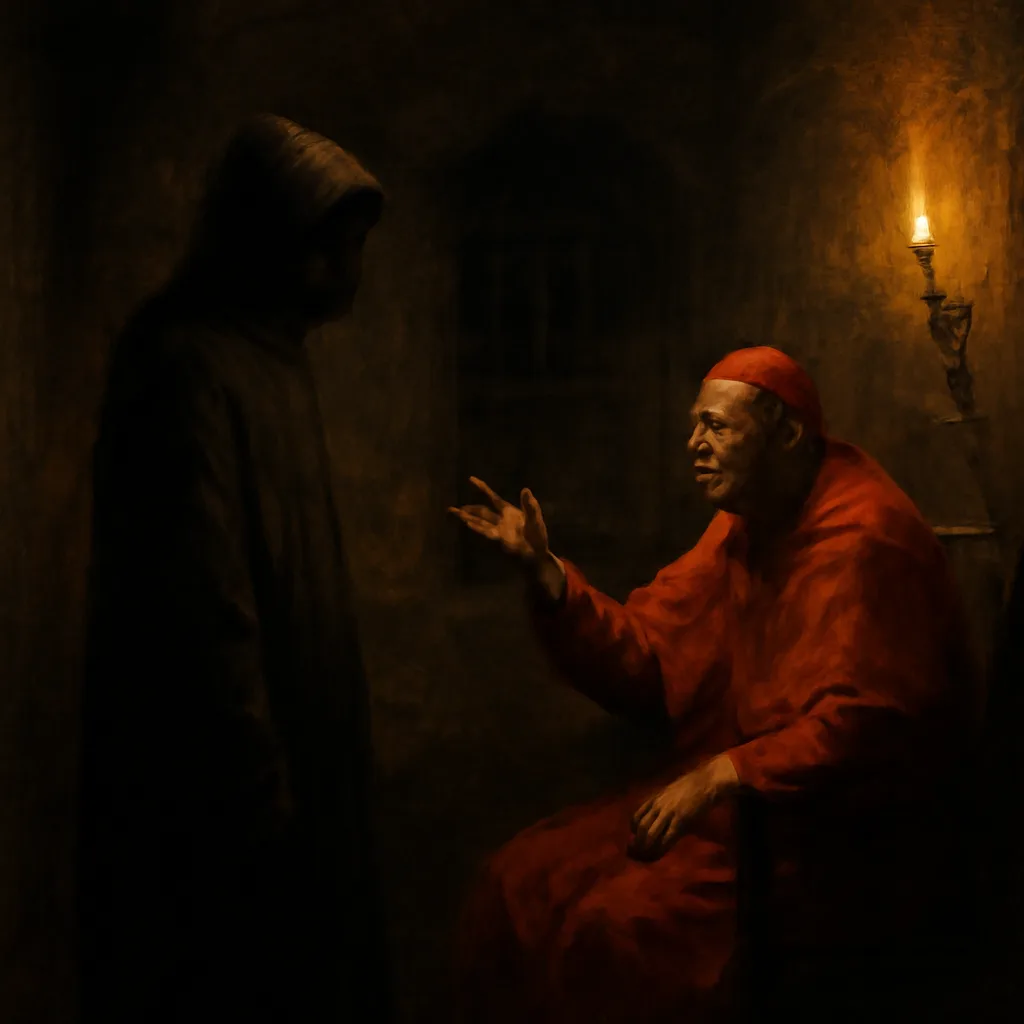
Illustration generated for this article. It represents the Grand Inquisitor scene as narrated by Ivan Karamazov; it is literary fiction, not historical record.
When preserving religion requires domesticating Jesus
The Inquisitor's problem is not a lack of religion. It is too much religion and too little Christ. The institutional machine is running so efficiently, so effectively managing people's hunger and fear, that a living, unpredictable, free presence like Jesus becomes an operational risk. It is not hatred of Christ — it is the cold diagnosis that he, if he stayed, would dismantle the system built in his name.
That is the point connecting Dostoevsky to the rest of this series: what happens when the system created to serve a message acquires interests of its own? Authority begins defending the institution, and then learns to reinterpret the founder so that he fits inside the institution — instead of letting the institution be continually reformed by him.
The man behind the parable
It is impossible to separate the force of this chapter from the biography of the man who wrote it. In 1849, Dostoevsky was arrested for taking part in a political and intellectual discussion circle the Tsarist government considered subversive. He was sentenced to death and led, along with the other defendants, to a public square to be shot. The soldiers were already positioned, rifles raised, when a messenger arrived on horseback with a commutation of the sentence — a mock execution, deliberately staged by Tsar Nicholas I as a form of psychological punishment before the announcement of the real sentence: forced labor in Siberia.
Dostoevsky spent the following years in a prison camp and then in forced military service in Siberian exile. During that period, the only book the authorities allowed prisoners was a New Testament — and it was, for years, practically the only reading he had. He himself would later describe having reached a faith forged through what he called the "crucible of doubt" (gornilo somneniy): a belief that did not arise from easy certainty, but was refined, like metal in fire, through direct contact with nihilism, extreme suffering, and the hardest questions modern Russia raised against religion.
It is this same hard-won doubt, not naive piety, that allows Dostoevsky to put into the mouth of Ivan Karamazov — the intellectual, skeptical, nearly atheist brother — the strongest argument ever written against the practical usefulness of the Gospel. Ivan is no cardboard villain. He presents the Grand Inquisitor as a seductive thesis, almost impossible to refute in purely rational terms, precisely because Dostoevsky knew that thesis from the inside.
The answer the author considered most important
Dostoevsky himself, in letters and preparatory notes on the novel, treated the reply to the Grand Inquisitor as the true core of The Brothers Karamazov — more important, in fact, than Ivan's parable itself. That reply does not come as a logical counter-argument within the same chapter, but as a lifelong counterpoint: Book VI of the novel, devoted to the figure of the elder Zosima, the aged monk who serves as Alyosha's spiritual mentor.
Where the Inquisitor proposes order, guaranteed bread, and centralized authority as the answer to human suffering, Zosima proposes something else: active responsibility of each person for everyone, a love practiced in concrete, humble acts, not in systems of control. Dostoevsky does not try to defeat Ivan by arguing point by point against the Inquisitor's logic — he answers by presenting an entirely different way of living, embodied in Zosima and, later, in Alyosha himself. The answer to power that replaces freedom is not a better argument. It is another way of living.
This structure — Ivan's powerful thesis, followed not by a direct rebuttal but by a life that contradicts it in practice — is what makes the novel, in the view of much literary criticism, one of the most sophisticated works ever written on faith, doubt, and freedom.
The Brothers Karamazov was written and published in installments between 1879 and 1880, near the end of Dostoevsky's life; he would die only months after completing it. In correspondence from that period, he described the difficulty of composing Book VI: he knew the Inquisitor's argument was strong enough to convince the reader, and he feared he might not manage to give Zosima's answer the same literary weight. That tension — between the almost irresistible force of well-written doubt and the seeming fragility of an answer made of humility and action rather than rhetoric — is, for much of the criticism, what makes the novel endure. Dostoevsky does not try to prove that faith wins a debate against doubt. He wagers that a life lived a certain way answers questions no argument alone can settle.
Recommended reading
The Brothers Karamazov — Read especially "Rebellion" and "The Grand Inquisitor" (Book V), but the whole novel, including Book VI on Zosima, provides the full context for the argument.
Crime and Punishment — Guilt, conscience, redemption, and moral transformation, told through a crime and its inner weight.
Demons — Religion, political nihilism, and ideology taken to the extreme, written in light of the revolutionary movements Dostoevsky saw emerging in Russia.
Sources and further reading
- •Primary source: The Grand Inquisitor — Project Gutenberg
- •Academic article: Nihilism and freedom in the Legend of the Grand Inquisitor (2017)
- •PMLA / Cambridge — Freedom: An Existentialist and an Idealist View
Method note: this text separates primary source, the author's interpretation, and historical consensus. When a thesis is contested, it is presented as a thesis — not as established fact.
Same series: Thinkers and Christ
Read the complete series in the app
Memra is 100% free — the Thinkers and Christ essays, with discussion and AI for questions on each one, are available in the app.
Open in Memra