Tolstoy: Following Jesus or Believing Things About Jesus?
For the Russian novelist, Christianity's crisis began when the practice Jesus taught was replaced by dogma, metaphysics, and institution.
A novelist in crisis
Leo Tolstoy came to religion not through institutional comfort, but through a crisis of meaning that nearly broke him. In the late 1870s, after having already written War and Peace and Anna Karenina — the two novels that would establish him as one of the greatest writers in history — Tolstoy went through what he himself would later describe as a period of profound despair. He had fame, wealth, family, international literary prestige. And yet the question that haunted him was more basic than any of those achievements could answer: if death erases everything, what makes a life truly worth living?
That question is not a decorative biographical detail. It is the key to understanding why Tolstoy went looking in Jesus for something very different from what most of the Christian tradition of his time was looking for. He was not after a doctrine that explained the universe, nor a system of salvation after death. He was after a criterion for living — something that would give weight and direction to an existence that, without it, seemed absurd to him. In What I Believe (also published as My Religion) and, later, in The Kingdom of God Is Within You, his answer runs through Jesus. But a Jesus read in a radically practical way, almost like a manual of conduct rather than a theological system.
Practice, not creed
Tolstoy's central point is that Christianity should not be measured first by the precision of its creed, but by the way of life it produces. This is a deliberate inversion of the emphasis he saw in the institutional Christendom around him: for him, centuries of debate over the nature of Christ, the Trinity, and the sacraments had shifted attention away from what Jesus actually asked people to do.
The Sermon on the Mount — Matthew 5 through 7 — sits at the center of this reading. It stops being a collection of beautiful, almost poetic phrases and becomes a concrete standard of conduct. Tolstoy read Matthew 5:21-48 in particular as the ethical core of Christianity, organizing the passage around what he described as five practical commandments of Jesus:
- •Do not be angry with your neighbor (Matthew 5:21-22) — Jesus radicalizes the Mosaic Law's "you shall not murder," extending the prohibition on violence down to the emotional root that produces it.
- •Do not commit adultery, not even in thought, and treat the marriage bond with seriousness (Matthew 5:27-32).
- •Do not swear oaths at all — let your "yes" be yes and your "no" be no (Matthew 5:33-37), which Tolstoy read as a refusal of any oath of loyalty that could be used to justify violence in the name of a state or institution.
- •Do not resist evil with evil — the instruction to turn the other cheek (Matthew 5:38-42), which Tolstoy took literally, not as metaphor.
- •Love your enemies and make no distinction between neighbor and foreigner (Matthew 5:43-48), the commandment he considered the summit of the entire passage.
For Tolstoy, these were not unreachable ideals reserved for monks or saints. They were literal instructions, applicable to the everyday life of anyone willing to take them seriously. Refusing the allegorical or "spiritualized" interpretation of these commandments was, for him, the first step toward recovering Christianity as it had originally been proposed.
The Tolstoyan question is not just "what do you believe about Christ?" but "what would your life look like if you actually took Christ seriously?"
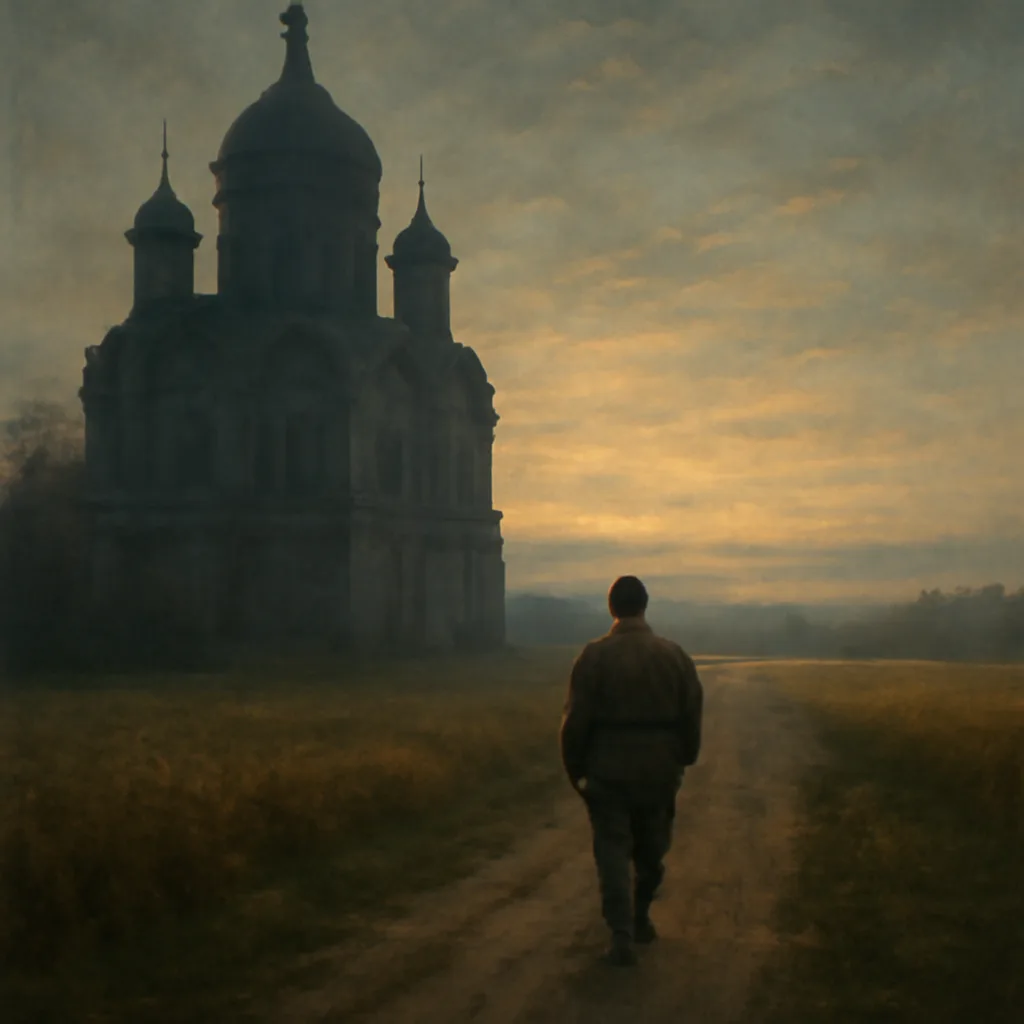
Illustration generated for this article. It represents the tension between institution and practice that Tolstoy describes; it does not depict a historical episode.
Why did this put him at odds with the Church?
Tolstoy saw a direct contradiction between the teaching of Jesus and a Christian civilization perfectly adapted to war, state punishment, nationalism, social hierarchy, and the accumulation of wealth. His critique was not that of an atheist who wanted to erase Jesus from the map. It was, on the contrary, the critique of someone who judged Christendom itself — including the Russian Orthodox Church, of which he was a member by birth — by the demanding standard of Jesus himself, and found it guilty.
That explains why he treated nonresistance to evil by violent means as absolutely central, not as a detail of personal conduct. The Stanford Encyclopedia of Philosophy lists Tolstoy among the classic names of modern religious pacifism — alongside figures like the early Quakers, but with an unusually literal textual radicalism: he rejected not only war, but any state apparatus ultimately grounded in the threat of violence, including courts, prisons, and armies.
In his reading, the problem was not simply distinguishing "just war" from "unjust war" — a debate with centuries of tradition in Christian theology. The problem was the very attempt to reconcile the commandment to love one's enemy with social and political structures built on coercion. For Tolstoy, that reconciliation was logically impossible: either one takes the Sermon on the Mount seriously, and therefore rejects institutionalized violence, or one accepts institutionalized violence, and then the Sermon on the Mount becomes a poetic ideal with no practical consequence.
This position had a real cost. In 1901, the Holy Synod of the Russian Orthodox Church formally excommunicated Tolstoy, largely because of his criticism of the clergy, the Russian state, and official dogma — including his rejection of doctrines such as the divinity of Christ as formulated by the historical councils, and the bodily resurrection as a literal fact necessary for faith. The excommunication did not silence Tolstoy; if anything, it cemented his public image as the most famous critic of institutional Russian Christianity of his generation, and his correspondence with readers on the subject only grew in the years that followed.
What about Paul?
This is where Tolstoy becomes especially relevant to this series. In What I Believe, he argues that an important break occurred very early — almost at the origin of the Christian movement — at the moment when the ethical message of Jesus began receiving an increasingly extensive and elaborate metaphysical construction. Tolstoy attributes much of this process to the figure of Paul, and later, centuries afterward, to the imperial institutionalization of Christianity under Constantine and his successors.
In the Tolstoyan reading, Christianity underwent a kind of shift of axis: instead of being primarily an ethical path — loving one's neighbor, rejecting violence, detaching from wealth — it became primarily a system of beliefs about the nature of Christ, his role in the economy of salvation, and the metaphysical mechanics of atonement. Practicing what Jesus taught was, little by little, replaced by correctly professing what the Church taught about Jesus.
It is important not to turn this reading into settled historical fact. This is explicitly Tolstoy's interpretation — a brilliant reader, but not a historian of early Christianity, writing in a polemical context against the Church of his own time. Contemporary research into Christian origins shows far more continuity between Paul, Second Temple Judaism, and the earliest communities of Jesus followers than the caricature of a Paul simply "inventing another religion" from scratch. Scholars such as E. P. Sanders and other representatives of the so-called "New Perspective on Paul" document how Pauline thought remains deeply rooted in Jewish categories, rather than an abrupt Hellenizing break from the historical Jesus.
Even so, even acknowledging the historical limits of the thesis, Tolstoy's question remains uncomfortable and productive: when explaining the death of Jesus starts taking up more space than practicing what Jesus taught, has the center shifted? It is a question that any Christian tradition — Catholic, Orthodox, Protestant — needs to be able to answer without dodging it.
| What Tolstoy claimed | What current historical research says |
|---|---|
| Paul initiated a decisive break, turning the ethics of Jesus into metaphysics about Christ | There is strong continuity between Paul and Second Temple Judaism; Paul saw himself as a faithful interpreter of the messianic message, not as the founder of another religion |
| The imperial institutionalization of Christianity (4th century onward) corrupted the original message in a linear, deliberate way | The process was more complex and gradual, with multiple competing Christian currents before and after Constantine, not all oriented toward accommodation with power |
| Nonresistance to evil (Matthew 5:38-42) must always be read literally, as an absolute practical rule | New Testament historians debate whether the passage is an absolute rule, a rhetorical hyperbole for emphasis, or a situational instruction for the original community |
| Correct belief about Christ is secondary to ethical practice | Most historical Christian traditions treat belief and practice as inseparable, not as mutually exclusive alternatives |
Christianity as a way of life
This is the most radical part of Tolstoy's thought, and also the most uncomfortable for any conventional religious reader. For him, someone can correctly profess the divinity of Christ, recite the Creed word for word, participate in every rite and sacrament of the Church — and still live in a way directly opposed to what Jesus taught: accumulating wealth at the expense of the poor, supporting wars, taking part in structures of violent punishment, discriminating by class or nationality. In that case, Tolstoy argued, verbal orthodoxy does not correct, or even soften, the moral incoherence. It can even mask it, giving someone who lives contradictorily the reassuring feeling of being "saved" or "right" before God.
This view places Tolstoy close to a specific kind of Christianity, sometimes called ethical Christianity or Christian anarchism, markedly anti-ecclesiastical in orientation. He preserves central elements of the faith — God, Jesus as the supreme moral reference point, ethical obligation, the possibility of deep personal transformation — but is deeply suspicious of institutionalized religious systems that, in practice, make literal obedience to Jesus optional, as long as the person is on the "right side" of official doctrine, correctly baptized, and participating in the required rites.
Method note: Tolstoy is a valuable source for understanding the modern critique of institutional Christianity, not a neutral authority on Christian origins. He is best read alongside historical scholarship on Jesus, Paul, and first-century Judaism, in order to separate what is historical evidence from what is interpretation — often brilliant, but interpretation nonetheless — by a nineteenth-century reader deeply caught up in his own spiritual crisis and in his polemic against the Russian Church.
Influence beyond Russia
Tolstoy's impact was not confined to Russian religious debate. His emphasis on nonresistance to evil and his rejection of institutionalized violence reached, through direct correspondence, a young Indian lawyer named Mohandas Gandhi, who at the time was working in South Africa. Gandhi read The Kingdom of God Is Within You and exchanged letters with Tolstoy in the last years of the Russian writer's life — Tolstoy's so-called "Letter to a Hindu," originally addressed to another correspondent, circulated and influenced Gandhi's thinking on nonviolent resistance. Gandhi would go on to name one of his experimental communities in South Africa "Tolstoy Farm," in explicit tribute to the writer. From this line of influence — from Tolstoy to Gandhi, and from Gandhi to Martin Luther King Jr. — descends much of the modern tradition of nonviolent civil resistance, even though none of these thinkers simply copied the other; each adapted the idea to his own religious and political context.
The provocation that remains
If someone read only the Gospels, without two thousand years of commentary, councils, and accumulated tradition, which behaviors would seem central? Loving the enemy. Not repaying violence with violence. Distrusting accumulated wealth. Treating every person as someone whose dignity does not depend on group, class, nationality, or religion. And if that same person then read the history of the Christian churches across the centuries — crusades, inquisitions, alliances between throne and altar, religious wars — which of those central behaviors would, in practice, look optional?
Tolstoy did not want a less demanding, more palatable, more comfortable-for-the-modern-conscience Christianity. He wanted exactly the opposite: a Christianity in which calling Jesus Lord meant accepting, without rhetorical escape routes, that his words carry immediate practical consequences — in how one treats the enemy, the poor, the foreigner, the state, and wealth itself.
Tolstoy died in November 1910, under circumstances that became part of the myth surrounding him. At 82, in domestic conflict with his wife Sofia over the copyright to his works and increasingly isolated in his radical religious convictions, he left his estate at Yasnaya Polyana before dawn, in secret, accompanied by his youngest daughter and his doctor. He fell ill during the train journey and died a few days later at the Astapovo railway station, a remote village that, by chance, became the final setting of one of the most influential — and most contradictory — lives in modern Christian thought.
Recommended reading
What I Believe (My Religion) — Start here. It is the most direct and personal text for understanding Tolstoy's reading of Jesus: the crisis that led him there, the discovery of the Sermon on the Mount as a practical standard for living, and the formulation of the five commandments he draws from Matthew 5.
The Kingdom of God Is Within You — Tolstoy's most mature and systematic work on religion. It develops the critique of violence, the state, and institutional Christianity with more argumentative rigor than What I Believe, and was the book that most directly influenced Gandhi.
The Gospel in Brief — Tolstoy's attempt to reconstruct, as a continuous text stripped of what he considered later additions, what he saw as the original core of Jesus's message. It is the most controversial of the three, precisely because it reorganizes the gospel material according to his own criteria.
Sources and further reading
Same series: Thinkers and Christ
Read the complete series in the app
Memra is 100% free — the Thinkers and Christ essays, with discussion and AI for questions on each one, are available in the app.
Open in Memra