Nietzsche and Jesus: The Critic Who Separated Christ from Religion
Nietzsche rejected Christian morality, but in The Antichrist he treated Jesus and Pauline Christianity as distinct phenomena — making Paul his main target.
A Philosopher Raised in the Parsonage
Friedrich Nietzsche (1844–1900) did not approach Christianity as an outsider trying to understand something foreign. He was born inside it. The son and grandson of Lutheran pastors, he grew up in a household where the Bible, Sunday worship, and the language of faith formed the natural backdrop of everyday life. This background matters for understanding the tone of his mature critique: it is not the disdain of someone who never took religion seriously, but the rupture of someone who knew it from the inside and decided to judge it with the same rigorous tools he had learned to apply to any other object of study.
Those tools came from classical philology. Before becoming the philosopher we know, Nietzsche was a professor of philology at the University of Basel — a reader trained to examine ancient texts, to ask how and why certain ideas took the shape they did, and to distrust narratives that present themselves as obvious or natural. It is this philological instinct that he later applies to Christianity: rather than asking only whether a doctrine is true, he asks where it comes from, what kind of psychological life it expresses, and whose interests it serves.
From this method comes one of the most influential concepts in his entire body of work: ressentiment. In On the Genealogy of Morals, Nietzsche describes how certain values — humility, meekness, guilt, the idea that suffering in this life will be rewarded in a future one — can arise not from a superior view of existence, but from the reaction of someone who lacks the power to act directly on the world and instead inverts values: turning weakness itself into virtue and the other's strength into sin. It is this lens — the genealogy of values — that he carries into the New Testament when he writes The Antichrist, his most direct work on religion, published near the end of his productive life. In 1889, only months after completing this final phase of writing, Nietzsche suffered a mental collapse in Turin from which he never recovered; he would live eleven more years under his family's care, without resuming philosophical work.
The Unambiguous Critique of Christian Morality
Nietzsche was not an "alternative Christian" or a disguised sympathizer. He rejected fundamental points of Christian morality as it had crystallized in European culture, and he regarded that morality — with its emphasis on compassion, asceticism, and the denial of vital impulses — as a force of negation of life, something that teaches human beings to distrust their own strength, their own body, their own will to self-affirmation. The Stanford Encyclopedia of Philosophy locates precisely here the core of his critique of European morality: a direct confrontation with the Christian foundations on which that morality was built.
But rejecting institutionalized Christian morality did not lead Nietzsche to treat Jesus and the Church as the same thing. This is where his reading becomes most interesting — and most uncomfortable for readers on both sides, Christians and critics of Christianity alike. In The Antichrist, he constructs a psychological interpretation of Jesus that sharply separates him from the religion that would later bear his name: someone who lives without ressentiment, who does not respond to the enemy in kind, who does not organize his existence around vengeance, judgment, or the calculation of future reward.
In section 39 of The Antichrist, Nietzsche makes his best-known provocation: there was, he suggests, only one Christian — and he died on the cross.
The line is deliberately paradoxical. It does not claim that Jesus failed; it claims that no one after him actually lived that way. For Nietzsche, Jesus's existential practice — the concrete way he handled offense, power, and suffering — was immediately replaced, after his death, by something structurally different: a religion organized around doctrines of sin, guilt, judgment, and future salvation.
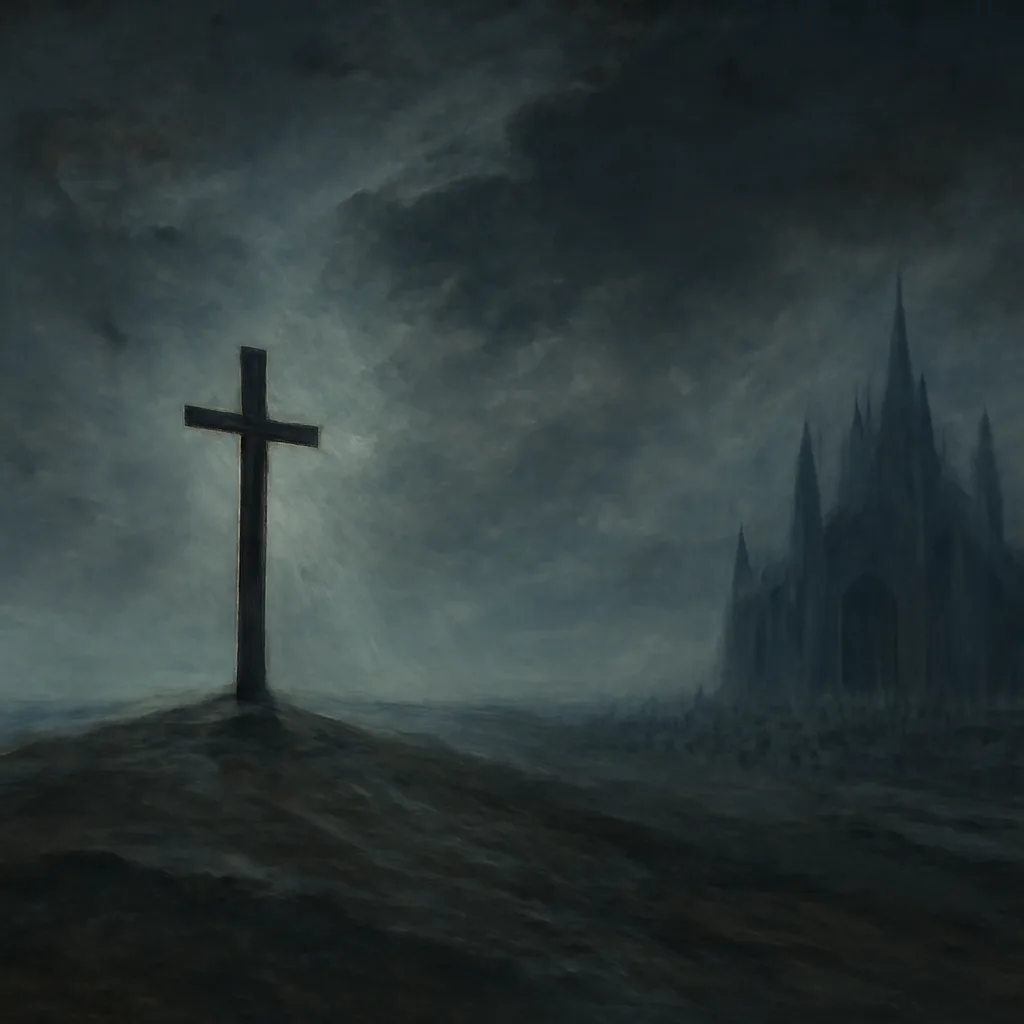
Illustration generated for this article. It represents the distinction Nietzsche proposes between Jesus and later Christianity; it is a conceptual, not historical, image.
Does This Mean Nietzsche Admired the Christianity of Jesus?
Not in the ordinary sense of "religious admiration." Nietzsche does not accept Jesus as God, does not adopt gospel morality as a universal rule of conduct, and never abandons his general critique of compassion, asceticism, and the denial of vital impulses that he associates with Christianity as a whole. What he does is more specific and more surgical: he distinguishes the historical and psychological figure of Jesus from the religious system that organized itself afterward.
In Nietzsche's reading, Jesus does not found a theology of ressentiment; he lives out an existential disposition. The difference seems subtle, but it is decisive for the entire argument: it is one thing to live in a certain way — without rancor, without a need for revenge, without any urgency to judge others; it is quite another to build a doctrine — a systematic teaching about original sin, divine tribunal, vicarious atonement, and eternal life as reward. The first is, for Nietzsche, a practice. The second is a theology. And he insists that confusing the two is the fundamental historical error of institutional Christianity.
Why Paul Irritated Nietzsche So Much
If Jesus emerges relatively unscathed from Nietzsche's critique, the apostle Paul does not share the same fate. Nietzsche credits Paul with the great inversion of the movement: instead of Jesus's life — his way of acting, his concrete ethical teaching — being the "good news" in itself, the center of faith shifts to the theological interpretation of Jesus's death and resurrection. It is in this shift, according to Nietzsche, that categories such as sin, guilt, judgment, and an eschatological horizon — in which present life only makes sense when judged from beyond — gain their force.
This accusation has a fairly precise textual target. When Paul writes 1 Corinthians 15, he places the resurrection of Christ — not the Sermon on the Mount, not the parables, not the ethics of the Kingdom — at the absolute center of what he calls the gospel: "if Christ has not been raised, our preaching is useless and so is your faith" (paraphrasing Paul's argument in 15:14-17). In Romans, the language of justification by faith, inherited guilt, and judicial reconciliation with God occupies a structural place that indeed has few direct parallels in the teaching attributed to Jesus in the synoptic Gospels. It is this contrast — between the practical ethics of the Sermon on the Mount and the doctrinal apparatus of the Pauline letters — that feeds Nietzsche's thesis that there was, in practice, a second religious founding, distinct from the first.
What Historical Scholarship Says About This Thesis
Contemporary historiography does not simply accept Nietzsche's narrative as an accurate historical portrait of Paul. Yale University's New Testament course, for example, presents exactly this image — "Paul as corruptor," the man who supposedly diverted the Jesus movement into another religion — as a famous and influential historical position, and then goes on to show why the real Paul, as reconstructed from the authentic letters and the first-century Jewish context, is far more complex than that caricature allows.
An important part of this more recent reconstruction is what scholars call the "New Perspective on Paul," an academic movement that gained momentum in the second half of the twentieth century. Its central argument is that Paul was not inventing a new religion alongside Judaism, nor breaking with it wholesale; he was operating within categories and debates internal to Second Temple Judaism, arguing chiefly about the terms of Gentile inclusion in the people of God — not the replacement of a "religion of works" with a "religion of grace," as older readings (including some Protestant ones) sometimes assumed. In Galatians 1, Paul himself claims to have received his gospel by revelation, but he also describes trips to Jerusalem to meet with Peter and James — textual evidence that he did not operate in isolation from leaders who already belonged to the movement before him.
Method note: Nietzsche is a valuable philosophical source for thinking about the psychology of morality and the critique of values — not a reliable historical source on the origins of Christianity. His reading of Paul is a nineteenth-century philosopher's thesis, formulated decades before the discovery of the Dead Sea Scrolls and much of the modern research on Second Temple Judaism. Treating it as a historical portrait is a category error.
| Nietzsche's Thesis | What Current Historical Scholarship Holds |
|---|---|
| Paul inverted the Jesus movement, creating a new religion centered on sin and salvation | Paul operated within Second Temple Judaism, arguing about terms of Gentile inclusion — not founding another religion |
| Paul is the "corruptor" who replaced Jesus's practice with doctrine | Paul received and transmitted traditions already present in the movement (cf. 1 Corinthians 15:3, "I passed on to you as of first importance what I also received") |
| The resurrection and eschatology are Pauline inventions to justify guilt and judgment | Messianic and eschatological expectation already circulated in Judaism of the period; Paul discussed these ideas with Peter and James, leaders who preceded him |
| Jesus is the only genuine Christian; institutional Christianity is a later distortion | The distinction is an interesting philosophical thesis, not a historical consensus on continuity or rupture between Jesus and Paul |
So Why Does the Critique Remain Interesting?
Despite the historical caveats — and perhaps partly because of them — Nietzsche's provocation continues to pay off. It forces the reader to separate two questions that religion often blurs together without noticing: "what did Jesus teach, and how did he live?" and "what did Christianity, as an institutional tradition, come to claim about Jesus?" Even when the answers to these two questions turn out to be compatible — and historical scholarship suggests they are more compatible than Nietzsche assumed — they remain different questions, with different methods and different risks of confusion.
Nietzsche exaggerates, polemicizes, and at times oversimplifies; that much is undeniable, and later historical scholarship has corrected much of his reading of Paul. But the central provocation survives the factual correction: a religion can venerate a person and, at the same time, render secondary that person's actual way of life. It is a warning that applies to any religious tradition, Christian or otherwise — which is why philosophers and theologians keep returning to Nietzsche even while disagreeing with him.
It is also worth noting that Nietzsche did not write The Antichrist as a neutral academic treatise; it is a polemical, almost prophetic text, written to provoke a reaction rather than to be read as careful historiography. This does not invalidate his questions, but it helps explain why his reading of Paul is so one-sided: he was building a philosophical argument about the psychology of values, using the figure of Paul as a case study, not carefully reconstructing, with a historian's care, the circumstances of first-century Judaism. Reading The Antichrist, then, requires a double attentiveness: taking seriously the philosophical question it raises about the difference between living an ethic and professing a doctrine, while also recognizing the book's limits as a source on the historical origins of Christianity. It is precisely this double movement — taking the question seriously without accepting the answer as final — that this series tries to model with each thinker it covers.
Recommended Reading
The Antichrist — essential reading for the critique of Paul, the Church, and Christian morality; this is where Nietzsche states most directly the distinction between Jesus and institutional Christianity.
On the Genealogy of Morals — helps clarify the concepts of ressentiment, guilt, and the genealogy of values that underlie Nietzsche's entire critique of Christian morality.
Beyond Good and Evil — situates Nietzsche's broader critique of European morality, of which the critique of Christianity is only one part.
Sources and Further Reading
Same series: Thinkers and Christ
Read the complete series in the app
Memra is 100% free — the Thinkers and Christ essays, with discussion and AI for questions on each one, are available in the app.
Open in Memra