Red Letter Christian: Jesus as the Center, Not the Decoration
What does it mean to read the Bible, the Church, Paul, and your own life through what Christ taught and lived? A complete guide to the Red Letter movement.
What Is a Red Letter Christian?
In some editions of the Bible, the words attributed to Jesus are printed in red. The contemporary Red Letter Christians movement took that editorial convention as a symbol: if someone claims to follow Jesus, they should take seriously what the Gospels present Jesus as saying and doing.
The organization Red Letter Christians (RLC) states that its mission is to combine Jesus and justice, mobilizing people to live out the "countercultural" teachings of Jesus. According to its official history, the group began in 2007 as a community of Christian authors and speakers brought together by Tony Campolo; in December 2010, Campolo and Shane Claiborne launched the blog that became the movement's home base.
The central idea is not "only the red letters count as Bible." It is: if Jesus is the decisive revelation of God for the Christian, then Jesus must be the lens through which everything else is interpreted.
This matters because RLC itself rejects the caricature that it disregards the rest of Scripture. In its current statement, it says it believes in the "black letters" too, and in the whole Bible as the Word of God, but treats Jesus as the reading lens for both the Bible and the world. This isn't a movement that physically cuts up the Bible, but one that ranks it theologically.
It is not a denomination. RLC describes itself as a media and movement-building organization, not a new church with its own creed, sacraments, and hierarchy. That's why people with "Red Letter" sensibilities can be found across evangelical, mainline, Anabaptist, Anglican, Methodist, Catholic, and other traditions — even though not all of them use the label.
Where Did the "Red Letters" Come From?
Printing Jesus's words in red is a recent practice, not a tradition from the ancient manuscripts. The first known New Testament in this format was published in 1899; a complete "red letter" Bible appeared in 1901. The initiative is associated with Louis Klopsch, editor of the Christian Herald.
Red ink is a modern editorial tool; the centrality of Christ is a much older theological claim. There is no "red letter" in the Greek autographs of the Gospels. The practice arose from a commercial and pedagogical decision by a late-19th-century editor, meant to help readers quickly locate Jesus's words within the narrative text.
What Changes When Jesus Becomes the Filter?
The Red Letter point isn't just to highlight nice-sounding lines from Jesus. It's to reorganize priorities. Instead of starting from a denominational tradition, a theological system, or a political agenda and then searching for verses that confirm it, the proposal is to ask first: what kind of God, human being, and community shows up in Jesus?
One possible Christ-centered hermeneutic follows five steps: the life and teaching of Jesus; the Gospels read in their historical context; the apostles and the early community; the tradition and doctrine the Church developed over the centuries; and applying all of that today. Order matters: each step engages the previous one, but no later step should easily override the character and way of Christ established in the first.
This doesn't mean every later step gets discarded whenever it doesn't sound exactly like a verse from Matthew. Tradition and doctrine still have a function — they help apply principles to situations the Gospels never literally anticipated, like bioethics or modern economic structures. The test is one of compatibility: any later development has to be explainable in continuity with the character of Jesus, not merely with a theological system.
Texts That Usually Sit at the Center of This Reading
| Passage | Content and why it supports the argument |
|---|---|
| Matthew 5–7 | The Sermon on the Mount: deals with enemies, reconciliation, mercy, prayer without spectacle, wealth, judgment, and fruit. It's the most-cited text for Red Letter readers because it gathers, in a single block, almost every ethical axis of the movement. |
| Matthew 22:34–40 | Jesus sums up the Law and the Prophets as love of God and neighbor, offering a synthesis criterion that Red Letter hermeneutics uses as a reading key for the whole of Scripture. |
| Matthew 25:31–46 | The parable of the sheep and the goats directly ties the treatment of the hungry, the stranger, the naked, the sick, and the imprisoned to the person of Christ himself — "whatever you did for one of these... you did for me." It is the most direct biblical basis for the movement's emphasis on social justice. |
| Luke 4:16–21 | In the episode at the Nazareth synagogue, Jesus reads Isaiah and ties his own mission to good news for the poor, freedom for captives, and restoration — a program Red Letter Christians read as a mission statement. |
| Luke 6:27–36 | A parallel to the Sermon on the Mount that insists on loving enemies, doing good to those who hate you, and being merciful "just as your Father is merciful." |
| John 13:34–35 | The "new commandment" to love one another appears as the visible mark of belonging: "by this everyone will know that you are my disciples." |
| Mark 10:42–45 | Facing the disciples' dispute over positions of honor, Jesus redefines power as service, in explicit contrast to how "those regarded as rulers of the Gentiles" dominate. |
| Matthew 23 | The series of "woes" against scribes and Pharisees criticizes religious hypocrisy, the pursuit of status, and legalistic rigor that forgets "the more important matters of the law — justice, mercy and faithfulness." |
In historical scholarship, the proclamation of the Kingdom of God is often treated as the central axis of Jesus's ministry. Yale presents the historical Jesus within first-century Judaism and expectations about the in-breaking of the Kingdom; Bible Odyssey, affiliated with the Society of Biblical Literature, likewise highlights the Kingdom as the central language of Jesus's teaching. This centrality explains why the texts above carry so much weight for the movement: they aren't scattered moral advice, but descriptions of life under the reign of God Jesus was inaugurating.
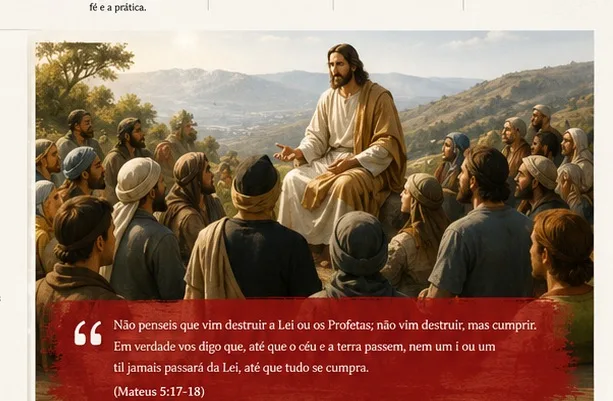
Illustration generated for this article. It represents recurring themes from the Gospels; it does not attempt to historically reconstruct Jesus's appearance.
The Ethical Axes of a Red Letter Reading
Love that costs something. Loving those who love you is easy — Jesus makes this point in the Sermon on the Mount. The radical point shows up with the enemy, the offender, the stranger, and whoever cannot repay you. It's a love measured by cost, not ease.
Mercy over spectacle. Public religiosity, titles, and displays of piety don't make up for a lack of compassion. Matthew 23 is the classic text: Jesus isn't attacking religious practice itself, but the practice that turned into performance and forgot justice and mercy.
Power as service. Greatness gets inverted: the first serves, and the leader doesn't reproduce the domination logic they criticize. Mark 10:42–45 is explicit — even the Son of Man "did not come to be served, but to serve."
Money under moral suspicion. Jesus repeatedly talks about wealth, treasures, greed, sharing, debt, and the seduction of serving two masters — a recurring warning about how wealth competes with loyalty to God and neighbor.
Peace, not revenge. Much of contemporary Red Letter thought reads the command to love enemies and refuse retaliation, present in both Matthew 5 and Luke 6, as a foundation for nonviolence — shaping the movement's engagement with issues like capital punishment and armed conflict.
The neighbor as a test. Orthodoxy is confronted by its fruits: how are the vulnerable, the poor, the stranger, the sick, and the enemy treated? Matthew 25 is decisive here, turning concrete care for others into the criterion of final judgment.

Illustration generated for this article. It represents recurring themes from the Gospels; it does not attempt to historically reconstruct Jesus's appearance.
The current movement applies these principles to issues such as peace, capital punishment, immigration and refugees, race, practical justice, politics, and theology. The existence of a category on the website doesn't imply absolute uniformity among all participants — it's an editorial and action agenda, not a closed creed with mandatory positions on every issue.
Does Being Red Letter Mean Rejecting Paul?
Not necessarily — and, in the official movement, the answer is explicitly no. RLC states that the "black letters" matter too. The disagreement lies in interpretive hierarchy: Paul is read as an apostle and interpreter of Christ, not as someone who can be automatically merged with Jesus himself.
Historically, there's a real discussion about a shift in emphasis. In a Yale lecture on Paul, Dale Martin summarizes a classic observation: Jesus proclaims the Kingdom of God; in Paul, Jesus shifts from proclaimer to proclaimed, and the person, death, and resurrection of Christ become the center of the message. This gave rise to extreme readings, such as those of Nietzsche and George Bernard Shaw, who accused Paul of corrupting the religion of Jesus.
But recognizing this shift doesn't force the conclusion that Paul "invented another religion." Paul received earlier traditions, knew leaders of the movement that preceded him, remained tied to Judaism, and formulates an ethic of love that resonates strongly with the Gospels. The shift in emphasis is compatible with deep ethical continuity — and it's exactly that continuity a Red Letter reading tries to bring out.
| Paul | Possible connection to Jesus |
|---|---|
| 1 Corinthians 11:1 | "Imitate me, as I imitate Christ": Paul himself points to Christ as the reference point, not himself. |
| Romans 13:8–10 | Love of neighbor appears as the fulfillment of the Law — the same synthesizing principle Jesus formulates in Matthew 22. |
| Galatians 5:13–14 | Christian freedom doesn't become selfishness; it must result in service and love of neighbor, echoing the inversion of power in Mark 10. |
| Philippians 2:5–11 | The pattern of Christ is self-emptying, service, and the abandonment of status. |
| 1 Corinthians 13 | Gifts, knowledge, and religiosity lose their value without love, echoing Jesus's critique of empty religiosity in Matthew 23. |
An intellectually serious Red Letter reading doesn't need to say "Paul against Jesus." It can say: "Paul should be interpreted in light of Christ, just like any other Christian theologian."
When There's Tension, What Should You Do?
- •Identify who is speaking and to whom.
- •Distinguish teaching attributed to Jesus from apostolic pastoral application.
- •Reconstruct the historical context: Judaism, the Roman Empire, local conflicts, literary genre.
- •Compare against the whole of the Gospels, not an isolated verse.
- •See how Paul builds his own argument as a whole, avoiding proof-texting.
- •Only then ask whether there is continuity, development, or real tension.
This method is stronger than simply erasing Paul, because it treats the Bible as a historical and theological library, instead of pretending all its authors speak with the same voice, at the same moment, for the same problem.
Were Tolstoy, Kierkegaard, Gandhi, and Nietzsche "Red Letter"?
There's a family resemblance, but not an identity. Tolstoy and Kierkegaard come close to criticizing a Christianity that professes Christ without imitating him. Gandhi was deeply affected by the Sermon on the Mount, but wasn't Christian. Nietzsche separated Jesus from later Christianity, yet rejected Christian morality as a universal project — for him, the problem wasn't the distance between the Church and Jesus, but the very ethic Jesus represented.
The genealogy needs careful handling: the contemporary RLC movement is specific, with a documented origin in 2007. Earlier authors can be compared to it, but shouldn't be retroactively labeled as members of a movement that didn't yet exist.
The Strongest Criticisms of Red Letter Christianity
A good proposal has to survive the best objections against it. And there are relevant criticisms.
- •The red letters are not a recording. The Gospels were composed by authors who select, organize, and interpret traditions about Jesus. Yale, for instance, teaches Mark as a constructed theological narrative, not an audiovisual transcript.
- •Jesus cannot be ripped out of Judaism. If "Jesus as filter" turns into "ignore the Hebrew Bible," we end up manufacturing a modern Jesus disconnected from the tradition that shaped his language, symbols, and debates.
- •There's a risk of cherry-picking the comfortable Jesus. Jesus speaks of mercy, but also of judgment; he welcomes the marginalized, but demands transformation; he criticizes legalism, but doesn't turn ethics into an absence of expectation.
- •There's an epistemological problem. We know Jesus's words precisely through texts transmitted by the early community. A critique published by ABC Religion & Ethics argues it isn't logically simple to separate a "pure Jesus" from the witnesses who give us access to him.
- •The political risk cuts both ways. A movement created to resist the capture of faith by the right can just as easily be captured by the left if the political conclusion arrives before the exegesis. RLC itself claims to be non-partisan, even as it explicitly engages public issues and social justice.
The Best Red Letter Response to These Criticisms
The most consistent response isn't to say "the words in red are more inspired." It's to admit that all the words reach us mediated through texts, while holding onto a theological claim: for the Christian, God's revelation culminates in Christ; therefore, no biblical interpretation should produce a God morally incompatible with the Christ that same Bible presents.
That turns Red Letter Christianity less into a typographic marker and more into a Christ-centered hermeneutic of coherence. The question stops being "is this printed in red?" and becomes "is this compatible with the character of the one printed in red?"
The Data: Why Has This Debate Gained Traction?
There's no reliable census of "how many Red Letter Christians exist." The organization itself claims to reach hundreds of thousands of Christians, but that describes media/movement reach, not audited membership. So any figure for "Red Letter members" should be treated with caution.
The figures below, from the Pew Research Center, don't measure the Red Letter movement directly — they measure the broader religious context of the United States in which this debate is happening:
- •62% of U.S. adults identified as Christian in the 2023–24 Religious Landscape Study.
- •29% identified as religiously unaffiliated.
- •35% of adults had changed religion since childhood.
- •23% of adults were classified as evangelical Protestants.
- •44% said they pray at least once a day.
- •33% said they attend religious services at least monthly.
The historical series of religious identification in the U.S. shows a clear trend across nearly two decades:
| Year | Christian | Unaffiliated |
|---|---|---|
| 2007 | 78% | 16% |
| 2014 | 71% | 23% |
| 2023–24 | 62% | 29% |
Source: Pew Research Center, Religious Landscape Study 2007, 2014, and 2023–24. This data describes the U.S. religious context, not the size of the Red Letter movement.
The numbers don't prove people leave churches specifically because those churches "don't look like Jesus." RLC makes that interpretive move in its institutional narrative, but the Pew data measures identity and religious switching, not the single cause of that process. Separating data from interpretation matters: the drop from 78% to 62% over nearly twenty years is a well-documented fact; the explanation that much of that drop stems from the gap between institutional Christian practice and the example of Jesus is a plausible interpretation, but it is not something the Pew research, on its own, proves.
What a Red Letter Christian Should Not Be
- •It should not be "Jesus against the Bible." That contradicts the movement's own official formulation.
- •It should not be a method for eliminating uncomfortable texts. The Christ filter should demand better interpretation, not convenient censorship.
- •It should not be just progressivism with Christian vocabulary. If Jesus is truly the standard, he can also contradict progressive preferences.
- •It should not be just softened conservatism. Loving enemies, serving the poor, forgiving, renouncing status, and questioning wealth are concrete demands.
- •It should not be anti-intellectual. Taking Jesus seriously includes history, languages, first-century Judaism, textual criticism, and literary context.
- •It should not turn Jesus into an ideological mascot. The goal is to let Christ critique the reader, not merely confirm what the reader already thinks.
A Simple Test for Any Doctrine, Leader, or Tradition
Instead of only asking "is there a verse for it?", a mature Red Letter hermeneutic would add other questions:
- •Is this consistent with the character of God revealed in Jesus?
- •Does it produce love of neighbor — including the enemy?
- •Does it produce mercy, or pleasure in condemning?
- •Does it protect the vulnerable, or does it protect the powerful?
- •Does it turn leadership into service, or into status?
- •Does it produce concrete good fruit, or just religious identity?
- •Is it reading the text in context, or using it as ammunition?
- •Would I accept this interpretation if it were used against my own group?
Perhaps the most uncomfortable Red Letter question is this one: if we removed the name "Jesus" from what we do, would anyone recognize his teachings just by watching the way we live?
Conclusion: Jesus Not as a Stamp of Approval, but as Judge of Christianity Itself
The value of Red Letter Christianity lies less in the color of the ink and more in the inversion it proposes. Instead of using the Bible, tradition, or politics to explain why Jesus must agree with us, it tries to work the other way around: letting Jesus judge our readings, traditions, priorities, and alliances.
This method can be misused. It can produce a selective, sentimental Jesus shaped by contemporary politics. The criticisms are real. But the opposite problem is just as real: a Christianity in which Christ receives verbal worship while losing practical authority.
That's why the best version of Red Letter thinking doesn't say the rest of the Bible is disposable. It says something harder:
Jesus is the center. Paul is read in light of Jesus. Tradition is read in light of Jesus. The Church is judged in light of Jesus. Politics is judged in light of Jesus. And, above all, so am I.
Sources and Further Reading
- •Red Letter Christians — Our Mission & Story — Official source for the movement's origin, mission, declared non-partisanship, and the claim that Jesus is the lens for interpreting the Bible.
- •Red Letter Christians — website and current themes — Shows the movement's contemporary engagement with peace and nonviolence, capital punishment, immigration/refugees, race, politics, theology, and other issues.
- •Red Letter Christians — Tony & Shane — Biographies of the co-founders and information about Tony Campolo, who died on 11/19/2024.
- •Pew Research Center — 2023-24 Religious Landscape Study — Recent data on Christian identification, the unaffiliated, religious switching, prayer, and worship attendance in the U.S.
- •Pew Research Center — Religious identity — Historical series: Christians 78% (2007), 71% (2014), 62% (2023-24); unaffiliated 16%, 23%, and 29%.
- •Open Yale Courses — The Historical Jesus — Historical-critical contextualization of Jesus within first-century Judaism and the centrality of the Kingdom of God.
- •Open Yale Courses — Paul as Missionary — Discusses the well-known historical shift from "Jesus who proclaims" to "Jesus proclaimed" and also complicates the caricature of Paul as a mere corrupter.
- •Open Yale Courses — The Gospel of Mark — An example of historical-critical reading of the Gospels as theological narratives, not modern transcripts.
- •ABC Religion & Ethics — The logical and theological problem with Red Letter Christians — A well-articulated critique of the risk of separating Jesus's words from their apostolic mediators and the wider biblical context.
- •Crossway — The Origins of the Red-Letter Bible — Editorial history of red-letter Bibles: a New Testament in 1899 and a complete Bible in 1901, associated with Louis Klopsch.
- •Bible Odyssey — Kingdom of God, Kingdom of Heaven — A Society of Biblical Literature resource on the Kingdom of God as the axis of Jesus's message.
Editorial note: the illustrations were generated for this article. They are visual reconstructions, not documentary evidence.
Same series: Thinkers and Christ
Read the complete series in the app
Memra is 100% free — the Thinkers and Christ essays, with discussion and AI for questions on each one, are available in the app.
Open in Memra