Jesus and Paul: continuity, rupture, or reinterpretation?
The strongest critique of Paul isn't "he made it all up." It's asking whether he shifted the center of gravity of Jesus's movement, from the Kingdom to Christ.
The phrase "Paul invented Christianity" is seductive because it collapses a complex history into a single line. The problem is that the real history resists slogans. Paul was decisive, but he did not start from zero: he found communities already formed, traditions already circulating, apostles who came before him, and a belief in the resurrection that already existed before his letters were written.
At the same time, it is hard to deny Paul's weight. His letters are the oldest Christian texts that have reached us in extended form — earlier than any of the four Gospels — and his mission among the Gentiles helped transform a messianic movement born inside Second Temple Judaism into a trans-ethnic phenomenon that would go on to spread across the Roman Empire.
The more historically productive question is not "did Paul betray Jesus?" but "what changes when the preacher's message becomes a message about the preacher?"
That formulation is not neutral — it has a specific academic genealogy, and it is worth naming before going further.
The displacement thesis: from proclaimer to proclaimed
The German theologian Rudolf Bultmann, in the mid-twentieth century, coined the formula that still organizes much of this debate: Jesus was the proclaimer (der Verkündiger) who, in later Christian preaching, became the proclaimed (der Verkündigte). In other words, the man who announced the coming of the Kingdom of God became, himself, the content of the announcement. For defenders of the rupture thesis, this shift from subject to object of proclamation is the exact point where something moves.
The thesis has force because it describes something real in the texts. Mark 1:14-15 summarizes the core of Jesus's Galilean preaching: "the time is fulfilled, and the kingdom of God is at hand: repent ye, and believe the gospel." The focus is on the Kingdom drawing near and the response it demands. In Paul's earliest letters, by contrast, the grammatical center is different: not "the Kingdom has arrived," but "Christ died, was buried, was raised." The emphasis migrates from the announcement of a state of affairs (God's reign being established) to a person and an event (the Messiah's death and resurrection) as the very content of salvation.
In the Synoptic Gospels, the Kingdom of God is the organizing axis of Jesus's ministry — present in parables, beatitudes, and the ethical call concentrated in Matthew 5-7, the Sermon on the Mount. Material from Bible Odyssey, a project affiliated with the Society of Biblical Literature, highlights this historical and Jewish horizon: Jesus speaks as a Jewish eschatological prophet announcing God's imminent intervention in history.
This does not mean Paul abandons the Kingdom. Bible Odyssey itself devotes a specific study, "Paul and the Kingdom," showing that the hope of the Kingdom remains present in Pauline thought — he mentions it in several letters as a future horizon of judgment and restoration. But the discursive center of gravity has shifted: the crucified and risen Christ now organizes the proclamation, the community's identity, and its eschatological hope, with the Kingdom relegated to one topic among others rather than the structuring axis.
The rebuttal: Paul as an interpreter within Judaism
The displacement thesis, however, faces a robust rebuttal in recent decades of scholarship — what has become known as the "New Perspective on Paul," associated above all with E. P. Sanders, James D. G. Dunn, and N. T. Wright. The central argument is that reading Paul as someone who abandoned Judaism to found "another religion" is an anachronism produced by centuries of later Christian reading — much of it shaped by the Reformation-era polemic against Catholicism, projected backward onto a first-century text.
Sanders, in Paul and Palestinian Judaism (1977), argued that Second Temple Judaism already operated with a grace-based structure — what he called "covenantal nomism": a person enters the covenant by God's grace, and observance of the Law is the response to that already-granted covenant, not a mechanism for earning salvation. If this is correct, the older reading of Paul as someone who replaced "law" with "grace" oversimplifies what is actually at stake in the letters: a dispute over who belongs to the people of God and on what terms, not a rupture between two opposing soteriologies.
A second argument, perhaps the most decisive for the question "did Paul invent Christianity?", is textual and direct: Paul explicitly cites traditions he received from others, predating him.
In 1 Corinthians 11:23-26, narrating the institution of the supper, Paul writes: "For I have received of the Lord that which also I delivered unto you." The formula "received... delivered" (paralabon... paredoka in Greek) is technical terminology for the transmission of tradition in rabbinic Judaism. Paul is not inventing the scene of the Last Supper — he is passing on something that already circulated before him, with an internal chronology that points back to the historical Jesus.
Even more notable is 1 Corinthians 15:3-8, where Paul cites what most New Testament scholars consider a pre-Pauline creed, possibly formulated in Aramaic within the first years after the crucifixion, decades before Paul wrote the letter: "that Christ died for our sins according to the scriptures; and that he was buried, and that he rose again the third day according to the scriptures; and that he was seen of Cephas, then of the twelve [...] after that, he was seen of James; then of all the apostles." This is very likely the oldest doctrinal core of Christianity that we possess in writing — and Paul inherits it, he does not create it.
Method note: the early dating of this creed (often placed between 3 and 8 years after the crucifixion by specialists from a range of theological traditions) is one of the best-supported inferences in New Testament scholarship, even though the exact reconstruction of its Aramaic origin remains hypothetical.
Paul is also not an isolated, theologically autonomous figure with no contact with those who knew Jesus in life. In Galatians 1:18-19, he recounts going up to Jerusalem and spending fifteen days with Peter (Cephas), also seeing James, "the Lord's brother." In Galatians 2:1-10, fourteen years later, he returns to Jerusalem and submits his gospel to James, Peter, and John — the "pillars" of the community — who extend him "the right hand of fellowship." The relationship is tense (the rest of Galatians 2 narrates a public confrontation between Paul and Peter at Antioch), but it is tension within a network of mutual recognition, not Paul's isolation from tradition.
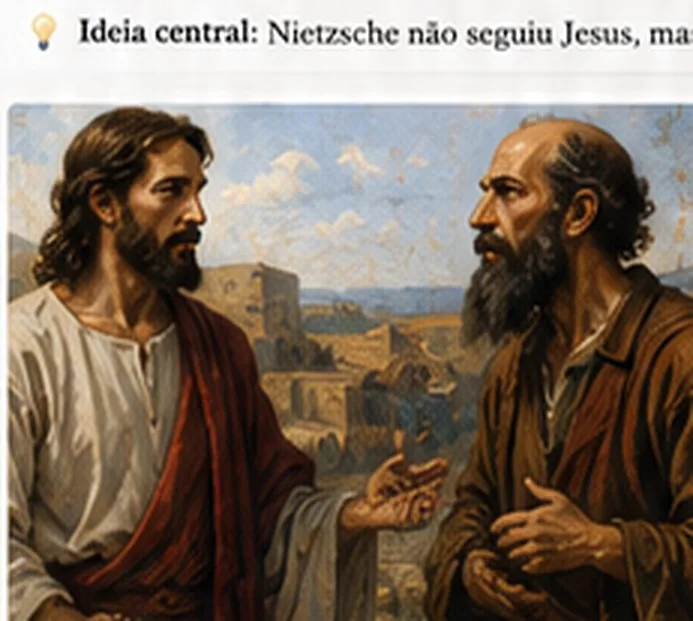
Illustration generated for this series. A visual reconstruction of the first-century Christian setting; it does not depict identified people or places.
The Jerusalem council and the limits of consensus
Acts 15 narrates the episode known as the Jerusalem Council, in which the question of circumcising converted Gentiles is formally debated among Paul, Barnabas, Peter, and James. The text of Acts is Luke's work, written decades later with its own literary and theological purposes — historians treat its reconstruction of the episode with caution, comparing it to Paul's own first-person account in Galatians 2, which diverges in emphasis and sequence. Even so, the two texts agree on something structurally important: a real negotiation took place, with divergent positions, among leaders who recognized one another as part of the same movement. This weakens the image of a solitary Paul inventing doctrine against everyone else's wishes, but it also confirms that the Gentiles-and-Law question was genuinely contested, not obvious from the start.
The chronology that changes the picture
One fact deserves emphasis because it often escapes popular conversation on this topic: the relative chronology of the texts. Paul's authentic letters — 1 Thessalonians, Galatians, 1 and 2 Corinthians, Romans, Philippians, Philemon — were written between roughly 50 and 60 CE. The Gospels, by contrast, were composed later: Mark around 70 CE, Matthew and Luke between 80 and 90 CE, John around 90-100 CE.
This means that, in actual order of composition, the Pauline texts predate the written Gospels, not the other way around. The popular image of "first came the simple Jesus of the Gospels, then Paul complicated everything" inverts the real documentary sequence. What actually happened was the opposite: Paul's letters are the oldest written testimony we have about the Jesus movement, and the evangelists, writing later, had access to decades of oral — and possibly liturgical and communal — tradition, part of which Paul himself already attests to in writing before them.
This chronological inversion does not settle the theological question of who stands "closer" to the historical Jesus. But it dismantles a common assumption: that the Gospels represent a more primitive, non-theologized layer, to which Paul supposedly added later speculation. The four evangelists are themselves theological interpreters writing after Paul — each with his own Christology, emphases, and communal purpose.
| Text | Approximate date | Note |
|---|---|---|
| Pre-Pauline creed cited in 1 Corinthians 15:3-8 | ~33-38 CE | Oldest oral/liturgical tradition preserved in writing; likely Aramaic origin |
| 1 Thessalonians | ~50-51 CE | Generally considered Paul's earliest surviving letter |
| Galatians | ~50-55 CE | Autobiographical account in Galatians 1-2 is a primary source on Paul's relationship with Peter and James |
| 1 and 2 Corinthians | ~53-56 CE | Contains the supper formula (1 Corinthians 11:23-26) and the resurrection creed (15:3-8) |
| Romans | ~56-58 CE | Paul's most systematic theological exposition |
| Gospel of Mark | ~70 CE | Generally accepted as the earliest Gospel |
| Gospels of Matthew and Luke | ~80-90 CE | Written decades after Paul's letters |
| Gospel of John | ~90-100 CE | Most theologically developed Christology among the four |
Where the difference is real
Recognizing that Paul inherits tradition does not eliminate the problem — it only sharpens it. Paul does develop a conceptual architecture that does not appear in the same form in Jesus's sayings as recorded in the Gospels: being "in Christ," the Adam-Christ parallel, justification by faith, mystical participation in Christ's death and resurrection through baptism, the church as "the body of Christ," and a long, systematic reflection on the relationship between Gentiles and Torah that the historical Jesus, operating almost exclusively within Galilee and Judea among fellow Jews, had no occasion to develop in the same detail.
This is theological development, not necessarily contradiction. The dispute among scholars is over how much development still counts as legitimate continuity with the core of Jesus's message, and at what point a development effectively creates a new center of gravity.
A concrete example helps test the question: the ethic of love. In Matthew 5-7, Jesus radicalizes the ethical demand — love enemies, not merely neighbors (Matthew 5:43-44) — as an expression of the character of the coming Kingdom. Paul, in Romans 13:8-10, writes that "he that loveth another hath fulfilled the law," citing the love commandment of Leviticus 19:18 as a summary of the entire Torah. In Galatians 5:14 he repeats almost the same formula: "all the law is fulfilled in one word, even in this: Thou shalt love thy neighbour as thyself." The convergence here is striking — Paul appears to preserve, almost verbatim, an ethical emphasis that also sits at the center of Jesus's teaching, even though he arrives at it through a line of argument about the Torah that Jesus, in the Gospels, does not need to traverse in the same way.
Another point of contact is Paul's self-description as an imitator of Christ. In 1 Corinthians 11:1, he writes: "be ye followers of me, even as I also am of Christ" — suggesting that, for Paul, there was a pattern of life and character in Jesus that could be referenced and imitated, not merely a doctrine about him to be accepted. And the Christ-hymn of Philippians 2:5-11, which many scholars consider — like the creed of 1 Corinthians 15 — another piece of pre-Pauline tradition incorporated into the letter, presents Christ as a model of humility and self-emptying (the Greek term is kenosis) to be followed by the community: "Let this mind be in you, which was also in Christ Jesus." The communal ethic Paul prescribes is anchored in a narrative about Christ's character, not detached from it.
What Tolstoy, Nietzsche, and Buber noticed
Three very different readers, by independent paths, perceived a displacement similar to what Bultmann would later formalize academically. Tolstoy criticized the shift from Jesus's concrete ethical practice toward metaphysical constructions that, in his view, diverted from the direct moral call of the Sermon on the Mount. Nietzsche, in a more hostile tone, accused Paul of moving the "center of gravity" of life toward death, judgment, and the beyond — subordinating earthly existence to an economy of guilt and salvation that Nietzsche viewed as theologized resentment. Buber, the Jewish philosopher of dialogue, distinguished emunah — relational trust, a bond of concrete fidelity between persons, which he located in Jesus's faith and in biblical Judaism generally — from Christian pistis, closer to propositional assent to a set of claims about Christ, which he associated especially with Pauline theology.
These three authors do not represent historical-critical consensus — they are philosophical and theological readings, each with its own agenda and limitations (Nietzsche's reading, in particular, is openly polemical and makes no claim to historical rigor). But all three, from different angles, identify the same real point of tension in the material: Jesus as a teacher of a relationship and a way of life versus Christ as the object of a doctrine of salvation.
Two readings in tension
| The critical case against Paul | The case in Paul's defense | |
|---|---|---|
| On the Law and the Gentiles | Relativizes Jewish identity markers (circumcision, dietary laws) to include Gentiles, which can be read as a departure from the historical Jesus's Judaism | Operates within Jewish categories of covenant and grace (covenantal nomism); the dispute was over how to include Gentiles, not whether the Torah had value |
| On the center of the message | Makes Christ — his death and resurrection — the explicit object of faith, displacing the Kingdom of God from the center of proclamation | Preserves the hope of the Kingdom (Bible Odyssey, "Paul and the Kingdom") and cites pre-Pauline traditions about Jesus (1 Corinthians 15:3-8) rather than replacing them |
| On authority and origin | Never knew Jesus during the Galilean ministry; grounds his calling in an experience of revelation, not direct eyewitness testimony | Consults Peter and James (Galatians 1:18-19, 2:1-10); submits his gospel to the scrutiny of the Jerusalem leadership |
| On ethics | Builds a complex theological architecture (justification, participation in Christ) absent from the ethical simplicity of Jesus's sayings | Summarizes the Law in the love commandment (Romans 13:8-10, Galatians 5:14), echoing almost verbatim Jesus's central ethic |
The best test
Rather than choosing between demonizing Paul and fusing him completely with Jesus, a historically responsible reading can maintain the distinction between layers of testimony. When Paul speaks, it is Paul — a first-century Jew, trained as a Pharisee, writing occasional letters to specific communities, decades before any Gospel existed in written form. When an evangelist narrates Jesus, it is a Gospel tradition about Jesus, already filtered through memory, oral transmission, editorial selection, and each author's own theology. When a church formulates a dogma centuries later — the Trinity at Nicaea, the hypostatic union at Chalcedon — it is a later formulation, legitimate within its own tradition of theological reasoning, but belonging to another historical layer.
Faith does not require erasing these layers to function. On the contrary: recognizing them precisely is what allows us to ask, with historical honesty, where documentable continuity exists, where reasonable interpretation exists, and where genuine, unresolved tension may exist — without forcing harmony where the texts do not offer it, and without forcing rupture where the texts actually show a dense network of citation, deference, and shared memory.
What is fact, what is inference
| Category | Example |
|---|---|
| Well-established fact | Paul's authentic letters (e.g., 1 Thessalonians, Galatians, 1 Corinthians) were written before the four canonical Gospels |
| Well-established fact | Paul explicitly cites tradition received from others in 1 Corinthians 11:23-26 and 15:3-8, and recounts meetings with Peter and James in Galatians 1-2 |
| Probable inference | The creed in 1 Corinthians 15:3-8 is a pre-Pauline formula, dating very close to the crucifixion, possibly originally composed in Aramaic |
| Probable inference | The account in Acts 15 of the Jerusalem Council and Paul's account in Galatians 2 describe the same central historical event, with differences in emphasis and sequence |
| Possible hypothesis | The exact degree to which the "New Perspective on Paul" correctly describes Second Temple Judaism is debated within specialist scholarship itself, with critics such as Douglas Moo defending readings closer to the traditional perspective |
| Theological tradition | The readings of Tolstoy, Nietzsche, and Buber regarding a "displacement" from Jesus to Paul are influential philosophical-theological interpretations, not consensus historiographical reconstructions |
Recommended reading from the author
Jesus Remembered — James D. G. Dunn. An extensive work on memory, tradition, and the historical Jesus, and one of the central references of the "New Perspective on Paul."
Paul: The Pagans' Apostle — Paula Fredriksen. Excellent for reading Paul within Second Temple Judaism and his specific mission to the Gentiles.
The Challenge of Jesus — N. T. Wright. A historical and theological reading that offers a solid counterpoint to the rupture thesis between Jesus and Paul.
The First Paul — Marcus Borg & John Dominic Crossan. A critical and accessible reading of Paul's authentic letters and his theological legacy.
Sources and further reading
- •Open Yale Courses — Introduction to the New Testament History and Literature
- •Yale — Lecture 5: The New Testament as History
- •Yale — Lecture 14: Paul as Missionary
- •Yale — Lecture 16: Paul as Jewish Theologian
- •Bible Odyssey (SBL) — Jesus
- •Bible Odyssey (SBL) — Paul and the Kingdom
- •Bible Odyssey (SBL) — Paul and Judaism
- •Cambridge — historiography of Christian origins and the "Jesus or Paul?" question
- •Cambridge / New Testament Studies — Paulus Oecumenicus
Same series: Thinkers and Christ
Read the complete series in the app
Memra is 100% free — the Thinkers and Christ essays, with discussion and AI for questions on each one, are available in the app.
Open in Memra