Kierkegaard: Christianity Is Not Admiring Christ, It's Trying to Imitate Him
The Danish philosopher attacked "Christendom": a society where everyone is Christian by tradition, without it requiring anyone to actually follow Jesus.
Kierkegaard did not criticize Christianity from the outside. His critique was born from within a radical Christian faith — perhaps the most demanding faith the nineteenth century produced. For him, the greatest danger to the Church was not the atheist who openly rejects Christ, but an entire society that calls itself Christian out of habit, out of infant baptism, out of family tradition, and turns that identity into something comfortable, something that costs nothing.
Kierkegaard was born in Copenhagen in 1813 and died in 1855, at age 42, just weeks after collapsing in the street and being taken to the hospital — at the end of an exhausting public campaign against the Church of his country. Between these two points lies one of the most uncomfortable bodies of philosophical work ever written on what it actually means to follow Jesus.
The admirer and the imitator
At the center of Kierkegaard's late thought is a distinction that seems simple and, looked at closely, dismantles much of what passes for ordinary Christian life. In Practice in Christianity (1850), he separates two possible postures toward Christ: admiration and imitation.
The admirer looks at Christ the way one looks at a statue in a museum, or a hero on a page of history. He recognizes greatness, feels moved, perhaps even sheds tears at the account of the passion. But he keeps his distance. Admiration, Kierkegaard writes, is a safe relationship: it demands praise, not a change of life. The admirer can talk for hours about Christ without a single decision in his daily routine needing to be revisited.
The imitator is something else entirely. He is not satisfied with admiring — he tries to follow. And to follow, for Kierkegaard, means accepting the cost. It means that the life of Christ — his poverty, his rejection by the powerful, his path to the cross — is not a moving spectacle to be contemplated, but a pattern to be lived, as far as possible, by anyone who calls himself a disciple.
Historical distance can become anesthesia: we admire Jesus precisely because we don't have to stand before him when his demands reach us.
This is Kierkegaard's sharpest accusation against the Christianity of his time — and, by extension, against any Christianity that grows comfortable. Nineteen centuries of distance make it easy to admire a man who died for convictions that, preached today, would trouble the very people now applauding him. It is far safer to admire a Christ who has already died than to obey a Christ who still demands something of us.
| Admirer | Imitator | |
|---|---|---|
| What he does | Praises Christ from a distance, appreciates his moral greatness | Tries to follow Christ's pattern of life, even when it costs something |
| What he avoids | Any practical change in his own life | Nothing — accepts that faith alters concrete decisions |
| Relationship to cost | Treats Christ's sacrifice as a spectacle to be contemplated | Recognizes the sacrifice as an invitation to a similar path |
| Spiritual risk | Confusing religious sentiment with faith | Despair, social persecution, isolation |
"Christendom" versus Christianity
To name this deviation at the social scale, Kierkegaard coined the term "Christendom" (Christenhed, in Danish) — not as a synonym for Christianity, but as its institutionalized distortion. Christendom is the fusion of culture, State, social respectability, and religion, to the point where being born in a certain country and being baptized in infancy is enough for someone to count, for all civil and social purposes, as a Christian.
When this happens, Kierkegaard argues, Christianity stops being a personal, existential, risky decision — and becomes a registry entry. A cultural label. Something inherited the way one inherits a surname, without examination, without crisis, without any real possibility of refusal. And where everyone is already a Christian by definition, no one needs to convert anymore. The word loses its edge.
This critique grew sharper and more personal in the final years of Kierkegaard's life. The spark was the death of Bishop Jakob Peter Mynster in 1854 — a central figure of the Danish People's Church and, for many, a symbol of the established, respectable Christianity that Kierkegaard saw as a quiet betrayal of the Gospel. When one of Mynster's successors publicly praised him as a "witness to the truth," Kierkegaard could not stomach the euphemism. Between 1854 and 1855 he launched a series of furious pamphlets called The Moment (Øieblikket, "the blink of an eye") — his final and most direct attack on the Danish State Church, collected posthumously under the title Attack Upon Christendom. He died before seeing the end of that campaign, physically and financially exhausted, but without retracting a single line of what he had written.
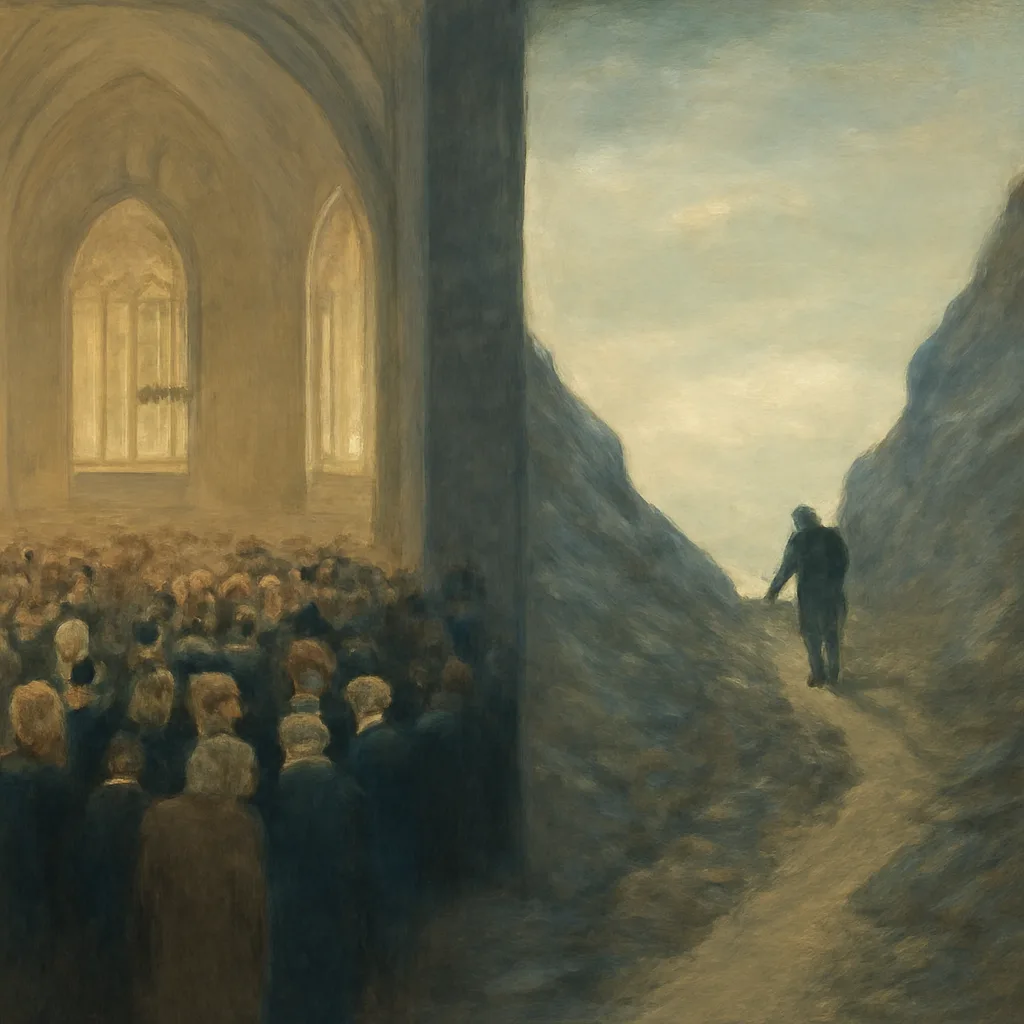
Illustration generated for this article. It represents the distinction between admirer and imitator; it is a conceptual image.
Why the pseudonyms
A reader coming to Kierkegaard for the first time notices something strange: much of his work was not published under his own name. It appeared under names like Johannes Climacus, Anti-Climacus, Johannes de Silentio, Victor Eremita — each with its own voice, its own perspective, and, in some cases, declared limitations.
This was neither a whim nor a fear of taking a stand. Kierkegaard called this method "indirect communication." His wager was that certain truths — especially existential truths, about how to live, not merely what to believe — cannot simply be handed from teacher to student the way a fact is transmitted. They have to be staged, provoked, and the reader has to be left alone before the decision of whether to make them his own.
A pseudonym like Johannes Climacus, for instance, writes as someone outside Christianity trying to understand faith rationally — and failing, in an instructive way, precisely because faith is not the kind of thing reached by logical deduction. Anti-Climacus, on the other hand, writes from a Christian standpoint higher than the one Kierkegaard himself claimed to occupy — a voice that holds up a standard the author confessed he did not fully meet. It is under this very pseudonym, in fact, that the distinction between admirer and imitator appears, in Practice in Christianity.
The leap of faith and the three spheres
Kierkegaard described human existence as a journey through three possible spheres. The aesthetic sphere is life organized around pleasure, novelty, the flight from boredom — living for the immediate sensation. The ethical sphere is life organized around duty, moral coherence, lasting commitment — the individual who chooses to become responsible. And the religious sphere is the one in which the individual stands before God directly and personally, often in contradiction with the very social ethics surrounding him.
The passage from one sphere to another does not happen by accumulating arguments. It is not a logical conclusion reached after weighing pros and cons. Kierkegaard calls this passage a "leap" — especially the leap into religious faith, which requires giving up rational certainty and throwing oneself into a relationship that cannot be fully justified from the outside. It is a risk taken, not a theorem proven.
That leap produces what Kierkegaard calls anxiety (Angest) — not simple nervousness, but the vertigo proper to human freedom faced with real possibilities, including the possibility of getting it wrong, of sinning, of choosing badly. Anxiety is not a flaw to be eliminated: it is the price of being a genuinely free individual before God, rather than an anonymous piece within the crowd.
Abraham and the suspension of the ethical
No biblical text occupies a more central place in Kierkegaard's philosophy than the story of Abraham and Isaac, in Genesis 22. In Fear and Trembling — published under the pseudonym Johannes de Silentio — Kierkegaard revisits the moment when God commands Abraham to sacrifice his own son on Mount Moriah, and Abraham obeys, explaining himself to no one, hesitating in front of no one, willing to see it through to the end.
From the standpoint of universal ethics — of what any society would recognize as right or wrong — what Abraham prepares to do is simply a crime: killing his own son. No ordinary ethical category absolves that act. And yet the Judeo-Christian tradition treats Abraham as the father of faith, the supreme model of trust in God.
Kierkegaard names this paradox the "teleological suspension of the ethical": at certain moments, the individual before God may be called to a commitment that goes beyond — that suspends, temporarily, for the sake of a telos, a higher purpose — the very universal ethical norms that govern human coexistence. Abraham does not abandon ethics because he is mad or cruel. He is called into a relationship with God that no general rule, no institutionalized "Christendom," could prescribe or approve in advance.
It is an uncomfortable text, and Kierkegaard knew it — he does not use it to justify violence, but to show just how far genuine faith can demand of the "single individual" (den Enkelte) something the crowd, public opinion, conventional morality, would never endorse. Abraham's faith is not applauded by the audience of his time: it is lived in silence, without the possibility of communication, between him and God alone. Precisely the opposite of the comfortable, sociable faith of the Danish "Christendom" Kierkegaard had before his eyes.
The single individual against the crowd
This insistence on the "single individual" runs through the whole of Kierkegaard's work and explains why he distrusted every form of collective, institutional, or automatic Christianity. For him, "the crowd is untruth" — a harsh-sounding phrase that points to something specific: before God, no one can hide behind the group, the church, the nation, the family, the custom. The responsibility of faith cannot be diluted by numbers.
This is why Christendom is, structurally, the opposite of Christianity: it offers exactly the hiding place Kierkegaard saw as incompatible with faith — the possibility of being a Christian without ever having to decide alone, without ever having to answer personally the question Christ puts to each individual.
James and Luke: biblical echoes of the same thesis
Kierkegaard wrote as a philosopher and theologian, but his central thesis has direct biblical roots, in texts he knew well. The Letter of James is especially close to his argument. James 1:22-25 warns that one must "be doers of the word, and not hearers only, deceiving yourselves" — comparing someone who merely hears, without acting, to a man who looks at his own face in a mirror and, on turning away, immediately forgets what he saw. It reads almost like an anticipated biblical definition of Kierkegaard's admirer: someone who receives the word, feels something in its presence, and walks away exactly as he was before.
Luke 14:25-33 offers the other side of the same coin. There, Jesus turns to the crowds following him and, instead of making it easier to join, raises the cost: he speaks of hating father and mother by comparison with commitment to him, of carrying one's own cross, and offers two short parables — one about a man who sets out to build a tower without first calculating whether he has the resources to finish it, and another about a king who weighs whether his ten thousand soldiers can withstand an army of twenty thousand before going to war. Jesus's conclusion is direct: whoever is not willing to give up everything he has cannot be his disciple.
This is, almost literally, the program of Practice in Christianity. Jesus is not recruiting admirers among the crowds of Luke 14 — he is turning away those who have not calculated the price. Kierkegaard read this kind of passage as an invitation to take Christ seriously to the very end, not as a rhetorical invitation to religious emotion.
The legacy of an uncomfortable question
Kierkegaard left no closed system, nor did he intend to. He left a question that crosses the centuries and reaches, intact, any reader of any Christian tradition today: do you admire Christ, or do you try to follow him? The honest answer is rarely comfortable — and that is exactly why Kierkegaard considered it the only question that truly matters.
His work finds direct echoes, decades later, in Leo Tolstoy, who likewise saw in the imitation of Christ the forgotten core of institutional Christianity. The two disagree profoundly on theology: Tolstoy tends to reduce Christianity to the ethical teaching of Jesus, emptying out the supernatural; Kierkegaard forcefully preserves the paradox of the incarnation, faith as its own category, and the direct, personal relationship of the individual with God. But both men, each in his own way, distrust exactly the same trick: turning Christ into an object of admiration precisely to keep him from becoming a model for life.
Recommended reading
Practice in Christianity — The work most directly tied to Christ as a model and to the problem of imitation. Published under the pseudonym Anti-Climacus.
Attack Upon Christendom — The final critique of the accommodated Church and cultural religion, collecting the pamphlets of The Moment.
Fear and Trembling — For understanding faith, paradox, and the individual before God, through the story of Abraham and Isaac.
Sources and further reading
Same series: Thinkers and Christ
Read the complete series in the app
Memra is 100% free — the Thinkers and Christ essays, with discussion and AI for questions on each one, are available in the app.
Open in Memra