Simone Weil: Christ, Affliction, and Radical Attention to the Other
Philosopher, factory worker, and mystic, Weil saw in Christ the place where the other's suffering becomes impossible to ignore — yet never crossed the Church's threshold.
Simone Weil occupies a strange and fascinating place in the history of twentieth-century Christian thought. A French philosopher trained at the prestigious École Normale Supérieure, a philosophy teacher, a labor activist, a factory worker by choice, and an involuntary mystic, she drew profoundly close to Christianity without ever allowing herself to settle inside a religious institution. She died at 34, in 1943, leaving behind a body of thought that still unsettles theologians, philosophers, and ordinary readers in equal measure.
The Stanford Encyclopedia of Philosophy shows how her social and political philosophy becomes, year after year, increasingly threaded through with Christian themes: suffering, justice, attention, decreation, obligation, and love of neighbor. This is not the trajectory of someone who "finds faith" and discards everything else. It is the trajectory of someone who carries into Christianity the tools of a philosopher trained in conceptual rigor — and who, precisely for that reason, cannot treat faith as easy consolation.
A life that tests its own philosophy
What sets Weil apart from most thinkers is that she refused to separate idea from practice. When she wanted to understand the condition of factory workers, she did not read reports: between 1934 and 1935 she voluntarily worked on assembly lines, including at the Renault factory, enduring the physical exhaustion and depersonalization of industrial labor that would mark her thinking ever after. When the Spanish Civil War broke out, she went, even though her frail constitution and severe myopia made her an unlikely combatant — a domestic accident with boiling oil pulled her away from the front line before she could do more damage to herself than to the enemy.
It was during this period of immersion in others' pain and in her own fragility that Weil had the mystical experiences that would mark her decisively: first at the Benedictine abbey of Solesmes in 1938, listening to Holy Week Gregorian chant while suffering from terrible migraines, and later in Assisi, in the small chapel where Saint Francis used to pray, where she reported being "compelled" — her own word, recorded in her letters — to kneel for the first time in her life. These experiences did not lead her to immediate baptism. They led her into a tension she would carry to the end: drawn to Christ almost completely, and still unable to cross the threshold of the Church.
She died in England in August 1943, and the official inquest recorded tuberculosis as the cause of death, aggravated by her refusal to eat more than the food ration imposed on the population of occupied France — an act of extreme solidarity with her compatriots that, in other readings, is also read as a symptom of a tormented relationship with her own body. The two readings do not exclude each other: in Weil, the coherence between conviction and action was carried to a point most of us shrink from even naming.
Attention as a form of love
If one concept sums up Weil's spiritual project, it is attention. For her, pure attention — not benevolent distraction, not superficial sympathy, but full, sustained attention that suspends one's own ego to make room for the other's reality — is the rarest and most genuine form of generosity there is. It is not sentimentality. It is the discipline of holding back the impulse to immediately interpret, judge, or instrumentalize whoever is suffering in front of us.
Weil framed this idea around a question that sums up an entire ethic: faced with someone who suffers, the essential question is not "what should I do?" nor "what does this person represent?" but simply "what are you going through?" It is a question that recognizes the other as a concrete, irreducible person, not as a case, a category, or an opportunity for virtue. For Weil, most of moral life is resolved — or fails — in this small distinction: whether we look at someone suffering and see a problem to solve, or whether we look and see someone to whom, before any action, a sincere question is owed.
In Weil, Christ is not a license to escape human suffering; he is precisely the place where the suffering of the other becomes impossible to ignore.
This idea of attention as love finds direct echo in the account in Matthew 25:31-46, the parable of the judgment of the nations, where the decisive criterion is not doctrinal but practical: feeding the hungry, giving water to the thirsty, welcoming the stranger, clothing the naked, visiting the sick and the imprisoned. "Truly I tell you, whatever you did for one of the least of these brothers and sisters of mine, you did for me" (Matthew 25:40). Weil read this passage not as a checklist of good deeds, but as a radical claim: genuine attention to the other's concrete suffering is the encounter with Christ, not a secondary substitute for it.
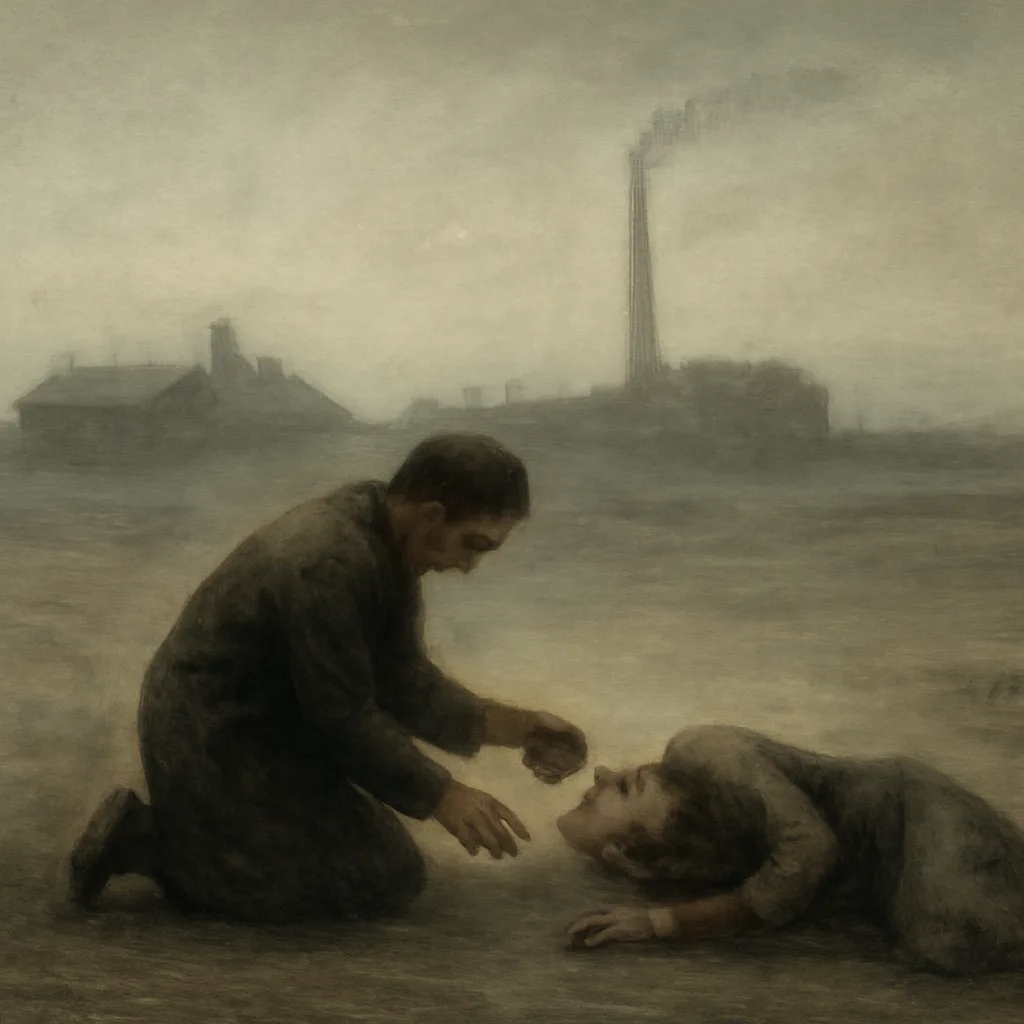
Illustration generated for this article. It represents the concept of attention Weil describes; it is a conceptual image.
Malheur: the suffering ordinary language cannot reach
Weil drew a surgically precise distinction between ordinary suffering and what she called, in French, malheur — a term imperfectly translated as "affliction," because no single English word carries quite the same weight. Malheur, for Weil, is not simply intense physical or emotional pain. It is a condition that strikes the body, the soul, and the person's social standing all at once — a threefold wound that degrades the person in their own eyes, that makes them feel guilty for existing, that renders them invisible or contemptible even to themselves.
It is precisely this feature — the self-degradation, the sense of deserving one's own suffering — that distinguishes malheur from a pain that is great but bearable. Someone in a state of malheur does not merely suffer: they lose the language to name their own suffering before others, and often before themselves. This is why attention — the question "what are you going through?" — becomes an almost literal act of rescue: it restores to the afflicted person the possibility of being seen as someone, rather than as residue.
Weil placed the crucifixion precisely in this category. The cross, for her, is not noble or heroic suffering — it is malheur in its most extreme form: a man tortured publicly, humiliated, emptied of social dignity before a crowd, feeling abandoned even by God ("My God, my God, why have you forsaken me?" Matthew 27:46). It is precisely by refusing to soften the horror of the cross that Weil was able to see in it the deepest point of contact between the divine and the human experience of extreme affliction.
The Book of Job offers the most precise biblical key for understanding malheur. Job loses possessions, children, health, and social status almost simultaneously — the threefold wound Weil would describe centuries later. And the most striking thing, for a reader like Weil, is what Job does not receive at the end: he receives no satisfying theological explanation for his suffering. God's speeches from the whirlwind (Job 38-41) do not answer "why did this happen to you" — they answer with the immensity of creation, with the absolute presence of God before a man who no longer asked for answers, only for company in his ruin. For Weil, this is exactly the point: faced with genuine malheur, the fitting response is not a theodicy that explains the suffering away, but a presence that accompanies it without dissolving it into discourse.
Décréation: emptying oneself to make room for God
Weil's third central concept is the hardest to translate and the most radical in its implications: décréation, or "decreation." It is not destruction — Weil is careful about this distinction. To destroy something created is a violent act still centered on the self who destroys. To decreate is different: it is the movement by which the creature consents to empty itself of its self, of its own will, of its pretension to be the center, so that whatever in it is falsely "I" gives way to what is real — to God.
Weil saw in this movement the most exact philosophical echo of Christ's kenosis, described in Philippians 2:5-11: "In your relationships with one another, have the same mindset as Christ Jesus: Who, being in very nature God, did not consider equality with God something to be used to his own advantage; rather, he made himself nothing by taking the very nature of a servant, being made in human likeness." The original Greek verb, ekenōsen — "he emptied himself" — is the theological starting point of the very word Weil uses. If Christ, being God, emptied himself of his glory to take on the most vulnerable human condition, then decreation is not one spiritual technique among others: it is the very structure of the incarnation, offered as a model for the life of anyone who seeks God.
For Weil, this emptying carries an immediate, concrete ethical consequence: only a person sufficiently decreated — sufficiently free from their own ego, from their need to be the center of every scene — is capable of the pure attention described above. Selfishness and genuine attention are, in practice, incompatible. This is why the three concepts are not separate pieces of Weil's thought but a single movement: decreation empties the self; that emptiness makes attention possible; attention recognizes and accompanies the other's malheur without trying to turn it into something else.
| Concept | What it is | Passage that illuminates it | What it demands in practice |
|---|---|---|---|
| Attention | Suspending one's own ego to perceive the other's concrete reality, without turning them into a case, category, or instrument | Matthew 25:31-46 — "you did for me" | Asking "what are you going through?" and truly waiting for the answer |
| Malheur | Affliction that degrades body, soul, and social standing at once, making the person feel guilty for their own suffering | Job — God's presence without an explanation of the suffering | Accompanying without explaining, without rushing to console, without looking away |
| Décréation | Emptying the self and one's own will to make room for God, rather than a self-centered self-destruction | Philippians 2:5-11 — Christ "emptied himself" | Consenting not to be the center; yielding space before acting |
Why did she remain on the threshold?
Weil was drawn to the liturgy, to the cross, and to Christian mystical experience almost irresistibly — and, at the same time, she deeply distrusted the Church's claim to exclusivity, what she saw as the spirit of anathema sit ("let him be anathema"), the historic formula for condemning whoever disagreed with established doctrine. Weil recognized genuine fragments of spiritual truth outside institutional Christianity: in Plato, in the Greek tragedians, in Hinduism — traditions the Church of her time often treated as error, or at best incomplete preparation for Christian truth. For Weil, accepting baptism would, in practice, mean accepting that exclusivity too — and that she could not do with intellectual honesty.
This is what makes Weil's position singular when compared to other figures this series has already visited. She is radically different from Thomas Jefferson, who handles the difficulties of Jesus by rationalizing him — literally cutting from the biblical text everything that does not fit a palatable Enlightenment morality, keeping an ethical Jesus while discarding the supernatural. Weil does the opposite: she does not prune Christ to fit a system; she lets herself be pierced by him in his totality — cross, suffering, mystery — without domesticating him.
She is also the opposite of Nietzsche, who breaks frontally with Christianity, seeing it as a slave morality, a resentful inversion of noble values. Weil arrives at a critique of the institutional Church that, at certain moments, sounds almost as harsh as Nietzsche's — but she does so from within her attraction to Christ, not from outside it. Nietzsche moves away from Christ. Weil moves as close as possible and, even so, does not cross the door. It is an uncomfortable position for any system — religious or secular — because it refuses to resolve itself in either of the two obvious directions.
The point for our series
Weil relocates the discussion onto ground religious discourse often avoids because it is too uncomfortable: it is not enough to say we love God. The way we see the weak, the humiliated, the exhausted worker, the sick, and the foreigner reveals, concretely and with no room for rhetoric, how much of that love is real and how much is merely well-constructed language.
Her life — the factory, the war, the fast in solidarity, the stubborn refusal to cross the Church's threshold even while drawn to it with an intensity few documented mystics match — functions as a lived commentary on the very concepts she formulated. Attention, malheur, and décréation are not, in Weil, abstract philosophical categories to admire from a distance. They are a demand she tried, with her whole body and at the cost of her own health, to fulfill.
Recommended reading
Waiting for God — The best point of entry into her relationship with Christ, prayer, and the Church.
Gravity and Grace — Aphorisms on ego, suffering, grace, and decreation.
The Need for Roots — Her mature social philosophy, obligation, and the needs of the soul.
Sources and further reading
- •Stanford Encyclopedia of Philosophy — Simone Weil
- •Notre Dame Philosophical Reviews — The Christian Platonism of Simone Weil
Editorial criterion: this text separates primary source, the author's interpretation, and historical consensus. When a thesis is contested, it is presented as a thesis — not as established fact.
Same series: Thinkers and Christ
Read the complete series in the app
Memra is 100% free — the Thinkers and Christ essays, with discussion and AI for questions on each one, are available in the app.
Open in Memra