The Rich Man and Lazarus: A Distance Built in Life
From the series The Bible Is Not Literal, published by Memra.
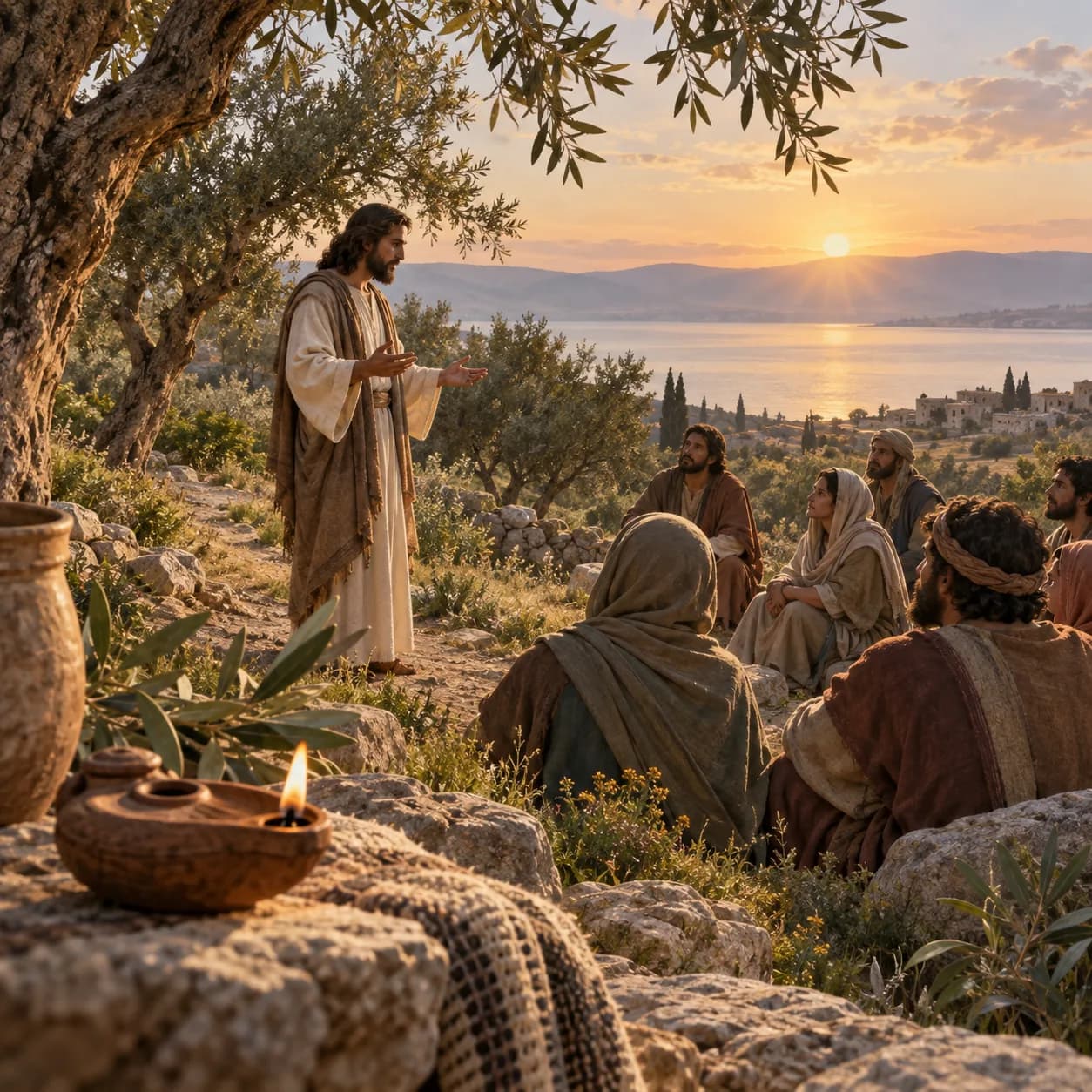
The Door As Moral Boundary
There is a door at the center of this story, and it is there that everything is decided before anything even happens. On one side, a man dressed in purple and finest linen, who "feasted sumptuously every day" (Luke 16:19). On the other, lying down, covered in sores, a beggar named Lazarus, who longed to satisfy himself with the crumbs that fell from the rich man's table, while dogs came and licked his wounds (Luke 16:20-21). The two men do not live in distant worlds. They live pressed against each other, separated only by a threshold. And it is exactly this proximity that makes the story unbearable: the rich man's problem was never that he didn't know Lazarus existed. The problem is that he knew, saw him, passed by him every day, and kept feasting.
Jesus does not open this story with the death of the two men. He opens with daily life. That narrative choice already contains the entire argument. Before any judgment in the afterlife, the text wants the reader to feel the weight of a coexistence that never became responsibility. The distance that will separate the two men after death already existed before—only installed in a crueler way: as habit.
The Missing Name And The Name Left Over
A structural detail rarely repeated in Jesus' other parables stands out: the beggar has a name. He is called Lazarus. The rich man, whose entire social identity rested on possessions, implicit titles, and abundance, remains nameless from beginning to end. Later tradition tried to christen him—"Dives," simply "the rich man" in Latin—but the Greek text refuses to grant him that dignity. It is a silent and devastating inversion: the one whom society made visible through his wealth becomes, in the account, anonymous; the one whom society erased through his misery receives, in the account, the scene's only proper name.
This choice is not decorative. It anticipates, at the literary level, the reversal that the second part of the story will narrate at the theological level. When death reaches both men, Lazarus "was carried away by the angels to Abraham's side," while the rich man, buried, "in Hades, being in torment, lifted up his eyes" (Luke 16:22-23). The narrative does not invent this outcome out of nothing; it only reveals, in death, what was already true in life—only inverted in relation to social appearance. The one who seemed to have everything lacked the essential. The one who seemed to have nothing had, apparently, something the rich man never cultivated.
The Dialogue That Changes Nothing
Starting at verse 24, the scene turns into a tense dialogue between the rich man and Abraham—and it is in this dialogue that the passage reveals its true intention. The rich man first asks for relief: that Lazarus dip the tip of his finger and cool his tongue, "because I am in agony in this flame" (Luke 16:24). It is a small request, almost humble in form, but revealing in content—he still treats Lazarus as someone at his service, as though the social hierarchy could simply be carried over into the afterlife. Abraham refuses, and the reason he gives is not vengeance but accomplished fact: "a great chasm has been fixed between us and you, so that those who wish to pass from here to you cannot, nor can anyone cross from there to us" (Luke 16:26). The separation is not an arbitrary punishment handed down in some distant tribunal; it is the definitive crystallization of a distance the rich man himself built, day after day, while he still could have crossed it.
Refused in his first request, the rich man changes strategy. He then asks that Lazarus be sent to his father's house, to warn his five brothers, "so that they will not also come to this place of torment" (Luke 16:27-28). It is the moment when, too late, he seems finally to recognize the gravity of what he lived—but the recognition arrives after it can no longer change anything for himself, and he tries to transfer it, as a warning, to those still living. Abraham answers with a sentence that shifts the entire axis of the story: "They have Moses and the Prophets; let them listen to them" (Luke 16:29). The rich man insists: no, that is not enough, "but if someone from the dead goes to them, they will repent" (Luke 16:30). And Abraham's final response closes the parable with a harshness that is, at the same time, a diagnosis: "If they do not listen to Moses and the Prophets, neither will they be convinced even if someone rises from the dead" (Luke 16:31).
This three-step progression—relief, warning, extraordinary sign—is not a mere dramatic device. It is a staircase descending ever deeper into the human attempt to avoid present responsibility. First comfort is requested. Then a second chance for others. Finally, a miracle capable of forcing belief. At every step, Abraham returns the question to the same point: the word already given is sufficient, and resistance to it is not resolved with more evidence, but with a willingness to listen.
What Comes Before The Parable
This story does not appear in isolation in Luke's Gospel. It comes right after the parable of the dishonest manager (Luke 16:1-13), which had already dealt with the use of money and the impossibility of serving two masters. Luke then records that the Pharisees, described as "lovers of money," heard all this and ridiculed Jesus (Luke 16:14). It is in this atmosphere of tension over wealth, fidelity, and scorn that the story of the rich man and Lazarus is told. It does not introduce a new theme; it intensifies, through a concrete and named narrative, what had already been said in more abstract language. The reader of the whole of Luke 16 is not surprised by the subject—he is confronted by the image.
Images That Are Not A Map
Some care is needed with the vocabulary the passage uses for the afterlife. "Abraham's side" (or "bosom") is an expression evoking welcome, honor, and belonging—the position of one reclining beside the patriarch at an intimate banquet—not a verifiable coordinate of heavenly geography. "Hades" designates, in the narrative language available to Luke, the state of the dead, without the text intending to function as a systematic treatise on the afterlife. The very fact that the rich man, in Hades, is able to see, feel thirst, recognize Abraham at a distance, and articulate complex requests already indicates that we are looking at a scene constructed to communicate a moral judgment, not to supply an anatomy of the world of the dead. Reading these details as a literal diagram forces onto the narrative a kind of precision its form simply does not offer—and in doing so, one risks losing precisely what the text most urgently wants to say: the gravity of how one lives now.
The same applies to the dogs that lick Lazarus's wounds. The image does not suggest animal comfort amid human abandonment; it suggests the extreme of exclusion, the point at which not even the minimal dignity of being treated as human is granted him by those who pass by his door. The NABRE, in its notes on this chapter, places the parable of the manager and that of the rich man and Lazarus within the same thematic unit on wealth and the use of possessions—which reinforces that the account's interest lies in conduct, not in the cartography of the afterlife.
What Falls Outside The Condemnation
It is worth marking what the text does not say. It does not say that all wealth is condemnable in itself, nor that all poverty is automatically justified before God. The rich man is not punished for possessing purple and linen; he is confronted for having turned abundance into moral anesthesia, in a life entirely closed in on itself, incapable of registering the existence of another human being at his own door. Lazarus, for his part, is not rewarded for his suffering in itself—as though misery were a virtue—but welcomed in a reversal that exposes the injustice of his earthly situation. Nor does the parable authorize using this story as a blanket weapon against people of means: its target is narrower and, precisely for that reason, more uncomfortable—the indifference that settles in, regardless of the income of whoever practices it.
Nor can one extract from this a closed doctrine about the immediate fate of the dead, as if this text replaced or resolved the diversity of languages the Bible uses to address life after death. The force of the passage lies elsewhere: in demonstrating that the distance between indifference and responsibility, when maintained long enough, ceases to be reversible.
It is worth noting that Abraham, in refusing the rich man's first request, invokes no new authority nor any decree issued at the moment of death. He describes a chasm already "fixed"—in the Greek, a participle suggesting something set, consolidated, not a measure taken then and there, at the hour of judgment. This verbal choice is decisive: the chasm does not separate the two men because a judge decided to separate them after they died, but because the distance between them had already, in life, reached a point of solidification that death merely revealed. The threshold mentioned almost in passing at the beginning of the parable, and the chasm of verse 26, are, in the structure of the story, the same reality at two stages: first crossable, then final. The rich man had an entire lifetime to turn that door into a bridge. He did not, and the text offers him no second chance to do so afterward.
That is why the rich man's second request—the warning to his five brothers—deserves slower attention than it usually receives. He asks for nothing for himself beyond what has already been denied him once; he gives up personal relief and shifts the request toward the future of others. At first glance, it seems a gesture of genuine, almost generous concern. But Abraham's answer dismantles that appearance by rejecting the very premise the request assumes: the idea that the brothers lacked sufficient information, a more dramatic alert, a sign that would break their routine. Abraham denies this premise at the root—"They have Moses and the Prophets"—because the issue was never access to truth, but willingness to let it reorganize daily life. The rich man, ironically, keeps thinking in terms of spectacle even after having lived and died within the logic of spectacle: purple, linen, daily banquet. His imagination of what would convert his brothers is still the imagination of someone who only recognizes the force of the extraordinary.
This insistence of the rich man—first for a small miracle, then for a greater one—allows us to see more clearly what the passage is actually diagnosing. It is not religious ignorance, nor absence of revelation, nor scarcity of warnings. It is the same blindness that led him never to register Lazarus at his door, now reappearing in another form: the conviction that the problem lies outside himself—in the lack of a sign, a piece of information, a dead man raised—rather than within himself, in a persistent refusal to let what he has already heard produce obedience. The parable leads the reader to this exact point before closing: the chasm between the rich man and Lazarus was never, at bottom, a matter of geographic distance or physical torment, but of a life lived without listening. It is this realization, not the description of post-mortem suffering, that prepares Abraham's final word and organizes the ultimate meaning of the whole story.
The Answer That Was Already Available
The sharpest point of the parable may not be the rich man's torment, but Abraham's final refusal to grant an extraordinary sign. If the rich man's brothers do not listen to "Moses and the Prophets," not even the return of a dead man will convert them. It is a severe statement about the nature of human resistance: it is rarely born of a lack of evidence, and almost always of a lack of willingness. The revelation already given—the Law, the Prophets, and for the Christian reader, Christ himself—needs no spectacular reinforcement to be sufficient; it needs people disposed to hear it and act.
That is the turn that closes the story without resolving the rich man's fate, because it is already resolved—not by Abraham's sentence, but by an entire life of doors closed to whoever stood outside. The question the parable leaves is not about the geography of the afterlife, but about the present: what need, what face, what name is so close to your daily routine that indifference toward it can no longer be called ignorance?
Sources Of This Text
Primary source: Luke 16:19–31. Biblical text. The literary observations refer to the passages indicated; the applications of the Memra are editorial interpretations.
46 · USCCB · NABRE | Luke 16: text and notes | https://bible.usccb.org/bible/luke/16 | — Parables of the manager and of the rich man and Lazarus.
Continue the study in Memra
Read the complete course with progress tracking and connected references.
Open the course