Study Center
The Bible is not Literal

The Bible is not Literal
How Genre, Context, and Evidence Transform Reading Scripture
Full reading
In Jerusalem, after the exile, the people stand while Ezra reads the Book of the Law. The scene in Nehemiah 8 contains a detail that often slips past too quickly: the reading does not end when the words are spoken. The Levites move among the people, explaining, unfolding, helping them understand. The verb returns insistently: they needed to "understand." Scripture is read aloud, but comprehension of the text does not arise from sound alone. It calls for attention, mediation, patience.
This is a good entry point for this collection. Before any difficult episode, before any discussion of miracle, prophecy, creation, violence, or apocalypse, there lies a deeper question: how do we read a book that comes to us already in such different forms? Anyone who enters the Bible as though entering a warehouse of loose sentences quickly gets lost. Anyone who treats it as though every page obeyed the same logic makes a subtler mistake: taking the words seriously, but not the way they work.
When Reading Requires Understanding
Nehemiah 8 does not depict an indifferent people. Quite the opposite: they gather, listen, respond, weep. There is reverence, desire, impact. Even so, the text treats clarification as indispensable to the reading. Not because Scripture was some esoteric riddle reserved for initiates, but because hearing is not yet understanding. Between the sentence spoken and the meaning received, there is work to be done.
This detail matters because it corrects two opposite impulses. The first is devotional haste, which imagines it enough to open the text, pluck out a line, and carry it directly into life. The second is a sophisticated suspicion that supposes every interpretation is already a betrayal of the original. Nehemiah authorizes neither. Public reading remains central; explanation does not replace it. But explanation is necessary; the bare reading does not, in every situation, contain its own understanding.
The scene itself shows that understanding changes the response. The people, once they understand, are moved. They receive more than information. This prepares a decisive intuition for what follows: biblical interpretation is not license to invent meanings; it is the discipline of listening to a text according to the kind of text it is.
Many Forms, Many Questions
The first claim of this methodological preface is simple, and for that very reason decisive: the Bible gathers different genres. Narrative does not work like proverb. Law does not work like hymn. Vision does not work like letter. Parable does not work like archival record. This does not seem controversial until the moment a reader tries to apply the same expectation to everything and finds the text pushing back.
The canon itself has already trained us for this variety. Psalm 78 announces its teaching in "parable" and "ancient riddles." The word of instruction can arrive in the form of figure, condensed memory, language that demands more than immediate decoding. The psalmist does not consider this a deficiency of truth, as though truth could only come in flat prose. The poetic form is part of what is being communicated. It preserves, intensifies, reverberates.
For this reason, responsible reading does not begin by asking only "did this happen?" or "is this literal?" In many cases that question comes too early, as though one could treat a psalm as meeting minutes or a prophetic vision as an advance photograph of the future. The prior question is usually more elementary: what kind of speech is this? Who speaks? To whom? For what purpose? Where does the force of the text lie — in the plot, the image, the norm, the shock, the consolation, the repetition, the irony, the promise?
The collection begins by pressing this point because a category error produces distortions down the line. A proverb read as an absolute guarantee becomes an accusation against those who suffer. A metaphor treated as technical description impoverishes both the text and the debate. A parable turned into reportage loses its edge. A narrative flattened into allegory loses its historical density. This is not a choice between reverence and intelligence. It is precisely out of reverence that intelligence is required.
The Preface Already Teaches By Its Shape
How does this introductory text work? Its very form is already a lesson. It does not open with a theory of language, nor with a slogan war over "literal" versus "symbolic." It begins with the diversity of the Bible itself. Only afterward does it draw a methodological consequence. And only then does it set limits so that the method does not turn into arrogance.
This order matters more than it might seem. Before discussing whether a passage is figurative or historical, the reader is reminded that Scripture does not present itself as a single type of document. It already arrives plural. The preface, then, does not impose an academic grid on the Bible from outside; it tries to bring the reader into agreement with primary evidence from the very book in hand.
There is also a pedagogy of restraint here. The text does not promise to settle in advance every dispute about inspiration, history, symbol, or application. It marks out terrain. It says, in essence: first read the passage; then ask how it functions; then see how far the historical context allows you to go; finally, acknowledge what remains uncertain. This arrangement matters because it subjects commentary to the text, not the reverse.
At this point four planes that are often blurred together can be clearly separated. The preface explicitly affirms that the Bible comprises diverse genres and that no single rule of literalness fits them all. Its literary form, being that of a pedagogical preamble, suggests prudence rather than spectacle: it prepares the reader for the craftwork of reading. Historically, it authorizes investigation of the world behind the text without promising full access to the past. And on the plane of faith, it assumes that Christian reading seeks the unity of the Scriptures without leveling their diversity.
Letter That Speaks, Form That Acts
One of the most persistent confusions in biblical reading arises from a poor use of the word "literal." In many debates, "reading literally" ends up meaning simply "taking seriously." But taking something seriously does not mean treating everything the same way; it means recognizing the seriousness proper to each form. We take a poem seriously precisely when we admit that it works through condensation, parallelism, image, rhythm, expressive exaggeration. We take a parable seriously when we look for its dramatic turn, not when we demand of it the kind of precision expected from another genre.
The preface wants to avoid a false dilemma: if there is symbol, then there is no truth; if there is historical reference, then every detail must function like a modern record. Neither alternative does justice to the biblical text. Psalm 78 is a good antidote to the first oversimplification. The psalmist says he will open his mouth in parable, will utter ancient riddles, will tell the coming generation of God's deeds. Notice the movement: parable and memory stand side by side. Figurative language does not cancel reference to God's action in Israel's history. The figure can carry real truth without pretending to be a spreadsheet.
The other excess also needs checking. The presence of some historical grounding does not oblige the reader to suppose that every narrative operates according to the conventions of contemporary reportage. The biblical text selects, orders, highlights, omits, repeats. It narrates with theological purpose. This does not make it less serious; it makes the reader responsible for not demanding of it what it does not offer to be.
When this collection speaks of reading "beyond the letter," it will not be proposing an escape from the letter, as though spiritual meaning could hover above the words and dispense with them. It will be proposing the opposite: attention to the letter so patient that it reveals its form, its reach, its silences, its way of persuading. There are ways of being superficial both through devotional haste and through learned abstraction. The remedy, in both cases, is careful reading.
How Far History Can Go
The preface also sets a healthy limit: historical investigation is necessary but not all-powerful. There are passages whose context can be reconstructed with some firmness. In others, we know less. Sometimes it is possible to compare customs, institutions, political landscapes, ways of writing. Sometimes the text leaves us in thinner air. Naming this difference does not weaken the reading; it prevents false certainty.
Acts 17 offers a useful image of this spirit. The Bereans are praised because they receive the word with readiness and, at the same time, examine the Scriptures daily to see whether these things were so. The faith praised there is neither credulous nor cynical. It listens and it examines. Something similar appears in 1 Thessalonians 5: "test everything; hold fast to what is good." These passages do not, of course, offer a complete manual of historical criticism, but they legitimate an intellectual posture unafraid of verification.
Here it is important to state precisely what the evidence permits and what it does not. In many cases it can support the claim that a text is rooted in a particular world, engages real circumstances, responds to concrete communities, or draws on forms recognizable in its environment. What it does not authorize is the easy leap from "there is historical reference" to "every detail is externally confirmed," nor the reverse leap from "I cannot confirm everything" to "nothing has real reference." Between naivety and dissolution lies the more demanding terrain of responsibility.
A serious collection needs to learn to say "we don't know" with the same clarity with which it says "there are good grounds for affirming this." Honesty about uncertainty is part of the truth being sought.
Christ Opens The Scriptures
If Nehemiah 8 shows that reading requires understanding, Luke 24 shows, for Christian faith, the horizon that gives that understanding its unity. The Risen One meets confused disciples on the road to Emmaus. The striking thing is not merely that he speaks to them, but how he speaks. "Beginning with Moses and all the Prophets," he interprets in the Scriptures what concerned himself. Later, the chapter repeats the same dynamic: Jesus speaks of the Law of Moses, the Prophets, and the Psalms; then he "opens their minds" to understand the Scriptures.
The verb "open" is decisive. The Scriptures are not discarded to make room for Christ; they are opened by Christ. He does not erase their diversity; he moves through it. He does not leap directly to isolated sentences like someone hunting for secret codes. He goes from Moses to the Prophets, from the Psalms to fulfillment. Christ-centered reading, when it is sober, follows this same movement: it seeks convergence in Jesus without doing violence to the particular texture of each text.
This avoids two common abuses. The first is reading the Old Testament as though it were merely a warehouse of explicit predictions, incapable of having its own voice. The second is reading it as though nothing points beyond its immediate context. Luke 24 allows for more depth. There is a center, and that center is Christ; but there is also a path, preparation, promise, figure, expectation, tension. The Christian unity of the Bible does not eliminate exegetical work. It orients it.
On the plane of faith, then, this collection assumes something specific: the Scriptures are read as testimony that finds its key in Jesus. This is not a conclusion archaeology can prove, nor a disguised academic neutrality. It is confessional interpretation, and it needs to be owned as such. Precisely for that reason it must be practiced with discipline, so that it does not become pious arbitrariness.
Applying Without Replacing The Text
In 2 Timothy 3, Scripture is described as God-breathed and useful for teaching, rebuking, correcting, and training in righteousness. The emphasis falls on its formative usefulness. The text does not offer, there, a technical map of genres; it offers a horizon of use: Scripture serves to form persons and communities. This protects biblical reading from becoming a purely dissective exercise.
But a necessary caution belongs here. Between explaining a text and applying it to life lies a real step. An honest commentary does not pretend this step does not exist. When a Christian community brings a text to bear on questions of power, sexuality, money, suffering, politics, worship, or violence, it is interpreting in a situation. This can be faithful; it can also be abusive. The difference shows up when the application itself is passed off as though it were simply the raw voice of the verse.
The preface gets this boundary right. Ethical application matters too much to be hidden. Whatever this collection proposes as pastoral or moral consequence should appear as editorial interpretation, not as automatic equivalence. This gesture is less timid than it seems. It blocks one of the most common and most damaging uses of the Bible: dressing the interpreter's opinion in an authority the text, at that point, may not actually grant it.
Proverbs 1:5 says the wise person listens and grows in learning. Biblical wisdom does not sit well with the self-sufficiency of one who imagines possessing the whole meaning before reading at all. To grow in learning is to admit that the text sometimes corrects both our haste and our favorite certainties.
What Changes From Here
The practical consequence of this chapter is concrete. In the texts that follow, the question will not be simply "what do I think of this passage?" nor "how does it sound to my modern ear?" The first task will be more humble and more demanding: to let the passage be what it is. If it sings, to hear its song. If it argues, to follow its reasoning. If it narrates, to observe who acts, what repeats, where the plot turns. If it legislates, to ask what community and what situation it serves. If it sees in images, not to flatten them into a prose the text never intended.
Reading beyond the letter, then, is not reading against the words. It is refusing both the laziness that turns all language into a single block and the anxiety that demands of the biblical text the format of truth our own age finds most comfortable. Some truths arrive as command, others as memory, others as lament, others as vision, others as parable. The reader's maturity lies in learning to recognize each one.
If this preface fulfills its role, it will make the chapters that follow less prone to two symmetrical errors: hardening the Bible until it becomes an opaque stone, or thinning it out until it becomes symbolic mist with no weight at all. Responsible reading walks a different road. It listens to the letter, observes the form, tests the claims, accepts the limits of the evidence, and, within Christian faith, asks that Christ open the understanding.
This is how an ancient book stays alive without being domesticated. And this is how the Bible, instead of serving as an arsenal of sentences for winning arguments, returns to being what it always meant to be: a word to be heard with intelligence, judged with honesty, and received with obedience.
Sources Of This Text
Base text provided by the dossier:
"HOW TO USE THIS STUDY"
"RESPONSIBLE READING"
Biblical passages cited throughout the chapter:
Nehemiah 8:1-8
Luke 24:27, 44-45
2 Timothy 3:16-17
Acts 17:11
1 Thessalonians 5:21
Proverbs 1:5
Psalm 78:1-2

Before there is morning and evening, there is a scene almost without a scene: "the earth was without form and void," darkness over the deep, and the breath of God hovering over the waters. The text does not lead us into a workshop where matter and energy are measured. It leads us into a world not yet arranged, not yet bounded, not yet habitable. The first tension in Genesis 1 is not between faith and science, but between disorder and order, between formlessness and a livable world.
Then comes the phrase that governs the whole chapter: "And God said." The account moves forward through speech, not through combat. There is no war between deities, no god shaping the world against equivalent resistance. There is word, response, evaluation: "and it was so"; "and God saw that it was good." Creation here is not conceived primarily as a problem of mechanism. It is conceived as radical dependence: everything that exists receives existence, place, and function from the God who speaks.
If this seems less "literal" than some would like, perhaps the problem lies in the adjective. The question is not whether the chapter speaks truth. It does. The question is what kind of truth it intends to offer. Genesis 1:1–2:3 does not resemble a laboratory report or a cosmological equation. Its form is liturgical, rhythmic, architected. And that form does not decorate an idea; it carries the idea. The text wants the reader to hear the order of the world in the very cadence of its sentences.
Before The First Day
"The heavens and the earth" in the opening verse do not appear as two objects among others, but as a way of naming totality. What follows does not describe God emerging within the universe. God is already on the scene before any day begins. The universe, in turn, emerges as dependent reality.
Verse 2 preserves an important strangeness. The earth is "without form and void"; darkness is over the face of the deep; the breath or spirit of God hovers over the waters. The text does not explain where these waters come from, nor is it interested in answering every question a modern reader might raise. This is not carelessness. It is focus. The chapter was not assembled to satisfy curiosity about the early physical stages of matter. It was assembled to announce that, faced with whatever primordial disorder the human imagination might picture, God is not threatened by it. He orders it.
There is here a first decisive contrast. The "formless and void" of the beginning is not the world's destiny; it is the condition that the divine word transforms. And the transformation happens not by eliminating materiality but by organizing it. God separates, names, gathers, blesses. To create, in this chapter, is to make the world differentiable and habitable.
This already helps us avoid two opposite errors. One is to treat the passage as though it were an advance lecture in astrophysics. The other is to treat it as though, because it is not an astrophysics lecture, it were mere symbol without reality. The text speaks of the real world, but it does so in the language of a theology of order.
A World Made Of Words
The repetition in Genesis 1 is not monotony; it is method. "God said." "Let there be." "And there was." "And God saw that it was good." "There was evening and morning." With each day, the reader is trained to perceive that the cosmos is not chaotic in its deepest structure. It responds to a received intelligibility. The world can be known because, in the account, it does not spring from caprice: it springs from a stable and effective word.
On the first day, God separates light from darkness. It is significant that light appears before the sun is mentioned. The text does not begin with the heavenly bodies, as though they were the ultimate source of reality. It begins with the word of God distinguishing what was previously undifferentiated. Then God calls the light day and the darkness night. Naming here is not the pasting of arbitrary labels; it is the establishment of a recognizable order.
On the second day, God makes the firmament to separate waters from waters. Again, the central gesture is distinction. There is a "between." The world opens into levels, spaces, boundaries. On the third day, the waters under the sky gather, the dry ground appears, and then the earth produces vegetation. Notice the progression: first spaces are delimited, then they become fruitful. Order is not opposed to life. It is the condition of life.
The refrain "and God saw that it was good" deserves attention. The goodness of creation is not stated only at the end, as a general conclusion. It is repeated throughout the process. The world is not good only when complete; its parts, in their proper place, are good too. When the third day closes with two works — the appearing of dry land and the production of vegetation — the text repeats the evaluation of goodness, as if underscoring the fruitfulness of this newly established arrangement.
What the passage affirms, then, is clear: God creates, orders, and approves his creation. What its literary form suggests is equally important: creation is presented as a rhythmic process of distinction and distribution, not as an explosion of raw data. And that changes the whole reading.
Three Days Of Form, Three Days Of Fullness
The chapter's architecture becomes more visible when one observes the relationship among the six days. The first three build domains; the following three populate them or give them rulers. On day 1, light and darkness; on day 4, lights to govern day and night. On day 2, sky and waters; on day 5, birds and creatures that fill the waters. On day 3, dry land and vegetation; on day 6, land animals and humanity.
This correspondence need not be forced; it is present in the text's own progression. And it is a decisive clue against a hasty reading, as though the primary intent were to construct a physical chronology in the modern sense. The chapter was organized with symmetry. It thinks of the world in pairs of form and filling.
That is why the question "how long did it take?" is not the question most faithful to the text. The account is less interested in measuring duration than in distributing meaning. "Day" here certainly marks narrative succession, but it also functions as the literary unit of a constructed week. The text leads us through the world like someone watching a house being installed before seeing it inhabited.
None of this empties the reality of what is being affirmed. On the contrary: it strengthens it. The literary form says something about the content. The God of Genesis 1 does not create in a disorderly way. He first establishes conditions, then fills them. He first makes there be a world, then makes that world teem with life.
This observation also prevents a simplistic anthropocentrism. The human being is important, no doubt, but enters the scene in a universe already prepared, already good, already fruitful, already regulated by rhythms it did not invent. Humanity does not arrive to transform chaos into cosmos on its own; it arrives into a cosmos already received.
The Fourth Day And The Demotion Of The Heavenly Bodies
The fourth day always strikes the modern reader as strange: how can there be an alternation of day and night before the lights appear? The question is legitimate, but precisely for that reason it reveals what the text is and is not doing.
On day 4, God makes "lights in the firmament of the heavens" to separate day from night, to serve as signs for appointed times, days, and years, and to give light on the earth. The focus falls on their function. They regulate, mark, govern. They are great, they are useful, they are splendid — but they are creatures. The chapter does not present them as autonomous powers. They enter the sequence late and receive defined tasks.
This detail matters a great deal. In various ancient cultures, celestial bodies could be treated with religious fascination. Genesis 1 does not deny their importance, but it strips them of ultimacy. The sun and moon, which a reader might expect to find as the natural protagonists of any cosmological narrative, appear subordinated to the divine word and integrated into an order already begun before them.
It is here that the text most clearly resists being read as a scientific timetable. The vegetation of the third day comes before the lights of the fourth. This does not fit well with a physical reconstruction of cosmic or biological development, and it is better to acknowledge this tension than to paper over it. Attempts to say that each "day" represents a long era relieve only part of the difficulty, because the problem is not only duration; it is the arrangement of elements in the account.
On the historical-scientific plane, the available evidence points in another direction: the universe is about 13.8 billion years old, and the Earth about 4.5 billion. This data collides with reading Genesis 1 as a description of six ordinary solar days in a recent past. At the same time, this evidence does not by itself resolve the metaphysical question of why there is something rather than nothing, nor the ultimate meaning of the world. It does mark out what cannot honestly be demanded of the chapter: cosmological precision in the terms of modern science.
The contribution of the fourth day, then, is twofold. It disallows the idolizing of the heavenly bodies, and it disallows the wrong demand placed on the text. The lights are not gods, and Genesis 1 is not an astronomical spreadsheet.
The Image Of God Within Limits
The sixth day slows down and expands. After the land animals, the narrative shifts in cadence when it reaches the human being. God does not merely speak; he deliberates: "Let us make humankind in our image, according to our likeness." The text then alternates singular and plural in an expressive way: "God created humankind in his image"; "male and female he created them." The human being is one; humanity is twofold. Dignity belongs not to a single sex in isolation but to the human as shared humanity.
The "image of God" has received many readings, and the chapter itself does not define the term in a technical way. What it certainly does is link that image to vocation. Right after the creation come blessing and mandate: be fruitful, multiply, fill the earth, subdue it, exercise dominion over living creatures. This is where abusive interpretations tend to arise. But the chapter's own context corrects them.
First, because human dominion is not absolute. Humanity receives a task within a world that continues to belong to God, that was already called good before humanity's arrival, and whose rhythm includes limits. Second, because this dominion is given together with blessing and fruitfulness, not with license for devastation. The text does not imagine the human as sovereign consumer of a neutral stock of resources. It imagines the human as a situated representative, responsible before the Creator.
There is also a fine contrast between the animals and the humans. Both are creatures, both receive the blessing of fruitfulness in certain forms, both belong to the living world. And yet only humanity is created "in the image of God." The difference does not license contempt for the rest of creation; rather, it increases human responsibility within it. Dignity, in Genesis 1, is not a pretext for arrogance; it is moral weight.
In what the text affirms, the human being occupies a singular place. In what its form suggests, that singularity comes hedged with restraints: we are the summit of the sixth day, but not the ultimate end of the account. The chapter has not yet finished.
The Seventh Day, When Creation Stops
The decisive surprise lies in 2:1–3. After six days of creative speech, the seventh day arrives with no new material work. God "rested," that is, ceased his work. The text does not suggest physical exhaustion, as though the Creator had worn himself out. The emphasis is on deliberate interruption. God finishes by creating a limit.
This changes the whole reading of the chapter. If it culminated only in the human being, we could read the rest as preparation for human productivity. But it culminates in the Sabbath. The only day God blesses and sanctifies is the seventh. Time, not only space, is consecrated. Creation is not complete when there is matter, life, and humanity; it is complete when there is also a holy pause within time.
This is probably the account's most subversive claim for any culture obsessed with performance. Rest does not appear as a patch added after excess. It appears as a structural element of the world God desired. Work is part of the goodness of creation; so is stopping. Not stopping, in light of Genesis 1, is not maturity. It is disorder.
Here the Christian reading of faith meets a very concrete consequence. To read creation as a week oriented toward the seventh day means recognizing that human life is not fulfilled in unlimited production, in unchecked dominion, or in consumption without wisdom. The world is gift, not prey. Time is creature, not private property. And worship, far from being a religious appendix, corresponds to the very texture of reality.
Still, the distinctions should remain clear. What the passage affirms is that God created, ordered, blessed, and sanctified the seventh day. What its literary form suggests is that the creative week theologically organizes the world and time. What history and science allow us to say is that this chapter does not fit as a literal physical description of a recent week, and that the age of the cosmos is vastly greater. What faith interprets, from there, is that the truth of the text does not depend on its functioning as a scientific manual, but on its revealing who the Creator is and what kind of life corresponds to creation.
The interpretive consequence is less abstract than it seems. If the seventh day is part of creation, then a responsible Christian reading of Genesis 1 must confront not only debates about origins but also our practices of work, consumption, and power. The chapter was not given to us to feed chronological anxiety; it was given to de-idolize the world and de-idolize ourselves. The heavenly bodies are not gods. Humanity is not absolute owner. Work is not absolute. Only God is absolute.
And perhaps this is the most faithful way to read the creation in six days without impoverishing it. Not reducing the text to a vague metaphor, nor forcing it to say what it never set out to say. Listening to it as a great confession that the universe has its origin in God, its form under the word of God, its goodness before God, and its limit set by God. In a world where everything wants to be continuous — continuous production, continuous exposure, continuous expansion — Genesis 1 holds onto the courage to affirm that creation is finished when, at last, it stops.
Sources Of This Text
Primary basis: Genesis 1:1–2:3. Biblical text. The literary observations refer to the passages indicated; the applications drawn from the Memra are editorial interpretations.
03 · Christine Hayes · Yale | The Hebrew Bible in Its Ancient Near Eastern Setting: Genesis 1–4 in Context | https://oyc.yale.edu/religious-studies/rlst-145/lecture-3 | — University lecture; literary comparison of cosmogonies.
09 · NASA Science | Facts About Earth | https://science.nasa.gov/earth/facts/ | — Formation of the Earth and the solar system.
08 · NASA Science | Overview: The Universe's History | https://science.nasa.gov/universe/overview/ | — Institutional scientific synthesis of cosmology.
On the second day, the world still offers no ground to stand on. There is water above, water below, and between the two a command sounds out into the void: "Let there be an expanse in the midst of the waters." It is one of the strangest scenes in Genesis for a modern reader. We see no mountains there, no rivers, no animals, not even dry land. We see containment. Limit. A gap opened by the word of God so that chaos will not occupy everything.
The strangeness is worth preserving. It keeps the text from being tamed too quickly — whether by the rush to make it science avant la lettre, or by the opposite rush to dissolve it into a fog of "symbols" with no substance. Genesis 1:6–8 speaks in an ancient cosmic idiom, and that idiom has its own shape, weight, and imagination. The account presupposes waters above the heavens, and other biblical texts pick up the same image: the psalmist summons the "waters above the heavens" to praise God; Job compares the heavens to something "firm," like polished metal. The question, then, is not how to rescue the Bible from its own language, but how to read that language with enough honesty to see what it is doing.
Between Waters
The passage is brief and decisive. First comes the divine speech: "Let there be an expanse in the midst of the waters, and let it separate the waters from the waters." Then comes the execution: God makes the expanse and separates the waters under it from the waters above it. Finally, God names it: he calls the expanse "heavens." In three movements — speaking, separating, naming — the text raises up an architecture of the world.
The one who acts in every central verb is God. The waters do not cooperate, do not resist, have no voice. They are there as a mass prior to habitation, a reality still without internal boundaries. The effect of the divine word is not to produce matter through some technical explanation, but to institute distinctions. Genesis 1 proceeds by separations: light and darkness, waters and waters, sea and land, day and night. The world becomes world when it ceases to be undifferentiated.
At this point, the passage affirms something quite concrete within its own horizon: there exists an upper region of waters, a lower region of waters, and between them a space called "heavens." The text does not pause to justify this picture; it simply uses it. That difference matters. The author is not arguing for a cosmology; he is narrating the ordering of reality with the imaginative materials available to his audience.
Contemporary readers tend to stumble right here, because the image seems incompatible with what we learn about atmosphere, gravity, and space. The stumble is understandable. Still, it is worth noting that the dramatic center of the scene lies not in the upper waters themselves but in the act of separating them. What comes onto the stage is a God who gives shape to what threatens to remain shapeless.
THE SECOND DAY WITHOUT "GOOD"
There is another peculiarity. On the second day, the formula "and God saw that it was good," so characteristic of the chapter, is missing. It reappears later, on the third day, even in reinforced form. Its absence does not by itself prove that the second day is negative or defective. But it does alter the rhythm of the narrative. The work is not yet finished. Space has been opened, but the habitable world has not yet appeared.
This is confirmed by the sequence. Only on the third day do the waters below gather "into one place" and dry land become visible. The second day prepares; the third stabilizes. One opens the gap between above and below; the other organizes what remains below and exposes the ground where life will be able to sprout. Read this way, the silence about "good" is not a decorative detail. It sustains the narrative's expectation. There is still no place for feet to stand.
This literary observation helps correct hasty readings. Genesis 1 does not present a neutral inventory of cosmic objects; it presents a progression. The reader follows a process of domesticating the formless. Creation, here, has the rhythm of a world being prepared as a home. First light, then space, then ground, then the markers of time, then living creatures, and finally rest. The second day takes part in that movement as a work still in progress.
That is why reducing the "firmament" to an ancient curiosity misses the point. The scene was not written to satisfy the question "what is the sky like?" but to answer "how did the world become a place where life can exist under God's rule?" The sky emerges as a functional boundary within that ordering: it contains, it separates, it establishes conditions.
Heavens, Name, And Ancient Horizon
After separating, God names: "heavens." In Genesis 1, naming is not pasting on arbitrary labels. It is fixing a reality within the created order. The name seals the act and gives it a place within the whole. The space between the waters ceases to be a mere interval; it becomes a recognizable region of the cosmos.
When Portuguese translations choose "firmament," "expanse," or "vault," each one tilts the reader's imagination in a different direction. "Firmament" preserves the impression of firmness; "expanse" sounds more open and less material; "vault" suggests curvature and covering. None of these choices removes the main difficulty: the text describes the heavens as that which divides the upper waters from the lower. The image carries real cosmic density within the account. It does not float as a loose metaphor.
Here comparison with the ancient Near East is illuminating, provided it is used with restraint. In a lecture on Genesis 1–4, Christine Hayes observes that the Bible shares with other ancient cosmogonies a repertoire of images and questions about the world's origin and organization. This does not erase its distinctiveness. On the contrary: it shows how the biblical text works within a known cultural horizon while reorienting it theologically. Where other accounts may populate the cosmos with divine forces in conflict, Genesis concentrates the scene on the sovereignty of a single God who orders by word alone. The resemblance lies in the imaginative furnishings; the difference lies in the distribution of authority.
This historical observation allows us to say something important with sobriety. Genesis 1 reflects an ancient way of imagining the universe. That is not an insult to the text; it is a recognition of its context. Nor does it mean that every detail of this imagery must be read with the same degree of materialist rigidity. What remains uncertain is just how far ancient authors and hearers distinguished, in each instance, between cosmic description, traditional language, and poetic exploration. The text does not open a transparent window into the minds of all its earliest readers. What it does offer is a verbal picture coherent enough to reveal its central intent: God imposes order on what could otherwise swallow up life.
The Waters Above Are Still There
The image does not die out in Genesis. Psalm 148 picks it up and puts it to a different use. The psalm summons the whole cosmos to praise: angels, heavenly hosts, sun, moon, stars, the heaven of heavens — and then, notably, "the waters above the heavens." Here we are no longer in an origin narrative but in a cosmic liturgy. The entire universe is called to acknowledge the Lord.
That shift in genre changes the image's function. In Genesis, the waters above take part in the construction of habitable space. In the psalm, they take part in the choir. What earlier appeared as part of the world's architecture now becomes part of the assembly of creation. The detail matters because it blocks two opposite oversimplifications. The first would say the upper waters were merely a disposable cosmographic belief, with no spiritual weight at all. The second would say that, because they appear in poetry, they never had any connection to a concrete way of imagining the cosmos. The psalm itself shows how an inherited image can remain alive within a key of praise.
There is a theological beauty in this summons. What lies above the heavens, inaccessible to man, also belongs to the realm of the creature. Nothing in the cosmos, however lofty it may seem, escapes the call to praise. The upper waters do not form a zone of threatening autonomy. They were created "by command," the psalm goes on to say. The emphasis falls less on their composition than on their dependence.
This helps us grasp the Bible's tone before the world. The cosmos is vast, at times frightening, always greater than the human being; and yet it is not divine. It praises. It answers. Its grandeur does not rival God's.
A Sky As Firm As Metal
Job 37:18 introduces another variation. In the midst of a speech that exalts God's works and human smallness before them, the heavens are compared to something firm, like a mirror of polished metal. The phrase is not sketching an astronomical map. It is intensifying a sense of solidity, brightness, distance, inaccessibility.
The literary effect is powerful. Whoever hears this image feels the sky not as a neutral void but as an impressive, almost intimidating surface. The comparison gives body to wonder. For Job, the sky is not a mute backdrop; it is a work whose resistance and splendor make the creature measure its own limitation.
This wisdom usage bears a family resemblance to Genesis and to the psalm, but it repeats neither mechanically. The same cosmic grammar circulates across different genres and shifts function according to context. In narrative, it organizes. In hymn, it summons. In wisdom poetry, it humbles human pride and deepens wonder. The recurrence of the image suggests it is no isolated verbal accident. At the same time, the variation in function counsels caution against overly rigid readings. The biblical text preserves and reshapes its own cosmic language.
What Science Allows Us To Say
If we move from the text to the scientific description of the world, the situation is different. Modern observation of the earth, its atmosphere, and its position in the solar system finds no solid dome holding back an ocean above the sky. The current description of the planet speaks of atmospheric layers, water concentrated on the surface, circulating vapor, clouds, radiation, gravity, and space — not of upper waters held in place by a rigid structure, as can be seen in the general data on Earth presented by NASA.
This scientific fact places a clear limit on certain harmonizing readings. There is no basis for saying that Genesis 1 was already describing the atmosphere in modern terms, or that the "firmament" secretly meant gravitational field, interstellar space, atmospheric pressure, or the expansion of the universe. Such readings import later categories into an ancient scene without sufficient textual support. They sound clever, but they pay for it by undoing the historical character of biblical language.
The opposite limit also needs to be maintained. Saying that current science does not confirm an ocean above a celestial vault does not turn the passage into useless error or arbitrary fantasy. The text remains intelligible when read in its own register. It describes the world as an order established through divine separations, using an ancient cosmological horizon. That is precisely why it can be set alongside science without being absorbed into it. Each discourse answers different questions, even though both speak of the same world.
Science asks about the constitution and functioning of the cosmos according to observational methods and testable models. Genesis 1 asks, within its narrative and liturgical form, who establishes limits and makes life possible. Confusing the two questions impoverishes both.
Reading Without Disguise
The interpretive consequence is concrete. Reading Genesis 1:6–8 well requires giving up the makeup. It is not necessary to disguise the waters above the heavens for the passage to remain Scripture. Nor is it necessary to ridicule the text for speaking as an ancient text speaks. The spiritual gain of an honest reading outweighs the comfort of an artificial reconciliation.
What does the passage affirm? That God creates space in the midst of the waters, separates above from below, calls that space "heavens," and thereby advances the ordering of the world. What does its literary form suggest? That the cosmos becomes habitable through a series of distinctions pronounced and stabilized by the divine word; that the second day is provisional, still lacking the rest of "good"; that creation moves toward a world arranged like a home. What does history allow us to say? That this picture takes part in a broader ancient imagination, similar in certain contours to that of neighboring peoples, though reoriented in Genesis toward the exclusive sovereignty of God, as Christine Hayes observes. What does science allow us to say? That there is nothing in the current physical description of Earth resembling a solid firmament with an ocean above it. What can faith confess on this basis? That the biblical God is presented as the one who imposes limits on chaos and makes the world a place of life, praise, and rest.
This distinction does not empty the Christian reading; it disciplines it. Rather than using the text to wage needless battles against astronomy, the Christian reader can listen to its deeper claim. The world is not handed over to indistinction. There are boundaries that make life possible. Chaos is not master. The sky, with all its ancient strangeness, appears as a sign of a reality that is received, structured, sustained.
Such a reading also corrects abusive uses of the religious text. Whoever treats the Bible as a repository of scientific secrets ends up demanding of it what it never set out to give, and in the end weakens its authority by tying it to fragile proofs. It is more fruitful to recognize that Scripture speaks of God through the images of its own time, and that this historical mediation does not nullify its force; it is the concrete form through which it reaches us.
On the second day, there is still no ground beneath our feet. There is only a separation that opens up space. Perhaps that is why the passage remains relevant. It reminds us that creation, before being a problem of mechanism, is a matter of limit, place, and trust. To live in the biblical world is to inhabit a space we did not make, sustained by an order that precedes us. Reading the firmament this way does not resolve every riddle of the sky. It resolves something closer to home: it teaches us not to confuse the Creator with the creature, and to recognize that even what seems most threatening to us can be set within a boundary by the word of God.
Sources Of This Text
Primary basis: Genesis 1:6–8; Psalm 148:4; Job 37:18. Biblical text. The literary observations refer to the passages indicated; the editorial applications are interpretive.
03 · Christine Hayes · Yale | The Hebrew Bible in Its Ancient Near Eastern Setting: Genesis 1–4 in Context | https://oyc.yale.edu/religious-studies/rlst-145/lecture-3 | — University lecture; literary comparison of cosmogonies.
09 · NASA Science | Facts About Earth | https://science.nasa.gov/earth/facts/ | — Formation of Earth and the solar system.
Between the first breath and the sword that guards the garden, Genesis 2–3 draws a portrait of humanity that still reaches us today. The opening scene is intimate: God forms the human from the dust of the ground and breathes into his nostrils the breath of life. The closing scene is severe: the same God sends him out, back to the ground from which he was taken, while cherubim bar the way to the tree of life. Between these two images, the text speaks of work, limit, companionship, nakedness, and mortality. It speaks less like something answering a laboratory curiosity and more like something asking: what creature is this, made of earth and called to live before God?
Dust And Breath
The account begins in a world with no human cultivation yet. "There was no one to till the ground," the text says; from the start, the human's entrance onto the scene is tied to the earth that will need to be worked. God then acts almost like a craftsman: he forms, breathes, plants, takes, places. The human, for his part, does nothing until he receives life and place. This distribution of verbs matters. The human does not appear as the source of himself, nor as owner of the setting. He is derived, received, situated.
Genesis 2:7 concentrates this portrait into two inseparable materials: dust and breath. The NABRE notes point out the wordplay between *adam*, "human," and *adamah*, "ground" — a verbal link the verse itself enacts. The text does not treat this earthly condition as humiliation; it treats it as truth. Human life is bodily, earthly, dependent. At the same time, this body of dust lives because God communicates breath to it. Neither pure spirit nor mere clay: an animated creature.
This first scene already forecloses two common mistakes. The first is to imagine that human dignity requires absolute autonomy. Here, dignity is not born of independence but of the divine act that gives life. The second is to think of the body as a shameful prison that mature faith ought to escape. In Genesis 2, the body is not an inferior accident; it is part of the good creaturely condition. The earth is not despised. It is what we are made of.
A Garden, A Limit
When God places the human in the garden of Eden, the task given is not punishment: "to till it and keep it." Before any fall, there is work. Before any punishment, there is responsibility. The garden does not exist for careless consumption. It is an entrusted gift. The idea that labor only begins after sin is contradicted by the very rhythm of the chapter. What comes later is not work itself, but its hardship.
Soon after, the text introduces the limit. The command regarding the tree of the knowledge of good and evil appears before the creation of the woman and before the drama of transgression. This means the limit is not a punitive improvisation; it is built into life in the garden from the start. The human is free, but his freedom is not unlimited. There is a tree he may eat from and one he must not. The creature is not invited to invent the good on his own; he lives receiving from God a command that structures his existence.
This detail is decisive for reading the whole. Genesis 2 does not describe a golden age of natural independence later spoiled by an arbitrary prohibition. The garden is already a life with boundaries. The world is good, abundant, and habitable; even so, it does not belong to the human as sovereign possession. The limit stands at the center of communion, not at its margin.
It Is Not Good To Be Alone
In Genesis 1, the sequence of created works came with declarations of goodness. Here, for the first time, something is declared "not good": "It is not good that the man should be alone." The phrase shifts the narrative's axis. The problem is not material; the garden is fertile. It is not spiritual; the human has already received the divine breath. The lack is relational. He needs someone who corresponds to him.
The text then produces a deliberate delay. God forms the animals and brings them to the man to see what he will call them. The gesture matters: naming is an exercise of discernment and authority. The human begins to act, speaks, classifies, participates. But the episode ends by underscoring the lack: among all the creatures presented, "there was not found a helper fit for him." The scene does not exist to demean the animals; it exists to show that human solitude is not resolved by dominion, by utilitarian company, or by a multitude of living beings nearby.
The very order of the episodes teaches something. First, the limit. Then, the solitude. Then, the search that fails. Only then comes the woman. The text delays her arrival so the reader feels the weight of "not good." When she finally appears, she does not enter as an accessory to a man's already-complete life. She enters as God's answer to a lack that the rest of creation had not filled.
The phrase translated as someone who "corresponds to him" is better understood from the whole scene than from later slogans. The chapter is not distributing superiority and subordination; it is constructing fitness and reciprocity. No animal corresponds. The woman does. The solution to solitude is not one more servant, but a presence in relationship.
"THIS AT LAST"
The forming of the woman is narrated with rare solemnity. God causes a deep sleep to fall on the man, takes a part from him, closes up the flesh, and brings the woman to him. Once again, the human receives before he acts. His first great words in the chapter come as recognition: "This at last is bone of my bones and flesh of my flesh." It is not a command, nor a distant naming, nor a declaration of ownership. It is a cry of identification.
The text slows down for this moment because in it humanity sees itself reflected in the other. The man recognizes in the woman not a duplicate of himself but someone of his own order, sharing the same flesh. His speech carries a poetic rhythm because the discovery is not merely functional; it is almost liturgical. After the long series of named creatures that failed to resolve the lack, someone finally appears before whom the human is no longer alone.
Verse 24 widens the scene. "Therefore a man leaves his father and his mother and holds fast to his wife, and they become one flesh." This "therefore" shows that the narrator is not simply recounting a remote origin; he is interpreting ordinary human life. The first couple did not literally have a father and mother to leave. The sentence, then, already turns the primordial story into a key for reading concrete relationships. The account speaks of a beginning, but that beginning opens onto a pattern: bond, covenant, unity of life.
Then comes the chapter's final note: "And the man and his wife were both naked and were not ashamed." Nakedness here is neither eroticized nor mocked. It expresses vulnerability without humiliation, exposure without fear. The body has been present since the account's first verse and remains present here, now within a relationship where nothing needs to be hidden. Earth animated by breath is not ashamed to be body.
From Garden To Ground
By the time we reach Genesis 3:19–24, the language changes temperature. The text leaves the register of formation and encounter and enters that of sentence and expulsion. But it does not abandon the symbols of the beginning; it takes them up and twists them. "You are dust, and to dust you shall return" answers 2:7 like a dark echo. The human who came from the soil will now hear that the earth is also his final destination.
This return to dust does not mean materiality has become evil. It means mortality now governs an existence already marked by rupture. Work, once a vocation, becomes toilsome: sweat, resistant soil, wearing down. The passage does not curse the body; it shows the body subjected to weariness and death. Nor does it curse work as such; it shows work wounded.
God's verbs continue to frame the narrative. In 2:15, he "took" the man and "put" him in the garden. In 3:23, he "sent him out" to till the ground from which he was taken. The verbal similarity sharpens the contrast. The same God who gives place now removes it. The same soil that was once the setting for vocation becomes a field of survival. The garden was land inhabited under communion; the outside is land inhabited under an aggravated limit.
Verse 24 gives the scene a memorable symbolic harshness: cherubim and a flaming sword guard the way to the tree of life. Access to unending life is closed. The text does not treat this as mere decorative detail. Exclusion from the garden seals a truth: acquired knowledge did not make the human divine. He remains a creature, and now a mortal one. If in chapter 2 the center of the drama was solitude, here it is the impossibility of living forever in a state of rupture.
Clay, Rib, And Laboratory
Read on its own terms, Genesis 2–3 is extraordinarily concrete. It speaks of dust, trees, food, sleep, flesh, sweat. This concreteness, however, does not automatically turn it into technical biological description. The text conveys meaning through dense narrative images: a human molded from soil, a woman arising in correspondence to the man, a garden with central trees, a return to dust. Its force lies in saying who we are before God, not in anticipating the language of modern science.
Here it is worth listening honestly to what the natural evidence can and cannot say. The overview compiled by the Smithsonian on human evolution points to a long, population-based, gradual history, supported by fossils, artifacts, and genetics. This picture does not fit a reading of Genesis 2 as a direct anatomical account of the formation of a man from clay and the biological origin of a woman from a single part of the male body. As a description of the mechanisms behind the species' origin, the passage finds no support in that kind of evidence.
But science also does not exhaust the question the text raises. It does not, by itself, decide whether Adam and Eve should be read as representatives of humanity, as primordial figures in narrative language, as theological memory of a human beginning before God, or under some other model proposed by faith. Those hypotheses belong to another level of reflection. What the evidence reliably does is narrow certain readings while leaving others open.
The passage, for its part, does not ask the reader to turn symbols into equations. The center of the chapter is not how many chromosomes were in the clay, nor how some primordial surgery might be described. The center is dependence, limit, relationship, and mortality. Reading this text well means letting it answer the question it itself asks, without demanding of it a question that arose millennia later.
Earth, Bond, And Humility
There is an interpretive consequence that matters greatly today. If Genesis 2–3 is reduced to a debate about the mechanism of origins, almost everything the text most carefully builds is lost: work as vocation, relationship as the answer to solitude, nakedness without shame, limit as the creature's condition, mortality as real drama. And along with that, necessary corrections to certain abusive uses of the passage are lost as well.
One concerns the woman. In this account, she does not enter as a prize, property, or reinforcement of male power. She enters when God declares that the man's solitude is "not good," and she enters as the one who finally corresponds to the human. The joy of encounter, not hierarchy, is the climax of the scene. Using this text to naturalize contempt or automatic subordination misses its central tension entirely.
Another correction concerns our relationship to the world. Being made from the earth and sent to cultivate it forecloses both the arrogance of the dominator and spiritual contempt for the body and the soil. We are earthly creatures with a received task. The chapter does not authorize the fantasy that human maturity consists of escaping dependence. On the contrary: the creature's truth appears precisely when it recognizes that it lives by given breath, given food, and given companionship.
For Christian faith, this reading does not diminish the gravity of sin or dilute the drama of Eden. It places it more accurately. The evil here is not materiality, sex, work, or bodily finitude in themselves. The drama is a humanity that wants to live outside of trust, loses the transparency of relationships, and discovers death as its destiny. This is why later biblical hope will not need to save us from the condition of being creatures, as though the earth were a mistake. It will need to save us within the condition of being creatures, reconciling us with God, with one another, and with the very mortality we cannot overcome on our own.
In the end, Genesis 2–3 forbids us to dream of a self-sufficient humanity. We are dust with breath, gardeners under mandate, beings made for bond, not for sovereign solitude. And when we read it this way, the text stops being a weapon in a culture war or a model of an ancient laboratory. It becomes again what it is: a hard and merciful mirror. It reminds us where we came from, what we have lost, and why human life does not fit the fantasy of being enough unto itself.
Sources Of This Text
Primary basis: Genesis 2:4–25; 3:19–24. Biblical text. Literary observations refer to the passages indicated; applications drawn by Memra are editorial interpretations.
04 · USCCB · NABRE | Genesis 2: text and notes | https://bible.usccb.org/bible/genesis/2 | — Primary text and confessional commentary on the anthropogony and Hebrew wordplay.
10 · Smithsonian Institution | Human Evolution Evidence | https://humanorigins.si.edu/evidence | — Fossils, artifacts, genetics, and chronology of human evolution.
At the end of the day, when the garden should have been the simplest place in the world, the man and the woman are crouched behind the trees. They have improvised clothing from fig leaves, heard the Lord God walking in the garden, and done what until then had seemed unthinkable: they hid. The question that tears through the silence — "Where are you?" — is not searching for a location. It is searching for a voice. The whole chapter moves toward this instant in which the creature, no longer transparent before God, tries to survive behind a version of itself.
Genesis 3 does not begin with theories about the origin of evil. It begins with a conversation. Nor is it interested in the species of the fruit, and it does not describe the serpent to satisfy zoological curiosity. Its subject lies closer to the skin: how trust breaks, how desire learns to justify itself, how guilt shifts, how human life comes to be lived outside the garden. Whoever reads the chapter only to discover "what the fruit was" misses the essential. The drama is not in the botany but in the boundary.
At The Cool Of The Day
The hiding scene is both the climax and the interpretive key of the chapter. At the end of Genesis 2, the man and the woman were naked and not ashamed. By the middle of Genesis 3, the two already know they are naked, sew leaves together, and flee the divine presence. In a few verses, nakedness changes meaning. Before, it was transparency without threat. Now it is unbearable exposure.
This change does not come from the body itself but from the broken relationship. The text does not suggest that the body became evil. It suggests that self-perception became painful. "The eyes of both were opened," says verse 7. The serpent's promise, then, is not entirely disproved; there is, in fact, an opening of the eyes. The decisive point is the content of this new knowledge. What appears is not majesty, serene independence, or an ascent to the divine plane. What appears is shame. The first use of the newly acquired knowledge is an attempt at covering. The second is hiding.
The image of God walking in the garden "at the cool of the day" belongs to the narrative form of the text. The passage states that the Lord God comes to the garden and calls the man; its language presents him in concrete, almost domestic terms, to show the closeness now lost. It is not necessary to turn this image into a physical description of divine movement to grasp its force. The contrast lies in the relationship: the presence that once meant communion has become a threat to one who wishes not to be seen.
Did God Really Say?
The rupture begins before the forbidden act. It begins in the way the word received is taken up again. The serpent enters the scene as "the most cunning" of the wild animals, and its first line is not a frontal denial but a skewed question: "Did God really say you shall not eat from any tree in the garden?" The question already shifts the whole field. The command given in Genesis 2 was generous: one could eat from every tree in the garden except one. The serpent represents this command as if it were, at bottom, a blanket deprivation.
The woman corrects the distortion, but her answer also shows that the divine command is already being reprocessed within another atmosphere. She says they must not eat from the fruit of the tree in the middle of the garden, "nor touch it." The earlier command spoke only of not eating. This addition need not be treated as a separate fault, but it functions literarily as a sign that the received word no longer circulates intact. The boundary is now repeated under the weight of suspicion.
The serpent then drops the questioning and moves to outright contradiction: "You will not certainly die." It then offers an alternative interpretation of the command: God knows that on the day you eat of it, your eyes will be opened and you will be like God, knowing good and evil. The center of the temptation is not hunger. It is the idea that the limit set by God exists to preserve a privilege, and that human fulfillment requires autonomy from the divine word.
The chapter does not condemn knowledge as such. The problem is not thinking, learning, or discerning. The problem is the pretension of seizing for oneself the power to define good and evil without reference to the Creator. The serpent's cunning lies in presenting dependence as loss and transgression as emancipation.
There is also a subtle literary detail here. The end of the previous chapter describes the couple as "naked"; the beginning of this one calls the serpent "cunning." In Hebrew, the terms sound alike. The effect is not to decorate the text with wordplay but to bring two ways of being in the world close together: nakedness without shame, and cleverness that manipulates. The story moves from transparency to duplicity.
Saw, Took, Gave
When the dialogue ends, the narrative compresses the entire movement of desire into a single sentence. The woman sees that the tree is good for food, pleasing to the eye, and desirable for gaining wisdom. Then she takes the fruit, eats, and gives some to her husband, and he eats as well.
The verbs matter. Seeing is not yet falling, but it is already more than looking. The fruit is now evaluated by a new standard. It is "good," "pleasing," "desirable." The word "good," so often repeated in Genesis 1 for God's judgment on creation, reappears here in a tense register: the creature declares for itself what seems good, apart from the order it received. The next step is fast and irrevocable: take, eat, give.
The force of the scene also lies in the fact that the text does not dramatize any resistance from the man. He eats. There is no room to turn him into a passive victim of the woman, nor to concentrate all responsibility on her. The narrative distributes the act with uncomfortable dryness. She eats; he eats. Later, both will speak; neither will speak the whole truth about themselves.
This is why the chapter has been so badly misused to blame women as a group. The text does not authorize that simplification. Anyone wishing to find a single culprit in the story will have to work against the very way the narrative itself is built.
What happens right after the fruit is a small chain-reaction catastrophe. "The eyes of both were opened," they realize they are naked, sew fig leaves together for themselves, and, on hearing the Lord God in the garden, hide among the trees. The human being just promoted by its own imagination immediately becomes someone who needs to cover up and disappear.
It is striking that the first human technology in the chapter is a disguise. Fig leaves heal nothing; they only offer a quick fix for a deep wound. The text is economical but precise: they made coverings for themselves. The human initiative after the transgression is not reconciliation but the management of exposure.
When God calls — "Where are you?" — the man answers without answering. He does not simply say "here I am." He says: "I heard your voice in the garden, and I was afraid, because I was naked, and I hid myself." Fear appears where there was no shame before. And nakedness, which had required no defense, becomes an excuse for flight. Consciousness does not produce inner freedom; it produces withdrawal.
The questions that follow tighten the noose: "Who told you that you were naked? Have you eaten from the tree I commanded you not to eat from?" The text shows a God who interrogates not to gather information but to bring the creature to the truth of what it has done. The question "Where are you?" keeps echoing here. It concerns not merely a location in the garden but the moral and relational position in which the man and the woman now find themselves.
The Ground, Because Of You
Faced with the direct question, the man does not deny having eaten. But the way he speaks is already a defense. "The woman you gave to be with me — she gave me fruit from the tree, and I ate." The sentence shifts responsibility in two directions at once: toward the woman and, indirectly, toward God himself, who gave her. The woman, in turn, also does not dispute the fact: "The serpent deceived me, and I ate." The act is admitted; the responsibility is cushioned.
This small chain of statements is one of the sharpest x-rays in the chapter. After the fruit comes the version. Sin does not end with the act; it continues in the reshaping of the story to protect the self. The text does not show human beings caught by accident but people who, when confronted, prefer to shift the center of blame.
The sentences that follow strike at the most concrete points of existence. The serpent is brought low. The woman will hear about the multiplication of pain connected with childbirth and about a relationship marked by tension. The man will hear about ground that will resist him and about bread earned by sweat, until his return to dust. The human world comes to be described in terms of hard labor, conflict, and mortality.
One detail deserves attention: the man is not called cursed; the ground is cursed because of him. The effect of the rupture is not confined to the inner life of the conscience. It reaches the soil, the livelihood, the common life. Genesis 3 does not portray transgression as a private, purely inward event. It wounds the fabric of existence.
Here, too, an interpretive limit must be marked. When the text speaks of the relationship between man and woman after the rupture, it does not issue a command for one to dominate the other; it describes a disorder that now marks that relationship. Reading this verse as authorization for abuse turns a consequence into a norm. The chapter denounces the fracture; it does not sanctify it.
Serpent, Apple, Satan?
Some popular certainties do not come from the text. Genesis 3 does not say the fruit was an apple. It does not identify the serpent by the name Satan. It does not describe the scene with the later, already systematized theological language of a "Fall." The account works with the elements it needs: tree, fruit, serpent, voice, shame, judgment, exile.
This does not mean the story is irrelevant to later theology. In the Christian tradition, the serpent has often been read in connection with the personal tempter, and that reading has its place within the broader canonical reading of Scripture. But it goes beyond what Genesis 3 explicitly states. The chapter itself presents the serpent as a character in the narrative, endowed with cunning and speech, without developing a full theory of the metaphysical origin of evil.
As for history, archaeology, and science, they can illuminate the symbolic background of serpents in the ancient Near East, where such animals could carry associations of danger, vitality, and ambiguity. What these fields cannot do is turn the chapter into a mere zoological document or a puzzle to be solved in a laboratory. The text was not written to explain how a serpent could speak biologically. Its question is another one: why does the human being, faced with a word received, choose to distrust it?
Calling the passage figurative in certain elements does not make it false. The account is serious precisely because it uses narrative form to say something true about the human condition. Its truth does not depend on the reader discovering the fruit's variety but on recognizing the mechanism of suspicion, desire, and self-justification.
Clothed In Skins, The Door Closed
The chapter could end with the judgment, but two decisive movements remain. First, the man names his wife Eve, because she will be the mother of all the living. The name appears just after death has been pronounced. It is a strange flash of life's continuity in the midst of loss. Then the Lord God makes garments of skin for the man and his wife and clothes them. The leaves they had sewn were fragile; the covering now comes from God and is more lasting.
The passage states this divine gesture simply. The shape of the scene suggests something greater: the creature cannot resolve on its own the shame it has produced. Its best stitching remains insufficient. For Christian faith, a pattern that runs throughout the Bible already opens up here in miniature: the human being covers itself poorly; God provides what it cannot provide. The chapter, on its own, does not spell out the whole doctrine of redemption. But it prepares the ground for it.
Finally comes the expulsion. The man is sent out of the garden, back to the ground from which he was taken. Cherubim and a flaming sword guard the way to the tree of life. The ending is severe. Humanity will live, yes; it will labor, bear children, love, suffer, die. But it will live east of Eden, in a world where immediate communion has been broken off.
The interpretive consequence is concrete. Genesis 3 should not be used as a weapon against women, nor as a pretext for schoolroom curiosities about apples, nor as license to despise figurative language. The chapter forces us to pay attention to the way we distort the word we have received, call "good" whatever we have decided to take, and then try to save our own image by casting the blame forward. To read this text well is to learn to suspect God less and to suspect more the stories we fabricate to escape ourselves. When the question "Where are you?" sounds again, the first faithful answer is not an excuse. It is to step out from behind the trees.
Sources Of This Text
Primary basis: Genesis 3. Biblical text. The literary observations refer to the passages indicated; the Memra applications are editorial interpretations.
05 · USCCB · NABRE | Genesis 3: text and notes | https://bible.usccb.org/bible/genesis/3 | — Serpent, etymologies, and history of interpretation.
The question comes too late for Abel and too early for Cain. "Where is Abel your brother?" By the time it sounds, the field has already swallowed the body, and the earth has already drunk the blood. No one saw the scene besides the two brothers and God; still, the text makes the crime a public event. The ground speaks. Silence accuses. And the man who answers "I do not know" discovers that some guilt cannot be buried.
Genesis 4 begins with birth and ends with a song. Between the two, the first family becomes the site of the first death. The chapter is not concerned with satisfying curiosity about the secret reason for divine preference, nor with offering a biography in the modern sense. It concentrates attention elsewhere: on what happens when religious frustration descends from the altar to the face, from the face to speech, from speech to the field, and from the field to an entire lineage. The central question is not why Abel was favored. The decisive question is what Cain will do when he cannot bear that the other was seen.
Two Offerings And A Fallen Face
The account is economical. Eve conceives, gives birth to Cain, then to Abel. One becomes a tiller of the soil; the other, a keeper of sheep. The text places two modes of subsistence side by side without declaring war between them. The tension is born when both bring an offering to the Lord.
Here the narrative is precise in a way that deserves attention. Cain brings "of the fruit of the ground." Abel brings "of the firstborn of his flock and of their fat portions." The difference in wording is unmistakable: Abel's offering receives qualification; Cain's does not. Abel offers from the first-born and from the choice parts. Of Cain, the narrator simply records that he brought from the fruit of the ground. One can sense here a hint of quality, priority, generosity. But the text does not turn that hint into a closed explanation. It does not say, "Cain was rejected for offering vegetables," nor would it permit that simplification, since elsewhere in Scripture offerings from the ground have a legitimate place in worship. Nor does it open a window into the inner psychology of the two brothers. The narrative focus falls almost immediately on Cain's reaction.
"Cain was very angry, and his face fell." The first visible consequence of the rejection is not a theological argument but an altered face. What falls first is not the arm; it is the countenance. The narrative perceives violence before the blow, while it is still dejection, irritation, bitter comparison. That is why God intervenes before the murder: "Why are you angry, and why has your face fallen?" The divine question exposes the interior without yet pronouncing it a lost cause.
At this point, the text states with full clarity that Cain is not treated as a puppet of inevitable fate. He is warned. The crisis does not excuse him; it summons him to responsibility.
Sin Crouching At The Door
Verse 7 concentrates the tension of the chapter. In many translations, God tells Cain that if he does well, there will be acceptance; if he does not do well, sin is crouching at the door, its desire is for you, but you must rule over it. The image is memorable because it turns evil into a near presence, crouched, waiting to enter. Sin has not yet entered; it is at the door. It has not yet ruled; it desires to rule. The act has not yet happened; the confrontation has already begun.
This speech does two things at once. First, it dramatizes the human experience of temptation. Evil does not appear as an abstraction but as a force circling the decision. Second, it prevents Cain from treating his anger as mere fatality. There is a distance between feeling wounded and rising up against one's brother. The text inhabits precisely that distance. It is there that God speaks. It is there that Cain can listen. It is there that he chooses not to.
Literarily, this moment is decisive because it interrupts the narrative's march with a warning that could change everything. The reader knows this, and so the murder that follows carries more weight. It is not an impulse without a name, but the refusal of a word received before the act. The chapter's moral drama depends on this pause. The field is not the place where Cain suddenly "loses his head." The field is where he carries a decision matured under warning.
There is a bitter irony in the text. Cain is a farmer, a man of the soil; it is precisely the soil that will turn against him. Before that, however, sin waits at the door like a visitor he may refuse entry. Instead, he opens the way for what is to come.
In The Field, Without Witnesses
Verse 8 is dry as a blow. Cain speaks to Abel his brother; and when they were in the field, Cain rose up against Abel his brother and killed him. The repetition of "his brother" is not ornamental detail. The narrator insists on the closeness that the crime tears apart. This is not the death of a stranger in combat. It is brotherhood turned into a target.
Also striking is how quickly the language contracts. Before, there were questions, warning, possibility. Now there is only motion: speaking, going to the field, rising up, killing. The word, which might have been the place of confession or of plea, becomes instead the passage to ambush. The field, an open space, becomes the scene of concealment. The first shepherd dies outside any domestic protection, far from any community able to intervene.
The text does not give us the details of the scene, and this reticence is part of its force. There is no description of a weapon, a struggle, a cry. The narrative refuses any fascination with the mechanics of the crime. It concentrates the episode's weight on what comes after: God's question, Cain's answer, the voice of the blood, the curse of the ground. The horror does not depend on visual detail; it depends on what the murder does to fundamental relationships.
Historically, this is where sobriety is called for. We possess no external data allowing us to locate Cain and Abel as figures recoverable through documentation or archaeology. The chapter functions as a founding narrative about human violence. This does not make it "less serious"; it simply indicates the kind of truth it pursues. Its aim is not to supply a forensic record but to interpret the human condition through a first fratricide.
Where Is Abel Your Brother?
God's question after the crime echoes another question in Genesis: "Where are you?" addressed to the couple in the garden. Here, however, the center is not fear before God but responsibility toward the other. "Where is Abel your brother?" God is not asking for information he lacks. He is summoning Cain to speak the truth about what he has done.
Cain's answer is short and famous: "I do not know; am I my brother's keeper?" First comes the lie; then the ethical refusal. Cain tries to dissociate himself from Abel by way of the very title the text has kept repeating: brother. As if to say: his life is none of my concern. The murderer wants to limit his responsibility to himself alone, as though brotherhood were an accident, not a calling.
It is here that the chapter reaches an extraordinary moral clarity. What the text affirms is simple: God holds Cain accountable for Abel. Cain's question, framed as defense, becomes for the reader an accusation against him. Yes, you were your brother's keeper. Not in a policing sense, but in the most basic human sense: his life was not a matter of indifference to you; it was entrusted to your love, to your restraint, to your self-mastery.
When God answers, the ground enters the scene: "The voice of your brother's blood is crying out to me from the ground." The image is poetic, but not merely decorative. The spilled blood is treated as an appeal for justice. The earth, which receives the blood, becomes a witness. Creation does not remain neutral before the murder. The human world and the cultivated world become entangled. Cain, the man of the soil, now carries the hostility of the soil that received his brother's blood.
The Ground That No Longer Cooperates
God's sentence does not simply repeat the expulsion from Eden. It deepens the rupture in a way particular to Cain. "Now you are cursed from the ground," and when he tills it, it will no longer yield its strength to him; he will be a fugitive and a wanderer. The farmer loses the cooperation of what had been his field of labor. The bond between work and fruit is undone. The ground does not cease to exist, but it ceases to respond as before.
The text here affirms a connection between violence and the disordering of human habitation. Murder produces not only inner guilt; it produces a disruption in how one inhabits the world. The man who has shed blood becomes restless even before the ground itself.
Cain answers with fear. His speech matters because it shows that the guilty party also discovers himself vulnerable. He will be hidden from the face of God, he will be a fugitive, and he fears that "whoever finds me" will kill him. The chapter does not pause to explain the demographics of this "whoever." Modern readers often want to fill the scene with a census of humanity, but the narrator shows no interest in that. The phrase serves, above all, to expose the exile's dread: the one who has killed now sees the whole world as a threat.
It is at this point that a surprising element of the narrative appears: God places a mark on Cain so that no one finding him would strike him down. Judgment remains; protection also remains. Cain is not exonerated. He continues marked by exile and by the sterility of the soil. Yet God prevents violence from multiplying against him without restraint. The mark serves as a limit on vengeance.
This is an important interpretive boundary. The text does not describe the mark. Therefore, any attempt to turn it into a specific racial, ethnic, or bodily trait goes beyond what is written. Using "the mark of Cain" to justify racism or human hierarchies is not rigorous reading; it is abuse of the text. Genesis 4 speaks of judicial protection imposed by God, not of hereditary inferiority.
A Fugitive's City
After this, Cain goes out "from the presence of the Lord" and settles in the land of Nod, east of Eden. The phrase matters. Geographic distance carries spiritual weight. The chapter sketches a world both expanding and, at the same time, in exile.
Cain knows his wife, fathers Enoch, and builds a city, which he names after his son. The gesture is telling: the fugitive attempts to establish permanence. The wanderer builds walls, gives a name, organizes continuity. The city appears as a human answer to precariousness. This does not mean Scripture is condemning all urban life, nor that founding a city is inherently sinful. Nor does the text demonize technology, music, or craft. It would be a hasty reading to extract from this a contempt for culture.
What the narrative suggests, by its form and by its placement, is something else: civilization grows without the moral wound having been healed. Cain's descendants become associated with tent-dwelling and livestock, with the music of lyre and pipe, with the working of bronze and iron. Human life grows more complex. The world does not stop after the murder. There is inventiveness, urbanization, trades. None of this, however, undoes the blood in the ground. Culture is a real human greatness; moral salvation is not. The city can shelter from homelessness, but it does not absolve the brother who killed his brother.
This point helps distinguish what history and archaeology could say from what the text wants to say. We have no way to prove, through external documentation, that these figures were historical founders of cities or specific trades. The genealogy functions as an origin narrative, linking lineages, techniques, and destinies under one theological shadow. Its primary interest is interpretive.
Lamech And The Song Of Vengeance
The chapter could have ended with the city. Instead, it ends with a poem. And what a poem. Lamech speaks to his wives: "I have killed a man for wounding me, a young man for striking me. If Cain is avenged sevenfold, then Lamech seventy-sevenfold." The violence that in Cain arose under lies and fear here gains a proud voice. It no longer needs to hide in the field. It is sung within the home.
This passage shows a notable intensification. The protection given to Cain was meant to contain the spiral of retaliation. Lamech turns it into a personal program of excess. The number grows, and with it grows the avenger's arrogance. Murder ceases to be merely an act; it becomes narrated identity, almost a domestic triumph.
Literarily, this is a brilliant and dark close. The chapter began with the begetting of children and ordinary labor; it ends with a man celebrating his own capacity to retaliate far beyond the offense received. Violence has matured. It has learned to speak in verse.
There is a concrete interpretive consequence here. Genesis 4 does not merely describe the origin of a crime; it describes the path by which a society learns to normalize that crime. First, wounded envy. Then, the refusal of warning. Next, the lie. Further on, divine protection misunderstood. Finally, the boast of vengeance. The text recognizes that personal evil quickly seeks social form, public language, family tradition.
Being One's Brother's Keeper
Read this way, the chapter demands care in four directions at once. It affirms that there was an offering, a rejection, a warning, a murder, a judgment, a protection, a city, and an escalation of violence within the lineage. Its literary form suggests a progressive widening: from the house to the field, from the field to the land, from the land to the city, from the city to culture, from culture to the song of vengeance. History and archaeology do not allow us to turn these verses into a verifiable report of figures identifiable outside the narrative, nor do they resolve with modern precision questions such as the population implied by Cain's fear. And a reading of faith perceives, in this framework, a God who takes seriously worship, anger, innocent blood, and fraternal responsibility.
The consequence for Christian reading is not a quick moralism about "anger management," as though the text were only about temperament. The wound runs deeper. Cain cannot bear a world in which the other receives attention without feeling that this is theft from him. That is why the question "Am I my brother's keeper?" crosses the centuries with undiminished force. Whenever a religious community accepts rivalry as the norm, whenever resentment disguises itself as zeal, whenever another's success awakens the desire to eliminate him, Genesis 4 happens again before there is even blood.
At the same time, the chapter forecloses two common distortions. It does not authorize using the mark of Cain against peoples and bodies. And it does not authorize imagining that cultural refinement can by itself cure human brutality. There can be cities, music, metalwork, and genealogy; still, God's question remains standing.
Perhaps this is the text's most concrete consequence: any faithful reading of Genesis 4 ought to make indifference harder. Abel cannot be reduced to collateral damage in Cain's story. The chapter trains us to hear what usually goes unvoiced: the spilled blood, the offended earth, the absent brother. And it reminds us that a spirituality which brings offerings to God but does not know how to answer for its brother already has its face fallen at the door of the field.
Sources Of This Text
Primary basis: Genesis 4:1–24. Biblical text. The literary observations refer to the passages indicated; the applications of the Memra are editorial interpretations.
This essay focuses on a comparative reading of the biblical text. It does not present archaeological verification or an independent reconstruction of the episode.
The genealogy of Genesis 5 is often read with tired eyes. Name after name, age after age, the sentence seems to move along a single track. Then, suddenly, a figure lifts the reader's head: 969 years. Methuselah crosses the page like an excess. No adventures, speeches, or public deeds are attributed to him. His name comes bound to bookkeeping: he lived, he begot, he went on living, he accumulated so many years, he died. And yet it is precisely this man, almost without a story, who received one of the most persistent memories in the Bible. Methuselah became synonymous with extreme old age.
What is curious is that the chapter does not build this effect to celebrate a record. The highest number in all of Scripture appears within a text that closes every life with the same short, unyielding sentence. The genealogy climbs to almost absurd heights, and at the end of each climb, it lands on the same word: died. To read Methuselah as a mere biological curiosity is to miss the chapter's nerve. The point is not only how long a man lived. It is what that time, however prolonged, still cannot overcome.
The Name In The Middle Of The Corridor
Methuselah does not appear in isolation. He is planted between two figures who give the chapter its relief: Enoch, his father, and Lamech, his son. This matters more than it seems.
The formula that organizes Genesis 5 is nearly invariable. The text states a patriarch's age when he fathers the named son, adds how many years he lived afterward, records "all his days," and concludes: "and he died." This pattern creates a corridor of repetition. That is why any deviation gains force. Enoch is the clearest deviation. Instead of merely "he lived," the text repeats twice that he "walked with God" (Gen 5:22, 24). Instead of "and he died," something else comes: "he was not, for God took him" (Gen 5:24). Here, for the first time, God enters explicitly as an agent in a genealogy that until then seemed driven only by the human succession of being born, begetting, and dying.
Right after this rupture, the text returns to the formula with Methuselah. "Methuselah lived a hundred and eighty-seven years, and begot Lamech. After he begot Lamech, Methuselah lived seven hundred and eighty-two years... So all the days of Methuselah were nine hundred and sixty-nine years; and he died" (Gen 5:25–27). No vision, no journey, no oracle. Just the common frame, taken to its extreme.
This position between Enoch and Lamech is not accidental in terms of reading. Methuselah's father escapes the ordinary cadence of death. His son, in turn, will father Noah, and with Noah the chapter already begins to lean toward the flood. Methuselah occupies the middle of this corridor as the longest life in the lineage, but not as the triumphant life. His place is strategic: he receives the maximum duration precisely where the chapter insists that not even maximum duration changes the rule.
The Refrain No One Breaks
If there is one verb that carries weight in Genesis 5, it is not "to live"; it is "to die." The genealogy is built so that repetition produces meaning. Adam lives and dies. Seth lives and dies. Enosh lives and dies. Kenan lives and dies. The reader enters a kind of funeral liturgy of humanity.
This repetition is the chapter's literary response to the judgment that has hung over the text since Genesis 3. The threat "you shall surely die" did not remain a loose phrase; it begins to be fulfilled in series. The genealogy, so dry in appearance, is a powerful commentary on the human condition. Each patriarch fathers sons and daughters, extends the line, expands the descendants, occupies centuries of existence — and dies. Life expands; death does not retreat.
Methuselah, in this setting, does not represent an escape from mortality, but its sharpest irony. The most long-lived man of all is still enclosed by the same sentence. The genealogy does not treat him as a superman or demigod. The higher the number climbs, the more severe the effect of the conclusion becomes. Nearly a thousand years, and still the same end.
It is important to notice how the text works with contrast. Enoch receives a special formula; Methuselah does not. That silent "not" makes a difference. If the chapter wanted to teach that the great human hope lies in prolonging life as much as possible, the place of honor would belong to Methuselah. But the real rupture belongs to Enoch, not to him. The man who lives the longest is not the man who interrupts death's refrain. The man who "walks with God" is the one who interrupts it. Methuselah prolongs the rule; Enoch wounds it, for an instant.
This observation preserves the seriousness of the number without turning it into an absolute theological center. Genesis 5 is not fascinated by longevity the way modern readers, or amateur chronologists, tend to be. The figure impresses, of course. The text knows it. But it places that figure in the service of another emphasis: humanity can occupy vast stretches of time and still remain under a limit it does not know how to remove.
Nine Hundred And Sixty-Nine
What, then, does the passage actually claim? In the current form of Genesis 5, it claims that Methuselah lived 187 years until he fathered Lamech, then lived another 782, totaling 969, and died. The text does not present this as a riddle. There is no sign of irony, no hint that "years" means something else, no physiological explanation, no attempt to defend the plausibility of the figure. The genealogy simply states it.
Nor is there, in the text, any theory of longevity. Genesis 5 does not say that bodies were different, that the environment was different, that diet explained everything, or that the calendar used a smaller unit. These solutions come from outside the passage. Some try to protect the text from embarrassment; others try to reduce it to a code we will decipher. The problem is that the genealogy itself does not go that route. It does not discuss mechanism; it organizes memory.
Within that organization, the figures play a visible role. They are not numbers thrown out at random. The regularity of the formula — age at fathering, years afterward, total — creates a framework of precision. At the same time, the set of ages produces a sense of strangeness. The text places us before an exactness that exceeds our usual horizon. This is an important literary fact: the genealogy wants to be read as counting, but counting from a remote world, not as a family record written according to modern habits.
The very structure of the chapter reinforces this impression. Methuselah is not alone in his excess. Before him and around him, other patriarchs also surpass centuries on a scale that escapes ordinary experience. The figure of 969 is the peak, not an isolated anomaly. The whole chapter inhabits a regime of extended time.
Before The Flood
That regime changes. One need only move ahead to Genesis 11:10–32. The genealogy continues linking generations, but the ages are already lower. The post-flood world still holds long lives, but not of that same colossal magnitude. The literary effect is clear: the narrative is drawing nearer to the time of the patriarchs, to the field of promise concentrated in Abraham, to a horizon less primordial and more recognizable as a history of families and migrations.
Here the comparison with texts from the ancient Near East becomes useful, without needing to turn into a shortcut. The Sumerian King List, preserved in an academic edition from the University of Oxford, also attributes extraordinary durations to the time before the flood. This does not prove direct dependence on Genesis, and the two texts do not share the same function. The Sumerian list speaks of kings and reigns; Genesis speaks of fathers, sons, and the continuity of descent. But the comparison helps situate a convention of grand scale: the most remote past could be described using measures of enormous time.
This historical and literary observation does not resolve everything, but it clears the ground. It shows that Genesis 5 is not an aberrant piece fallen from the sky, as if only the Bible had imagined a primeval time of extraordinary dimensions. At the same time, it prevents oversimplification. This shared repertoire does not erase the singularity of the biblical text. The Bible does not use enormous numbers to glorify antediluvian empires or to eternalize thrones. It uses them in a genealogy that insists on generation, mortality, and, later, judgment.
There is also a suggestive narrative detail. If one adds up the figures in Genesis 5 and sets them against the start of the flood in Genesis 7, Methuselah dies in exactly the year the flood begins, at least by the count as we read the text. The chapter does not highlight this with explicit comment, but the coincidence deepens its function. The most long-lived man belongs entirely to the world that will be brought to an end. Not even the longest life passes intact through the turn of judgment.
This background helps us see what the literary form suggests. The numbers do not merely inform us how long each person lived; they draw a certain shape of time. Genesis 5 opens before the reader a vast, ancient, almost monumental world. Genesis 11, without abandoning the genealogy, gradually narrows that vastness. The effect is one of approach: the camera leaves the horizon of primeval humanity and begins to focus on the lineage in which the promise will be worked out.
What Cannot Be Measured
The inevitable question arrives, then: did Methuselah really live 969 years in a measurable biological sense? With the kind of evidence available to us, this question receives no independent historical demonstration. There is no external documentation allowing us to verify his age as if we were facing a modern archival record. The biblical text states the figure; historical investigation does not confirm it by any other path.
Nor does it help much to claim that "years" means "months." This solution seems clever at first glance because it reduces the ages to something more palatable to contemporary sensibility. But the chapter itself resists. If the same system applied to the ages at which the patriarchs fathered children, several calculations become implausible or absurdly premature. The text gives no indication of a unit change. This is a hypothesis brought in from outside, not something Genesis 5 requires.
From a scientific standpoint, the passage does not function as a laboratory description of human longevity. It offers no observable mechanism, no series of comparable data, no medical context. To demand this of it is to displace it from its genre. On the other hand, recognizing this does not require calling the numbers "false" in the vulgar sense, as if the only choice were between modern biology and deception. Ancient texts can speak seriously of realities received through tradition, using forms of representation different from ours.
The honest point is narrower and more solid. Historically, we can say that Genesis 5 preserves a genealogical tradition that organizes the primeval past with extraordinary figures. Literarily, we can see that these figures structure the perception of a remote and majestic time, yet one still subject to death. Scientifically, we have no basis for converting Methuselah's age into verifiable data by modern standards. Where the evidence does not decide, it is better to name the uncertainty than to fill it with improvised solutions.
Between The Record-Holder And The Righteous One
This is the point at which a reading of faith can be formulated without pretending to have resolved every question. The genealogy does not call the reader to envy Methuselah. It makes the reader hear the weight of mortality on an enlarged scale. Living longer is not the same as overcoming death. The champion of longevity still ends in the same verbal ground where the others end.
That is why Enoch matters so much for reading the chapter. Not because he authorizes us to dismiss Methuselah, but because he repositions the center. Between the man who walks almost a thousand years and the man who walks with God, the text hints at which exception truly matters. Methuselah shows the maximum extent of human existence within the old regime. Enoch points to a relationship with God that interrupts that regime in an unexpected way. And soon after, Noah will pass through judgment, not because he lived longer, but because he occupies a place in God's preserving action.
Read this way, Methuselah stops being the mascot of biblical trivia. He becomes a sign of a more uncomfortable truth: time, by itself, saves no one. Accumulating years, even in an unimaginable number, does not remove the sentence that hovers over all of Genesis 5. Biblical hope is not born from indefinitely extending the biological line; it is born from God's intervention in human history.
This reading has a concrete consequence for anyone who opens genealogies with impatience or discomfort. There is no need to turn them into a secret code, nor to dismiss them as leftovers from an ancient book. They think theologically with the tools they have: names, numbers, repetitions, silences. In Genesis 5, these tools say that humanity remains fruitful, that time can seem enormous at the origins, that death does not lose its authority, and that communion with God — not the mere prolongation of life — is the only rupture worthy of the name.
In the end, Methuselah does not solve the mystery of the world's beginning. He deepens it. His figure remains larger than our measures, and it is better not to domesticate that excess too quickly. But the chapter in which he appears keeps us from using that excess as a distraction. The man of 969 years is there to remind us that even the longest life, when counted only in years, still needs an outcome better than the simple sum of time. That is why Genesis 5, so full of numbers, is not an ode to longevity. It is a severe meditation on death — and, by contrast, a preparation to seek life where counting is no longer enough.
Sources Of This Text
Primary source: Genesis 5; 11:10–32. Biblical text. The literary observations refer to the passages indicated; theological applications are editorial interpretations.
11 · ETCSL · University of Oxford | The Sumerian King List: translation | https://etcsl.orinst.ox.ac.uk/section2/tr211.htm | — Academic edition of a primary Mesopotamian source; longevities and flood.
It's easy to rush through Genesis 5. The chapter seems built for that. Name, age, son, remaining years, other sons and daughters, final total. And then the beat that returns like a funeral bell: "and he died." Once the reader has learned the rhythm, it's almost impossible not to hear it coming before it arrives. Then Enoch appears. His name enters the same machinery of the genealogy, but his line ends differently. The expected sentence never comes. In its place, a small gap: "Enoch walked with God, and he was not, for God took him."
It is one of the shortest and most unsettling episodes in Genesis. Not because it describes much, but because it refuses to explain. A man appears inside a list dominated by death and, instead of dying like everyone else, disappears from the refrain.
The Refrain That Stops
Enoch's force lies, first, not in the character but in the chapter where he appears. Genesis 5 is not a collection of individual portraits. It is a calculated sequence. From Adam to Noah, human life is presented in series. Each generation begets the next; each name receives a number; each existence ends. The form does the work of theology. After the disobedience narrated in Eden, human history moves forward, fruitful and long, but not free of mortality.
That is why the repetition matters so much. The chapter is not monotonous by accident; it trains the reading through insistence. "Lived," "begat," "begat sons and daughters," "all his days were," "and he died." The genealogy affirms continuity, but a wounded continuity. Humanity presses on, and precisely because of that, death shows itself all the more encompassing: no one breaks the line of descent, yet no one escapes the sentence.
Enoch enters this frame in Genesis 5:21–24. At sixty-five he begets Methuselah. Then he lives three hundred years and begets other sons and daughters. So far, everything seems normal. Verse 23 sums up: "All the days of Enoch were three hundred sixty-five years." The final sentence, however, alters the whole chapter: "Enoch walked with God, and he was not, for God took him."
The effect depends exactly on what is missing. The text does not say "and he died." That omission is not a minor detail. In a chapter built by repetition, the absence of a formula carries the weight of an accent. The reader senses the rupture before being able to name it. If the entire genealogy seems to say that human history advances under the sign of death, Enoch's line opens a crack. It does not cancel the rule. It does not undo the rest of the chapter. But it prevents death from being read as the only possible action on the human horizon.
A Man Defined By A Verb
In Genesis, Enoch is not presented as lawgiver, warrior, visionary, or city founder. His identity is given by a verb repeated twice: he "walked with God" (5:22, 24). That repetition is the key to the episode.
"Walked" here does not carry the flavor of an exceptional mystical instant. The image is earthly, everyday, almost ordinary. To walk is to advance step by step, to keep direction, to remain in company. The text does not paint a continuous rapture; it describes an oriented life. And notice how the sentence is placed. After Methuselah's birth, "Enoch walked with God three hundred years." His relationship with God does not occupy a margin of the biography. It covers the long span of his adult life, with the explicit addition of "sons and daughters." The man who walks with God is not withdrawn from the ordinary history of family life. He takes part in it.
The second occurrence, in verse 24, does more than recall the first. It closes the episode like a frame. Enoch begins and ends defined the same way. Between the two occurrences, there are no exploits. The narrator does not fill the three hundred years with extraordinary deeds. This shifts the reader's attention. What matters is not a spectacular moment but a quality of life. There are biblical characters whose greatness is concentrated in a crisis or a single gesture. With Enoch, greatness seems to lie in persistence.
This emphasis becomes even clearer when we recall that the same book will use a similar formulation for Noah in Genesis 6:9. "Walking with God" belongs to the field of faithfulness. In Enoch, though, the expression gains singular weight because the mode of life and the outcome are placed in direct relation. The text does not explain that relation in terms of cause and mechanism. It does not say: "because he walked with God, God therefore did such-and-such." But the proximity of the sentences prevents treating them as accidental. The walk with God is the center of the portrait; the "God took him" is the divine response inscribed upon that portrait.
Three Hundred Sixty-Five
The numbers in Genesis 5 always draw attention. Everyone lives long, and Enoch lives shorter than several other patriarchs before the flood. Still, his figure stands out: 365 years. In a chapter of vast and irregular ages, that number has a sharpness of its own.
Many readers notice the coincidence with the days of the solar year. The association is plausible, especially since 365 is a round number in another register as well, not only the biographical one. But the text does not declare that intention. There is nothing in Genesis 5 that authorizes turning the hypothesis into certainty. It is worth keeping the suggestion without loading it beyond the evidence. The figure may carry symbolic value; what exactly that value means remains open.
Still, one thing can be said with sobriety. Genesis 5 belongs to an ancient world in which lists of ancestors and large numbers served to give depth to the remote past. The Sumerian King List, preserved in scholarly translation by ETCSL, also organizes the past in series and attributes extraordinary durations to the earliest ages, especially around the period before the flood. This comparison helps us see that genealogies and large figures, in the ancient Near East, could carry a literary and commemorative function, not merely that of a record in the modern sense. It does not prove direct dependence of Genesis on this Mesopotamian text. Nor does it license saying that both want exactly the same thing. But it prevents a naive reading, as if the only possible question before the chapter were one of chronological calculation.
In Enoch's case, the number produces a curious effect. His life is shorter than that of many around him and, at the same time, more marked. The chapter does not measure importance by duration alone. In a genealogy of long lifespans, the man who receives the most singular treatment is not the oldest; he is the one who "walked with God." This already corrects an old and persistent human tendency: to assume that greatness is proven by accumulation, extent, or measurable achievement. Here, the distinguishing mark is relational.
"HE WAS NOT"
If "walked with God" describes the life, "he was not" describes the disappearance. The sentence is dry, almost abrupt. The text offers no scene, no witnesses, no explanations, no physical effects. There is no described ascent, no open vision of heaven, no family lament. There is only the statement of an absence: he "was not."
The expression carries precisely the reserve that so many readers would like to remove. Enoch ceases to be where the others were. He vanishes from the common field of human experience. The narrator does not translate this into detailed images. He then adds the decisive cause: "for God took him." This time, the one acting is not time, nor old age, nor illness, nor violence. The subject of the verb is God.
This is the most important thing Genesis affirms. Not the mechanism of the event, but its authorship. Enoch does not vanish by chance; he is not simply lost by the narrator; he does not slide into ordinary, nameless death. God takes him. The verb retains enough openness to prevent triumphalist curiosity, and at the same time enough firmness to attribute the action to God himself. The text wants the reader to stand before this divine initiative, not before some engineering of the beyond.
This reserve has often been disrespected. On one side, there are readings that turn Enoch into material for unrestrained speculation, as though Genesis had left a puzzle to be solved with imagined details. On the other, there are readings that empty the sentence until it means merely an ordinary, obscure, or discreet death. The problem with the first is filling the silence with fantasy. The problem with the second is ignoring the literary force of the exception. If the narrator wanted simply to say that Enoch died, the formula used throughout the chapter was ready at hand. The fact that it is not used carries real weight.
Outside the text, history cannot describe what happened; nor could it. There is no archaeological or scientific data capable of reconstructing this event the way one reconstructs a battle or a kingdom. The field of historical evidence here is narrow: we can situate Genesis 5 within the environment of ancient genealogies and recognize that the episode operates as an exception within that genre. As for the event itself, the biblical text is our source, and it chooses reserve.
The Reading In Hebrews
When the New Testament takes up Enoch, it does something important: it does not invent the episode, but reads it. Hebrews 11:5 says that "by faith Enoch was taken up so that he would not see death, and he was not found, because God had taken him." The author further adds that, before being taken up, he received the testimony that he had pleased God.
Here the brevity of Genesis receives explicit interpretation. What the genealogy left as a literary rupture, Hebrews formulates in theological language: Enoch "did not see death." This does not correct Genesis; it develops an implication already suggested by the missing refrain and by the divine action of "God took him." Hebrews also reads "walked with God" in light of the faith that pleases God. The emphasis remains relational. Even when Christian tradition speaks of a translation to heaven, the point is not to satisfy curiosity about celestial trajectories, but to show that faith has, in Enoch, an extraordinary testimony.
Jude 14–15 adds another layer by mentioning a prophecy attributed to Enoch. This use shows that, in later traditions, Enoch became a figure of great symbolic and apocalyptic density. But it is important not to invert the order. Genesis is economical. Jude belongs to a world in which the figure of Enoch already circulated more broadly. Reading Jude and Hebrews together with Genesis is legitimate within the Christian canon; fusing all these materials as though they were a single continuous account erases differences of genre, purpose, and detail.
Christian reception, then, can affirm on the basis of Hebrews that Enoch was taken by God in a way that exempted him from ordinary death. This is a faith interpretation anchored in the canonical text. What it should not do is claim that Genesis said more than it said. Scripture here is clear on the essential and reticent on the manner. Not knowing the "how" does not diminish the passage; it is part of its pedagogy.
What A Genealogy Teaches
Perhaps the most surprising aspect of this episode is where it appears. Enoch is not in the midst of a narrative cycle of his own, with scenes, dialogues, and visible conflicts. He is inside a genealogy, that is, in a passage many readers consider secondary. The narrator hides a decisive exception in the heart of a list.
This alone should change how we read similar texts. Biblical genealogies do not serve merely to carry names from one point to another. They think through repetition, through arrangement, through small variations. In Genesis 5, the doctrine of mortality is not presented as a treatise. It is staged in the cadence of names that live and die. And hope, too, does not enter as abstract discourse; it enters in the line of a man whose life is summed up by companionship with God and whose departure from the human world does not repeat that of the others.
There is, then, a very concrete interpretive consequence. Enoch was not given to the church to feed a fascination with the extraordinary as an end in itself. The text turns the gaze away from that path. Everything in Genesis 5 pushes the reader to ask about the secret of his withdrawal; everything in its form brings the reader back to the main sentence: "walked with God." If a sermon, a class, or a devotional reading turns Enoch into merely a rare case of individual escape, it loses the center of the portrait. Enoch's extraordinariness is inseparable from the communion that defines him.
At the same time, the passage prevents a shallow moralism. "Walking with God" does not function here as a formula for predictable reward. The text offers no general principle of the sort: everyone who lives faithfully will be spared physical death. The rest of the Bible contradicts any such simplification. Enoch's case is singular. Its singularity, however, is not arbitrary. It testifies that death, though it reigns over the chapter, does not close off the possibilities of divine action.
That is why Enoch remains so brief and so necessary. In a world where human genealogy seems to advance from grave to grave, he is the small interruption that keeps despair from becoming doctrine. Genesis does not turn this interruption into a rule, nor into a spectacle. It simply places it there, in the middle of the list, like someone opening a window in a closed corridor.
Read this way, Enoch ceases to be a puzzle for initiates and becomes again what the text makes of him: a man whose entire life fits within the expression "walked with God," and whose final absence declares that God is not bound by the refrain that dominates the other names. The genealogy continues after him. Death remains serious. But it can no longer be read as the only sentence available about human destiny.
Sources Of This Text
Primary basis: Genesis 5:21–24; Hebrews 11:5; Jude 14–15. Biblical text. The literary observations refer to the passages indicated; applications drawing on the Memra are editorial interpretations.
11 · ETCSL · University of Oxford | The Sumerian King List: translation | https://etcsl.orinst.ox.ac.uk/section2/tr211.htm | — Academic edition of a primary Mesopotamian source; longevities and flood.
Four verses, and the ground of the narrative seems to give way. Before the flood, while Genesis is still describing humanity's multiplication over the earth, a short, harsh scene appears: daughters are born, "sons of God" see them, take wives for themselves, God speaks of a limit, and then the Nephilim appear. The text does not slow down to explain who these figures are, nor does it trouble itself to satisfy the reader's curiosity. The strangeness is part of the episode's force.
This is why Genesis 6:1–4 tends to attract so much sensationalism. The passage seems to offer raw material for unbridled speculation: giants, hybrid beings, a lost race, visitors from another world. But read closely, it works in a different key. Its energy lies less in describing an extraordinary biology than in showing a world in which boundaries are being violated and human greatness already appears entangled with disorder and judgment. When Numbers 13 picks up the word "Nephilim" again, the effect shifts once more: we are no longer facing an ancient memory on the threshold of the flood, but a fear-driven report that turns enemies into nightmares.
Before The Flood: A Gaze That Takes
The movement of Genesis 6 is quick, but not careless. The first verse opens with something common, even promising: humanity multiplies on the face of the earth, and daughters are born. The scene begins in the register of fertility, of life's expansion. There is nothing monstrous in this yet. What follows disfigures the picture.
The "sons of God" see that the daughters of men were beautiful. Then, "they took as wives whomever they chose." The verbs deserve attention. First, seeing; then, taking. The text describes no covenant, no conversation, no mutual choice, no celebrated marriage. The center of the action lies with the one who looks and appropriates. The women enter the sentence as the object of another's desire and act. What should have been an encounter appears instead as capture.
This small sequence matters because it sets the moral tone of the passage. Whatever the exact identity of the "sons of God," the text shows them acting without measure. The detail "whomever they chose" intensifies this: it is not a matter of a particular bond, but of a selection governed by appetite and power. The verb "take" carries more weight than any attempt to romanticize the scene.
The contrast between the two named groups also stands out. On one side, "sons of God"; on the other, "daughters of men." The narrative does not pause to explain the expression, and this reticence is significant. The reader senses an asymmetry, a crossing of orders, but is given no detailed map. The effect is deliberate: the episode is built around a boundary being crossed.
The Verse That Cuts Through The Scene
In the middle of this condensed action, God speaks. Verse 3 interrupts the sequence and introduces a limit: human life will not extend indefinitely; its days will be a hundred and twenty years. The passage does not fully clarify the contours of this word. Readers debate whether it refers to the maximum span of a human life or to a countdown before the coming judgment. The text alone does not eliminate the doubt entirely. But one thing is clear: the scene of appropriation and mixing is not narrated as triumph. It provokes a divine response.
This cut is decisive for reading the whole episode. Genesis 6:1–4 is not interested in exalting extraordinary beings. It is set within the preparation for the flood. Right afterward, the chapter opens onto a broader diagnosis of human wickedness. These four verses, then, do not function as a curious file on an extraordinary lost race. They function as a symptom of a world in disorder, where the creature's proper measure is being abandoned.
The divine speech puts mortality back at the center. When the narrative touches this point, it dismantles any naive fascination with greatness. The human being remains flesh, finite, subject to limit. If there was here a pretension to exceed the human condition, the text surrounds it with judgment, not admiration.
There Were Nephilim On The Earth
Then comes the most famous and most fog-bound phrase: "The Nephilim were on the earth in those days, and also afterward." The construction is frustrating for anyone seeking a clean classification. The Nephilim enter almost sideways, as a passing remark, and the verse does not say unambiguously everything we might wish to know. Are they the result of the union just mentioned? Were they already there before? The phrase "and also afterward" extends their presence but does not organize a precise chronology.
This ambiguity deserves respect. The verse places the Nephilim near the scene of the "sons of God" and the "daughters of men," but offers no detailed genealogy. The text suggests connection; it does not hand over a dossier. The temptation to fill the silence with certainty usually reveals more about the reader's imagination than about the passage.
The end of the verse adds another layer: "these were the mighty men who were of old, men of renown." Here the surprise is that the Nephilim — or at least the figures associated with this scene — are not described merely as frightening beings. They are mighty ones, men of renown, figures of ancient fame. The semantic field is that of strength and celebrity.
This changes the reading considerably. The text is not simply sketching monsters out of folk tale. It is evoking grand, memorable figures, belonging to the imagination of extraordinary deeds. But this memory is glued to the announcement of limit and to the context preceding the flood. Fame, here, absolves no one. On the contrary: it may be a sign of a world that has learned to admire the wrong kind of greatness.
This detail matters both for a Christian reading and for a critical reading of power. There are forms of greatness that seduce precisely because they impress, dominate, and leave a name. Genesis 6 does not separate that brilliance from the moral problem; it places both in the same frame.
The Text Does Not Hand Over A Map
At this point, caution becomes an obligation. The episode affirms the existence of Nephilim "in those days" and associates them with a scene of transgression and ancient fame. It does not, however, define with modern precision what these beings were. The identity of the "sons of God" also remains open within the passage itself.
This is why different readings have arisen over time. Some understand the text as speaking of heavenly beings; others prefer to see it as a description of powerful men, perhaps rulers or warriors acting violently; others still try to fit it into a dispute between human lineages. The problem is not that diverse interpretations exist. The problem begins when one of them is treated as though it were explicitly written in the verse, when the verse does not formulate it that way.
The word "Nephilim" itself does not settle everything either. Translating it as "giants" may convey part of the impact that tradition has attached to the term, especially in Numbers 13, but in Genesis 6 the text does not measure height, does not describe anatomy, does not offer bodily traits. It suggests exceptionality; it does not draft a medical report.
This has consequences for any attempt to use the Bible as proof of a hybrid population of giants. Nothing in Genesis 6:1–4 allows one to demonstrate, in historical or scientific terms, the existence of an identifiable species of this kind. Archaeology and the life sciences require another kind of evidence: controlled excavation, verifiable analysis, rigorous documentation. These four verses do not supply that, and the available material does not authorize that leap.
Nor does the text support the extraterrestrial hypothesis. That idea may seem seductive to a modern imagination accustomed to turning ancient riddles into cosmic fiction, but it does not arise from the passage. It is a reading projected onto the text, not demanded by it.
Reading responsibly, here, means accepting that the Bible sometimes preserves zones of shadow. Not every obscurity is an invitation to delirium; often it is part of how the text produces its meaning.
In The Promised Land, Fear Magnifies The Enemy
When the word reappears in Numbers 13:33, the setting is different. We are no longer in the antediluvian world, but on the edge of the land of Canaan, in the account of the spies. And that changes everything. There, the mention of the Nephilim does not come as the narrator's comment on ancient times; it arises in the speech of frightened men.
The sentence is revealing: "There we saw the Nephilim (the sons of Anak, who come from the Nephilim), and we seemed to ourselves like grasshoppers, and so we seemed to them." The emotional center of the verse lies less in the Anakim than in the spies' self-perception. "To ourselves" comes first. Before knowing how they were seen by the other, they already see themselves diminished.
This order matters. Fear produces an optic. The spies interpret reality from their own smallness and then project that image onto the enemy: "so we seemed to them." There is no objective measurement of the adversary here. There is the language of a community that feels defeated before the battle.
This is where Numbers helps us read Genesis without fantasy. The word "Nephilim" in 13:33 does not function as an independent biological report. It functions as rhetorical amplification. The name summons an imagination of disproportion and extreme threat. To say "we saw the Nephilim" is to turn the challenge into impossibility.
The very contrast with "grasshoppers" sharpens this. The problem is not only that the enemy is large; it is that the spies narrate themselves as minuscule. Fear shrinks the speaker and magnifies what stands before him. The passage shows how a people can be disarmed by the way it describes its obstacles.
Thus the same term works differently in the two texts. In Genesis, it belongs to an ancient picture of broken limits and fame under judgment. In Numbers, it enters the rhetoric of panic. Joining the two passages as if they formed a single report on giants is to lose precisely what each one does in its own context.
Between Fascination And Panic
These two scenes, placed side by side, reveal a persistent human trait. On one side, fascination with greatness without measure — with strength, with fame, with the exception that seems to lift some above the ordinary. On the other, the panic that turns adversaries into near-mythical creatures and reduces the self to the condition of an insect.
Genesis 6 dismantles the first temptation. The "men of renown" appear in a world heading toward judgment. Their brilliance does not correct the corruption of the scene. The passage refuses to treat extraordinary power as an automatic sign of blessing or nobility.
Numbers 13 exposes the second temptation. The terrible name given to the enemy does not merely describe the enemy; it describes the speaker. The community that absolutizes the obstacle loses, along with courage, an accurate view of reality.
This double warning is more useful than any curiosity about legendary bones. Some religious readings turn the Nephilim into fuel for apocalyptic fear, occult theories, or a cult of the extraordinary. The biblical text moves in another direction. It does not feed the imagination so that discernment might be abandoned; it provokes the imagination so that we might recognize where desire exceeds its limit and where fear distorts testimony.
How To Read Without Doing Violence To The Text
One concrete interpretive consequence follows. Genesis 6:1–4 should not be read as though it were a lost chapter of ancient biology. Its place is theological and narrative: it prepares the reader to understand the gravity of the pre-flood world. What we see there is disorder reaching the point of striking at the very boundaries that sustain creation.
Numbers 13:33, in turn, calls for a different kind of care. It is not a second proof of the existence of giants; it is part of an interested discourse, produced by spies overcome by fear. To use it as neutral testimony is to ignore the dramatic function of the speech within the chapter.
For Christian faith, this does not empty the text; on the contrary, it makes it more demanding. The question ceases to be "what secret creatures does the Bible mention?" and becomes "what form of greatness seduces us?" and "how does fear alter what we claim to see?" The episode becomes less useful for curiosity and more incisive for conscience.
The Bible, here, does not ask the reader to choose between credulity and skepticism before ancient legends. It asks something harder: to resist both the allure of transgressive force and the rhetoric that turns threat into inevitable destiny. Genesis 6 and Numbers 13, read together without being confused, speak of a world in which desire and fear can manufacture giants — some to be admired, others to be feared. In both cases, the result is a loss of measure.
If the text still lives, it is because we still know how to do this. We still call greatness what is born of appropriation. We still inflate the size of our enemies until we feel like grasshoppers. And we remain tempted to trade the patient reading of Scripture for spectacular explanations that spare us from facing that mirror.
Sources Of This Text
Primary source: Genesis 6:1–4; Numbers 13:33. Biblical text. The literary observations refer to the passages indicated; the Memra applications are editorial interpretations.
06 · USCCB · NABRE | Genesis 6: text and notes | https://bible.usccb.org/bible/genesis/6 | — Nephilim and the composition of the flood narrative.
First "the fountains of the great deep" burst open. Then "the windows of heaven" are opened. The image is violent because it strikes at what Genesis 1 had built so carefully: a world in which the waters were held back so that life could have a place. In the flood, that boundary gives way. The ground disappears, the distinction between above and below dissolves, and creation seems to slide back into its threatening state. Genesis 6–9 does not merely narrate a flood. It narrates a world coming undone.
That is why the ark, at the center of the story, is not a picturesque detail or a toy for religious imagination. It exists as a kind of capsule of continuity within disorder. Everything around it sinks; inside it, life is kept safe for later. The movement of the account runs from collapse to new beginning, but without naivety. When the waters recede, human evil has not magically vanished. The earth receives a promise; humanity does not receive easy absolution, but limits.
The Earth Filled With Violence
Before the rain, the text lays out an indictment. God sees that "the wickedness of man was great" and that "the earth was corrupt" and "filled with violence" (Gen 6:5, 11). The point is not simply the sum of individual sins. There is a spoiled moral environment. Corruption has spread so far that it contaminates the whole earth as a place of life.
This vocabulary matters. In Genesis 1, the earth was the space where life could flourish under the Creator's blessing. Here it appears ruined as a human habitat. The judgment to come does not fall into a moral vacuum; it responds to a situation described insistently. "God saw." "The earth was corrupt." "All flesh had corrupted its way" (Gen 6:12). The verb *to see*, so decisive in creation — "God saw that it was good" — reappears now in a darker key. The world remains under God's gaze, but what that gaze finds is not goodness, but violence.
Noah emerges in this scene as a relative exception, not as a spiritual superman. The text says he "found favor" in the sight of the Lord (Gen 6:8) and calls him "righteous" and "blameless" among his contemporaries (Gen 6:9). This is enough to set him apart, but not enough to make him a flawless figure. The narrative itself will take care to prevent that idealization later, after the ark. Even now, though, Noah is presented less as an inventive hero and more as a man who responds to a word he has received.
The Ark And The Rhythm Of Obedience
When God speaks, the narrative slows down to make room for instructions: the ark's dimensions, materials, decks, opening, door, provisions, the entry of family and animals. To a hurried reader, this passage can seem excessively technical. Within the flow of the story, though, it produces a different effect. Amid widespread corruption, a space governed by order, measure, and obedience emerges. While the world around is described as violence overflowing its bounds, the ark is built according to exact limits.
There is also an insistent rhythm between command and execution. God commands; Noah does. "Thus Noah did; according to all that God commanded him" (Gen 6:22; cf. 7:5). The repetition does not merely reinforce the character's piety. It structures the narrative. Noah does not save himself through cleverness, nor overcome chaos by his own skill. His action is derivative: he responds to what he was commanded.
Some details of the account do not fit smoothly into a wrinkle-free reading. In 6:19–20, Noah is to take a pair of each species; in 7:2–3, seven pairs appear of the clean animals and birds, plus one pair of the unclean; in 7:8–9, the formula "two by two" returns. These variations show that the final form of the text preserves traditions woven together in a complex way, something the NABRE notes point out in commenting on the composition of the account (USCCB, notes on Gen 6). This does not make the passage confused or dismissible. It shows, rather, that we are dealing with a carefully worked narrative, not a homogeneous bulletin in the modern style.
What matters is the effect of these repetitions. The boarding of the animals does not exalt absolute human dominion over nature. The center is God preserving "all flesh" through Noah. The ark is not a trophy of civilization; it is a precarious refuge sustained by promise.
When The World Comes Undone
Then the water invades everything. The text chooses verbs of advance and domination. The waters "came," "increased," "prevailed" over the earth (Gen 7:17–20). This "prevailed" is repeated and bears down on the reading like continuous pressure. This is not a passing storm. The narrative wants us to feel human incapacity before a force that erases the contours of the habitable world.
The images are cosmic: the deep breaks open below; the heavens open above (Gen 7:11). It is hard not to hear here an inverted echo of creation. In Genesis 1, God had separated waters from waters and made the dry land appear. Now the separations give way. Dry ground, the foundation of human existence, vanishes beneath the return of watery chaos. The flood is a kind of de-creation.
This observation belongs to the literary form of the text. It does not, by itself, claim that the episode is "merely symbolic." On the contrary: it is precisely because the passage narrates a judgment on a world-wide scale that it resorts to images of cosmic unraveling. The account speaks of real death, real loss, real interruption of life outside the ark. Its language, however, organizes this catastrophe in direct connection with the theology of creation. The world that God ordered can also be handed over to a return of disorder when human violence makes it morally unlivable.
There is a necessary point of sobriety here. The text offers no sentimental explanation for the deaths. Nor does it individualize each victim to prove to the modern reader that everyone died with equally demonstrable personal guilt. Its accusation is collective and structural: "the earth" was corrupt and filled with violence. This scale does not remove the harshness of the judgment; it makes it more disturbing. Reading Genesis 6–9 seriously rules out both superficial scandal and the cruel use of the episode to trivialize human suffering.
The Verse That Changes Everything
At the heart of the narrative stands a short sentence: "God remembered Noah" (Gen 8:1). From that point on, everything moves in the opposite direction. Up to this point, the story has been one of rising waters; after it, it becomes one of recession, landing, waiting, and departure. The center of the account is not the flood's peak, but this divine remembering.
In biblical language, to remember is not to retrieve lost information, as if God had forgotten a survivor adrift. It is to turn toward someone with effective faithfulness. The verse shows this through the acts that follow: God makes a wind pass over the earth, the fountains of the deep and the windows of heaven are closed, the rain stops, the waters begin to recede (Gen 8:1–3). The same God who allowed the invasion of the waters now sets a limit on them.
The entire structure responds to this turning point. Before it, the ark rises with no human direction. After it, it comes to rest. Before, the earth is invisible beneath the water. After, Noah opens the window, sends out the raven, and then the dove. The episode of the birds is not a delicate ornament. It dramatizes the slow return of the world. First, there is nowhere to land; the dove returns. Then it comes back with a fresh olive leaf — not yet the end of the waiting, but already a sign of fertile land reappearing. Finally, it does not return at all (Gen 8:8–12). The outside world, once deadly, becomes habitable again.
This movement is patient. Even after the ark comes to rest on the mountains of Ararat (Gen 8:4), Noah waits. The earth needs to dry. The new beginning does not happen out of anxiety. The obedience that built the ark now sustains the delay of leaving it. Noah does not abandon the refuge at the first sign of improvement; he leaves when God commands (Gen 8:15–19). The life that was preserved remains dependent on the divine word.
The Scent Of Sacrifice And The Limit Of Judgment
Stepping onto dry land, Noah does something striking in its priority: he builds an altar (Gen 8:20). Before cultivating, organizing, or exploiting the new beginning, he worships. The gesture responds to the judgment just endured and acknowledges that the continuation of life was not his own achievement. The text says the Lord smelled the "pleasing aroma" of the sacrifice and then declared that he would never again curse the ground because of humankind, "for the inclination of the human heart is evil from its youth" (Gen 8:21).
This sentence carries a particular gravity. The reason for the promise is not that humanity has become better. It is almost the opposite. The human problem remains. The flood did not produce a regenerated race. The judgment revealed the seriousness of evil; it did not eradicate it from the human heart. Here the narrative refuses any moral triumphalism.
That is why the promise that follows matters so much: "while the earth remains, seedtime and harvest, cold and heat, summer and winter, day and night shall not cease" (Gen 8:22). The text does not describe an autonomous nature running on its own by blind laws; it presents a divine decision to sustain the regularity of the world. After chaos, the stability of ordinary time is received as grace.
This passage belongs to what the text affirms theologically. It offers no scientific model of climatology, nor does it claim to sum up all future natural disasters. What it promises is that God will not repeat the total dismantling of creation through the waters of the flood. The world will remain vulnerable, and history will continue to be marked by violence, but chaos will not be permitted to swallow up all flesh again in the same way.
The Bow In The Clouds
In Genesis 9, the new beginning clearly echoes Genesis 1. "Be fruitful and multiply" reappears for Noah and his sons (Gen 9:1, 7). Creation begins again, but not simply from scratch. There is continuity of blessing and also new conditions. Humankind receives the animals for food, with the restriction concerning blood, and the shedding of human blood is treated with particular severity, because man was made in the image of God (Gen 9:3–6). The new world is born with explicit limits. The preservation of life requires restraints.
Then comes the covenant. It is established not with Noah alone, but with his descendants and "with every living creature" (Gen 9:9–10, 12). This breadth deserves attention. The text does not reduce divine care to the human line; the animals that came out of the ark are included in the promise. In an account where "all flesh" was threatened, "all flesh" is now embraced by the divine commitment.
The sign of this covenant is the bow in the clouds (Gen 9:13–17). The text presents it as a public memorial of the promise. When it appears, God "will remember" the covenant. Once again, to remember is not to correct forgetfulness but to affirm active faithfulness. The sky, which had taken part in the threat when its windows opened, becomes the stage for a sign of restraint. The bow is not a comforting ornament placed over a simple story; it is the mark of a limit imposed on judgment.
The interpretive consequence is concrete. This is not a text available for fantasies of violent "purification" of the world, as if the divine will were to resolve corruption by eliminating the undesirable. The flood denounces precisely the violence that makes the earth unlivable. And God's response, after the judgment, includes covenant, restraint, and the preservation of every creature. Any use of the episode to sanctify human brutality betrays the direction of the chapter.
What We Can And Cannot Say
Within the horizon of the ancient Near East, stories of great floods were not unique to Israel. Mesopotamian traditions such as Atrahasis and Gilgamesh also preserve the memory of a watery catastrophe, a survivor, and a saving vessel. This suggests a shared cultural repertoire; it does not, by itself, authorize a simple explanation of copying or mechanical dependence. What Genesis does with this repertoire is distinctive: it exchanges the whims of many gods for a single God who judges violence and preserves life.
From a historical standpoint, devastating regional floods in river-valley contexts are entirely plausible and could have left lasting memories. It is possible that the biblical tradition preserves echoes of experiences of this kind. But the available evidence does not allow us to identify with certainty which event might lie behind the account, nor to demonstrate a direct line between a specific flood and the final form of Genesis 6–9.
As for science, geological evidence does not support the hypothesis of a recent global flood capable of explaining, on its own, the entire history of the earth's surface. There are sequences of reefs, soils, and deposits formed under diverse conditions and over extended processes, incompatible with the idea of a single recent planetary flood, as summarized in the essay from the National Center for Science Education on the failures of "flood geology" (NCSE, *The Fatal Flaws of Flood Geology*). Saying this does not empty the biblical text of meaning. It simply prevents us from asking of it what it is not configured to offer: a modern geological description of the planet.
A reading of faith, then, needs to be more demanding than the choice between literalist reportage and dismissible fable. Genesis 6–9 announces that human violence carries cosmic weight, that God is not indifferent to the moral collapse of the world, that judgment does not eliminate God's commitment to creation, and that the future rests less on the survivor's virtue than on the covenant of God himself. The final scene is not a celebration of a humanity healed forever. It is a still-fragile world, sustained by promise.
This sobriety is confirmed shortly after, when Noah appears vulnerable in his drunkenness (Gen 9:20–27). The ark preserved life; it did not perfect the human heart. This is one of the most uncomfortable and most lucid truths of the account. After the judgment, history still needs grace and still needs limits.
Reading the flood this way changes its function. Instead of a curiosity about animals and measurements, it becomes a severe mirror for societies that normalize violence, and also an announcement that God does not abandon creation to chaos. The bow in the clouds does not erase the memory of the waters. It crosses through that memory with a promise: the world remains threatened by human evil, but it is not set loose in a universe without faithfulness.
Sources Of This Text
Primary basis: Genesis 6–9. Biblical text. The literary observations refer to the passages indicated; the Memra applications are editorial interpretations.
06 · USCCB · NABRE | Genesis 6: text and notes | https://bible.usccb.org/bible/genesis/6 | — Nephilim and the composition of the flood account.
12 · National Center for Science Education | The Fatal Flaws of Flood Geology | https://ncse.ngo/fatal-flaws-flood-geology | — Technical essay of critical popularization; example of geological sequences incompatible with a single recent flood.
First, the sky. The floodwaters have receded, the survivors have come out of the ark, and God speaks like one setting a limit on his own judgment: never again will a flood destroy all flesh. Then comes the image that has traveled through centuries of reading, art, and devotion: the bow in the clouds.
But Genesis 9 does not end in the sky. The same chapter that opens a cosmic horizon suddenly descends to the floor of a tent. The man saved from the waters plants a vineyard, drinks, becomes drunk, and lies uncovered. One son sees and goes out to tell. Two sons enter walking backward and cover him. Then come words that are harsh, difficult, disproportionate at first glance: a curse on Canaan, blessings on Shem and Japheth, and the sense that the world has begun again without ceasing to be what it was.
This juxtaposition is the key to the text. The bow does not erase the tent; the tent does not cancel the bow. The passage holds the two scenes in tension in order to say something more demanding than a simple "God made a promise" or "a family fell out." After the flood, creation is preserved; humanity, however, remains capable of shame, exposure, and domination.
The Bow In The Clouds
The first scene, in Genesis 9:8–17, has a solemnity marked by repetition. God speaks to Noah and his sons, but does not stop with them: "with you," "your descendants," "every living creature," "all flesh." The reach of the covenant keeps widening with each sentence. The text insists on expanding its addressees because the promise does not belong only to the family that came out of the ark. It concerns the future of life in the world.
What the passage states clearly is simple and decisive: there will be no other flood to destroy all flesh. Judgment by water will not become God's regular method for dealing with human corruption. In a book where the earth had been covered by the waters of chaos, this promise sounds like a containment: creation will continue.
The word "covenant" appears centrally. Here it carries public weight, not private sentiment. God "establishes" the covenant; it is declared, named, given a sign. The repetition creates stability. After a narrative of rupture and submersion, the language becomes almost liturgical, as though the text wanted to fix in the reader's memory that the world henceforth exists under a divine commitment to preservation.
The sign of this covenant is the bow set in the clouds. The detail matters. It is not a sign on dry land, not a monument raised by Noah, not a mark on the ark. The sign appears precisely in the space from which the threatening waters came. The cloud, which during the flood was tied to judgment, now becomes the visible place where that judgment is limited. The laden sky no longer announces only danger; it now carries a reminder that total destruction has been forbidden.
When the text says that, on seeing the bow, God "will remember" the covenant, it does not build the image of an inattentive God who needs help recalling a fact. Within the scene itself, remembering is tied to the promise not to destroy all flesh again with the waters. The verb functions narratively as a guarantee of faithfulness: the sign makes visible that God acts according to the commitment announced.
An important distinction should be kept here. The passage offers no physical explanation for the origin of the rainbow. The phenomenon can be recognized as part of the natural order; the text interprets it theologically. Its interest is not to describe how light refracts, but to say what this bow means within the story. Reading it this way does not diminish the text. It simply listens to it on the plane where it itself speaks.
From The Ark To The Vineyard
After this solemn register, the narrative shifts scale with calculated abruptness. "Noah began to be a man of the soil, and he planted a vineyard" (Gen 9:20). It is a quiet, earthy, almost domestic sentence. After a covenant embracing all flesh comes the work of the ground. After the world's great new beginning comes routine.
The shift does more than advance the plot; it reorients the gaze. The man who has just heard the divine promise is not transported into some angelic condition. He remains a man of the land, a man of cultivation, a man exposed to his own fragility. The vineyard might suggest abundance, stability, settlement in a once again habitable land. Instead, it becomes an occasion for vulnerability: Noah drinks the wine, gets drunk, and is uncovered inside his tent.
The text is brief and offers no explicit moral commentary. There is no discourse on the evils of drink, no psychological portrait of the patriarch. The force lies in the dry sequence of verbs. Noah planted. Noah drank. Noah became drunk. Noah uncovered himself. The one who was preserved from the outward chaos appears disarmed before an inward disorder.
There is, at this point, a refusal of easy heroism. The narrative does not shield Noah from his humanity, nor does it keep him untouched because of the momentous role he has just played. This sobriety is one of the chapter's strongest marks. The Bible does not treat its main characters as flat figures incapable of falling. God's promise does not depend on the survivor's moral perfection.
To See, To Go Out, To Tell
The next scene is built around a few gestures and a rigorous contrast. "And Ham, the father of Canaan, saw the nakedness of his father, and told his two brothers outside" (Gen 9:22). Then: "But Shem and Japheth took a garment, laid it upon both their shoulders, and went backward, and covered the nakedness of their father; and their faces were turned away, and they did not see their father's nakedness" (Gen 9:23).
The contrast could not be sharper. On one side, seeing and telling. On the other, taking, carrying, entering, covering, turning the face away. The narrative lingers longer over the movements of Shem and Japheth than over Ham's act, and this already directs the reading. The backward march, the shoulders sharing the same garment, the care taken not to turn nakedness into an object of the gaze: everything conspires to give weight to the gesture of shielding.
What the text states, on its surface, is this: Ham saw and told; Shem and Japheth covered without looking. What its literary form suggests goes beyond the bare information. The episode is arranged to set two postures against each other before another's fragility. One exposes it, carries it outside, turns it into news. The other treats it as something that needs covering — not to deny that a failing occurred, but to refuse turning it into spectacle.
This is where the passage becomes most contested. The phrase "saw the nakedness of his father," and later the words "knew what his younger son had done to him" (Gen 9:24), have led many readers to suppose a graver act than a mere indiscreet glance. The text, however, does not describe such an act. It does not name sexual violence, does not report touch, offers no details that would settle the question. The suspicion of something more intense arises from the severity of the reaction and from the phrase "had done to him"; but that suspicion remains a suspicion. The textual evidence does not allow it to be turned into certainty.
This limit matters. There are narratives in which the Bible is brutally explicit; here it is not. A responsible reading must therefore admit the ambiguity. The chapter makes clear that a serious dishonor occurred. It does not make clear how far that dishonor should be defined. Between the minimum the text affirms and the maximum some readers would like to affirm lies a zone of uncertainty that cannot be filled with dogmatism.
The Curse That Does Not Fall On Ham
When Noah awakens, the narrative offers no examination of the facts. It moves directly to the patriarch's performative word: "Cursed be Canaan; a servant of servants shall he be to his brothers" (Gen 9:25). The shock lies in two points. First, the severity. Second, the recipient. The text had said that Ham saw his father's nakedness; Noah, however, curses Canaan.
This displacement is decisive. Genesis 9 does not curse all of Ham's descendants, nor some undefined human group; it names Canaan. This must be said with complete clarity, because many later distortions arose from a refusal to respect this textual limit. When the passage is extended to peoples, ethnicities, or "races" it does not mention, one is no longer reading Genesis 9 but using Genesis 9 for something else.
Why Canaan? The chapter does not explain. And the absence of explanation is not a minor detail; it is one of the chapter's central opacities. The name "Canaan" may signal to the reader that the domestic scene opens onto collective horizons, onto relations among lineages and peoples in the rest of the biblical narrative. As literature of origins, the episode seems to carry more than a private incident. Even so, the text offers no external documentation nor sufficient commentary to reconstruct with certainty what specific historical situation might lie behind these words. There may be an echo here of tensions between peoples; the chapter alone does not allow that hypothesis to be settled.
The very form of the blessings shows that Noah's oracle is not a mere outburst. "Blessed be the Lord, the God of Shem" (Gen 9:26). Noah does not simply say "blessed be Shem." The blessing passes through God. Shem appears bound to a relation with the Lord, and Canaan stands in a position of servitude before him. Then comes Japheth: "May God enlarge Japheth, and let him dwell in the tents of Shem; and let Canaan be his servant" (Gen 9:27). The image is compact and does not resolve every detail: dwelling in the tents of Shem may suggest cohabitation, protection, participation, or some more complex form of closeness. The verse does not develop the picture; it only sketches it.
The one secure point remains: Canaan is the name pronounced in the curse. Any reading that turns this speech into a general authorization for racial hierarchies or systems of slavery breaks with the text's precision. The passage is dealing with a lineage named in its own narrative terms; it does not deliver a moral map of the world.
What The Chapter Leaves Open
Genesis 9 is more precise than certain hasty readings suppose, and more enigmatic than certain dogmatic readings admit. The precision lies in what the text actually states: the covenant applies to Noah, his descendants, and every living creature; the sign is the bow in the clouds; Ham sees and tells; Shem and Japheth cover; the curse falls on Canaan. The enigma lies in what is left unexplained: why does the reaction take exactly this form? What, beyond seeing and reporting, is contained in the phrase "had done to him"? Why does Canaan stand at the center of the judgment?
These questions should not be dismissed, but neither should they be forced into resolution. There are biblical passages written to close off meaning; this one keeps a rough edge. Perhaps precisely for this reason it demands a rare discipline of the reader: to accept that the text has said enough to unsettle us and not enough to leave us triumphant.
Here too it is worth keeping separate spheres that are often confused. The chapter's literary form works through contrast, repetition, and shifts of scale: from the universal to the domestic, from sky to tent, from preservation to dishonor. History, archaeology, and science, for their part, receive from this passage no material capable of independently confirming the vineyard episode or of identifying without remainder the historical situation that gave rise to the curse on Canaan. The interpretation of faith, meanwhile, asks what it means to believe in a God who limits his own judgment and preserves a world whose violence has not disappeared. Mixing these planes impoverishes the reading.
A World Preserved, Not Healed
Read as a whole, the chapter produces an austere impression. The flood has passed, but humanity's moral healing did not come with it. God's first great gesture after the waters is a commitment to preservation; the first great portrait of Noah after the ark is a picture of fragility; the new world's first family crisis arises from a nakedness seen, reported, and handled unequally.
This is why the bow in the clouds is not a sentimental ornament. It hovers over a world where dishonor still happens inside the home. The divine promise does not consist in claiming that humanity has finally learned its lesson. It consists in declaring that God will not abandon creation to the repetition of annihilation. For Christian faith, this limit placed on destruction carries a larger reach: God preserves the world he still intends to redeem. The chapter, however, does not anticipate that redemption as though the problem were already solved. It keeps the fracture before us.
There is also a concrete ethical consequence. Between Ham and his brothers, the narrative values the gesture that covers without exploiting. This does not mean hiding evil in order to perpetuate it, nor protecting abuse under a cloak of religious silence. The text does not address that kind of situation. It addresses something else: the temptation to turn another's weakness into an occasion for publicity, mockery, or power. In this sense, the story remains strangely current. Exposing can be a form of dominating.
The chapter's ending, with the note on Noah's years and his death (Gen 9:28–29), returns the narrative to the sober rhythm of Genesis. The man of the ark and the tent dies like the rest. What remains, however, is the tension the text has built: above the earth, a sign of mercy; inside the house, a scene of humiliation and judgment. To read Genesis 9 carefully is to refuse both the piety that forgets the tent and the harshness that forgets the bow.
Every time this text is used to legitimize the humiliation of peoples, the servitude of bodies, or inherited superiority, its grammar has been betrayed. The chapter names Canaan, not a race; it shows the persistence of sin, not the right to manage it through oppression. And every time the bow is reduced to a sweet image, with no memory of the flood and no memory of the tent, something essential is also lost. The sign in the clouds announces the containment of God's judgment over a world that still has to learn what to do with another's nakedness.
Sources Of This Text
Primary basis: Genesis 9:8–29. Biblical text. The literary observations refer to the passages indicated; the Memra applications are editorial interpretations.
This essay focuses on a comparative reading of the biblical text. It does not offer archaeological proof or an independent reconstruction of the episode.
"Come," they say to one another. The story of Babel opens with this short, decisive impulse, repeated like a hammer on a construction site. "Come, let us make bricks." "Come, let us build ourselves a city." "Let us make a name for ourselves." Humanity speaks in unison, works in unison, dreams in unison. The imagined outcome is likewise singular: one city, one tower, one name, one center. The text concentrates everything into this single movement until, suddenly, another voice enters the scene. The Lord comes down to see. And what had seemed grand in the builders' eyes now gets measured from another height altogether.
Genesis 11:1–9 is short, but it occupies a decisive point in the biblical narrative. After the flood, the command given to Noah and his descendants is to be fruitful and fill the earth (Gen 9:1–7). Before the call of Abram, this attempt to fix all of humanity in one place appears. The tension of the episode arises from that placement: people trying to avoid dispersion precisely when the narrative horizon points toward spreading across the earth. Babel is not a little story about the ridiculous failure of an overly tall building. It is a concentrated meditation on language, power, security, and fame.
One Language, The Same Words
The account opens with an absolute statement: "the whole earth had one language and the same words" (Gen 11:1). The text asserts this as the starting condition of the scene. It does not explain where this unity came from, nor does it propose a linguistic theory. Its interest is narrative. All humanity shares a single verbal repertoire; it can coordinate desire, skill, and direction with no apparent friction.
The phrase "the same words" deserves attention. The theme is not merely a shared idiom, as if the point were grammar. There is a convergence of speech, of agenda, of imagination. Everyone says the same thing because everyone wants the same thing. The narrator describes no debates, no hesitations, no internal disagreements. The human chorus enters the scene as a single compact voice.
Next, "journeying from the east," they find a plain in the land of Shinar and settle there (Gen 11:2). The text states the migration and the settling. It offers no comment on whether this is geographically admirable, prudent, or reckless. But literarily the scene narrows its focus: from "the whole earth" we move to a settlement on a plain, to a point where mobility gives way to a project of permanence. The story of universal humanity becomes the story of a human center.
Shinar, within the biblical imagination, evokes the world of the great cities of the plain. It is legitimate to detect here echoes of the Mesopotamian environment, especially since the narrative speaks of baked bricks and bitumen, materials associated with construction in that region. This helps situate the text's cultural setting. It does not, however, allow us to confidently identify the tower with any specific building, nor to turn the account into an archaeological memory of a particular structure. The setting is plausible and recognizable; the text's target lies elsewhere.
Bricks, City, Tower, Name
The first human speech lays out the project step by step: make bricks, use them as stone, employ bitumen for mortar (Gen 11:3). There is technique, ingenuity, organizational capacity. The text does not react to this with horror. On the contrary, it narrates the builders' competence calmly. The Bible knows cities, walls, temples, craftsmanship, administration. Babel is not a protest against human intelligence.
The issue appears in the speech that follows: "Let us build ourselves a city and a tower with its top in the heavens, and let us make a name for ourselves, lest we be scattered over the face of the whole earth" (Gen 11:4). The elements bind together. The city provides cohesion. The tower displays grandeur. The name promises permanence. The refusal of dispersion reveals the deep goal: to concentrate humanity around a shared project and a self-manufactured reputation.
"Let us make a name for ourselves" is the heart of the episode. In Scripture, a name is not a mere label. It is fame, memory, public weight, recognized identity. These builders want more than shelter; they want an existence guaranteed by a monument. The name they seek is not received — it is fabricated. The city and the tower function as a machine of remembrance. If the whole world stays gathered there, that center will define what counts, what endures, what has worth.
The final clause of the human speech exposes the fear driving the ambition: "lest we be scattered." There is a desire for security here, and the text does not treat that desire as insignificant. The problem is the form it takes. Instead of entrusting the future to God and occupying the earth, humanity tries to overcome its fragility through concentration. It makes the center its salvation.
The God Who Comes Down
The great irony of the text lies in Genesis 11:5: "And the Lord came down to see the city and the tower, which the children of men had built." The builders want a tower "with its top in the heavens"; the Lord, to see it, must come down. The line shrinks the scale of the project without diminishing its seriousness. The tower is at once important enough to draw divine judgment and small enough not to alter the distance between creature and Creator.
This descent does not imply any difficulty of vision, as though God were too far away to notice. It is a literary gesture. The account sets two movements in contrast: the men ascend by means of their work; God descends by sovereignty. The human ascent is programmatic, laborious, noisy. The divine descent is simple and decisive. One image suffices to shift the entire scale of the scene.
After seeing, the Lord speaks: "Behold, the people are one, and they all have the same language; and this is only the beginning of what they will do; and now nothing that they propose to do will be impossible for them" (Gen 11:6). The text affirms that linguistic unity amplifies collective capacity. There is no denunciation of cooperation as such; the diagnosis falls on the limitless horizon of the project. The problem is not merely that they can build a great deal, but that they now imagine no limit is set for them at all.
Here the reader must avoid two shortcuts. The first would be to imagine a God threatened by human progress, as though engineering could rival divine sovereignty. The text suggests nothing of the kind. The second would be to turn the passage into a manifesto against cities, technology, or civilizational ambition. That is not it either. The focus is on a humanity that is compact, self-centered, and unbridled, convinced it can found its own name and destiny by itself.
That is why the divine response strikes precisely at the strong point of the project: "Come, let us go down and confuse their language there, so that they may not understand one another's speech" (Gen 11:7). The men had said to one another, "Come"; now God says, "Come." The human plural of constructive conspiracy meets the divine plural of judgment. The tool of centralization is struck at its nerve. If the project was born from shared speech, it collapses through fractured speech.
What Changes When Words Break Apart
The final sequence of the account is dry: "So the Lord scattered them abroad from there over the face of all the earth, and they stopped building the city" (Gen 11:8). The text describes no violence, no fire, no smoking ruins. The tower need not even fall dramatically. It is enough that language ceases to function as a tool of absolute coordination. The venture loses its organizing force and stops.
This detail matters. God's judgment does not eliminate humanity's capacity to build; it interrupts a specific arrangement of concentration. The end of the episode is not humanity's annihilation but its dispersion. What the builders wanted to avoid happens at the close: they are scattered over the face of the whole earth. The phrase from the opening, "the whole earth," returns at the end with new meaning. What once designated a homogeneous humanity now designates the vast space into which that humanity is sent.
The name of the city seals the memory of the event: "Therefore its name was called Babel, because there the Lord confused the language of all the earth" (Gen 11:9). The account plays on the sound resemblance between Babel and "confuse." Within the narrative, the city's name is theologically reinterpreted. The center that aimed to unify the world now carries, in its very name, the mark of its undone speech.
The literary form of the episode, then, suggests more than a curious origin story for languages. It presents linguistic diversity as a limit imposed on a project of power. Multiplicity, here, interrupts the fantasy of a single center, a single discourse, a single name for everyone.
Between The Mandate And The Promise
Babel occupies a strategic place in Genesis. Before it, God had told Noah and his sons to multiply and fill the earth (Gen 9:1–7). After it, God calls Abram and makes a striking promise: "I will make your name great" (Gen 12:2). The juxtaposition changes the shape of the episode.
At Babel, humanity says: "Let us make a name for ourselves." In Genesis 12, God says to one man: I will make your name great. The difference is decisive. The text does not condemn the existence of a name, of memory, of influence. It condemns the attempt to wrest them from the ground by one's own strength and to secure them through a monument. Abram receives no tower; he receives a promise. His name will not be the product of human centralization but of a calling that exists to bless "all the families of the earth" (Gen 12:3).
This also sheds light on the dispersion. At Babel, scattering is seen by the builders as a threat. In the logic of Genesis, however, the whole earth is the space of human vocation. God's judgment does not introduce absurd chance; it forces history back toward a direction already indicated before.
For a Christian reading, this line continues further on. Acts 2:1–12 does not restore a single language. The Spirit does not erase the languages of the nations; it makes the good news heard within them. The communication of the gospel moves through plurality rather than abolishing it. This is an important difference. God's response to a divided world is not to make humanity uniform again, but to gather diverse people around Christ without dissolving their voices.
How Far The Text Can Take Us
It is important to state clearly what the text affirms and what it does not offer.
The passage affirms, within its narrative, that there was one language, that people gathered in Shinar, planned a city and a tower, sought to make a name for themselves, and that the Lord confused their language and scattered them. It also affirms, through the way it structures the scene, that there is divine judgment upon this human project of concentration.
The literary form suggests a broader critique of totalizing unity. The repetition of the single language, the desire for a name, the irony of "coming down," the ending without spectacular destruction but with geographical dispersion — all of this points the reading beyond mere curiosity about languages. The narrative target is a kind of human power that closes in on itself.
Historically, the most that can be said with confidence is that the account uses a setting compatible with the world of the great constructions on the plain of Shinar and with known brick-making techniques. The text evokes that world; it does not identify a verifiable date, a king, an inscription, or a specific monument. As an account of the origin of all the world's languages, it does not function as scientific description either. It offers no mechanisms, no stages, no observations of the kind historical linguistics requires. The text's question is theological and literary before it is scientific.
A reading of faith goes one step further: it reads in this story a truth about the human heart. When security, reputation, and unity are sought apart from God, they tend to turn into instruments of domination. The divine intervention, then, can be read not only as judgment but as severe mercy. God prevents humanity from carrying an unbridled project all the way to its end, left entirely to itself.
When Babel Returns
Babel returns whenever a community confuses unity with control of discourse. This holds for empires, for ideologies, for institutions, and for churches too. A shared language is necessary for any collective life; the danger begins when it becomes a demand for total uniformity, when only one accent, one culture, one class, one spiritual temperament, or one political agenda may occupy the center.
The episode in Genesis 11 does not authorize contempt for the city, for cooperation, or for culture. It would be easy to turn it into a slogan against all complex organization, but the text itself resists that simplification. What it strikes at is narrower and more penetrating: the attempt to secure future, fame, and cohesion through collective self-construction, without receiving either limit or gift.
The interpretive consequence, then, is concrete. Whenever the church calls "unity" something that requires everyone to speak the language of the dominant group, it draws near to Babel. Whenever a society promises peace in exchange for homogenization, suspicion is warranted. The Bible does not sanctify fragmentation, and no one needs to romanticize confusion. But neither does it allow us to call a blessing a cohesion purchased at the price of erasing real people.
Babel teaches us to distrust towers built to preserve our own name. The biblical alternative appears just ahead: a name received as promise, a dispersion crossed by blessing, a word from God capable of gathering without leveling. It is an old lesson, and a current one. The problem was never simply building too high. The problem was imagining that, by all speaking the same word around the same center, we would finally be sufficient unto ourselves.
Sources Of This Text
Primary basis: Genesis 11:1–9. Biblical text. The literary observations refer to the passages indicated; the applications beyond the text are editorial interpretations.
This essay focuses on a comparative reading of the biblical text. It does not offer archaeological verification or an independent reconstruction of the episode.
Related passages: Genesis 9:1–7; Genesis 12:1–3; Acts 2:1–12.
At Noon, The Open Tent
The Abraham cycle reaches one of its most dense moments when an old man, sitting at the entrance of his tent "in the heat of the day," looks up and sees three visitors before him. The scene, in Genesis 18, seems domestic: water for the feet, bread hastily kneaded, a tender calf, milk and curds. But everything in it vibrates with something greater. The tent is open, the table widens, the promise is spoken again, and Sarah laughs behind the curtain when she hears she will have a son. The laughter is born from the friction between word and body: she is old, barren, and the time of fertility has passed. Abraham's story lives on that friction. God speaks in the future tense; reality answers with hunger, fear, delay, jealousy, and aging.
Reading Genesis 12–18; 20–21 as a simple exemplary biography impoverishes the text. Abraham does not enter the scene as a finished hero. He appears as someone uprooted from a place and cast into a promise whose content is too vast to fit immediate experience: land, offspring, blessing. Each of these terms, however, meets resistance further along. The promised land is already occupied. The offspring runs into barrenness. The blessing for "all the families of the earth" passes through episodes in which the patriarch himself proves unable to protect his wife with courage.
This is precisely why the narrative has force. It does not offer an impeccable founder; it presents an ancestor called by God and exposed, along the way, to his own limitations. The center is not Abraham's linear greatness, but the tenacity of the promise and the way it upends an entire family.
Go
The first decisive word is an imperative: "Go from your country, your kindred, and your father's house" (Gen 12:1). The call dismantles the usual circles of security: land, blood, household. Then come the promises: "I will make of you a great nation," "I will bless you," "in you all the families of the earth shall be blessed" (12:2–3). The text's sequencing matters. First, loss; then, the future. First, rupture; then, the naming of a destiny.
Abraham's response is dry and striking: "So Abram went, as the Lord had told him" (12:4). The narrator does not adorn the obedience. This laconic quality gives weight to the gesture. The reader may expect the journey to confirm the promise at once. The following chapter dismantles that expectation. There is famine in the land, and Abraham goes down to Egypt. The promised land does not present itself as a stage set for happy habitation. It demands crossing, and crossing includes retreats.
The descent to Egypt also inaugurates a disturbing pattern. Fearing he will be killed because of Sarah's beauty, Abraham asks her to say she is his sister (12:13). The verb of fear drives the scene; the verb of promise seems absent. The man who had just heard "I will bless you" acts as if the future depended on a strategy that exposes his wife to danger. The text does not interrupt the plot to condemn him aloud, but the arrangement of actions speaks for itself. Pharaoh takes Sarah; God intervenes; Abraham leaves enriched, yet morally diminished.
This kind of ambivalence runs through the whole cycle. Abraham builds altars and calls on the name of the Lord; at the same time, he calculates, disguises, hesitates. The narrative does not choose between a devotional image and a critical one. It holds both. Its literary force lies in that uncomfortable coexistence.
The Land That Is Not Yet His
After Egypt, Abraham returns, and the theme of land reappears in a new key. In Genesis 13, the conflict between Abraham's herdsmen and Lot's shows that even family life becomes difficult when flocks grow and resources are contested. The sentence is remarkable: "the land could not support both of them" (13:6). The reader hears an ironic echo. How can the land of promise still fail to accommodate the beneficiaries of the promise? The text turns the promise into concrete waiting, made of material limits.
The separation from Lot organizes the space and sharpens the reader's eye. Lot chooses the well-watered plain of the Jordan, "like the garden of the Lord," and heads toward Sodom. Abraham remains in the less impressive land, but is then invited by God to lift his eyes in every direction (13:14–17). There is a subtle contrast here between the gaze that chooses by immediate appeal and the gaze that receives by word. The narrative does not demonize Lot's prudence, nor idealize Abraham's situation. It simply makes clear that promise and appearance do not coincide.
In Genesis 14, Abraham appears in another register: he gathers men, pursues kings, rescues Lot. The story shows him capable of decisive action within the political networks of the region. Even so, when the king of Sodom offers him goods, Abraham refuses. His refusal serves to protect the source of the blessing: no one will be able to say "I made Abram rich." The narrator keeps adjusting the character. He is neither pure nor passive; he is a man situated between the divine promise and the power networks of his world.
As historical context, this resembles ancestral narratives of migration, kinship, local pacts, and tensions over resources — the kind of material that, in the structure of Genesis, forms the transition between the stories of origins and the stories of the ancestors, as the NABRE introduction to the book notes. Saying this, however, does not resolve the modern question of biography. The text has ancient plausibility, but that is not enough to reliably reconstruct the chronology of an individual named Abraham. What lies before us is ancestral memory shaped literarily, not a historical dossier in the modern sense.
The Stars And The Marked Body
Genesis 15 and 17 are the two great moments when the promise takes clearer shape. In both, the focus falls on offspring, and in both the text makes the reader feel the distance between word and reality.
In chapter 15, Abraham responds to God not with enthusiasm but with a wounded question: "What will you give me, since I continue childless?" The detail is decisive. The promise, repeated so many times, does not silence the absence; it sharpens it. God takes him outside and tells him to count the stars, "if you are able." The image does not function as astronomical calculation. It amplifies the disproportion. The abundant sky contrasts with the tent without an heir.
The verse "Abram believed the Lord" (15:6) is often isolated as a summary of the whole story. Yet within the chapter itself, faith does not eliminate the following question: "How am I to know that I shall possess it?" The narrative allows confidence and demand for a sign to coexist in the same person. The covenant rite, with the animals cut in half and the passage of fire and smoke, intensifies this asymmetry. It is not Abraham who passes between the pieces, but the divine sign. The text asserts, through its own staging, that the decisive weight of the promise rests on God.
In Genesis 17, the same promise descends from heaven to the body. Abram becomes Abraham; Sarai becomes Sarah. The name change is not ornamental. It marks a new stage of the vocation. Then circumcision is instituted as a sign in the flesh. The covenant ceases to be only word or vision and comes to inscribe belonging on the male body of the entire household. The promised son receives a name and a timeframe: he will be Isaac; he will be born of Sarah. The uncertainty is narrowing.
Abraham's reaction is another form of laughter: he falls on his face and laughs (17:17). Sarah will laugh later, in Genesis 18. Laughter runs through the cycle before it becomes a name. Isaac, "he laughs," will be born into an atmosphere saturated with impossibility. The narrative turns the promised future into a kind of scandal in the face of biological plausibility.
The Household The Promise Wounds
If the promise is one of offspring, Sarah's barrenness is not a side detail; it is the wound at the heart of the plot. Genesis 16 shows what happens when the household tries to manage the delay of the promise on its own. Sarah gives Hagar, her Egyptian servant, to Abraham. The gesture is socially understandable in the ancient world; the text does not treat it as an incomprehensible extravagance. Even so, it produces a cascade of humiliation.
The sequence of verbs matters. Sarah "takes" Hagar and "gives" her to Abraham; Abraham "goes in" to Hagar; Hagar conceives; then Sarah finds herself "despised" in the servant's eyes. The conception changes the household's emotional hierarchy. What seemed a technical conflict becomes personal. When Sarah mistreats Hagar, the servant flees into the desert. And there occurs one of the cycle's most important theological shifts: God sees the woman no one treats as central and speaks to her.
The promise, then, leaves a trail of suffering. This does not mean the divine word is false; it means that the human reception of the promise can be narrow, anxious, and cruel. The narrative does not erase that cost. On the contrary, it returns to it in Genesis 21. Isaac is born, Sarah declares that God has given her cause for laughter, and fulfillment at last seems tangible. Yet the birth of the promised son does not bring peace to the household. Sarah sees Ishmael and demands his expulsion along with Hagar. Abraham is distressed, but complies after hearing from God.
The scene is spare and harsh. Abraham rises early, places bread and a skin of water on Hagar's shoulders, and sends her away with the boy. The founder of the promise appears here in the full insufficiency of human arrangements. Even so, the text follows Hagar into the desert. When the water runs out and the mother turns away so as not to watch the child die, God hears the boy's voice. The same God who promised Abraham an heir also listens to the affliction of the expelled son. This double faithfulness forbids triumphalist readings. The covenant centered on Isaac does not authorize indifference toward Ishmael.
The Same Cowardice, Another King
Genesis 20 disturbingly repeats the Egypt episode. Another land, another ruler, the same maneuver: Sarah is presented as a sister, now before Abimelech. The repetition has a clear literary function. It prevents the reader from treating the earlier fall as a resolved accident. Abraham's fear resurfaces after the promise has already been reaffirmed many times. Between one episode and the other there has been covenant, vision, a new name, circumcision, an announcement of birth. And yet the old cowardice returns.
Here too God intervenes to protect Sarah. The foreigner, warned in a dream, proves more upright in the situation than the bearer of the promise. This contrast matters. Genesis does not distribute virtue automatically by religious or family affiliation. Those who have received God's word are not immune to acting wrongly; those outside the main circle can act with surprising integrity.
The repetition of the motif serves another purpose. It preserves Sarah at the threshold of Isaac's birth. Immediately after, in Genesis 21, "the Lord visited Sarah as he had said." The formula links fulfillment and word. The birth is not the product of Abraham and Sarah's earlier strategies, nor of the kings' power, nor of domestic improvisation. It comes at the time God appointed. The narrator carefully separates the child of promise from every shortcut attempted along the way.
Justice And Right
In the midst of this tangle of family and politics, Genesis 18 offers the ethical key to the cycle. Before narrating the judgment on Sodom, God says of Abraham that he chose him so that he would command his children and his household after him to keep "the way of the Lord by doing righteousness and justice" (18:19). Election here has a moral purpose. It is not an empty title, nor a shield for the family, nor a privilege without responsibility.
This is why the hospitality of the tent matters so much. Abraham runs to meet the visitors, bows, offers rest and food. Soon after, he remains standing before the Lord and intercedes for Sodom. The sequence is eloquent: welcoming the stranger and arguing on behalf of others belong to the same lesson of the promise. The patriarch who so often acted to save himself is called to become someone who pleads for the lives of others.
This interpretive consequence is concrete. Those who read Abraham merely as a champion of faith miss the text's demand. The promise does not exist to justify fear disguised as prudence, nor to conceal the suffering that falls on women, servants, and marginal children of the story. It calls for a household that learns righteousness and justice. It calls for an open table. It calls for responsible use of election.
As for history, the decisive uncertainty remains: we have no means here to prove Abraham's biography by the standards of modern historiography, nor to safely dissolve him into pure literary fiction. The text preserves the memory of an ancestor and shapes it literarily as a foundation for identity, vocation, and faith. That is the solid ground. Going beyond it requires caution.
For Christian reading, the universal scope of the promise — "in you all the families of the earth shall be blessed" — resonates as an opening beyond biological descent. Even so, this rereading should not spiritualize the drama away or dissolve its concrete characters. Sarah remains the woman who laughs too late by common reckoning; Hagar, the servant seen by God in the desert; Ishmael, the son whose voice is heard; Abraham, the man called to leave and to learn, often slowly, the weight of the word he received.
It is a lesson for today as well. Whenever the promise is treated as private property, the tent closes. Whenever election becomes an excuse to humiliate the vulnerable, Abraham's household forgets its own origin. Genesis 12–21 asks for something else: people capable of leaving in trust, of waiting without creating victims, and of measuring faithfulness not by the brilliance of possession but by the practice of righteousness and justice.
Sources Of This Text
Primary basis: Genesis 12–18; 20–21. Biblical text. The literary observations refer to the passages indicated; the Memra applications are editorial interpretations.
07 · USCCB · NABRE | Introduction to Genesis | https://bible.usccb.org/bible/genesis/0 | — Organization of the origin stories and the ancestor stories.
At dawn, the plain smokes like a furnace. But before that, the whole night had tightened around a door. On one side, vulnerable guests. On the other, the city gathered together. Between them, Lot, trying to keep shut the last frontier between shelter and violence. And when the escape finally begins, one small, devastating gesture remains: looking back.
This is the sequence through which Genesis 18–19 needs to be read. Not as a block of moral slogans, still less as ammunition for culture wars, but as a narrative of severe contrasts: an open tent and a besieged house, a patriarch who intercedes and a city that surrounds, Abraham's generous haste and Lot's hesitation, the outcry that rises and the salt that remains.
The Door At Dusk
The two messengers arrive at Sodom "in the evening." The hour matters. In Genesis 18, the visitors had come to Abraham during the heat of the day, and everything there was a movement of welcome: he runs to meet them, hurries, asks for water, provides bread, meat, rest. The chapter is marked by verbs of hospitality. Abraham's greatness in that scene lies not in some lofty speech but in a table set with urgency and respect.
When the messengers reach Sodom, the situation seems similar only on the surface. Lot is sitting at the city gate, sees the visitors, rises, bows, and insists that they come into his house. The insistence matters. The messengers say they will spend the night in the square; Lot, however, knows the square is not neutral. He senses what the city might do to outsiders. His hospitality carries less of Abraham's ease and more of the nervousness of someone trying to head off disaster.
The house then becomes the moral center of the narrative. In the Bible, a meal offered to a stranger can be simple kindness; here it becomes resistance. Before the guests lie down, the men of the city surround the house. The narrator widens the frame: this is not an isolated troublemaker but a collective mobilization. The threat does not come from some dark corner; it comes from the city itself.
The text is not merely describing bad manners. It stages the collapse of a basic order, in which the stranger, once received, is under protection. The door, which should regulate passage into shelter, becomes a battle line. Seen this way, Genesis 19 is far more than the story of a private vice. It is the story of a community that no longer recognizes the boundary between power and abuse.
Before The Fall, The Negotiation
That night in Sodom was prepared in the previous chapter. Genesis 18 is not merely a prelude; it frames the meaning of the judgment. After receiving the visitors, Abraham hears that the "outcry" against Sodom and Gomorrah is great and that their sin is "very grave." The word "outcry" matters because it shifts the scene away from mere individual infraction. There is social suffering, violence that produces a cry. Sodom's evil is not described as the moral eccentricity of a few but as something that produced victims.
It is then that Abraham intercedes. The passage is built as a tense negotiation: fifty righteous, forty-five, forty, thirty, twenty, ten. With each reduction, the question remains the same: will the Judge of all the earth do justice? The chapter offers no abstract theory of divine justice; it puts that justice under reverent interrogation. Abraham does not deny the gravity of the case, but neither does he let the reader grow comfortable speaking of human destruction with ease.
This detail changes the reading of chapter 19. The judgment to come does not appear as divine pleasure in punishing, nor as an impulsive reaction. It comes surrounded by scrutiny, by attentiveness to the outcry, by intercession. When Lot is later saved, Genesis 19:29 attributes this to God's remembrance of Abraham. The small family's escape is not a technical accident in the midst of catastrophe; it remains tied to the prayer of someone who refused to separate judgment from justice.
Abraham And Lot, The Imperfect Mirror
The contrast between Abraham and Lot is deliberate but not simplistic. Both welcome visitors. Both bow. Both offer bread. The repetition draws the scenes close so the differences stand out. Abraham receives in freedom; Lot receives under pressure. Abraham is in open country; Lot, in a closed city. Abraham serves and remains standing before his guests; Lot will have to go out, shut the door, negotiate with the mob.
Even so, Lot does not become a clean hero. The text exposes him as an ambiguous figure. His desire to protect the guests leads him to a terrible gesture: offering up his own daughters to the attackers. Nothing in this episode authorizes imitation or relativizing. The fact that the Bible narrates a horror does not turn it into virtue. On the contrary: the scene shows just how far a culture of violence can deform moral sense, even inside the house trying to resist the city.
This ambiguity continues in the flight. When the time comes to leave, Lot hesitates. The text slows down precisely here. We would expect readiness; we get delay. Then the messengers "seized his hand," as well as the hands of his wife and his two daughters, and brought them out. Salvation, at this point, is almost physical. It is not a family advancing with full conviction; these are people dragged out by mercy. The narrator insists on this so that no one romanticizes the scene. Even those who leave Sodom leave broken.
THE CITY WANTS TO "KNOW"
When the men of Sodom demand that Lot bring out the visitors "so that we may know them," the narrative does not let the meaning drift. In other contexts, the expression might sound neutral. Here, however, context defines it. The crowd surrounds the house at night, Lot responds by offering his daughters, and the whole scene revolves around bodily threat and humiliation. What is at stake is collective sexual violence.
This needs to be said clearly, because this passage has often been reduced, in modern debates, to a generic verdict on sexual orientation. The chapter does not describe a consensual relationship between adults. It describes an attempt to subdue strangers through rape, an extreme form of domination. The city wants to break the guests, violate the house, and turn the other into an object of power. Reading this episode as though it were simply about erotic desire disfigures the scene.
At the same time, it would be impoverishing to dissolve everything into sociological abstraction and forget the concreteness of the horror. Sexual violence is not a peripheral detail in the text; it is its sharpest point. What Genesis 19 shows is a society in which the refusal of hospitality culminates in organized brutality. The stranger is not merely rejected. He is desired as a victim.
This is where Ezekiel 16:49–50 helps broaden, without contradicting, the picture. When the prophet summarizes the "sins of Sodom," he speaks of pride, fullness of bread, careless ease, neglect of the poor and needy, arrogance, and "abominations." This later rereading keeps Sodom from being locked into a single accusation. The city comes to signify an entire order of insensitivity, excess, and humiliation of the vulnerable. Genesis 19 supplies the extreme scene; Ezekiel names the structure that made it possible.
Blindness And Smoke
At the height of the siege, the messengers pull Lot inside, shut the door, and strike the men outside with blindness. The irony is precise: those who came seeking bodies to violate can no longer even find the entrance. They have strength in numbers but have lost basic orientation. The text does not present this blindness as a magical curiosity. It is judgment in miniature, a symbolic foretaste of what happens to the whole city: people capable of surrounding a house, incapable of finding a way.
From there, the account picks up speed. Lot is told to gather his own and get out. The prospective sons-in-law treat the warning as a joke; awareness of the danger is not uniform. As morning breaks, the messengers press the pace further: "Get up, take your wife and your two daughters." But Lot keeps hesitating. The contrast with Abraham, who ran to welcome, is eloquent. In Sodom, even fleeing death is slow.
Then comes the command: "Escape for your life; do not look back." This is not an enigmatic whim lost in the story. The whole narrative moves toward this moment. Leaving Sodom requires breaking the bond with the place one is fleeing. The reader has already seen how that city works; the prohibition against looking back protects the movement of departure. The judgment, within the plot, asks not for curiosity but for detachment.
When destruction finally falls on Sodom and Gomorrah, the text describes it with images of sulfur, fire, and smoke. The next morning shows Abraham standing in the place where he had stood before the Lord, looking out over the plain rising in smoke "like the smoke of a furnace." The scene closes the arc begun in chapter 18. The man who interceded now beholds the outcome of the judgment he had questioned. There is no celebration; there is bitter vision.
The Look That Remains
Lot's wife appears only briefly, but her brevity concentrates the memory of the narrative. She "looked back" and became a pillar of salt. The narrator does not comment on her motives. He does not say whether it was longing, disbelief, fear, attachment, or shock. This restraint is part of the passage's force. Instead of explained psychology, the text offers image.
On the narrative level, the main effect is interruption. The escape was already precarious; now it is definitively broken. A couple does not arrive together. The crossing toward survival exacts a loss within the family itself. Salt, in this context, functions as the matter of immobility. The woman becomes that which does not walk on. Where there should be a future, a marker remains.
Faithful readers often perceive here a warning about attachment to the world one is leaving. This reading is plausible, provided it does not erase the human weight of the scene. Lot's wife is not merely a walking symbol of disobedience; she is also a character swept up in the judgment being narrated. The text's sobriety prevents both easy sentimentality and interpretive cruelty. This is not about mocking a curious woman. It is about recognizing that, in certain departures, turning one's face means losing one's body.
There is also a compositional detail worth noting: while Abraham, from a distance, looks at the devastation after it has happened, Lot's wife is forbidden to look during the flight itself. The text distributes the places of looking differently. There is a gaze that accompanies God's command and a gaze that breaks the movement of obedience. The difference is not between seeing and not seeing, but between contemplating from the proper place and refusing the required crossing.
What The Story Cannot Settle
None of this turns Genesis 19 into a geological report. The text affirms the destruction of Sodom and the transformation of Lot's wife into a pillar of salt within its own narrative. Historically, the identification of Sodom with a specific site remains uncertain. Tall el-Hammam, for instance, has been proposed by some as a relevant candidate, and a 2021 article went so far as to link the site's destruction to an airburst explosion. But this proposal lost evidentiary force when Scientific Reports itself published, on April 24, 2025, a retraction of the article, citing insufficient evidence to support its central conclusion.
This does not prove the opposite; it merely limits what can be said with seriousness. There may have been cities destroyed in the Dead Sea region by war, fire, earthquake, or other events. There may be ancient memories of ruin behind the account. The current state of the evidence, however, does not authorize claiming that "Sodom has been found," nor using that 2021 article as decisive proof.
Nor does the region's salt-laden landscape, however suggestive, resolve the image of Lot's wife. A pillar of salt, in the text, is not primarily a mineral observation; it is a narrative blow. Biblical literature works with memory and theological meaning, not with the kind of neutral description modern science requires. Mixing these two registers only produces false certainties.
After The Salt
Perhaps the most important interpretive consequence is this: Sodom cannot be honestly read as a shortcut for condemning others, without the reading community itself seeing its reflection in the text's mirror. Ezekiel 16:49–50 pushes in this direction when it links Sodom to pride, indifferent abundance, and abandonment of the poor. Genesis 19 makes visible the terminal stage of that logic: a city so accustomed to power that it turns the stranger into prey.
Read this way, the episode gains an unsettling clarity for any age. Where doors close against the vulnerable, where abundance no longer sees the needy, where the crowd protects its privileges by surrounding the weak, the memory of Sodom burns again. And Lot's wife adds a second, more intimate warning: it is not enough to know that an order is destructive; one must leave it. There are bonds with evil that are not broken by intellectual clarity alone. Sometimes liberation requires walking on without turning one's face back toward what still fascinates us.
This is a more sober and more demanding use of the text than turning it into a stone to throw at already vulnerable groups. Genesis 18–19 offers no license for religious cruelty. It judges a city that lost the capacity to welcome, exposes the degradation of a family that barely manages to escape, and insists that God's justice moves in response to the cry of victims. If the chapter is still to be preached or taught, let it be with this gravity.
The Bible, here, does not hand us a quaint riddle about salt. It hands us a question about the kind of society we are building and the kind of attachment that still binds us to it. When a community surrounds the stranger's door, its own ruin has already begun. And when the heart keeps turning back, the escape is not yet over.
Sources Of This Text
Primary basis: Genesis 18–19; Ezekiel 16:49–50. Biblical text. The literary observations refer to the passages indicated; the Memra applications are editorial interpretations.
16 · Editors of Scientific Reports | Retraction Note: A Tunguska sized airburst destroyed Tall el-Hammam… | https://www.nature.com/articles/s41598-025-99265-5 | — Primary editorial notice: insufficient evidence to support the 2021 article's conclusion.
"My father... Here are the fire and the wood, but where is the lamb for the burnt offering?"
Few questions in the Bible hurt as much as this one. Isaac sees what stands before him and notices what is missing. There is fire. There is wood. There is a knife, though the boy does not name it. There is a mountain ahead and an altar soon to be built. The one element missing is precisely the one without which the rite makes no sense: the victim.
The reader, however, has already entered the scene wounded by information Isaac does not have. Before any walking, before the wood is cut, before the donkey is saddled, the narrator opens the chapter with a key: "God tested Abraham" (Gen 22:1). This sentence forecloses two opposite mistakes. It does not let the episode be read as a tragic accident; there is narrative intention at work. And it does not soften the violence of the command that follows. The test is precisely this: God asks for "your son, your only son, Isaac, whom you love," and commands that he be offered as a burnt offering (Gen 22:2).
The story does not become less harsh because the narrator calls it a test. It becomes sharper. What is at stake is not only Abraham's obedience but the very intelligibility of the promise. Isaac is not just any son within the narrative of Genesis. He is the awaited son, the named son, the son through whom Abraham's future had been drawn. If he goes up the mountain to die, everything God had promised goes up with him.
The Missing Animal
The divine command comes with a cruel slowness. "Your son, your only son, Isaac, whom you love." The sentence could have simply said "Isaac." It does not. It lingers over the bonds. Each phrase adds weight. Son. Only. Beloved. Only then the name. The demand does not fall on a religious abstraction but on a concrete relationship. The text takes pains not to let the sacrifice be thought of in cold terms.
There is a further decisive detail in how the chapter is constructed: the reader knows from the outset something the most vulnerable character does not know. Isaac walks inside the scene; the reader walks over an abyss. That is why the boy's question, partway up the mountain, cuts through the narrative with such force. It does not discover the problem; it gives it voice. The drama was already fully set from the first verse. But it is Isaac who speaks it aloud.
Abraham's answer also deserves an unhurried reading: "God himself will provide the lamb for the burnt offering, my son" (Gen 22:8). The sentence can be heard in more than one way. It offers real trust in God, and at the same time it leaves Isaac unenlightened. There is comfort in it; there is also opacity. Abraham does not lie outright, nor does he explain directly. He speaks from a limit.
Three Days And Silence
The narrative moves by gestures. Abraham rises early. Saddles the donkey. Takes two servants and Isaac. Cuts the wood. Sets out. Across three days, the text opens no one's mind. No thought is narrated. No prayer is recorded. No conversation breaks out between father and son. The language is dry, and precisely because of this the scene becomes almost unbearable.
This silence does not mean an absence of drama. It means the opposite. The chapter shifts the weight onto visible actions. Each verb pushes the reader up the hill. In many biblical accounts, speech explains the conflict; here, verbal economy compresses it. The father prepares the instrument of the offering, and the reader sees, with cruel clarity, that obedience is taking material shape: wood cut, path traced, altar built, hand outstretched.
The pace slows deliberately when they arrive at the place. "On the third day Abraham lifted up his eyes and saw the place from afar" (Gen 22:4). Seeing, in this chapter, is never mere noticing. Seeing is recognizing a point of decision. Abraham sees the mountain; Isaac sees the absence of the lamb; later Abraham will see the ram caught in the thicket. The semantic field of vision runs through the whole narrative until it flows into the name given to the place.
Between one sighting and another, the text repeats a short phrase: "and the two of them walked on together" (Gen 22:6, 8). The repetition is delicate and devastating. Father and son walk in the same direction, but they do not carry the same knowledge. The father knows why he is going up; the son does not. And yet, "the two of them together." The phrase physically joins what the story threatens to separate forever.
The Son Of The Promise
The weight of this scene grows when we recall, from Genesis itself, who Isaac is. From the earlier chapters, the promise of descendants accompanies Abraham as the axis of his story. Isaac emerges in that plot as the son through whom the covenant would move forward. Genesis 22 introduces not merely a family sorrow; it introduces an apparent collision between the word of God and the command of God.
This is why the chapter does not fit a simplistic reading about religious virtue. Abraham's problem is not only emotional, though it is sufficiently that. It is also theological: how does one hand over precisely the one through whom the future was promised? The son upon the wood is, at the same time, the beloved one and the bearer of the promise. The altar seems to demand the destruction of the very thing the promise had commanded him to expect.
The form of the text lets this conflict appear without resolving it through explanations. The dialogue between the two concentrates all the tension. "My father." "Here I am, my son." Abraham's "here I am" occurs at decisive moments in the chapter: before God at the start, before his son on the way, and before the angel at the instant of interruption. The same readiness answers three different voices. This matters. Abraham is not presented as available only to God; he is present also when his son calls him. The drama is born from the fact that these presences collide within the same ascent.
When they reach the place, the narration slows even further: Abraham builds the altar, arranges the wood, binds Isaac, lays him on the altar, on top of the wood (Gen 22:9). The succession of verbs is harsh because nothing in it is wasted. The narrative follows the gesture almost to the end. The son is spared neither by the reader's foreknowledge nor by any softening of language. He is bound. He is laid on the wood. The threat is real within the story.
The Suspended Hand
The climax fits into a single movement: "Abraham stretched out his hand and took the knife to slay his son" (Gen 22:10). The narrative has reached its limit. From here, either the blow falls, or heaven intervenes.
And heaven intervenes. "Abraham! Abraham!" The repeated name cuts through the gesture like a hand grasping another hand. The patriarch answers once more: "Here I am" (Gen 22:11). Then comes the command opposite to the first: "Do not lay your hand on the boy, and do nothing to him" (Gen 22:12). The same God who had commanded him to climb the mountain with Isaac now prevents the violence from being carried out.
This point is central to reading the chapter. The story does not end in the sacrifice of the son; it ends in his preservation. Any reading that treats Genesis 22 as a celebration of religious killing loses the nerve of the scene. The decisive moment is not the raised blade but the halted blade. The altar was built; the boy is not consumed. The sacrificial gesture is interrupted at the exact point where it would stop being a threat and become an act.
The angel's words—"now I know that you fear God, since you have not withheld your son, your only son, from me"—keep the emphasis on the test and on the offering made. But the text does not turn that offering into a model of sacred violence. The fear of God is recognized in the context of obedience carried to the extreme; even so, the consummation is forbidden. The chapter does not erase the moral scandal of the command received. It carries that scandal through to the final prohibition.
One detail deserves attention: the first command says "offer him"; the last command says "do nothing to him." The ending does not merely interrupt the action; it redefines the boundary. Isaac will not be the victim.
Seeing And Providing
Only after the prohibition does Abraham lift his eyes again. Now he sees "a ram caught by its horns in a thicket" (Gen 22:13). And the text names with precision what happens next: Abraham takes the ram and offers it as a burnt offering "in place of his son." This small expression carries the interpretive center of the ending. It is not merely an animal found by chance in the scenery. It is a narrative substitute. The son is spared; the ram takes his place.
Here Isaac's question finally closes. The lamb that was missing appears, though in the form of a ram. The lack voiced on the way up finds its answer at the top of the mountain—not through Abraham's calculation, nor through any resolution by Isaac, but through a provision that arises after the interruption. The story does not lead from father to son; it leads from the spared son to the animal offered in his place.
It is in this context that Abraham names the place: "The Lord will provide," or, in an equally possible translation, "The Lord will see" (Gen 22:14). The Hebrew allows the play between seeing and providing, and the whole chapter has been preparing this link. God is not a distant spectator of the drama; his "seeing" flows into concrete provision. The vision does not remain at the level of perception; it becomes intervention.
Within the very form of the account, this changes everything. Up to this point the mountain seemed to be the place where the promise would die. After the ram, the mountain becomes the place where the son's life is preserved and the future of the promise remains open. What changes the meaning of the scene is not an argument but a substitution.
The way the chapter closes also draws attention. The promise is reaffirmed: numerous descendants, blessing for the nations, continuity of what God had said before. Narratively, this matters because the test fell upon the very son through whom that promise would continue. The reaffirmation at the end shows that the mountain did not annul the promise; it carried the promise to its point of greatest risk and then returned it.
What We Can Say, And What We Cannot
At the level of what the passage states, the text is clear: God tests Abraham; Abraham climbs the mountain with Isaac; Isaac is bound and placed on the altar; his death is prevented; a ram is offered in the son's place; the promise is renewed. These elements belong to the narrative itself and do not depend on outside hypotheses.
As for literary form, the economy of speech, the repetition of "here I am," the phrase "the two of them together," the accumulation in "your son, your only son, whom you love," and the field of "see/provide" all guide the reading. The chapter was composed to produce mounting tension and to make the interruption its turning point. The final substitution is not a decorative detail; it is the key to the resolution.
Historically, there is greater uncertainty. The ancient world knew extreme sacrificial practices, including the sacrifice of children, and this makes it plausible that the theme was alive within the religious horizon in which the text circulated. But the available evidence does not allow us to demonstrate the narrated event as a verifiable historical fact, nor to identify the specific mountain with certainty from Genesis 22 alone. It is also possible to read the chapter as a critique of human sacrifice; the divine interruption and the substitute animal support such a reading. What cannot be affirmed with certainty, on the basis of this material, is that this was the sole historical intention of the text.
The narrative is larger than any single thesis. It does touch the question of human sacrifice, yes, but it also touches trust, promise, the destructive power of an absolute command, and the limit that the divine voice itself places on the act.
Reading Without Imitating
In a reading of faith, especially a Christian one, Genesis 22 does not invite imitation of Abraham's gesture as though religious greatness lay in being willing to sacrifice one's son. The center of the chapter lies elsewhere: God does not let Isaac die. The test ends in preservation and provision. This difference is decisive. The text does not absolve any violence carried out in God's name; it drives violence to the threshold in order, there, to forbid it.
This interpretive consequence is concrete. Whenever a religious authority demands the destruction of the vulnerable in the name of some supposed greater good, Genesis 22 must be read with the closest attention to the moment when the voice from heaven says, "Do not lay your hand." The chapter offers no alibi for fanaticism. It exposes its temptation and, at the decisive instant, cuts it short.
This does not remove the reader's discomfort, nor should it. The text's power lies also in its refusal to be easily tamed. It forces us to admit that biblical faith knows zones of darkness, where promise and loss seem to collide. But it also forces us to notice that God's final gesture in the scene is not to demand human blood; it is to prevent it from being shed.
For a Christian reading, there is also a possible theological resonance, provided it is treated as resonance and not as simple equivalence. The God who sees and provides does not ask that we hand over our children to sustain his glory. He himself provides. Within the whole of Christian faith, this speaks to the conviction that the initiative of salvation belongs to God, not to any human production of victims. This connection, however, belongs to the horizon of faithful interpretation; it is not something Genesis 22 states on its own in explicit terms.
In the end, Isaac's question keeps working inside the reader. Where is the lamb? The chapter's answer is not a theory about sacrifice. It is a scene: the son comes down alive, the hand is stayed, the ram takes his place, and the mountain receives a name so that no one forgets where the violence was stopped. Whoever reads this text seriously comes away from it less willing to sanctify the blade, and more attentive to the voice that stays it.
Sources Of This Text
Primary source: Genesis 22:1–19. Biblical text. The literary observations refer to the passages indicated; the applications of the Memra are editorial interpretations.
This essay focuses on a close comparative reading of the biblical text. It does not present archaeological proof or an independent reconstruction of the episode.
A stone for a pillow. Then, years later, a river crossed in haste, the family sent ahead, and the man alone on the dark bank. Between these two nights, Jacob did what he knew how to do: he calculated, deceived, negotiated, feared, prospered, fled again. Yet at both edges of his story, something slips out of his hands. First he sleeps as a fugitive and wakes before a promise he did nothing to produce. Later he wrestles until dawn and comes away with a new name, but limping. Scripture places these two scenes side by side with evident care. Whoever reads one in light of the other comes to see that Jacob's life is not simply the story of a blessed man; it is the story of a man disarmed.
A Night With A Stone
Genesis 28 opens with movement and loss. Jacob has left Beersheba and set out toward Haran. The text is spare: he goes because he has fled a house he could no longer inhabit in peace. He carries the blessing wrested from his father, but also his brother's threat. When the sun sets, he "comes to a certain place," takes one of the stones there, puts it under his head, and sleeps. The scene contains almost nothing. No altar, no tent, no visible inheritance, no flock, no protection. There is a man between places, without a home, lying on the hardness of the ground.
This beginning matters because it sets up the center of the passage. Jacob, who so often acted to get what he wanted, here does almost nothing. He does not seek out a sanctuary; he stumbles onto an ordinary spot. He does not climb a mountain in search of God; he stops because it has grown dark. He does not even offer a prayer before the dream comes. The protagonist of the scene is not his initiative but the interruption of his flight.
The dream comes precisely there. Jacob sees a structure rising from the earth, its top reaching the heavens. Tradition calls it a ladder, and the image remains useful, so long as we preserve the visionary character of the scene: the text describes something seen in a dream, an access point between the two realms, not a piece of architecture to be measured. What draws attention is not the form itself but the movement upon it. The angels of God are ascending and descending. Heaven, in Jacob's dream, is not a closed ceiling. There is traffic. There is communication. The world through which he walks as an exile has not been abandoned to itself.
A Promise That Pursues Him
At the top of the vision — or beside it, as some translations leave open — stands the Lord, speaking. And what he says takes up the promise given to Abraham and Isaac: the land, the numerous descendants, the blessing that will reach "all the families of the earth." Jacob's future is framed by a history that precedes him and is greater than he is. The promise is not born that night; it reaches him that night.
But the decisive line is not about numbers or territory. It is the one that descends to the level of the fugitive: "Behold, I am with you, and will keep you wherever you go, and will bring you back to this land; for I will not leave you until I have done what I have promised you." The text insists on presence and continuity. God does not appear merely as the giver of some remote destiny. He appears as a traveling companion to someone who, at that very moment, has no safe road.
The order of things deserves attention. First comes the divine word. Only then does Jacob wake. Only then come fear, recognition, the raised stone, the poured oil, the name of the place, the vow. The initiative is God's from beginning to end. This corrects any simplistic reading of Jacob as a man who builds his own blessing. In the central scene at Bethel, he builds nothing before he receives.
Even so, Jacob's response retains his characteristic mixture of awe and calculation. Waking, he says: "Surely the Lord is in this place, and I did not know it." The astonishment comes not from finding God in a temple but from realizing that the common ground, the hard road beneath him, was crossed by a presence he had not noticed. Then he grows afraid and exclaims: "How awesome is this place! This is none other than the house of God, and this is the gate of heaven." The "certain place" of the opening now gains density. The anonymous spot receives a name of memory: Bethel.
And yet the final vow is not that of a man already purified. "If God will be with me... and will keep me... and will give me bread to eat and clothing to wear... and I come again in peace... then the Lord shall be my God." Jacob still speaks in conditional terms. Even after the vision, there remains in him something of negotiation. The text does not hide this ambiguity, and it is good that it does not. The Bethel experience does not erase, in one stroke, the man Jacob is; it inaugurates a process.
Bethel Is Not The End
It is tempting to read the dream as Jacob's spiritual resolution. The rest of the narrative forecloses that shortcut. Between Bethel and the Jabbok, he remains a man of quick resources and defensive tactics. He loves Rachel and serves for her, is deceived by Laban, learns to survive in a game of mutual cunning, grows wealthy, flees again, fears the reunion with Esau. The word received at Bethel does not eliminate fear; it accompanies him through it.
This is why Genesis 32 is so decisive. Jacob is on his way back. The promise "I will bring you back" is nearing fulfillment, but the return is not peaceful. Ahead lies Esau, the offended brother. Jacob takes precautions, divides his people and goods, sends gifts ahead, calculates the possibilities of disaster. The old impulse to manage danger is still active. Then he crosses the ford of the Jabbok with his household, sends his family and possessions ahead, and the text produces once more the essential image: "Jacob was left alone."
The solitude of Bethel was that of a homeless fugitive; the solitude of the Jabbok is that of a man surrounded by possessions and memories, yet unable to send anyone in his place for this night. Before, God appeared to him while he slept. Now, no one speaks to him. A man wrestles with him until daybreak.
The Unnamed Combat
The Jabbok narrative is remarkably economical, and precisely for that reason it is charged with tension. We receive no prior explanation. A man wrestles with Jacob. The text does not open the combat with theology; it opens with a physical clash. The verb is harsh, bodily. The night, which at Bethel had been a place of vision, becomes here a place of resistance.
The indeterminacy of the opponent is not a flaw in the account; it is part of its force. He is called a "man" throughout the struggle. Only afterward does the interpretation widen. Jacob names the place Peniel, "for I have seen God face to face, and my life has been preserved." And the new name itself, Israel, comes with its explanation: "for you have striven with God and with men, and have prevailed." The text thus maintains a kind of double focus. The encounter is concrete enough to dislocate a joint of the body, and at the same time it exceeds the category of a mere human duel.
It is important not to rush to fill in this zone of shadow. The passage makes no effort to satisfy the curiosities that a modern reader brings to it: Was it an angel? Was it God himself? Was it an externalized vision? The narrator chooses to leave the experience at that threshold. And he does so because the center of gravity is not the classification of the opponent but what happens to Jacob under his touch.
There is a point where the struggle changes in quality. "When he saw that he did not prevail against him," the man touches the socket of Jacob's hip, and it is put out of joint. The combat does not end through ordinary physical exhaustion but through a minimal gesture that reveals asymmetry. Up to this point, Jacob had seemed capable of sustaining the contest. Now he discovers, in his own body, that his resistance has an absolute limit. The opponent does not defeat him through gradually applied greater force; a mere touch suffices.
Even wounded, Jacob holds on. The man says: "Let me go, for the day has broken." Jacob answers with the phrase that condenses the entire night: "I will not let you go unless you bless me." Is this the speech of someone who finally understands whom he is dealing with? Perhaps. It is also speech consistent with his whole history: Jacob holds on in order to receive a blessing. Except now his hand is not taking the blessing from a blind father, nor managing a domestic arrangement. He asks for it from an adversary who has wounded him. For the first time, his persistence stops being efficient calculation and becomes exposed dependence.
A New Name, A New Step
The blessing comes by way of a question: "What is your name?" It seems strange, since the opponent surely knows. But in the logic of the text, the name must be spoken before it can be transformed. "Jacob." The name carries his whole history: the brother who grasps the heel at birth, the man associated with cunning and displacement. In saying his own name, he stands before God without disguise.
Then comes the change: "Your name shall no longer be Jacob, but Israel." The account does not erase the earlier name from the rest of the narrative — the text itself will keep calling him Jacob in many later moments — and this is significant. The new name does not function as an eraser over everything that came before. It functions as a mark of vocation and interpretation: this man, with this past, has been remade by the encounter.
The explanation of the name is equally dense: "for you have striven with God and with men, and have prevailed." "Prevailed," here, does not sound like a simple victory. Jacob wins and limps. He receives a blessing and does not come away unscathed. He survives the encounter, and that alone is astonishing. When the text places side by side prevailing, being wounded, receiving a new name, and seeing the face of God, it dismantles any triumphalist notion of spirituality. There are encounters with God that do not crush a person, but neither do they leave that person untouched.
Jacob, for his part, tries to reverse the scene: "Tell me, I pray, your name." He receives no direct answer. "Why is it that you ask my name?" The refusal preserves the mystery of the opponent and shifts the emphasis to what is essential: "And there he blessed him." At Bethel, the divine word had promised him a future. At the Jabbok, the blessing is given in the midst of struggle and wound. The man who always tried to secure tomorrow through strategy receives, once more, something he cannot produce.
The ending ties the passage together with striking delicacy. "The sun rose upon him as he passed over Peniel, limping because of his hip." After a long night, the sun finally appears. But the new day does not restore the body to its former state. Jacob's dawn is a limping dawn. He walks toward his meeting with Esau without his former sense of security. The text adds, further, the note about the custom of not eating the sinew of that joint. The memory of the night passes into the body of a people.
What The Text Says And What It Does Not Say
Taken together, Bethel and the Jabbok form a clear arc. In both scenes, Jacob is in transit. In both, night is the time of revelation. In both, a place receives a name, and with that the experience passes out of the private sphere into shared memory. At Bethel, the axis is vertical: heaven and earth communicate. At the Jabbok, the axis is bodily: a dislocated hip changes the patriarch's gait forever. First God promises presence. Then that presence becomes confrontation.
This is what the passage affirms with literary force. A different question is what can be said about the kind of event that lies behind these scenes. The answer here must be modest. Genesis 28 presents a dream; the text itself identifies it as such. Genesis 32 narrates a nocturnal struggle whose exact nature remains open within the narrative itself. There is no way, from this material, to decide from outside whether we are dealing with an extraordinary physical combat, an intensely embodied visionary experience, a tradition shaped to explain place-names and custom, or some combination of these dimensions. The evidence does not settle the point.
Nor would it be faithful to the text to empty everything out as symbol without substance. Bethel and Peniel do not appear as spiritual ornaments. They are named places, remembered, tied to words, body, practice, and identity. The account wants to be received as founding memory, even if not in the format of modern reportage.
On the level of faith interpretation, the consequence is clear and demanding. The God who meets Jacob does not seek him out only once he has become transparent and upright. He seeks him out while he is fleeing. He keeps him through his long education by life. And at the decisive moment of return, he does not merely console his fear; he passes through it with him. The blessing does not arrive as a reward for maturity already attained. It arrives as grace that disarms, that wounds the pride of self-sufficiency, and that teaches another way of walking.
Walking After The Night
The best proof that Jacob has changed is not an abstract declaration. It is his gait. He leaves Peniel limping. This detail carries an interpretive force that devotional readings sometimes smooth over too quickly. The text does not imagine transformation as a clean ascent in which the old self is left behind without residue. Jacob carries the memory of the encounter in his own flesh. His new name does not cancel his history; it re-inscribes that history under blessing and under dependence.
This helps us read the passage without narrow literalism and without corrosive skepticism. Bethel's ladder does not need to become an observable mechanism to be true to its purpose; it belongs to the register of the dream by which God becomes present to the fugitive. The Jabbok struggle does not need to be reduced to psychological metaphor for its depth to appear; the text wants us to feel the real weight of a night in which a man is remade and his walk altered forever. Visionary language and a wounded body do not compete here. They serve, together, one narrative and theological truth.
The concrete consequence for reading is this: Jacob does not merely learn that God exists. He learns that the promise accompanies him, but also unsettles him; that it sustains, but also corrects the illusion of control. Whoever has encountered Bethel and Peniel can no longer imagine blessing as private possession, nor faith as a technique of security. Sometimes the house of God appears where there was only stone. Sometimes the face of God is glimpsed in a struggle from which we emerge alive and changed. And there are changes proven not by the brilliance with which someone speaks of them, but by the way, from then on, that person walks.
Sources Of This Text
Primary source: Genesis 28:10–22; 32:22–32. Biblical text. The literary observations refer to the passages indicated; the Memra applications are editorial interpretations.
13 · Christine Hayes · Yale | Israel in Egypt: Moses and the Beginning of Yahwism | https://oyc.yale.edu/religious-studies/rlst-145/lecture-7 | — Joseph, the memory of Egypt, and the birth of Moses.
The decisive moment does not happen when Joseph rides in Pharaoh's chariot, wears fine linen, or receives the ring of authority. The scene that truly reorders this story is far more vulnerable. Standing before his brothers, after months of playacting, suspicion, and fear, the most powerful man in the room orders every Egyptian out and begins to weep so loudly that Pharaoh's household hears it. Only then come the words his brothers never imagined hearing: "I am Joseph" (Gen 45:3).
It is a recognition that comes late, but has been prepared from the very beginning. The Joseph cycle, in Genesis 37–50, does not simply narrate the improbable rise of a Hebrew in Egypt. It follows a family sickened by favoritism, deceit, and rivalry to the point where the past comes back demanding an answer. Joseph's dreams open the wound; the famine reopens it; the encounter in Egypt makes sure it cannot be closed with cheap forgetting. The text is not interested in individual triumph. It is interested in whether a household accustomed to sacrificing one son to preserve the rest can finally learn not to repeat the same crime.
The Robe And The Pit
The first half of the tragedy fits into a handful of gestures. Jacob loves Joseph "more than all his sons" and marks that love with a special robe (Gen 37:3). It is not merely a garment. In the logic of the chapter, it makes visible a preference that was already known and already unbearable. The narrator does not simply say the brothers feel envy; he reports that "they could not speak peaceably to him" (37:4). Before the physical violence, the family's very language has already broken down.
Then come the dreams. Joseph dreams of sheaves bowing before his sheaf; later, of sun, moon, and eleven stars bowing before him (37:5–11). The problem is not that dreams are strange; in the world of this narrative, they can carry real meaning. The problem is that these dreams fall on a household already saturated with rivalry. Joseph tells them, the brothers hate him all the more, and even Jacob responds with rebuke. The text does not paint Joseph as a spotless martyr from the first scene. There is in him an almost reckless candor, perhaps a youthful one, that sharpens the tension. But the disproportion of the response is unmistakable: the brothers move from resentment to a plot of elimination.
At Dothan, the violence takes shape. They see him from a distance and say, "Here comes this dreamer" (37:19). The nickname is cruel and exact. They want to kill not only their brother but the future hinted at in his dreams. Reuben delays the bloodshed; Joseph is thrown into a pit; then, through an initiative tied to Judah, he is sold. It matters who acts and how. The group decides, Reuben hesitates, Judah proposes a cold calculation: better to profit from their brother's body than to bear his death directly. The evil here does not have the blind fury of a single instant; it has method.
Soon afterward, the robe reappears, bloodied, before Jacob. The brothers say, "Please examine it, and see whether it is your son's robe or not" (37:32). The phrasing is calculated. They do not say "our brother," but "your son." They hand the father an object and let him draw the conclusion. The verb "recognize" becomes a key to the whole cycle. Jacob recognizes the robe and misreads his son's fate; Joseph will recognize the brothers who fail to recognize him; in the end, true recognition will demand far more than identifying an external sign. It will demand revising the story the family has told about itself.
Going Down To Rise
Joseph's story is marked by descents. He goes down into the pit, down to Egypt, down to prison. The repetition is not accidental. The physical movement also charts the character's moral experience. In Canaan he was the favored son; in Egypt he becomes a slave. In Potiphar's house he rises through his master's trust; then he falls again under a false accusation. When Potiphar's wife seizes him by his garment, another piece of clothing becomes evidence against him, just as the robe had been evidence against Jacob. Garments circulate through this story as ambiguous signs: they look like proof, but they serve deception.
Even in prison, though, the text insists on a quiet, decisive presence: "the LORD was with Joseph" (39:21). This is the narrator's statement of faith. It is not a sociological explanation, nor is it offered as a key for escaping suffering. God's being with Joseph does not prevent the sale, the harassment, the imprisonment, or the forgetting. It only prevents the story from ending there. Providence, in Genesis 37–50, does not cancel human causes; it moves through them, without absolving them.
This nuance matters because the account never calls evil good. The brothers sold him; Potiphar's wife lied; the cupbearer forgot. Each agent bears responsibility for his act. At the same time, the narrative leads the reader to sense a strange continuity running through the ruptures. Joseph does not control the central events of his life, but he responds to them with a competence that is tested in ever-larger spheres: first in the household, then in the prison, finally at court.
When The Dreams Change Hands
At the start, Joseph is the young man who dreams and talks too much. At the center of the narrative, he becomes the man who interprets other people's dreams. The shift is decisive. Dreams stop being material for domestic rivalry and start bearing on public destiny.
In prison, Joseph listens to the cupbearer and the baker. Before them, he claims no independent power: "Do not interpretations belong to God?" (40:8). The phrase defines his stance. Joseph reads the signs, but does not present himself as master of the mystery. Later, before Pharaoh, he repeats the same posture: "It is not in me; God will give Pharaoh a favorable answer" (41:16). The text thus underscores an important contrast. The dreams of Genesis 37 were received by the brothers as personal ambition; the dreams of Genesis 40–41 become service.
The scale of the consequences also changes. The cupbearer's dream restores an official to his post; the baker's announces his death; Pharaoh's put the survival of whole peoples at stake. Seven fat cows and seven lean ones, seven full heads of grain and seven withered: the repetition in pairs, using images of livestock and crops, conveys abundance followed by devastation. Joseph offers not just a meaning but a policy. Storing up during the good years to survive the bad ones is the bridge between revelation and administration.
Here the text states plainly that Joseph's rise flows from his reading of Pharaoh's dreams and his capacity to govern (Gen 41). Historically, one can speak with far less certainty. The Egyptian setting of the account — court, officials, prisons, grain storage, movement between Canaan and Egypt in times of famine — is broad enough to be plausible, and Egypt was indeed, across many periods, a place of refuge and survival for populations of the region. But the available evidence does not allow us to identify Joseph in Egyptian records, nor to confirm through independent sources the precise sequence of seven years of plenty and seven of famine. The general setting is recognizable; the details remain beyond secure verification.
Famine, Disguise, And Memory
The famine does what the years could not: it brings the brothers back. When they arrive in Egypt to buy grain, they bow before Joseph "with their faces to the ground" (42:6). The reader immediately catches the echo of the original dreams. The family tried to destroy the announced future; now, unknowingly, they step into it.
The scene turns on a mismatch of recognition. Joseph recognizes them; they do not recognize him (42:8). This imbalance of knowledge gives the text its peculiar tension. Joseph could reveal himself at once, but he does not. He speaks harshly, accuses them of spying, holds Simeon, demands that Benjamin be brought. This is not simple sadism, as though it were now his turn for revenge. Nor is it unambiguous innocence. Joseph is testing. He needs to find out whether the men who once sacrificed their father's favorite son are still the same men.
The test falls exactly on the most sensitive point of the old story: Rachel's son, the brother of the same womb, the new center of Jacob's affection. Benjamin occupies, in the second half of the cycle, the position Joseph had occupied in the first. If the brothers repeat the old logic, they will abandon Benjamin to save themselves. If they act otherwise, something will have changed.
This is why chapters 42–44 are not mere obstacles between the famine and the happy ending. They are the moral laboratory of the reconciliation. The brothers begin speaking among themselves of guilt: "In truth we are guilty concerning our brother" (42:21). They do not know that Joseph understands their language, and the reader watches the double scene: on one side, men finally naming the crime; on the other, the wronged man hearing them and withdrawing to weep. Joseph's weeping recurs several times in the cycle. He governs, calculates, decides — but he does not harden to the point of becoming immune. Power has not healed the wound.
Judah In His Brother's Place
The dramatic turn does not happen when the cup is found in Benjamin's sack. It happens in Judah's speech in Genesis 44. This is the same Judah who, in chapter 37, helped turn a murder into a sale. Now he takes the floor to describe the aging father, the vital bond with the youngest son, and the catastrophe it would be to return without the boy. For the first time, the father's suffering enters the story not as a piece to be manipulated, but as a reality the son wants to spare him.
The high point of the appeal is the offer: "Let your servant remain instead of the young man as a slave" (44:33). The sentence answers the past directly. Before, Judah sold a brother and preserved himself; now he offers himself so that a brother may be preserved. The narrative does not need to announce a conversion in abstract terms. It enacts it. The man who once profited from substituting for a brother now becomes the substitute himself.
This moment prepares the revelation of Genesis 45. Joseph does not make himself known merely because he misses his family. He does so when the moral structure that destroyed the family begins to give way. Biblical reconciliation, here, is not born of haste to close the matter. It is born when the truth becomes bearable because there has been real change in how people act.
"GOD SENT ME AHEAD OF YOU"
When Joseph finally speaks, he interprets the past on two levels at once. First, the level of human action: "you sold me here" (45:5). Then, the level of providence: "God sent me before you to preserve life" (45:5–7). Near the end of the book, the same tension reappears even more sharply: "You meant evil against me; God meant it for good" (50:20).
These are among the most beautiful lines in Genesis, and also among the most dangerous, because they can be turned against the text itself. Read carelessly, they become license to call violence a necessary instrument, as if unjust suffering ceased to be unjust once it produces some good result. The narrative resists that abuse. The evil is still named as evil. Joseph does not thank his brothers for their cruelty; he distinguishes it from God's action. Providence does not excuse the guilty, nor does it erase the need for repentance. It affirms only that the harm did not have the last word.
This also marks the boundary of what belongs to faith. Historiography can study migrations, famine, administration, and relations between Canaan and Egypt. It can consider it plausible that Israel's traditions preserved a memory of an Egyptian sojourn, a theme that will become decisive in the story of Moses and the exodus. But it cannot measure the claim that God turned evil intent into the preservation of life. That is the text's own theological interpretation, and for the Christian reader, a legitimate confession: God works through twisted human histories without becoming complicit in the twisting.
The Price Of Survival In Egypt
There is, however, an important shadow in the final chapters. While Jacob and his household find shelter in Goshen, the Egyptians hand over to Joseph their money, their livestock, their land, and finally themselves, in exchange for food (Gen 47:13–26). The text does not hide the political effect of the crisis: power becomes concentrated in Pharaoh's hands.
This detail forecloses any naïve reading. Joseph saves many people from famine and preserves his family, but the very mechanism of salvation strengthens the imperial structure. The narrative offers no explicit comment condemning or celebrating this concentration of power; it simply shows it. The attentive reader must hold both things together: real lives were preserved, and there was also a rearrangement of power favoring the Egyptian center.
This ambivalence is valuable. It keeps the blessing received by one family from being confused with the full justice of a system. God can work within empires without canonizing their methods. For a critical Christian reading, this remains relevant: beneficial outcomes do not automatically make just the structures that produced them.
AFTER "I AM JOSEPH"
Even after the reconciliation, the fear does not vanish. When Jacob dies, the brothers again suspect revenge and send Joseph a preemptive message (50:15–18). Trust is still fragile. This is psychologically sober and literarily precise. Certain wounds do not close simply because there was an embrace; they need, little by little, to learn that the past no longer governs the present in the same way.
Joseph weeps again, speaks of God again, promises provision again. The book ends not with amnesia, but with a family preserved by mercy and still marked by the memory of what it did. This may be the most concrete interpretive consequence of Genesis 37–50. The Bible does not romanticize reconciliation. It subjects it to truth, change, and time.
For this reason, the cycle authorizes neither of two common and equally impoverished readings. The first is the reading of providential success, in which Joseph becomes an example of personal resilience and the rest of the family disappears from the frame. The second is the reading of hasty forgiveness, in which it would be enough to declare a spiritual meaning for the damage to dissolve. Genesis chooses neither. It insists on something more demanding: God can carry life forward through human evil, but that does not remove guilt; reconciliation is possible, but it only becomes credible when the old patterns stop running the show.
Reading Joseph this way also changes how the text should be used today. It does not serve to ask someone to minimize what they suffered because "it turned out fine in the end." It serves to refuse evil the last word without stripping evil of its name. It serves as a reminder that repentance is seen in actions, as it was seen in Judah. And it serves as a warning against any family, church, or political peace built on silence about the truth. The words "I am Joseph" could only be spoken after much hunger, much testing, and much weeping. Perhaps that is the hopeful realism of this story: grace does not skip over memory; it passes through it.
Sources Of This Text
Primary basis: Genesis 37–50. Biblical text. The literary observations refer to the passages cited; the Memra applications are editorial interpretations.
13 · Christine Hayes · Yale | Israel in Egypt: Moses and the Beginning of Yahwism | https://oyc.yale.edu/religious-studies/rlst-145/lecture-7 | — Joseph, the memory of Egypt, and the birth of Moses.
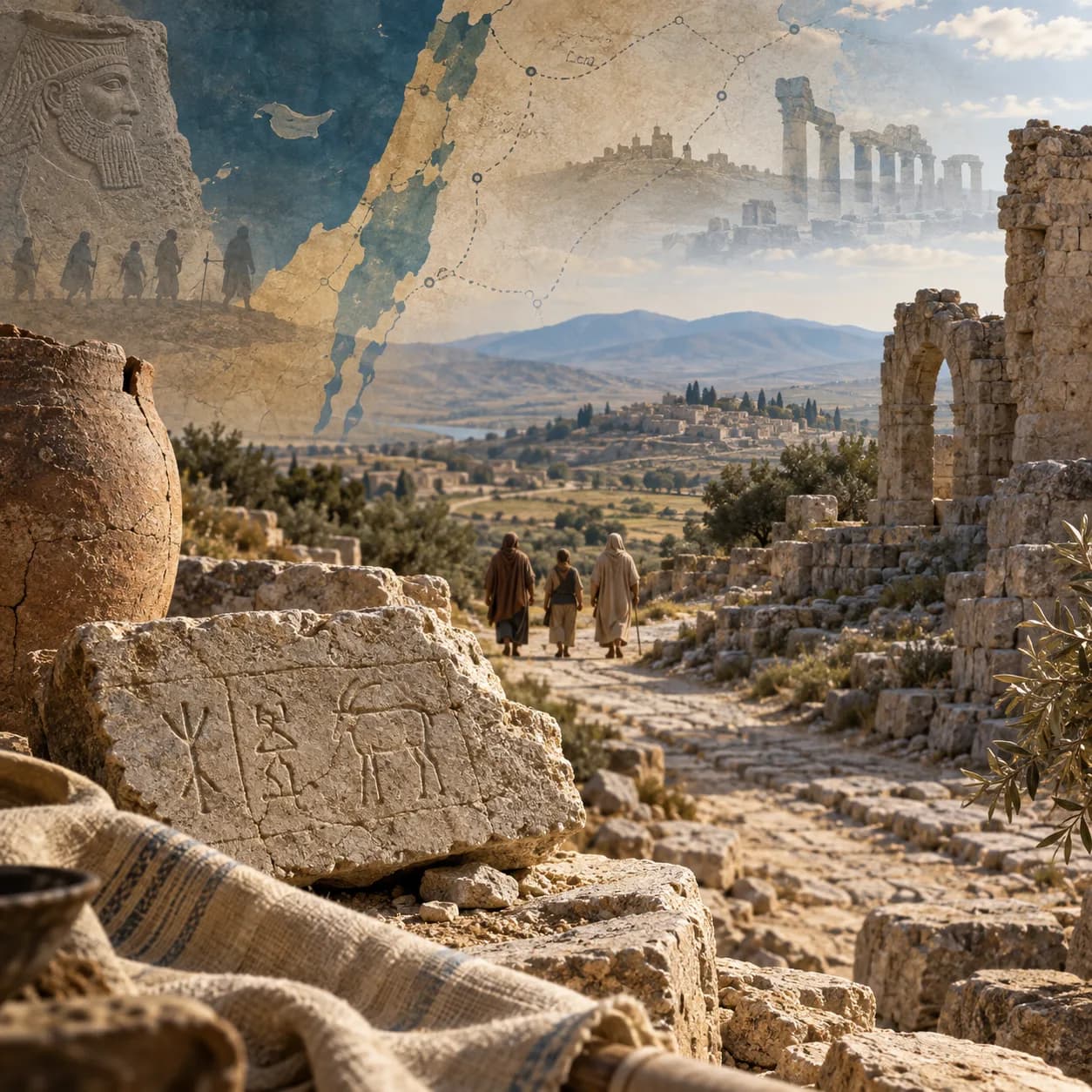
First, the river. A decree came down from the palace to the banks of the Nile: the Hebrew boys must die. Then, the fire. In the desert, a shepherd sees a bush burning without being consumed and hears the name of God speak from the flames. Between one scene and the other lies the same life: a baby hidden among reeds, and a man made of hesitations, exile, and wounded memory.
Exodus 1–4 does not present Moses as a ready-made hero. From the beginning, the text surrounds him with people more anonymous and more courageous than he is: midwives, a mother, a sister, a foreign princess. Only much later does the great scene of the call arrive. And when it comes, it does not find a confident leader, but someone who questions, resists, argues, and nearly backs away. Liberation, here, begins before the liberator. It begins with the refusal to collaborate with death, and with a God who declares he has heard the cry of the enslaved.
The Women And The Decree
The story opens under the logic of empire. Pharaoh fears the growth of Israel and tries to control the future through the womb and the cradle. The plan tightens in stages: first oppression through forced labor, then the order to the midwives, and finally the general command to throw the boys into the river. The violence grows cruder, more public, more desperate.
The text answers this escalation with a chain of disobedience, and it does so with sharp literary precision. Pharaoh, the supreme figure of power, does not even receive a name. The midwives do: Shiphrah and Puah. They are the first named characters in this confrontation, and the reason for their resistance is stated plainly: they "feared God." This is not a devotional detail tossed in passing. It is the first crack opened in the king's program. Power commands death; the fear of God preserves life.
This line continues in Exodus 2. A man and a woman of the house of Levi have a son; the mother hides him for three months; when she can no longer conceal him, she makes a basket, coats it with pitch, places the boy inside, and sets it among the reeds; the sister stands at a distance to see what will happen. None of this carries the shine of a public intervention. It all unfolds in a domestic register — improvised, vulnerable. But it is precisely there that the text locates the beginning of liberation.
Pharaoh's daughter comes down to bathe in the river. She sees the basket, sends for it, opens it, hears the crying, and feels compassion. The sequence matters: see, open, hear, have compassion. She recognizes the baby as Hebrew and, even so, acts against the policy of her own house. The boy's sister then appears with the agility of a well-staged scene: she offers a Hebrew wet nurse. The mother recovers her son for a time and raises him. Later, when she hands him over to Pharaoh's daughter, he receives a name: Moses, "because I drew him out of the water."
That name sums up the narrative's first movement. The water that should have swallowed him becomes the means of his preservation. The decree is real; the danger does not dissolve; salvation happens inside the threat, not far from it. The text states this simply and powerfully: the life of the future liberator depended on the courage of those who, one by one, refused the role the empire had assigned them.
The Rescued Boy, The Divided Man
The next scene is no longer about a cradle, but a crisis of identity. "When Moses had grown up," the text says, he went out to see the hard labor of his brothers. The verb "to see" carries weight in these chapters. Pharaoh's daughter saw the basket and acted with compassion. Moses sees an Egyptian beating a Hebrew and reacts with violence: he kills the Egyptian and hides him in the sand. The next day he sees two Hebrews fighting and tries to intervene, but is rebuffed: "Who made you a ruler and judge over us?" The question anticipates the whole problem of his calling. Moses wants to act, but he has not yet received authority, nor does he know how to use the strength he has.
The narrative does not shield its protagonist from this failure. He does not appear as a natural-born liberator, instantly recognized by his own people. Quite the opposite: his first attempt to defend a Hebrew ends with a hidden corpse, and his second attempt ends in rejection. When Pharaoh hears of it, Moses flees. The boy drawn from the waters becomes a man in exile.
In Midian, another episode defines him. At a well, he intervenes on behalf of Reuel's daughters against shepherds who were driving them away. There is continuity here: Moses reacts to scenes of injustice. But now the violence does not turn into murder; the narrative moves him instead toward a life of shepherding, marriage, fatherhood, and foreignness. The name of his son, Gershom, is born from this condition: "I have been a sojourner in a foreign land."
This displacement matters. Moses belongs and does not belong to the worlds he passes through. Hebrew by birth, raised in the Egyptian court, a fugitive in the desert, a son-in-law in Midian. The text shapes his identity through crossings, not through purity. Perhaps that is precisely what allows him to become a mediator: he knows the weight of oppression from the inside, but he also knows what it is to have no stable place.
Meanwhile, the narrator turns the camera back to the people. "The children of Israel groaned under the bondage and cried out." God "heard," "remembered," "saw," and "took notice" of them. These verbs prepare the way for the bush. Before Moses hears the call, the reader already knows that God has heard the cry of the enslaved. The mission is not born from one individual's inner restlessness; it is born from a collective suffering that rises up to God.
The Bush In The Desert
The burning bush enters as a visual interruption. Moses is tending his father-in-law's flock, comes to Horeb, sees the bush ablaze, and notices the impossible: it burns but is not consumed. He decides to draw near to look more closely. The call begins with this turn of the eye. Moses is not seeking a religious experience; he is working. The extraordinary breaks into the ordinary path and demands attention.
When the Lord sees that he has turned aside to look, he calls to him from the midst of the bush: "Moses, Moses." The doubled name carries urgency and intimacy. The answer is brief: "Here I am." Then comes the command that marks the place: "Do not come near; take off your sandals, for the place where you are standing is holy ground." The holy, in Exodus 3, is not an abstraction. It is a presence that redefines space. The ground of pasturing suddenly becomes a place of encounter.
The first word about God is not yet the enigmatic name of 3:14. It is memory: "I am the God of your father, the God of Abraham, the God of Isaac, and the God of Jacob." The new fire presents itself in continuity with an ancient history. The voice from the bush does not inaugurate an unknown deity; it links Moses to the covenant, to the ancestors, to the promise that had seemed buried beneath Egypt's bricks.
Then comes the center of the call, and it deserves close reading. God does not begin by saying "go." He begins by saying "I have seen." "I have surely seen the affliction of my people who are in Egypt, and have heard their cry... I know their sufferings; therefore I have come down to deliver them." The progression is striking: see, hear, know, come down. The God of the bush is neither indifferent nor remote. His movement toward Israel precedes Moses's mission. Only after these verbs comes the sending: "Come now, and I will send you to Pharaoh."
This command places Moses between two poles that will dominate the whole book: the Pharaoh who hardens his heart, and the God who has heard. The authority of the one sent will not rest on temperament, eloquence, or social standing. It will rest on the fact of having been sent by the one who saw the affliction and came down to deliver.
The Name That Sustains The Mission
Moses's first objection is personal: "Who am I that I should go to Pharaoh?" The question is not theatrical. It makes sense given the story we have already read. Who is he? A fugitive, a man with no stable place, someone whose earlier attempt to intervene had failed. God does not respond by inflating his self-esteem. He responds with presence: "I will be with you." The answer to "who am I?" is not a new résumé, but companionship.
The second question touches the divine name. If the Israelites ask who sent him, what should he say? Exodus 3:14 has been read in many ways, and the text itself does not reduce its scope to a simple formula. Traditionally it comes to us as "I am who I am." The decisive point, however, appears in the narrative context. The name is revealed to sustain the mission before an oppressed people; it is not given to satisfy metaphysical curiosity. It guarantees that the God of the fathers remains present and faithful to his purpose. Right afterward, the message Moses is to carry reaffirms the same line: "The Lord... has appeared to me," "I have surely visited you," "I have seen what has been done to you in Egypt."
Here, Christine Hayes observes that the Exodus cycle serves as Israel's origin narrative not only by recalling the oppression in Egypt, but also by linking that memory to the revelation of the divine name and to the beginning of an identity centered on this God who acts in history. That connection helps explain why the name, in the text, is never an isolated curiosity; it appears bound to the cry of the slaves and to the project of liberation.
It is also worth noting the contrast with the opening chapter. Pharaoh speaks in order to eliminate future Hebrews. God speaks in order to remember the fathers and open a future for Israel. The empire treats bodies as a demographic problem; the voice from the bush calls a people "my people" and makes their history his own concern.
Moses's Objections
The call scene does not end with an immediate "yes." It stretches out into resistance. Moses foresees the people's disbelief: "They will not believe me." God then gives him signs. The staff becomes a serpent and becomes a staff again; the hand turns leprous and is restored; water from the Nile, poured on dry ground, becomes blood. The signs do not function as gratuitous spectacle. Each one answers the fragility of the one sent and prepares the future confrontation with Egypt.
Moses insists further. Now the problem is speech: "I have never been eloquent... I am slow of speech and slow of tongue." Once again, the divine answer does not romanticize the limitation. God asks who made man's mouth, and promises to be with his mouth, teaching him what to say. The call does not depend on an ideal natural aptitude. It creates space for a speech Moses does not master on his own.
The fifth objection is the barest: "Send someone else." At this point the text records the Lord's anger. There is a limit to refusal. Even so, the anger does not cancel the mission; it reorganizes it. Aaron enters the scene as brother and spokesman. Moses will remain central, but not alone. The calling, from this point on, is already collegial.
This detail is precious. The text does not hide the fact that Moses resists to the very end, nor does it conclude that he is therefore disqualified. He will be sent with signs, words, and concrete help. Biblical faith is not nourished by the myth of the flawless leader. It tells the story of a man called amid real fear, and assisted at the exact point of his insufficiency.
What The Text Establishes And What We Cannot Verify
There are at least four levels worth holding together without confusing them.
What the passage asserts is clear. It asserts that Israel lived under oppression in Egypt; that there was a policy of death against the Hebrew boys; that Moses was preserved as a child, grew up between two worlds, fled to Midian, and received, before the burning bush, a call to confront Pharaoh and lead the people out. It also asserts that God saw the affliction, heard the cry, and committed himself to liberation.
What its literary form suggests is equally strong. The plot binds birth and vocation together as two halves of a single story. The child saved from the waters and the man called in the fire belong to the same design. The repetition of verbs of seeing and hearing, the contrasts between imperial power and quiet compassion, the series of objections and answers — all of this shapes the reader's perception. Liberation does not begin in the leader's charisma; it begins in the preservation of a threatened life and in a God who takes the side of the humiliated.
What the story allows us to say is more limited. The general scenario of servitude in Egypt corresponds to the founding memory of Israel preserved in the book itself, and Hayes draws attention to the force of that memory in shaping Israelite identity. But we do not have, from this material, external documentation capable of confirming in detail the decree to kill Hebrew boys, the palace adoption of Moses, or the exact form of the burning-bush episode. Caution is needed here. The biblical text does not present itself as an administrative record, and the available evidence does not authorize us to reconstruct these scenes with modern precision.
As for the bush, even less room remains for false certainty. The passage wants to communicate a holy, commissioning presence. If someone asks about the physical mechanism of the phenomenon, the text does not answer on that register. Its interest lies elsewhere: in the encounter that changes Moses's life and inaugurates the confrontation with Egypt. Reducing the scene to naturalistic curiosity is to read against its gravity.
Finally, there is the interpretation of faith. For the Christian reading, these pages testify to a God who sees suffering, acts in history, and calls fragile mediators to tasks greater than themselves. That is a theological judgment, not a conclusion imposed by archaeology. It arises from the believing reception of the text. And it needs to be held in honest dialogue with the limits of what can be historically demonstrated.
The interpretive consequence is concrete. Whoever reads Moses merely as a great individual loses the thread of the chapter. Before the prophet's public voice, there are women protecting a child; before the revealed name, there is a people groaning; before the miracles before Pharaoh, there is a man who can barely manage to say "yes." Exodus 1–4 asks that the calling be read starting from the affliction God heard and from the small acts of courage that had already been resisting evil.
This corrects abusive uses of the text. A spirituality fascinated by grand callings but indifferent to threatened children, exploited people, and dehumanizing labor has read the bush without paying attention to the river. And a theology of the strong, self-sufficient leader has also failed to recognize Moses. The God of these pages begins by preserving vulnerable life, and only afterward sets a man before power. If we want to understand Exodus, this is where we need to linger longer: among the reeds of the Nile and before the fire that does not destroy, where liberation had already begun long before it found a voice.
Sources Of This Text
Primary basis: Exodus 1–4. Biblical text. The literary observations refer to the passages indicated; the Memra applications are editorial interpretations.
13 · Christine Hayes · Yale | Israel in Egypt: Moses and the Beginning of Yahwism | https://oyc.yale.edu/religious-studies/rlst-145/lecture-7 | — Joseph, the memory of Egypt, and the birth of Moses.
The day has barely broken, and the meeting already carries something of ritual and defiance. Pharaoh goes down to the Nile, the river that sustains Egypt, and Moses waits for him on the bank with a word he can no longer bear to hear. The first blow of the series does not fall on the palace but on what makes the palace possible: water. In Exodus 7, the river turns to blood, the fish die, the stench covers the land, and what seemed permanent reveals itself to be vulnerable.
The scene sets the tone for everything that follows. The plagues are not an arbitrary collection of dark wonders. The text organizes them as the progressive dismantling of a power that considered itself limitless. Pharaoh controls labor, bodies, time, and territory. The God of Israel asks for one thing, repeated almost to exhaustion: "Let my people go, that they may serve me." The whole conflict fits inside that sentence. It is not merely about geographic departure. It is about who human service belongs to, who has the right to demand total obedience, who may call a people "mine."
At The Bank Of The Nile
The first plague already shows how the narrative frames this confrontation. In Exodus 7:17, the strike on the Nile comes with a formula of recognition: "By this you shall know that I am the Lord." What is at stake is not a display of force for its own sake; it is the shattering of an illusion of sovereignty. Egypt depends on the river to live, to plant, to transport goods, to order the year. When the water fails, it is not some incidental feature of the landscape that fails—it is the nerve center of stability itself.
The text insists on concrete effects. The fish die. The river stinks. The Egyptians must dig around the Nile to find water. This is not an abstract marvel; it is a disruption of everyday life. At the same time, the scene includes a telling detail about the court magicians: they manage to reproduce the sign on a small scale. It is a sharp observation by the narrator. The rival power can even imitate the damage—but it cannot restore the world. The court knows how to duplicate the spectacle, but it does not know how to heal what breaks.
This note recurs throughout the cycle. The narrative does not present Moses and Aaron as better conjurers than the Egyptians. It presents the word of the Lord as the one that creates a new world and strips the empire's techniques of authority. That is why the story begins, before the first plague proper, with the staff that becomes a snake and swallows the staffs of the magicians (7:8–13). From the outset, the issue is absorption and defeat: Egypt's sign is swallowed by the sign of the God of Israel.
"LET MY PEOPLE GO"
The recurring phrase stitches the plagues together from beginning to end. Sometimes it comes with the addition "that they may serve me in the wilderness"; sometimes the request is followed by the warning of a new calamity. It always returns to the same dispute over possession and service. Pharaoh's position amounts to: they are mine. The Lord's response: they are my people.
This repetition rules out a sentimental reading of the exodus. The goal of liberation is not some vague idea of individual autonomy. It is the end of a concrete servitude. The verb "to serve" changes masters. What Pharaoh holds onto are workers; what God claims are worshippers. And the text does not separate the two, as though worship were an escape from the world. Israel must leave in order to serve God, because it is prevented from serving him while it is forced to sustain the machinery of empire.
The organization of the plagues reinforces this mounting pressure. Many readers note three sets of three, followed by the final blow. Without turning this into a rigid diagram, the pattern helps us hear the cadence of the chapter. There are morning announcements, confrontations in Pharaoh's presence, acts carried out without warning, moments when the king negotiates, temporary relief, and relapse. The drama advances in waves, not in a straight line.
First come blows that invade and humiliate: frogs everywhere, gnats or lice out of the dust, swarms that make the land unbearable. Then the focus widens to the economic and bodily foundations of life: livestock, skin, crops. Finally, sky and light collapse: destructive hail, locusts consuming what remains, thick darkness. One by one, the Egyptian world loses the supports on which it imagined its safety rested.
There is also a significant shift partway through the narrative: the text begins to highlight the distinction between the Egyptians and Israel. In Exodus 8:22–23, the land of Goshen is spared the swarms; in 9:4–7, Israel's livestock is distinguished from Egypt's; in 10:23, while darkness covers some, there is light in the dwellings of others. This selectivity is part of the text's claim, not a decorative detail. Judgment is not portrayed as blind chaos. It has direction, aim, and narrative purpose: to show that the Lord knows how to separate, to judge, and to deliver.
When The Magicians Stop
In the early episodes, the Egyptian court still responds. The magicians reproduce the sign of blood, reproduce that of the frogs, keeping up for a while the appearance of equivalence. Pharaoh can go on telling himself that nothing decisive has happened. But then comes the moment when the empire's symbolic machinery jams.
In Exodus 8:19, faced with the plague of dust turned into small insects, the magicians tell Pharaoh: "This is the finger of God." They do not convert, do not become allies of Moses, but they recognize a limit. Their vocabulary shrinks: they no longer speak of strategy, of diplomacy, of chance. They speak of God. It is the first explicit crack in the court's self-sufficiency.
Later, in 9:11, the defeat becomes physical. The magicians "could not stand before Moses" because of the boils. The narrator handles this reversal skillfully. At first they stood, on stage, competing. Now they cannot even show up. The bodies of the regime's experts become proof of the regime's own failure. Egypt has lost not merely an argument but its composure.
These details matter because they reveal the text's literary texture. The plagues are not simply a sequence of events. They are enactments of collapse. There is a calculated progression from imitation to recognition, and from recognition to incapacity. Pharaoh's world is gradually losing both the language and the posture needed to sustain its claim to control.
The Heavy Heart
If the plagues display the empire's external collapse, Pharaoh's heart displays its internal core: obstinacy. Almost after every reprieve, he backslides. He asks Moses to pray, promises to let the people go, and once the pressure eases, he hardens again. With the frogs, this appears clearly in 8:15: he sees that there is relief, and he hardens his heart. With the hail, in 9:27, he even confesses: "I have sinned this time; the Lord is righteous, and I and my people are wicked." It is a striking admission. But once the rain, hail, and thunder cease, he sins again and hardens his heart once more (9:34–35).
The narrative is almost clinical at this point. Pharaoh's problem is not lack of information. He sees, hears, suffers, negotiates, admits guilt. And still he returns to the same place. His conscience is not absent; it is overpowered by the need to keep his own sovereignty intact. The text understands that there are people who learn only for as long as it hurts.
Across the chapters, the formulation varies. Sometimes it says Pharaoh hardens his own heart; sometimes that his heart hardens; sometimes that the Lord hardens Pharaoh's heart. This oscillation is not a flaw to be corrected but part of the story's theological weight. The text offers no abstract theory of freedom and determinism. It places the reader inside a process in which repeated refusal becomes character, and character becomes judgment. The man who refuses to listen gradually becomes, himself, incapable of listening.
It is worth noting the verb implicit in this imagery: the heart becomes heavy. It is not merely hard, like stone. It is heavy, inert, without moral mobility. The irony is fine-grained. The absolute sovereign, who moves multitudes, can no longer move himself.
The Night Of The Firstborn
Everything converges on the tenth plague because it strikes power at its most sensitive point in the ancient world: the household, the inheritance, continuity. Up to now Egypt has lost comfort, harvest, livestock, skin, light. Now it will lose the future. In Exodus 11, the blow is announced as final. In 12:29–30, it happens at midnight, from Pharaoh's firstborn to the firstborn of the captive, and among the animals as well. The breadth of the statement is deliberate: no level of society is left outside the mourning.
It is impossible to read this scene honestly and treat it as a mere religious special effect. The text does not conceal the gravity of what it narrates. "There was a great cry in Egypt," says 12:30. The same country that made Israel groan now groans itself. This correspondence lies within the logic of the whole book. The exodus began, in its opening chapters, with a policy against the Hebrew children. The final blow answers that original violence by striking the very domestic structure of the oppressor. Even so, an answer does not mean moral simplicity. The reader remains before a difficult page.
There is, however, a decisive contrast in the scene. Throughout the whole cycle, Pharaoh tries to control the rhythm: he summons Moses, bargains over terms, concedes little, then takes it all back. In the tenth plague, it is he who calls "by night" (12:31). The hour is no longer his. His speech changes tone: "Rise up, get out from among my people." The man who used to say "mine" about other people's bodies must now release what he was holding. The text makes absolute power speak the language of defeat.
Memory Marked On The Doors
Chapter 12 shifts the narrative's register in a surprising way. The plot does not run directly toward departure; it slows down to institute a rite. The month becomes "the first of months" (12:2). Israel's time is reset. It is not enough to say that God delivered them; it is necessary to teach how that deliverance will be remembered.
The Passover instructions are meticulous because memory, here, is not decorative. The lamb, the hurried meal, the loins girded, the sandals on the feet, the staff in hand, the blood on the doorposts: all of it composes a pedagogy of urgency. The house becomes a place of protection and transmission. In 12:13, the blood is a "sign." The text does not treat it as a magical mechanism but as a mark of belonging within obedience to what God commands. In 12:26–27, when the children ask the meaning of the rite, the answer must lead them back to the deliverance.
This movement is central to understanding the shape of the account. The tradition does not merely want to preserve the memory of an ancient catastrophe. It wants to turn that memory into a practiced identity. Liberation is not filed away in an archive; it comes to the table, organizes the calendar, shapes the family's language. History becomes liturgy.
In Christian reading, this Passover vocabulary will carry forward and take on new developments within the Bible itself. But that extension of faith should not dissolve the substance of Exodus. Before any later reinterpretation, Passover is the memory of a people brought out of servitude by a divine intervention that judged a regime and preserved a community.
How Far The History Reaches
Here is where responsible reading needs to take a deep breath. The biblical text affirms a sequence of plagues, Pharaoh's resistance, the distinction between Egypt and Israel at various points, and the institution of Passover as a memorial of this deliverance. That is what the chapter says.
The chapter's form, however, shows intense literary craftsmanship. Repetitions, formulas, parallels, dramatic escalation, and the interweaving of narrative and rite indicate that we are not looking at an administrative record. As Christine Hayes observes in discussing the exodus traditions, this is formative theological memory, written to say who the Lord is and who Israel is because of its liberation. That does not make the account false; it defines the kind of truth it intends to offer.
Historically, the question is narrower. There are hypotheses that link some of the plagues to natural phenomena: changes in the water, proliferation of amphibians and insects, livestock disease, severe storms, locust swarms, darkness caused by dust or other atmospheric events. Such hypotheses may illuminate isolated elements of the picture. They do not, however, reconstruct the entire sequence as the text arranges it, nor do they securely explain the narrated selectivity, nor do they reach as far as the death of the firstborn. Nor is there, from the available evidence, sufficient basis to claim that each plague corresponds exactly to an Egyptian deity in a fixed scheme, although the tone of confrontation with Egypt's religious and political order is unmistakable.
The absence of a parallel Egyptian account does not settle the matter either. Ancient regimes were not known for willingly recording their own humiliation. What can be said soberly is both less and more at once: less, because we have no way to verify every detail of the series as though following a modern chronicle; more, because the chapter preserves a foundational memory of liberation from oppression and interprets it with theological boldness.
Reading Without Domesticating
There are readings that impoverish the text in opposite directions. One turns it into literalist laboratory reportage, as if its force lay in providing a kind of proof it never sets out to provide. The other reduces it to spiritual allegory, as if Egypt, servitude, and liberation were merely states of the soul. The chapter resists both escapes.
It speaks of exploited bodies, of economics, of state violence, of political resistance, and of worship. And it also speaks of the God who judges, distinguishes, protects, and claims a people for himself. Its ethical harshness should not be hidden. People suffer in Egypt. Animals die. Households weep. The Bible does not ask the reader to find this beautiful. It asks the reader to recognize what the obstinacy of absolute power produces when it repeatedly refuses to release those it oppresses.
The interpretive consequence is concrete. The center of the text is not a license to celebrate religious destruction, nor a manual for justifying cruelty in God's name. The center is the liberation of the enslaved and the defeat of a sovereignty that absolutizes itself. Every reading of the exodus that forgets this trades the heart of the chapter for its special effects.
That is why Passover, here, cannot be reduced to an intimate metaphor. It is born as the public memory that God heard the cry of a subjugated people and confronted an empire on its own ground. To read Exodus 7–12 today is to let that memory unsettle our comfortable accommodations. Wherever human labor is treated as property, wherever religion shields the hardness of rulers, wherever authority yields only when pressure becomes unbearable, Pharaoh is still alive. And the text's question remains equally alive: who, after all, has the right to say "my people"?
Sources Of This Text
Primary source: Exodus 7–12. Biblical text. The literary observations refer to the passages indicated; the applications by Memra are editorial interpretations.
14 · Christine Hayes · Yale | Exodus: From Egypt to Sinai | https://oyc.yale.edu/religious-studies/rlst-145/lecture-8 | — Composition and theology of the exodus traditions.
The people have the sea in front of them and the army behind. The decisive detail is that this predicament was no accident of the road. At the beginning of Exodus 14, it is the Lord himself who orders Israel to change course and camp in a place that will make them look disoriented, vulnerable, easy to recapture. Pharaoh will see a lost band in the wilderness; God, however, sees a scene set up to reveal who truly rules history. The text builds the tension from this point: liberation does not move in a straight line. It passes through a dead end.
This trait matters because it rules out a sentimental reading of the episode. The crossing of the sea is not the successful escape of people who planned well. It is the passage of a people who have already left Egypt and yet discover that freedom can include a night in which everything seems to reverse. The biblical memory of the exodus is born at exactly this point: between the panic of the people, the obstinacy of Pharaoh, and the action of God, who turns the dead end into a road.
Cornered On Purpose
The first half of the chapter is dominated by looking. Pharaoh "will see" Israel hemmed in; the Israelites "lift up their eyes" and "see" the Egyptians advancing; Moses responds by inviting them to "see" the salvation of the Lord. What changes the scene is not yet any movement by the people, but a dispute over what is being seen.
When the Egyptians draw near, Israel reacts with bitter clarity: "Were there no graves in Egypt, that you have taken us away to die in the wilderness?" The line mixes sarcasm, fear, and selective memory. Egypt, the place of servitude, appears for a moment as a place of safety. The text does not flatter the freed people. They grumble, they accuse, they prefer the bondage they know to the risk of the promise. The drama of the crossing includes this inward regression: leaving the empire is one thing; ceasing to think like a slave is another.
Moses answers with three short imperatives in Exodus 14:13-14: "do not fear," "stand firm," "see." Then comes the most surprising line: "The Lord will fight for you, and you have only to be still." The words seem to call for absolute stillness. Yet a few verses later, God commands the people to march. The tension is not a literary slip; it is a way of ordering priorities. Israel will not win by its own strength, but that does not exempt it from crossing over once the way opens. Faith here does not consist in engineering the exit, nor in standing frozen before it.
The literary shape of the chapter reinforces this logic. Pharaoh commands horses, chariots, and officers; Israel has only the word it has received and the necessity of obeying under threat. The text dwells on the Egyptian military apparatus because it wants the reader to feel the disproportion. Salvation will be recognized as salvation precisely because nothing in the scene allows for a self-sufficient explanation.
The Column Between Two Worlds
Before the waters part, something shifts in the narrative space: the column that had gone ahead moves behind, between Israel's camp and that of the Egyptians. This movement, in Exodus 14:19-20, is a small dramatic miracle. The guide becomes a bodyguard. The presence that had been leading now blocks, creates distance, buys time.
The verse works with a strong contrast: on one side, darkness; on the other, light through the night. The same divine presence that protects one people confounds the other. The text states this without embarrassment. For its theology, Israel's liberation and Pharaoh's judgment belong to a single act. They are not two parallel events. The night of the crossing is a night of separation.
This point tends to unsettle modern readers, and rightly so. The chapter does not offer a generic spirituality of overcoming. It narrates the downfall of concrete pursuers. It would be a mistake to soften this dimension. It would equally be a mistake to turn it into license for demonizing today's adversaries. The text speaks of a conflict in which the oppressor is Pharaoh, already defined throughout Exodus as the king who enslaves, hardens his heart, and persecutes. The story does not hand out a ready-made label to be pasted onto whatever enemy a reader chooses.
Literarily, the column between the two camps does more than separate characters. It divides two regimes of reality. Behind it, the logic of empire still holds: force, pursuit, capture. Ahead of it, a people will be invited to walk across ground that does not exist under normal conditions. The passage to freedom requires this fold in the world.
The Night Of The Wind
Then Moses stretches out his hand, and the Lord drives back the sea "by a strong east wind all that night." The detail of the whole night deserves attention. The scene is not instantaneous. The text slows down. There is waiting, darkness, duration. Liberation does not arrive as a trick; it takes time, spanning hours in which the people remain exposed.
An important question arises here for reading the text. The passage affirms that God acts, and it names the wind as the means of that action. It does not debate whether the wind is a "natural cause" as opposed to divine agency. That opposition is ours, not the chapter's. In biblical narrative, the Creator can act through what belongs to his own creation. Saying there was wind does not weaken the theological meaning of the episode; it is part of it.
Historically, though, this detail does not settle the reconstruction of the event. One can imagine physical conditions under which shallow waters are temporarily driven back by wind. This possibility shows that the scene is not inherently absurd from a material standpoint. But physical possibility is not the same as historical proof. The text of Exodus 14-15 remains far more solid as literary and theological memory than as a verifiable map. Christine Hayes observes, when discussing the exodus traditions, that the account reached its biblical form as memory shaped theologically, and this affects the kind of question it allows us to answer with confidence. The chapter clearly affirms that Israel attributed its deliverance to the Lord's action; it does not give us the tools to fix with precision the geographical setting and empirical scale of the event.
This distinction matters. The passage claims that God opened a way through the sea. Its narrative form suggests an intervention involving duration, suspense, and the mediation of wind. Historical inquiry can discuss plausibilities and uncertainties. The interpretation of faith confesses the hand of God there. Blurring these two planes produces only false certainty or false disillusionment.
Water To The Right And To The Left
When the path appears, the text reaches its most powerful image: "the waters were a wall to them on their right hand and on their left." This is not simply crossing some soaked ground. The narrative wants the reader to feel the abnormality of the space. The sea, a symbol of boundary and threat, comes to obey as though it had internal corridors.
The chapter works through successive reversals. What had blocked now leads. What had protected Egypt as a natural barrier no longer serves the empire. The chariots, the pride of Egyptian warfare, become useless weight. When the Egyptians enter after Israel, God "throws into confusion" their camp, clogs the wheels of their chariots, and the war machine falls apart in the very element it thought it controlled. Even the pursuers' own words acknowledge the reversal: "Let us flee from before Israel, for the Lord fights for them against the Egyptians."
This line is central. The people who had just been told to stand still now receive, from the enemy's own mouth, confirmation of their true advantage. Israel has no military superiority. It has a God who acts. The repetition of the verb "fight" ties Moses's word of assurance to what actually happens on the ground. What had been spoken in confidence becomes visible in the enemy's defeat.
It also matters who performs each gesture. Moses stretches out his hand over the sea; the Lord makes the waters withdraw and then return. The servant acts as an obedient mediator, never as a technician of the wonder. At the end, in Exodus 14:31, the people fear the Lord and believe "in the Lord and in his servant Moses." The order is telling. Moses matters, but as a servant. The chapter legitimizes his leadership without displacing the center of the action.
The morning seals the reversal. The sea returns to its place "when the morning appeared," as if creation itself resumed its ordinary form once it had served the rescue. For Israel, the night opened a future. For Pharaoh, it closed off a claim: the claim to recover by force what God had set free.
When Narrative Becomes Song
If Exodus 14 ended with bodies washed up on the shore, we would already have a climax. But the text is not content with the scene. It immediately transforms it into song. Exodus 15 is not a devotional appendix. It is the interpretation of the event in poetic language.
The opening verse concentrates the theme: "I will sing to the Lord, for he has triumphed gloriously; the horse and his rider he has thrown into the sea." The prose had spread the tension across stages; the poetry condenses it all into one memorable image. Notice what disappears and what remains. The tactical detail disappears; what remains is the asymmetry between imperial power, represented by horse and rider, and the sovereign act of God, who "throws" them into the sea. The victory is narrated from above, already converted into communal memory.
The song intensifies certain aspects of the episode and silences others. It magnifies the majesty of the Lord, compared to a warrior, and dwells on the ruin of the enemies. It is not a neutral chronicle. It is praise. This helps us understand the difference in register between the two chapters without forcing an opposition between them. The prose presents the sequence; the poetry gives it cultic meaning. The people do not keep the exodus merely as information about the past. They keep it as a word to be repeated before God.
The repetition is decisive. "The Lord is my strength and my song"; "your right hand, O Lord"; "who is like you?"; "the Lord will reign forever and ever." The poem moves from the shore to the divine kingship. The issue is no longer just the end of a pursuit, but the revelation of who truly governs above Pharaoh. In a world where imperial kings embodied almost absolute power, the song shifts the axis: the true king is not found in the sunken war chariot, but in the God who saves.
The final verses project this memory forward, toward the sanctuary and God's dwelling with his people. The exodus from Egypt is not liberation into emptiness. The whole chapter points toward belonging, worship, and a way forward. This is why Miriam reappears with tambourines and dance, repeating the central line of the song. The memory ceases to be merely verbal; it becomes bodily, collective, rhythmic. Liberation must be sung, so that it will not be forgotten.
What We Can And Cannot Say
On the importance of the crossing for the Bible, the evidence is clear: this is a founding memory. The episode organizes Israel's identity, closes out the exodus from Egypt, and prepares the way for the wilderness and Sinai. Its enduring weight in later biblical tradition confirms this. On the precise historical reconstruction, the situation is different.
The biblical text does not allow us to locate the exact point of the crossing with certainty. The available external evidence likewise does not authorize us to affirm, with verifiable certainty, every empirical contour of the event on the scale that the book narrates. Behind the final tradition there may have been memories of flight, displacement, and liberation tied to Egypt; there may also have been a long process of composition and communal rereading before it reached its present form. Hayes draws attention to this process of formation of the exodus traditions. What remains uncertain is how far we can convert this theological memory into detailed historical description.
This does not reduce the text to empty fiction. What it does reduce is our own pretension to treat it as a modern report. Exodus 14-15 aims to shape the memory of a people, not to satisfy the curiosity of an expert in ancient topography. Reading the chapter well means respecting this kind of truth. There is possible historical truth here, but it reaches us already worked over by confession, liturgy, and narrative art.
Memory Of The Exodus, Without Triumphalism
Perhaps the most concrete interpretive consequence lies here: this chapter teaches how to remember liberation without turning it into arrogance. The people reach the far shore unable to credit themselves with the victory. They did not cross because they were more disciplined, stronger, or purer. The crossing exposes their fear, their complaint, and their dependence. All of this should inoculate against any triumphalist reading.
For Christian faith, the scene continues to speak as a paradigm of salvation: God opens a future where no way out is visible and leads his people along a path that he himself creates. But this appropriation is faithful to the text only if it preserves its ethical gravity. The sea does not authorize rhetorics of holy war for today's disputes. The God who defeats Pharaoh is not a mascot for projects of domination. The memory of the exodus serves those who resist oppression far better than it serves those looking for sacred varnish for their own power.
There is also a less grandiose, more immediate lesson. Between the command to "stand firm" and the command to "march," the chapter teaches the rhythm of biblical trust. First, recognize that salvation is not born of our own control. Then, when the way opens, walk into it. Neither the panic that turns back toward Egypt, nor the activism that invents shortcuts. The memory of the open sea calls for a humble practice of freedom: to move forward without forgetting who opened the passage.
Sources Of This Text
Primary basis: Exodus 14-15. Biblical text. The literary observations refer to the passages indicated; the applications in the Memra section are editorial interpretations.
14 · Christine Hayes · Yale | Exodus: From Egypt to Sinai | https://oyc.yale.edu/religious-studies/rlst-145/lecture-8 | — Composition and theology of the exodus traditions.
In the morning, the desert floor appears covered with a thin, fine layer, "like flakes." No one is quite sure what they're looking at. "What is it?" they ask in Exodus 16:15. The question remains embedded in the name itself: manna. But the wonder is quickly fenced in. Each family must gather only what it needs to eat that day. Whoever tries to secure tomorrow by stockpiling finds, the next day, worms and a foul smell. The miracle, here, does not offer itself as a warehouse. It arrives in the form of a food that teaches limit.
That is the key to the whole sequence in Exodus 16–17 and Numbers 11 and 20. These are not scattered scenes of wonders meant to impress the reader, as if the wilderness were simply a stage for special effects. They are episodes in which hunger and thirst cease to be private problems and become the most delicate material of communal life. A people learns, under extreme conditions, that eating and drinking are not merely biological matters; they are also matters of memory, power, justice, and trust. And Moses learns that mediating divine provision does not place him above judgment.
Bread That Spoils
In Exodus 16, the people's complaint carries the tone of distorted memory. "Would that we had died by the hand of the Lord in the land of Egypt," they say, recalling the pots of meat and the bread eaten "to the full" (16:3). Slavery disappears from the picture; only the kitchen remains. Present hunger reorganizes the past until it seems bearable. The Bible does not mock bodily need—it stages it with full force—but it exposes how deprivation can produce selective nostalgia.
The divine response does not come first as rebuke, but as provision. God announces, "I will rain bread from heaven for you" (16:4). The verb is generous, almost excessive; but that abundance is immediately disciplined. The people must go out and gather "a day's portion every day." The narrative slows down over the instructions because that is where the sign's meaning lies. The food falls from heaven, but it does not become a license for anxiety.
The details matter. In 16:16, each person is to gather "according to what he can eat." In 16:18, when what was gathered is measured, a decisive equalization occurs: "the one who gathered much had nothing left over, and the one who gathered little had no lack." The text does not pause to explain the mechanism. The narrative effect is enough: the divine gift, when obeyed, produces shared sufficiency. The miracle is not merely the appearance of manna; it is also an economy that prevents both scarcity for some and excess for others.
That is why the attempt to hoard becomes, within the plot, a refusal of the very kind of life God is forming. Some do not listen to Moses and set part aside for the next morning. The result is repulsive: "it bred worms and stank" (16:20). This is not an abstract condemnation of all material planning, as though any reserve whatsoever were sinful. The text is speaking of something else: anxious appropriation, within a newly liberated community, of a good given to everyone under the rule of the day. The lesson arises from a specific situation and must be read within that frame.
The exception of the sixth day confirms this. There, the people gather double and the food does not rot (16:22–24). The difference lies not in storage technique but in the word received. The sabbath enters the scene before any broader elaboration of Sinaitic law, and it enters bound up with food. Rest is not the luxury of those who already have plenty; it is part of the order by which God sustains his people. The holy day keeps survival from devouring the whole of time. Manna, then, does not merely answer hunger. It reorganizes the week, the body, and fear itself.
The Measure Of The Day
In Exodus 16, God himself declares that this provision will serve "to test them" (16:4). The test does not measure the capacity to endure privation heroically. It measures the willingness to receive enough without turning "enough" into a terrified possession. The test of faith, in this chapter, runs through the bowl.
This narrative shape guards the text against two poor readings. The first turns the episode into a fantasy of abundance without discipline: God provides, therefore the community may live without rule, without sharing, without limit. The chapter moves in the opposite direction. The second turns it into moralism against the hungry: the people complain, therefore their real problem is merely spiritual. That, too, fails. The hunger is there, concrete, and God does not treat it as illusion. The fault is not being hungry. The fault lies in turning hunger into a running accusation, in erasing liberation, in rebuilding Egypt as though bondage could be offset by a better menu.
There is a less obvious point as well. Manna is a strange food. Its name is born from a question; its rhythm, from a discipline; its preservation, from a holy exception. It resists domestication. Rather than settling Israel immediately into a life of stability, it teaches a dependence renewed every morning. The wilderness thus appears not only as a place of lack but as a place where freedom learns not to reproduce the logic of captivity in another form.
Massah And Meribah
In Exodus 17, the crisis shifts object and rises in temperature. Now water is lacking, at Rephidim. The people "quarrel" with Moses and demand, "Give us water to drink" (17:2). Moses answers sharply, but the sharpness reveals the danger: the scene already brushes against violence. In 17:4 he cries out to the Lord, "What shall I do with this people? A little more and they will stone me."
Thirst here is no pious metaphor. It is immediate threat. Precisely for that reason the narrative lets the submerged question surface: "Is the Lord among us or not?" (17:7). This is the point at which material need becomes theological crisis—not because water ceases to matter, but because its absence seems to disprove divine presence. The wilderness compresses body and faith into the same vise.
The response comes publicly. God tells Moses to go ahead of the people, take some elders, take the staff with which he struck the Nile, and strike the rock at Horeb (17:5–6). The elders serve as witnesses. The staff recalls earlier acts of power. The rock, an unlikely site for a spring, becomes the focus of the action. Water flows out, and the community lives.
But the episode does not end with the gushing water. The place receives a name: Massah and Meribah. Testing and quarreling are inscribed into the geography of memory. The place-name does more than locate; it interprets. The people will not remember only that there was water. They will also remember how they moved through the crisis: testing, contending, asking whether God was present or not. The Bible does not let the provision erase the disorder of the scene.
Meat And Desire
When Numbers 11 takes up the theme of food again, it is not the same scene revisited. The setting is similar; the tone, darker. The complaint now has tears and a chorus. The people weep, "each at the door of his tent" (11:10). The memory of Egypt returns, again culinary: fish, cucumbers, melons, leeks, onions, garlic (11:5). The oppressive past reappears as a generous market. The present, reduced to manna, feels unbearable.
The text does something notable: precisely when manna is being despised, it describes it with care. In 11:7–9 it details its appearance, the way it was prepared, its taste. The narrator does not deny that the food could grow monotonous; but neither does he allow it to be reduced to a symbol of abandonment. The gift remains a gift, even as it wearies those who receive it.
The dramatic center of the chapter is not merely the demand for meat, but the transformation of desire into collective insubordination. God declares he will give meat, not for one day but for a month, "until it comes out of your nostrils and becomes loathsome to you" (11:20). The phrase is deliberately harsh. The request will be granted in a way that exposes it. Not every concession is approval.
In the midst of this food crisis, the narrative opens another front: Moses collapses under the weight of the people. He complains that he cannot carry this burden alone (11:11–15). God then distributes among seventy elders the spirit that was upon Moses (11:16–17, 25). This insertion matters. Before the meat arrives, a redistribution of responsibility arrives first. The community's problem is not only scarcity or desire; it is also an overburdened leadership. The wilderness tests not only the trust of those who follow but the capacity of those who lead.
The quail finally come in abundance (11:31–32). The people gather them feverishly. And then the chapter dismantles any simple reading of a happy miracle: "while the meat was still between their teeth," the Lord's anger is kindled and a plague strikes (11:33). The place receives another name, Kibroth-hattaavah, "graves of craving" (11:34). The sequence is harsh because it wants to separate need from covetousness. Appetite itself is not the enemy; the desire that rewrites liberation as mistake, and mistakes the present gift for offense, is.
Blows On The Rock
Numbers 20 returns to thirst while, at the same time, shifting the tragedy's setting. Once again there is no water; once again the people quarrel with Moses and Aaron; once again comes the accusation that it would have been better to remain in Egypt (20:2–5). The repetition makes the reader recall Exodus 17. But the similarity is what prepares the decisive difference.
This time, God tells Moses to take the staff, gather the congregation, and speak to the rock before the people, so that it will give water (20:8). Moses, however, before the assembly, explodes: "Hear now, you rebels; shall we bring water for you out of this rock?" (20:10). He then raises his hand and strikes the rock twice (20:11). Water gushes out abundantly. The people and the livestock drink. Real need is met.
It is precisely this that makes the scene more serious. The practical outcome does not absolve the act. God says to Moses and Aaron, "Because you did not believe in me, to uphold me as holy in the eyes of the sons of Israel, therefore you shall not bring this assembly into the land" (20:12). The failure lies not in helping the people, nor in recognizing the gravity of their thirst. It lies in how the mediation was carried out before everyone.
The contrast between speaking and striking carries much of the episode's weight. In Exodus 17, striking the rock fell within the order received. In Numbers 20, it did not. Repeating an old solution outside the present word becomes disobedience. Added to this is Moses' phrase—"shall we bring out water"—which dangerously draws the mediator close to the source itself. The irritated leader, under legitimate pressure, turns a public crisis into a scene of exasperation and control. The water flows, but God's holiness is not honored.
This chapter forecloses any comfortable conclusion: effectiveness and faithfulness are not the same thing. A leadership can produce the expected effect and still fail in how it represents God and treats the people. For religious readers, the warning cuts sharp. The text does not shield the leader simply because he occupies a central place in the sacred story. On the contrary: the more visible the mediation, the more public the responsibility.
What The Wilderness Lets Us Know
From a historical and environmental standpoint, the background of these narratives is broadly plausible. Arid regions make water and food matters of collective organization, not just individual initiative. Crossing the desert demands discipline of route, distribution, and vigilance. This helps explain why the Bible chooses the wilderness, precisely, as the site of social and theological learning.
There are also natural analogies often invoked: sweet substances produced by certain plants or insects, quail migrations, springs associated with rock formations. Such parallels can make some elements imaginable. But the reach of that observation must be measured carefully. They do not demonstrate the event as narrated in the text: they do not prove the daily regularity of manna for the whole community, nor the sabbath pattern, nor the link between the demand for meat and judgment, nor the gushing of water exactly under the conditions described. Science can illuminate possible scenarios; it does not verify the final shape of the narrative as though it were a technical report.
On the literary plane, the differences between Exodus 16–17 and Numbers 11 and 20 should likewise not be smoothed over too quickly. There are repeated motifs—hunger, thirst, complaint, provision, naming of the place—and there are significant shifts of emphasis. This may indicate that distinct traditions were preserved and brought together theologically, something Christine Hayes notes in discussing the composition of the exodus traditions. The final text does not read as a simple duplicate, nor as a raw inventory of facts. It works crisis memories into a vision of the wilderness as a school of covenant.
The evidence, however, does not settle everything. It is not possible to say with certainty, from these passages alone, whether we are looking at wholly separate episodes, reinterpretations of analogous experiences, or reorganized parallel traditions. The uncertainty lies exactly there: in the historical relation between the scenes. What the text gives us clearly is its narrative and theological intent.
What These Scenes Demand Of Us
A reading of faith, especially a Christian one, can recognize here more than memories of survival. It can see a God who sustains his people without treating the body as an embarrassing detail, and who at the same time refuses the idolatry of possession, of nostalgia, and of irritated religious power. But such a reading stays honest only if it does not crush the material weight of the plot. The people are truly hungry. Truly thirsty. And God answers real needs.
A concrete interpretive consequence follows from this. These chapters do not authorize using the word "murmuring" to silence the cry of anyone who suffers. Hunger and thirst are not sins. What the text judges is the rebellion that turns the memory of liberation into chronic ingratitude, and desire into refusal of the gift received. In the same way, these chapters do not authorize leaders to hide behind their own office. Moses does not enter the land because, at Meribah, he struck the rock and failed before the people. The Bible, here, is severe with sacred power.
This is also why manna remains central. "The one who gathered much had nothing left over, and the one who gathered little had no lack." This sentence, in Exodus 16:18, offers more than a wilderness curiosity; it offers a criterion. Where a community reads these passages seriously, provision cannot be thought of merely in terms of private miracle or individual merit. It must be organized so that the abundance of some is not fed by the lack of others. The wilderness did not teach Israel to spiritualize deprivation, but to receive it as a shared problem under the word of God.
In the end, perhaps the most striking sign is neither the food that falls nor the water that springs forth. It is the fact that the text insists on binding together gift, limit, and responsibility. The bread from heaven cannot be hoarded as though life depended only on fear. The craved meat can become judgment. The water from the rock can flow even when the leader fails. And the presence of God, far from dispensing with communal order, is precisely what demands it.
Sources Of This Text
Primary base: Exodus 16–17; Numbers 11; 20. Biblical text. The literary observations refer to the passages indicated; the Memra applications are editorial interpretations.
14 · Christine Hayes · Yale | Exodus: From Egypt to Sinai | https://oyc.yale.edu/religious-studies/rlst-145/lecture-8 | — Composition and theology of the exodus traditions.
At the foot of Sinai, the people look up and see no one coming down. On the road from Edom, the people look at the ground and find serpents. Centuries later, in Jerusalem, a king looks at an ancient object and orders it destroyed. All three scenes turn on the same nerve: what happens when faith tries to fix the presence of God in something visible.
Read in isolation, they seem to push the reader in opposite directions. Exodus 32 condemns the golden calf with the severity reserved for the great ruptures of the covenant. Numbers 21 commands the making of a bronze serpent and links it to the healing of the bitten. In 2 Kings 18, that same serpent is destroyed because it has become the focus of incense offerings. This tension is not a flaw in the Bible. It is precisely the way the text guards against two equally seductive oversimplifications: the one that treats any religious object as ready-made idolatry, and the one that assumes a sign, having once served a purpose, is forever safe from corruption.
When The Mountain Feels Far Away
Exodus 32 begins with an absence. "When the people saw that Moses delayed to come down from the mountain," the community gathers against Aaron. The verb of delay sets everything else moving quickly. Anxiety does not stay contained; it turns into demand: "Up, make us gods who shall go before us." The reason given is revealing: "As for this Moses, the man who brought us up out of the land of Egypt, we do not know what has become of him."
The text exposes an exchange already underway. Instead of waiting for the God who brought them out of Egypt, the people fix their eyes on the absent mediator. At first glance the crisis looks political — a lack of leadership, a lack of direction, a lack of someone to "go before" them. But the shape of the narrative shows the crisis runs deeper. The people are not merely asking for guidance; they are asking for a manageable presence, something that can be made and set out in front of them.
Aaron gives in. He takes the gold, melts the metal, forms a calf. The contrast with what came before in the book matters. Up to this point, God speaks, promises, delivers, leads. Now human hands gather, melt, shape. The object does not descend from on high; it rises from the forge. And when the calf appears, the interpretation is already prepared: "These are your gods, O Israel, who brought you up out of the land of Egypt." The phrase seizes the central verb of the exodus — bringing up out of Egypt — and transfers it to the artifact.
There is a further unsettling detail. Aaron builds an altar before the calf and proclaims, "Tomorrow shall be a feast to the Lord." The episode does not present itself as a formal abandonment of the Lord's name in favor of some other name. What emerges is more dangerous: an attempt to domesticate the Lord into an available form, reduced to the reach of the eyes and the rite. Idolatry here does not consist merely in preferring another god. It consists in remolding the living God according to the urgency of the people.
A God Within Reach Of The Hands
The following sequence sharpens the critique. "The people sat down to eat and drink and rose up to play." The narration is brief, but the order of the gestures matters. Sacrifice, feast, celebration: the religion works. That is exactly what makes it so grave. The calf is not condemned for being ugly, exotic, or ritually ineffective. It is condemned because it offers a workable religious experience without requiring trust in the invisible God who speaks and commands.
The dialogue between God and Moses deepens this rupture. God says: "Go down, for your people, whom you brought up out of the land of Egypt, have corrupted themselves." Shortly after, Moses returns the language: "O Lord, why does your wrath burn hot against your people, whom you brought out of the land of Egypt?" There is a verbal contest over whose people this is, as if the rebellion had scrambled the very identity of the community. The object fabricated from gold is not a side detail of worship; it wounds the center of the relationship.
Then come the acts of undoing. Moses breaks the tablets, destroys the calf, grinds the metal, scatters it on the water, and makes the people drink it. The image of stability and guidance ends in dust and bitter water. What seemed solid is reduced to its material fragility. The whole scene insists on one truth: what hands have made cannot bear the weight of salvation.
If we stopped with Exodus 32, it would be easy to conclude the matter is settled: no image can have a place. But Scripture itself does not let us close the question so quickly.
A Healing That Comes From Above
In Numbers 21, the setting returns to the wilderness, but the mechanics of the narrative are different. The people "became impatient on the way." The impatience explodes into complaint against God and against Moses: "Why have you brought us up out of Egypt to die in the wilderness?" The phrase echoes the exodus in a dark register. The great act of liberation is reinterpreted as a march toward death. To this is added contempt for the food given: "We loathe this worthless food."
Then the serpents appear. The text presents them as judgment: they bite the people, and many die. For the first time in this set of episodes, the people's response includes explicit confession: "We have sinned, for we have spoken against the Lord and against you." Moses intercedes. And God responds in a surprising way. He does not simply remove the serpents; he commands that a fiery serpent be made and set on a pole. "Everyone who is bitten, when he sees it, shall live."
Here every verb carries weight. God commands; Moses makes; the bitten one looks; the bitten one lives. The object does not appear as an autonomous solution, nor as a permanent companion of the march. No one credits it with the exodus from Egypt. No one sets it "before" the community. Its function is strictly limited: to serve as a sign in the moment of judgment, so that the obedient gaze receives life.
The strangeness of the scene is part of its force. The sign of healing bears the shape of the very harm that wounded them. The narrative does not explain the mechanism; it does not invite speculation about some magical property of the bronze. The center remains the divine word received by Moses and obeyed by the wounded. The serpent, by itself, does nothing in the text. What matters is the relation between promise, obedience, and preserved life.
Here too, materiality is not despised. God does not save by means of an abstract idea. There is a pole, a raised object, lifted eyes, threatened bodies. The biblical text has no horror of the tangible. Its concern lies elsewhere: a material sign can serve faith as long as it remains a sign. When it stops pointing and starts retaining, when it captures religious attention for itself, its vocation is perverted.
Until That Day
This is exactly what 2 Kings 18 records in a dry and decisive sentence. Summarizing Hezekiah's reform, the narrator lists his acts: he removes the high places, breaks the pillars, cuts down the Asherah, and shatters the bronze serpent that Moses had made. The surprise lies in this last item. Among objects clearly tied to improper worship, there appears an object whose origin, according to Numbers, traces back to a command from God himself.
The explanation follows immediately: "for until those days the people of Israel had made offerings to it." The phrase "until those days" is anything but incidental. It marks the duration of a deviation. The object had endured through time. What had once been an instrument of healing had become the receiver of cultic smoke. The serpent was not born idolatrous, but the use made of it turned it into a rival to the trust owed to God.
The narrator adds that Hezekiah gave it a name that reduces it to its materiality — Nehushtan — as if demoting it to mere bronze. The king's gesture and the text's comment move together. The problem is no longer the memory of the wilderness, nor the possibility of giving thanks for an ancient deliverance. The problem is the cult that has attached itself to the object, making it untouchable precisely because it once proved useful.
This casts retrospective light on Numbers 21. The bronze serpent could be made without guilt because, there, its function was narrow and obedient. In 2 Kings, it must be broken because that function was betrayed. The same object passes, in the biblical story, through two distinct judgments. Not because the text is incoherent, but because the people's relationship to it changed.
Bronze, Incense, And Memory
Religious memory is a fragile blessing. Communities need markers, signs, stories, places, songs, inherited objects. Without memory, faith loses depth. But the Bible knows another possibility: remembrance can coagulate into fetish. Something received as a testimony to God's action begins to concentrate reverence, attachment, fear, and expectation in a way that no longer passes through God but stops at the object.
The smoke of 2 Kings 18 is, in this sense, eloquent. Burning incense is more than preserving an ancient relic. It is treating the object as the recipient of a cultic gesture. The sign no longer points; it absorbs. And when that happens, faithfulness does not consist in preserving the object out of respect for tradition, but in breaking it out of respect for God.
This is where the golden calf and the bronze serpent touch without merging. The calf is condemned at its origin, because it is born from the demand for a fabricated presence. The serpent is good at its beginning, because it is born from the word of God in response to intercession. One begins wrong and stays wrong. The other begins as remedy and ends as problem. The decisive point lies not in the material — gold or bronze — nor in the bare fact that an image exists. It lies in the theological place the object occupies and the kind of action it awakens.
The very literary design reinforces this. In Exodus, the initiative rises from the people to Aaron; in Numbers, it descends from God to Moses; in 2 Kings, the correction comes from a king who perceives the accumulated abuse. First, anxious fabrication. Then, a granted sign. Finally, necessary destruction. This progression resists any easy rule.
What The Text Affirms — And What It Does Not Hand Us
These passages allow us to affirm certain things with confidence. First: the Bible contains an internal critique of the religious use of objects. It does not only condemn images made against God's will; it also admits that an initially legitimate object can become corrupted and need to be eliminated. Second: a visible sign can, in certain circumstances narrated by the text itself, be commanded by God and serve to preserve life. Third: none of this data authorizes the conclusion that every sacred object is always holy, or always suspect.
It is also worth acknowledging the limits of what we have in hand. This essay works with a comparative reading of the texts. Beyond them, the evidence does not allow us to reliably reconstruct the historical trajectory of these objects. The ancient world knew animals and images charged with symbolic value; this helps us understand the force of the calf and the serpent in the imagination of the time. But it does not, by itself, prove the plot of Exodus, Numbers, or 2 Kings. The continuity of the serpent "that Moses had made" down to the time of Hezekiah belongs to the horizon of the biblical narrative; absent external support presented here, it is within that horizon that we read it.
There remains, finally, the level of faith interpretation. A Christian reader may recognize in these passages a permanent discipline against every attempt to imprison the presence of God in controllable supports. This is not an archaeological conclusion nor a scientific deduction. It is a theological reading of the text.
After The Wilderness, Inside The Church
The interpretive consequence is concrete and uncomfortable. The problem of the golden calf did not stay behind in the wilderness, and the problem of the bronze serpent did not end with Hezekiah. A community can turn into a substitute the very thing that should only serve: a devotional object, a cherished tradition, a liturgical form, the memory of a revival, a charismatic leader, even the language of orthodoxy itself. Good things, sometimes given as real help, can come to receive the trust, the fear, and the reverence that belong to God.
Scripture does not, for this reason, call for nervous iconoclasm or contempt for the materiality of faith. It does not teach us to confuse art with idolatry, memory with superstition, symbol with rival to God. What it demands is severe discernment. Always to ask: does this sign still lead us to obedience, or does it now offer us the illusion of possession? Does it still make us look toward God, or does it now make us stop at the bronze? Does it still serve the life received from the word, or does it now ask for smoke of its own?
When the answer changes, faithfulness changes with it. There are moments when preserving is right. There are moments when fabricating is already sin. And there are moments when breaking becomes an act of reform. This is the deliberate tension that all three texts preserve. Not everything visible is an idol. Not everything that once helped must remain standing. Between the mountain that seems silent, the pole raised in the wilderness, and Hezekiah's hammer, Scripture teaches us to suspect matter less than the heart that wants to control God — and to have the courage to call bronze what has gone back to being merely bronze.
Sources Of This Text
Primary basis: Exodus 32; Numbers 21:4–9; 2 Kings 18:4. Biblical text. The literary observations refer to the passages indicated; the Memra applications are editorial interpretations.
This essay focuses on a comparative reading of the biblical text. It does not offer archaeological proof or an independent reconstruction of the episode.
In the tightest stretch of road, walled in by vineyards on both sides, the donkey has nowhere to go. Ahead of her stands the messenger of the Lord, sword drawn in hand. Balaam, however, sees nothing. He sees the donkey. He sees the detour. He sees his own foot crushed against the wall. And he reacts like someone who imagines himself in control: he strikes her again. The scene is almost too cruel to be merely comic. An expert in handling the sacred, hired to produce a powerful word, turns out unable to perceive the most immediate danger. The animal beneath him sees more than he does.
This is how Numbers 22–24 dismantles Balaam. The episode of the donkey is not a folkloric ornament, nor a comic interlude in the middle of a political negotiation. It prepares the reader for what comes next: the man paid to curse Israel will discover, publicly, that his mouth is not for sale. Before he fails at Balak's altars, he fails on the road. Before he pronounces blessings against his own commission, he is exposed by an animal that refuses to cooperate with his blindness.
The Permission That Does Not Absolve
The tension begins before the journey. Balak, king of Moab, fears Israel and seeks out Balaam to deploy an invisible but seriously regarded weapon: the effective curse. In the world of the text, words pronounced by someone reputed to mediate the divine are not mere opinions. They carry weight, direction, expected effect. Balak does not want just a religious opinion; he wants a verbal intervention against a people who terrify him.
Balaam is not described as a prophet of Israel. Nor does he appear as an empty fraud. The account presents him as someone who genuinely consults the Lord and receives an answer. In the first approach, the answer is clear: he must not go, and must not curse, because that people is blessed. When a more prestigious delegation returns with greater promises, the ambiguity of the character deepens. Balaam says that not even a house full of silver and gold would make him go beyond the word of the Lord; but he asks the men to stay one more night, so he can see "what else" the Lord will say. The phrase holds reverence and self-interest together. The narrator does not need to comment on his motivation; the scene itself already leaves the reader suspicious.
Then comes the detail that unsettles any hasty reading. God allows him to go, provided he speaks only what he is told. Balaam rises early, saddles his donkey, and departs. And yet God's anger burns because he went. The chapter does not pause to resolve this tension didactically. It remains there, like a splinter. The problem is not simple geography, as if the fault lay merely in setting foot on a forbidden road. Permission does not suspend judgment on the heart. Balaam may go; he may not turn that permission into a license to serve his own greed or Balak's strategy.
This nuance matters. There are decisions that, from the outside, fall within what is permitted, yet still expose crooked dispositions when put to the test. Numbers 22 does not depict a contradictory God who says "go" and then punishes the physical movement. It depicts a God who permits the walk and, along the way, reveals who the walker really is.
Three Times The Donkey Sees
The account of the journey is built with remarkable precision. The messenger of the Lord takes his stand in the road as an adversary. The donkey sees him. Balaam does not. This pattern repeats three times, but never mechanically. Each scene tightens the space and escalates the violence.
In the first, there is open field. The donkey leaves the road and goes into the terrain. Balaam forces her back. There is still room to correct the course, at least from the perspective of one who cannot see the real obstacle.
In the second, the setting narrows: a path between vineyards, with walls on either side. Swerving away from the messenger, the donkey crushes Balaam's foot against the wall. The animal's resistance produces concrete pain for her master. Blindness, here, stops being merely a spiritual incapacity and becomes humiliated fury. Balaam strikes her again.
In the third, there is no margin left at all. The place is so narrow there is nowhere to turn, neither right nor left. Facing the messenger, the donkey simply lies down. Not out of stubbornness, but because there is no space left for any maneuver. Balaam responds with the only language he still thinks he commands: he beats the animal a third time.
The repetition does not merely build rhythm. It shifts meaning with each cycle. The outer space keeps shrinking while Balaam's inner world shows itself ever narrower. The donkey, who in his eyes "strays" from the path, is the only creature who actually perceives that the path is blocked. And the messenger does not appear as a neutral observer. He comes with sword drawn. He has not come to inform; he has come to stop. There is judgment on the road.
The chapter, above all, insists on the verb "to see." The donkey sees the messenger. Balaam does not see. Later, when his eyes are opened, he too sees. The irony could not be sharper: the professional summoned for his supposed perception of the invisible is contradicted by the very animal carrying him. In biblical narrative, sight sometimes separates the wise from the fool. Here, it separates the vulnerable from the violent. The donkey is not ridiculous. What is ridiculous is the man who beats the creature that is saving him.
The Mouth Opened, The Eyes Opened
Then the extraordinary happens in two stages, and the order is decisive. First, the Lord opens the donkey's mouth. Only afterward does he open Balaam's eyes.
The animal's speech has nothing mystical or sublime about it. It is domestic, almost prosaic, and precisely for that reason cutting: "What have I done to you, that you have struck me these three times?" The question raises no theology; it exposes injustice. Balaam answers at once, as if arguing with a talking donkey were the least strange aspect of the scene. His response implicates him further still: he accuses her of mocking him and says that if he had a sword in hand, he would kill her. The speech that should be at the service of the sacred now shows itself governed by rage and disproportion.
The donkey presses a simple memory: am I not your own donkey, the one you have ridden all your life? Have I been in the habit of treating you this way? Balaam is forced to admit: no. The animal, in effect, testifies to her own record of faithfulness. The creature he treated as an obstacle had been acting in keeping with years of care. The man of inspired speech must hear from his own mount an elementary lesson in discernment: not every interruption is rebellion; sometimes it is deliverance.
Only then does the Lord open Balaam's eyes. He sees the messenger and falls prostrate. The reversal has already been completed. The animal's mouth opened before the seer's eyes did. The text is saying something about spiritual authority: it is not a stable possession of office, fame, or technique. Balaam sees only when God grants him sight. And he will speak rightly only when God puts words in his mouth.
The messenger interprets the whole scene retroactively. Had the donkey not turned aside, Balaam would have been killed, and she spared. That statement changes everything. The animal not only saw first; she acted better. The resistance that infuriated Balaam was the means of his preservation. The story reaches here a harsh clarity: someone may interpret their own frustration as sabotage when, in fact, they are being spared a ruin they cannot perceive.
Altars That Do Not Deliver The Result
After the road, chapters 23 and 24 return to Balak and his commission. But now the reader already knows that the question is not whether Balaam possesses ritual skill. The question is who governs the word.
Balak leads him to high points, arranges sacrifices, builds altars, and waits for the desired pronouncement. The repetition reappears, now on a public and ceremonial scale. Again and again the setting is prepared as though the outcome could be obtained by adjusting place, angle, rite. Balak wants to find the exact vantage point from which Israel might be seen and, at last, cursed. It is a politics of sacred manipulation: if the right mountain, the right altar, and the right professional are combined, Israel's blessing might be reversed.
None of it works. In each cycle, God intervenes and puts yet another word in Balaam's mouth. The man hired to produce ruin becomes a spokesman for preservation. The king who wanted to control the language of the sacred hears, again and again, the defeat of his own plan. The high point of this reversal lies in how Balaam himself is presented in his oracles: not as the owner of a vision, but as someone upon whom a vision falls. In Numbers 24, he describes himself as one who hears the words of God and sees the vision of the Almighty, with eyes uncovered. The phrase echoes the scene on the road. His eyes are indeed open — but opened by another.
This is what makes the donkey an indispensable prologue. Without her, the oracles might be read merely as a contest between two religious agents. With her, it becomes clear that the axis of the narrative is God's freedom against every attempt to instrumentalize him. Balaam can stage the scene; he cannot produce the content. Balak can pay for the journey; he cannot buy the verdict.
What The Text Asserts — And What Its Form Suggests
On its narrative surface, the passage asserts that the donkey saw the messenger of the Lord, that the Lord opened her mouth, and that afterward he opened Balaam's eyes. It also asserts that Balaam could not curse Israel and pronounced blessings instead of curses. Those who read the chapter as miraculous report find in the text a straightforward presentation of these events; the narrator offers them without hesitation.
The literary form, however, does more than convey events. It sharpens certain meanings through repetition, contrast, and sequence. The threefold encounter on the road, the progressive narrowing of space, the escalation of the blows, the animal's speech preceding the man's sight — all of this builds a theological satire of high voltage. Balaam's religious competence is exposed as dependent, limited, and morally fragile. The narrative does not mock the supernatural; it mocks the human pretension of managing it.
For this reason, too, the episode resists two easy reductions. One need not call the scene "mere allegory" to appreciate its literary irony. And one need not ignore that irony in order to take it seriously as a narrative of divine intervention. The text works on two levels at once: it recounts something, and it shapes the reader by how it recounts it.
What The Story Allows Us To Say
Outside the Bible, the most relevant evidence is the Deir Alla inscription, in the archaeological context studied by Leiden University. It shows that the figure of "Balaam, son of Beor" circulated in ancient tradition in the Levant. Nathan Steinmeyer, summarizing the state of the question, points precisely to this: there is extrabiblical testimony to the name and the literary memory surrounding him, which rules out treating Balaam as a character invented from nothing.
But this datum has a limited reach, and it is worth respecting that limit. The inscription does not confirm the scene of the donkey, does not authenticate every detail of Numbers 22–24, and does not allow a reliable reconstruction of Balaam's historical biography. It illuminates the background of the tradition; it does not convert the plot into a verifiable report by the standards of ordinary historiography. The most that can be said, soberly, is that the character belongs to an ancient memory broader than what the Bible preserved in its final form.
This distinction does not weaken the text. It simply avoids asking of archaeology what it cannot deliver, and, conversely, avoids using a real find to prove more than it proves.
Who Sees More
The interpretive consequence of the episode is uncomfortable because it touches religion directly. Numbers 22–24 does not attack the gift of speaking in God's name; it attacks the illusion that such a gift can be possessed, sold, or managed apart from a converted heart. Balaam knows many things. He knows how to answer diplomatically, how to raise altars, how to wait for a word. What he does not know is how to submit his desire for gain and his anger to the reality of God. That is why the donkey surpasses him.
Read in a key of faith, the story proclaims that God protects his people even from threats they do not know about, and can frustrate curses before they ever reach the right mouth. Read with ethical attention, it denounces something else: the violence with which we react when someone or something interrupts our project. Balaam strikes because he interprets resistance as offense. The text asks whether we sometimes do the same — especially when we are so invested in our own role that we no longer recognize deliverance when it appears in the form of delay, embarrassment, or detour.
Balaam's road teaches us to distrust our own religious haste. Not every open door is full approval. Not every interruption is an enemy. And it is not always the one who speaks with the greatest authority who sees best. Sometimes the first sign of blindness is precisely the fury against whatever is keeping us from moving forward. The chapter ends, then, with a concrete criterion for reading and for living: faced with a powerful religious word, the decisive question is not merely whether it impresses, but whether it allows itself to be governed by God — or tries to govern him.
Sources Of This Text
Primary basis: Numbers 22–24. Biblical text. The literary observations refer to the passages indicated; the applications of the Memra are editorial interpretations.
17 · USCCB · NABRE | Numbers 22: text and notes | https://bible.usccb.org/bible/numbers/22 | — Balaam and the donkey.
18 · Leiden University | Levant: Deir Alla (Jordan) | https://www.universiteitleiden.nl/en/research/research-projects/archaeology/levant-deir-alla-jordan | — Institution responsible for the excavations; context of the Balaam inscription.
19 · Nathan Steinmeyer · Biblical Archaeology Society | Who Is Balaam Son of Beor? Part Three | https://www.biblicalarchaeology.org/daily/ancient-cultures/ancient-israel/balaam-son-of-beor-part-three/ | — Specialist synthesis; distinguishes attested literary tradition from a historically confirmed person.
Sound comes before sight. In Exodus 19, the people are camped before Sinai while the mountain is still, from a distance, just a rise in the desert. Then the text fills the air: thunder, lightning, a thick cloud, a trumpet blast growing louder. No one rushes up to "have an experience." On the contrary — boundaries are marked, clothes are washed, waiting begins. Moses goes up and comes down; the people remain at the foot. Revelation, here, does not arrive as spontaneous intimacy. It arrives as a presence drawing near, and precisely because of that, it requires a boundary.
That is the question of Sinai: how can a liberating God dwell close by without being reduced to a tribal talisman, and how can a people freshly out of slavery receive commandments without trading freedom for oppression all over again? Exodus 19–24 answers by narrating a trembling and an ordering at the same time. The mountain shakes, but speech takes articulate shape. The fire frightens, but the word takes the form of covenant. And the law, before it is a code, appears as the means by which God's presence becomes bearable and common life stops being a mere gathering of survivors.
Do Not Touch The Mountain
The chapter's first gesture is not "go up" but "fence off." In Exodus 19, God commands a boundary to be set around the mountain and forbids crossing that line. The scene insists on this more than once. The people are to consecrate themselves; Moses receives and relays instructions; the warning is repeated so that no one will "break through" toward the Lord. The verb of religious curiosity — advance, see, touch — is restrained. Holiness, at Sinai, is not availability.
This insistence changes the tone of the whole passage. The God of the exodus has already shown himself in the crossing of the sea and in provision in the wilderness, but now he is not merely the liberator who intervenes on the people's behalf; he is the Lord who claims a particular form of approach. The text is careful to show who is acting: it is not the assembly that produces the experience — it is God who "comes down" onto the mountain. It is not Israel that invents the terms of the encounter — it is God who fixes them. Moses, for his part, hardly stops moving: he goes up to listen, comes down to speak, goes up again. This repeated movement dramatizes mediation. Between the voice and the people there is an authorized human crossing.
The literary form of the scene already teaches something decisive. Sinai is not an invitation to rule-free ecstasy. Thunder without limit would be panic; limit without voice would be mute distance. The chapter combines both. The fence around the mountain does not diminish the divine presence; it makes it possible to receive that presence without being destroyed. To read this fence literally as a mere topographical detail is to miss its function in the episode. The text states that there was a command not to cross over. Its form suggests something more: the relationship with God includes real proximity and irreducible difference.
The Voice That Speaks From The Fire
When the voice finally sounds in Exodus 20, it does not begin with a rule but with memory: "I am the Lord your God, who brought you out of the land of Egypt, out of the house of slavery." This opening matters. Before prohibiting images, murder, adultery, and covetousness, the divine speech identifies itself by the act of liberation. The authority of the commandments does not come from a moral abstraction or from the power of an empire; it comes from the God who took slaves out of a house of bondage.
This order is essential if we are not to read Sinai as though the Bible presented first a severe lawgiver and only afterward a liberator. The text does the opposite. The law is born within liberation. That is why the best-known commandments must be read with the prologue still echoing. "You shall have no other gods before me" is not a demand born of divine vanity; it is a requirement of exclusive faithfulness to the God who has just acted. "You shall not make for yourself an image" strikes directly at the temptation to domesticate the presence that, in the previous chapter, shook the mountain. A God who descends in fire does not fit into a controllable object.
Here too the scene is bodily. The people see the thunder, the lightning, the sound of the trumpet, the mountain smoking, and they tremble. Then they say to Moses: "You speak to us, and we will listen; but do not let God speak to us, or we will die" (Exodus 20:19). The request does not reject the covenant; it recognizes that the divine voice, heard without mediation, is unbearable. Moses answers that the fear came "to test you" and so that the people would not sin. There is an important shift here: raw fear is educated into reverence. One paralyzes; the other orients.
The passage affirms that Israel heard a voice coming from the midst of the fire. What it does not offer is a technical report on acoustics, meteorology, or geography. Its language is theophanic: it describes manifestation, not mechanism. Outside the text, this essay has no data to establish how, in modern terms, such phenomena would occur, nor to convert the narrative into a reproducible experiment. But within the text the meaning is clear: God's word is not an inner idea of the people; it arrives as otherness, as speech that interrupts, commands, and judges.
From Heaven To The Goring Ox
After the Decalogue, the narrative does something surprising. The same voice that forbade idols and sanctified the sabbath descends to the rough matters of ordinary life: servitude, assault, restitution, damage caused by animals, lending, bribery, care for the foreigner, the widow, and the orphan, the festival calendar. Some readers feel a drop in altitude, as if the text had fallen from the sublime into the mundane. In fact, this is exactly where Sinai shows its force.
Exodus 21–23 refuses the comfortable separation between religious experience and social organization. The God of the mountain does not speak only about worship; he speaks about wounds, debts, fences, fields, false testimony. The text's movement runs from the absolute to the concrete without asking permission. Whoever heard "you shall not murder" then encounters cases of violence with differing consequences; whoever heard "you shall not covet" then encounters rules about property and restitution; whoever received the sabbath then encounters rhythms of rest that touch not only the head of the household but children, servants, and animals as well.
This does not erase the ethical difficulties of these laws. Some reflect a harsh, hierarchical world, far from many moral commitments Christian readers hold today. The text does not hide institutions and penalties that strike us as strange. Taking it seriously does not require canonizing every social practice it regulates. It requires, rather, grasping the direction of the whole: freedom out of Egypt cannot become collective life without responsibility. Sinai does not grant permission for the strong to do as they please; it subjects force to judgment.
There is a revealing detail in Exodus 22:21–24 and 23:9. The foreigner is remembered not through abstract theory but through memory: "for you were foreigners in the land of Egypt." The experience of oppression returns as an ethical criterion. The people who were exploited must not reproduce exploitation, as though liberation existed only for their own benefit. Here the law shows its liveliest moral nerve: it turns memory into obligation.
This point carries an important interpretive consequence. Using Sinai to sanctify abuses of power, religious violence, or contempt for the vulnerable runs against the text itself. Divine presence on the mountain does not authorize sacred bossiness. It places all common life under a demand for justice born of liberation.
Blood On The Altar, Blood On The People
In Exodus 24, what was heard becomes a ratified covenant. Moses writes down "all the words of the Lord," builds an altar at the foot of the mountain, orders sacrifices offered, and reads to the people the "Book of the Covenant." Twice the assembly answers in the same direction: "All that the Lord has spoken we will do." The repetition is not careless redundancy. It turns obedience into a public, communal, assumed response.
Then comes the chapter's strongest gesture: Moses takes the blood, sprinkles part on the altar and part on the people, saying, "Behold the blood of the covenant" (Exodus 24:8). The text states this rite in direct terms; its form suggests a reciprocal bond of extreme gravity. This is not the signing of a reversible contract, but entry into a relationship that touches life and death. The blood joins the place of offering and the assembly that commits itself. The covenant does not float at the level of intentions.
Right after, however, the chapter introduces an unexpected scene. Moses, Aaron, Nadab, Abihu, and seventy elders go up; "they saw the God of Israel"; under his feet was something like a pavement of sapphire; God did not raise his hand against them; "and they ate and drank" (Exodus 24:9–11). After so much boundary, so much smoke, so much prohibition against touching, the narrative arrives at a meal before God. The contrast is decisive. Sinai is not only regulated terror. Its aim is communion without domestication.
The phrase "they saw the God of Israel" resists easy reduction. The text itself surrounds the vision with restraint: it describes what was under his feet, not his face; it preserves transcendence and still insists on encounter. What the passage affirms is this disconcerting combination of vision, preserved life, and a shared meal. What it suggests, literarily, is that the summit of the covenant is not only receiving orders, but sharing a table in peace before the holy God.
From The Peak To The Tent
If the story ended at Exodus 24, Sinai could remain an unrepeatable moment: a unique mountain, a concentrated theophany, a sublime past. But the book does not stop there. In Exodus 25–40, the narrative turns to the tabernacle. The same God who came down on the mountain commands: "And let them make me a sanctuary, that I may dwell among them" (Exodus 25:8). Presence will not stay confined to the smoke-wrapped peak; it will take shape at the heart of the camp.
This passage from mountain to tent is one of the keys to the whole. The mountain is fenced and has strictly controlled access. The tabernacle also has degrees of access and holiness, but its function is different: to sustain, along the journey, the nearness of God to a people on the move. Sinai is not abandoned; it is carried forward. The fire and the cloud, the word and the boundaries — all of it is translated into ritual space, times, furnishings, garments, procedures.
The literary form changes. We move from dramatic narrative to long instructions. Many readers grow impatient here, as if the text had traded the living moment for tedious detail. Yet these details answer precisely the problem opened on the mountain: how does holiness remain near without consuming? The measurements, the fabrics, the altar, the priesthood, the rites — all of it attempts to order a coexistence between divine presence and human fragility.
This continuation prevents two opposite errors. The first would be to think that Sinai taught pure spiritual interiority: that it would be enough to "remember God" without common form, without body, without worship. The second would be to imagine that God now fits inside the sanctuary like a domesticated deity. Neither is true. The tent extends the presence but does not capture it. The God of the tabernacle remains the God of the mountain.
When Memory Changes The Sabbath
Deuteronomy 5 reopens Sinai in a different key. We are no longer facing the immediate event but its retelling to the generation about to enter the land. The Decalogue reappears, but memory carries the scene with it: the people heard the voice from the midst of the fire, saw the mountain burning, asked for a mediator. The event becomes transmitted teaching.
The most famous change concerns the sabbath. In Exodus 20:8–11, the rest of the seventh day is grounded in creation: God made the heavens and the earth in six days and rested on the seventh. In Deuteronomy 5:12–15, the commandment is anchored in liberation: "remember that you were a slave in the land of Egypt." The two formulations are not identical, and the text does not seem anxious to erase the difference. One inscribes the sabbath in the order of the world; the other, in the history of redemption. Together, they broaden the commandment's reach. Resting is not only imitating the Creator; it is refusing the logic of slavery.
This shows something important about Scripture itself. The word received at Sinai is not treated as a dead artifact. It is taken up again, proclaimed anew, applied so as to form obedient memory. What remains is the covenant; the manner of re-presenting it brings out different aspects. The biblical text, then, already teaches how to reread without dissolving.
What can be said historically with the material available here is limited. The passages from Exodus and Deuteronomy testify that Israel understood itself on the basis of a founding revelation linked to Sinai and the covenant. This essay, however, has no independent archaeological confirmation to locate the mountain with certainty or to reconstruct, outside the narrative, each stage of the event. This uncertainty does not nullify the weight of the text; it only prevents turning theophany into a report verifiable by laboratory criteria.
Reading Sinai So As Not To Betray Sinai
The most concrete interpretive consequence is this: law, at Sinai, is not license to reduce God to commandment without presence, nor presence to emotion without form, nor authority to religious control. The whole chapter resists these three distortions.
It resists the first because the law comes wrapped in fire, cloud, voice, and fear. Commandments are not divine bureaucracy; they are the speech of the living God. It resists the second because presence is translated into concrete words, into justice for the vulnerable, into rest, into truth, into restitution. There is no spirituality of Sinai that despises one's neighbor. And it resists the third because all mediation, including that of Moses, exists to serve the covenant and protect the people, not to found an arbitrary power.
For Christian readers, Sinai remains indispensable — not as an archive of ancient harshness to be cited selectively, but as revelation that the grace which liberates also orders life. Whoever was brought out of the house of slavery received no authorization to build new houses of slavery, whether at home, in religion, at work, or in politics. The test of a faithful reading of Sinai lies not in the volume of thunder it claims, but in the shape of community it produces.
If the mountain ended in a tent, if the fire ended also in a table — "they saw God, and they ate and drank" — then the covenant was not given to keep a people forever cowering at the foot of the mountain. It was given so that they might learn to live near holiness without leaving justice and mercy behind. That is why Sinai cannot be read as a monument to religious intimidation. It is the moment when freedom takes shape, presence finds a dwelling, and power, at last, is placed under the word of the God who freed slaves.
Sources Of This Text
Primary basis: Exodus 19–24; 25–40; Deuteronomy 5. Biblical text. The literary observations refer to the passages indicated; the applications of the Memra are editorial interpretations.
This essay focuses on a comparative reading of the biblical text. It does not present archaeological confirmation or an independent reconstruction of the episode.
The people advance with no battering rams, no siege towers, no ladders. They advance in silence.
For six days, armed men, trumpet-bearing priests, and the ark circle Jericho; on the seventh, they repeat the gesture until the restrained rhythm bursts into sound. The scene in Joshua 6 has something of a procession about it, and something of an execution of sentence. The one who occupies the center is not the general, but the ark. What sets the pace is not military tactics, but a received command. And when the city finally falls, the narrative does not end with the collapse of the walls. It pauses on a house built into the wall, marked by a scarlet cord, where a foreign woman and her family survive.
That combination is decisive. Jericho inaugurates the entry into the promised land with a language of totality and judgment; at the same time, it introduces at the heart of the scene an exception the reader cannot ignore. The first city to fall is also the place where a Canaanite woman is spared. Israel's first victory already carries within it the question of who belongs, how they belong, and in whose name one speaks of "total conquest."
Seven Circuits And No Ladder
Joshua 6 was written to be heard as an event charged with solemnity. Repetition organizes the meaning: seven priests, seven trumpets, seven days, seven circuits on the seventh day. The text does not rush toward the outcome; it prolongs the expectation. Each circuit seems to say the same thing, and that is precisely why something changes. The city is besieged by a patient obedience that unsettles the reader accustomed to conventional war scenes.
The silence of the people is also striking. Joshua orders that no one shout or let a word leave their mouth until the appointed moment. The city hears footsteps, hears trumpets, sees the insistent outline of the march, but receives no negotiation, no threat, no challenge. The silence concentrates the action in God. When the shout finally breaks out, it does not launch the attack; it seals a process that has been conducted from the start by the divine command.
The ark stands at the center of this movement. In Joshua, it is not a decorative symbol of national religion. It marks the presence of the Lord who goes ahead, as it had marked the crossing of the Jordan. The land is not being taken because Israel discovered a favorable geopolitical opportunity. The narrative asserts something more demanding: possession of the land depends on the promise of God and the obedient response of the people. That is why the siege is narrated almost as ritual. The literary form suggests that Jericho should be read as the inaugural city, the paradigm of what entry into the land theologically means.
If the reader looks for military technique, the chapter frustrates that expectation. It does not explain how the walls fell, nor describe a prolonged battle. Human action is reduced to a minimum: marching, carrying, blowing trumpets, waiting, shouting, entering. The decisive agent is the Lord, who had already told Joshua: "I have given Jericho into your hand." The city's fall, before being narrated, has already been declared. The account moves between promise and fulfillment.
The House In The Wall
But Jericho does not begin in Joshua 6. It had already been opened by a woman in Joshua 2.
The spies enter the city and end up in Rahab's house. The text presents her with a social and moral standing that, for many readers, would place her on the disposable side of the story. The plot itself does the opposite. She has heard what happened at the exodus and in the wilderness, she interprets these events, and she arrives at the central conclusion: "the Lord your God is God in the heavens above and on the earth beneath." In Joshua 2, the clearest confession of the Lord's sovereignty over the condemned city comes not from an Israelite, but from a Canaanite woman.
Who acts with discernment? Rahab. Who takes a risk to align herself with the God of Israel? Rahab. Who asks for mercy on the basis of mercy offered? Rahab. The text constructs her role deliberately. While the city represents resistance, she represents recognition. While Jericho will be handed over to judgment, her house becomes a place of refuge.
This tension resurfaces in chapter 6 in visually powerful form. The wall falls; Rahab's house remains standing. The fortified city, a sign of political security, saves no one. The fragile house of a marginalized woman does. The contrast alters the meaning of the conquest. Jericho cannot be read merely as the elimination of the enemy, because the narrative preserves, inside the city, a life that will be incorporated. Joshua 6:25 underscores this: Rahab comes to dwell "in the midst of Israel." The first door opened to someone "from outside" opens precisely in the harshest episode of the conquest.
This observation belongs to the text itself; it is not a modern attempt to soften its harshness. The narrative insists on Rahab twice: first as an unlikely ally, then as a preserved survivor. The reader who sees only the walls has missed the house in the wall — and without that house, has missed the theology of the chapter.
The City As A Consecrated Thing
Jericho is also singular for another reason: it is placed under the *herem*, a term traditionally translated as "anathema" or "consecration to destruction." In Joshua 6, this means that the city and everything in it belong to the Lord in a way that excludes ordinary appropriation. Silver, gold, and objects of bronze and iron go into the Lord's treasury; the rest is marked for destruction. The first city functions as firstfruits of the land.
This detail matters because it prevents reading Jericho's fall as a simple triumphant plunder. The people are not given license to convert victory into private enrichment. The city is, so to speak, "taken out of circulation" and returned to the God who delivered it. The narrative expresses judgment, but it also sets a boundary on Israel's desire for possession — so much so that the following chapter, at Ai, will show the gravity of violating that boundary when Achan takes for himself what had been forbidden.
There is a difficult aspect here, and it would be dishonest to hide it. The text speaks of destruction in God's name. No responsible reading should neutralize the verbal violence of the chapter. What can be said with precision is that, in the way Joshua tells the story, this violence is framed by two simultaneous lines: divine judgment on the city and a restraint on Israel's appetite. Victory does not legitimate any use of force or any seizure of goods. It comes hedged about with prohibitions.
For a reading of faith, this alone is enough to make it impossible to use Jericho carelessly as a slogan for holy war. If the first city cannot be plundered at will, and if the first survivor is a welcomed foreigner, then the chapter resists readings that turn God into a patron of brute power or ethnic purity.
WHEN "ALL THE LAND" ENTERS THE PICTURE
After Jericho and Ai, the book widens its scale. In Joshua 10 and 11, the narrative shifts cadence. Defeated kings, captured cities, subdued regions multiply. The text repeats formulas of totality: Joshua struck all the land, left no one remaining, took everything as the Lord had said. The climax comes in Joshua 11:23: "So Joshua took the whole land." The intended impression is unmistakable. The promise has reached its fulfillment.
These chapters function as grand theological summaries. The focus no longer rests on a single dramatic episode, as with Jericho, but on a sequence that produces an effect of totality. The reader comes away with a sense of irresistible advance, of promise converted into territorial dominion.
It is important to notice the kind of language employed. These summaries do not have the texture of a campaign journal, with logistics, setbacks, losses, and negotiations recorded in detail. They compress, synthesize, generalize. This is a literary observation, visible in the repetition of formulas and the arrangement of episodes. The text wants to say that the Lord fulfilled his word by giving the land to Israel. To assert this, it mobilizes a sweeping rhetoric.
None of this obliges the reader to treat every expression of completeness as a literal photograph of every piece of territory and every human group. In the ancient Near East, formulas of total victory were a well-known device of political and religious exaltation; Christine Hayes draws attention to this backdrop in discussing Joshua and Judges and the way the Bible organizes its memories of the land. This observation does not empty the narrative of meaning. It helps us read its verbal scale. "All the land" can be a vigorous theological affirmation without functioning as an exact map of uniform occupation.
The Other Portrait Of The Same Land
Perhaps the most important piece of evidence lies within the Bible itself. The portrait of total conquest in Joshua coexists with another, far less tidy, portrait in Judges 1.
There, several tribes fail to fully drive out the inhabitants of certain cities. Jerusalem remains with the Jebusites alongside the Benjaminites. Gezer stays occupied by Canaanites. Elsewhere, the text says that Judah did not drive out the inhabitants of the plain "because they had chariots of iron." The land exists, it was promised, there are real victories — but the occupation is partial, uneven, drawn out, full of tense coexistences and concrete failures.
This friction is one of the most revealing literary facts of the whole corpus. Judges 1 does not read like a careless appendix that forgot what Joshua had asserted. It preserves a different memory of Israel's settlement in the land. The canon did not erase the friction between the two voices. It chose to keep both. In doing so, it prevents a triumphalist reading from closing the question too soon.
What does the passage affirm? Joshua affirms the gift of the land in a broad, victorious key. Judges affirms the persistence of populations, military limits, and historical incompleteness. What does the form suggest? That Israel's tradition organized diverse memories to make sense of its existence in the land under the Lord's rule. What remains uncertain? How to relate, in detail, each of these formulations to a single sequence of events reconstructible by modern criteria. The text itself offers no such retrospective engineering.
What History Allows Us To Say
When we move from the text to historical reconstruction, caution becomes indispensable. The available evidence does not authorize describing a single, uniform, simultaneous campaign in which one Israelite army took all of Canaan everywhere mentioned. In the case of Jericho, Ai, and other sites, there are debates about chronology, occupation, destruction, and archaeological identification. As Christine Hayes observes in her presentation of the Deuteronomistic History and the models of Israel's formation, the archaeological picture does not align simply with Joshua's totalizing storyline.
This allows some statements and forbids others. It allows us to say that, over time, there were processes of conflict, displacement, settlement, and identity formation in the region. It also allows us to say that Joshua shapes these processes into a theological narrative of strong unity. It forbids, however, turning Joshua 6 into a technical report directly verifiable layer by layer. It also forbids using archaeological difficulty as proof that the text is pure invention with no relation to historical memories. The evidence does not decide the matter so easily.
Here the phrase "the Bible is not literal" needs to be used with precision. Jericho does not call for a simplistic choice between "this happened exactly this way in every detail" and "nothing happened." The chapter is narrated memory, theology in the form of history, tradition that selects, organizes, and emphasizes. There is an event affirmed by the text; there is a literary form that frames it; there is a historical field in which the correlations remain disputed; and, finally, there is a reception of faith that discerns in this history a teaching about God and his people. Blending these levels only produces confusion.
How Jericho Reads The Church
The most concrete interpretive consequence appears when we ask what Christian communities do with this text. Jericho has often been invoked to legitimize fantasies of triumph: defeating enemies, seizing territories, toppling opponents, purifying spaces. The narrative itself disallows that hasty use.
First, because the protagonist is the Lord, not the aggressiveness of the people. Victory comes hedged by silence, discipline, and dependence. Second, because the inaugural city is removed from the logic of plunder. Third, because Rahab occupies the moral center of the story through her faith and her preservation. And, finally, because Judges 1 forecloses any romance of flawless dominion. The land given by God does not become, in the Bible, a certificate authorizing the dehumanization of whoever stands before us.
For Christian readers, Rahab carries even greater weight. She anticipates a biblical line dear to the gospel: God welcomes whoever recognizes him, even when that person comes from outside the expected boundaries. The first story of conquest in the land already contains a story of incorporation. Grace appears exactly where an imagination of purity would see only threat.
Reading Jericho attentively, then, does not soften its severity; it prevents its abuse. The chapter continues to speak of judgment, of holiness, of obedience. Only it speaks of these things in a way that breaks the arrogance of the victor. Whoever enters the land does so by gift, not by merit. Whoever survives inside the condemned city does so by mercy, not by pedigree. And whoever sums up the story as "we took everything" needs to hear, just a little further on, the voice of the tribes that failed to drive out all the inhabitants.
Jericho remains standing, so to speak, as a demanding text. Its walls fall within the narrative; its difficulties remain. But a mature reading knows where to rest its eyes: on the ark advancing, the silence waiting, the shout answering, the marked house holding firm, and the following book, where triumphant totality meets its limits. Without that, the story becomes propaganda. With it, it becomes Scripture again.
Sources Of This Text
Primary basis: Joshua 2–12; Judges 1. Biblical text. The literary observations refer to the passages indicated; the applications of Memra are editorial interpretations.
15 · Christine Hayes · Yale | The Deuteronomistic History: Life in the Land | https://oyc.yale.edu/religious-studies/rlst-145/lecture-12 | — Joshua, Judges, archaeology, and models of Israel's formation; overview from 2006.
The battlefield has already moved down the slope when the scene reaches its strangest point. The Amorite kings have fled down the mountain, Israel is in pursuit, stones fall from the sky upon the defeated, and then Joshua speaks as though time itself could receive orders: "Sun, stand still over Gibeon; and moon, over the valley of Aijalon." The war, which began as a night march to rescue a besieged city, suddenly opens up to the sky.
It is this shift in scale that gives Joshua 10:1–15 its force. The text moves from diplomatic terrain, through military strategy, and ends with the cosmos drawn into the same story. Reading this episode well requires following that movement without haste: first, a pledged word; then a march; then a pursuit; finally, a day that seems greater than other days.
The Covenant That Binds
Before there is a sun standing still, there is a promise exacting its price. The previous chapter told how Gibeon secured a treaty with Israel through deceit. Deceived, Joshua swore to spare them. In Joshua 10, that oath returns with urgency. Adoni-zedek, king of Jerusalem, hears that Gibeon has made peace with Israel and gathers a coalition of five kings: Jerusalem, Hebron, Jarmuth, Lachish, and Eglon. The immediate target is not Israel but Gibeon. Punishing the rebellious city serves as a political message to the whole region.
The Gibeonites send a short, tense appeal: do not abandon your servants; come up quickly; save us. There is an important detail here. Gibeon appeals to the bond created by the covenant, and Joshua responds as someone bound by his own word. The chapter does not begin as a conquest adventure; it begins as an obligation undertaken. Israel was deceived, but now must act with faithfulness.
The text marks this transition through its verbs. The kings "gather," "go up" against Gibeon, and "lay siege" to it. Gibeon "sends" messengers. Joshua "goes up" from Gilgal with all the fighting force. The whole battle is born from movements forced by a covenant. There is no room for cold calculation. There is only the pressure of loyalty.
It is at this moment that the divine word enters: "Do not fear them, for I have given them into your hands; not one of them shall stand before you" (10:8). The statement anticipates the outcome but does not eliminate human action. Joshua still has to march all night. The text does not set confidence against effort. The promise does not replace the march; it sustains it.
The Night March And The Flight Downhill
The narrative accelerates. Joshua goes up from Gilgal "all night." The urgency of the rescue shows in the body of the text: this is not a leisurely, well-planned campaign but a surprise attack after an exhausting climb. The reader can almost feel the troops' short breath before dawn.
When the fighting begins, however, the main protagonist is no longer Joshua. "The Lord threw them into a panic before Israel" (10:10). That verb shifts the axis of the story. Israel strikes, yes; pursues, yes; kills by the sword, yes. But the first break in the enemy ranks does not come from Israelite skill. It comes from God. Panic precedes defeat.
Geography helps narrate the coalition's disintegration. The flight goes up the ascent of Beth-horon and down toward Azekah and Makkedah. The text lets the battle run through defined, known, earthly places. We are not floating in a groundless myth. There are cities, valleys, roads. Precisely for that reason, the next detail hits harder: while the Amorites flee, "the Lord threw down great stones from heaven on them." The narrator takes care to add a comparison uncomfortable for any national triumphalism: more died by the stones than by the sword of Israel.
This contrast is decisive. The victory cannot, within the story's own logic, be credited to Israel's bravery as though the people had mastered the day by their own strength. The text shifts the glory. The warriors run and strike; God decides the outcome. Human pursuit takes place under an intervention that surpasses it.
Here too, the war meets a limit. The chapter is full of violence, and it would not do to soften it with hasty piety. But the narrator prevents the sword from becoming an idol. Israel's weapon is not the center of the scene. Not even the center of the killing. The sky weighs more than the metal.
A Poem Enters The Scene
At the height of the pursuit, the prose gives way to a poetic fragment. The text says that Joshua's speech is written in the "Book of Jashar" and quotes the verse. This insertion matters because it changes how we read. The narrative had been describing movements, attacks, flight, stones. Suddenly a condensed language enters, memorably vivid, made to be repeated.
War poems do this: they crystallize a moment so that a community's memory can carry it across generations. Rather than offering more operational detail, the verse expands the event's significance. Gibeon and the valley of Aijalon remain there as coordinates on the map, but above them rise sun and moon. The local battle receives a cosmic frame.
The passage from prose to poem also forestalls a simplistic reading. We are not looking at a technical bulletin accidentally lodged in a religious narrative. The chapter itself is arranged so the reader sees two things at once: there was a concrete battle, in concrete places; and that battle was understood and celebrated as something in which the very heavens served God's purpose.
It's worth noting the sobriety of the framing. After the verse, the narrator returns to prose and comments on the effect: the sun "stood still in the midst of heaven" and "did not hurry to set for about a whole day." The poetry does not stand alone. The narrative receives it, explains it, and turns it into an interpretive key for the battle.
Sun Over Gibeon, Moon Over Aijalon
Joshua's words deserve to be heard slowly. He speaks to the sun and the moon, not to an army. The request — or command, depending on how one reads the verse's grammar — is not aimed directly at the enemy but at time itself. That already says much about the urgency of the moment. The problem is not merely winning; it is finishing what was begun before the light runs out.
The text states, in plain terms, that the day was prolonged. That is its surface meaning, and there is nothing to be gained by pretending otherwise. The narrator does not mean only to convey the subjective sensation of a long battle. He writes as one who saw, in that day's duration, an extraordinary act of God. The closing remark reinforces this: "There has been no day like it before or since, when the Lord heeded a human voice, for the Lord fought for Israel" (10:14). The focus lies less on celestial mechanics than on theological wonder: God listened.
At the same time, the form of the passage resists hasty reductions. Joshua addresses the sun and the moon; the conclusion, however, does not say that Joshua controlled the heavenly bodies. It says that the Lord heeded the voice of a man. The efficacy belongs to God. The verse gives human speech a poetic boldness; the closing comment sets everything back within the relationship between prayer and divine response.
There is also a fine contrast between regularity and crisis. The sun and moon, signs of the world's rhythm, are summoned here into an exceptional situation. War is disorder, urgency, the risk of collapse. The sky, in the human imagination, represents constancy. When the text makes celestial constancy bend to the urgency of battle, it suggests something greater than a tactical advantage: it suggests that the world's order is not a closed mechanism, indifferent to God's action.
This is the point where some modern readers move too fast — either to defend a literal physical interruption of the universe, or to dissolve everything into mere figure of speech. The text itself asks for more caution. It speaks with poetic intensity about an event it understands as real. Its greatness lies precisely in that combination.
What History And Science Can Tell Us
There are things this passage allows us to affirm with confidence, and others it does not permit us to settle.
It allows us to affirm that Joshua 10:1–15 describes a battle fought for Gibeon's sake as a victory granted by God. It also allows us to affirm that the narrative combines prose and poetry, and that this combination is part of the episode's meaning, not mere ornament. The excerpt from the "Book of Jashar," as the notes to the NABRE on Joshua 10 observe, shows this poetic core of the war account embedded in the larger narrative. The chapter wants to be read as interpreted memory, not as a neutral sheet from a military archive.
Science, meanwhile, works with a different kind of question. If someone turns "the sun stood still" into a literal astronomical proposition, they enter territory the text was not written to map. Elementary astronomy, as summarized by NASA Science in explaining the day-night cycle, describes that cycle in terms of Earth's rotation. A global physical interruption of that rotation would carry immense consequences. The biblical account does not concern itself with them and gives us no means of testing them historically.
Hence two necessary cautions. First: using Joshua 10 as scientific proof of a "missing day" discovered by observatories or space agencies has no basis in the material we have. The chapter provides no such documentation, and the reference to NASA, when it appears in popular discourse, usually serves apologetic imagination more than serious reading of the text. Second: there is likewise not enough data here to settle the question with some specific physical-natural explanation, as if one need only find the right phenomenon and be done with it. The text was not composed to satisfy that curiosity.
What remains open is the mechanism of the event. What remains clear is its theological interpretation within the narrative: God fought for Israel and prolonged, in some way described in elevated language, the time needed for victory.
The most common danger with Joshua 10 is not simply reading it too literally; it is using it for ends the chapter itself contradicts.
The first is a fascination with spectacle. Some readers approach the text looking for a cosmic trick, a scientific puzzle, or a miraculous rarity to win arguments. In doing so, they lose the moral nerve of the episode. The battle exists because a word was pledged and needed to be honored. Gibeon was rescued because Joshua did not treat an oath as disposable. The sky moves, in this story, around a demanding faithfulness. When curiosity about the stars drowns that out, we read the loudest detail and lose the chapter's backbone.
The second is the sacralizing of violence. It would be easy to turn "the Lord fought for Israel" into a password for any war dressed up as devotion. The text itself resists that abuse. It reminds us that victory is not the possession of an armed people; it is God's action. It also reminds us that Israel's sword does not occupy the center of the scene. And the immediate motive for the fighting is not unchecked expansion but rescue of a city bound by covenant. Nothing here authorizes baptizing political ambition with the name of faith.
For Christian readers, this caution matters even more. The chapter affirms that human history is not closed in on itself and that God can act beyond available calculation. That conviction remains alive. What does not remain legitimate is taking an ancient war account as license to dress our own conflicts in heavenly guarantee. God's sovereignty comforts the weak and humbles the proud; it does not hand the faithful an automatic seal for their causes.
A Day Greater Than Calculation
In the end, the wonder of the text lies not in teaching us astronomy but in declaring that time answered the God who listens. The day seemed unwilling to yield because the story of that covenant could not yet go dark. That is the audacity of Joshua 10.
Read this way, the chapter yields a concrete interpretive consequence. It trains us to ask less "how exactly did the sun stop?" and more "what happens when a community believes that its pledged word matters before God?" The text's answer is radical: even the hours cease to be neutral. Time is not an indifferent backdrop; it becomes a servant of the divine purpose.
This changes how the passage should be taught and preached. Rather than a weapon in culture wars between faith and science, it becomes a summons to reverence, faithfulness, and sobriety. Reverence, because the world is not sealed off within our mechanisms. Faithfulness, because the battle is born of a promise that had to be honored. Sobriety, because the God who fights for his people does not hand the glory to the human sword.
The day the sun stood still remains strange. It should remain so. But its strangeness works in service of a deeper truth than the marvel itself: when God decides to act, the ordinary measure of things is no longer enough to tell the story.
Sources Of This Text
Primary source: Joshua 10:1–15. Biblical text. The literary observations refer to the passages indicated; the applications of the Memra are editorial interpretations.
20 · USCCB · NABRE | Joshua 10: text and notes | https://bible.usccb.org/bible/joshua/10 | — Poem of the Sun and Moon in the war account.
09 · NASA Science | Facts About Earth | https://science.nasa.gov/earth/facts/ | — Formation of the Earth
When Gideon first appears, he is not on an open battlefield, sword in hand, calling men to arms. He is in a winepress, threshing wheat in secret to escape the Midianites. The image is almost unsettling. A winepress is for grapes; wheat is threshed in another space, more open, more visible. Gideon works where he should not, because fear has reorganized ordinary life. The scene says a great deal before any speech is uttered: the land still produces, but its people cannot live off it in peace.
It is in this hiding place that he hears the most improbable greeting of the episode: "The Lord is with you, mighty warrior" (Judg 6:12). The text does not rush to smooth over the contrast. On the contrary, it makes the contrast the engine of the narrative. The "mighty warrior" is in hiding; the deliverer called by God responds like a man crushed by his people's collective experience of defeat; the future victor will ask for signs, will tremble, will obey under cover of night, and will only advance after repeated confirmations. Judges 6–8 does not build a seamless hero. It builds a man used by God without ceasing to be afraid, and a victory shaped in such a way that the final explanation cannot be credited to human strength.
In The Winepress
Gideon's opening words are not an abstract doubt about God's existence. They are a protest bound up with his people's history: "If the Lord is with us, why then has all this happened to us?" (6:13). He recalls the ancient deeds, the wonders recounted by the fathers, and sets those accounts beside the present misery. The chapter thus opens under tension between memory and experience. The God of the exodus is confessed, but the devastated countryside seems to contradict the confession.
The setting of the oppression itself matters. Judges 6 describes ruined harvests, stolen herds, hiding places in caves and cliffs. The crisis is economic and social before it is military. Midian does not appear merely as a foreign army; it appears as a recurring presence that makes survival unstable. Gideon is born, within this framework, as God's answer to the cry of an exhausted people.
Even so, the divine response does not immediately dissolve the messenger's fragility. When the Lord tells him "Go in this your strength," Gideon's "strength" is anything but evident. He answers with his own familial and personal smallness: his clan is the weakest, and he is the least in his father's house (6:15). The book of Judges is familiar with the theme of the deliverer's insufficiency. Here, though, that insufficiency takes on particular weight because the text preserves it to the end. Gideon does not overcome his fear all at once; he moves through it in stages.
This is already evident when he is commanded to tear down the altar of Baal in his father's house. Gideon obeys, but "at night," because he fears his family and the men of the town (6:27). The verse does not disguise his motive. The divine call did not instantly produce a fearless leader. It produced a man obedient enough to act, and fearful enough to choose the darkness.
The Wet Fleece, The Divided Man
It is in this context that the scene of the fleece comes. It is often remembered in isolation, as if it were a portable spiritual method—when facing a decision, one "puts out a fleece" and waits for an external sign. In Judges, however, the scene has a different function. Gideon has already received a word, already seen fire consume his offering, already torn down the altar of Baal, already heard a new call. The fleece does not inaugurate his relationship with God; it exposes the difficulty of sustaining that relationship as the mission draws near.
The very wording of his request deserves attention. Gideon says: "If you will save Israel by my hand, as you have said..." (6:36). That last phrase carries considerable weight. He is not claiming ignorance of what God has spoken. The problem is not a lack of instruction but an inability to rest in it. His request takes the form of a material test, domestic and almost humble: a wool fleece on the threshing floor, the dew falling selectively—first on the fleece and not on the ground, then on the ground and not on the fleece.
The narrator lingers over the concrete detail. On the first morning, Gideon wrings out the fleece and fills a bowl with water (6:38). The abundance of moisture makes the scene tactile. The second time, before repeating the request in reverse, he says: "do not let your anger burn against me; let me speak just once more" (6:39). The phrase shows awareness of the limit he is pressing. Gideon knows he is insisting. He does not present himself as a master of discernment; he speaks like someone constrained by his own hesitation.
The narrative does not explicitly comment on whether his gesture is exemplary or blameworthy. That restraint is part of its power. Scripture, here, does not hand down a manual but dramatizes a divided soul. God grants the signs; the text does not turn that concession into a rule for all times. The fleece is singular because the mission is singular: this is the call of a deliverer for a national crisis, within a plot in which God himself is dismantling every illusion of self-reliance.
Too Many Men
If the fleece reveals Gideon's fear, the following scene reveals God's purpose with rare clarity. The assembled army is too large. The Lord explains why: "lest Israel boast over me, saying, 'My own hand has saved me'" (7:2). The key to the episode is stated without evasion. The problem with a large force is not tactical; it is interpretive. If victory comes with sufficient force, the human heart will find in itself the cause of deliverance.
The reduction happens in two stages. First, the fearful go home. Then a still smaller group is chosen at the water, until what remains is an almost absurd number for the size of the threat: three hundred men. The passage does not offer this procedure as a replicable military technique, nor as a formula for religious organizations proud of being small. It serves the argument of the chapter: God empties out the possibility of boasting before handing over the victory.
Curiously, even at this point Gideon still needs support. God tells him that if he is afraid to go down to the camp, he should go by night with his servant Purah and listen to what is said there (7:10-11). The text names the fear once more. Divine condescension appears again. Gideon goes down and overhears a dream: a loaf of barley bread tumbles into the camp of Midian, strikes a tent, and overturns it (7:13). A companion interprets it: "This is nothing other than the sword of Gideon."
The dream is remarkable in its logic. No image of a war chariot or a colossal hero appears. What appears is a loaf of barley bread, plain food, tied to the poor, to rural daily life—perhaps uncomfortably close to the man who had been threshing wheat in hiding. The weak overturns the strong; the ordinary becomes an instrument of judgment. Gideon hears this and, for the first time, the narrative shows him moving from hesitation to worship: he bows down, returns to the camp, and says, "Arise, for the Lord has given the camp of Midian into your hand" (7:15). The confidence that was lacking is not born of a sudden inner impulse but of a word overheard in the enemy's own camp.
Clay, Fire, And Trumpets
The battle itself defies any conventional heroic ideal. There is no description of a brilliant duel or a massive infantry charge. There are three hundred men divided into three companies, trumpets, empty jars, and torches hidden inside them. The setting is nocturnal, "at the beginning of the middle watch" (7:19), when the changing of the guard favors confusion.
Gideon gives each man a trumpet and a jar with a torch inside. The jar hides the light until the exact moment; the sound spreads through the darkness; the action is simultaneous. Around the camp, they blow the trumpets, smash the jars, and hold up the torches. The combination of noise and sudden light produces panic. The battle cry rings out: "A sword for the Lord and for Gideon!" (7:20). The order of the names matters. The Lord comes first, and yet the leader's name is already dangerously attached to the God who grants the victory. The book will let that ambiguity grow later.
At the decisive moment, it is the Lord who actually turns the tide of battle: "the Lord set every man's sword against his fellow" (7:22). The three hundred surround, signal, sustain the scene. The enemy's collapse, however, is attributed to divine intervention. Literarily, everything has been arranged for this. The reader has followed the reduction of human strength, the leader's insecurity, the dream overheard in the enemy camp, and the nocturnal choreography. When victory comes, it does not reward Gideon's exceptional skill as a strategist—though there is a plausible tactic in the surprise—it confirms the word spoken earlier: Israel cannot come out of this story praising its own arm.
Midian In The Fields
Historically, the general framework makes sense as a portrait of an agrarian society subjected to raids that ruin harvests and impose continuous fear. The text speaks of hiding places, the devastation of livelihood, and rural vulnerability. This picture is broadly compatible with local conflicts and recurring raids in times of instability.
The details of the episode, however—the sign of the dew on the fleece, the exact number of the three hundred, the selection procedure, the dream as Gideon heard and reported it—cannot be independently verified with the material available to us. The narrative preserves a memory of deliverance and organizes it theologically. This does not require treating it as arbitrary invention; nor does it allow turning it into a verifiable military report in every detail.
Likewise, the pre-dawn tactic, with noise, light, and panic spreading through the camp, is entirely intelligible on the narrative level and plausible as a way of disorganizing a numerous enemy. But the text's focus does not rest on the ingenuity of the plan. The very explanation given in 7:2 rules out that reduction. The episode was told to teach who saves Israel, and how the victory ought to be read.
The Ephod Of Ophrah
If Judges 6–7 ended with the flight of Midian, Gideon might be remembered simply as an improbable victor and nothing more. Chapter 8 does not allow that comfort. First, because the victory does not eliminate internal conflicts. The Ephraimites resent not having been called earlier to the fight, and Gideon calms them with verbal skill. Then, because the deliverer himself hardens elsewhere: on returning from the pursuit, he punishes the men of Succoth and tears down the tower of Penuel, exacting payment for support denied him during the campaign. The hesitant man from the beginning also knows how to be ruthless once he holds power.
The culminating scene comes when Israel offers him a dynasty: "Rule over us, you and your son and your grandson also, for you have saved us from the hand of Midian" (8:22). The answer seems exemplary: "I will not rule over you... the Lord will rule over you" (8:23). It echoes exactly the theology of the chapter. Deliverance belongs to God; the judge is a temporary instrument.
But the narrative does not close there. Gideon asks for the gold earrings taken as plunder and, with them, makes an ephod, setting it up in his own city, Ophrah. Then comes the bitter verdict: "all Israel whored after it there, and it became a snare to Gideon and to his family" (8:27). The same man who refused the royal title fashions a religious object that concentrates attention, prestige, and deviation. The text does not spell out in detail how the ephod functioned in this context, and that uncertainty must be respected. What is known, from the verse itself, is enough for the narrative's judgment: the object became an occasion for infidelity.
This ending is decisive for reading the whole cycle. Gideon is not canonized as a flawless model. His life shows God's patience with human fear, the reality of an extraordinary deliverance, and, afterward, the danger of turning victory into symbolic capital. The hero who began in hiding ends up surrounded by honors, gold, and an ambiguous religious legacy. In Judges, Israel's crisis is never merely a lack of deliverers; it is also the ease with which deliverances warp into new centers of dependence.
Afterward, For Us
For faith, this story brings both comfort and warning. The comfort lies in the fact that God does not require, as a precondition for acting, a courage already fully formed. Gideon wavers, questions, fears, asks for confirmation, and God leads him on. There is room here to acknowledge fragility without dramatizing it and without turning it into a virtue. The text does not celebrate insecurity; it shows that insecurity does not stand in the way of God's mercy.
The warning is twofold. First, the fleece should not be turned into a universal technique of discernment. In Judges 6, it appears within an exceptional calling and a relationship already begun by divine word. To make the episode a rule for any everyday decision is to ask of the text something it does not intend to offer. God may, in his freedom, grant confirmations; the narrative, however, does not institute a rite of consultation based on signs we manufacture for ourselves.
Second, the three hundred do not authorize a romanticizing of weakness. The point is not that small groups are automatically better, purer, or more approved by God. The point is different: when salvation happens, Israel cannot credit it to its own greatness. The reduction serves to dismantle boasting. That lesson remains uncomfortable wherever spiritual, ministerial, or institutional victories are used to inflate human names.
And it is here that the ephod of Ophrah becomes the most concrete interpretive consequence of the whole episode. The greatest danger to a work of God can arise after success, when the instrument comes to occupy a place that does not belong to it. Christian communities know this temptation well: leaders who refuse grand titles but accept practical devotion; ministries that confess that God is Lord while erecting around themselves symbols, dependencies, and excessive loyalties. Judges 6–8 teaches us to give thanks for deliverance and, at the same time, to keep watch over the memory of that deliverance.
Gideon begins in the winepress and ends in Ophrah, between gold and a snare. Between one scene and the other, God wins with a fearful man and with three hundred who were not enough. Precisely for this reason, the text forces the reader to choose where to place the glory—and whom to distrust once the victory has already passed.
Sources Of This Text
Primary basis: Judges 6–8. Biblical text. The literary observations refer to the passages indicated; the applications drawn from the Memra are editorial interpretations.
This essay focuses on a comparative reading of the biblical text. It does not offer archaeological proof or an independent reconstruction of the episode.
She leaves the house with tambourines and dancing, as if stepping into the right scene for victory. Her father has come home alive. The Ammonites have been defeated. The city can breathe again. Then, in a single step, the plot breaks apart. The first person to cross the doorway to greet Jephthah is his daughter, "his only child"; the text quickly adds that he had "neither son nor daughter besides her" (Judges 11:34). The celebration that should crown Israel's deliverance becomes instead the seal of a household's ruin. Judges 11:29–40 was written to produce exactly this shock: the war ends, and the tragedy begins at home.
The episode is usually approached because of an unavoidable question — did Jephthah actually sacrifice his daughter, or did he consecrate her to a life of permanent virginity? The question is serious, and the text allows for it. But before that question, the narrative poses another: how does a deliverer of Israel arrive at a point where he places his own household under sentence in the name of a vow? The force of the passage lies less in satisfying our curiosity about the final rite than in showing the moral trajectory of catastrophe. Jephthah wins on the battlefield and loses the future at home. The book of Judges is fond of these poisoned victories.
Drums At The Door
The detail of the tambourines and dancing in 11:34 is not there for color. The daughter enters the account carrying the standard repertoire of biblical victory celebrations. Women come out with instruments and song when the war is over, when the danger has passed, when ordinary life is about to resume. Here, though, this gesture does the opposite of what it promises. She does not open a celebration; she triggers a lament.
The narrator controls the timing with cruel skill. First he recounts Jephthah's victory over the Ammonites in brief, efficient terms: he strikes them down "with a very great slaughter" (11:33). Nothing slows this triumph down. The military account, which in another context might be the climax, is crossed almost too quickly, as though the text were in a hurry to get to what really matters. The external battle is resolved so that the internal one can appear. When Jephthah returns to Mizpah, the reader already knows about the vow made before the campaign; the daughter, of course, does not. We watch her walk toward disaster without knowing it awaits her. This gap in knowledge is the tragic engine of the scene.
Jephthah's reaction sharpens the blow. He "tore his clothes" and said: "Alas, my daughter! You have brought me very low" (11:35). The father speaks like someone crushed by what he sees, but he also speaks in a register that shifts the center of the pain toward himself: "I have opened my mouth to the Lord, and I cannot take back my word." The sentence matters. What occupies his speech is not, first, his daughter's life, but the irreversibility of his own commitment. He presents himself as trapped by the words he pronounced.
The narrative, however, does not let the daughter be absorbed into her father's grief. She responds. This short response keeps her from remaining merely an object of someone else's vow. Her first sentence echoes Jephthah's own language: "My father, you have opened your mouth to the Lord; do to me according to what has gone out of your mouth" (11:36). The verb "to open the mouth" returns, now in her voice. The repetition exposes the trap created by the father's speech and transfers onto the daughter the weight of a decision she never made.
The Spirit, Then The Vow
There is a decisive detail at the start of the passage: "Then the Spirit of the Lord came upon Jephthah" (11:29). Only after this does he cross Gilead and Manasseh, pass through Mizpah, and go on to war; only after this does he make the vow of 11:30–31. The order matters. The text does not say that Jephthah needed to wrest victory from God through bargaining. Before his rash promise, the narrative had already placed him under the Spirit's action.
This literary arrangement functions as commentary without a sermon. If the Spirit came first, the vow is not born of God's absence but of Jephthah's anxiety. He speaks as though he needed to guarantee a favor already granted to him. There is here an uncomfortable portrait of religion when it trades trust for calculation: I offer something extreme, so victory will come. The problem with the vow is not its intensity; it is its logic. Jephthah tries to manage the future through a solemn promise, and the promise opens the door to devastation.
What the text asserts at this point is simple: Jephthah made a conditional vow. "If you will give the Ammonites into my hand, then whatever comes out of the doors of my house to meet me when I return in peace from the Ammonites shall be the Lord's, and I will offer it up as a burnt offering" (11:30–31). The wording itself is already unsettling. It mixes the joyful return "in peace" with the hypothesis of a sacrifice, turning the happy moment of homecoming into a potential occasion of loss.
The literary form adds another layer. The house, a place of welcome, appears poisoned from the start by the father's phrase. Before we even know who will come out that door, the domestic space is already contaminated. When the daughter appears, the reader understands that the tragedy does not begin at the doorway; it begins in Jephthah's mouth. The text insists on this through repetition. First "I have opened my mouth"; then "what has gone out of your mouth"; finally, "he did with her according to the vow he had made" (11:39). Everything turns on words that become destiny.
The Sentence That Opens The House
The core of the interpretive dispute lies in 11:31 and 11:39. Jephthah promises to offer as a "burnt offering" whatever comes out of his house; then, at the end of two months, "he did with her according to the vow he had made." The language of "burnt offering," in its most common usage, points to total sacrifice. This is why many readers understand the passage as describing the daughter's death. This reading respects both the usual weight of the term and the devastated tone of the entire account.
At the same time, the text itself creates room for controversy. The young woman asks for two months "to weep for my virginity" with her companions (11:37), and the narrator concludes with the observation: "she had never known a man" (11:39). The final emphasis falls on her condition as a woman who will have neither marriage nor descendants. Those who defend a reading of consecration without death rely precisely on this: the chapter would be highlighting the loss of a family future, not a sacrificial execution as such.
The evidence, however, does not settle the matter. The text does not describe the rite. It does not narrate an altar, does not report an act of immolation, does not develop material details of the vow's fulfillment. Nor does it offer an explicit mechanism of substitution that would turn "burnt offering" into a mere cultic dedication. On the other hand, the absence of description does not equal a denial of sacrifice; biblical narrative is often sparest at its gravest points.
The most prudent conclusion is this: the passage affirms that Jephthah fulfilled the vow and retains enough ambiguity that the exact nature of that fulfillment remains debated. Those who read the episode as human sacrifice have on their side the more immediate force of sacrificial language. Those who read it as lifelong dedication to virginity have on their side the insistent emphasis on virginity and the silence about execution. The text does not authorize turning either position into comfortable certainty.
This uncertainty, in fact, has a literary function. The horror of the account does not depend on ritual detail. The moral center has already been reached before that point: a young woman with no part in her father's vow has her destiny confiscated by him. Whether the loss is narrated as sacrificial death or as a life set apart from marriage and offspring, the point of rupture remains. The victory cost the household its future.
"YOU HAVE BROUGHT ME VERY LOW"
Jephthah is an ambiguous figure throughout the book, and the episode does not try to clean him up. He is a real deliverer, not a caricature. God grants him victory over the Ammonites. Yet the central scene of the chapter shows him as a man whose words wound exactly the person he should have protected. The Bible knows how to portray leaders who win outside and fail within.
His words to his daughter are revealing: "you have brought me very low." The sentence can sound almost unjust. She did not bring him low; he placed her under the weight of the vow. But the text preserves it because it reveals the anatomy of religious self-pity. Jephthah perceives the tragedy, tears his clothes, genuinely suffers — and even so, keeps orbiting his own gesture, his own honor, his own impossibility of turning back. Awareness of pain does not automatically correct the logic that produced it.
The daughter's response is harder to hear than it first appears. She does not dispute the vow's legitimacy. She does not appeal, does not protest, does not cite any higher principle to stop it. She asks only for time: "let me alone for two months, that I may go and wander on the mountains and weep for my virginity" (11:37). The request slows the plot down. The tragedy, which could have been instantaneous, gains an interval of consciousness. Two months to look at what is being lost. Two months in which nothing can be reversed, but everything can be felt.
The lament for virginity must be understood within the social world of the text. The theme is not an abstract idealization of celibacy, still less the assumption that dying would matter less than not marrying. Virginity here condenses another loss: she will never form a family, will never carry on her father's house, will never have the common future expected of a daughter in Israel. The narrator had already prepared this point by saying she was his only child. When she goes, Jephthah's line comes to an end. The house the vow was supposed to preserve, in some sense, ends up with no tomorrow.
Two Months In The Mountains
The interval in the mountains is one of the strangest and most beautiful passages in the account. The act of war has been left behind; now the story climbs into the mountains with a group of young women who weep. There is no army, no strategy, no masculine bravery. There is female solidarity around a life cut short. The text shifts setting, rhythm, and voice. This shift carries the weight of judgment.
It is also at this point that the narrative moves its focus from the military feat to the daughter's fate. Jephthah had gone out to win public honor; she receives the chapter's final focus. She is not even given a name, and this makes the effect more poignant. The absence of a name prevents any individual heroic appropriation and turns her into a figure for the many victims silenced by decisions made above their heads, in the name of alliances, wars, reputations, or religious promises.
From a historical standpoint, what can be said is modest. The text preserves a memory of a reckless vow and communal mourning. There is, from this chapter alone, no independent evidence allowing the episode to be reconstructed as a verifiable fact in the mold of modern historiography. Nor is there sufficient basis to turn the story into proof that human sacrifice was a normative practice in Israel. The account shows the possibility of a terrible distortion of religion; it does not authorize normalizing it.
The broader biblical tradition itself treats vows seriously, but it also knows severe moral limits. This tension helps explain why the passage sounds so harsh within Scripture: the solemnity of a vow does not sanctify whatever content it carries. The chapter does not develop a legal lesson; it narrates what happens when a leader's solemn word becomes detached from wisdom and comes to demand another person's body.
The Silence Over The Altar
If Genesis 22 hovers in the background of the biblical imagination as the story in which God prevents the sacrifice of a son, Judges 11 works with the absence of that intervention. Here there is no angel who steps in, no substitute ram, no outcome that disarms the knife at the last instant. The comparison highlights an emptiness. Jephthah carries his vow through to the end without the narrator recording any divine interruption.
This silence carries weight. As a literary matter, it makes the passage even darker: the book of Judges portrays a time when disorder reaches even into the use of God's name. Jephthah is not presented as an exemplary devotee whose firmness of character we should admire. The whole chapter is arranged to steer our perception elsewhere. The deliverer of Israel becomes the agent of his own line's destruction. The promise made to secure victory produces an intimate defeat. The man returns "in peace" from war, but peace does not enter the house with him.
As a matter of faith interpretation, the consequence is concrete. The text warns against a piety that confuses radicalism with faithfulness. There are religious promises that are already wrong at birth because they turn one's neighbor into a bargaining chip. A daughter is not collateral for a campaign. An innocent cannot be the price of another's spiritual prestige. Read christianly, the episode exposes the perversion of any leadership that shifts onto third parties the cost of commitments made in God's name. The gospel does not authorize this logic; it judges it.
The Memory Of The Daughters Of Israel
The account ends with an annual custom: "the daughters of Israel went year by year to lament the daughter of Jephthah the Gileadite, four days in the year" (11:40). This closing is decisive. The community does not commemorate the vow-maker's integrity; it mourns the young woman struck down by the vow. The public memory of the episode is organized around the victim, not the military hero.
This changes the reading of the whole chapter. Anyone who wished to turn Jephthah into a model of religious steadfastness would have to pass over the text's final note. The narrator chose instead to record a recurring women's lament. The individual tragedy becomes a collective memorial. Israel is invited not to forget what happened when a rash word was given too much sacred value and a real life was given too little.
This is precisely why the passage remains both dangerous and necessary. Dangerous, because it can be used to glorify spiritual hardness, as though keeping a promise were always virtuous, whatever damage it produces. Necessary, because it resists that abuse by keeping the pain on the surface of the text. Judges 11 does not ask for applause for Jephthah. It asks for remembrance of his daughter.
The interpretive consequence is practical. Not every commitment made "to the Lord" deserves to be kept in the form it was made; there are vows whose very structure betrays a lack of reverence, love, and judgment. Biblical faith is not a servant of obstinacy. When religion demands that the innocent pay for words they never spoke, it has already departed from the God who claims to love. Jephthah comes home from war with a trophy of victory; Scripture makes a point of leaving us, in the end, beside the young women who weep.
Sources Of This Text
Primary source: Judges 11:29–40. Biblical text. The literary observations refer to the passages indicated; the applications drawn are editorial interpretations.
This essay focuses on a comparative reading of the biblical text. It does not present archaeological verification or an independent reconstruction of the episode.
He ends up groping his way forward. The man who once tore a lion apart with his bare hands now needs a boy to guide him to the pillars of the temple. His eyes have been gouged out, his strength is gone, the crowd is laughing. Yet in the midst of the mockery, the narrator drops a quiet, almost cruel line, precisely because of how calm it is: "But the hair of his head began to grow again after it had been shaved" (Judg 16:22). Samson's story lives on contrasts like this. Nothing in it is simple. Strength is not sovereignty, the gift is not maturity, and the ending is not a victory without cost.
Judges 13–16 does not simply narrate the fall of a strong hero. It narrates the ruin of a man consecrated to God who never learned to inhabit the boundaries of his own calling. From the womb, his life is marked by signs of separation; as an adult, almost everything about him moves as though limits were provocations. The result is not merely moral. It is narrative. Each episode pushes him from impressive power toward an ever-deeper loss: of measure, of freedom, of sight, of self.
In The Womb, Before The Strength
The first surprise is that Samson enters the story before he is born. The one who acts in Judges 13 is not the future judge but God. The mother, who was barren, receives the messenger's announcement; the father, Manoah, appears afterward — asking, hesitating, seeking confirmation. The instructions come before the child. Before we know what Samson will do, we know under what sign he must live.
This detail shapes the entire account. The future deliverer is defined, at first, not by feats but by restrictions. The mother is not to drink wine or strong drink; the boy will be consecrated to God from the womb; no razor shall touch his head (Judg 13:3–5). The calling is born hedged by visible boundaries. A reader might expect such a man to be shaped by discipline. The book delivers the opposite: someone who received a life bounded by God, yet who repeatedly acts as if strength exempted him from self-governance.
There is also a decisive phrase in the announcement: he will "begin" to deliver Israel from the hand of the Philistines (Judg 13:5). The verb is modest. No full, orderly liberation is promised. His very birth already bears the mark of the unfinished. Samson will be a real agent of resistance, but his story will not take the serene shape of a founder's. His calling is great; his performance of it will be fragmentary.
This helps us grasp the central irony of the cycle. The man set apart for God will be remembered, above all, for episodes in which he cannot bear any separation at all: he wants what he sees, touches what he should not touch, turns occasion into impulse, impulse into provocation, provocation into vengeance.
Pleasing To My Eyes
Samson's first notable statement as an adult already reveals the axis of his character. In Timnah, he sees a Philistine woman and tells his parents to get her for him as a wife. Faced with their objection, he insists: he wants that one, because she is right in his eyes. The movement is swift: see, desire, demand. The parents ask, weigh, seek a path; the son decides by the appetite of the eye.
This is not simply about her being Philistine, as though the episode boiled down to an inconvenient marriage. The text underscores a pattern of behavior. Samson is guided more by immediate impression than by discernment. The narrative has him moving this way again and again, drawn to something that shines in the moment and will cost dearly later. His eyes choose before his calling can weigh in.
Right after this comes the scene with the lion. When the animal attacks him, the Spirit of the LORD rushes upon him, and Samson tears it apart with nothing in his hand (Judg 14:6). The narrator is precise: the extraordinary strength does not arise from a technique, nor from the hair as some magical object, but from the action of God. Later, passing that way again, Samson turns aside to look at the lion's carcass and finds honey inside it. He takes the honey, eats it, and gives some to his parents as well, without telling them its source (Judg 14:8–9).
This small scene concentrates the character's ambiguity. From death he extracts sweetness. From what should repel him, he draws pleasure. And he shares the result without revealing its cost. The image is powerful because it sums up his entire trajectory. Samson makes a habit of converting improper contact into immediate satisfaction. The problem is not that the narrative recoils from matter or body; it is that he grows accustomed to toying with what he ought to recognize as a limit.
The riddle he poses at the feast grows out of this: "Out of the eater came something to eat, and out of the strong came something sweet" (Judg 14:14). The saying is clever, but it also works as an unwitting self-portrait. His verbal intelligence is real; his wisdom for living is minimal. He knows how to turn experience into wordplay, not into discernment.
From Wedding To Vengeance
After this, almost nothing slows down. The wedding feast turns into a trap, the bride caves to pressure from her countrymen, the riddle is solved, and Samson responds with violence. The sequence of events matters more than a body count: the narrator shows how a private desire turns into public conflict.
Everything about Samson grows by reaction. He feels exposed, so he strikes. He is frustrated, so he burns. When his wife is given to another man, he sends foxes with torches to destroy Philistine crops (Judg 15:4–5). The Philistines retaliate by burning the woman and her father. Samson vows revenge and kills many. Judah, fearing reprisal, hands him over bound. Once again the Spirit of the LORD rushes upon him; the ropes fall away, and he kills more men with the jawbone of a donkey (Judg 15:14–15).
The escalation is deliberate. The narrative does not describe a planned military campaign but a chain of reprisals in which Samson's strength always exceeds the moment, without ever redirecting the course of history. He is effective and chaotic at once. He is a judge of Israel, yet he acts almost always alone, without gathering a people, without reordering common life, without giving the gift he received any lasting shape.
Then, just when the reader might be tempted to celebrate the feat, the text interrupts the heroic momentum with an elemental need: thirst. Samson, exhausted, cries out to God so that he will not die after that victory (Judg 15:18). The indomitable man becomes, once more, a dependent body. And God answers, causing water to gush out. The contrast is striking. Samson kills many, but cannot produce his own life. The gift that makes him terrifying in combat does not make him self-sufficient for even a minute.
Gaza And Playing With The Abyss
The Gaza episode is short and violent, like a flash. Samson goes into the city, lies with a prostitute, is surrounded, rises in the middle of the night, and tears off the city gates, carrying them away (Judg 16:1–3). It is a humiliating display of strength for his enemies. But morally and spiritually, nothing here suggests maturation. His life continues along the same pattern: he moves into the territory of risk, turns danger into a stage, emerges victorious, and learns nothing.
For this reason, Delilah should not be read as an isolated accident, a sudden romantic ambush that destroys a man previously master of himself. Chapter 16 builds the fall through repetition. The Philistine lords seek her out, offer money, and the scene becomes almost liturgical in its insistence: she asks where his strength comes from; he answers with a lie; she tests the answer; men lie in wait; she cries that the Philistines are upon him; he breaks whatever bound him. And it all begins again.
Each round moves a little closer to the center. First, fresh bowstrings; then, new ropes; then, his locks woven into a loom. The trap is not merely external. Samson takes part in it. He toys with the edge of his own ruin as though escaping yesterday guaranteed escaping tomorrow. The repetition gives the reader a sense of erosion. It is not the shock of a sudden betrayal, but the exhaustion of a man who cedes ground bit by bit until his "whole heart" is disclosed (Judg 16:17).
There is a responsibility here that the text does not allow us to shift entirely onto Delilah, as if she were the sole origin of the ruin. She acts, betrays, and sells the trust placed in her. That must be said without softening. But reducing the narrative to the old fable of the woman who brings down the man falsifies the very construction of the chapter. Samson knew he was being tested; he had heard the same request repeated again and again; he had already awakened surrounded before. The decisive problem is not the presence of a dangerous woman, but his own obstinate habit of treating his consecration as a plaything.
When He Did Not Know
The coldest and most terrible verse of the cycle may be Judges 16:20: "he did not know that the LORD had left him." After the cutting of his hair, Samson wakes and imagines he will go out as before. His tragedy lies precisely in that assumption. The recent past has become, for him, an automatic guarantee. Because he escaped before, he thinks he will escape again. Because he was strong yesterday, he believes strength is simply his.
The detail of the hair matters precisely here. The text never presents it as a magical substance that generates muscle. In the earlier scenes, the strength comes when the Spirit of the LORD rushes upon Samson (Judg 14:6, 19; 15:14). The hair is the public sign of a life set apart. When the locks fall, what breaks visibly is that sign of consecration. The cutting dramatizes the rupture of a relationship, not the loss of some physical energy stored in the strands.
The punishment strikes the character exactly where the narrative had been shaping him all along. The man led by his eyes loses his eyes. The one who always moved toward what he "saw" as desirable is now reduced to walking led by others. The strong man becomes an object of spectacle. The free man is set to grind in prison, repeating a servile motion. The passage from fierce mobility to circular, captive movement is one of the most powerful in the entire book.
And yet, in the depths of the degradation, the narrative issues an ambiguous sign of hope: the hair began to grow. This is not automatic restoration, still less absolution for the whole course of his life. It is only an indication that the last word has not yet been spoken.
The Pillars And The Final Prayer
The ending unfolds amid religious laughter. The Philistines credit their victory to Dagon, offer sacrifices, and have Samson brought out to entertain the crowd (Judg 16:23–25). The man consecrated to the God of Israel has become a trophy of the enemy's cult. The humiliation is public, liturgical, political. It is not merely personal.
For the first time in a long while, however, Samson stops testing limits and asks for help. "Lord GOD, remember me and strengthen me only this once" (Judg 16:28). The prayer is brief, and its motivation remains mixed: he also speaks of vengeance for his eyes. The text does not purify the character in this final minute. His plea is real, but it still bears the mark of his history.
He gropes for the two central pillars, leans on them, and pulls them down. He dies with the Philistines. The narrator concludes that the dead in that act were more numerous than those he had killed during his life (Judg 16:30). There is judgment upon the oppressors, without doubt. But there is no reconciliation of Samson's life with itself. His final act is also his self-destruction. The mission "begun" at his birth ends in an extreme gesture, effective and ruined at the same time.
For this reason the ending resists both triumphalism and easy moralizing. If we read it only as national glory, we erase the inner devastation and the human cost of the story. If we read it only as a lesson in good conduct, we lose the text's insistence on showing God acting through a deeply flawed instrument.
What The Text Does Not Let Us Do
Beyond the narrative, this chapter gives us no basis for turning Samson's hair into a physiological mechanism of strength, nor for independently proving every detail of the account. What we have before us is a text that weaves gift, consecration, impulse, and judgment into the form of a saga. It sets its events within the conflict with the Philistines; beyond that, absent further evidence, historical certainty narrows considerably. The primary function of the cycle, as we have received it, is literary and theological.
Nor does it let us use Delilah as a shortcut to misogyny, or Samson as the mascot of a heroic masculinity immune to criticism. The book does not blame "women" for the strong man's fall, nor does it celebrate brute strength as though it were virtue enough. Its target is more uncomfortable: it shows how charisma and disorder can coexist in the same man, and how extraordinary gifts do not substitute for character.
For a reading of faith, the consequence is concrete. Religious communities tend to be impressed by visible results: leadership, impact, courage, talent. Judges 13–16 warns that spiritual power, influence, or public capacity are not automatic signs of maturity. Samson was called by God and used by God; and yet his life lost its shape from within. The text asks for less fascination with strength and more attention to measure, to obedience, to the governance of desire.
In the end, Samson pulls down the pillars. But before that, the narrative had already shown something more unsettling: a man can collapse from within long before he falls outwardly. That is what makes this story so relevant today. The greatest danger is not always a lack of power. Sometimes it is having too much power and treating it as though it needed no limits.
Sources Of This Text
Primary source: Judges 13–16. Biblical text. The literary observations refer to the passages indicated; the applications drawn are editorial interpretations.
This essay focuses on a comparative reading of the biblical text. It does not offer archaeological verification or an independent reconstruction of the episode.
The next morning, the household god is lying on the floor.
The Philistines had placed the ark in the temple of Dagon, the way one displays a trophy before the conquering deity. During the night, however, the scene reversed itself with no human witnesses. At dawn, Dagon appears prostrate before the ark of the Lord. They lift him up and set him back in his place, as though order could be restored by the hands of priests. The next morning, the humiliation repeats and deepens: the idol is on the ground again, this time with head and hands cut off, lying on the threshold, leaving only the torso. The captured object does not behave like a spoil of war. And the god of the temple, who should be guarding his own house, must be propped up by his devotees.
This scene stands at the center of one of the Bible's harshest narratives about the presence of God. In 1 Samuel 4–6, and later in 2 Samuel 6:1–11, the ark passes through battlefields, foreign sanctuaries, terrified cities, an interrupted harvest, and a royal procession. Everywhere it goes, it dismantles the same illusion: that the sacred can be carried around like power on demand. Israel tries to make the ark a guarantee of victory. The Philistines try to turn it into a trophy. David wants to bring it to the center of his kingdom amid feasting and music. No one possesses it. No one neutralizes it. The ark brings the God of Israel near — and for that very reason, it upsets every attempt to domesticate that presence.
The Shout In The Camp
The story begins with defeat. Israel goes into battle against the Philistines and loses men on the field. The decisive point is not merely military. After the setback, the elders ask, "Why has the Lord defeated us today before the Philistines?" The question acknowledges, if only for a moment, that the defeat is not blind accident. But the answer they settle on already reveals the wrong turn: "Let us bring the ark of the covenant of the Lord from Shiloh, that it may come among us and save us" (1 Sam 4). The problem shows up in that subtle shift. The Lord had struck them; now the ark is expected to save them. The symbol begins to take the place of obedient relationship with God.
The narrator doesn't need to comment much, because the sequence itself does the commenting. The ark arrives at the camp, and the people shout so loudly that the ground shakes. The sound alarms even the Philistines, who remember the God of Israel and grow afraid. Everything suggests an imminent reversal. The text builds up expectation only to dismantle it shortly after. Instead of victory, there comes an even greater defeat. Israel flees, Hophni and Phinehas die, and the ark is captured.
The tragedy spreads beyond the battlefield. In Shiloh, Eli falls backward at the news and dies. His daughter-in-law, in labor, names her newborn son Ichabod — "the glory has departed" — because the ark of God had been taken. The whole narrative is threaded through with loss: loss of soldiers, of priests, of a judge, of honor. On the level of plot, the text affirms that the ark really was carried into battle and really was captured. In how the story is told, the emphasis falls elsewhere: Israel does not lose despite having the ark with them; it loses precisely because it brought the ark as a way of trying to activate sacred power in its favor. The shout in the camp produces no obedience. It produces only the illusion of sound.
Dagon Face Down
At first glance, the capture of the ark might seem like a victory of the Philistine gods over the God of Israel. The following chapter exists precisely to dismantle that reading. The Philistines bring the ark to Ashdod and set it beside Dagon's cult image in his temple. It is a scene of religious propaganda: the local god has triumphed, the rival god has been subdued. But the night rewrites the grammar of the temple.
The narrator works through repetition. "The next day, early in the morning," Dagon is found fallen face down before the ark. The Philistines set him upright. "The next day, early in the morning," he falls again. The repetition doesn't produce routine — it produces escalation. The second time, his head and hands lie severed from his body. These parts are not chosen at random. Head and hands represent identity, capability, the power to act. The defeated god loses both face and hands. And the detail of the threshold, where the severed parts lie, turns the very entrance of the temple into a memorial of shame.
There's a fine edge of irony running through all this. Who actually needs help here? The ark, an object carried off from another people's territory, stays exactly where they placed it. Dagon, the supposed lord of the place, cannot even stay standing. The rival image is not refuted by argument; it is dismantled by staging. In the literary form of the account, this is one of the most forceful ways to mock idolatry without a single line of abstract argument: the idol falls and has to be picked back up by its own worshipers.
The Hand That Presses Down
After Dagon's fall, the narrative shifts from the ridiculous to the terrifying. The phrase "the hand of the Lord" recurs insistently, pressing heavily upon the Philistines. The same language runs through Ashdod, Gath, and Ekron. This is not a private affliction but a collective one. The ark gets passed from city to city like a political and religious problem no one wants to keep. Wherever it arrives, panic grows; wherever they decide to move it, the crisis simply changes address.
The repetition of "the hand of the Lord" plays, by contrast, against the severed hands of Dagon lying on the threshold. The Philistine god loses his hands; the Lord stretches out his. The text isn't interested in describing mechanism. It doesn't explain how this hand operates in the physical world. It names the hand to say whose action this is. The focus lies less on "how" and more on "who."
Another important thread emerges here: God does not need an Israelite army to defend his honor. Israel was defeated on the battlefield, but the Lord was not defeated along with the ark. The captured object doesn't prove divine absence; rather, it proves that God's presence cannot be reduced to the success of his people or to the ritual control of their leaders. The ark leaves Israel's hands, and, paradoxically, it is outside Israel that its power becomes undeniable. The Philistines learn through pain what Israel had not learned through liturgy: the holiness of the Lord is not at anyone's disposal.
Cows On The Road
When the calamity becomes unbearable, the Philistines consult their priests and diviners. The advice is pragmatic and cautious. The ark must be returned along with a guilt offering. The account mentions golden images tied to the plague afflicting them, a sign that the Philistines are trying to respond religiously to what they interpret as judgment. Then they propose a test. They put the ark on a new cart, hitch it to two nursing cows, and separate the cows from their calves. If, against instinct, the animals head off alone toward Israelite territory, then it will be confirmed that the disaster came from the God of Israel; if not, it was chance.
The test carries narrative force because it works against natural expectation. Nursing cows would be expected to turn back to their calves. The text describes them heading straight down the road to Beth-shemesh, lowing as they go, turning neither right nor left. Within the story, this course functions as confirmation. It is not a scientific report for a modern laboratory, nor a clue for technical speculation. It is a sign within the narrative: even the ark's return escapes human control.
At Beth-shemesh, the arrival at first seems to bring relief. The men are out reaping wheat, they see the ark, and they rejoice. The cart becomes firewood for sacrifice; the cows become the offering. The scene blends celebration and worship, as though the journey were ending in reconciliation. But the joy is short-lived. In the form the text has come down to us, some men of Beth-shemesh look into the ark improperly, and judgment strikes them. There are known textual difficulties in the transmission of the number affected, but the narrative point remains clear: the ark has returned, and even among Israelites its presence is not treated as an ordinary thing.
It is then that the community voices the most important question of the whole sequence: "Who can stand before the Lord, this holy God?" It is not a theoretical question. It arises out of fallen bodies, an interrupted celebration, reverence wounded by familiarity. The entire episode had been building toward this line. First Israel discovers it cannot carry holiness into war as a tactical resource. Then the Philistines discover they cannot host it as a trophy. Now Israel, at home, discovers that it too cannot receive it without fear.
David And The New Cart
When the ark reappears in 2 Samuel 6, the setting has changed. We are no longer in the crisis of Eli's days but in the rise of David. The king gathers people, organizes a procession, turns the transfer of the ark into a public act. There is music, celebration, movement toward Jerusalem, the city that will consolidate as his political center. Everything has the sheen of a legitimate gesture: uniting the throne with the symbol of divine presence.
But the narrator introduces a detail that sounds familiar. The ark rides on a new cart. The device echoes what the Philistines did in 1 Samuel 6. What served to return the ark amid fear now reappears in the procession of the king of Israel, amid joy. This resemblance is not incidental within the literary logic of the whole. Is David more reverent than the Philistines? Undoubtedly. Is his project nobler? It seems so as well. Even so, the narrative refuses to let good intention, liturgical enthusiasm, and political centralization be enough.
When the oxen stumble near the threshing floor, Uzzah reaches out to steady the ark. The gesture seems instinctive, even protective. Precisely for that reason the scene is so shocking. The text says the Lord's anger burns and Uzzah dies right there, beside the ark. There is no psychological cushioning to soften the blow. The music stops in the same instant the procession loses a man.
David reacts in two stages: anger, then fear. First he is indignant; then he is afraid. The interruption of the procession matters as much as the death itself. The ark does not enter Jerusalem that day. The king does not bring it to its destination as planned. The political-religious project comes to a halt, because God's holiness will not consent to being annexed to royal power as an ornament of rule. The text is not saying Jerusalem will never receive the ark; it is saying that the king, before receiving it, must learn that divine presence does not fold into his kingdom as one more symbol of legitimacy.
A Blessing That Cannot Be Tamed
If the story ended with Uzzah, we might imagine the ark as an unpredictable source of death, a kind of sacred danger with no moral face. The text itself blocks that oversimplification. David leaves the ark in the house of Obed-edom for three months, and the Lord blesses Obed-edom and his whole household. After Dagon on the floor, the panicked Philistine cities, the stricken men of Beth-shemesh, and the death of Uzzah, a household emerges on which blessing rests.
This contrast matters greatly. The Lord's presence is not described as an impersonal force, nor as a cursed object, nor as a lethal device. The same ark that brings judgment also brings prosperity. The decisive factor is not some physical property of the object, as though it emitted automatic harm; it is the relationship with the God whose presence it signals. Within Israel's faith, "holy" does not simply mean dangerous. It means set apart, glorious, not available for ordinary handling. That is why holiness can both judge and bless, without contradiction.
What The Text Allows And What It Does Not
Outside the plot, it's worth speaking with sobriety. We have no way to archaeologically authenticate the ark of the covenant, nor to materially verify the episodes of 1 Samuel 4–6 and 2 Samuel 6:1–11. Nor is there any basis in this material for fantasies about lost technology, radiation, ancient weaponry, or any other sensationalist explanation of that kind. None of that arises from the passage; these are modern attempts to escape the strangeness of the text through a false technical familiarity.
What can be said with more confidence is more modest. The account reflects a world in which sanctuaries, cult images, processions, and warfare were part of collective life. In that context, it makes sense that a people would try to bring a sacred object into battle, and it makes sense that a victorious people would install it in the temple of their deity. But contextual plausibility is not the same as verifying the episode. The biblical narrative, as we have it, was shaped to teach something about God, Israel, and the use of sacred symbols.
That literary framing is clear enough on its own terms. The sequence of events, the recurring "hand of the Lord," Dagon's fall, the cows' path, the question at Beth-shemesh, Uzzah's death, the blessing on Obed-edom — all of it converges on the same lesson. The Holy One does not fit inside our strategies. Israel's most sacred object is not treated here as a national amulet but as a dangerous sign of a presence that judges its enemies and its own people alike.
After The Ark
The interpretive consequence is less abstract than it might seem. These chapters were not preserved to feed curiosity about ancient relics, but to correct an impulse that is always with us: using the sacred as an instrument of security, prestige, or power. It's possible to do this with an ark; it's possible to do it with a Bible open on a table; with a carefully staged worship service; with "God with us" language put in service of national ambitions; with religious authority used to shield leaders, win arguments, or dodge moral scrutiny.
The text's critique does not fall on symbols as such. The ark really is holy; it is not an empty prop. The problem begins when the symbol stops pointing to the living God and starts functioning, for us, as possession. Israel carried it into war so that "it" would save them. The Philistines set it beside Dagon to display superiority. David brought it in grand procession to the center of his kingdom. Each gesture has its own logic; all of them stumble on the same limit.
For a Christian reading, that limit remains necessary. God's nearness is grace; for that very reason, it cannot be manipulated. Reverence is not superstitious fear, and joy is not irreverence. But faith grows sick when it turns what is holy into religious capital. A church can have liturgical beauty and still treat God's presence as decoration. A minister can speak of glory and still use that glory as a shield. A community can celebrate intensely and still forget the question at Beth-shemesh: who can stand before the Lord, this holy God?
These stories leave that question echoing — not to drive us away from God, but to break the fantasy that we already know how to carry him. Perhaps the first form of reverence, after reading 1 Samuel 4–6 and 2 Samuel 6:1–11, is this: to stop turning signs of divine presence into tools for our own projects. When that happens, the shout in the camp, the fall of Dagon, and the celebration cut short by Uzzah all belong to the same diagnosis. The sacred stops being encounter and becomes use. And the text answers, with memorable severity, that the Holy One will not be used.
Sources Of This Text
Primary source: 1 Samuel 4–6; 2 Samuel 6:1–11. Biblical text. The literary observations refer to the passages indicated; the Memra applications are editorial interpretations.
This essay focuses on a comparative reading of the biblical text. It does not offer archaeological proof or an independent reconstruction of the episode.
For forty days, morning and evening, one man goes down into the valley and speaks with the voice of an entire army. The scene in 1 Samuel 17 does not begin with a stone flying through the air, but with a routine of intimidation. Goliath appears, speaks, taunts, withdraws. Israel listens, retreats, trembles. Before the decisive blow, the narrative makes the reader breathe the heavy air of a standoff in which force seems already to have won simply by occupying the field and dominating the discourse.
That is why this chapter is more than the memory of a famous duel. It puts a criterion on trial: who defines the real weight of a battle? The warrior's height, the gleam of his bronze, his military experience, his ability to humiliate an opponent in public? Or is there a way of seeing conflict that escapes this logic? Everything in 1 Samuel 17 is arranged so that this question can mature before the sling is ever swung.
Forty Days Of Fear
Goliath enters as an overwhelming presence. The narrator describes him at length: his height, his helmet, his coat of mail, his greaves, his spear, the shaft of his spear, his shield-bearer walking ahead of him. The description has the rhythm of a parade. The Philistine's body seems clad in metal, and the metal seems to amplify the body. It is not enough for him to be strong; he must be seen as irresistible.
Then comes the voice. Goliath proposes a representative combat: one man for a people, one body for a nation. The offer seems to simplify the war, but it actually turns it into a spectacle of shame. If Israel accepts and loses, it loses before everyone. If it refuses, it is already morally cornered. The text repeats the effect of his speech on Saul and the army: they "were dismayed and greatly afraid" (1 Sam 17). The Philistine threat works first from within, disorganizing Israel's imagination.
The detail of the "forty days" is decisive. Fear here is not momentary; it settles in as a discipline. Morning and evening, the challenge reappears. The regularity of the taunt wears down any possibility of response. The narrative insists on this point because it wants to show that, before David ever faces Goliath, the whole army has already been defeated by the repetition of the scene.
This literary construction matters. The chapter lingers over the preparation and reserves the final action for only a few verses. The result is clear: David's victory, when it comes, does not look like the fruit of youthful impulse but the rupture of a collective paralysis. Goliath dominates the valley with size, equipment, and speech. Israel's terror is born from the fact that everyone has already accepted these measures as final.
The Boy Who Asks Questions
David enters the chapter by an almost domestic route. He does not arrive armed to save the fatherland. He arrives carrying provisions to his brothers. The contrast with Goliath is calculated: on one side, the champion of war; on the other, someone on a family errand, still tied to his father's house. The narrative knows the effect this produces and exploits it unhurriedly.
The turning point lies not in his hands but in his ears. David hears the taunt and interprets it differently. Where the others perceive only a military risk, he sees a religious and political insult: "Who is this uncircumcised Philistine, that he should defy the armies of the living God?" The question shifts the axis of the scene. Not because it offers a strategy, but because it restores to the conflict a reference point that fear had erased: those soldiers are "the armies of the living God."
It is notable that David asks more than once. He presses, repeats, returns to the subject. The repetition shows that his courage is born not of thoughtlessness but of growing conviction. While Goliath monopolizes public speech to impose his definition of reality, David introduces another language. The central problem is no longer the difference in size; it is the affront to God and the shame of a people who have forgotten who they are.
The reaction of his older brother, angry with David, deepens the scene. The text adds an internal obstacle: incomprehension within his own family. David is accused of presumption and idle curiosity. The accusation matters because it reveals how courage can look like insolence when everyone has already learned to call fear prudence. The chapter does not set David only against Goliath; it also places him under suspicion among his own.
At the level of plot, then, David's entrance is not the arrival of a ready-made hero. It is the eruption of a different reading of the same facts. The valley remains the same, the giant remains immense, the army remains terrified. What changes first is the interpretation of what is happening.
Saul's Armor
When David offers to fight, Saul responds with realism: "You are not able to go against this Philistine to fight with him, for you are but a youth, and he has been a man of war from his youth." It is a sensible statement given the available criteria. The king does the obvious math. Years of training, physical strength, combat record. Everything weighs against David.
The young man's response shifts the measure again. He recalls his past as a shepherd and speaks of lion and bear, of rescuing lambs from the predator's mouth, of striking the attacker when it rose against him. These verses are sometimes read quickly, as if they served only to prove his bravery. They serve for more than that. David presents a pattern: protection of what has been entrusted to him, personal risk assumed, deliverance attributed to God. His experience is not military in the conventional sense, but neither is it improvised. There is a trained body, reflexes, courage, and a memory of dependence.
It is then that Saul tries to dress him in his own armor. The scene has a rare narrative elegance. The king offers what is most properly his own: helmet, breastplate, sword. David puts it on, tries walking, and realizes that this apparatus does not fit his way of fighting. "I cannot walk with these, for I have not tested them." The sentence is simple but does a great deal. It rejects the idea that the only legitimate way to confront power is to copy its appearance.
David takes off Saul's armor and gathers five smooth stones from the brook. The narrative slows down to show each gesture: removing, taking, choosing, placing in the pouch, taking up the sling. The hero of the chapter does not become effective by adopting the signs of established power; he becomes recognizable when he acts from what has already been entrusted to and trained in him. The shepherd does not enter battle disguised as a king.
Here caution is needed. The chapter does not teach that preparation is unnecessary, or that it would be enough to "have faith" in the sense of some spiritual bravado. David brings a history of practice, responsibility, and deliverance. The text binds confidence and experience together, without confusing either with self-sufficiency.
Sword, Spear, And Name
The center of the chapter lies in the speeches that precede the impact of the stone. Goliath curses David by his gods and despises his appearance: "Am I a dog, that you come to me with sticks?" His language is one of degradation. He tries to diminish his opponent before ever touching him.
David answers with one of the densest declarations in the book: "You come to me with a sword and with a spear and with a javelin, but I come to you in the name of the LORD of hosts, the God of the armies of Israel, whom you have defied." The sentence does not oppose matter and spirit, as if weapons were unreal and words were everything. It contrasts two foundations of confidence. Goliath comes relying on the apparatus he displays; David comes representing a name.
The weight of the verse grows in what follows. David announces the outcome and, above all, states its meaning: "all the earth may know that there is a God in Israel," and "all this assembly may know that the LORD saves not with sword and spear, for the battle is the LORD's." There are two circles of audience. One is broad, "all the earth"; the other is immediate, "all this assembly." The Philistines need to see something, and Israel needs to learn something. The miracle expected by popular imagination would be the giant's defeat; the deeper correction falls on David's own people, who also need to relearn what counts as salvation.
These speeches show that the battle has already received its interpretation before it begins. The action that follows will be neither a lucky underdog's trick nor a happy accident. It will be the visible manifestation of the verbal judgment already announced at the chapter's center. As a literary construction, 1 Samuel 17 arranges the entire combat so that the stone confirms an argument already spoken aloud.
At the same time, the phrase "the battle is the LORD's" does not authorize pious passivity. David does not fold his arms waiting for a bolt from heaven. A few verses later, he runs to meet the Philistine. In this chapter, confidence in God does not produce inertia; it produces freedom in the face of the theater of fear.
One Blow, Then Brutality
After so much preparation, the ending comes quickly. "When the Philistine arose and came and drew near to meet David, David ran quickly toward the battle line to meet the Philistine." The verb of haste here is revealing. For forty days, Israel had retreated. Now someone runs in the opposite direction. The movement of the body already contradicts the pedagogy of terror.
David reaches into his bag, takes out a stone, slings it, and strikes Goliath on the forehead. The giant falls face down to the ground. The image is striking: the one who came standing tall, occupying the valley with height and voice, ends up prostrate even before the final blow. The bodily fall enacts the reversal the whole chapter has been preparing.
But the text does not close the scene with delicacy. It says that David runs, stands over the Philistine, takes his sword, and kills him, cutting off his head. The violence is explicit. The chapter offers no sweetened parable about personal triumph. It deals with ancient warfare, public humiliation, and bloody victory. Whoever uses David and Goliath as a mere motivational fable strips the account of exactly what it refuses to hide.
This final detail also has a narrative function. Earlier the narrator had said that David had no sword in his hand. The absence matters. He defeats his opponent with the weapon he brought; he confirms the defeat with the enemy's own weapon. What had terrorized Israel is absorbed into the sign of victory. Afterward, the Philistines flee, and Israel, who had trembled before, raises a shout and gives chase. Courage reappears as contagious, just as fear had been.
Who Killed Goliath?
If we read only 1 Samuel 17, the memory of the episode would seem crystal clear: David killed Goliath. Yet Scripture itself preserves a tension that keeps hasty readings at bay. In 2 Samuel 21:19, in a list of later battles against the Philistines, we find the information that Elhanan killed Goliath the Gittite. 1 Chronicles 20:5, however, frames the tradition differently: Elhanan killed "Lahmi, the brother of Goliath."
These verses cannot be treated as irrelevant noise. They show that the transmission of this memory was not straightforward. There is, at the very least, a point of friction between Samuel and Chronicles, and the honest reader needs to let it stand. Chronicles clearly represents a reading in which the honor of killing Goliath remains with David, and Elhanan defeats the giant's brother instead. 2 Samuel 21:19, for its part, preserves a more disconcerting wording.
With the material available to us, it is not possible to decide definitively among the possible hypotheses. It may be that 2 Samuel preserves an old and difficult formulation, later adjusted in Chronicles. It may be that there is a problem of textual transmission in Samuel, and Chronicles reflects a correction. It may be that different heroic traditions were brought into proximity with one another. The available biblical text attests to the difficulty, not its final resolution.
This has an important interpretive consequence. The story of David and Goliath, as it stands in 1 Samuel 17, works fully as narrative: it builds its conflict, articulates its theological center, and produces its resolution. At the same time, the comparison with 2 Samuel 21:19 and 1 Chronicles 20:5 warns against the temptation to treat this narrative as a simple military report, isolated from the whole history of its transmission. Scripture here does not present itself as a frictionless spreadsheet; it presents memory that has been preserved, narrated, and reworked within Scripture itself.
The Valley After The Reading
Read on its surface, 1 Samuel 17 states that David defeated Goliath and freed Israel from a humiliation that had already lasted forty days. Read as literature, the chapter displaces the center of power: what seemed decisive—height, armor, reputation, intimidation—loses its monopoly on defining reality. On the historical plane, with the passages we have in hand, the most one can say with certainty is that the textual tradition is more complex than the popular version of the episode usually admits; we have here neither independent proof of the duel nor grounds for dissolving it into pure invention. In a reading of faith, the chapter testifies to a characteristic mode of God's action: he exposes the fragility of powers that present themselves as absolute, and he acts through unlikely agents.
This last claim requires care. The text does not promise that every smaller person will defeat any giant if only they have enough courage. David does not enter the valley to fulfill the modern dream of the individual who triumphs through authenticity. He enters because he interprets the moment in light of God's name and takes on a specific responsibility. His confidence is not generic, and his calling cannot be copied wholesale.
Perhaps the most concrete consequence of this reading lies in the scene with the armor. Communities of faith, churches, and individual readers often let themselves be convinced that they will only be effective if they put on Saul's bronze: the instruments of prestige, the languages of intimidation, the adversary's own methods, the external signs that command instant respect. 1 Samuel 17 resists that fascination. The chapter does not sanctify improvisation nor despise skill; it exposes the inner servitude that makes us believe that no one can confront Goliath without looking like him.
The valley remains current whenever the loudest voice defines the field, whenever fear repeats itself morning and evening until it starts to look like wisdom, whenever God's people forget the name they carry and begin measuring everything by the yardstick of the other side's champion. The question that remains, then, is not whether we have a personal "giant" to defeat. It is more serious than that: from whom have we learned to calculate strength, and what armor have we grown accustomed to calling indispensable?
Sources Of This Text
Primary basis: 1 Samuel 17; 2 Samuel 21:19; 1 Chronicles 20:5. Biblical text. The literary observations refer to the passages indicated; the applications of the Memra are editorial interpretations.
This essay focuses on a comparative reading of the biblical text. It does not offer archaeological verification or an independent reconstruction of the episode.
That night, the king of Israel goes seeking help in disguise. He strips off the garments that identify him, dresses as another man, and slips out into the dark with two companions. There is something of calculated humiliation in the scene, and something of panic. Saul, who so often occupied the center of the battlefield, now moves along the edges of the land he rules, knocking on the door of a woman who lives by the very practice he himself had banned. The whole chapter breathes this reversal: the one who held authority has no answer left; the one meant to protect is gripped by fear; the one who expelled the necromancers now needs a necromancer.
1 Samuel 28 is disturbing not only because of its theme of consulting the dead. It is disturbing because it exposes a king with no way out. The Philistines gather for war, Saul sees them, and "trembles greatly." The verb of seeing matters. He sees the enemy camp before he hears any word at all. The threat enters through the eyes, takes hold of the body, and only then does he consult the LORD. The narrator is spare and severe: God does not answer him, "either by dreams, or by Urim, or by prophets." Three channels are named to mark the totality of the silence. Nothing comes at night, nothing comes through the official rite, nothing comes through prophetic word. This is not momentary inattention; it is a complete shutting-off.
The King's Night
The text's first movement is this silence. Saul seeks guidance where he ought to find it, and receives none. This does not fall from the sky without history. The book has already shown the deterioration of the relationship between Saul and the word of God, especially in the episode where Samuel announces that the kingdom has been torn from his hands. At Endor, the crisis does not begin; it ripens. The battlefield merely forces into the open what had already long been true.
When Saul sends his servants to find "a woman who is a medium," the contrast becomes almost cruel. The man who once ruled by edict now depends on clandestine information. The woman, for her part, reacts with concrete fear, not grandiose mysticism. She recalls Saul's repression, speaks of a trap, fears for her own life. The narrative does not present her as some romantic figure of the occult, but as someone who knows the political risks of her trade. Saul then swears by the name of the LORD that she will suffer no punishment.
That oath is one of the driest blows of the chapter. The name of the LORD appears on Saul's lips to guarantee a practice that Israel's own tradition forbade. The king invokes the authority of the God who does not answer him in order to gain access to the very resource he had once condemned. The text offers no comment; it lets the irony speak for itself. Saul's fall includes this moral entanglement, in which the language of faith is mobilized to authorize flight from faith itself.
The Silence And The Shortcut
The decisive request is simple: "Bring up Samuel for me." Saul does not ask for just any dead man; he asks for the prophet who spoke to him in life and who is now dead. The chapter offers no vague curiosity about the beyond. He wants a specific word, from the specific mouth of the one who has already judged him. This matters, because it forecloses a superficial reading of the episode. Saul does not stand before some abstract metaphysical puzzle. He is chasing after the word he refused when there was still time to obey it.
The woman performs the rite, and suddenly the narrative accelerates. She "sees Samuel" and lets out a great cry. Her fright is part of the scene's force. Whatever the explanation for what happens, the text does not portray the medium as mistress of a calm, predictable technique. Something here throws her off balance. Right afterward, she recognizes who stands before her: "You are Saul." The king's disguise, sufficient until now, falls away at the very moment the scene reaches its highest pitch. Saul wished to enter unrecognized; he ends up exposed.
When he asks what she has seen, the answer comes in strange phrasing: "I see a god coming up out of the earth." The word can be understood in different ways, and the passage preserves that uncertainty. A "divine being," "divine beings," perhaps something the woman describes in the language of dread. The narrator does not pause to offer a glossary. He leaves us in the same murky atmosphere as the character. Saul then asks for more description: "What is his appearance?" She answers: "An old man is coming up, wrapped in a robe." That is enough. Saul understands it is Samuel and bows with his face to the ground.
There is a literary delicacy here. Saul does not "see" Samuel directly at this point in the scene; he recognizes him through the description, and above all through the robe. The detail immediately reopens the memory of 1 Samuel 15. It was there that Saul grasped the hem of Samuel's robe, and Samuel interpreted the tear as a sign of the torn kingdom. Now, years later, the robe returns. It is not mere costume for recognition; it is condensed memory. The old sentence enters the room even before it is repeated. The past dresses itself before Saul.
The Robe And The Torn Kingdom
The speech attributed to Samuel occupies the center of the episode. And it opens with an uncomfortable question: "Why have you disturbed me by bringing me up?" The verb "to bring up" recurs several times in this scene. Saul had asked the woman to "bring up" Samuel; the woman had described something "coming up" from the earth; Samuel asks why he has been "brought up." This verbal insistence stitches the episode together. There is a strange vertical movement: the king descends morally even as he tries to make the prophet ascend; the dead man rises while the living man falls. Shortly afterward, Saul will lie stretched out on the ground, without strength. On the level of imagery, the entire scene is an exchange of positions.
Saul answers in few words: he is in great distress, the Philistines are fighting against him, God has turned away and no longer answers him, neither through prophets nor through dreams; and so he has called Samuel, to learn what he should do. There is honesty and self-deception together in this speech. Honesty, because Saul names his anguish without disguise. Self-deception, because he still treats the matter as a lack of guidance, when the central problem is no longer ignorance. Samuel does not reveal to him some new path. He hands back to Saul the old word that Saul preferred not to carry.
"Why do you ask me, since the LORD has turned from you and become your enemy?" The question cuts. Saul wants practical instruction for war; he receives an interpretation of his own history. Samuel continues: the LORD has done just as he spoke through him; he has torn the kingdom out of Saul's hand and given it to David; and the reason is explicitly recalled: Saul did not obey the voice of the LORD, nor carry out the fury of his wrath against Amalek. The text names the past disobedience to explain the present silence. Endor is not a shortcut to information amid the crisis; it is the place where the crisis receives its name.
Then comes the final announcement: the LORD will deliver Israel, with Saul, into the hands of the Philistines, and "tomorrow" Saul and his sons will be "with me." The word "tomorrow" compresses the horizon. The chapter strips away any illusion of maneuvering room. The king who went out by night in search of a future hears that only one day remains to him. The detail "with me" has provoked many readings, but the passage does not explain it. What matters in the narrative flow is the imminence of death and the certainty of defeat. The war that opens the chapter as a threat closes here as a sentence.
The Body's Collapse
Saul reacts with his whole body: he falls, stretched out on the ground, overcome with great fear because of Samuel's words. The text adds an almost prosaic physical detail: he had eaten no bread all that day and all that night. The lack of food does not diminish the spiritual gravity of the scene; it embodies it. The king is not merely frightened. He is exhausted, empty, without support. The word he has received strikes down a body already weakened.
It is at this moment that the woman returns to the foreground. She sees him terrified, approaches, and speaks firmly. She reminds him that she obeyed him, that she risked her life to carry out his order; now she asks that he, too, listen to her and accept a piece of bread to have strength for the road ahead. The scene takes on a surprising humanity. The woman Saul sought as an instrument becomes his host. The marginalized one takes charge of the king's care.
Saul refuses at first: "I will not eat." But his servants and the woman press him, and he listens. There is another small shift of power here. The man who came to command ends up persuaded. He rises from the ground and sits on the bed. The woman then acts quickly: she has a fattened calf, kills it, takes flour, kneads it, bakes unleavened bread, sets it all before Saul and his servants. They eat, and depart that same night.
This ending is remarkable for its restraint. After one of the strangest scenes in the Bible, the chapter closes with domestic gestures: slaughtering an animal, preparing bread, serving food, eating, leaving. The everyday does not dispel the horror; it gives it weight. Saul does not depart illuminated by some secret of the invisible world. He departs fed, so that he can walk on toward death. The last care he receives comes precisely from the house where he went seeking what the law of Israel had rejected.
The Woman Of Endor
The woman of Endor should not be reduced to a convenient symbol for some ready-made thesis. The text does not approve her practice. The very existence of the prohibition in Israel is part of the chapter's backdrop. Nor does it turn her into a one-dimensional villain. She appears fearful, prudent, perceptive, and compassionate. She knows she could die, she grasps the gravity of what is happening, and in the end she feeds a ruined man.
This complexity matters because the chapter is not a piece of propaganda meant to satisfy curiosity about necromancy. Its focus rests on Saul. Even so, the way the woman is portrayed forecloses lazy religious readings that use the text merely to demonize a character and divert attention from the center of the narrative. The drama lies in the king who has lost his hearing and now chases after a word already known. The woman makes visible, by contrast, the vulnerability of power: the one who once legislated now depends on the care of someone who lived under threat from that very power.
What The Text Affirms And What It Leaves Undecided
Here precision is called for. What the passage affirms at the narrative level is clear: Saul consults a medium; she sees something she describes; the narrator then speaks of Samuel and attributes a speech to him; that speech confirms and deepens the condemnation already announced earlier; the next day, Saul's death approaches just as foretold. Within the plot of 1 Samuel, the scene functions as the final confirmation of judgment.
What the literary form suggests is broader. The night, the disguise, the recognition, the robe, the repetition of the verb "to bring up," Saul's collapse to the ground, and the final meal together compose a portrait of real disintegration. The narrative is built to show that political authority, without a hearing of God's word, becomes a caricature of itself. The king still commands, but he no longer governs his own story.
What history, archaeology, and science allow us to say, based on the material available here, is more limited. The text reflects a world in which consulting the dead was considered possible, and precisely for that reason forbidden in Israel's legal traditions. This helps situate the episode culturally. It does not allow us to turn Endor into historical proof of some verifiable method of contact with the dead. Nor does it require us to reduce the scene to fraud, ventriloquism, or hallucination. Such explanations may be proposed, but the chapter, on its own, does not prove them.
A reading of faith, meanwhile, must respect these limits without emptying the text of meaning. A Christian reading can recognize here the gravity of seeking spiritual shortcuts when the word of God confronts rather than comforts. It can also recognize that God's silence in 1 Samuel 28 does not appear as arbitrary caprice, but as part of a history of resistance to obedience. And it can note, with a certain trembling, that the final word about Saul is not new information, but the repetition of the word he had refused.
After Endor
The interpretive consequence is concrete. This chapter was not given to feed fascination with the occult; it was given to unmask the human impulse to seek extraordinary experiences when one no longer wishes to submit to the ordinary truth already received. Saul wants to know "what I shall do." The text answers by showing why he has reached the point of no longer knowing what to do. There are moments when the great spiritual temptation is not ignorance, but flight. One flees into rituals, into techniques, into voices that promise special access, into any mediation that seems less costly than obedience.
The episode also warns religious communities about the misuse of power. Saul forbade, watched, threatened; in the end, he needed the table of someone at the margins. There is a severe critique embedded here against authority that imagines itself secure merely because it controls others. A leadership may keep its symbols, its oaths, and its apparatus, and still have lost the essential capacity to listen.
This is why Endor remains relevant. The question is not whether the passage authorizes us to draw up a map of the afterlife. The question is what we do when God will not be manipulated and when the word already spoken judges us. The chapter suggests that, at that point, the way forward is not to descend further into the night in search of shortcuts, but to recognize the truth we have tried to sidestep. Saul arrives at Endor in disguise. He leaves it exposed. That is the harshest judgment in the scene: in the dark, seeking another voice, he finally encounters the full shape of what he has become.
Sources Of This Text
Primary source: 1 Samuel 28. Biblical text. The literary observations refer to the passages indicated; the applications of the Memra are editorial interpretations.
This essay focuses on a comparative reading of the biblical text. It does not offer archaeological verification or an independent reconstruction of the episode.
After the fire on Carmel, after the people fell prostrate, after the rain finally returns, Elijah flees into the wilderness and asks to die. That is the surprise at the heart of this cycle. The prophet who called down fire from heaven does not end the story as a serene victor, but as an exhausted man, afraid of a threat issued from the royal court. The narrative of 1 Kings 17–19 and 2 Kings 1–2 was not shaped to produce a flat legend of religious heroism. It moves through contrasts: drought and food, public stage and a widow's bedroom, outcry and silence, fire and bread, glorious departure and work that continues in other hands.
If there is one question running through these chapters, it is not simply "Can God perform miracles?" The text goes further. The question is: how do we recognize the presence of God without reducing it to spectacle? The God of Elijah sends ravens, sustains a poor household drop by drop, answers with fire when truth must be exposed before everyone, and then refuses to be identified with the logic of noise and thunder itself. The whole cycle corrects a religious expectation that is ancient and forever being reborn: the idea that God's power only deserves the name when it appears overwhelming.
Under The Broom Tree
The turning point comes in 1 Kings 19. Jezebel threatens to kill Elijah, and he flees. The man who had faced down hundreds on Carmel cannot bear a message delivered in the queen's name. This is not incoherence in the text; it is its clarity. Public courage immunizes no one against private collapse.
In the wilderness, Elijah lies down under a broom tree and asks that his life end. The request is dry, weary, unadorned. Instead of an immediate rebuke, he receives food and sleep. The angel touches him, tells him to rise and eat; then touches him again and repeats the command. The repetition matters. Before any great revelation, the prophet needs his body restored. The cycle many remember for its fire reserves a central place for bread, water, and rest. God's care does not first appear as speech, but as elemental sustenance.
This scene reshapes our reading of what came before and what is still to come. Elijah is not merely the man of confrontation. He is someone who can reach his limit and need to be carried to the next step. For faith, this matters greatly: prophetic authority does not eliminate human frailty; sometimes it makes that frailty more visible.
Ravens And Flour That Does Not Run Out
Elijah had already learned this at the beginning of the story. In 1 Kings 17 he enters the scene abruptly, without lengthy introduction, announcing that there will be neither dew nor rain except by his word. The drought is not a neutral backdrop; it is the setting for the entire conflict. In an agricultural world, the absence of rain means famine, collapse, and the question of who truly governs the fertility of the land.
Right after the announcement, though, the prophet vanishes from the public square and goes into hiding. God sends him to a wadi, where he will drink water and receive food brought by ravens, morning and evening. The account states this without asking the reader's permission. What the shape of the scene suggests is more delicate: Elijah, who had spoken in the Lord's name before the king, now depends on unlikely and undignified means. The repetition of the meals, morning and evening, gives the episode the rhythm of routine. It is not a single flash but regular provision. And then the wadi dries up. The place that sustained him does not sustain forever.
From there, the move to Zarephath, in Sidon, gains weight. The next guardian of the prophet's life will be neither someone from the loyal court nor a temple priest, but a foreign widow, in circumstances so precarious that she is preparing a last meal for herself and her son. Elijah asks her for water and bread; she explains the scarcity; he responds with a promise limited to what is needed: the flour will not be spent and the oil will not run out until the rain comes. The domestic miracle of chapter 17 is not excess but continuity. The house does not become a storehouse. The jar and the jug carry them through the time of want without ever being emptied completely.
This difference is decisive. On Carmel, God will act before a crowd. In Zarephath, he acts within the interior of survival. The Bible knows how to narrate both registers, and the Elijah cycle refuses to call the grace that arrives without spectacle lesser grace. The text also relocates the reader: the word of God finds welcome in a household outside Israel, while the king of Israel hardens his heart. The geography is already interpretation.
The episode of the widow's son intensifies this movement. When the boy dies, the house once preserved by provision now becomes a place of mourning. Elijah protests in prayer, carries the boy to his room, and cries out to the Lord. The account states that life returns to the child. Here the historical limit must be stated soberly: we have no external verification of this event, just as we have none for the cycle's other wonders. The text does not present itself as a modern forensic report. It testifies, in narrative form, that the word proclaimed by Elijah is not confined to drought and judgment; it also touches life threatened by death. The widow's conclusion is revealing: now she recognizes that Elijah is a man of God and that the word of the Lord in his mouth is true. Chapter 17 ends, at bottom, with this question of credibility.
A Drenched Altar
In 1 Kings 18, the question of truth moves from the house to the mountain. The confrontation on Carmel is usually remembered for its fire; before that, however, the narrator works at length on silence. The prophets of Baal cry out from morning until noon, and then still go on. The text insists: there was no voice, no answer, no one paying attention. The formula repeats like a hammer blow. It is not just that their petition failed; the narrative itself empties out the ritual through this accumulation of sound without response.
Elijah does almost the opposite. Instead of prolonging the frenzy, he repairs the altar of the Lord that had fallen into ruin. He gathers twelve stones, arranges the wood, prepares the sacrifice, digs a trench, and has water poured over everything, again and again, until the water runs around the altar and fills the trench. The altar is set up so that no doubt remains about the impossibility of an easy trick. When he finally prays, his prayer is brief. He asks that it be known who God is in Israel, and that it be known that he acts by a word received, not by his own religious technique.
Then the fire comes. The account spares no verbs of consuming: it burns the burnt offering, the wood, the stones, the dust, and even licks up the water. The intensity here has a public function. The scene affirms, within the narrative, that the Lord answers and that Baal does not. The people fall with their faces to the ground and repeat: the Lord is God. The repetition has now changed sides. Where before there was "no voice, no answer," now there is choral recognition.
It would be a mistake, however, to read Carmel as authorization for a religion addicted to displays of force. The cycle itself will prevent this in the following chapter. It would likewise be irresponsible to gloss over the violence of the outcome, when the prophets of Baal are killed. The text narrates this act as part of the judgment within that particular conflict. Narrating it, however, is not the same as turning it into a rule for other times and communities. A responsible Christian reading cannot use Elijah to sanctify religious persecution or sectarian pleasure in another's defeat.
The rain that returns after the sacrifice completes the picture. First a small cloud appears; then the sky darkens. Once again, what changes the course of the story is not only the great public gesture, but also the discreet sign that grows until it becomes a storm.
The God Who Is Not Where One Expects
It is at Horeb that the cycle reaches its maturity. Elijah walks forty days to the mountain and enters a cave. There he hears a question: "What are you doing here, Elijah?" His answer is a complaint of wounded zeal and extreme loneliness. He believes he is the only one left.
Then the text arranges a memorable sequence: a strong wind, an earthquake, fire. And with each element, it repeats that the Lord was not in it. The repetition matters as much as the phenomena themselves. In the previous chapter, fire had meant God's public answer; now fire appears again, and the narrative refuses the automatic identification. God had already shown himself powerful, but that does not fit into a formula of "it will always be this way."
After the fire comes what our translations try to capture in different ways: "a still small voice," "a gentle breeze," "the sound of a thin silence." The exact nuance remains difficult to pin down through the English equivalent alone, but the contrast is unmistakable. After the overwhelming, something faint. After what shatters rocks, something that demands attention. When Elijah perceives this, he covers his face and goes out to the entrance of the cave. The reaction is no smaller than on Carmel; it is simply of a different nature.
There is also a decisive literary detail. The question repeats: "What are you doing here, Elijah?" And Elijah answers again in almost the same words. The experience on the mountain does not magically erase the crisis. God's presence does not function here as instant anesthesia. What changes is the direction forward. Elijah receives a new task, with concrete names, concrete movements, a concrete future. Moreover, his claim of absolute isolation is corrected: he is not as alone as he imagined. The thin silence does not come merely to console; it comes to dismantle the prophet's narrow perspective.
For faith, this is perhaps the cycle's most demanding lesson. God can act in the extraordinary, and the text offers no apology for saying so. But the extraordinary does not authorize the prophet to think he now knows how God will always act. Horeb unsettles the religious imagination fascinated by impact.
Fire Again, And The Falling Mantle
The chapters of 2 Kings are not an ornamental appendix. They show what happens when Elijah's authority must outlive Elijah's own person. In 2 Kings 1, the prophetic word again confronts the king, now Ahaziah. The episode of the fire that consumes the detachments sent against the prophet picks up a symbol already familiar, but with an important modulation: when a third captain abandons arrogance and pleads for his own life and the lives of his men, the outcome changes. Even within a harsh account of judgment, human posture alters the scene.
In 2 Kings 2, the focus shifts to succession. Elijah walks a final road with Elisha. Three times he tries to leave him behind; three times Elisha refuses. This repeated pattern prepares the reader for a transfer that will not be incidental. At the Jordan, the mantle strikes the water and the river divides. Then comes the chariot of fire, the horses of fire, and the whirlwind that carries Elijah away. The text affirms his extraordinary departure; historically, there is no way to demonstrate this event by external means. But its literary function is clear: Elijah does not disappear through failure, nor is he replaced by mere dynastic routine. His departure is treated as a transfer of office.
The proof lies in the mantle that falls and is taken up by Elisha. When he returns to the Jordan and repeats the gesture, the question is not "Where is Elijah?" but "Where is the Lord, the God of Elijah?" The proper focus reappears. Continuity does not depend on preserving the hero; it depends on the God who acts and the word that goes on. The mantle matters, but it is not magic. Without the Lord, it would be just cloth.
What The Text Says, What We Cannot Prove, What Faith Hears
These chapters affirm, on their own terms, that the Lord sustains Elijah, acts in a foreign household, answers on Carmel, meets the prophet in his ruin, judges kings, and secures succession through Elisha. That is what the text says.
The literary form adds something a mere summary of facts would lose. The episodes were arranged to move us from the hidden to the public and back to the interior; from destitution to the mountain; from a cry without answer to a brief prayer that is answered; from consuming fire to a silence that reorients; from the solitary prophet to the mantle handed on. Repetitions, contrasts, and geographical shifts are not decoration: they are part of the meaning.
As for what history can establish, the claim must be modest. The backdrop of conflict between the prophetic word and the monarchy, as well as the struggle over fidelity to the God of Israel, belongs to the text's real historical horizon. The wonders themselves — ravens bringing food, inexhaustible flour and oil, life returning to the boy, fire from heaven, the whirlwind that takes Elijah up — are not verifiable through independently available documentation. This does not make them false by definition; it only prevents their being treated as demonstrable facts by the standards of a modern investigation.
Faith, for its part, receives the cycle as testimony to a free God. Free to feed his servant by unlikely birds. Free to honor the hospitality of a foreign widow. Free to answer before the whole nation. Free also not to be confused with wind, earthquake, or fire when the prophet needs to relearn how to listen. And free, finally, to carry on his work without turning any leader into an irreplaceable figure.
The interpretive consequence is concrete. Whoever reads Elijah only in the key of power ends up looking for God solely in what impresses, and risks sanctifying their own aggression. Whoever reads him only in the key of interiority forgets that there are moments when the truth must be spoken before kings and altars. The cycle asks for something else: discernment. Not every silence is empty, not every fire is God's presence, and not every public victory means the prophet's heart is whole. Sometimes faithfulness will be found on Carmel; sometimes at a widow's small table; sometimes simply in rising, eating, and moving on.
Sources Of This Text
Primary basis: 1 Kings 17–19; 2 Kings 1–2. Biblical text. The literary observations refer to the passages indicated; the Memra applications are editorial interpretations.
21 · USCCB · NABRE | 2 Kings 2: text and notes | https://bible.usccb.org/bible/2kings/2 | — Elijah, Elisha, prophetic succession, and the she-bears.
Elijah disappears upward in a whirlwind. The chapter has barely had time to breathe before it returns the same word as mockery: "Go up, baldhead! Go up, baldhead!" The tension of 2 Kings 2–6 is born from this echo. If Elijah "goes up," carried off by God, what place remains for Elisha on earth? The book's answer does not come through a speech of succession, but through a series of scenes in which water, oil, flour, iron, and even bones become the stage for his authority. In the middle of them, like a stone in the road, stands the story of the she-bears.
Reading this set of episodes as a collection of isolated wonders impoverishes the design of the text. What 2 Kings does is present a successor under public examination. Each episode tests the same question: does the word that accompanied Elijah now rest on Elisha? The answer unfolds in different registers, from a contaminated well to a household debt, from a poisoned pot to a corpse restored to life. The prophet appears in kitchens, fields, workshops, roads, and tombs. Biblical faith here places its hand on what is rough, urgent, and material.
GO UP, ELIJAH; WHO REMAINS ON THE ROAD?
The succession begins before the domestic miracles. In 2 Kings 2, Elisha follows Elijah from city to city and refuses to leave him. When he finally asks for a "double portion" of his master's spirit, the request does not sound like private ambition; it is the language of inheritance, as though he were asking for the place of the firstborn son in the continuation of that mission. After the ascension, the first decisive act is his: he picks up the fallen cloak, returns to the Jordan, strikes the waters, and asks, "Where is the LORD, the God of Elijah?" The river opens again.
This repetition matters. The same river, the same cloak, the same kind of gesture. The text does not hide the continuity; on the contrary, it stages it. Afterward, the "sons of the prophets" acknowledge: "The spirit of Elijah rests on Elisha." Before he heals water, multiplies oil, or makes iron float, the narrative has already placed him under Elijah's shadow and led him through a public rite of recognition.
That is why the mockery at Bethel weighs so heavily. It does not merely strike one vulnerable-looking man, a "bald" prophet climbing the road. It wounds the succession just established. The imperative "go up" could sound like "get lost," but placed so close to Elijah's ascension, it carries a flavor of theological derision: if your master went up, you go up too. Get out of here. The insult is not mere teasing about physical appearance; it is rejection of the prophet as bearer of God's word.
Bad Water, Good Word
Right after crossing the Jordan, the city of Jericho presents a concrete problem: "the location of this city is good, as my lord can see, but the water is bad, and the land is unfruitful." The sentence is beautiful in its conciseness. Everything seems promising; something invisible undermines it all from within. Elisha asks for a new bowl with salt, goes to the spring, and throws the salt into it. The decisive point, however, is not the substance used, but the words that accompany it: "Thus says the LORD: I have healed this water; from now on it shall not cause death or unfruitfulness."
The one who acts, on the level of the plot, is Elisha. The one who speaks behind the gesture is the LORD. The salt participates in the sign, but the text does not treat it as a chemical technique capable of solving a water problem. The scene belongs to prophetic language: a simple object is incorporated into an effective word. And the result reaches beyond one individual. It is not a healed sickbed, a relieved fever, or a supplied household. It is a city's water source.
There is also a contrast that prepares the rest of the cycle. Jericho receives the prophet with an acknowledged need; Bethel meets him with contempt. In Jericho, the lack is named and the word heals. In Bethel, human speech becomes aggression, and the prophet's word comes as judgment. The text does not turn this into a mechanical formula for all religious life, but it uses the juxtaposition to color the portrait of Elisha: wherever he passes, his presence is not neutral.
Historically, such a scenario is plausible. Ancient cities could depend on inadequate springs; fertile land could be frustrated by bad water. This helps situate the narrative in a recognizable world. What history cannot do is independently verify the healing of the spring. The account asks to be read as theological memory of a prophetic act, not as a laboratory document nor as a vague metaphor for "inner purification."
Oil Against Debt
If Jericho showed the word reaching public space, 2 Kings 4 descends into a threatened household. A widow approaches, and she does not speak of religious emotions; she speaks of credit, collection, and sons about to be taken. The economy appears without disguise. The woman does not ask for spiritual illumination to accept her condition. She asks for help so that the debt will not devour the family.
Elisha responds with two short questions: "What shall I do for you? Tell me, what do you have in the house?" The first opens space for aid; the second forces a fresh look at the little that remains. "Your servant has nothing in the house except a jar of oil." The miracle is born from that "except." The almost-nothing becomes the starting point.
The next order is strange and practical at once: borrow vessels, "empty vessels, not just a few," go into the house, shut the door, and pour the oil. The detail of the empty vessels creates suspense. The text makes abundance dependent on the space available to receive it. As long as there is a container, the oil flows; when the mother asks for one more and the son answers, "There are no more vessels," the oil stops. The narrative's movement is precise: lack, gathering, pouring, interruption. There is no exuberant waste, no spectacle for the public square. The outcome is economical and morally clear: "Go, sell the oil, pay your debt, and you and your sons live on the rest."
This scene refuses a disembodied religion. The prophet of the LORD enters the mathematics of survival. Debt, pledge, the risk of the sons' servitude: all of this has plausible historical ground in ancient Israel. Fragile families could indeed be crushed by mechanisms of credit. What cannot be demonstrated by outside investigation is the multiplication of the oil. The historical plausibility of the social background does not automatically turn the miracle into verifiable data. Even so, the text leaves a clear theological mark: God is presented as one whose word reaches into the household budget.
Death In The Pot
Something similar happens when the narrative returns to food. In Gilgal, during a famine, the company of the prophets set a large pot on the fire. One of them gathers wild produce without recognizing what he brings. When they begin to eat, the cry goes up at once: "Death in the pot, man of God!" The phrase is almost theatrical, but the danger is entirely domestic, nothing epic. Again Elisha acts on the food, and the threat ceases.
Shortly after, another episode intensifies the same tone. Twenty loaves of barley bread and fresh grain seem insufficient for a hundred men. The servant protests at the disproportion; Elisha insists; they eat, and there is still some left, "according to the word of the LORD." The repetition matters. This is not about exalting an autonomous wonder-worker. The text takes care to tie the unexpected surplus to the divine word that precedes the act.
These stories, read alongside the widow's, form a pattern. Elisha's authority does not hover over abstractions. It is measured where life fails: unsuitable water, a poisoned pot, scarce bread, a creditor at the door. Faith here does not belittle small needs by calling them minor. It treats them as proper ground for God's action.
Bethel And The She-Bears
Then comes Bethel, and the tone suddenly darkens. Elisha is going up the road when a group comes out of the city and begins to taunt him: "Go up, baldhead! Go up, baldhead!" The narrator does not pause the scene to explain motives, exact ages, or psychological intentions. The group is described by an expression our translations usually render as "boys" or "young men." This does not license imagining them automatically as small children; nor does the text turn them into an organized gang. Their age range and social standing remain imprecise.
What is clear comes in three quick movements. First, they come out of the city and take the initiative of the insult. Then Elisha turns, looks, and curses them "in the name of the LORD." Finally, two she-bears come out of the woods and maul forty-two of them. The dryness of the narration heightens the shock. No defense of the prophet is offered, no moral commentary softens the violence, no sentimental note reconciles the reader to the scene. Elisha continues on his way.
Bethel, moreover, is not a neutral setting within 2 Kings. In the larger horizon of the Deuteronomistic narrative, the city is tied to a rival cult that symbolizes Israel's unfaithfulness. This background does not resolve everything, but it keeps the episode from being isolated as though it happened on any ordinary street without religious resonance. The affront to the prophet can be read, in this context, as an affront to the word of the LORD on ground heavy with cultic memory.
The story, therefore, performs a function of severe legitimation. Right after Elijah's ascension, the successor will not be presented as a gentler, more manageable version of the master. The same man who heals waters and helps widows also appears surrounded by a fear that cannot be dispelled. The NABRE note on 2 Kings 2 moves in this direction, connecting the episode to the respect owed to the prophet. This helps explain why the scene is here.
But understanding its function does not remove the scandal. The text remains harsh. And here an interpretive consequence is essential: the narrative attributes the judgment to God; it does not hand readers a license to retaliate against mockery, shield religious leaders from criticism, or sanctify authoritarianism. Whoever reads the she-bears as authorization to intimidate dissent has used the text against the very cycle of Elisha, which shortly afterward shows him healing foreigners, feeding the hungry, and rescuing the indebted.
Iron That Sinks, Iron That Rises
The episode of the axe head, in 2 Kings 6, is brief and almost humble, but its humility is precisely the point. The company of the prophets need a larger place to live. They go to cut wood by the Jordan. While working, the iron axe head falls into the water. The man cries out, "Oh no, my lord! It was borrowed!" The loss hurts not only because of the tool but because of the obligation that will follow. The detail of the loan brings the theme of debt back to the center.
Elisha asks where it fell, cuts off a piece of wood, throws it in, and the iron floats. The text does not describe technique; it describes reversal. The heavy thing rises. What sank comes back within reach. As in the story of the oil, the concern is small in the eyes of anyone who values only the grand, but enormous for someone who would have had to repay what he could not replace.
This repetition of small problems is deliberate. Between a public healing and the restoration of a life, the narrative makes room for a man in despair over a borrowed tool. God does not appear only where existence is about to end; he appears also where it is complicated by apparently secondary losses. It is a broad vision of providence.
Even The Bones
If the cycle began with bad water and passed through food, debt, and a tool, it ends by touching the extreme limit: death. This is already foreshadowed in the story of the Shunammite's son, when Elisha goes up to the room, shuts the door, prays, and lies down over the boy until his flesh grows warm. The account takes enough time that the return of life does not seem instantaneous or abstract. There is waiting, contact, repetition. The boy sneezes seven times and opens his eyes. Life returns with bodily signs.
Later, in 2 Kings 13:20–21, the narrative compresses everything into a stunning miniature. Elisha has already died and been buried. Then, during a burial interrupted by raiders, a man's body is thrown into Elisha's tomb. The corpse touches Elisha's bones, comes back to life, and stands up. The prophet himself barely appears as a character; only his bones remain. And still, life bursts forth.
Literarily, this epilogue pushes prophetic authority past death itself. The man who brought healing to waters, food, and bodies remains associated with life even when he himself no longer speaks or acts. It would be a mistake to treat this as though it were a thesis about relics in general. The scene is singular and abrupt. It would also be a mistake to dissolve it into a harmless metaphor. The text narrates it as an event. Historically, we are again beyond what can be verified. Theologically, the book insists on something greater than Elisha: the word of God does not lose its force in the grave.
How To Read Without Domesticating
There are two easy ways to ruin this set of texts. The first is to soften everything until Elisha becomes a generic symbol of "hope," where oil, water, iron, and bones count only as subjective images. This loses the good scandal of the text: God acts in concrete things. The other way is to harden the narrative until it becomes a manual for defending religious leaders against any challenge. This loses the difficult scandal of the text: the prophet who must be taken seriously is the same one sent to the fragile, the poor, the hungry, and the indebted.
A responsible Christian reading does not separate these two dimensions. Authority that comes from God is neither empty spectacle nor sacred immunity; it carries the weight of judgment and the obligation of mercy. The Elisha cycle resists sentimentality and abuse equally. It does not let faith forget the kitchen, the debt, the water, the tool, the sick body. And it does not let the sacred be reduced to something decorative, always agreeable, incapable of confrontation.
For this reason, the most concrete interpretive consequence may be this: whoever invokes the she-bears to demand blind fear of the prophet, while ignoring the threatened widow, the poisoned pot, and the borrowed axe, has read 2 Kings only halfway. The test of authority in this chapter is not only whether it inspires fear; it is whether it bends down over real life. Elisha is credentialed on the road to Bethel just as much as inside the house without resources. To separate one scene from the other is to fabricate a prophet to our own measure. The book refuses to allow that.
Sources Of This Text
Primary basis: 2 Kings 2–6; 13:20–21. Biblical text. The literary observations refer to the passages indicated; the Memra applications are editorial interpretations.
21 · USCCB · NABRE | 2 Kings 2: text and notes | https://bible.usccb.org/bible/2kings/2 | — Elijah, Elisha, prophetic succession, and the she-bears.
The shadow moves down the steps; suddenly, it goes back up. The sun does not learn to walk backward, death does not unlearn its trade, but in that instant the text asks the reader to see the impossible as a sign: time given back. It is a strange and beautiful image for the crisis of Hezekiah. The king who had just faced the insolence of an empire now faces something more intimate and more inescapable. Before Assyria, he could still send envoys, hear reports, consult the prophet. Before illness, he turns his face to the wall and weeps. The chapters of 2 Kings 18–20 and Isaiah 36–39 bring these two scenes together to ask a sharper question than "did a miracle happen or not?": what kind of deliverance is this, if the city is spared, the king is healed, and yet the story does not end in security?
The Shadow That Returns
In 2 Kings 20:1–11 and Isaiah 38:1–8, the crisis opens with a sentence that offers no cushioning. Isaiah enters and tells Hezekiah: "Set your house in order, for you shall die, you shall not live." There is no dramatic buildup before this line. The word arrives whole, the way news arrives when there is no negotiating it. The king's reaction is silent and bodily: he turns his face to the wall, prays, weeps "bitterly." The text makes no attempt to dress up faith as composure. Hezekiah does not speak like a serene hero; he speaks like someone who sees the end approaching.
What transforms the scene is how quickly the prophetic word returns. Before Isaiah has even left the middle court, according to 2 Kings 20:4, a new message comes: God has heard the prayer, seen the tears, will add fifteen years to the king's life, and will also deliver the city from the hand of the king of Assyria. The answer joins the personal and the political. The same God who deals with the sick body deals with the siege of the city. This interweaving is decisive for the shape of the narrative: Hezekiah's illness is not a private episode tacked on after the war by chance; it echoes, in miniature, the same drama of limit and dependence.
The sign requested takes the form of an image, not a treaty. Will the shadow advance ten steps or go back ten steps on the stairway of Ahaz? Hezekiah chooses the harder option: to go backward. The text states that this is what happened. Its literary form, however, does more than register a wonder. It enacts, in visible language, what had been promised in spoken language: days will be added. The shadow recedes the way death receded for a moment. This is not merely to confirm that Isaiah spoke the truth; it is to give the king an emblem of what was granted him — not immortality, but a postponement of the final hour.
There is a detail often overlooked because it seems small next to the sign: the poultice of figs applied to the boil, in 2 Kings 20:7 and Isaiah 38:21. The text does not set the word of God against ordinary bodily care. The healing is announced by prayer and prophecy, and it also passes through a simple therapeutic gesture. This does not resolve for us the clinical "how" of the recovery; the text itself gives us nothing to reconstruct it with. But it blocks any reading that would picture biblical faith as contempt for ordinary means.
The Letter Spread Out In The Temple
If the illness is the crisis of the closed room, the Assyrian threat is the crisis of the public square. In 2 Kings 18–19 and Isaiah 36–37, the tension builds through voice. The Assyrian envoy talks a great deal; Hezekiah says little. Imperial power tries to defeat Jerusalem before the battle by dismantling its confidence. The speech mocks the alliance, the religious reform, Judah's military capacity, and even the very possibility of divine help. The arrogance of the empire appears first not in horses or weapons but in interpretation: "do not trust," "do not be deceived," "no god has delivered." The Assyrian speech wants to define the meaning of the situation before any outcome occurs.
Hezekiah's response moves in the opposite direction. When he receives the letter, he goes up to the house of the LORD and spreads it out before God (2 Kings 19:14; Isaiah 37:14). The image is striking. The king does not rebut it point by point. He does not draft counter-propaganda. He transfers the enemy's speech to another court. The center of the scene is not the king's diplomatic cunning but the gesture of exposing the threat to the divine presence. Then comes the prayer, and in the prayer the real theme of the conflict emerges: not merely surviving, but that "all the kingdoms of the earth may know" who the LORD is (2 Kings 19:19; Isaiah 37:20). The political crisis is read as a crisis of recognition.
The structure of the episode insists on this. First the blasphemy and the mockery; then the prayer; then Isaiah's oracle; only then the outcome. The text wants interpretation to precede the fact. Before the enemy falls, the prophetic word has already put him back in his place. Sennacherib seems overwhelming, but he is described as someone whose advance has an established limit: he will come this far and no farther. The narrative strips the empire of any monopoly on initiative. On the visible plane, Assyria is besieging; on the plane of the plot, it is already besieged by a word.
A Night And A Number
The climax comes suddenly. "That night," the angel of the LORD went out and struck the Assyrian camp; by morning there were "a hundred and eighty-five thousand" corpses, according to 2 Kings 19:35 and Isaiah 37:36. The text states this directly. It offers no mechanism, no description of battle, no narrative of heroic military resistance by Judah. The one who acts is the angel of the LORD; the one who wakes up defeated is the army that had seemed unshakable. The humiliation of the empire lies precisely in this narrative economy: a colossal machine, dismantled without an epic clash.
The number contributes to the effect. Within the narrative, it communicates crushing scale, a total collapse of the aggressor's power. It functions less as a figure for auditing and more as a narrative measure of the disproportion between Assyrian pretension and its downfall. The modern reader naturally asks whether such a figure can be verified. Here it is worth being precise about the limits of the evidence: the biblical text of 2 Kings 19:35–37 and Isaiah 37:36–38 asserts the divine intervention and the death toll; beyond that, the material available for this essay does not allow us to demonstrate how this would have occurred, nor to convert the number into data controllable by modern criteria. Hypotheses about plague, panic, logistical collapse, or strategic withdrawal can be formulated in the abstract, but they are not settled by these verses.
This does not make the language "false," nor does it require dissolving it into pure metaphor. The form of the text is theological: it attributes the outcome to God through the angel of the LORD. The reader of faith may receive this attribution as a description of real intervention. The historical reader can say only that the narrative interprets an enemy collapse as divine judgment and that the mechanism remains undetermined. These two things are not identical, and it is better not to conflate them. What the passage asserts is clear; what historical inquiry can confirm from it is considerably more limited.
Fifteen Years Are Not Enough
If the episode ended with Sennacherib's retreat and Hezekiah's recovery, the king would leave these pages nearly triumphant. But the text sabotages any easy glory. First, because the healing itself already comes measured: fifteen years. Not "you shall live forever," but "I will add fifteen years to your days" (2 Kings 20:6; Isaiah 38:5). The gift is real and, at the same time, strictly finite. The time limit reappears as an antidote to any theology of invulnerability. Hezekiah has been heard, but he remains mortal. The shadow goes back, but only a few steps, not all the way to the morning of the first day.
In Isaiah 38, Hezekiah's song deepens this truth from within. Kings narrates the facts; Isaiah adds the voice of the convalescent. The king speaks of life as a tent pulled up, as cloth cut by the weaver. He speaks of broken expectation, of weary eyes, of nearness to Sheol, of the fear of no longer seeing the LORD "in the land of the living" (Isaiah 38:9–20). The poem is not a decorative appendix. It interprets healing as the restoration of praise. To live is to return to giving thanks, to return to speaking of God among the living, to return to taking part in the assembly of human time.
This point deserves care. The song offers no complete doctrine of the afterlife; it expresses the existential experience of one who believed himself cut off before his time. Sheol appears as a region of silence, incapable of praise, because the poem's horizon is the loss of worship in the land of the living. The poetic form concentrates the drama not in philosophical abstractions but in the rupture of communion and memory. When Hezekiah says that the father will make known to the children God's faithfulness (Isaiah 38:19), he translates healing into a task: the life given back must become testimony.
After The Healing, Babylon
The narrative's final blow is its refusal to end too well. In 2 Kings 20:12–19 and Isaiah 39:1–8, messengers from Babylon arrive after the convalescence. Hezekiah shows them everything: silver, gold, spices, weapons, storehouses, the treasure house. The verb of the scene is to show. Having once spread a letter out before God, he now throws his house open before visitors. The first exposure was prayer; the second, ostentation or naivety — the text does not need to settle on a precise psychology for the risk to show through. Isaiah asks bluntly: "What have they seen in your house?" The king's answer is total: "They have seen everything."
From this comes the announcement that retroactively changes the tone of the whole sequence. Days are coming when all of this will be carried off to Babylon, and even descendants of the royal house will be taken (2 Kings 20:17–18; Isaiah 39:6–7). Jerusalem has just been freed from Assyria, but it has not won historical immunity. The king has just received fifteen more years, but he has not bought his dynasty's future. The narrative brings deliverance and judgment startlingly close together. The very same account that exalts Hezekiah's prayer also exposes his limitation. The faithful king is not the definitive king.
Here the chapter's central question emerges. These accounts were not placed side by side to produce an album of miracles, but to prevent two opposite illusions. The first is despair: the empire does not have the last word, the sentence of death can be postponed, prayer matters. The second is religious self-sufficiency: no partial deliverance licenses the belief that history is settled, or that one ruler's faithfulness is enough to heal a people once and for all.
What We Can Say
In light of these passages alone, some things can be said firmly and others only with modesty. What the text asserts is clear: God delivered Jerusalem from the king of Assyria, heard Hezekiah's prayer, added fifteen years to his life, gave a sign in the shadow, and, further on, announced that Babylon would still come. What the literary form suggests is also clear: war and illness mirror each other; the fate of the city and that of the king are read together; the external victory does not suspend the internal fragility; the healing is deliberately narrated as a provisional return of time.
What history, archaeology, or science would allow us to say is not settled by these texts alone. With the material made available here, one cannot independently demonstrate the death of the army by angelic action, nor explain in a verifiable way the shadow's retreat as an astronomical phenomenon. Nor can the king's illness be reconstructed clinically. This caution does not weaken the reading; it only prevents demanding of the text what it does not set out to offer.
What remains is the interpretation of faith. For a Christian reading, this set of chapters traces a pattern of salvation that is real and insufficient. Real, because God acts in history and in the body; insufficient, because the spared city will still face a threatened future, and the healed king will still die. The narrative teaches gratitude for concrete deliverances without turning them into a doctrine of perpetual guarantee. It also teaches prayer without staging faith against remedies, signs, or ordinary means. And, above all, it teaches suspicion of any solution that defeats one enemy while leaving intact the larger problem of time and death.
This consequence is more practical than it appears. Whoever reads Hezekiah merely as a manual for spiritual success will leave these pages either frustrated or presumptuous. Frustrated, if the same outcome does not follow; presumptuous, if a present victory is taken as proof of total approval. The text offers another wisdom. There are nights when the empire retreats. There are days when the shadow moves back a few steps. Receive both with gratitude. But do not mistake relief for consummation. Hezekiah's God is no mascot of immediate triumphs; he is the Lord to whom the threatening letter is carried, the Lord before whom shortened days are wept over, the Lord who can grant more time — and who, precisely for that reason, asks that this time be lived without vanity, without display, and without the illusion that fifteen years are enough.
Sources Of This Text
Primary basis: 2 Kings 18–20; Isaiah 36–39. Biblical text. The literary observations refer to the passages indicated; the Memra applications are editorial interpretations.
This essay focuses on a comparative reading of the biblical text. It does not offer archaeological corroboration or an independent reconstruction of the episode.
Biblical references cited in the body of the text: 2 Kings 19:35–37; 20:1–11; Isaiah 37:36–38; 38:1–8; 39:1–8.

At the end of Jonah, the prophet is outside the city, sitting east of Nineveh, eyes fixed on the horizon. He has rigged up a makeshift shelter and waits to see "what would become of the city." The scene is almost disconcerting. After the storm, the casting of lots, the plunge into the sea, the fish, and the preaching in enemy territory, the story does not end with the messenger triumphant, nor with judgment falling, nor with a miracle that settles every question. It ends with a man angry because God showed mercy.
This is where the book wants to wound. The fish matters; without it, Jonah's flight would have ended at the bottom of the sea. But the narrative's nerve center lies elsewhere: in a prophet's resistance to divine mercy when it reaches people he would rather see destroyed. The greater scandal is not a sea creature preserving a man. It is a man saved from death digging in against the salvation of others.
Outside The City
Jonah 4 is the true climax of the book. After Nineveh hears the warning and humbles itself, one would naturally expect the prophet's relief — his mission, after all, succeeded. What comes instead is the opposite. Jonah becomes furious and prays a complaint. He is no longer fleeing the command to proclaim; he is fleeing the consequences of a proclamation that worked. His crisis is not a lack of divine power but an excess of divine compassion.
The scene with the plant makes this visible. God causes a plant to grow, giving Jonah shade, and the narrator records his joy. It is a brief, revealing joy: Jonah rejoices intensely over something that benefits him immediately. Then God appoints a worm; the plant withers. Then a scorching wind strikes the prophet, and he again asks for death. The scale is small, almost domestic — shade, heat, discomfort. But it is precisely in this miniature that the book tightens the moral knot of the story.
God's final question sets two mercies side by side: Jonah's pity for the plant and God's pity for Nineveh. Jonah mourns something he did not grow and that lasted one night; God speaks of an immense city, full of people "who do not know their right hand from their left," along with many animals. The book closes without telling us the prophet's answer. That silence is not a lack of finish; it is the finish. The story ends open so that the question can change address and land on the reader.
Jonah's Descent
When the narrative begins, God commands: "Arise, go to Nineveh." Jonah does indeed arise — but to go in the opposite direction. The verb of the call reappears in the flight, as if outward readiness concealed an inward refusal. From there, chapter 1 is marked by a movement of descent. Jonah goes down to Joppa, finds a ship, goes down into it, goes down into the hold, and falls asleep there. When he is finally thrown into the sea, the descent deepens further still.
This geography carries narrative weight. The flight is not merely a change of route; it is a gradual, almost pedagogical withdrawal from the obeyed presence of God. Meanwhile, everything around Jonah takes on a strange moral vitality. God hurls a great wind upon the sea. The sailors spring into action: they cry out, throw the cargo overboard, question one another, try to understand. Jonah sleeps. The man who should be interpreting the crisis is absent from it; the pagans, by contrast, display growing sobriety and reverence.
The contrast sharpens when the lot falls on Jonah. Questioned, he declares who he is and whom he fears. But the one who acts with more fear in that scene is not the prophet. The sailors resist handing him over to the waters; they row to get back to land; only after exhausting every alternative do they pray to the Lord and throw him into the sea. When the sea grows calm, they fear greatly, offer sacrifices, and make vows. The narrative distributes the roles uncomfortably: the one sent resists, the strangers respond; the one who knows God flees, the ones who do not know him learn.
From the first chapter on, there is an insistent repetition of the word "great": a great wind, a great storm, a great fear, a great fish, a great city, great joy, great displeasure. Nothing in Jonah is small — not the evil, not the compassion, not the irritation. This continuous amplification gives the story a deliberately sharp outline. The book wants certain reactions to seem excessive, precisely in order to reveal what is at stake.
Who Obeys In The Book
One of Jonah's finest ironies is the obedience scattered everywhere except in the prophet. The wind fulfills its function. The sea rages and then grows calm. The fish comes when God appoints it. Later will come the plant, the worm, and the scorching wind, all summoned at the right moment. Creation responds promptly; Jonah does not.
This is why the fish does not appear as an isolated spectacle but as part of a chain of agents carrying out orders the prophet tries to avoid. It is important because it interrupts the flight and preserves the fugitive. It is judgment, because Jonah does not gain the freedom he sought. And it is mercy, because he is not handed over to death. The fish functions as a kind of living border between rebellion and return.
At the center of this experience stands the prayer of chapter 2. The prose account is interrupted by a psalm of affliction and gratitude. Jonah cries out, recalls the depths of the waters, speaks of his despair, and acknowledges his deliverance. This poetic insertion slows the narrative to give inner depth to what has happened. Even so, the book does not present this prayer as a complete resolution of the character. Jonah gives thanks for having been saved, but the later story will show that someone can celebrate mercy when it rescues him and detest it when it spares others.
This disparity is decisive. Jonah's problem is not ignorance about God. He knows a great deal. He prays, confesses, preaches. The problem is the misalignment between religious knowledge and moral disposition. The book is severe precisely with this form of piety.
Nineveh Listens
After the fish, the word of the Lord comes to Jonah a second time. The repetition of the call creates a second start for the story. This time the prophet goes. The mission, however, is narrated with surprising restraint. Nineveh is described in grandiose terms, and Jonah's preaching is extremely short: forty days, and the city will be overthrown. There is no development, no argumentation, no elaborate appeal. The effect is out of proportion to the instrument.
The Ninevites believe, proclaim a fast, and put on sackcloth, from the greatest to the least. When the news reaches the king, he rises from his throne, removes his robe, covers himself with sackcloth, and sits in ashes. Each gesture descends a step of power: from throne to ground, from royal garment to sign of mourning, from authority to vulnerability. The royal decree amplifies the collective response and even includes the animals. This presence of animals in the scene of repentance has always struck readers as strange, and probably should. The strangeness is part of the effect.
This is where the work's literary form makes itself felt most strongly. The NABRE introduction notes that the book has been classified as parable or satire. That observation helps explain the use of exaggeration, compression, and moral reversal without forcing the reader to reduce the work to a simple fable. The whole city moves, the king humbles himself, the animals join the fast: the narrative works in an intensified register to display how quickly outsiders respond to the word that the insider was reluctant to deliver.
The crucial point, however, lies in the content of the repentance. The king orders each person to turn from his evil way and from the violence in his hands. This is not loose collective emotion. The response demanded has ethical expression. And it comes with a decisive phrase: "Who knows?" There is no presumption here. Nineveh does not manipulate God; it simply humbles itself before the possibility of mercy. When God sees what they do, he relents from the disaster he had threatened against the city. The story states this clearly: the declared judgment is not a mechanical fate, indifferent to the human response.
The Prophet's Anger
The book's great surprise is not Nineveh's repentance but Jonah's reaction to it. What was salvation for the city becomes for him a cause of bitter irritation. The mercy that interrupts the catastrophe also interrupts the prophet's intimate expectation. He would rather see his word fulfilled destructively than see those who heard it preserved.
This casts the whole preceding narrative in new light. Jonah did not flee merely out of fear. He fled because he knew God's character well enough to suspect that the announcement might lead to forgiveness. His protest is born not of atheism but of a theology wounded by compassion. He wants a God who is reliable for himself and severe toward the enemy.
This is why the book's contrasts cut so sharply. Foreign sailors fear the Lord. Violent Ninevites humble themselves. A pagan king steps down from his throne. A prophet of Israel, saved from the waters, is disgusted by divine clemency. The reversal does not humiliate faith; it humiliates religious privilege turned into a claim to decide who may receive mercy.
The question "Is it right for you to be angry?" appears both before and after the episode with the plant. God does not argue with abstractions; he educates Jonah through a scene. He gives him shade, takes away the shade, and exposes his heart. The pedagogy is delicate and uncomfortable at once. Jonah is led to feel, on a minimal scale, a loss that affects him, so that he might finally be confronted with the enormity of what he wanted to happen to an entire city.
What Can Be Affirmed
Some things can be said firmly, and others require more caution. The book of Jonah presents itself as a narrative about a prophet who receives a mission, flees, is stopped, obeys, and rages at God's mercy. That is the world the text itself affirms. Within it, there is a storm, a lot, a fish, a prayer, a sermon, a collective repentance, a plant, a worm, and a final question.
As for external history, the picture is narrower. 2 Kings 14:25 mentions "Jonah, son of Amittai" in connection with the reign of Jeroboam II. This shows that the prophet's name circulated in Israel's tradition. That fact, however, does not by itself confirm every episode narrated in Jonah 1–4. It only prevents us from treating the name as an invention with no traditional root at all.
There is also, based on the available material, no independent confirmation for Jonah's survival inside the fish or for a conversion of Nineveh exactly as the book describes it. The absence of such confirmation does not settle the question of faith, nor does it license easy certainties in the opposite direction. Historical criticism can register the limits of external verification; it has no means of proving, through literary analysis, that a divine intervention is impossible. What it can observe, with more confidence, is the highly crafted character of the narrative: its parallels, ironies, amplifications, and its interrogative close.
For this reason, it is reasonable to read Jonah as a carefully composed theological narrative. Saying so does not empty it of truth. It only recognizes that the book communicates its truth through controlled literary form, not in the style of a modern report. The fish, in this context, remains important, but as a turning point within a larger design.
Mercy Without Borders
Read in its final form, Jonah confronts a recurring religious temptation: rejoicing in grace when it preserves us, and resisting it when it crosses the border toward the other. The book does not minimize Nineveh's evil. The city is called to repentance precisely because its violence matters. What the book dismantles is the desire that God's justice should mainly serve to confirm our hostilities.
This interpretive consequence is concrete. Jonah should not be read merely as a debate over the possibility of a maritime miracle. If the reading stops there, it misses the wound the book wants to open in communities of faith, in preachers, in pious readers. The final question is not "Do you believe a fish could swallow a man?" The final question is harder: "Can you bear for God to have mercy on someone you judge unforgivable?"
For Christian readers, this page remains a warning against every spirituality that turns election into possession and doctrine into a fence. The prophet knows God's name but wants to administer his compassion. The narrative refuses to give him the last word. It leaves Jonah sitting outside, under the sun, so that no one may read the book from inside a comfortable shelter.
Perhaps this is the simplest and most demanding consequence of a good reading of Jonah. The fish returns the prophet to the shore. The book, if truly heard, should return the reader to the world with less eagerness to see enemies destroyed and more willingness to desire their conversion. If that does not happen, the story has been reduced to a curiosity. And Jonah has been left, once again, alone outside the city.
Sources Of This Text
Primary basis: Jonah 1–4. Biblical text. The literary observations refer to the passages indicated; the Memra applications are editorial interpretations.
2 Kings 14:25.
22 · USCCB · NABRE | Introduction to the Book of Jonah | https://bible.usccb.org/bible/jonah/0 | — Classifications as parable/satire, irony, and mercy.
Job sits in the ashes, potsherd in hand, scraping his own skin. Everything that gave shape to his life has been ripped away in two waves: first the flocks, the servants, the house of his children; then the body itself. From the outside, the scene is one of ruin. From inside the book, however, there is one piece of information that changes everything: before any calamity fell, Job had already been declared righteous.
This is the particular harshness of Job 1–2. The reader is given, right at the entrance, something the people around Job never have. We know the catastrophe did not begin in the secret guilt of a man masquerading as pious. We also know that this knowledge does not solve the riddle of suffering. It only forecloses the cruelest and easiest solution: turning pain into proof, mourning into sentence, illness into moral autopsy.
The Man Already Declared Righteous
The book opens with a solemn, spare introduction: Job was "blameless and upright," "one who feared God" and "turned away from evil" (1:1). This is no casual compliment. The same assessment returns when God speaks of his servant before the accuser (1:8), and returns again after the first round of disasters: "he still holds fast his integrity" (2:3). The narrator and God himself insist on the same point, like stakes driven into slippery ground.
This repetition prepares the reader to resist the logic that will dominate the friends' speeches later on. The book knows how the religious imagination works in the face of suffering: if someone has fallen so far, some hidden sin must explain the fall. So before the debate even begins, the case is fenced in by a double certification. Job does not appear as an abstract saint, incapable of conflict or anger. He appears as a man of whole, integrated life, without the duplicity his friends will later search for in vain.
There is also a decisive detail in how this integrity is described. The text does not say Job had an armored existence, or that his righteousness placed him beyond human vulnerability. It says he feared God and shunned evil. The first trait speaks of reverence; the second, of conduct. Nothing here promises immunity. What is affirmed is moral, not mechanical. The tragedy of the book begins precisely where many readers would try to turn one into the other.
The Question That Poisons Religion
The scene then rises to heaven — not as a report from the invisible world, but as a narrative device. There the accuser appears, whose function is to test the assessment made of Job. His question strikes at the heart of the book: "Does Job fear God for nothing?" (1:9). Is there devotion without profit? Can God be honored when blessing is no longer evident, when life no longer rewards the faithful?
The accusation comes with a reading of Job's prosperity: God has hedged him in, blessed his work, multiplied his possessions. Remove the hedge, undo the protection, and piety will wither. The accuser is not describing a vice peculiar to Job; he is formulating a suspicion about human religion in general. Faith would be a successful transaction. Worship, an investment. Gratitude, a calculation delicately disguised.
Job 1–2 does not answer this with a treatise. It answers with plot. God allows Job's life to be struck, first in possessions and children, then in the body. The narrative does not offer here a general theory of all human pain. It sets up, for this one case, the proving ground where the suspicion can be shown true or false.
There is an important verbal repetition at this opening. The accuser asks whether Job fears God "for nothing" — that is, without gain. Later, when the first trial fails to topple Job's integrity, God declares that the accuser incited him against his servant "without cause" (2:3). The word for gratuitousness reappears, displaced. The suspicion said: no one serves God without getting something in return. The result exposes another scandal: a righteous man was struck without any guilt that would justify such a blow. The book brings together two opposite gratuitousnesses — disinterested faith and undeserved suffering — and forces the reader to face both.
Four Messengers And Time Collapsing
The first catastrophe does not fall all at once; it comes in linked blows. A messenger arrives to report the raid on the oxen and donkeys. Before he finishes, another comes in with news of the fire that consumed the sheep and the shepherds. While this one is still speaking, the third arrives: the camels have been taken, the servants killed. And with no room to breathe, the fourth announces the worst: a wind has collapsed the house where Job's sons and daughters were gathered, and all of them have died (1:13–19).
The formula repeats like a hammer: "while he was yet speaking, another came." The effect is devastating. Job does not receive four pieces of news; he is buried under them. The narrative compresses time and mimics the experience of someone who has barely begun to grasp one loss before having to absorb another. It also widens the scope of vulnerability. There is human plunder, there is fire falling from the sky in the messenger's language, there is desert wind. The whole of life is exposed: economy, labor, household, offspring.
And then comes Job's response, made first of gestures, then of words. He "arose," "tore his robe," "shaved his head," "fell to the ground," and "worshiped" (1:20). Nothing here resembles indifference. Job mourns with his body. Tearing one's robe and shaving one's head are signs of grief, not of superior serenity. Worship happens in the midst of pain, not after overcoming it. His famous saying is born from this ground: "Naked I came from my mother's womb, and naked shall I return; the LORD gave, and the LORD has taken away; blessed be the name of the LORD" (1:21).
It is a sentence too large to fit into ready-made devotional phrases. It is not a settled theory of providence. It is the speech of someone who has lost the world and stays standing only on the awareness that everything was received before it was possessed. The narrator, right after, fixes the decisive point: "In all this Job did not sin nor charge God with wrong" (1:22). The book closes the door, for now, on any reading that treats his lament as disguised blasphemy or his misfortune as deserved punishment.
When The Test Enters The Flesh
The second heavenly scene repeats the first and intensifies it. The accuser admits, in effect, that the loss of possessions and children did not wring from Job the curse he had predicted. His new argument retreats to the body: "skin for skin"; a man will give up everything to save his own life. Touch "his bone and his flesh," and his loyalty will collapse (2:4–5). God permits the new assault, imposing one limit: "spare his life" (2:6).
From there, the story descends to the most intimate level of misery. Job is struck "with loathsome sores from the sole of his foot to the crown of his head" (2:7). It is no longer about what he has lost outside himself, but about the one place every human being inhabits without being able to leave: one's own skin. He sits among the ashes and takes a shard of pottery to scrape himself. The man once surrounded by possessions can now only relieve his pain by scratching himself with a broken piece of clay.
His wife enters with a cutting question: "Do you still hold fast your integrity? Curse God and die" (2:9). Her words need not be read as simple villainy. They sound like the voice of someone who has also been crushed and can no longer find meaning in prolonging the humiliation. What matters for the book is the clash between two possible responses to extreme pain: bitter rupture, which returns curse for curse to God, and wounded endurance, which explains nothing but still refuses to sever the bond.
Job answers: "Shall we receive good from God, and shall we not receive evil?" (2:10). The sentence does not absolve suffering or make it desirable. Nor does it offer a complete doctrine of evil. It marks a spiritual limit: God cannot be embraced only insofar as he fits within the frame of prosperity. Job's faithfulness, up to this point, consists in refusing to reduce God to the function of a dispenser of benefits.
The narrator comments again, now with a slight shift: "In all this Job did not sin with his lips" (2:10). The observation is precise. With his lips, Job has not yet sinned. The book is quietly preparing the ground for the poetic chapters, in which he will speak at length, and speak fiercely. The integrity the prologue defends does not require silence. Before any speech, however, there is a silent conclusion to this opening: the three friends arrive, lift up their eyes, barely recognize him, weep, tear their robes, throw dust on their heads, and sit with him on the ground for seven days and seven nights, "and no one spoke a word to him, for they saw that his suffering was very great" (2:11–13). For one brief moment, before they ruin everything with explanations, they do the one right thing.
The Heaven Only The Reader Sees
Historically, this is where caution must enter. There is no independent basis for treating Job 1–2 as verifiable chronicle in the modern sense, and the heavenly scene has no human witness within the story itself. Read as literature, it works with enormous precision: it gives the reader access the protagonist never has. The NABRE introduction describes the book as a didactic literary composition on the suffering of the innocent; Christine Hayes, in her reading of wisdom literature, places Job at the point where the biblical tradition tests and contests confidence in automatic retribution. These observations align with what the prologue actually does.
The decisive point is not to figure out what it would be like to photograph the heavenly council, but to grasp the dramatic irony the narrative creates. We see the scene from above; Job does not. We know his pain does not arise from hidden guilt; he does not know why he suffers. We know more than the friends; we also do not know enough to turn the tragedy into a formula. The book opens a window beyond the earth and, at the same time, frustrates theological curiosity. The reader is given context, not possession of the secret.
This formal choice prepares the passage from prose into poetry. Chapters 1–2 set the frame; from there on, suffering will be thought through, cried out, contested. The prose gives the facts of the plot. The poetry will show what those facts do to language and to faith. Whoever tries to stay only in the prologue to escape the laments that follow misreads the book. Whoever ignores the prologue and treats the laments as a confession of guilt also misreads it. Each side protects the other.
What Job Forbids Us To Say
Struck at its spine, the prologue dismantles a religion of reward. Not the elementary perception that choices have consequences, something biblical wisdom knows well, but the pretension of turning that perception into a universal, immediate key. If the righteous can be declared righteous and still be thrown into ruin, then the suffering before us has lost the right to be used as automatic proof of guilt.
The interpretive consequence is very concrete. When a Christian community tells someone who has fallen ill that their faith has failed, when it suggests to someone who has lost a child that God is collecting on some error, when it reads poverty, grief, or depression as nearly forensic evidence of hidden sin, it falls into exactly the kind of theology Job disallows before the friends even open their mouths. The book does not eliminate all talk of human responsibility; it forbids the cruelty of inferring responsibility from pain without knowing its cause.
In Christian reception, this prologue inevitably echoes in the scandal of the cross. The innocent sufferer does not begin with Job, nor end there, and the book should not be flattened into an allegory of Christ's passion. Even so, it disciplines the Christian imagination never to treat affliction as synonymous with divine condemnation. After Job, and even more after the Crucified One, it becomes spiritually indecent to speak of another's suffering with the confidence of God's accountants.
Seven Days Before Speaking
The chapter ends better than it continues. The friends arrive and fall silent. Is that little? For someone suffering, it is sometimes almost everything. They see the vastness of the pain and suspend the urge to explain it. They will fail precisely at the point where they later prefer to defend a theory about the moral order of the world rather than remain before the wounded man in front of them.
Job 1–2 leaves behind a simple and severe task. Before someone fallen into ashes, the first faithfulness is not to interpret; it is to recognize that not every misfortune carries a verdict with it. The book grants the reader a privilege denied to the characters: knowing, in advance, that guilt does not explain this pain. That privilege comes with responsibility. Whoever has read Job can no longer use another's suffering to prop up a tidy view of God.
There are questions the prologue does not close. Why does God consent? Why can the life of the righteous be exposed this way? Why does the future restoration, later in the book, not undo the weight of the dead? The text does not deliver these answers in the form of a system. It delivers something more urgent: a prohibition and a discipline. The prohibition is to accuse without knowing. The discipline is to remain, for seven days if need be, beside a pain that does not fit into ready explanations.
If this opening of Job is taken seriously, a great deal of religious speech will have to die before any true word can be born again.
Sources Of This Text
Primary basis: Job 1–42. Biblical text. The literary observations refer to the passages indicated; the Memra applications are editorial interpretations.
23 · USCCB · NABRE | Introduction to the Book of Job | https://bible.usccb.org/bible/job/0 | — Didactic literary composition and the suffering of the innocent.
24 · Christine Hayes · Yale | Responses to Suffering and Evil: Lamentations and Wisdom Literature | https://oyc.yale.edu/religious-studies/rlst-145/lecture-20 | — Wisdom, poetry, and the critique of automatic retribution.
There are no whole bodies at the start of the vision. There are remains. Bones scattered across the floor of a valley, exposed, unburied, unnamed, without a trace of final dignity. Ezekiel does not see a recent death, still warm with mourning. He sees death after death has finished doing everything it could do. The text insists on this with a double emphasis: the bones were many, and they were "very dry." The time of emergency has passed. The time of any attempt at rescue has passed. The scene is one of irreversibility.
It is from this landscape that one of the most powerful images in the whole Bible is born. And precisely because it is so powerful, it tends to get ripped out of its ground. It becomes a slogan about personal resilience, a hasty proof-text for a complete doctrine of resurrection, a generic metaphor for any crisis whatsoever. The chapter itself resists this loose usage. It does not leave the reader without direction: it offers the image and then hands over its key. The vision does not float above history. It descends into the depths of a collective defeat and speaks there, where a people had come to say of themselves: we have dried up, we have lost hope, we are cut off.
The End After The End
The first significant action is not the resurrection. It is the displacement of the prophet. "The hand of the Lord" comes upon Ezekiel, and the Spirit sets him down in the middle of the valley. He then makes him walk all around among the bones. The vision could have been instantaneous: a single glance would have sufficed. But the text slows down. The prophet must circle the scene, examine it, absorb the full extent of the ruin. This is not a quick impression. He is compelled to see.
This delay changes the weight of the question that follows: "Son of man, can these bones live?" The question would be almost cruel if it did not already come wrapped in divine irony. Who, after walking among bones this dry, would answer "yes" by human calculation? Ezekiel does not risk it. His answer — "O Lord God, you know" — is not an elegant dodge; it is the refusal to speak as though reality lay within reach of his own measure. He does not deny, but neither does he turn faith into bravado.
There is a decisive detail here. The vision does not begin from religious optimism confronting a difficult situation. It begins from the recognition that the situation, seen from below, is finished. The valley is not the place of hidden possibilities; it is the place where every possibility has been shut down. That is why the promise, when it comes, does not sound like moral encouragement. It sounds like creation.
Bodies Assembled, Life Absent
The first command given to Ezekiel is unsettling: "Prophesy over these bones." Not over discouraged people, not over a wounded army, not over the sick in their beds. Over bones. And stranger still, the bones are to "hear the word of the Lord." The scene is deliberately excessive. The text stretches the image to its limit to show that the divine word is addressed precisely to what no longer responds.
Then the first phase of the restoration begins. Ezekiel prophesies. There is a noise. The silent valley gains sound: a rattling, a shaking, a movement. The bones come together, "bone to its bone." The phrasing is concrete, almost anatomical, but its function is not to satisfy physical curiosity. What matters is the passage from dispersion to form. What was scattered begins to find relation, position, belonging again. Then sinews appear, then flesh, then skin. What was a scattered skeleton comes to look like a human body once more.
And yet the high point of the first half of the vision is an absence: "but there was no breath in them," or spirit, depending on the translation. The text makes a point of interrupting any triumphant reading. Reassembled is not the same as alive. Structure is not life. Form is not presence. A body can be whole and still remain inert.
This pause is one of the finest observations in the whole chapter. It blocks two opposite illusions. The first is imagining that disaster resolves itself, as if it were enough simply to gather broken pieces. The second is despising outward reassembly, as if flesh, sinews, and skin were irrelevant. The text holds both dimensions together. The life that God gives does not dispense with the body; but the body, alone, does not produce life.
For a community in ruins, this carries a severe implication. It is possible to recover institutions, borders, language, worship, leadership, shared memory — and still lack the essential thing. The vision does not mock reorganization; it simply refuses to call it rebirth before its time.
When The Wind Obeys
The second command is different. Ezekiel must now prophesy not to the bones but to the breath, the spirit, the wind. The same Hebrew term carries all these resonances, and the chapter exploits this range without trying to tame it. What the bodies lacked was not one last technical adjustment. It was that which makes a living being alive.
"Come from the four winds," the command says, "and breathe on these slain, that they may live." The image widens the scene. The valley ceases to be merely a space of national ruin and opens onto the whole world, as if the four points of the compass were being summoned to hand back what death had held. Ezekiel prophesies again, and now the effect is immediate: the breath enters them, they live, they stand on their feet.
The text works through very sharp contrasts. Before, there was ground; now there is verticality. Before, there were fragments; now there are standing bodies. Before, there was mineral silence; now there is a "vast army." This last expression is surprising. It is not enough to say they lived. They rise as a gathered force, as a ready collective, not as staggering survivors. The vision does not imagine a partial return to existence; it imagines a restoration capable of turning defeat into public presence.
But it is important to note who acts at each stage. Ezekiel speaks because he was sent to speak. The bones do not cooperate of their own will. The prophet does not operate by personal power. The breath is not an impersonal energy available to any spiritual technique. The entire sequence depends on the word of God that commands, promises, and fulfills. The prophet participates; he does not control.
The Key Lies Within The Vision Itself
From verse 11 onward, the chapter does what much symbolic literature does not do: it interprets itself. "These bones are the whole house of Israel." With that, the vision closes the door on easy arbitrariness. The symbol is not left floating free. We are not invited to imagine whatever we wish; we are directed to a specific historical crisis.
More than that: the text puts into the people's mouth the very phrase the vision had already enacted before explaining it. "Our bones are dried up, and our hope is lost; we are cut off" — or "we are cut off completely," depending on the translation. It is a devastating self-description. Israel was already speaking of itself in the language of death. The vision takes up that desperate speech and hands it back transformed. God does not deny the gravity of the diagnosis; he radicalizes it into image, only then to contradict its conclusion.
This is the point at which a historical reading becomes indispensable. The chapter speaks to a community marked by exile. The loss of land, city, temple, and political stability was not merely a series of administrative defeats. For Israel, it struck at the very fabric of identity. When the people say their hope has perished, they are not exaggerating for effect. They are naming a collective experience of collapse.
Here, too, a boundary must be marked. The valley of dry bones is not a journalistic record of a publicly observable event, nor a map of the afterlife. It is a prophetic vision — that is, a literary form in which extreme images interpret history in the light of God. Nothing in the text requires us to go looking for an archaeological field of reanimated skeletons. Archaeology can illuminate the world of the exile; it cannot confirm or refute a vision of this kind, because that is not what the vision is offering.
At the same time, calling the scene visionary does not make it any less true. It simply shifts the truth from the register of reportage to that of symbolic revelation. The exile is the historical datum; the valley is the figure that unveils it.
Open Graves
After identifying the bones with "the whole house of Israel," the text introduces a new image: graves. "I will open your graves and raise you from your graves, O my people, and bring you back to the land of Israel." The shift matters. Until now the bones lay scattered in the open, unburied. Now God speaks like one visiting tombs and calling the dead out. The funerary language thickens.
This passage explains why the chapter has mattered so much to later reflection on resurrection. When graves open and spirit enters the dead, the biblical imagination is already touching a theme that will later receive more explicit formulation. The Christian reading, rightly, has always heard here a broad foreshadowing: the God who recreates a people out of its historical death is not a stranger to the hope of victory over death in the fuller sense.
But it would be a mistake to leap straight to that later development and forget the text's first horizon. In Ezekiel 37, the immediate promise remains collective and historical: God will bring his people back, reestablish them in the land, give them his spirit so that they may live. The chapter does not deliver a complete doctrine of the individual fate of the dead. It uses images of death and revivification to announce the restoration of Israel.
This precision matters. Without it, the force of the text dissolves into devotional abstraction. The valley loses its people, the exile loses its name, and the promise loses its ground. The Bible loses density when its most concrete images are treated as interchangeable allegories.
And yet the passage also does not fit within a narrow naturalism. Its language exceeds mere political return. Not because it denies that return, but because it interprets it theologically. To return to the land, here, is not a simple geographic rearrangement; it is to come out of death. To receive the spirit, here, is not mere collective enthusiasm; it is to take part in a divine action that restores a future where before there had been only a final sentence.
The Breath And The Community
It is tempting to turn the chapter into a private lesson on spiritual morale. The reader feels dried up, God breathes, everything improves. There is a possible application in that, and it would be artificial to deny it. But the scene resists being reduced to the interior of the individual. The subject of the vision is a people. The tragedy is collective; so is the revival.
This observation has concrete consequences. There are communities that retain skin, flesh, sinews: organization, discourse, agenda, liturgy, routine, visibility. Everything is in place. And still breath is missing. Ezekiel 37 does not license us to confuse functioning with life. Nor does it permit calling resurrection what is merely the management of remains.
On the other hand, the vision also does not legitimize a spirituality that despises form, institution, memory, and shared body. The breath enters reassembled bodies, not mist. God's action does not replace the patient rebuilding of bonds; it passes through it and completes it. The text is more demanding than the easy opposition between structure and spirit. It wants both, in the right order.
For faith, this means recognizing a trait of divine action: God does not merely console ruins; he names them, exposes them, and by his word reorders them. But the chapter also corrects a frequent abuse. It does not promise that any failed project will be revived if someone "prophesies" with sufficient intensity. The promise is addressed to Israel at a determined historical hour. Later applications need to respect that measure, or they risk turning revelation into motivational technique.
What The Vision Forbids Us To Do
Perhaps the most important contribution of Ezekiel 37 to a non-literalist reading is this: the alternative between "it happened exactly this way" and "it's just a metaphor" is too poor for the text. The vision does not ask for anatomical credulity, nor does it accept being reduced to a vague illustration. It speaks through impossible images to state a very concrete historical and theological truth: God did not abandon the house of Israel even when Israel had already judged itself lost.
Reading it this way changes the interpretive consequence. Instead of using the valley of dry bones as a password for any burst of religious enthusiasm, the reader is compelled to ask where, today, we confuse reassembly with life; where we call hope what is only a covering of skin; where we declare dead what God has not yet finished judging or remaking.
The chapter closes with a formula Ezekiel repeats elsewhere: "then you shall know that I am the Lord, when I have spoken and done it." Recognition comes after the act. It is born not from any human capacity to foresee the impossible, but from the surprise of seeing it accomplished by God. In the valley, faith does not begin with explanations. It begins when the prophet agrees to speak to what does not hear, to wait for what he does not control, and to let the text itself say who those bones are.
If this discipline is maintained, the vision keeps its force. It does not serve to deny death, nor to romanticize collapse, nor to promise revivals on demand. It serves to remind us that there are situations in which the truest word about a community is not the autopsy it performs on itself. Israel said: we have dried up. God answered: I will open, I will raise, I will put my spirit within you. Between one sentence and the other lies the whole difference between describing the end and listening to the one who can still create a future.
Sources Of This Text
Primary source: Ezekiel 37:1–14. Biblical text. The literary observations refer to the passages indicated; the applications by Memra are editorial interpretations.
25 · USCCB · NABRE | Ezekiel 37: text and notes | https://bible.usccb.org/bible/ezekiel/37 | — The text itself identifies the bones as Israel.
The first shock of the vision is not the wheel. It is the wind.
Ezekiel is among the deportees, far from Jerusalem, by the river Chebar, when he sees "a stormy wind" coming from the north, with a thick cloud, fire flashing continually, and a bright metallic glow radiating from within it (Ezek 1:4). Before there are creatures, wheels, a throne and a voice, there is this atmospheric eruption that fills the horizon. The text opens as though the known world were being torn open by a presence that draws near while at the same time resisting all naming.
First-time readers of Ezekiel tend to get stuck on the exoticism of the scene: four beings with multiple faces, wheels "as it were a wheel within a wheel," eyes on every side, a shining firmament, and above it, a throne. But the strangeness is not decorative excess. It belongs to the message itself. The God who reveals himself here does not fit ordinary categories of sight, and the prophet can only speak by approximation: "appearance," "likeness," "as." The whole chapter gropes toward an excess it cannot fully contain.
This vision reappears in Ezekiel 10, now in the midst of the crisis over Jerusalem and the temple. There, one decisive piece of information changes the reading: the "living creatures" are named — cherubim. And the movement of the vision takes on a historical direction: the glory of the Lord relocates. The result is one of the most unsettling claims in the book: the divine presence is not bound to the place where it was once expected to be found.
By The Waters Of The Chebar
The setting matters. Ezekiel is not in the temple, not on pilgrimage, not on a sacred mountain. He is in exile. The vision is born in a space of political, religious, and emotional discontinuity. For a priest torn from the land and from the cultic center of his people, an unspoken question would be unavoidable: if Jerusalem is the chosen place, what remains of God's presence outside it?
Chapter 1 answers without abstract argument. It answers by making God arrive.
The vision's progression is exact. First come the cosmic elements: wind, cloud, fire, brightness. Then, out of the midst of the fire, four living creatures emerge (1:5). They have human form, but with four faces and four wings. Their legs are straight, their feet like the sole of a calf's foot, and they gleam "like burnished bronze" (1:7). Under their wings, human hands. When they move, they do not turn; each goes straight forward in the direction of one of its faces (1:9, 12). The effect is one of absolute stability within total motion: nothing hesitates, nothing corrects course, nothing needs to turn its body to go forward.
The description insists on pairs and repetitions. Four creatures, four faces, four wings. Each detail returns with minimal variation, as if the prophet were forcing the reader to keep looking until the symmetry itself becomes meaningful. This is not fantastic fauna thrown together at random. There is order within the astonishment.
Then the visual field descends: beside each creature a wheel appears on the ground (1:15). Only then does the vision reveal what made it famous. The wheels all have "the same appearance and structure"; their look is "like beryl"; and their form is "as it were a wheel within a wheel" (1:16). The text does not explain the mechanism. It records the impression. What matters comes right after: they "could move in any of the four directions" without turning (1:17). What was already true of the living creatures becomes true of the wheels as well. Full mobility, without deviation, without maneuvering.
This parallel is decisive. The wheels are never presented as an autonomous object. They belong to the living whole of the vision.
A Throne That Does Not Stay Still
Above the heads of the creatures is something "like a firmament," shimmering like terrible crystal (1:22). Above the firmament, "like the appearance of a sapphire stone," something like a throne; and upon the throne, "a likeness with the appearance of a man" (1:26). The sequence is vertical and deliberate. The text begins with the storm on the horizon, passes through the zone of the creatures and the wheels, rises to the firmament, and culminates in the throne. The whole vision is an ascent of the gaze.
But this throne, the supreme symbol of stability, appears bound to an apparatus of motion. Here lies the tension that governs the chapter. Thrones belong to palaces, sanctuaries, audience halls; they presuppose fixity, centrality, a seat. Ezekiel's throne arrives amid wind, fire, and displacement. This is not a picturesque detail. It is the chapter's central thesis, dramatized: the sovereignty of God does not depend on immobility.
The prophet's language preserves transcendence and nearness at once. There is a figure "with the appearance of a man," yet everything around it prevents any domestication of that image. From the waist up and down, Ezekiel sees something like fire and brightness; finally, the whole is compared to the rainbow in the clouds on a rainy day (1:27–28). The closing verse gives the name the chapter had been withholding: "This was the appearance of the likeness of the glory of the LORD" (1:28).
The entire chain of verbal caution matters: the appearance of the likeness of the glory. The text does not offer raw access to the divine essence. It shows the limit of language before the encounter. Ezekiel truly sees; at the same time, he knows he is seeing through images suited to his condition. That is why he falls on his face. This reaction is as much a part of the vision as the brightness or the fire. Glory does not produce technical curiosity — it produces prostration.
Wheels Full Of Eyes
It's easy to see why these wheels have fed modern imaginations. They are strange, mobile, luminous, "so high they were dreadful," their rims full of eyes all around (1:18). But the text calls for a different kind of attention.
First, the "eyes" belong to the symbolic universe of the vision. Nothing in the chapter converts them into measurable parts or mechanical devices. Their literary function is to heighten the impression of total perception. The whole vision seems awake in every direction. Nothing is blind, partial, or drowsy in this throne that moves.
Second, the wheels move as one with the living creatures. "When the living creatures went, the wheels went beside them; and when the living creatures were lifted up from the earth, the wheels were lifted up" (1:19). Then the text repeats it: "Wherever the spirit wanted to go, they went... and the wheels rose along with them, for the spirit of the living creatures was in the wheels" (1:20; cf. 1:21). The repetition is not excess. It shuts down a wrong reading before it can take hold. The wheels do not form an independent system. Their movement is bound to that of the creatures because everything in the vision is animated by one and the same force of life and direction.
Here the literary form suggests more than spectacle. It enacts a sovereignty that meets no friction. Will, motion, and elevation belong to a single impulse. God's throne need not be dragged. It advances with perfect correspondence between life and movement.
This is exactly where the technological reading loses the text. The passage affirms wheels, brightness, eyes, and movement in four directions. It does not affirm engines, a cabin, propulsion, advanced metallurgy, or any human artifact. History and science may note that ancient cultures possessed images of guardian beings, divine thrones, and complex symbolic compositions; they may also note that a visionary account does not function as an engineering report. What they cannot do, on the basis of these chapters, is turn the vision into evidence of an unknown aircraft or an extraterrestrial visitation. That leap does not come from the text but from an imaginary imported into it.
It would also be hasty to reduce everything to mere conscious fiction. The chapter has reached us as a literarily elaborate composition; that much is clear. But the crafted form of the account does not, by itself, decide whether an intense visionary experience of the prophet lies behind it. On that question, the evidence does not settle the matter. What we possess is the final account: a vision that is theological, artistic, and rigorously controlled.
Cherubim Recognized
When the scene returns in Ezekiel 10, it no longer appears as an inaugural astonishment. It surfaces as part of the judgment upon Jerusalem. The chapter opens with the firmament above the heads of the cherubim and something like a sapphire throne (10:1). A man clothed in linen is commanded to go in among the wheels, under the cherubim, and fill his hands with burning coals to scatter over the city (10:2). The fire that in chapter 1 shimmered as a manifestation of glory now enters the field of judgment.
It is in this chapter that the reader discovers the living creatures are cherubim (10:20). The identification links the vision to the world of the temple, where cherubim are associated with sacred space. Ezekiel's mobile throne is not a curiosity disconnected from Israel's tradition; it converses with the imagery of the sanctuary and displaces it into exile. The glory once assumed to be bound to the temple shows that it can appear outside it — and, more gravely, that it can withdraw from it.
The very rhythm of Ezekiel 10 shows this in stages. In 10:4, "the glory of the LORD went up from the cherub to the threshold of the temple." The house fills with the cloud; the court fills with the brightness of the glory. Then, in 10:18, the glory departs from the threshold of the temple and stands over the cherubim. In 10:19, the cherubim lift their wings and rise from the earth in the prophet's sight, the wheels beside them, and they stop at the entrance of the east gate of the Lord's house, "and the glory of the God of Israel was over them."
This sequence is everything. The glory does not vanish in an instant. It relocates. It rises, hovers, fills, departs, comes to rest above the cherubim, moves on to the east gate. The judgment here has visible motion. The temple still stands, but the center is no longer a center simply by existing. The holiness of the place does not make it immune to the people's unfaithfulness, nor does it grant permanent possession of the divine presence.
When The Glory Leaves The Temple
This is where the vision stops being merely impressive and becomes spiritually unsettling. Many biblical texts celebrate the temple as the dwelling place of the Lord's name. Ezekiel knows this tradition. Precisely because he knows it, he can announce its perversion. The problem is not the temple itself. The problem is the illusion that sacred structures, by themselves, guarantee God's permanent presence.
In Jerusalem, the glory's departure means judgment. The building may continue standing for a while longer; worship may keep its gestures and forms; the memory of election may go on being repeated. Even so, something central may have already withdrawn. Ezekiel 10 gives shape to that emptying — not through abstract argument, but through successive displacements.
For the exiles, however, that same mobility carries a different meaning. If the glory can leave the temple, it can also reach the deportee by the waters of the Chebar. The movement that condemns the false security of those who trust in the place also comforts those who have lost the place. This double effect is one of the nerves of the book: the same God who judges the wounded institution sustains the scattered.
A reading of faith, within the Christian horizon, recognizes here a broad pattern of Scripture: God does not allow himself to be captured by buildings, systems, or religious prestige. This does not diminish worship, nor disdain the materiality of faith, nor dissolve the importance of the gathered community. It does something more demanding. It reminds us that every sacred form is a servant of the presence, never its owner. When that order is reversed, religion may keep functioning, but Ezekiel's text sounds an alarm.
What The Text Allows Us To Say
It is useful to keep the boundaries clear.
The passage affirms that Ezekiel had a vision of the glory of the Lord in comparative, imagistic language; that in it there are living creatures, wheels, a firmament, and a throne; that in chapter 10 these creatures are identified as cherubim; and that the glory of the Lord moves in relation to the temple. This belongs to the level of the text's statement.
Its literary form suggests inexpressibility, majesty, order, vigilance, and sovereign mobility. The insistence on "as," "likeness," and "appearance" trains the reader not to mistake vision for photograph. The repeated movements of the creatures and the wheels bind everything to a single dynamic of life. The staged departure of the glory dramatizes judgment.
History and literary analysis allow us to place the vision within the setting of exile and to note its affinity with cultic language tied to the temple and the cherubim. They also allow us to notice that the text participates in an ancient repertoire of theophanic and royal imagination. They do not authorize mechanical reconstructions or laboratory-style speculation drawn from Ezekiel's wheels.
Faith, for its part, reads in this vision a word for today: God remains free, holy, and present beyond the centers we imagine we control. This reading goes beyond what philology alone can demonstrate, but it does not contradict it. It grows out of the book's own theological axis.
Presence Without Possession
The interpretive consequence is direct and uncomfortable. Religious communities, then and now, run the risk of confusing memory with guarantee, institution with presence, verbal orthodoxy with real obedience. Ezekiel 1 and 10 dismantle that confusion with the most powerful image available: the throne moves.
The exile learns that geographic distance does not put him beyond God's reach. The religious establishment learns that historical proximity to sacred things guarantees nothing in itself. Between these two poles, the vision keeps working on us.
Perhaps this is why the text has resisted superficial readings so well. The wheels fascinate, but they serve a truth more serious than fascination. The point is not to decode a celestial mechanism. It is to grasp that the God of Israel comes, speaks, judges, and moves without asking permission from the maps of our religious security.
Reading Ezekiel this way changes a concrete practice of biblical reading and church life. Instead of asking only where God acted in the past, we come to ask whether our present forms still correspond to his holiness. Instead of treating temples, traditions, or ministries as automatic guarantees, we come to receive them as gifts that can be honored or profaned. And when loss casts us outside the center — outside the place, the prestige, the stability — the river Chebar remains there as witness that the glory of God knows how to find its people on the margin.
Sources Of This Text
Primary source: Ezekiel 1; 10. Biblical text. The literary observations refer to the passages indicated; the applications of Memra are editorial interpretations.
02 · USCCB · NABRE | Ezekiel 1: text and notes | https://bible.usccb.org/bible/ezekiel/1 | — Vision, comparisons, and imagery of the throne and guardian beings.
There is a dead king arriving in the realm of the dead, and the dead rise to greet him. Not to honor him, but to laugh. In Isaiah 14, the scene is deliberately cruel. The one who made the earth tremble now descends to Sheol and hears the question that dismantles all his grandeur: "Have you too become as weak as we are?" The text is not opening the curtain on a secret drama in heaven. It is staging the final humiliation of a human oppressor.
This is where popular readings of "Lucifer" tend to break away from the chapter. Many people come to Isaiah 14 and Ezekiel 28 expecting to find there the biography of the devil before creation—his ambition, his expulsion, his original name. But when the text is read within its own movement, something else appears: two prophetic attacks on rulers who imagined themselves beyond human measure. The power of these passages does not lie in satisfying curiosity about the invisible world. It lies in tearing apart the political fantasy of kings who wanted to look like gods.
At The Bottom Of The Abyss
Isaiah 14:4 already sets the tone: this is a "taunt," a song of mockery against the king of Babylon. The text states this right at the outset. Before any celestial imagery, there is an earthly target. The poem celebrates the oppressor's end, and the first significant change is public: the fury of the tyrant has ceased, the rod that struck the peoples has fallen silent, the earth is at rest. The poem then lowers the king's figure even further by bringing him down to the realm of the dead, where even the cedars of Lebanon join in the ironic celebration of his fall.
The sequence matters. The prophet does not begin in heaven and descend to earth; he begins in history, in violence, in empire, and only then raises the language to its highest pitch in order to measure the man's arrogance. The satire's effect depends on this disproportion. The higher he imagined himself, the deeper he seems to fall.
At the center of the poem, Sheol almost gains a voice of its own. The dead stir, the former rulers rise from their thrones and ask the newcomer whether he has become just like them. The sarcasm works because every political power likes to present itself as an exception: this kingdom will last, this name will endure, this ruler will not be touched by the common fate. Isaiah puts the king back in line with mortals. Glory turns to worm, the bed turns to decay. There is nothing ethereal about this scene. There is politics, memory, and judgment.
Morning Star, Not A Proper Name
It is in this context that the famous line appears: "How you have fallen from heaven, O morning star." The Latin translation rendered this image as "Lucifer," and from there a long history of interpretation was born. According to the NABRE notes on Isaiah 14, the chapter is a satire against the king of Babylon, and "Lucifer" there belongs to the image of the morning star, not to an original use as a proper name for the devil. This does not erase the fact that later Christian tradition applied the term to Satan; it simply restores the word to its scene of origin.
The verse does not introduce a character named Lucifer making his first appearance in the Bible. It uses a bright, fleeting image: the star visible at dawn, which seems promising and then vanishes with the greater light of day. The figure condenses splendor and failure. The king seemed to stand above everyone; his brilliance was fleeting. Heaven, here, provides neither an astronomical map nor an angelological report. It provides the scale of the mockery.
The poem itself explains the image through words attributed to the sovereign: "I will ascend to heaven... I will raise my throne... I will make myself like the Most High." Whoever speaks this way is not presented as a disembodied spirit, but as someone whose political ambition has taken theological form. The king does not merely want to rule; he wants to overstep a limit. The sin described is not simply inner pride. It is a symbolic usurpation of God's place.
That is why the counterpoint comes with equal verbal force: "Yet you will be brought down to Sheol." The movement of the text is vertical from beginning to end. I will ascend / you will be cast down. Heaven / abyss. Throne / grave. This poetic architecture produces the meaning. If it is flattened into a literal narrative about a primordial angel, the poem's main target is lost: imperial pretension turning itself absolute.
What The King Wanted To Be
Isaiah's satire is subtler than a simple condemnation of vanity. It portrays a system of power that presents itself as inevitable. The king "struck down nations," "made the earth tremble," "turned the world into a desert." The text insists on public effects, not psychological states. Arrogance appears in deeds, in domination, in devastation. When the character says "I will ascend," that verb sums up an entire political practice: rising at the expense of others.
This is also why his fall produces rest beyond his own body. The earth is at peace, the peoples breathe again, the trees rejoice at no longer being felled. In such a poem, even creation stands as witness to the tyrant's end. This is not gratuitous exaggeration. It is a way of saying that a king's ambition does not stay confined to the palace. It spreads over peoples and landscapes.
Historically, what can be said with confidence from the chapter itself and the note cited is that Isaiah 14 addresses the king of Babylon as a figure of oppressive power. Exactly which king is in view is not resolved unambiguously by the text, and it need not be resolved to grasp the point of the oracle. The passage asserts the fall of the Babylonian sovereign; its literary form suggests that any authority that dreams itself heavenly ends up reduced to its mortal humanity.
IN TYRE, A MAN WHO SAYS "I AM A GOD"
Ezekiel 28 takes a different road and arrives at a neighboring place. The chapter first addresses the "prince of Tyre" and puts the decisive line in his mouth: "I am a god, I sit in the seat of the gods, in the heart of the seas." The reply comes dry: "you are but a man, and no god." The whole dispute lies right there. Not between one angel and another, but between self-image and truth.
Here, the repetition of "heart" matters. "Your heart has grown proud." "You have set your heart like the heart of God." Later, "your heart was proud because of your beauty." The core of the problem is not the ruler's intellect, though the language of wisdom does appear; it is an interiority convinced of its own invulnerability. Ezekiel ties this exaltation to wealth and trade. The character accumulates goods, his abundance grows, and with it grows his illusion of autonomy. The text does not demonize commercial skill in itself; it denounces the moment when prosperity becomes a cult of the self.
There is an important shift between the two parts of the chapter. In the opening verses, the speech is almost forensic: accusation, sentence, death before foreigners. Then, in the lament over the king of Tyre, the language suddenly soars. Eden appears, precious stones appear, a guardian cherub appears, the mountain of God appears. The question is unavoidable: has the prophet abandoned the human ruler and begun narrating the fall of a heavenly being?
The text itself resists this simple conclusion. The human markers remain in place: trade, violence, profanation, onlookers, death, ashes on the ground. The effect of the Edenic imagery is not to change characters but to intensify the portrait. The king is described in terms of primordial splendor precisely so that his corruption can appear as the profanation of the highest privilege. Ezekiel widens the stage in order to deepen the accusation.
Eden As A Mirror Of Pride
"You were in Eden, the garden of God." This line need not be read as a journalistic memory of the king's literal past. Within the lament, it functions as a poetic mirror. The ruler is placed in the greatest scene of beauty ordained by God and, precisely there, shown incapable of remaining whole. "You were blameless in your ways... till iniquity was found in you." That verb changes everything. Initial perfection guarantees no permanence; it only makes the fall graver.
The repetitions form a pattern similar to Isaiah's, though with a different texture. There was beauty; it corrupted wisdom. There was access to the mountain of God; expulsion follows. There was brilliance; ashes remain. There was symbolic holiness; violence enters. Instead of a star cast into the abyss, we have a cherub driven out of the garden and the mountain. In both cases, height serves to measure ruin.
What the passage states directly is that the ruler of Tyre exalted himself, corrupted himself, and will be humbled by God. What its form suggests is broader: human power, when clothed in sacredness, repeats an old temptation—turning gift into absolute possession, beauty into self-worship, access into usurpation. This still does not amount to saying that Ezekiel meant to narrate the origin of Satan. It amounts to saying that he judged human pride with images capable of revealing its full spiritual gravity.
There is an important difference between saying "the text uses figurative language" and saying "the text is false." Here, figurative language is precisely the instrument of prophetic truth. A king who calls himself a god cannot be dismantled with mere administrative prose. He must be exposed by a moral imagination equal to his pretension.
WHEN "LUCIFER" BECOMES A CHARACTER
The association between Isaiah 14, Ezekiel 28, and the fall of Satan belongs to the history of biblical interpretation, especially Christian interpretation. This rereading is ancient and influential. It rightly perceived that both texts describe a pattern of exaltation and fall that transcends any single case. Where it grows fragile is when it turns that pattern into a continuous biographical account and assumes that the prophets' main purpose was to tell the devil's pre-human career.
The distinction needed here does not devalue the tradition; it simply prevents a short circuit. It is one thing to grasp the oracle's first sense within its own literary frame: one against the king of Babylon, another against the ruler of Tyre. It is another thing to consider the later theological reading, which saw in these kings the historical expression of a deeper rebellion against God. The first reading arises from the immediate text; the second belongs to the way communities of faith weave Scripture together as a whole.
Not everything can be settled beyond this point. These passages, on their own, are not enough to build a chronology of angelic evil prior to humanity. Nor do they prove the opposite, as though the prophets excluded any spiritual reality. What they actually give the reader is more sober and more piercing: portraits of human rulers whose pride grows so extreme that only images of heaven, garden, and sacred mountain can expose it adequately.
The Fall That Still Reads Us
Reading Isaiah 14 and Ezekiel 28 this way changes quite a lot. Instead of using the texts merely to build a dossier on Satan, we begin to hear them where they cut: in the idolatry of power. The Bible does not preserve them to satisfy a fascination with ancient demons, but to teach us to recognize when human power begins to speak the language of divinity.
This consequence is concrete. Whenever an empire, a leader, an institution, or even a public figure presents itself as beyond criticism, beyond limit, and beyond the common condition, these chapters breathe again. The king of Babylon wanted to rise above the stars; the prince of Tyre claimed to sit on God's throne. The names change; the logic persists. The prophecy denounces exactly that point where authority stops serving and starts demanding worship.
For a Christian reading, there is yet another light cast on these texts. They reveal the counterfeiting of exaltation. To rise through violence, self-worship, and the denial of creaturehood ends in a fall. God's way does not run through usurpation, but through obedience. This is a reading of faith, not historical information drawn directly from Isaiah or Ezekiel; but it arises in continuity with what both passages denounce. The pride that tries to occupy God's place is the opposite of true glory.
In the end, "Lucifer" is not, in these chapters, the hidden name of a character whose biography has been lost among metaphors. It is an image that tradition turned into a name. And the image served, first of all, to ridicule kings of flesh and blood. This does not weaken the text. On the contrary: it restores its edge. The prophet uses heaven to judge earth because earth, at times, goes mad enough to want to be heaven. When that happens, the first task of the biblical word is not to feed speculation. It is to topple the imagined throne and remind the sovereign, with Ezekiel's coldness and Isaiah's sarcasm: you are a man, not God.
Sources Of This Text
Primary source: Isaiah 14:4–21; Ezekiel 28:1–19. Biblical text. The literary observations refer to the passages indicated; the Memra applications are editorial interpretations.
26 · USCCB · NABRE | Isaiah 14: text and notes | https://bible.usccb.org/bible/isaiah/14 | — Satire against the king of Babylon and the reception of the word Lucifer.
Before the prophet speaks a sermon, a child is born and given a name that weighs like a sentence. Then another. Then another. The cradle becomes a pulpit. In Hosea 1–3, the strangeness lies not only in the initial command — "go, take for yourself" — but in the way the word of God enters the household and rearranges everything: marriage, pregnancy, parenthood, affection, shame, hope. There are prophetic books in which the sign fits into a quick gesture. Isaiah walks barefoot and without a cloak for a time; Jeremiah breaks a jar; Ezekiel stages a siege with his own body. In Hosea, the sign lasts a lifetime. It is not an object raised before the people, but a relationship that becomes language.
This form already shapes the reading. The text does not present itself as a neutral report of a private marital crisis. Nor does it speak as disembodied allegory. It makes the two into one: domestic history and public oracle, each mirroring the other until the reader can no longer easily separate the wife from the land, the children from the nation, the marriage bed from the altar.
An Order That Displaces
The shock begins at Hosea 1:2. The command given to the prophet is harsh, uncomfortable, deliberately offensive to the ear: a "wife of whoredoms" and "children of whoredoms." The verse itself supplies the key to the scandal: "for the land hath committed great whoredom, departing from the Lord." Hosea's household does not enter the scene to satisfy biographical curiosity; it is summoned because the whole country has already been described in terms of infidelity.
The one who acts first is the Lord. The one who responds is the prophet. This detail matters. Hosea 1–3 does not arise from some dramatic initiative on the messenger's part, but from a word that places him within what he will have to announce. Later, in 3:1, the command returns: "Go yet again, love a woman..." The double "go" frames the entire block. The prophet is sent not merely to speak, but to bear a sign within himself.
On the narrative's surface, he marries Gomer, daughter of Diblaim. The text names her but is sparing with any psychological detail. We do not know what she thinks; we never hear her voice directly; we are given none of the detail a narrator interested in intimate biography would normally provide. This reticence is significant. The center of the scene is not the reconstruction of a marriage but the symbolic function that marriage acquires within the book.
This does not license the reader to treat the woman as a disposable character, nor to romanticize the harshness of the picture. It licenses something more precise: recognizing that Hosea wants to wound the ear. The metaphor of religious infidelity is intensified through marital and sexual imagery because idolatry, here, is not a theoretical error. It is a broken bond, a disordering of desire, a swapping of belonging.
Children Born As Oracles
In chapter 1, three names do nearly all the theological work.
The first son is named Jezreel. The text itself explains why: "I will avenge the blood of Jezreel upon the house of Jehu" and "I will break the bow of Israel in the valley of Jezreel" (1:4–5). The name does not function as mere geographic reference. It carries the memory of violence and the announcement of collapse. The boy is born, and the word immediately outstrips him: the family is already speaking of the fate of a kingdom.
Then comes the daughter named Lo-ruhamah, "Not Pitied" or "Not Favored." The saying attached to her is sharper still: "I will no more have mercy upon the house of Israel" (1:6). Next, the third son receives the name Lo-ammi, "Not My People," accompanied by the sentence that strikes at the heart of the covenant: "for ye are not my people" (1:9). The movement is stark. First, judgment on political violence; then, the suspension of mercy; finally, the rupture of belonging.
It is worth noting how the text concentrates its message. There is not yet a lengthy argument about idolatry. The name does the work of the discourse. Each birth does not enlarge the family but deepens the crisis. There is a descending rhythm: what is broken is not only the public order, nor only the experience of care, but "my people" itself.
Even here, though, the book refuses total closure. Still at the end of chapter 1, when the reader seems cornered by negation, words of reversal appear: the place where it was said "ye are not my people" will become the place where it is said "sons of the living God"; Judah and Israel, once separated, will appear reunited. The effect is remarkable. Hosea does not soften the judgment, but neither does he leave it standing alone. The same voice that names the rupture begins preparing another naming.
The Wife Becomes A People
Chapter 2 is the point at which the domestic narrative expands and, so to speak, loses the walls of the house. "Plead with your mother." The children are summoned to argue with the mother, and suddenly the reader is in a courtroom. Legal language enters without asking permission, yet the marriage imagery stays active. The text slides from the home to the public square, from family to community. It is in this slide that one most feels how Hosea 1–3 offers far more than private chronicle.
The wife speaks like someone chasing after lovers because she expects from them bread, water, wool, flax, oil, and drink. This catalogue of goods is decisive. Symbolic adultery, in Hosea, is not merely an abstract moral problem; it is a misattribution. The woman/people believes life comes from other providers. Hence one of the chapter's central verses, where the Lord says: "she did not know that I gave her corn, and wine, and oil" (2:8). The drama of the covenant is also a drama of recognition. Israel does not merely love badly; it misreads its own abundance.
From there, watch the verbs. First God hedges up the way with thorns; then he frustrates the pursuit of lovers; then he takes back the corn, the wine, the wool, the flax. This is not an arbitrary explosion of anger. There is a severe logic: if the gifts were misdirected to other masters, the gifts will be cut off so the illusion can be undone. The siege is not the text's final act, but it is a real act. Hosea allows no religion of cheap comfort.
At the same time, the accusation does not remain in a tone of humiliating exposure. In 2:14, something changes. "Therefore, behold, I will allure her, and bring her into the wilderness, and speak comfortably unto her." The "therefore" surprises us. We would expect an escalation of punishment; instead comes a shift in register. The wilderness, which might seem only a scene of deprivation, becomes a place of intimate speech and new beginning. The relationship will be remade not in the misunderstood abundance, but in the space where other voices fall silent.
This shift changes the whole chapter. Before, the Lord hedged in; now he leads. Before, he stripped bare; now he speaks to the heart. Before, the wife ran after; now she is drawn. The text's form follows this movement. The courtroom does not disappear, but it yields ground to courtship. What was being judged begins to be won back.
The Name Of The Baals And The Name Of The Husband
There is a delicate and brilliant point in Hosea 2:16–17. The Lord announces that "in that day" he will be called "my husband," no longer "my Baal." The contrast is no mere matter of vocabulary. The covenant crisis reaches into religious language itself. The problem is not simply worshiping other gods; it is organizing the relationship with God according to categories contaminated by divided loyalties.
The text presses the point by promising to remove the names of the Baals from the people's mouth. What is erased from the mouth is what had been shaping the imagination. The restoration, then, is not only emotional or political. It is verbal. A people returns when it relearns how to name.
Immediately after come the tenderest repetitions of the whole block: "I will betroth thee unto me for ever... I will betroth thee unto me in righteousness... I will betroth thee unto me in faithfulness" (2:19–20). The verb returns like a gentle hammer-blow. Before, the children's names said "no"; now the Lord multiplies the commitment across three clauses. Righteousness, justice, lovingkindness, mercy, faithfulness: the renewal of the covenant does not erase its ethical dimension. Love, in Hosea, is never mere indulgence. It remakes the bond by giving it shape.
The end of the chapter confirms the reversal through the very names that were once wounds. Compassion returns to Lo-ruhamah; Lo-ammi hears once more "thou art my people," and answers "thou art my God" (2:23). The book does not discard the names of judgment; it passes through them and reverses them. This matters for the whole passage. Hosea does not narrate two separate stories — one of condemnation, another of restoration — but a single story in which judgment prepares the possibility of truth.
Buying Back, And Waiting
Chapter 3 condenses everything into a brief, almost dry scene. The command reappears: "Go yet again, love a woman beloved of her friend." The central verb is to love, but love takes on unexpected contours. The prophet buys the woman for silver and barley, sets a period of abstinence, and waits: "thou shalt abide for me many days; thou shalt not play the harlot... so will I also be for thee." The reunion is not described as an immediate sentimental reconciliation. It is discipline of the bond.
The economy of the scene is striking. The text records the price, as if wanting to give the gesture material weight, but does not develop any inner drama. The focus rests on meaning. The chapter itself supplies the interpretation: "the children of Israel shall abide many days without a king, and without a prince, and without a sacrifice," and also without objects and practices that had structured their religious life (3:4). The list mixes political and cultic references. The effect is one of general suspension. Israel will pass through a time in which it can lean neither on its mechanisms of governance nor on its routines of worship.
This "many days" matters. Restoration, in Hosea, does not come as an instant solution. Between the buying-back and the full renewal, there is waiting. The prophet's sign embodies that interval. The redeemed woman is not simply returned to the former state of things. Nor will the people be restored by a wave of the hand. The covenant will have to pass through lack, silence, and unlearning.
Only after this does the text speak of return: "they shall return," "seek the Lord," and come trembling to his goodness (3:5). The verb "seek" reappears where earlier there had been a running after lovers. And the fear here is not panic before a tyrant, but startlement before an undeserved goodness. The book brings this block to a close without denying the gravity of the wound and without letting it be the last word.
Between Sign, History, And Faith
What, in the end, can we say about these scenes?
The text, in its present form, asserts that the prophet's life was used as a sign of the relationship between the Lord and Israel. It asserts a marriage, the birth of children with symbolic names, a long accusation against the people's infidelity, and a final gesture of love that buys, restrains, and waits. It also asserts the reversal of the names and the possibility of the covenant's renewal.
The literary form suggests more than domestic biography. The passage from wife to land, from children to people, from cradle to courtroom, and from courtroom to wilderness shows that the account was composed to function as public word. In this sense, Hosea stands close to Isaiah 20, Jeremiah 19, and Ezekiel 4–5: in all of them, the prophet does not merely speak; he embodies the message. The difference is that here the sign does not fit into a single isolated act. It is stretched across an entire relational plot.
As for the history behind the text, the available material does not allow us to verify every detail as a record of private events. In these chapters, we lack the means to decide how much corresponds to direct biographical experience and how much was shaped literarily in service of prophecy. The uncertainty lies precisely there: in the proportion between lived event and theological composition. The responsible reader does not turn that gap into dogmatic certainty in either direction.
As an interpretation of faith, however, the block has a powerful clarity. It presents a God who judges because he takes the covenant seriously, and who restores because he has not given up on it. The way back passes through truth, unmasking, and relearning the name. For a Christian reading, this divine insistence on seeking out an unfaithful people, without ever calling evil good, remains one of the most intense grammars of grace: a love that does not flatter, a mercy that is never confused with license, a faithfulness that passes through judgment.
How Not To Use Hosea
There is a very concrete interpretive consequence. Hosea 1–3 should not be read as a marriage manual, still less as religious authorization to humiliate, surveil, or control women in the name of some supposed divine pedagogy. The marital metaphor is harsh and heavily loaded; in the wrong hands it becomes an instrument of abuse. In the book, it serves to expose a people's idolatry and to dramatize the seriousness of the covenant. Outside that purpose, its use demands extreme care.
It would also be a mistake to flatten it in the opposite direction, as though everything here were "merely metaphor" and therefore weightless. The book chose to speak through a household, proper names, money paid, imposed waiting. There is flesh in this language. The question is not deciding between "literal" and "symbolic" as though they were rival compartments. The question is perceiving that the text works precisely in the zone where life becomes sign.
To read Hosea well is to accept this discomfort without exploiting it improperly. The cradle speaks. The courtroom speaks. The wilderness speaks. And what all these scenes say is that the rupture of the covenant is no religious abstraction: it invades ordinary life. But they also say that the final word does not belong to "Not My People." The same God who gave names of judgment reserves for himself the right to rename. That is why this chapter remains so disturbing — and so necessary.
Sources Of This Text
Primary basis: Hosea 1–3; Isaiah 20; Jeremiah 19; Ezekiel 4–5. Biblical text. The literary observations refer to the passages indicated; the applications of the Memra are editorial interpretations.
This essay focuses on a comparative reading of the biblical text. It does not offer archaeological verification or an independent reconstruction of the episode.
First comes the sound. Trumpet, pipe, zither, harp, lyre, and every kind of music. Chapter 3 of Daniel does not open with an idea but with a staged spectacle. The king erects a golden image, summons officials from every corner, and turns the empire into a liturgical assembly. At the orchestra's signal, everyone must fall to the ground. The power at work here wants more than administrative obedience: it wants the body prostrate.
A few chapters later, the scene is different, and the tension is even more finely drawn. There is no public square, no crowd, no music. There is an open window facing Jerusalem, and a man kneeling in prayer "as he had done before." Now the empire does not demand a public act of reverence; it tries to interrupt an intimate habit. In Daniel 3, the king wants to regulate the gesture. In Daniel 6, he wants to regulate the petition. In one story, the body must bow before the image; in the other, the mouth must fall silent before the king.
These two episodes were placed side by side because they illuminate each other. They are sister stories: both revolve around an imperial decree, a calculated denunciation, a lethal sentence, an unexpected deliverance, and a public confession of the God of Israel made by a foreign ruler. But the deeper kinship lies elsewhere. In both narratives, the problem is not simply religious persecution in general. It is the pretension of human power to overstep its sphere and reach for what does not belong to it: worship, prayer, ultimate allegiance.
The Empire's Orchestra
Chapter 3 is deliberately excessive. The statue is immense; the list of officials is long; the enumeration of instruments recurs; the formula "peoples, nations, and languages" reappears as if the text wanted to reproduce the exhausting weight of an official protocol that admits no failure. This accumulation serves a literary function. The empire displays itself through repetition, through pomp, through the occupation of sonic space. Nebuchadnezzar does not merely govern: he choreographs submission.
The scene is built as a rival liturgy. There is an image, a summons, music, a prescribed bodily gesture, and the threat of judgment against anyone who refuses. In this setting, the furnace is not merely an instrument of execution. It is the sacrificial seal of the decree. Whoever fails to worship will be thrown into the fire "immediately." Violence does not appear as a flaw in the system; it appears as part of the ritual.
It is against this backdrop that the three Jews become visible precisely by not doing what everyone else does. The text calls them by their Babylonian names — Shadrach, Meshach, and Abednego — reminding the reader that the pressure of assimilation had already begun before the furnace. They live under this same empire, bear names marked by it, serve in its administration. The test, then, is not between social belonging and physical exile, as if they were figures withdrawn from the world. They are deeply embedded in the machinery of the kingdom. Their refusal happens from within.
Their accusers understand perfectly what is at stake. They do not merely say that three officials disobeyed an order. They tell the king: "There are certain Jews." The denunciation turns religious difference into political suspicion. And they add three verbs that condense the entire case: they "pay no heed to you," they "do not serve your gods," they "do not worship the golden image." In the logic of the court, refusing to worship the image is equivalent to holding the king in contempt. Totalitarian power always fuses worship with loyalty, devotion with civic usefulness. Whoever does not pay homage to the symbol is accused of betraying the whole order.
But If Not
The response of the three men is one of the harshest and most luminous passages in the book: "If our God, whom we serve, is able to deliver us, he will deliver us from the fiery furnace and from your hand, O king. But if not, let it be known to you, O king, that we will not serve your gods nor worship the golden image that you have set up" (Dan 3:17-18).
The heart of the scene lies in that small phrase: "but if not." It prevents the story from being read as a technique for survival. The three men affirm God's ability, but they do not turn that ability into an obligation. They do not say, "God will save us, therefore we can take the risk." They say, "Even if deliverance does not come, our decision does not change." Faithfulness does not depend on the outcome.
This point is theologically decisive. The text does not teach that religious courage triggers miracles, as if correct faith automatically produced protection. Before deliverance comes an obedience that does not negotiate with the future. This "but if not" guards the passage against any triumphalist reading. It offers no easy promises to those under pressure, as if the righteous always escape the fire. What it shows instead is something else: that true worship cannot be revoked by threat.
The king's reaction deepens the irony of the episode. Furious, he orders the furnace heated "seven times more" than usual. The number intensifies the excess. The empire, defied, responds with a superlative. But the excess turns against it: the men charged with throwing the Jews into the fire die from the very violence meant to serve the king. The punitive machine devours its own operators before it even touches the condemned.
Then the scene shifts its axis. The king sees four men walking free in the midst of the fire, unharmed, and describes the fourth as one "like a son of the gods," according to the traditional rendering. It is important to note the limits of the phrase. It is Nebuchadnezzar speaking, not the narrator. The text records the astonished perception of a pagan king faced with something he cannot name. Christian tradition has often read this figure in a christological key, as a foreshadowing of the presence of Christ. That reading belongs to the faith of the Church and carries devotional legitimacy; but the plot, on its immediate level, preserves the ambiguity. The secure claim of the chapter is more sober: the three are not alone in the fire.
What emerges from the furnace is not merely a preserved group; it is a new assessment of power. The satraps and counselors draw near and record a series of material negations: the fire had no power over their bodies, their hair was not singed, their robes were unaltered, and no smell of fire was on them. The narrative, so lavish with official formulas, slows down to meticulously inventory the furnace's impotence. The element that seemed absolute failed in every detail.
Windows Toward Jerusalem
Daniel 6 takes up the same conflict in a different register. If chapter 3 is loud, this one is silent. The threat comes not in the form of an image and music, but of law and intrigue. Administrators and satraps persuade the king to sanction a temporary decree: for thirty days, no one may make petition to any god or man except the king. It is a brief measure, almost experimental, and effective precisely for that reason. Tyranny does not always present itself as a total system from the outset; sometimes it tests its capacity to invade conscience for a modest span of time.
The text underscores that the trap is legal. Daniel's adversaries know they will find no administrative corruption in him. They need to turn his faithfulness into a crime. This is an important detail: Daniel is not persecuted despite his integrity; he is persecuted because his integrity offers the only point at which he can be struck. The law was designed to convert devotion into civil disloyalty.
Daniel's reaction is almost anticlimactic, and precisely for that reason, eloquent. He organizes no public resistance, gathers no followers, dramatizes no gesture. "He went to his house," went up to his room, with windows open toward Jerusalem, and three times a day knelt down, prayed, and gave thanks before God, "as he had done before." The text insists on continuity. This is not a new act of defiance but the refusal to suspend an old habit. The empire wants to turn prayer into an exception; Daniel keeps it as routine.
The open windows are a decisive detail. They could be read superficially as display. The verse itself suggests something else: permanence. Daniel does not alter his practice to make it clandestine, nor does he alter it to make it theatrical. He continues as before. True resistance here does not take the form of a spectacular gesture but of persevering discipline. The kingdom tries to organize the time of another's prayer; Daniel answers with constancy.
The chapter's spatial movement also deserves attention. On the plain of Dura, in chapter 3, faithfulness had to remain standing while everyone else fell prostrate. In Daniel 6, faithfulness kneels down when the law forbids it. In one case, resisting means not falling; in the other, it means falling before the right God. The body remains central. The dispute is never merely internal.
The Night Of The Lions
Darius, unlike Nebuchadnezzar in chapter 3, seems less sovereign than he imagines. He signs the decree and soon discovers that he too has become hostage to his own word. When Daniel is denounced, the king strives until sunset to save him, but the conspirators remind him of the rule of the law's irrevocability. The narrative depicts a power that absolutizes itself in public and, in private, can no longer undo its own folly.
The phrase with which Darius hands Daniel over to the den is revealing: "Your God, whom you continually serve, will deliver you." There is faith, there is hope, there is impotence — all at once. The king recognizes Daniel's constancy before witnessing any miracle. It is as if the chapter were saying that the testimony had already occurred before the deliverance. Daniel is already known for a stable practice; the den merely makes visible the conflict that this practice produces.
The night is narrated through contrasts. Daniel descends into the den and vanishes from sight; the king returns to the palace and cannot eat, cannot be distracted, cannot sleep. The prisoner is among lions, but it is the king who spends a restless night. In the morning, he runs to the den and asks, in an anguished voice, whether the living God was able to deliver Daniel. The answer comes from below: "My God sent his angel and shut the lions' mouths." In chapter 3, there was an inexplicable figure in the fire; here, the agent of deliverance is named as an angel. In both cases, the text affirms divine intervention; the exact manner of it is not analyzed.
The final detail — Daniel taken out unharmed "because he had trusted in his God" — could be misread if isolated. It does not mean that faith functions as a predictable shield. The book of Daniel itself knows suffering, loss, and death; and chapter 3 had already articulated the possibility of "but if not." The verse links trust and deliverance in this particular narrated case; it does not establish a universal law for all the righteous in every age.
There is, however, a part of the story that should not be domesticated. Daniel's accusers, along with their families, are thrown into the den and torn apart before reaching the bottom. The text celebrates a severe retributive reversal, typical of the ancient world. There is no use pretending this outcome is simple. It is part of the narrative and imposes ethical discomfort on the reader. The passage wants to display the justice of Daniel's God against the malice of the court; but it does so with a violence that cannot be romanticized.
Kings Who Learn Late
Both chapters end in a similar way: the foreign ruler issues a public acknowledgment of the God who delivers. Nebuchadnezzar blesses the God of Shadrach, Meshach, and Abednego; Darius decrees that the God of Daniel be feared. These conclusions should not be read as detailed spiritual conversions. What the text offers is a public effect: the authority that tried to overstep its limits is now compelled to confess a limit.
Here too, form matters. The universal formulas — "all peoples, nations, and languages" — return at the end. The empire that once spoke in a totalizing voice has its language appropriated by the narrative for another purpose. The universal scope does not disappear; it changes hands. Literarily, this is central. Daniel 3 and 6 do not merely recount private experiences of successful piety. They close with an inverted political act: the king himself must announce that there exists a sovereignty he does not control.
This is why reducing these stories to examples of "individual courage" impoverishes the text. Of course there is personal courage. But the focus is larger. The book exposes the fragility of any order that demands worship, monopolizes prayer, or treats religious dissent as a threat to the throne. Power can heat the furnace, seal the stone of the den, summon officials, stamp decrees. Even so, there is something it cannot produce: true worship.
How Far The Text Takes Us
In the form in which the book of Daniel has come down to us, these stories belong to a set of court narratives distinct from the apocalyptic visions of the book's second half. Christine Hayes reads this material precisely as court tales and situates it, in its final form, within the Hellenistic horizon, where Jewish literature develops forms of resistance and identity consolidation under foreign domination. This observation helps clarify the nature of the text: it does not read like an administrative record but like a narrative crafted to form a people under pressure.
This does not, however, license two opposite oversimplifications. The first would be to treat the chapters as modern reportage whose historical precision can be established in every detail. The available evidence does not allow this. The case of "Darius the Mede" is a good example: there is not enough basis to identify him with historical certainty, and the text should not be forced to fill that gap. Nor do we have independent external confirmation of the wonders narrated. History and archaeology can illuminate the imperial setting, the logic of the decrees, and the literary character of the scenes; they cannot verify the shutting of the lions' mouths, nor the presence of a fourth man in the fire.
The second oversimplification would be to declare, because of this, that everything here is mere empty symbol. That is not so either. The concrete setting matters: king, court, bureaucratic envy, exemplary punishment, pressure on the exiled minority. Even when a narrative is literarily composed, it can express the truth of a historical situation more profoundly than a chronicle could. Daniel 3 and 6 condense, with high dramatic density, the experience of living under powers that demand more than administration and more than respect: they demand reverence.
Christian faith reads in these pages something more than a lesson in bravery. It sees a pattern. God is not merely the one who rescues from outside; he is the one who makes himself present in the midst of the fire and the night. The Church's tradition recognized in the fourth figure in the furnace an echo of the presence of Christ; the text itself does not require this identification, but it certainly opens space for a reading that recognizes, in the biblical story, the God who accompanies his people before removing them from danger — and sometimes without removing them from it immediately.
The interpretive consequence is concrete. These chapters were not given to the Church to feed fantasies of invulnerability, nor to sanctify every impulsive act of resistance to authority. They teach how to locate the point at which civil obedience ceases to be a virtue and becomes complicity with idolatry. That point appears when human power claims what belongs to God alone: worship, prayer, conscience, ultimate loyalty. Not every political conflict is a furnace; not every act of opposing a rule makes someone a new Daniel. But when power demands bent knees, devotional silence, or absolute reverence, the book stops being remote.
Read this way, Daniel 3 and 6 do not promise that the faithful will always emerge without the smell of smoke on them. The very phrase "but if not" forbids that promise. They do something more serious: they form people capable of remaining standing when the music begins, and of keeping the windows open when the law commands they be shut.
Sources Of This Text
Primary basis: Daniel 3; 6. Biblical text. The literary observations refer to the passages indicated; the Memra applications are editorial interpretations.
27 · Christine Hayes · Yale | Visions of the End: Daniel and Apocalyptic Literature | https://oyc.yale.edu/religious-studies/rlst-145/lecture-23 | — Apocalyptic literature and the Hellenistic context of Daniel.
The fingers appear before the voice. In the middle of the banquet, when the wine has already loosened the display and the vessels of the Jerusalem temple are circulating among the king and his guests, a hand writes on the wall. The text does not first describe the sentence but its effect: Belshazzar's face changes color, his thoughts terrify him, "the joints of his hips gave way" and his knees knocked against each other (Dan 5:5–6). The scene is carefully staged. The king who seemed to dominate the room suddenly loses control of his own body.
This disturbance is not merely fright before the strange. Daniel 5 makes the writing on the wall the moment when the imperial feast meets a limit it cannot buy, interpret, or postpone. And when Daniel enters to read the sentence, he does not begin with the written words. Instead, he pulls from the court's memory another image: the colossal tree of Nebuchadnezzar, felled by heaven's decree. The hand on the wall can only be properly understood alongside the cut-down tree. One chapter illuminates the other.
The Feast That Considers Itself Untouchable
Daniel 5 opens with calculated excess. "Belshazzar gave a great banquet for a thousand of his lords" and drinks wine before them (Dan 5:1). The number amplifies the scale; the wine, the recklessness; the next gesture sets the tone of the episode. Under the influence of drink, the king orders the vessels that Nebuchadnezzar had taken from the temple in Jerusalem to be brought, "that the king and his lords, his wives and his concubines might drink from them" (Dan 5:2–3). The text dwells on the participants and dwells on the vessels. These are no ordinary cups. They are objects tied to the worship of the God of Israel, now reduced to props of triumph.
The profanation is completed when the whole room drinks from these vessels and praises "the gods of gold, silver, bronze, iron, wood, and stone" (Dan 5:4). The enumeration carries weight. It piles up materials, gleam, and solidity, but the sequence itself has something satirical about it: noble metals descend to wood and stone, and this whole inert collection receives praise while the true hand writes. The chapter sets two acts side by side: human beings exalting manufactured gods; the God who is absent from the table responding without needing to appear in full form. Fingers suffice.
Here the passage affirms something quite concrete: there was a banquet, there was use of the temple vessels, there was praise of other gods, there was a mysterious writing that no one at court could read. But the form of the narrative does more than report a wonder. It stages a reversal of powers. Up to this moment, Belshazzar decides who enters, what is drunk, what is brought from the treasury, which sages will be summoned, and what rewards they will receive. After the writing, he keeps giving orders, but they solve nothing. The king still hands out purple robes and chains; he has, however, lost the central authority of the scene. What now commands is the word he cannot understand.
The Tree In The Midst Of The Earth
When Daniel finally speaks to Belshazzar, he does not begin with "mene, mene, tekel, parsin." He retells the story of Nebuchadnezzar (Dan 5:18–21). This is a decisive move. The judgment of chapter 5 does not fall out of nowhere; it is anchored in an earlier lesson the court already knew. It is worth returning, then, to chapter 4, where that lesson was staged through another image, broader and slower.
Nebuchadnezzar dreams of "a tree in the midst of the earth," tall, strong, visible to the ends of the world; its foliage was beautiful, its fruit abundant, and it held food for all; beneath it the animals of the field found shade, and in its branches the birds of the sky made their home (Dan 4:10–12). The image is generous before it becomes threatening. The empire appears, first, through what it offers: order, shelter, provision. The text does not portray power merely as a monstrous caricature. There is real greatness in the tree, real usefulness, real reach.
But the tree already contains its own danger. It is "great," "strong," its top "reached to heaven" (Dan 4:11). The expansion runs from the center of the earth to the heights. What looked like fertility can easily become pretension. Then "a watcher, a holy one" comes down from heaven, and the decree breaks the image's stability: cut down the tree, lop off its branches, strip its leaves, scatter its fruit; let the animals flee from beneath it and the birds from its branches (Dan 4:13–14). The language is abrupt. Everything the tree gathered dissolves into verbs of dispersal.
The strangest detail comes next: "leave the stump with its roots in the earth," bound with iron and bronze, amid the grass of the field; and the speech shifts from the tree to a person: "let it be drenched with the dew of heaven... let his mind be changed from that of a man, and let him be given the mind of an animal" (Dan 4:15–16). The vision never lets us forget that the tree is the king. Daniel will say it plainly: "You are the tree" (Dan 4:22). This is precisely where the metaphor gets its force. A ruler may appear more than human, vast as a landscape, but heaven calls him back to his creaturely condition.
A Repeated Decree
There is a line that repeats through Daniel 4 like a refrain and a key: "the Most High rules over the kingdom of men, and gives it to whom he wishes" (Dan 4:17; cf. 4:25, 32). The repetition is not ornamental. It marks the true center of the chapter. The dream matters less as curiosity than as a sentence on the origin of power. Nebuchadnezzar reigns; the text does not deny that. What it denies is the autonomy of that reign. The sovereign is not the source of himself.
When Daniel interprets the dream, he does not stop at announcing disaster. He introduces a rare and important ethical appeal: "break away from your sins by doing what is right, and from your iniquities by showing mercy to the poor" (Dan 4:27). The king's pride is not an isolated inner feeling; it has social expression. The possibility of prolonging the kingdom's peace runs through justice and mercy. This verse prevents a purely psychological reading of the chapter. The problem of imperial arrogance lies not only in how the king sees himself but in how he governs.
The fulfillment comes "at the end of twelve months" (Dan 4:29), and the delay is part of the message. There was time between the warning and the fall. The king walks on the roof of the palace of Babylon and says: "Is this not the great Babylon that I have built as a royal house, by the might of my power and for the glory of my majesty?" (Dan 4:30). The pronoun dominates the sentence: I, my, my. The whole city shrinks into the king's possession. And "while the word was still in the king's mouth," the voice from heaven answers (Dan 4:31). The text has the sentence interrupt the self-glorification before it even finishes. Pride does not get to complete its own speech.
From The Rooftop To The Field
Nebuchadnezzar's humiliation is described in extreme terms: he is driven away from men, comes to eat grass like oxen, his body is drenched with dew, his hair grows like eagles' feathers and his nails like birds' claws (Dan 4:33). The passage states this as an event in the plot. The reader may then ask what kind of occurrence is being described.
Here it is important not to demand of the text what it does not set out to provide. Daniel 4 is not a medical chart. The chapter does not offer enough elements for a clinical diagnosis, and it would be unwise to turn it into a retroactive psychiatric case. What the literary form suggests is something else: the dehumanization of the sovereign who tried to occupy a place above the human. The king who wanted to touch heaven is cast into the field; the lord of the courts loses the company of men; the one who seemed shelter for the animals becomes like them. Every detail intensifies the reversal.
The restoration is significant too. "At the end of that time, I, Nebuchadnezzar, lifted my eyes to heaven, and my understanding returned to me" (Dan 4:34). The verb is simple and decisive. The king does not recover his reason through some courtly technique, nor through the skill of the sages who had earlier failed. The movement comes together with an acknowledgment: he blesses the Most High and confesses that his dominion is everlasting (Dan 4:34–35). The chapter opens and closes with royal proclamations, but they are not the same. At the start, Nebuchadnezzar announces the signs and wonders of God; at the end, he makes them after having passed through collapse. The frame turns his testimony into the fruit of humiliation.
Read in faith, this arc matters greatly. Daniel 4 does not celebrate the king's destruction as an end in itself. The judgment has a pedagogical purpose. The stump remains in the ground, the roots are not torn out, the kingdom is returned once the king acknowledges his dependence (Dan 4:15, 36). There is discipline, but there is also the possibility of return.
"YOU KNEW"
It is exactly this squandered possibility that makes Daniel 5 harsher. When Daniel addresses Belshazzar, the blow lands in a short sentence: "You, his son Belshazzar, have not humbled your heart, even though you knew all this" (Dan 5:22). The chapter does not treat Belshazzar as someone without memory. He knows the case of Nebuchadnezzar. He knows what happens when a king exalts himself. Even so, "you have lifted yourself up against the Lord of heaven" (Dan 5:23).
The accusation returns to the temple vessels. Belshazzar had them brought, drank from them with his court, and praised gods that "do not see, do not hear, and do not know"; but to the God "in whose hand is your life and all your ways" he gave no glory (Dan 5:23). The contrast is sharp. On one side, idols incapable of perception; on the other, the God who sustains the very breath of the king. On one side, sacred objects turned into props for a party; on the other, the life of the reveler sustained by the one he despises. The sin here is not mere ritual irreverence. It is turning the sacred into a trophy and treating one's own existence as private property.
Only then does Daniel read the inscription. The narrative does not linger on philological questions; its interest lies in the authorized interpretation. "Mene": God has numbered the days of your kingdom and brought it to an end. "Tekel": you have been weighed on the scales and found wanting. "Peres": your kingdom is divided and given to the Medes and Persians (Dan 5:26–28). Numbered, weighed, divided. These are verbs of administration applied to a power that considered itself the administrator of the world. The empire too enters into accounting; the king too is evaluated; the kingdom too can be transferred.
The speed of the ending distinguishes Belshazzar from Nebuchadnezzar. Though the king rewards Daniel with purple, a gold chain, and third place in the kingdom (Dan 5:29), the narrative makes clear that these honors have already lost their substance. "That very night Belshazzar was killed" (Dan 5:30). In Daniel 4, there are twelve months between warning and fall, and afterward there is restoration. In Daniel 5, sentence and collapse nearly touch. The text builds this contrast to show that learning late is still learning; not learning when one already knows is something else entirely.
Memory, History, And Form
Historically, Daniel 4–5 work with figures tied to the Babylonian world, but they do not present themselves as palace records. Christine Hayes observes that the tales of Daniel handle history, memory, and literary shaping in an interwoven way; the tensions between characters, the succession of kingdoms, and the narrative frame show that the book is not writing neutral chronicle in the modern sense. This caution matters because it avoids two poor shortcuts.
The first shortcut would demand exact administrative correspondence and, faced with any tension, conclude that nothing in the text can be trusted. The second would swing to the opposite extreme and treat every detail as a direct transcript from an imperial archive. Neither chapter asks for that. What the evidence allows us to say with reasonable confidence is that we are dealing with theological narratives set within the world of empires, using real names and historical memory to formulate a judgment on human sovereignty. They need not be read as reports to be taken seriously; nor should they be dissolved into pure symbol with no historical footing.
This observation helps us read soberly both Nebuchadnezzar's humiliation and Belshazzar's fall. Regarding the first, the text does not authorize us to assert a diagnosis; regarding the second, it does not authorize us to simplify the historical problem as though a chronological reconstruction were enough to invalidate the narrative. The book's interest lies on another level: what the court learns — or refuses to learn — when confronted with the rule of the Most High.
When The Wall Speaks Now
The interpretive consequence of these chapters is not limited to an abstract moral about humility. Daniel 4 and 5 target a specific form of power: one that turns benefit into self-idolatry, warning into forgetfulness, and sacred things into instruments of display. Nebuchadnezzar, at his best moment, discovers that received greatness stays sound only when recognized as received. Belshazzar stages the opposite: he uses the temple's inheritance to decorate his party and turns the memory of conquest into a liturgy of invulnerability.
Read in a Christian key, these chapters continue to strike a very live nerve. Every time the language of God, the symbols of faith, or the goods of worship are used to legitimize power without justice, the banquet hall reappears. Every time rulers, religious leaders, or whole communities treat what they received as absolute possession, the tree grows toward heaven again. The text does not forbid greatness, influence, or governance. It forbids the fantasy of self-sufficiency and denounces the abuse of the sacred for one's own glory.
For this reason, Daniel 4–5 demand a concrete practice of reading. They compel us to ask not only whether we recognize pride in ancient kings, but whether we can tell, today, the difference between serving what is holy and putting it on display, between administering something received and possessing it as a trophy. Nebuchadnezzar is restored when he lifts his eyes. Belshazzar falls while holding a cup that was never his. Between one scene and the other, the text draws a choice: learn from the limit, or be measured by it.
Sources Of This Text
Primary basis: Daniel 4–5. Biblical text. The literary observations refer to the passages indicated; the applications in the Memra are editorial interpretations.
27 · Christine Hayes · Yale | Visions of the End: Daniel and Apocalyptic Literature | https://oyc.yale.edu/religious-studies/rlst-145/lecture-23 | — Apocalyptic literature and the Hellenistic context of Daniel.
The dream begins below. "The four winds of heaven stirred up the great sea," and out of that sea come four animals. Daniel does not first see a throne, or a temple, or a restored city. He sees churned water, and from it political power in its crudest form: a winged lion, a bear rearing on one side, a leopard with too many wings and heads, and finally a creature the text almost gives up trying to describe, so ferocious that its main traits are iron teeth, horns, and the drive to crush. In Daniel 9, the entrance is different: not a nightmare, but an open book. Daniel reads Jeremiah, does the math on the promised seventy years of exile, and realizes that the deadline seems to have arrived without the restoration having arrived whole with it. Between the churning sea of one chapter and the austere writing desk of the other, there is a single question: what does one do when the history God promised is delayed, while the beasts keep on winning?
When The Sea Produces Empires
Daniel 7 interprets power before it names it. The kingdoms appear as beasts, not because the author ignores concrete politics, but because he sees it in depth. Empire, viewed only through its titles, emblems, and ceremonies, tends to look inevitable; viewed by those who suffer its force, it bares its teeth. The first animal has a lion's majesty and an eagle's speed, but its wings are torn off and it is made to stand like a man. The second already enters off-balance: it "raised itself up on one side," as if its very bodily shape carried asymmetry and violence. The third accumulates mobility and multiplication: four wings, four heads, dominion given. The fourth breaks the pattern of comparisons. Daniel does not say "it was like"; he says it was "terrifying, dreadful, and exceedingly strong."
There is an important movement in these verses. The first three beasts still fit known analogies; the fourth exceeds the available repertoire. Political evil, in this chapter, is not merely a succession of governments. It grows in arrogance, sophistication, and capacity to grind down. The vision lingers on this last creature because that is where the people's suffering is concentrated. Out of the ten horns another rises, small at first but soon disproportionate: it uproots three, has eyes like a man, and a mouth that speaks "great things." This is a memorable image because it joins intelligence, propaganda, and violence. Power does not appear here only as brute force. It argues, blasphemes, puts itself on display, demands allegiance.
The chapter itself explains that the beasts are kingdoms and kings. This the passage states with full clarity. It is not fantastical zoology but figured history. The animal form, though, adds an evaluation. Regimes can become bestial when they absolutize themselves, when they devour instead of governing, when they treat ordinary life as matter to be crushed. This is a suggestion built into the literary form itself: the vision speaks in images precisely because certain truths about power show up better in a nightmare than in a report.
From The Sea To The Court
The center of Daniel 7 lies in a change of scene. While the "little horn" speaks without restraint, Daniel repeats: "I watched." The vision trains the eye not to stop at the noise of arrogance. Suddenly the scene shifts from the sea to the court. Thrones are set up, the Ancient of Days takes his seat, his robe is white, his hair like pure wool, his throne has flames of fire, and the books are opened. The one who now acts is not the beast. It is God.
This turn is decisive. The empire seemed to fill the whole screen; after all, it too is only part of the scene. The chapter does not answer violence with a symmetrical violence, as if the last word of history were a bigger animal. It answers with judgment. The detail of the opened books matters because it strips power of its ability to control the world's memory. Empires write edicts, monuments, official versions; the divine court opens another archive.
Notice, too, how the text distributes time and authority. To the beasts, dominion "was given." To the "one like a son of man," dominion "was given." The repetition of the verb rules out any illusion of autonomous sovereignty. Even monstrous power operates on a granted term, never as absolute property. The fourth beast is killed and its body given to the fire; the others lose dominion, though their lives are prolonged for a time. The vision does not erase history's ambiguities. There are regimes toppled whose influence endures. There are forms of power that die officially and go on breathing in institutions, mentalities, habits of fear. Even so, the axis has already shifted: from ferocity to judgment.
One Like A Son Of Man
Then the figure appears that makes the vision unforgettable: "one like a son of man," coming with the clouds of heaven. The contrast with the beasts is so strong it hardly needs comment. They rise from the sea; he comes with the clouds. They are described by ferocity; he, by human likeness. They seize; to him it is given. They make war on the saints; he receives a kingdom "that all peoples, nations, and languages should serve him."
Here the reading must be careful, because the chapter itself sustains a tension. On one hand, this figure seems individual: someone comes before the Ancient of Days and receives dominion. On the other, the later interpretation says that "the saints of the Most High shall receive the kingdom," and in the end "the kingdom, the dominion, and the greatness of the kingdoms" will be given to the people of the saints. The text does not force the reader to choose quickly between individual and collective. The image works both ways. There is a representative figure, and there is a people bound up in that figure's destiny.
On the literary level, the main point is clear: legitimate government has a human form. After the sequence of monsters, final sovereignty does not appear as appetite writ large, but as restored humanity. This does not idealize every human experience; the whole passage is well aware of sin. But it affirms that power, when it corresponds to God's purpose, does not dehumanize.
The Christian reading takes one further step. When Jesus takes up the expression "Son of Man" for himself, many Christian readers recognize here a line that converges on him. That is a reading of faith. The chapter itself does not name Jesus. What it offers with certainty is a royal figure sent from God, opposed to the bestial logic of empires and bound to the destiny of the saints. Christian faith reads in this figure its messianic fullness.
The Prayer Of One Who Had Read Jeremiah
Daniel 9 does not begin with visions of monsters, and this is already part of its force. The drama arises from a reading. Daniel "understood by the books" the number of years Jeremiah announced for the desolation of Jerusalem. After this he turns his face to the Lord in fasting, sackcloth, and ashes. The sequence matters: reading, perplexity, prayer. There is no rush to turn promise into timetable. Before asking about the clock, Daniel confesses the people's sin with an insistent "we": "we have sinned," "we have dealt wickedly," "we have not listened." The chapter shifts attention from curiosity to responsibility.
This opening protects the rest of the text from too anxious a reading. The famous "seventy weeks" do not fall from heaven as an esoteric riddle. They answer a very concrete spiritual and historical crisis: if Jeremiah spoke of seventy years, why does the healing still seem incomplete? Gabriel's answer widens the horizon. There are "seventy weeks" decreed over the people and the holy city to finish transgression, put an end to sin, atone for iniquity, bring in everlasting righteousness, seal up vision and prophecy, and anoint the most holy place. The pile-up of verbs shows that the problem was not simply going home. A deeper restoration was needed than the mere administrative end of exile.
The shape of the answer already teaches something. The promised time is stretched out and organized. Instead of one simple block, it divides into seven weeks, sixty-two weeks, and a final week. This last period receives disproportionate attention: covenants, cessation of sacrifice, desolation, decreed end. The text slows down precisely in the zone of affliction. Hope does not erase suffering by quick editing; it gives suffering a limit and a meaning.
Seventy Sevens And Half A Week
Translated literally, Daniel 9's expression speaks of groups of seven. Since the chapter is born from a rereading of Jeremiah's seventy years, many understand these as sevens of years, forming a grand scheme of 490 years. This is not a curiosity of biblical arithmetic; it is a way of saying that the history of restoration will be longer, deeper, and more crossed by crisis than Daniel perhaps expected when he opened Jeremiah.
The number seven, with all its biblical weight, suggests measure, completeness, order. Multiplied, it does not thereby become a simple calendar. It becomes an architecture of time. Evil is not infinite; it is counted. But the text also refuses the idea that counting lets the reader master the future. The division 7 + 62 + 1 does not present itself as a transparent spreadsheet. There are figures whose identification remains debated, and the statement about the "anointed one" and about "the prince who is to come" carries real zones of uncertainty.
Even so, some lines of the design are sharp. The last week is torn in half: "in the middle of the week" sacrifice and offering will cease. This half-week echoes another pattern in the book: "a time, times, and half a time" in Daniel 7 and 12. Suffering appears as broken, incomplete time. Oppression does not reach the full seven. The arrogance of power is cut short before becoming total.
Here it is worth keeping the levels distinct. The text affirms that there is a decreed term for the affliction and for the purification of the people. The numerical form suggests that this term is theologically ordered, not random. Historically, many scholars strongly connect these passages to the crisis provoked by Antiochus IV Epiphanes, especially the profanation of the sanctuary and the interruption of worship in the second century BCE; Christine Hayes summarizes well how Daniel 7–12 fits this Hellenistic horizon. This connection explains the precision with which the book focuses on persecution, suspended sacrifice, and the desolation of the temple. But the evidence does not settle every detail of the scheme, nor does it bind every reader to a single table of equivalences.
Between Antiochus And The Fascination With The End
The best historical reading of Daniel 7–12 is one that respects the thickness of its crisis. The book did not fall into a vacuum. It speaks to a community pressured by a foreign power that strikes not only politics but law, worship, and identity. Reading it this way does not reduce Daniel to a document of its time; rather, it keeps us from turning it into a loose code for any contemporary headline.
This is where many readings go astray. When Daniel 7 becomes a catalog for labeling every hated ruler "the beast," the image is trivialized. When Daniel 9 becomes a ruler for marking dates of the end of the world, the prayer that sustains the chapter evaporates. The whole book moves in another direction. It wants to form faithful resistance under arrogant empire. It wants to teach that the delay of the promise does not mean the failure of the promise. It wants to remind us that there are powers which, by demanding ultimate loyalty, reveal their bestial face.
This does not permanently chain Daniel to the Hellenistic past. The visionary form gives the text a wider reach. Different regimes can repeat the pattern when they demand what belongs only to God, attack conscience, rewrite truth, and treat people as fuel. The application, however, needs to be sober. Daniel denounces powers that devour; it does not authorize calling every authority we disagree with a beast.
What, then, remains for a reading of faith? A great deal remains. The certainty remains that the court stands above the sea. The hope remains that human history does not end in the mouth of the last empire. The conviction remains that the kingdom given by God has a human form, not a monstrous one, and therefore demands of the saints a resistance that preserves their own humanity.
The interpretive consequence is concrete. Daniel 7 and 9 ask for less obsession with decoding dates and more attention to the kind of power we agree to serve. They ask for communities that read the promise, confess sin, refuse arrogant propaganda, and do not call salvation what depends on crushing others. Whoever reads these pages looking only for the name of the next tyrant misses the main point. Daniel teaches us to recognize the beast, yes — but also not to become like it while we wait for the kingdom.
Sources Of This Text
Primary basis: Daniel 2; 7–12. Biblical text. The literary observations refer to the passages indicated; the Memra applications are editorial interpretations. Also considered, within the biblical text itself: Daniel 7:1–28; 8:13–14; 9:1–27; 12:7, 11–12, and Jeremiah 25:11–12; 29:10.
27 · Christine Hayes · Yale | Visions of the End: Daniel and Apocalyptic Literature | https://oyc.yale.edu/religious-studies/rlst-145/lecture-23 | — Apocalyptic literature and the Hellenistic context of Daniel.
Late at night in the palace, and the empire stalls because the king cannot sleep. In Esther 6, the book's crisis turns on a detail that is almost absurd: the sovereign orders the chronicles of the kingdom brought to him, someone reads an old episode aloud, and the name that rises from that reading is Mordecai's — the man Haman would like to see dead by morning. The story does not turn on a battle, nor on some flagrant miracle, but on a bout of insomnia. That is the tone of the whole book. Instead of lightning, corridors; instead of an altar, a banquet hall; instead of a prophet, a woman who knows how to wait for the moment to speak.
Esther is a narrative about planned extermination and improbable survival. Its drama arises not only from Haman's hatred but from the fragility of a people whose life depends on decrees signed far from home. That is why the book insists on seemingly small gestures: refusing to bow, concealing a name, entering unbidden, scheduling a second dinner instead of speaking at the first. Every delay carries weight. Every scene at the table moves death closer or farther away.
An Insomnia At The Center Of The Empire
The book opens with too much feasting. Esther 1 begins with a monumental banquet given by Ahasuerus, followed by another offered to the city of Susa; soon after, Vashti also gives a banquet for the women. Before any threat to the Jews appears, the court already looks like a world ruled by display, excess, and touchiness. The king shows off his wealth, drinks with his guests, and sends for the queen to display her beauty. When Vashti refuses, the whole scene cracks open. The empire that seemed solid reveals an insecure masculinity, surrounded by hasty advisers and theatrical solutions.
This opening matters because it teaches the reader not to be intimidated by pomp. Power in Esther dresses in gold, but it is fickle. It signs sweeping decrees, yet can be steered by whoever has its ear at the right moment. It reacts more than it governs. Vashti disappears from the narrative, but her refusal has already produced a decisive effect: it showed that the center of the empire is not stable, and that the imperial machine can panic because of one woman who says no.
It is into this world that Esther enters in chapter 2. The text introduces her alongside Mordecai, her relative, and immediately adds a detail repeated twice: she did not reveal her people or her kindred, "for Mordecai had charged her" (2:10; 2:20). The repetition is not incidental. The book marks her silence as a structural element. Esther rises to the position of queen, but she rises veiled. Her identity is present to the reader and absent to the court. From the outset, then, the plot binds together two questions: who has access to power, and at what cost is that access maintained?
Esther's Silence
When Haman appears in chapter 3, the threat takes political shape. Offended because Mordecai will not bow before him, Haman is not content to strike at one individual. He decides to destroy "all the Jews" of the empire. The leap from personal injury to collective decree is one of the darkest movements in the book. A powerful man turns his humiliation into public policy. And he manages to do it with frightening ease. The king hands over his ring; the scribes write; the couriers go out. Meanwhile, the text says at the end of the chapter, "the king and Haman sat down to drink, but the city of Susa was thrown into confusion" (3:15). The sentence sets the comfort of power beside the terror of the exposed, side by side. They drink; the city reels.
From that point on, Esther's silence can no longer remain intact. Mordecai tears his clothes, puts on sackcloth, cries out through the city, and finally sends Esther the order to intercede. The dialogue between the two in 4:10–16 is the moral heart of the book. Esther responds with a plain fact: entering the king's presence unsummoned can mean death, unless he extends the scepter — and she has not been summoned in thirty days. Mordecai then cuts through any illusion of neutrality. If she stays silent, relief and deliverance will arise "from another place," but she and her father's house will perish; and perhaps it is for a time such as this that she has come to royal position (4:14).
That verse is remarkable for two reasons. First, it shifts the problem from personal success to historical responsibility. Esther is not in the palace merely to survive there. Second, it introduces a kind of providence without an explicit name. The Hebrew text never mentions God, but Mordecai speaks like someone who believes history is not entirely at the mercy of Haman's whim. "Relief and deliverance" are possible, even when no one knows where they will come from.
Esther's answer is short and firm: "I will go to the king," and if I perish, I perish (4:16). There is no bravado here. The book does not romanticize the risk. What changes is that the strategic silence of the previous chapters becomes deliberate speech. Esther remains cautious, but she is no longer merely protected by Mordecai; she now acts.
The Table As Tribunal
When she enters the inner court in 5:1, the tension resolves in a single gesture: the king extends the scepter. Only then does Esther speak, and what she asks for is surprising. She does not immediately lay out her accusation. She invites the king and Haman to a banquet. During that first banquet, when the king offers her up to half the kingdom, she still delays: she asks for a second banquet the following day (5:7–8). The delay is calculated, and the book makes the reader feel it.
This double invitation is not narrative ornament. In Esther, the table functions as a tribunal. The book's first great banquet, in chapter 1, exposes the king's fragility. Esther's banquets, in chapters 5 and 7, shift control of the scene. The king remains at the ceremonial center, but it is the queen who constructs the space in which the truth will be told. She decides who sits, when the matter will be raised, and in what emotional climate. Haman, who thinks he is being honored by his exclusive closeness to the royal couple, walks unknowingly into the setting of his own ruin.
It is between one banquet and the next that the insomnia of chapter 6 comes. Esther's delay opens space for the reversal. Haman goes home swelling with pride because no one but he was invited to the table with the king and queen; in the same breath, he is stung again at the sight of Mordecai. He orders a gallows built to hang him. But that night the king cannot sleep. The record read before him recalls that Mordecai had once saved his life by exposing the guards' conspiracy in 2:21–23, and had never been rewarded. When Haman enters to ask for Mordecai's death, the king asks him how to honor the man in whom he delights. Haman imagines himself. This misreading is his undoing.
The scene is built with precise irony. Haman describes the honor he desires, and the king orders him to carry it out for Mordecai. The man who wanted to see him hanged must lead him in triumph through the streets (6:10–11). The book stages a public inversion: the honor imagined for one man lands on another. This is not merely personal humiliation. The court's system of prestige proves manipulable, unstable, unable to guarantee the fate of those who trust in it.
The Accusation And The Fall
At the second banquet, Esther finally speaks. Her sentence begins not with the language of the collective but with that of the threatened body: "if I have found favor... let my life be given me" (7:3). Only afterward does she add: "and my people." The request articulates the two dimensions the book has held together since the beginning. Esther is a singular queen, but she belongs to a people targeted by the decree. When she says, "we have been sold, I and my people, to be destroyed, to be slain, and to be annihilated" (7:4), the hidden identity emerges at the point of maximum effect. The text finally does what it had been delaying: it joins the most protected person in the story to its most vulnerable group.
The king's question — "who is he?" — carries something of comic and tragic blindness. He is the one who authorized the decree, yet the accusation returns him to the role of offended judge. Esther then names him: "the adversary and enemy is this wicked Haman" (7:6). Up to this point, almost everything in Esther has depended on documents, counsel, messages, and omissions. In this instant it depends on a direct sentence, spoken at the table.
The fall is swift. The king storms out to the garden in anger; Haman stays to beg. When the king returns and sees him fallen across the couch where Esther reclines, the gesture is read as an assault. A eunuch then reports the gallows Haman had raised for Mordecai. The image closes the circuit of reversal: the instrument prepared for the just man receives the wicked one. The chapter ends with a terse sentence: "the king's wrath was appeased" (7:10). In Esther's world, the justice of the palace is always mixed with impulse, misunderstanding, and convenience. Even when the threat recedes, the ground remains morally rough.
A Decree That Cannot Be Undone
Haman's death does not resolve everything. This is one of the points where the book refuses to be easy. The decree against the Jews has already been issued and, within the plot, cannot simply be revoked. The problem now is how to survive an imperial decision that still stands. Esther speaks to the king again; Mordecai receives Haman's ring; a new document is drafted. But the second decree does not erase the first. It authorizes the Jews to assemble and defend themselves (8:11).
This distinction matters. Chapter 7's climax produces narrative satisfaction, but the threat is only managed in chapter 8, through another legal act. The book insists on showing that certain historical harms are not undone by removing the villain. There are mechanisms already set in motion, letters already sent, violence already legitimized. Salvation here comes as a counter-order within the same system that had earlier served death.
Chapter 9 describes the result: on the day set for the destruction of the Jews, "the opposite" occurs — the word for reversal runs through the entire book — and the Jews gain mastery over those who hated them (9:1). The narrative speaks bluntly of the dead, in Susa and in the provinces. This passage troubles many readers, and it should. The book celebrates deliverance, but it does not deliver a bloodless ending.
Even so, the text marks a limit worth noting. Three times it is repeated that the Jews "laid no hand on the plunder" (9:10, 15, 16). The repetition alters the tone of the scene. It does not eliminate the violence, but it prevents the violence from being read merely as triumphant looting. The narrator wants us to see, at least within his own framing, an act of defense rather than opportunistic plunder. This does not make Esther 9 simple. It only shows that the book knows the memory of survival can be corrupted when vengeance is confused with spoils.
Purim, The Absent Name Of God
The book's final reversal is not military but liturgical. It began with imperial banquets, marked by ostentation and arbitrariness; it ends with a Jewish festival, Purim, instituted to remember days when "sorrow was turned into gladness" and mourning into a holiday (9:22). The table remains central, but now the banquet no longer serves the king's vanity. It serves the memory of a threatened people who were not erased.
Here the literary form of Esther carries as much weight as its plot. In the Hebrew version, God is never named. The reader notices too many coincidences to believe in pure chance — Vashti's refusal, Esther's rise, the king's insomnia, the exact reading on the exact right night, the timing of the second banquet — but the text refuses to comment on this pattern with devotional explanations. It leaves us inside the opacity of history, where God's care, for those who read by faith, must be discerned without being announced.
The Greek tradition of Esther reads this reticence differently. As the NABRE introduction observes, the Greek additions introduce prayers and explicit references to God, changing the theological experience of the book. This difference matters. It shows that already in antiquity the same story could be received in two ways: one more silent and indirect, the other more openly religious. This is not a footnote detail. It is a sign that Esther has always required interpretation.
Outside the text, sobriety is warranted. The NABRE introduction itself treats Esther as a fictional composition and calls attention to the difference between its Hebrew and Greek forms. This does not empty the book of meaning. It simply prevents it from being read as a neutral record of events at the Persian court. What can be safely said is that the narrative is set within this imperial world and represents it vividly; what should not be claimed without qualification is that every plot detail functions as verifiable historical record.
For Christian reading, this reticence has a fruitful consequence. Esther teaches us to recognize God's action where his name does not appear, without forcing the text to speak a language it did not choose for itself. And it teaches something else, less comfortable: the preservation of a people sometimes passes through decisions made within compromised structures, by fragile agents, through courage that does not arrive in history unstained. Whoever uses Esther to glorify vengeance loses the narrator's care. Whoever uses its silence about God to reduce the story to mere chance also misreads it.
The book ends with a feast, but not with innocence. Purim preserves a memory of deliverance shot through with fear, cunning, documents, blood, and joy. Reading Esther well requires accepting that mixture. And perhaps its most concrete interpretive consequence lies there: when the survival of vulnerable people depends on the speech of those with access, silence is never merely silence. It can be prudence for a time; after that time, it becomes complicity. Esther finds her voice only when she understands that her position in the palace does not separate her from the threatened people but implicates her with them. It is in that passage — from protected comfort to risky solidarity — that the book remains dangerously current.
Sources Of This Text
Primary source: Esther 1–10; Greek additions to Esther. Biblical text. Literary observations refer to the passages indicated; the applications of the Memra are editorial interpretations.
28 · USCCB · NABRE | Introduction to the Book of Esther | https://bible.usccb.org/bible/esther/0 | — Fictional composition and differences between the Hebrew and Greek versions.
The decisive scene takes place in a closed room. Outside, there are soldiers, servants, curtains, spears, the whole machinery of a victorious army. Inside, a man who believed himself master of the war lies defeated by wine and self-assurance. A widow takes his sword in both hands. She prays for strength "this day." She strikes Holofernes' neck twice. Then she hands the head to her maid, who stows it in the food sack as if it were just another provision for the night.
Judith does not rush the reader to that point. Before reaching the tent, the book deliberately builds an exaggerated world. It opens in the palace of a king named Nebuchadnezzar, presented as "king of the Assyrians" in Nineveh. The opening sounds imperial, grand, total. And it is precisely there that the reading needs to find its footing: the book speaks the language of history, but does not work with the precision of a modern chronicle. Its truth travels by another route.
Nebuchadnezzar In Nineveh
On the level of plot, the opening claim is simple: there is an enormous sovereign, surrounded by military apparatus, who intends to subdue peoples, cities, and territories. The narrative gives him a famous name, a famous throne, and a famous capital. Historically, however, this framework does not hold up as presented. The NABRE notes on Judith 1 draw attention to this explicit anachronism: Nebuchadnezzar was not king of the Assyrians in Nineveh. The problem is not a peripheral detail; it stands at the very entrance of the book.
This disorder need not be read as carelessness. It works better as a literary signal. Judith fuses memories of domination into a single face. Assyria, Babylon, military machine, absolute sovereign: the aggressor is assembled as a composite empire, a power that concentrates in itself the weight of several oppressors. The opening's "error" orients the reading of the whole. Anyone looking for the exact reconstruction of a campaign will already be stuck on the first page. Anyone who notices the symbolic scale of the adversary will understand why the besieged city and the faithful widow matter so much.
The book then makes a very intelligent move. It leaves the vast map of kingdoms and narrows its focus down to a surrounded community without water. The empire seems limitless; the salvation, minuscule. The grandiloquence of the opening exists so that the final reversal will carry weight. This is not about defeating some random officer. It is about dismantling, in narrative form, the pretension of a power that seemed to cover the entire world.
Thirst In Bethulia
When Holofernes enters the scene, the book translates imperial ambition into a method of siege. The city of Bethulia is not crushed all at once; it is strangled. The decisive blow comes first not by the sword, but by water. In Judith 7, the enemy army seizes the springs and the access routes. The community does not fall through moral inferiority, nor through a lack of rhetorical courage, but through an elementary bodily need. Children faint. Women and young people lose their strength. The whole city learns that the politics of empires runs through control of the means of survival.
This detail changes the tone of the story. The fear in Bethulia is not abstract. It is not merely "lack of faith." It is thirst. The people protest, pressure the leaders, demand an immediate way out. Uzziah and the elders try to hold the situation together, but they give in to the logic of the deadline. They promise to wait five days; if God does not come to the city's aid by then, they will negotiate surrender.
The repetition of the short timeframe matters. Five days are not just five days. They are the human attempt to impose on God a schedule dictated by exhaustion. The people want a manageable solution. The leaders, instead of steering the crisis, end up managing it on the edge of collapse. Bethulia appears, at this moment, less like a fortress than like a community out of breath, unable to imagine anything beyond the calculation between dying now and surrendering later.
The literary form heightens this sense of being cornered by delaying the protagonist's entrance. Judith already exists in the city, but the reader has not yet seen her act. First comes the weight of the empire, then the fragility of the besieged town, then the fatigue of the authorities. Only then does the narrative bring forward the person who will see further than the men charged with deciding.
The Widow Who Interrupts The Deadline
Judith enters the story late, and this is decisive. The book does not throw her onto the stage as an obvious heroine. It presents her first in her social condition: widow, respected, beautiful, disciplined in fasting and prayer. Before any bold gesture, she speaks. And she speaks to correct the men who occupy the public seat of decision.
In Judith 8, the heroine's first great act is theological and political at once: she denounces the presumption of setting a deadline for God. Her question to the leaders cuts right to the point. Who gave them authority to put the Lord to the test? The city is thirsty, but there is something worse than thirst: turning affliction into a ruler for measuring divine faithfulness. Judith does not yet offer her plan; she reorders the spiritual horizon of the crisis.
This moment defines the character better than the scene with the sword. Judith's courage does not begin in Holofernes' tent. It begins when she refuses the blackmail of despair. While the leaders negotiate with necessity, she refuses to make an idol of urgency.
Her prayer in chapter 9 confirms this. The book lowers the outside noise and lets the widow speak with God before acting among men. The prayer does not come as pious ornament. It names the conflict, asks for discernment, asks for strength for her own hand, and places the coming act under dependence on the Lord. The petition "strengthen me this day" gives the following scene an extraordinary clarity: Judith's faith does not make her ethereal. She wants strength for one concrete day, for one concrete gesture, on one concrete night.
For a reading of faith, this is the spiritual center of the book. Judith is not celebrated as an autonomous genius who solved a military problem on her own. Her initiative is born of a confidence that reorders the crisis. At the same time, the book blocks the opposite caricature, as if praying made strategy unnecessary. She prays and then acts with a precision the others lacked.
Fasting, Bathing, Ornaments
Chapter 10 produces one of the strongest tensions in the book. The woman who had been fasting bathes, perfumes herself, exchanges her mourning clothes, adorns herself. The visual transformation is deliberate. Judith's body enters the plot as an instrument of risk and intelligence. The book does not hide this, does not soften it, does not feign discomfort. The heroine goes into enemy territory knowing the effect her presence will produce.
This part requires careful reading, lest it collapse into hasty moralizing. The adornment does not signal conversion to the values of Holofernes' camp. It is part of the strategy by which a vulnerable person crosses an armed, hostile, masculine space. The same body that society would easily reduce to fragility becomes here a means of passage, a silent discourse, a key of access.
The contrast with Holofernes is prepared in detail. Judith controls her own speech. She answers just enough to seem useful, not enough to give herself away. She also controls her food. She brings her own provisions, keeps her distance, maintains discipline. Holofernes, for his part, grows in self-satisfaction. He believes he is welcoming a fugitive; he is welcoming the breach of his own defeat. He believes he is in command of the situation; in fact, he is being led into a scene in which his will counts for less than his vanity.
The opposition between fasting and feasting organizes the symbolic heart of the plot. Judith comes from a life marked by sobriety and prayer. Holofernes prepares a meal of display and desire. A body trained by restraint meets a body ungoverned by excess. It is not merely a moral difference; it is a difference of inner regime. She enters the tent with clarity. He enters the climax of the scene already defeated by himself.
On the level of form, the suspense depends on this asymmetry. The reader knows the turning point is approaching, but the book does not deliver everything at once. There are comings and goings, nighttime departures, conversations, glances, waiting. Victory will not come through matching military force. It will come when arrogance, drunk, creates the opportunity it never imagined it would need to guard against.
The General's Sword
The climax, in Judith 13, is spare and almost liturgical in its economy. Everyone leaves. Holofernes lies stretched out on his bed, sunk in wine. Judith remains standing. She prays. She approaches the bedpost, takes his sword, grasps the hair of his head, and strikes his neck twice.
There is a remarkable narrative precision here. Who acts? Judith. Who is passive? Holofernes. Whose weapon is it? The general's. The instrument of power turns against its own possessor. The man whose presence terrorized an entire region can barely inhabit his own final scene. His army depended on the spectacle of his authority; the book dismantles that spectacle by the head severed from the body.
The repetition of the gesture — twice — pulls the scene away from the terrain of easy marvel. It is not a magical touch. It is a physical act, difficult, heavy, carried out by someone who needs strength requested in prayer. Then comes a detail almost jarring in its ordinariness: the head is handed to the maid and stowed in the food bag. The object of political terror becomes clandestine cargo for the journey home. The mightiest empire now fits inside a sack carried by two women in the night.
This lowering is part of the meaning. Holofernes was built up as the visible center of the campaign; it takes only the exposure of his head for the army to collapse in panic. Military defeat begins as a defeat of image. When the Assyrians grasp what has happened, order dissolves. The authority was less solid than it appeared. It rested on a staging of invulnerability.
This helps in reading the violence of the episode without romanticizing it. The book does not treat it as bloody pleasure. It treats it as an extreme rupture within an extreme situation: a strangled city, a people on the verge of surrender, an aggressor convinced that he holds other people's bodies and destinies in his hands. Even so, the scene should not be turned into a general rule for religious or political conflicts. The book itself surrounds it with prayer, necessity, and singularity. It is an act of liberation narrated within a specific story, not a manual.
The Head On The Wall, The Hymn In The Temple
When Judith returns, the book shifts scale once again. Holofernes' head is hung on the wall. At dawn, the men of Bethulia go out to attack. The enemy camp, deprived of its center, falls into disarray and flees. The siege ends. The thirst, which had seemed like destiny, loses its power to blackmail. The city that had been ready to negotiate surrender discovers that its calculation had been too short-sighted.
But the book does not end with the exposed head. It ends in praise. After the army's flight and the plundering of the camp, Judith sings a hymn in chapter 16. This ending is fundamental to the meaning of the whole. If the narrative stopped at the heroine's cunning, it could be read as a celebration of individual ingenuity. By ending in thanksgiving, it shifts the focus. Judith is exalted in the plot, without doubt; yet the liberation is returned to God as its origin and destination.
This ending also blocks another reduction: turning the book into a simple praise of effective violence. What remains after the battle is not a cult of the sword. It is liturgical memory. The community sings because it survived, and because it recognizes that the pride of a total power was broken.
On the literary level, the entire progression takes shape here. The book began with the name of a gigantic king and ends with the name of God on the lips of a widow and a saved people. It began in Nineveh, the center of imperial pretension, and ends in communal worship. It began with decrees; it ends with a hymn. The final movement reinterprets everything that came before.
The Impossible Empire And The Honest Reading
A historically responsible reading needs to say what is possible and what remains uncertain. It is possible to affirm, based on the book itself and the observation recorded by the NABRE at Judith 1, that its opening framework combines elements that do not align with known chronology. This is enough to prevent using Judith as a direct historical bulletin of an Assyrian campaign under Nebuchadnezzar in Nineveh. From this evidence, we cannot reconstruct an exact event behind the plot. The book does not give us that kind of control.
It would likewise be impoverishing to treat it as empty fantasy. The besieged city, the hunger and thirst, the cowardly political calculation, the invader's arrogance, the improbable courage born on the social periphery: all of this reflects on very real human and communal experiences. The literary freedom of the setting does not erase the seriousness of the problem. It only shifts its form.
For Christian faith, Judith offers a discipline of reading and a discipline of imagination. The discipline of reading consists in not demanding of the passage a genre it never adopted. If the empire is strictly impossible, this does not expose fraud; it indicates deliberate construction. The discipline of imagination is more demanding. When a community is under siege, it tends to believe that only the official actors matter, the visible forces, the deadlines of necessity. Judith corrects this shortsightedness. God can act through someone the city would never have placed at the center of the decision-making table. And when God does act that way, it unmasks how much imperial force depends on theater, intimidation, and the desire for early surrender.
The interpretive consequence is concrete. This book does not authorize private crusades, nor does it canonize any violent act dressed up as faith. Neither does it teach passive resignation. It teaches something else: that faithfulness may require strategic clarity, that prayer may precede a risky act, and that collective fear should not dictate the terms of what is possible. To read Judith honestly is to refuse two shortcuts: the literal chronicle that ignores the impossible opening, and the cynical reading that sees only a trick where the book seeks to form courage.
In the end, the great reversal is not merely the death of Holofernes. It is the fact that the total empire, built to seem inevitable, collapses when it meets a person who refuses to surrender her imagination to the size of the enemy. Judith wins first when she refuses to fix, within five days, the limit of God's help. Everything else follows from that refusal.
Sources Of This Text
Primary source: Judith 1–16. Biblical text (English) ↗. The literary observations refer to the passages indicated; the Memra applications are editorial interpretations.
29 · USCCB · NABRE | Judith 1: text and notes | https://bible.usccb.org/bible/judith/1 | — Explicit anachronisms regarding Nebuchadnezzar and Nineveh.
The journey begins with a fright at the water's edge. Tobiah, the son, goes down to wash his feet in the Tigris, and suddenly a huge fish leaps toward him. The scream comes before understanding. This detail matters. The book does not first present the fish as symbol, remedy, or edifying curiosity. It presents it as threat. What will later heal the household first appears as what interrupts the road.
That small shock concentrates the logic of Tobit 6–12. Almost nothing here arrives looking like what it will turn out to be in the end. A traveling companion seems merely an experienced man and only later reveals himself as an angel. A relative desirable for marriage carries with her a history of death. The stored gall of a repulsive creature restores sight. The return home, which seemed the closing of a practical errand, becomes the restoration of a wounded family. The book was composed to teach through this plot; the NABRE introduction describes it as a "religious romance" with moral intent, and that observation helps us read it attentively to its artistry and its faith, without flattening it into reportage or dissolving it into weightless fantasy.
The Fish In The River
The first turn comes in Tobit 6:1-9. The young man travels with Raphael, still known only as Azariah. There is a concrete task at hand: recovering money left on deposit. Nothing suggests a heroic expedition. The setting is domestic life stretched by distance: an obedient son, a hired guide, a long road, relatives to visit, business to settle. Then the fish breaks that normalcy.
The sequence is very precise. Tobiah reacts; Raphael interprets. The young man is afraid; the companion orders action. Rather than leaving the creature in the register of danger, Raphael commands that it be caught, opened, and put to use. The heart, the liver, and the gall are to be kept. Food and medicine emerge from what looked like pure attack.
The decisive point lies not merely in the extraordinary event but in how the text makes Tobiah learn to handle it. The young man does not know what to do in the face of the unexpected. He receives instruction. When he asks what those parts of the fish are for, Raphael explains: some will be useful against the demon; another will serve for the eyes. The journey is no longer simple travel. It becomes a school of discernment, in which the value of things is not given by first impression.
There is a structural repetition here that will keep echoing. First comes the threat; then the interpretation; finally the saving use. The fish of 6:3-9 does not stay sealed within the episode at the river. It travels through the rest of the plot as stored promise. The heart and the liver will reappear on the wedding night; the gall will reappear when the son again stands before his blind father. The book asks the reader to remember. What frightens in one chapter may be the provision of another.
Keeping What Does Not Yet Make Sense
This gesture of keeping matters more than it seems. Tobiah preserves parts of a fish without yet fully seeing where they fit. The story thus works with a form of deferred knowledge. The reader moves forward with elements that do not yet resolve into a clear picture. The book is in no hurry to explain everything. On the contrary: it turns delay into a pedagogical instrument.
The same is true of Raphael. The reader knows from the start that the young man's companion is not merely an ordinary traveler, but the characters do not know this. Even the reader, though, does not yet know everything that this presence will mean in practice. Raphael does not impose his identity to control the scene. He advises, questions, guides, arranges. He accepts the rhythms of ordinary life: walking, eating, lodging, negotiating, arranging the marriage, thinking about payment. His greatness appears on a small scale.
This discretion changes the religious tone of the book. Providence here does not act as a theatrical intervention that paralyzes human action. Raphael does not replace Tobiah; he teaches Tobiah to act. It is the young man who catches the fish, travels, consents to the marriage, returns home, applies the gall to his father's eyes. The angel does not steal responsibility from the human being. He awakens and directs it.
This is one of the reasons the text resists hasty readings. Read merely as a report of wonders, its moral delicacy is lost. Read merely as an allegory of maturation, the religious reality the book claims for itself is lost. The narrative form joins both dimensions: God helps, and this help takes the shape of counsel, companionship, and concrete means.
The House Where Every Bridegroom Dies
The second tension arises as the journey draws near Raguel's house. In Tobit 6:10-18, the guide mentions Sarah, a relative of the young man, and proposes marriage. The proposal is not romantic in the modern sense; it involves kinship, duty, family future. But the text is careful to contaminate this possibility with fear. Sarah has already been married seven times, and her husbands died before the marriage could be consummated, killed by the demon Asmodeus.
Here the book draws on narrative material with something of the dramatic tale about it: a bride surrounded by mourning, a suitor threatened by a repeated death, a decisive night from which no one expects life. It is precisely at this point that the NABRE's classification of the book as a "religious romance" helps. The book uses strong, even folkloric, motifs to teach religiously. This does not empty them of meaning; it situates the kind of reading the text itself asks for.
The repetition of the seven dead husbands hangs over the scene like a funeral bell. It precedes the bridegroom's arrival and sets up the contrast with the eighth attempt at union. Sarah enters the narrative marked by a reputation for disaster. The marriage, therefore, cannot be read as the hero's sentimental prize. It will be shot through with compassion, courage, and obedience to guidance received.
Tobiah reacts with fear. The memory of the earlier deaths is not a peripheral detail; it lends seriousness to the decision. Raphael, once again, responds by interpreting what must be done. The stored fish now finds its purpose: on the wedding night, the heart and liver will be burned, and the demon will flee. The frightening element gathered at the river travels on to the haunted house. What seemed like leftover matter becomes the answer.
The Night Of Prayer
In Tobit 8, the most important turn is not the use of the fish's organs in itself, but how that gesture is framed. Tobiah enters the bridal chamber and does what Raphael had commanded: he uses the heart and liver, and the demon is driven away. The book narrates this with quick sobriety. Then, however, it slows down for the couple's prayer. And it is there that the moral and spiritual meaning of the marriage becomes clear.
Tobiah rises and invites Sarah to pray. They ask for mercy. The union is not presented as an explosion of individual desire but as a bond placed before God. The young man declares that he does not take Sarah out of disordered passion; he wishes to enter marriage in uprightness. The speech does not despise the body or demonize affection. It sets marriage within a wider covenant, where the couple do not belong to each other as possession, but as a gift received under responsibility.
The contrast with Sarah's earlier history is stark. Where there was a repetition of death, words of blessing now arise. Where another corpse was expected, a household is born. The text heightens the tension further with the almost ironic scene of Raguel, who secretly has a grave dug, expecting the worst, and then discovers that the bridegroom is alive. The house that had prepared itself for mourning is forced to relearn joy.
Here a reading of faith can go beyond the narrative mechanism and glimpse a vision of the world: evil is real but not absolute; just marriage is part of the restoration of life; prayer does not decorate action, it reorders it. Historically, however, sobriety is required. The book affirms that a demon was driven away and that a ritual gesture played a role in this. The modern interpreter has no means, from the text itself, of turning this episode into a verifiable description of cause and effect in the terms of contemporary medicine or psychology. What the book offers with clarity is its own frame of meaning: a deliverance granted by God, mediated by angelic instruction and by an act of obedience.
The Money, The Bride, And The Return
After the night is won, one might easily imagine that the plot has already reached its climax. But Tobit 9–11 knows that the greater healing has not yet happened. The deposited money is recovered, the marriage is confirmed with feasting and goods, and still the journey must continue. The father remains blind, waiting at home.
This insistence on the text's part is remarkable. The narrative does not separate the spheres of life. Money, kinship, illness, travel, mourning, and blessing belong to the same fabric. The original goal of the journey does not vanish because the marriage has taken place; it is folded into a wider restoration. The son does not return merely richer. He returns accompanied, matured, and carrying with him what will resolve the book's original wound.
The mother, at home, lives out the delay in anxiety; the father tries to console her while also waiting himself. The return is seen from both sides: from the road and from the house. This doubling deepens the theme of providence. God is not present only in the extraordinary moment of the exorcism; he is also present in the stretched-out time of family waiting, in the tears of one who does not know whether the traveler will come back.
When Raphael tells Tobiah about the cure for his father, the fish enters the scene a third time. The creature from the river, already transformed into provision against the demon, will now be medicine for blindness. Once again the text links distant episodes and asks the reader to remember.
The Father's Eyes
In Tobit 11:7-14, the son arrives and applies the gall to his father's eyes. The action is concrete, almost homely, and precisely for that reason the episode carries force. The book's great outcome is not manifested in temple, battle, or royal court, but in the vulnerable body of a father in his own house.
The scene works through touch and patience. The gall is applied; there is rubbing; the white film peels away; sight returns. The text does not describe the process in the categories of modern science, and it would not be honest to treat it as a therapeutic manual. Nor does it reduce it to an impersonal magic trick. The healing happens within the narrative logic of the whole work: God saves through means prepared in advance, during a guided journey, in response to a fidelity that has passed through loss.
Perhaps the most beautiful aspect of the scene lies in the reversal of roles. At the beginning of the book, the father instructed the son: how to live, how to bury the dead, how to act justly, how to seek out the deposited money. Now it is the son who returns bringing what the father needs. The outward mission has become inward maturity. Tobiah does not come back the same young man who left. And the healing of blindness does not benefit only one individual; it mends a broken family order.
One can also perceive a deliberate contrast between blindness and recognition. The father loses his sight at the beginning of the book and regains it shortly before Raphael's identity is revealed. Seeing, here, is not merely a physical function. It is part of a larger movement in which the whole family comes to understand the plot of its own story.
When The Companion Says Who He Is
Raphael's revelation in Tobit 12 retroactively reorganizes everything that has happened. Up to this point, the companion has been treated as a competent ally, worthy of payment and gratitude. Suddenly the frame opens: he is one of the angels who present prayers before God. What looked like simple help along the road was participation in an invisible economy of intercession and care.
The literary effect of the scene lies not in providing an arbitrary surprise but in gathering scattered threads. Now it is understood why the guide knew what to do with the fish, why he arranged the marriage, why he directed the healing, why he insisted on thanksgiving. The text retrospectively transforms chance into discerned providence.
At the same time, Raphael does not let the family dwell on him. When they try to respond with excessive reverence, the angel directs them to God. This redirection is theologically important. Raphael was decisive, but he is not the final center. Mediation exists to lead to praise, not to capture it.
For a reading of faith, this revelation makes the whole plot transparent: the ancient prayers, the almsgiving, the pious burials, the domestic suffering, the son's journey — all of it stood under a divine gaze that did not annul the delay or the anguish but worked within them. For a historical reading, the limit still holds: the text affirms a real angelic presence according to its own worldview, but its literary composition and formative purpose prevent turning it simply into a record of a supernatural occurrence. The book wants to shape the reader's perception, teaching him to recognize that God's help usually arrives mediated, late by human reckoning, and intelligible only in retrospect.
The Road Home
Here is where the title of this piece finds its depth. The fish, the angel, and the road home are not three picturesque motifs placed side by side. They form a single pedagogy.
The fish shows that what erupts as a threat can, under guidance, become a remedy. The angel shows that God's presence in biblical narrative does not always impose itself with irresistible brilliance; often it takes the form of company, instruction, and discretion. The road home shows that salvation, in Tobit, has a domestic address. It arrives at a table, in a bridal chamber, to a blind father, to a distressed mother, to relatives reconciled in celebration.
From this a concrete interpretive consequence follows. Reading Tobit 6–12 responsibly requires refusing two abuses. The first is using the chapter as a magical recipe, as though fish organs, smoke, or devotional formulas could be lifted out of the narrative and turned into religious technique. The second is domesticating everything into pure elegant symbol, emptying out the seriousness with which the book speaks of prayer, angels, deliverance, and gratitude. The text asks for another stance: attention to its way of telling, and respect for what, in that telling, it confesses about God.
Tobiah's return is not a return to the starting point. He leaves as a son given a task; he comes back as a man who has passed through fear, taken on covenant, brought healing, and learned the name of the help that accompanied him. The father regains his sight, but the whole family sees differently now. And the reader is invited to do the same: to reread the whole journey in light of its end and to realize that, sometimes, providence does not remove the road — it lets itself be recognized within it.
Sources Of This Text
Primary source: Tobit 1–14. Biblical text (English) ↗ . The literary observations refer to the passages indicated; the Memra applications are editorial interpretations.
30 · USCCB · NABRE | Introduction to the Book of Tobit | https://bible.usccb.org/bible/tobit/0 | — Religious romance, folklore, and moral instruction.
A royal official enters Jerusalem to collect money. The mission seems simple: open the temple treasury and channel it into the machinery of power. But 2 Maccabees stages the scene differently. Before Heliodorus can lay hands on what he came for, the whole city is already in convulsion. Women run through the streets, the high priest prostrates himself, the people cry out. The book's first conflict is not between two armies. It is between two ways of seeing the temple. For the empire, it can be treated as a financial reserve. For the narrator, this place is not a vault available for the taking, and the attempt to turn it into state coffers is a profanation.
From there, 2 Maccabees traces a striking trajectory. The temple threatened in chapter 3 returns in chapter 10, purified. In between, in chapter 7, the threat falls on human bodies: it is not enough to rule Jerusalem — consciences must also be bent. And at the end, in chapter 15, when the war reaches its point of highest tension, the book again turns to heaven to say how this history must be read. This is not a cold record of facts, nor a devotional piece detached from the ground. It is a memory of crisis written with theological passion.
When The King Wants The Treasure
Chapter 3 unfolds like drama. First comes the report that the temple treasury holds riches the regime can exploit. Then the political decision: Heliodorus is sent to confiscate them. Next, Jerusalem's response is not military. The text dwells on gestures of humiliation and supplication: the people gather, the priest intercedes, the city trembles. This delay matters. The narrator wants the reader to feel the imbalance of forces. On one side, official authority, an escort, orders from the sovereign. On the other, prayer.
The reversal happens inside the sanctuary. Heliodorus enters as the king's efficient agent and leaves the temple carried by others. The contrast is deliberate. He came to seize; he ends up dependent on the compassion of the very man whose house he intended to violate. Before, he represented imperial will; afterward, he needs Onias's prayer to survive. The whole chapter closes on this reversal.
This is where the vision of the horseman and the two young men appears. The text does not treat it as ornamental detail. It sits at the center of the episode because it supplies the key to it. Heliodorus's fall should not be read as accident, fainting spell, or a successful popular uprising. The narrator interprets it as divine defense of the temple. Heaven intervenes, and intervenes violently, because the book is dealing with real violence: power entered to subdue a space that did not belong to it.
Something more subtle is at work in this scene. The treasure is protected, but not because the money is in itself untouchable. What is at stake is sovereignty over the place. The narrative does not glorify accumulated wealth; it resists the idea that the sacred can be entirely translated into manageable value. When Heliodorus falls, it is not just one man who falls. What falls is the claim that the empire alone can define the meaning of the temple.
The Body Under Siege
In 2 Maccabees 7, the scene changes abruptly. We leave the temple and enter a torture chamber. It is no longer a matter of preserving a building, but of wringing obedience from actual bodies. Seven brothers and their mother are pressured to violate the dietary law. Power no longer invades the sanctuary; it invades the flesh.
The chapter is built through mounting repetition. One son after another is interrogated, mutilated, and executed. The scene could collapse into monotonous horror, but the narrator prevents this through the brothers' speeches. Each response adds something. The first brother marks the axis of fidelity: to obey the king here would be to betray the received law. The second shifts the horizon beyond execution: the king can kill, but he does not close off the destiny of the righteous. The third radicalizes the image by holding out his hands and tongue to be tortured, declaring that he received them from God and expects to receive them again from God. Violence, then, ceases to be mere physical suffering and becomes a dispute over who holds the last word concerning the body.
This emphasis is decisive. The body in 2 Maccabees 7 is not a disposable shell, and the text does not treat death with Stoic contempt. On the contrary: hands, tongue, limbs, entrails — all are narrated insistently because all of it matters. The persecutor destroys precisely what seems to constitute the sensory identity of the person. This is why the hope the brothers voice is not an abstraction of the soul. It answers concrete mutilation. The God to whom they remain faithful is the one who can restore what was torn away.
The idea of judgment also grows across the speeches. The brothers' hope is not vague spiritual continuity. It comes bound to the conviction that the persecutor will be held accountable. Some die looking toward the resurrection of the righteous; others face the king and declare that for him there is no such hope. The chapter does not level victim and executioner into some generic discourse on human suffering. There is innocence and there is abuse; there is testimony and there is tyranny.
The Mother Who Interprets
At the center of this chapter stands the mother. Without her, the narrative would be a series of exemplary deaths. With her, it becomes also a meditation on origin, language, and transmitted faith. The text presents her watching her sons' execution and, even so, encouraging them. This courage is not coldness. It is a terrible form of lucidity.
Her words to the youngest son are among the densest passages in the book. She confesses that she does not know how he was formed in her womb, and at the same time affirms that she knows who the Creator of all things is. The movement matters: she acknowledges a limit to her own knowledge and, from that limit, professes trust. She does not claim mastery over the mystery of life; she refers that mystery to God. That is why she can say that the one who gave origin to everything can give back life and breath.
This mother does not appear merely as an example of sacrificial affection. She interprets the martyrdom. While the king tries to seduce the last son with promises and arguments, she speaks "in the language of their ancestors," preserving a memory the empire cannot assimilate. In this choice, language itself becomes a field of resistance. It is not only the Jewish body under pressure; it is the Jewish way of naming the world.
The final scene with the youngest son concentrates the perversity of the persecution. The king alternates threat and persuasion. He wants to win not only by force but by co-optation. The boy should be the weak link; instead he becomes the final blow against the tyrant's arrogance. The whole chapter depends on this inversion: those who seem most vulnerable are precisely the ones who refuse to grant the king what he most desires — recognition that his power is absolute.
Purifying And Fighting
After this peak of concentrated violence, 2 Maccabees returns to war on a collective scale. Chapters 10 and 11 pick up Judas Maccabeus and his companions, but now the goal is not merely survival. It is the recovery of worship. The purification of the temple in chapter 10 does not appear as an administrative footnote after the battle; it is the center of what the battle was meant to make possible. The sanctuary is cleansed, the desecrated altar replaced, lamps relit, incense offered, and the community celebrates with joy.
This return of worship answers directly to chapter 3. The book had begun by defending the temple against outside appropriation; now it shows the temple restored to its function. It is not simply a matter of defeating enemies, but of remaking a moral and liturgical world undone by persecution. War, in the narrator's horizon, is not self-justifying. It receives its meaning from the restoration of worship and the possibility of faithful life.
Alongside this, chapter 10 links the fighting to heavenly assistance. In the midst of battle, mounted figures descend from heaven to protect Judas and confound his adversaries. Once again, 2 Maccabees does not let events speak for themselves. It comments on them through images. While 1 Maccabees generally narrates the events of the revolt in a more sober, continuous line, 2 Maccabees prefers to condense episodes and render them theologically transparent. This does not mean one is "history" and the other mere religious decoration. It means they work with different modes of ancient historiography. One follows the political and military sequence more closely; the other wants certain moments to shine forth as revelation of the crisis's meaning.
This difference becomes clear right here. If someone asks what the chapters assert, the answer is simple: there was persecution, resistance, war, and rededication of the temple. If someone asks what the literary form suggests, the answer shifts register: the author organizes this memory to show that the conflict was not merely geopolitical. It was a dispute over fidelity, worship, and mastery of the future.
The Sword Seen In A Dream
Chapter 15 carries this logic to its height. Before the final battle against Nicanor, Judas recounts a vision. In it appear Onias, the high priest, and Jeremiah, the prophet. Onias prays for the people. Jeremiah hands Judas a golden sword, a symbol of strength given by God. The book is not simply adding a wonder to the plot. It is binding the present war to the sacred memory of Israel. Priesthood, prophecy, and combat converge in a single scene.
It is important to read carefully what the text does. The vision does not replace strategy, courage, or actual combat. After it there is still battle, risk, death. But it prevents any victory, should it come, from being attributed to military technique alone. In 2 Maccabees, heaven does not absolve human action; it gives it a horizon. Judas fights, but fights as one who understands the war under a greater judgment.
Here a decisive distinction appears between what the text asserts, what history can verify, and what faith can confess. The text asserts that Judas had this vision and that it encouraged the people. Historically, it is possible to recognize that 2 Maccabees preserves an ancient memory of Jewish resistance under Seleucid rule, and that the rededication of the temple belongs to the core of that period; 1 Maccabees is an important source for the sequence of events, even though it writes from a perspective favorable to the Hasmoneans. Apparitions and visions such as those in chapters 3, 10, and 15, however, are not verifiable from the outside in the same way campaigns, political shifts, or public acts are. Historical evidence cannot decide whether the celestial horseman was seen "exactly like that." What it allows us to say is that the book interprets the crisis as history accompanied by God. Faith, for its part, may receive these scenes as true testimony to the conviction that God protected his people, without turning visionary language into a photograph of the invisible.
The Danger Of Misreading The Martyrs
This distinction matters because Maccabees tends to be misused in two opposite directions. The first reading takes every detail as a neutral transcript of fact, as though the narrator were a modern reporter and the martyrs' long speeches had been recorded word for word. This impoverishes the text, because it ignores precisely its artistry. The speeches do not weaken the seriousness of the account; they are the literary form chosen to condense the convictions of a community under extreme pressure.
The opposite reading calls all of it edifying legend and resolves the problem by reducing the book to religious propaganda. Here too something essential is lost. A text can be intensely theological and still preserve robust historical memory. The presence of visions, angels, and composed speeches does not automatically dissolve its connection to real events.
There is a still graver abuse: using 2 Maccabees 7 to sanctify suffering imposed on others. The chapter does not celebrate pain as a good in itself. No one there seeks torment as a spiritual ideal. The brothers and their mother were driven into a brutal alternative. They remain faithful because to yield would mean granting the king a lordship that does not belong to him. The dignity of the martyrdom lies in fidelity, not in the violence suffered. When this text is deployed to teach passivity in the face of abuse, or to demand heroism from the vulnerable, it is betrayed at its core.
Reading Heaven Without Emptying The Earth
The most fruitful point in Maccabees may lie precisely in how it binds together temple, body, and history. The temple is defended because worship cannot be absorbed by the state. The body is honored because fidelity to God is not disembodied interiority. History is contested because empires always try to present their power as ultimate reality. Against all this, 2 Maccabees insists: there is a limit the king does not set.
This insistence remains concrete. It keeps religion from becoming mere decoration for politics, and it also keeps future hope from serving as anesthesia for the present. The martyrs hope for resurrection, but the book does not thereby minimize the torture. Judas receives a vision, but still must fight. The temple is protected by God, but the people weep, fast, mobilize. Heaven enters the account without expelling the earth.
This may be the most important interpretive consequence. To read Maccabees responsibly is to refuse both cynicism and fanaticism. Cynicism says visions and martyrdoms are merely instruments of collective mobilization. Fanaticism answers by turning suffering into automatic proof of holiness and victory into absolute divine endorsement. The book offers another path, a more demanding one. It asks that we recognize the mixture of historical memory, literary composition, and confession of faith, without reducing any one of these dimensions to another.
When political power tries to treat everything as manageable — the temple as treasury, the body as material for coercion, memory as a resource for propaganda — Maccabees answers by recalling that there are realities that cannot be confiscated without remainder. This is a hard word, and a current one. It authorizes no cult of violence, no romanticizing of martyrdom. What it authorizes is a resistance of conscience: the conviction that neither the sacred, nor the faithful body, nor the future belongs entirely to the kings of this world.
Sources Of This Text
Primary basis: 1 Maccabees; 2 Maccabees 3; 7; 10–11; 15. Biblical text (English) ↗ . The literary observations refer to the passages indicated; the Memra applications are editorial interpretations.
31 · USCCB · NABRE | Introduction to 1 Maccabees | https://bible.usccb.org/bible/1maccabees/0 | — Ancient historical source with a dynastic and religious perspective.
Naomi enters Bethlehem with a sentence that hangs over her life like a verdict: "I went out full, but the LORD has brought me back empty" (Ruth 1:21). The whole book moves within that word. Empty of husband, empty of sons, empty of future. Famine had driven her from the land; death sends her back to it. When the town stirs at her arrival — "Is this Naomi?" — the very question carries estrangement. She has returned, yes, but returned disfigured by loss. And yet the book of Ruth does not end with Naomi's bitter self-definition. It ends with other women speaking over her grief: "A son has been born to Naomi" (Ruth 4:17). What happens between one sentence and the other is the heart of the narrative.
Ruth enters that gap as the improbable figure who sustains continuity. She arrives with no power, title, or property. She arrives as a foreigner, a widow, a dependent. The narrator insists on calling her "Ruth the Moabite," as if the mark of her origin could not be forgotten. The continuity of the house of Elimelech — and, by extension, the continuity of Israel in miniature — passes through the loyalty of someone who came from outside. That tension gives the book its force.
When Naomi Returns Empty
The opening is short and severe. There is famine in Bethlehem. Elimelech leaves with Naomi and their two sons for Moab (Ruth 1:1-2). The migration itself signals precariousness: the household leaves its land to survive. In Moab the sons marry Moabite women, Orpah and Ruth. Then Elimelech, Mahlon, and Chilion all die (Ruth 1:3-5). The text does not linger over psychological explanation or detailed causes. It simply piles up losses until three widows remain.
The book's first great movement is a return. The verb "to return" runs through chapter 1 in many forms: Naomi hears that the LORD has visited his people, giving them bread, and decides to go back; the daughters-in-law set out with her; Orpah returns to her people; Ruth refuses to return. The repetition does more than organize the scene. It turns "return" into the book's central question: who, in the end, belongs where?
Naomi tries to free her daughters-in-law from a future with no promise. Her speech is realistic, even harsh. She has no more sons to offer, no way to guarantee them a new household, no way to reopen the future that death has closed (Ruth 1:11-13). At this point the book does not idealize female solidarity. Naomi knows that poverty and widowhood crush people. Orpah weeps and turns back. The narrator does not condemn her; her decision is understandable. The surprise comes from Ruth.
Ruth's Words
"Where you go I will go, and where you lodge I will lodge; your people shall be my people, and your God my God" (Ruth 1:16). This speech is often read as a declaration of affection, and it is — but its depth goes beyond affection. Ruth does not offer Naomi sentimental company. She takes on an entire displacement: geographic, social, religious. The choice includes people, land, dwelling, burial. Her commitment extends to death itself.
At the level of plot, this is where the story changes hands. Until now, Naomi is the character who decides to leave, sends the others back, interprets her own fate. From here on, though she remains decisive, she is no longer the only active force. Ruth begins to carry the narrative through concrete acts. Her loyalty does not exhaust itself in one memorable speech; it will be proven in the field, on the threshing floor, and in the face of public risk.
At the same time, the book does not erase her otherness. When the two women arrive in Bethlehem, the narrator introduces them this way: "So Naomi returned, and Ruth the Moabite, her daughter-in-law, with her, who returned from the fields of Moab" (Ruth 1:22). The sentence could have spared the adjective. It does not. The foreigner has entered, but she has entered as a foreigner. The text does not build inclusion by dissolving difference. Its wager is more demanding: difference remains, and even so, faithfulness becomes a source of life for the community.
Boaz's Field
The immediate need is not symbolic; it is food. The two women must eat. So chapter 2 opens with a simple gesture: Ruth asks permission to go to the fields and glean grain behind whoever will show her favor (Ruth 2:2). The character's dignity appears in the realism of the request. She does not demand; she seeks grace. Her condition places her among those who depend on another's harvest.
It matters who acts. Naomi does not command; Ruth proposes. She goes out, works, gathers, comes back. The narrative builds her steadiness through the everyday. When Boaz arrives at the field and asks his foreman who the young woman is, the answer identifies her in two lines: "She is the young Moabite woman who came back with Naomi," and "she has been on her feet from morning until now" (Ruth 2:6-7). Her origin and her perseverance become visible at the same moment. She comes from outside, and she works without rest.
Boaz, for his part, enters the story as a man of standing, with land, servants, and public voice. But his first gesture is not possessive. He tells her not to go to another field, instructs the young men not to touch her, and grants her water and proximity (Ruth 2:8-9). The narrator turns this encounter into a moral turning point: Ruth's vulnerability could be exploited; instead, she receives protection.
Boaz's speech that follows reveals what he has actually seen. He does not praise Ruth's beauty or her economic usefulness. He names her story: "I have been fully told all that you have done for your mother-in-law since the death of your husband, and how you left your father and mother and your native land and came to a people that you did not know before" (Ruth 2:11). The text interprets Ruth through her actions. In Boaz's eyes, her primary identity is not her Moabite origin taken alone, but the costly faithfulness that brought her here.
Then comes a decisive image. Boaz says may the LORD reward her deed, "for you have come to take refuge under the wings of the God of Israel" (Ruth 2:12). The image prepares the next chapter. For now, it links Ruth's arrival to shelter received from God. Yet in this book that shelter never appears as spectacular intervention. It takes shape in orders given to reapers, in food offered at a meal, in grain left behind on purpose. Providence, here, passes through the ordinary arrangements of concrete generosity.
When Ruth returns home with a large amount of barley and the leftovers from the meal she was given (Ruth 2:17-18), Naomi's statement about emptiness begins to be contradicted by the facts. There is still no solution for the family line, but there is already bread. Naomi sees more than coincidence. Learning whose field it was, she says: "The man is a close relative of ours, one of our redeemers" (Ruth 2:20). The story of famine becomes a story of responsible kinship.
Wings Over The Servant
Chapter 3 is the most delicate in the book, and that delicacy is part of its force. Naomi again takes the initiative and seeks "rest" for Ruth — that is, a stable situation, a household, future protection (Ruth 3:1). Her plan depends on a night at the threshing floor, a place of harvest, wind, and watchfulness. Ruth goes down there after Boaz has eaten, drunk, and lain down. She uncovers his feet and lies down (Ruth 3:7).
The text does not turn the scene into idyllic romance, nor does it describe it with crudeness. It keeps the reader in a territory of controlled ambiguity. The social risk is evident: a foreign, widowed woman going at night to meet a landowner. There is an asymmetry of power. There is room for misunderstanding. Precisely because of this, every line of dialogue carries weight.
When Boaz wakes and asks, "Who are you?", Ruth answers with remarkable precision: "I am Ruth, your servant; spread your wing over your servant, for you are a redeemer" (Ruth 3:9). The phrase echoes the image of wings from chapter 2. The one who had come to seek refuge under the wings of the God of Israel now asks Boaz to spread over her his cloak, his care, his responsibility. The human gesture is summoned to give body to divine shelter.
Ruth's request also shifts the narrative. Until now Boaz has been the generous benefactor; now he is called to take on a defined commitment. She does not ask merely for kindness. She asks for redemption. She asks him to enter the plot of land, name, and future opened by the deaths of Elimelech and his sons. Boaz responds by acknowledging, once again, the greatness of her loyalty. He says this last act of kindness is even more remarkable than the first, because she did not go after young men, whether poor or rich (Ruth 3:10). The book insists: Ruth is not seeking convenience; she is acting on behalf of a house with no descendants.
Boaz's honorable conduct, however, comes bound with a restriction. There is a redeemer closer than he (Ruth 3:12). The favorable, generous man cannot simply settle everything in the intimacy of the night. What has been asked there must pass through the light of morning and the publicity of the gate. This is one of the book's finest strokes: the affection possible between the characters does not replace the community's order. The story demands desire disciplined by responsibility.
The Name At The Gate
Chapter 4 shifts the action to the public square. Boaz goes up to the gate, sits down, summons the nearer kinsman, gathers elders as witnesses (Ruth 4:1-2). The narrative sets up a strong contrast between the nighttime threshing floor and the city gate. At night there was discretion, danger, promise. At the gate there is procedure, formal speech, decision before others.
The scene centers on how Boaz presents the case. First, the land of Elimelech. Naomi is putting up for sale the parcel that belonged to their kinsman, and the nearer redeemer has first right (Ruth 4:3-4). The man answers at once: "I will redeem it." His property interest is clear. Then Boaz adds the other dimension: on the day he acquires the field, he also acquires Ruth the Moabite, the widow of the deceased, to raise up the name of the dead on his inheritance (Ruth 4:5). The answer changes instantly: "I cannot redeem it for myself, lest I impair my own inheritance. You redeem it yourself" (Ruth 4:6).
The turn is revealing. As long as the matter seemed merely economic, the man accepted. Once it included the cost of preserving the dead man's name and rearranging the inheritance, he withdrew. The text does not vilify him; it simply records his decision. But the contrast highlights Boaz. He takes up exactly the point at which the other man calculates loss.
Ruth's presence at the center of the speech is equally important. Boaz names her, and the narrator again preserves her origin: "Ruth the Moabite." The foreigner is not at the margins of the proceeding; she is at its core. The public act must speak her name, because the continuity of the household will pass through her womb, her honor, and her legal incorporation.
The blessings of the elders and the people broaden the scope of the marriage. They ask that the woman entering Boaz's house be like Rachel and Leah, who built up the house of Israel, and that his house be fruitful (Ruth 4:11-12). The comparison does not erase Ruth's singularity; it folds her into a larger memory of the people's founding. The Moabite is received in the language of foundation.
A Son For Naomi
After the gate, the book accelerates. "So Boaz took Ruth, and she became his wife; he went in to her, and the LORD gave her conception, and she bore a son" (Ruth 4:13). The divine intervention is mentioned with restraint. God does not replace human history; he enters it, granting fruitfulness after a chain of choices, labors, and responsibilities assumed.
The most beautiful detail comes right after: the women tell Naomi that the boy will be a restorer of life and a comforter in her old age, "for your daughter-in-law who loves you, who is more to you than seven sons, has given birth to him" (Ruth 4:14-15). The line deserves attention. The book does not treat the birth merely as biological success or male triumph. It interprets it through Naomi and Ruth's loyalty. It is the Moabite daughter-in-law who "loves" Naomi. It is the foreigner who is worth "more than seven sons." In a culture where continuity is usually counted through male lines, the text has the women of the town declare aloud who has sustained the household.
The final image is almost audacious: Naomi takes the boy, lays him on her lap, and becomes his nurse (Ruth 4:16). The woman who came back empty now holds in her arms the continuity she had thought lost. When the neighbor women say, "A son has been born to Naomi," the reader knows the son was born of Ruth. The sentence does not erase the mother; it celebrates the restoration of the whole household. The initial loss was not denied. It was passed through.
The Book And The World
So far, this is what the passage actually narrates. What its literary shape suggests is something more crafted: the book is built as an arc of reversal. It begins with famine and ends with a harvest transformed into a genealogy; it begins with three widows and ends with a boy surrounded by women; it begins on the road of return and ends in a household reopened to the future. The settings mark this progression: road, field, threshing floor, gate, house. Each place enlarges the problem and its resolution.
The repetitions sharpen the meaning. "To return" organizes chapter 1. "Ruth the Moabite" forecloses any hasty reading that would turn her welcome into invisible assimilation. "Name" and "inheritance" drive chapter 4. And the image of wings/cloak binds trust in God to the human duty of protection. Through its very stitching, the book suggests that providence does not fall ready-made from heaven; it is realized in visible faithfulness.
As for history, the available material allows us to recognize a plausible agrarian setting: famine, displacement, vulnerable widows, grain gleaning, public negotiation at the gate, the importance of kin and inheritance. It also allows us to say that the mention "in the days when the judges ruled" situates the plot within Israel's past. What it does not allow is biographical confirmation of Ruth, Naomi, or Boaz outside the book itself, nor a secure reconstruction of author, date of composition, or precise political intent. The text is a literarily shaped narrative; its force does not depend on reading like a notarial record.
Nor can the threshing-floor scene be reduced to two opposing simplifications. The text does not require reading the episode as a consummated sexual encounter, and its later emphasis on public honor points the other way. But it would be naive to pretend social neutrality. Ruth runs a real risk. The book knows this, and precisely because it knows it, makes Boaz's integrity an essential part of the plot.
Finally, there is a reading of faith that legitimately arises from the book, so long as it does not crush its materiality. Ruth shows a community preserved by acts of loyalty embodied in bread, labor, shelter, and public decision. The foreigner does not enter the story of promise through abstraction, but through persevering commitment; the righteous man does not welcome her out of vague sentiment, but through concrete protection that accepts cost. When this book is used to decorate pious rhetoric without attention to economic vulnerability, it is betrayed at its most elementary point.
The interpretive consequence is quite concrete. Ruth prevents the continuity of God's people from being reduced to a mere defense of borders, blood, or domestic tradition. The threatened household continues because someone from outside decides to love to the end, and because someone from inside decides to take responsibility in full view of all. The book does not romanticize foreignness, widowhood, or poverty. Nor does it hand hope over to purity of origin. It locates hope where faithfulness is practiced. Whoever reads Ruth carefully leaves the text with an uncomfortable question: on whom, today, does the continuity of our communities depend — and how often does that sustaining come precisely from people we have learned to call "outsiders"?
Sources Of This Text
Primary source: Ruth 1–4. Biblical text. The literary observations refer to the passages indicated; the applications drawn are editorial interpretations.
This essay focuses on a close comparative reading of the biblical text. It does not offer archaeological verification or an independent reconstruction of the episode.
The noise comes before the explanation. In one instant, a group is gathered at home; in the next, the whole city seems drawn into the scene by a sound that "fills" the space. The reader of Acts 2 enters not through a definition of the Spirit but through a sensory shock: something is heard, something is seen, something is said, and no one can treat it as routine. Yet the initial astonishment does not lie in the noise itself. It lies in the fact that, right after it, people of many backgrounds hear an intelligible message. The extraordinary does not spill into confusion; it spills into understanding.
This direction is decisive. Pentecost, in Acts, is not remembered as a private religious experience, closed in on itself, nor as a spectacle whose value lay in the intensity of the phenomenon. The whole chapter pushes the reader toward a different point: the Spirit makes the testimony about Jesus public and drives it across real boundaries of language, origin, and belonging. That is why the narrative begins with a roar and ends with a table, teaching, prayer, and the sharing of goods. If the beginning surprises, the outcome judges the beginning.
A Sound That Fills The House
Acts opens the scene with a simple detail heavy with expectation: "they were all together in one place" (2:1). The group is not yet shown acting; it is simply together, waiting. Then "there came from the sky a noise like a strong driving wind, and it filled the entire house in which they were" (2:2). The account does not say there was wind in the meteorological sense. The comparison is explicit: "like." Nor does the language invite the reader to physically reconstruct the phenomenon, as if the intent were to offer a technical report. The language aims to communicate impact, source, and force.
One verb organizes this first part: to fill. The sound fills the house. Shortly after, "they were all filled with the Holy Spirit" (2:4). The filled house prepares filled people. The movement runs from space to body, from environment to group. What comes "from the sky" does not hover above them; it takes hold of the place and takes hold of those who are there. The scene has both a collective and a personal dimension at once. The event is common to all, but no one remains a mere spectator.
Here an important trait of the narrative's literary form already appears. Luke does not try to reduce the experience to an invisible interior. He stages it with audible and visible signs, as he does at other decisive moments in the biblical story. To speak of God acting, in this register, does not mean dissolving everything into subjectivity. It means showing that God's action becomes public, interpretable, disputable — so much so that, shortly afterward, it will be misunderstood by some.
Tongues Distributed, Fire Upon Each One
The second sign intensifies the scene: "Then there appeared to them tongues as of fire, which parted and came to rest on each one of them" (2:3). Again, the text works by analogy. "Fire" is not to be read crudely, as if the narrator were recording actual combustion on the disciples' heads. What is read is "tongues as of fire." The expression joins image and function. A tongue is an organ of speech; a tongue is a language; a tongue is also a visual shape. What is distributed over the group prepares precisely what comes next: speech.
The detail of the distribution matters. It is not a single mass of fire hovering over the assembly; it is portions that separate and come to rest "on each one." The event preserves the group's unity without erasing the singularity of the persons. The Spirit does not homogenize. The gift is shared, but not undifferentiated. There is an "all" in verse 4 — "they were all filled" — and there is also an "each one" in verse 3. The whole chapter will sustain this fruitful tension between the collective and the person, the crowd and the particular listener.
When the text reaches the effect of the gift, the order of the verbs is precise: "they were all filled with the Holy Spirit and began to speak in different tongues, as the Spirit enabled them to proclaim" (2:4). The ultimate agent of the scene is the Spirit; the disciples speak because they are given to speak. This blocks two opposite oversimplifications. On one side, the episode does not present itself as a newly discovered natural skill. On the other, it does not erase the human subjects either, as if they were merely passive instruments. They speak, but they speak out of a gift received.
Galileans Before The World
The narrative then shifts from inside the house to the public square. Jerusalem is full of pilgrims because of the feast, which gives social plausibility to what follows: a multilingual crowd gathered in the city. The account states that "each one heard them speaking in his own language" (2:6). The point is not merely that there was sound; there was understanding. And this understanding did not require everyone to abandon their own language to enter some single sacred tongue. The good news reaches them where they already live and speak.
It is at this point that Luke introduces the long list of peoples and regions: Parthians, Medes, Elamites, inhabitants of Mesopotamia, Judea, Cappadocia, Pontus, Asia, Phrygia, Pamphylia, Egypt, the parts of Libya near Cyrene, visitors from Rome, Jews and proselytes, Cretans and Arabs (2:9–11). Even when the modern reader cannot immediately place every name on a map, the effect of the list is clear. It widens the horizon. The group that speaks is small and identified as Galilean; the audience, by contrast, represents a scattered world.
This contrast is underscored by the crowd's reaction: "Are not all these people who are speaking Galileans?" (2:7). The question carries social weight. Galileans were not exactly the prestigious center of the Jewish world. The astonishment arises from the mismatch between origin and reach, between modest provenance and unexpected scope. The gospel, from its very first public exposition in Acts, appears marked by this disproportion: it comes from a small place and finds hearers far beyond it.
There is here a literary echo that many interpreters notice, recalling Babel in Genesis 11. It deserves sober treatment. Acts 2 does not describe the cancellation of linguistic plurality; no one stops being Parthian, Median, or Arab. What changes is the relationship between difference and understanding. If there is a dialogue with Babel, it does not lead to uniformity. The Spirit does not reduce many languages to one; it turns many languages into a space of listening.
Perplexity And Mockery
The account is honest in showing that the same event produces contrary readings. Some are amazed and ask, "What does this mean?" (2:12). Others mock: "They have had too much new wine" (2:13). This division is literarily important and theologically sober. Not every sign imposes its meaning automatically. What is seen and heard needs to be interpreted. Without interpretation, an intense experience can look like revelation to some and disorder to others.
Peter steps in at precisely this point. His first task is not to celebrate the strangeness of the event but to free it from a reductive reading. "These people are not drunk," he says (2:15), before citing Joel. The argument is simple, almost prosaic, and effective for that very reason: it is still too early in the day for that accusation. He then frames the episode in prophetic language: in the last days, God would pour out his Spirit upon all flesh; sons and daughters would prophesy; young people would see visions, old people would dream dreams.
This move shifts the focus of the scene. What was being read merely as a strange occurrence is now presented as a moment within a larger story. The point is not to exalt a group swept up in fervor. The point is to affirm that God's promise has entered its public phase. The content of Peter's speech confirms this. He does not turn the sign into an autonomous subject. He moves quickly to Jesus: his life, his death, his resurrection, his exaltation. The center of the speech is not the tongues; it is the crucified and risen One. The sign receives its meaning from him.
One sentence of the sermon sums up the relationship between the phenomenon and its meaning: Jesus, exalted at God's right hand, "poured out this which you see and hear" (2:33). "This" includes what the crowd perceives through the senses. "See and hear" picks up the structure of the narrative: Pentecost has visual and auditory dimensions, but its source and its direction lie in the exalted Christ. In the Christian reading of the text, the Spirit does not compete with Jesus for attention; the Spirit makes Jesus proclaimable.
From The Roar To The Table
If Acts 2 ended with the crowd's astonishment, the reader might mistake Pentecost for an apotheosis of the extraordinary. But the chapter goes on. After Peter's preaching, many are moved, ask what they should do, receive the call to repentance and baptism, and the community grows. The close of the chapter is one of the densest passages in Acts: "They devoted themselves to the teaching of the apostles and to the communal life, to the breaking of bread and to the prayers" (2:42).
Here one sees the internal judgment the text itself renders on the initial event. The fire does not end in fire. It becomes teaching, communion, shared meals, persevering prayer. The same chapter that began with a sound filling the house ends with open houses, meals taken "with exultation and sincerity of heart," and a practice of material sharing on behalf of those in need (2:44–46). The presence of the Spirit, then, is recognized less by continued strangeness than by the form of life that gets established.
The verbs of the closing scene are almost the opposite of a scattered spirituality. They persevere, they share, they praise, they find favor with the people, they welcome. There is awe, yes — "awe came upon everyone" (2:43) — but the awe does not paralyze or disorganize. It turns into a visible community. This link is essential to reading the chapter. Whoever separates Pentecost from the ordinary life of the church ends up amputating the account itself.
Acts And Corinth
Comparison with 1 Corinthians 12–14 helps sharpen the sense of Acts 2 even further. Paul knows and values spiritual gifts, including speaking in tongues. But in dealing with the life of the assembly in Corinth, he insists repeatedly on common edification, interpretation, and order. Without understanding, the gift loses its public usefulness. If someone speaks in a tongue and no one understands, the community is not built up; an outsider can only watch something opaque.
This does not mean that Acts 2 and 1 Corinthians 12–14 describe exactly the same situation. In Acts, the emphasis falls on listeners of various origins understanding "the mighty acts of God" in their own languages (2:11). In Corinth, Paul deals with a context in which interpretation may be necessary for speaking in tongues to benefit the assembly. The vocabulary overlaps; the narrative and pastoral function is not identical.
This difference blocks two shortcuts. The first is using Acts 2 as an automatic seal of approval for any contemporary manifestation labeled "tongues." The second is pitting Acts against Paul, as if one endorsed pure enthusiasm and the other forbade it. The New Testament, read as a whole, suggests something more demanding: the Spirit's action can be surprising, but it is never indifferent to understanding and the common good. Paul goes so far as to say that, in the assembly, he would rather speak a few intelligible words than many unintelligible ones. Acts 2, for its part, places intelligibility at the center of the church's very first public proclamation.
What The Text Says And What We Cannot Measure
It is important to keep the levels of claim distinct. The account in Acts affirms that something decisive happened in Jerusalem at the feast of Pentecost: the disciples were filled with the Spirit, they spoke in other tongues, a crowd heard the message intelligibly, Peter interpreted the event in light of Scripture, and a new community took shape. This belongs to what the text wants to convey.
The literary form of the chapter suggests a few more things. The comparisons with wind and fire indicate that Luke prefers analogical language to raw physical description. The list of peoples functions as a theological map of the gospel's reach. The whole sequence — sign, perplexity, interpretation, conversion, community — shows a carefully composed narrative, in which the meaning of the phenomenon is given by its Christological and ecclesial outcome.
From a historical standpoint, there are clear limits. The presence of pilgrims from various regions in Jerusalem during the feast is plausible and fits well within the narrative setting. The NABRE note on Acts 2 also draws attention to the possibility that the scene compresses, into a single narrative frame, processes or experiences that may have unfolded over some period of time. This makes sense as a literary and historical hypothesis. What we lack is independent documentation capable of confirming, in detail, how the linguistic distribution described by Luke actually occurred, or of technically reconstructing the phenomenon.
The Christian faith, for its part, reads in this event the inaugural action of the Spirit in the church's mission. This reading is not a conclusion of archaeology or linguistics; it arises from the interpretation Acts itself offers and from the text's reception in the life of the church. It remains an interpretation of faith. Even so, it is not arbitrary. It is anchored in the internal logic of the chapter: the Spirit comes, Jesus is proclaimed, people are incorporated, the community learns to live differently.
The interpretive consequence is concrete and uncomfortable. A church that invokes Pentecost while cultivating unintelligible speech — whether in the form of showy ecstasy or in the more respectable form of religious, clerical, or ideological jargon — betrays the direction of the chapter. The Spirit of Acts 2 does not sanctify opacity. It creates linguistic hospitality. It makes people hear the gospel where they actually live. And it demands visible proof of that communication at the shared table, in perseverance in teaching, in prayer, and in care for those in need.
Pentecost, then, does not offer a mechanical model to reproduce phenomena. It offers a criterion. Where the message about Jesus crosses boundaries without crushing differences, where fervor finds communal form, where the word generates understanding and understanding becomes sharing — there the chapter begins to be read truthfully.
Sources Of This Text
Primary basis: Acts 2; 1 Corinthians 12–14. Biblical text. The literary observations refer to the passages indicated; the Memra's applications are editorial interpretations.
33 · USCCB · NABRE | Acts 2: text and notes | https://bible.usccb.org/bible/acts/2 | — Pentecost, symbolism, and communal organization.
Not long after two bodies have been carried out and hastily buried, the streets of Jerusalem fill with the sick. People from neighboring towns bring the ailing on stretchers; some hope for no more than Peter's shadow to fall on them. And in the middle of this human tide, the apostles end up in prison — only to be found the next morning not behind bars but teaching again in the temple. Acts 5 brings together scenes that, read separately, would tend to produce very different messages: sudden death within the community, public healings, prison doors that hold no one, floggings endured with joy. The whole chapter asks to be read as a unit. Its subject is not merely a punished couple, nor merely a miracle of release. It is the seriousness of God's presence in a growing church.
Barnabas And The Couple
The entrance of Ananias and Sapphira does not actually begin in Acts 5. It is set up at the end of the previous chapter. There, the community appears "of one heart and soul"; possessions are sold, proceeds are laid at the apostles' feet and distributed "to each as any had need." The last person named before the couple is Barnabas, who sells a field and hands over the money. The narrative singles him out by name, by origin, and by his gesture.
Then comes the turn: "But a man named Ananias..." The contrast is not hidden; it is constructed. Barnabas represents a whole and transparent act. Ananias and Sapphira reproduce the outward form of the same act, but with a flaw at its center. They too sell property. They too bring money. They too place it before apostolic authority. The resemblance is so strong that the difference must be stated with precision: it was not the sale, nor the withholding of part of the proceeds, that triggered the scene's collapse. It was lying about what was being done.
The text itself protects this distinction. Peter asks Ananias, in essence: did the property not remain yours? And after it was sold, was the money not at your disposal? This matters greatly. The narrator does not describe a regime in which no one may own anything, nor a system in which holiness depends on surrendering 100 percent of one's assets. The issue is sharper, and for that reason more uncomfortable: turning a partial donation into a performance of total surrender.
The couple wants the symbol without the corresponding truth. They want Barnabas's gesture without Barnabas's cost. In a setting where placing resources "at the apostles' feet" meant visibly participating in the care of the needy, this kind of staging is not an accounting detail. It is an attempt to buy spiritual reputation with appearance.
The Price And The Lie
Acts 5 is a text of short words and abrupt effects. The narrator gives us almost no psychological interiority; he gives us speech, response, and collapse. "Why has Satan filled your heart?" Peter asks. Then come the decisive phrases: "lie to the Holy Spirit," "keep back part of the proceeds," "you have not lied to men but to God." Money appears, but the text's focus quickly shifts elsewhere. The couple's crime is theological before it is economic. They falsify their relationship to God's presence in the community.
There is an important repetition between husband and wife. First Ananias enters alone, is confronted, and falls. Then, after an interval of about three hours, Sapphira enters "not knowing what had happened." Peter gives her the chance to break the arrangement, asking directly about the price. She confirms the lie. Only then does she receive the sentence: "How is it that you agreed together to put the Spirit of the Lord to the test?" The second scene is not an unnecessary duplicate; it closes the episode juridically. The sin was not an individual impulse of Ananias's. There was collusion. There was a domestic pact to sustain a false image before the church.
It is also worth noting who acts and who does not. Peter accuses, questions, interprets. The young men wrap the bodies, carry them out, bury them. There is no human order of execution, no disciplinary procedure ending in violence carried out by the leaders. Within the logic of the plot, Peter kills no one. The text presents the deaths as divine judgment tied to the apostolic word. That is how the passage offers itself to the reader.
This does not remove the harshness of the account. On the contrary: it concentrates it. Because the scene cannot be domesticated into a mere administrative matter. It instills fear. "Great fear" falls on those who hear, and after Sapphira's death, "upon the whole church." This is the first time in Acts that the word "church" appears in this way, tied not to enthusiasm but to shock. The community is born not only from the Spirit's comfort but also from the impossibility of trifling with its holiness.
Fear And The Crowd
One might imagine that after this episode the church would shrink back in panic. The narrator takes a different path. Immediately afterward, the apostles are gathered in Solomon's Portico; signs and wonders occur; the sick are brought; unclean spirits are cast out. There is a curious sentence in this transition: "None of the rest dared join them, but the people held them in high esteem." And in the next line, "more than ever believers were added to the Lord, great numbers of both men and women."
The sequence is deliberately tense. There is reserve and there is attraction. There is fear and there is growth. Not everyone dares approach lightly, but many believe. Acts does not describe an irresistible community because it is "light" or "informal." It describes a community whose spiritual gravity does not frighten off genuine faith, only discourages superficial adherence.
This combination helps explain why the chapter joins exemplary deaths and public healings. The same God before whom pretense is unsustainable is the God in whose name the sick seek help. Reducing Acts 5 to a story of punishment produces a caricature. The whole chapter insists that the divine presence judges and restores, exposes and heals, disciplines and makes things grow.
The NABRE introduction to Acts draws attention to the book's narrative and theological project: we are not dealing with loose notes, but with a narrative organized around the advance of the testimony about Jesus. This is clearly visible here. The episode of Ananias and Sapphira was not placed at random between an idealized description of communal life and a series of healings. It functions as a hinge. The community's generosity cannot be read as a showcase of virtue; it is subjected to truth. And the apostles' public expansion is not propaganda for religious success; it grows out of a community that has learned fear.
An Empty Prison
From verse 17 on, the chapter shifts arenas. It moves from inside the church to confrontation with the authorities. The high priest and his party act "filled with jealousy." The stated motive already sets up the contrast with the apostles, who are not seeking to preserve institutional prestige but to keep proclaiming Jesus. They are arrested and put in the public prison.
The following night, an angel of the Lord opens the doors, brings them out, and gives them a simple command: go back to the temple and speak to the people "all the words of this Life." Release is not an end in itself. In Acts, God does not open doors to spare the apostles from any risk; he opens doors so that the word may continue. That is why, at daybreak, they do not flee the city. They go teach.
The following scene is almost ironic. The Sanhedrin convenes, sends for the prisoners, and receives a flawless report: the prison is securely locked, the guards are at their posts, but there is no one inside. The institutions retain the form of control; the substance has slipped away. Soon after comes the decisive news: "the men you put in prison are in the temple teaching the people."
It is hard to miss the literary stitching between this open prison and the story of Ananias and Sapphira. At the start of the chapter, a couple tries to build an appearance that conceals reality. Here, the authorities possess the appearance of control — locked doors, guards in place, proceedings under way — while reality has already contradicted them. In both cases, Acts opposes façade and truth. The difference is that in the first case, falsehood arises inside the community; in the second, outside it, the repressive apparatus proves powerless.
This does not mean the apostles are invulnerable. Later they will be flogged. Open doors do not mean the absence of suffering. They mean that the mission does not depend on the authorities' permission, nor is it nullified by their power.
Whom To Obey
When the apostles are brought before the council, the conflict receives its most famous formulation: "We must obey God rather than men." The line is often quoted in isolation, as a slogan of resistance, but in the chapter it comes surrounded by content. Peter and the others are not defending generic autonomy. They are testifying about Jesus: the one the authorities killed, God raised and exalted. They add: "We are witnesses to these things, and so is the Holy Spirit."
Once again, the Spirit appears as the chapter's axis. It was against the Spirit that Ananias and Sapphira lied. It is the Spirit who now authenticates the apostolic testimony before the Sanhedrin. The text's line of force is consistent: the church does not exist merely through social affinity, and its message is not mere religious opinion. It stands before a divine action that demands truth and produces courage.
The council wants to silence the apostles; Gamaliel counsels caution; in the end they are flogged and ordered not to speak in the name of Jesus. The narrator closes the scene with a paradox that sums up the chapter: the apostles leave "rejoicing that they were considered worthy to suffer dishonor for the sake of the Name." After this, they continue every day, in the temple and from house to house, teaching and proclaiming that Jesus is the Christ.
The progression is remarkable. The chapter began with the danger of the lie within. It moved through the spread of healings. It confronted institutional violence. It ends in perseverance. The community that learns fear also learns boldness. These are not opposing virtues. In Acts, the same church that cannot live on religious spectacle also cannot be reduced to silence.
What We Can And Cannot Affirm
The passage states, without internal hesitation, that Ananias and Sapphira died under God's judgment and that the apostles were freed from prison by angelic action. That is the text's own voice. To deny it would be to pretend Acts 5 said less than it actually says.
It is another matter to ask what historical inquiry can establish independently. Here the picture changes. As Dale B. Martin points out in laying out the limits of historical method in the study of early Christianity, historical criticism works with probabilities, comparisons, and degrees of plausibility; it has no tools to directly verify a miracle reported by an ancient source. This holds both for the couple's sudden death and for the miraculous opening of the prison. We have no external documentation that would let us reconstruct the mechanism of these deaths or confirm the angelic intervention.
This limit, however, does not license two common simplifications. The first would be to declare: "Since I cannot verify the miracle, I know none of this happened." The evidence does not go that far. The second would be to treat the chapter as if it were unedited footage. The literary evidence points the other way. Acts arranges scenes, repeats motifs, works out contrasts, and distributes episodes with theological intent. Saying this does not reduce the text to edifying fiction; it simply recognizes that it was written as interpretive narrative.
It is plausible that the book reflects visible practices of sharing in a Jerusalem community and concrete conflicts with local authorities. It is also clear that the author wants to display apostolic authority, the church's holiness, and the irresistibility of the word. Where the memory of specific events ends and where its narrative shaping begins is something the available material does not allow us to determine precisely in every detail. That is exactly where the uncertainty lies.
The Abusers' Nightmare
Acts 5 is often invoked, sometimes with brutal speed, to intimidate vulnerable people: "Careful not to touch the Lord's anointed," "don't withhold what belongs to God," "whoever questions leadership falls like Ananias." This use of the text is not merely poor exegesis; it contradicts its very moral nerve. The couple is condemned for constructing an image, not for asking questions. Peter himself states that the property was theirs and that the money was at their disposal. The episode creates no doctrine of religious confiscation, nor any license for leaders to control consciences through fear.
There is something even more serious here. Using this story to cover up financial manipulation repeats the chapter's central sin: turning symbols of devotion into instruments of deceit. When leaders reach for Acts 5 to shield opaque structures, the problem is no longer the text's severity; it is the unwitting resemblance between the couple's staging and the institutional staging of those who invoke the Spirit to protect their own image.
The concrete interpretive consequence is less dramatic and more demanding. Churches sniff out sexual scandals or doctrinal heresies quickly; they do not always show the same clarity about pious vanity, performative philanthropy, inflated numbers, staged testimonies, generosity turned into spiritual marketing. Acts 5 suggests that God takes all of this more seriously than we do.
Reading this chapter responsibly means accepting its double warning. Internally, the community of Jesus does not live on appearances. Externally, it does not fall silent because it has been threatened. If the passage leaves us uneasy, it may be because it strikes at two permanent temptations: manufacturing holiness and managing fear. Acts 5 offers no method for governing churches through panic. It offers a portrait both harsher and more freeing: where the Spirit is taken seriously, lies lose their footing, and prisons do not have the last word.
Sources Of This Text
Primary basis: Acts 3; 5; 9; 12; 16; 19; 20; 27–28. Biblical text. The literary observations refer to the passages indicated; the applications by Memra are editorial interpretations.
32 · USCCB · NABRE | Introduction to the Acts of the Apostles | https://bible.usccb.org/bible/acts/0 | — Narrative and theological project of Acts.
39 · Dale B. Martin · Yale | The Historical Jesus | https://oyc.yale.edu/religious-studies/rlst-152/lecture-13 | — Historical method and the difficulties of harmonization. The classic criteria discussed are debated.
The vision of Revelation 13 brings two beasts onstage and, near its end, a mark without which no one can buy or sell (13:16–17). The narrator brings religious allegiance into contact with ordinary needs: obtaining food, working, taking part in exchange. That pressure belongs to the world of the vision. The sources cited here do not establish that someone in Ephesus or Smyrna had to display a seal, swear allegiance to the emperor, or burn incense every time they bought bread. The image condenses, in one scene, how far a power made into an object of worship might reach into daily life. The seven-headed monster is no zoological curiosity, and the closing number is no decoding game. Both lead toward the chapter’s central question: what happens when the worship demanded by power reaches even the act of buying and selling?
The Escalation Of The Figures
The chapter does not present its monsters all at once. First comes the dragon, already known from the previous chapter, identified as the ancient serpent, the devil, Satan (Rev 12:9). Then "a beast rising out of the sea, with ten horns and seven heads" (Rev 13:1), which receives from the dragon "his power and his throne and great authority" (Rev 13:2). Next, "another beast, rising out of the earth" (Rev 13:11), which does not compete for the spotlight but works for the first: "it makes the earth and its inhabitants worship the first beast" (Rev 13:12). The progression is deliberate. This is not a gallery of horrors stitched together at random — it is an anatomy of power in layers: spiritual origin, political incarnation, ideological apparatus.
The beast from the sea inherits the traits of the creatures Daniel had already seen emerge from the same turbulent water — lion, bear, leopard, now condensed into a single hybrid figure (Rev 13:2). Anyone who knew that prophetic repertoire did not read this as an exotic animal but as a summary: every devouring empire that had ever existed, synthesized into one beast. The text does not describe fauna. It describes a pattern that repeats every time power turns predatory.
What this beast does, specifically, is notable: "it opened its mouth to blaspheme against God, blaspheming his name and his dwelling" — and "it was allowed to make war on the saints and to conquer them" (Rev 13:6-7). It conquers. The text does not promise the resisters immediate political triumph; it promises something else, which only appears later, in the fall of Babylon. For now, the beast succeeds, and that is the most unsettling part of the vision: evil does not appear defeated. It appears acclaimed. "The whole earth marveled and followed the beast" (Rev 13:3).
The Second Beast And The Logic Of Propaganda
If the first beast rules, the second legitimizes. It "performs great signs" (Rev 13:13), "deceives those who dwell on earth, on account of the signs that it is allowed to perform" (Rev 13:14), and orders that "an image be made for the beast" (Rev 13:14). The text does not call it a prophet by accident: its function is religious, not military. It does not wield a sword — it produces worship. And it is this second beast, the one who speaks like a lamb but sounds like a dragon (Rev 13:11), who introduces the most concrete detail in the whole chapter:
"It causes all, both small and great, both rich and poor, both free and slave, to be marked on the right hand or the forehead, so that no one can buy or sell unless he has the mark" (Rev 13:16-17).
Note the list of pairs: small and great, rich and poor, free and slave. No one escapes by social standing. And note the double location: hand and forehead — action and conscience, what one does and what one thinks. The system does not ask merely for outward obedience; it demands inward adherence. It is this double requirement, not some specific device, that the text is describing.
What The Number Asks
The chapter ends with an explicit invitation to decode: "This calls for wisdom: let the one who has understanding calculate the number of the beast, for it is the number of a man, and his number is six hundred and sixty-six" (Rev 13:18). The verb is calculate — the text presupposes a system in which letters have numerical value, a common practice in the ancient world, and invites the reader to do the math. This already tells us something important about the literary form: the passage does not aim to be incomprehensible. It is a solvable riddle for those with the right tools, not a hermetic mystery reserved for future readers with access to technologies that did not yet exist.
The NABRE's note on the context of Revelation 13 situates this puzzle within the confrontation with the Roman imperial cult — an environment in which divine honors to a ruler were not metaphor but required civic practice. The hypothesis that the number refers to Nero, whose name transliterated into Hebrew sums to 666 in one spelling and 616 in another, gains strength precisely because it explains an actual manuscript variant, not a hypothetical one. Reading the ancient Greek text without this key leaves the number floating unanchored; reading it with this key, the "almost-seven" that never reaches fullness acquires a historical face recognizable to the first audience.
This does not settle the question definitively. The existence of two numerical readings in the earliest manuscripts shows that copyists themselves were already calculating differently — a sign that the riddle demanded active work of decoding, not passive reception of a fixed formula. What the textual evidence allows us to affirm is that the number had a plausible, calculable historical referent for first-century readers; what it does not allow is declaring with absolute certainty that Nero alone was in view, to the exclusion of any broader reading of Rome as a system.
Babylon: The Other Half Of The Portrait
Chapter 13 shows the beast in action; chapters 17 and 18 show its urban counterpart. There, a woman clothed in purple and scarlet, "drunk with the blood of the saints" (Rev 17:6), sits atop the beast itself. The angle shifts: it is no longer only about coercion and worship, but about commerce, luxury, appetite. This city's fall is mourned, in chapter 18, by the "merchants of the earth," for "no one buys their cargo anymore" (Rev 18:11) — a long list of goods, from gold to human bodies, "slaves, that is, human souls" (Rev 18:13). It is the same system as in Revelation 13, seen from the other side of the counter: whoever sells to the beast profits from it until it falls, and its fall ruins those who depended on it too.
Read beside chapters 17 and 18, chapter 13 cannot be reduced to an isolated puzzle about an emperor’s name. The vision brings compelled worship, control of exchange, and wealth built on exploitation into the same frame. That makes it possible to read the beast as a figure of organized power without turning every detail into a record of a known first-century commercial institution. The text criticizes political and religious power through images. History helps place its first readers in the Roman world, but it does not confirm a single buying-and-selling procedure corresponding to the mark.
What Remains Open
Here honesty requires acknowledging the limits of what can be affirmed. The Neronic hypothesis best explains the number and its variant, but the text does not name Nero explicitly — it works by allusion, and allusions leave room to maneuver. It is plausible that Nero functions as a memorable synthesis of a broader imperial pattern, without the figure of the beast being exhausted by him alone. The text invites calculation, but the calculation points to a specific first-century historical context, not to an open-ended sequence of future identifications.
This is the point that separates responsible readings from speculative ones. When the mark is read as a reference to some technological device yet to be invented, the text is unmoored from the Roman world that produced it and becomes a blank screen for each generation's anxieties. The gain in mystery is paid for with a loss of historical precision. On the other hand, when the beast is dissolved into a generic metaphor for "any evil in any era," what is lost is exactly what made the passage most incisive: a concrete critique of a concrete system that demanded worship as the price of economic survival.
Between these two excesses, what the text solidly sustains is more modest and, at the same time, more demanding: there are powers that turn idolatrous when they convert political loyalty into compulsory worship, and that turn predatory when they make access to basic goods conditional on accepting that loyalty. This is not exclusive to Rome, but Rome is the concrete case the text had before its eyes, and it is from this case that any later application must proceed — by cautious analogy, not automatic identification.
The mark enters the account as an imposition of the second beast (13:16–17). It tests allegiance and makes participation in exchange depend on that allegiance. Forehead and hand bring identity and action together: whom a person acknowledges as lord and what that person does in the world. The chapter itself supplies these elements; there is no need to posit a pre-existing network of commercial seals governing purchases, hands, and foreheads. Visionary language heightens a tension the first readers could understand, familiar as they were with imperial power and its cults, while leaving open what form comparable pressure might take. Historical reading should identify the Roman horizon without inventing a market rule the sources do not attest.
This is also why the mark appears on "the right hand or the forehead," and nowhere else on the body. The double location echoes, by contrast, a language that the first Jewish and Christian readers knew from elsewhere in Scripture: commandments that were to be bound as a sign on the hand and worn as a frontlet between the eyes, a constant reminder of to whom ultimate loyalty was owed. Revelation 13 inverts this devotional image and turns it into its coercive parody. Where there was once voluntary remembrance of covenant, there is now a mark imposed as a condition of survival. The chapter does not invent a symbol from nothing; it hijacks a symbol of authentic devotion and turns it into the emblem of an extorted devotion. It is this gesture of inversion — not the mark in itself, taken in isolation — that carries the theological weight of the scene.
The beast from the sea and the beast from the earth therefore do not play interchangeable roles. The first receives authority from the dragon; the second promotes its worship, performs signs, and imposes the mark. The vision combines force, religious persuasion, and economic coercion. That is enough to understand its warning without imagining an official demanding incense at a counter in Ephesus. The first readers could recognize tensions between imperial cult, fidelity to Christ, and material life; the text enlarges them into apocalyptic imagery. The task is to resist turning that imagery into a documentary description of every transaction in the Empire.
The Question Of Buying And Selling
Return instead to the vision’s own words: no one can buy or sell without the mark (13:17). The statement gives shape to the possible cost of refusal and asks what kind of fidelity can endure when power reaches the material conditions of life. The chapter needs no invented marketplace to make that pressure felt. It ends by calling for wisdom about the beast’s number, not by licensing readers to attach the cipher to any contemporary opponent. The difficult question remains: when an authority demands devotion and uses survival to enforce conformity, how can people discern the demand and keep their freedom to worship with integrity?
The question the passage leaves open, one each generation must answer anew before its own systems of compulsory loyalty, is simple to state and hard to live: when material survival is made conditional on the public display of a devotion one cannot give from the heart, what is left of the freedom to worship with integrity?
Sources Of This Text
Primary basis: Revelation 13; 17–18. Biblical text. The literary observations refer to the passages indicated; the Memra applications are editorial interpretations.
35 · USCCB · NABRE | Revelation 13: text and notes | https://bible.usccb.org/bible/revelation/13 | — Empire, imperial cult, and the Nero/666/616 hypothesis.
It all begins with a sealed book. In chapter 5, John saw the scroll in the right hand of the one seated on the throne, sealed with seven seals. No one was worthy to open it, until the Lamb appeared, standing as though slain. When Revelation 6 opens, the question is no longer who holds power, but what happens to the world when that book finally begins to be opened.
The scene matters because it shifts the center of the reading. The horsemen, the trumpets, the abyss, and the earthquakes do not enter on their own terms. The one who acts first is the Lamb. The entire sequence unfolds under his authority. The book does not hand us a loose catalog of horrors; it offers a vision of the human cost of history when history is examined in the light of God's throne and the Lamb's judgment.
The Closed Book And The Wounded Hand
The four horsemen tend to monopolize the imagination, but the key to the passage lies just before them. In Revelation 6:1, "I watched as the Lamb opened one of the seven seals." The phrase repeats decisively throughout the chapter. What opens is not merely the scroll; a way of seeing opens. Reality that had seemed scattered — campaigns of conquest, wars, famine, death, persecution, social collapse — now appears as part of a single story revealed before God.
Each of the first four seals is accompanied by the voice of one of the four living creatures: "Come!" The effect is liturgical and terrifying at once. There is rhythm, order, and progression. John is writing in apocalyptic language — that is, in dense, symbolic imagery, as the NABRE's introduction to Revelation notes. This does not make the vision less serious; it makes it more concentrated. The image does not replace reality — it intensifies it.
Here, too, the book converses with earlier Scripture. In Zechariah 1 and 6, horses and chariots range across the earth as agents sent by God. John recovers that prophetic memory and reinscribes it on another scale. Patrol has become judgment. The earth once merely observed is now the earth wounded.
Four Exits Toward Ruin
The first horseman appears on a white horse. He carries a bow, receives a crown, and rides out "conquering and to conquer" (Rev 6:2). White, in Revelation, sometimes accompanies images of purity, victory, and glory; for this reason some readers have associated this horseman with Christ or with the spread of the gospel. The problem is the immediate context. The three horsemen that follow bring war, scarcity, and death; together they form a coherent chain of devastation. Moreover, when Christ appears as a rider in Revelation 19, the scene is different: he is explicitly identified, wears many diadems, and judges with unmistakable clarity of his own. In Revelation 6, the figure remains unnamed, and that ambiguity is part of the threat.
The more probable reading, then, is one of conquest: expansive power, military victory, or domination that presents itself as triumph. This detail matters because the text locates the beginning of ruin not in chaos but in the pretension of order imposed by force. The first horseman does not look like disorder; he looks like success. It is that appearance that makes him dangerous.
The second horseman seals this illusion in blood. On the red horse, the rider is given power "to take peace from the earth, so that people would slaughter one another" (Rev 6:4). The phrase deserves attention. This is not merely war between armies; human coexistence itself breaks apart. Peace is not replaced by a localized conflict. The whole earth catches moral fire. And again the verb sets a boundary: "was given." The text insists that these powers are not absolute. They operate within a limit they do not control.
The third horseman carries a pair of scales. The shift in register is unmistakable. After conquest and open violence comes the market in crisis, food rationed, life reduced to a calculation of survival. The voice announces brutal prices for wheat and barley, equivalent to a day's wages for a bare ration (Rev 6:5-6). Famine here has economic texture. It is not abstraction; it is an impossible budget.
Then comes the enigmatic phrase: "do not damage the oil and the wine." The text does not explain whether this means protection of certain crops, partial limitation of the plague, or social inequality — the crisis tightening around the bread of the poor while other goods remain relatively preserved. The uncertainty stands. But the opacity of the detail does not weaken the scene; rather, it shows that scarcity is never experienced uniformly.
The fourth horseman receives a name the others did not: Death. His horse is "pale green," the color of sickness and decay. And "Hades followed him" (Rev 6:8). It is not enough to die; there is a power of death that gathers, accumulates, and devours. The whole sequence reaches its peak here. The text itself ties the threads together: sword, famine, plague, and the wild beasts of the earth. What began as conquest ends with the exposure of its final content.
This progression is one of the most important literary observations about the chapter. The four horsemen are not four independent curiosities. They form a machine of linked effects. Conquest produces war, war disrupts bread, scarcity opens the way to death on a massive scale. John is not fantasizing about horror; he is exposing the inner logic of domination.
The Altar That Gives Voice To The Dead
At the fifth seal, the vision shifts place and temperature. After the horses and the devastated fields, John sees "under the altar the souls of those who had been slain because of the word of God and the testimony they had maintained" (Rev 6:9). Violence ceases to be landscape and gains a face.
The detail "under the altar" is not decorative. It draws these dead into sacrificial language. Their spilled lives are presented as faithful offering, not as meaningless waste. And then they cry out: "How long, Sovereign Lord, holy and true, until you judge and avenge our blood?" (Rev 6:10). That "how long" forecloses any anesthetized reading of Revelation. Biblical faith does not call evil an illusion, nor does it tell the victim to find comfort in ready-made phrases. Heaven hears the protest.
The answer, however, is not immediate. Each is given a white robe, a sign of recognition and vindication, and told to wait "a little longer," until the number of their fellow servants is complete (Rev 6:11). Here the passage holds two difficult truths together: God has not ignored the dead, and the final reckoning has not yet arrived. The delay is not a denial of judgment; it is part of the drama.
Historically, it is plausible to relate this language to the pressures faced by Christian communities in Asia Minor in a world marked by imperial power, religious loyalties, and political violence. Caution, however, is necessary. The text does not give us enough data to reconstruct with precision the situation of each church, nor does it function as journalistic reportage of specific persecutions. What it certainly does is grant theological dignity to those who pay dearly for faithfulness.
Who Can Stand?
The sixth seal explodes on a cosmic scale: earthquake, darkened sun, blood-red moon, falling stars, sky rolled up like a scroll, mountains and islands removed (Rev 6:12-14). This language should not be treated as an astronomical bulletin. Its kinship is with prophetic poetry of judgment, in which the shaking of creation expresses the collapse of every false security. Kings, magnates, commanders, the rich, the powerful, slave and free all react the same way: they hide in caves and beg the mountains to fall on them (Rev 6:15-16).
The universality of the list matters. What the horsemen had already done within history is now exposed in its ultimate dimension. The whole world, from top to bottom, is summoned to answer before "the face of the one seated on the throne and the wrath of the Lamb." The phrase startles: the wrath of the Lamb. The Lamb's gentleness does not mean indifference to evil. Precisely because he was slain, his judgment is the condemnation of all that destroys life.
The chapter ends with a question: "For the great day of their wrath has come, and who can withstand it?" (Rev 6:17). The answer comes not as argument but as vision, in chapter 7. First, the servants of God are sealed; then an uncountable multitude appears standing before the throne and the Lamb. The question "who can stand?" finds a liturgical and pastoral answer: those who belong to God, marked by him, not by the world's violence.
This reshapes how we read the disasters. Revelation 7 does not interrupt the action out of distraction; it reveals that judgment does not erase preservation. Between the sixth and seventh seals, the book refuses the idea that the last word of history belongs to devastation.
When Heaven Falls Silent
The seventh seal does not immediately bring another catastrophe. It brings silence: "there was silence in heaven for about half an hour" (Rev 8:1). After verbal lightning, shouting, and motion, heaven stops. It is one of the most eloquent pauses in the book. The silence does not empty the scene; it loads it with weight. As if the entire heavenly court were holding its breath before what comes next.
Then another angel appears, with a golden censer. He is given much incense "to offer with the prayers of all the saints on the golden altar before the throne" (Rev 8:3). The link to the fifth seal is hard to miss. The martyrs' cry has not been forgotten. The prayers rise, and fire from the altar is hurled onto the earth (Rev 8:5). Thunder, voices, lightning, and earthquake begin again.
This passage forestalls any mechanical reading of the trumpets, as though they were merely new disasters in sequence. They are bound to the moral problem raised earlier. Judgment does not fall into an ethical vacuum. It answers a world in which the blood of the righteous was shed, and to which it was asked, from the altar, that God do justice.
A Third, Not The Whole
The first four trumpets strike the earth, the sea, the rivers, and the heavenly bodies (Rev 8:7-12). The pattern is unmistakable: "a third." A third of the earth is burned, a third of the sea becomes blood, a third of sea creatures die, a third of the rivers are struck, a third of the sun, moon, and stars are darkened. Creation is struck across its great domains.
The echo of the Exodus is clear. Water turned to suffering, darkness, plagues upon the created order: John reuses the memory of Egypt's judgment to say that the God of liberation remains the God who confronts oppression. This belongs to the literary form of the vision. It does not oblige us to search for physical or chemical equivalents for each image, nor to treat the text as scientific prediction. The symbolic construction itself operates in a different key.
The decisive feature, however, lies in the limit. It is not everything; it is a third. The judgment is real and severe, but it is not yet the final consummation. There is restraint. There is warning. The world is shaken without being abolished. This prepares the reading of what follows: the trumpets are not mere spectacles of ruin — they are calls to recognize the gravity of human idolatry.
After the fourth trumpet, an eagle flies through the midst of heaven crying, "Woe, woe, woe to those who dwell on the earth" (Rev 8:13). The book thus marks a turn. The visions that follow do not simply widen the damage; they make it more directly human.
What The Abyss Cannot Hide
At the fifth trumpet, a fallen star receives the key to the shaft of the abyss. When the shaft is opened, smoke rises like the smoke of a great furnace, and out of it come locusts with the power of scorpions (Rev 9:1-3). But they do not behave like ordinary locusts. They do not attack vegetation; they are ordered to strike only the people who do not have the seal of God on their foreheads (Rev 9:4). The contrast matters: the plague looks natural and, at the same time, exceeds nature. It is a deliberately monstrous image.
This is why readings that confidently convert the scene into modern machines or specific weapons, based on visual resemblance alone, fail. The text works by combining references, not by anticipatory technological description. Its interest is not in providing a code for identifying twenty-first-century artifacts, but in showing how evil disfigures creation and torments human beings.
These creatures can torment for five months, but not kill (Rev 9:5). Once again, the limit matters. The power of the abyss is terrible, not sovereign. Its king is named in Hebrew and Greek as Destroyer (Rev 9:11), a title that sums up his vocation.
The sixth trumpet shifts the scene to the Euphrates, from where four previously bound angels are released, and an innumerable cavalry emerges (Rev 9:13-19). The effect is of overwhelming invasion. Fire, smoke, and sulfur pour from the horses' mouths; a third of humanity dies. Here again, the image refuses banal realism. The picture is one of moral nightmare, not military reportage.
The real conclusion of this section comes in Revelation 9:20-21, and it is perhaps the most important of all. The survivors "did not repent." They gave up neither idolatry, nor murders, nor sorceries, nor immorality, nor thefts. After horses, earthquakes, heavenly silence, fire from the altar, darkness, and monsters, the text arrives at the heart of the problem: humanity's refusal to change.
This offers the concrete interpretive payoff of this passage. Seals and trumpets were not given to the church to fuel a fever of decoding, nor to turn the news into symbol-hunting. They were given to train moral discernment and faithfulness. The first horseman keeps riding whenever conquest dresses itself in glory; the second, whenever peace is sacrificed to force; the third, whenever bread becomes privilege; the fourth, whenever death becomes normalized. And the trumpets keep sounding whenever wounded creation and human hardness call for a reading that political triumphalism cannot offer.
For Christian faith, the central claim remains the one stated at the outset: it is the Lamb who opens the seals. History does not belong to the horsemen. The martyrs' cry is not lost in the void. God's judgment is not destructive caprice, and the preservation of those who belong to him is not an escape from reality. To read Revelation 6–9 soberly means resisting two abuses at once: the sensationalist literalism that turns symbol into secret timetable, and the domesticated reading that reduces the text to a religious drama with no contact with real hunger, war, fear, and idolatry.
John wrote so that vulnerable communities would learn to see. That learning remains urgent. Not every victory deserves the name. Some already carry, in their first gallop, the war, the scales, and the grave close behind.
Sources Of This Text
Primary basis: Revelation 6–9; Zechariah 1; 6. Biblical text. The literary observations refer to the passages indicated; applications of the Memra are editorial interpretations.
34 · USCCB · NABRE | Introduction to Revelation | https://bible.usccb.org/bible/revelation/0 | — Apocalyptic symbolic language. Some reconstructions regarding imperial persecution are discussed.
In heaven, a woman cries out in pain. She is pregnant, clothed with the sun, with the moon under her feet and a crown of twelve stars on her head — and before her, waiting for the birth, stands a red dragon with seven heads, ready to devour her child the moment it is born. It is one of the most charged scenes in the entire New Testament, and also one of the most misread: treated sometimes as a puzzle to be solved for the exact identity of the woman, sometimes as a coded script of Roman imperial politics. Revelation 12 resists both keys. It is neither a riddle nor a disguised news report. It is vision — and vision, in the apocalyptic genre, argues by the accumulation of images, not by a sequence of facts.
Heaven Opens Twice
The chapter announces itself with a word that already orients the reading: "sign." "A great sign appeared in heaven: a woman..." (Revelation 12:1), and shortly after, "another sign appeared in heaven: a great red dragon" (12:3). John does not say he saw a woman, the way one describes a person; he says he saw a sign, inviting the reader to interpret before imagining. The dragon, with seven heads, ten horns, and diadems, belongs to the same vocabulary as the beasts of Daniel 7 — figures that always mean more than they appear to, power that exceeds its form.
The woman is in labor, "crying out in her pangs of birth, in anguish for delivery." The dragon stands before her, "waiting to devour her child as soon as it was born" (12:4). The scene is one of maximum threat: evil does not arrive after the birth, it is already standing guard before it. But the text refuses to dwell on the danger. The child is born — "a son, a male child, who is to rule all the nations with a rod of iron" (12:5), a direct echo of Psalm 2:9, the psalm of the anointed king — and immediately "was caught up to God and to his throne." There is no account of infancy, flight, or earthly persecution of the child. The economy of the scene is deliberate: what matters is not the newborn's vulnerability, but his instant enthronement. The dragon arrives too late.
The woman, for her part, "fled into the wilderness, where she has a place prepared by God, so that there she can be nourished" for a set time (12:6). The provision in the wilderness echoes the exodus — manna, care, a counted time. The threat does not vanish, but it is managed: the text does not promise the absence of danger, it promises a prepared place.
Michael And A Fall That Has Already Happened
Midway through the chapter, the camera pulls back fully to heaven. "And war broke out in heaven; Michael and his angels fought against the dragon. The dragon and his angels fought back, but they were defeated, and there was no longer any place for them in heaven" (12:7-8). It is a war told in two sentences, with no choreography. What interests the text is not how the fight went, but its outcome: "The great dragon was thrown down, that ancient serpent, who is called the Devil and Satan, the deceiver of the whole world — he was thrown down to the earth, and his angels were thrown down with him" (12:9).
This verse does something the rest of the chapter does not: it closes the ambiguity of the symbol. The dragon is not left open-ended — he is named "that ancient serpent," "the Devil and Satan." Christian tradition will link this phrase to Genesis 3, but Revelation itself does not narrate a chronology of the fall; it simply uses the title to anchor the figure in biblical memory of deception.
After the fall, a heavenly voice interprets what has just happened, and the interpretation is the theological high point of the chapter: "Now have come the salvation and the power and the kingdom of our God and the authority of his Messiah, for the accuser of our comrades has been thrown down, who accuses them day and night before our God. But they have conquered him by the blood of the Lamb and by the word of their testimony, for they did not cling to life even in the face of death" (12:10-11). Victory is not described as the extermination of evil, but as the loss of an office: the dragon ceases to be an accuser with access to the heavenly court. And the victory of the faithful does not come from a force equal to the dragon's — it comes from the blood of the Lamb and the word of testimony, two instruments that bear no resemblance whatsoever to the weapons of a heavenly war.
What Changes When The Dragon Falls To Earth
Here lies the most important turn of the chapter, and the one that hurried readings tend to miss: the dragon's defeat in heaven does not end his activity — it redirects it. "Woe to the earth and the sea, for the devil has come down to you with great wrath, because he knows that his time is short!" (12:12). Expelled from heaven, the dragon turns against the woman: "So when the dragon saw that he had been thrown down to the earth, he pursued the woman who had given birth to the male child" (12:13).
The woman is given "the two wings of the great eagle" to fly to the wilderness, "where she is nourished for a time, and times, and half a time, away from the presence of the serpent" (12:14) — the same fragmented time-language found in Daniel, suggesting a limited period known to God, even if it cannot be decoded into exact years. The dragon tries to drown her with a river spewed from his mouth; the earth comes to her rescue, swallowing the waters (12:15-16) — an image that asks for no geological explanation, but communicates that even the elements cooperate in preserving the woman once heaven itself has already decided the outcome.
Frustrated, the dragon shifts his target one final time: "Then the dragon was angry with the woman, and went off to make war on the rest of her children, those who keep the commandments of God and hold the testimony of Jesus" (12:17). This is the chapter's final turn, and the most decisive one for the original reader: the woman ceases to be only a heavenly figure and expands into a concrete community — people who keep commandments and hold fast to testimony, that is, precisely the recipients of the letters to the seven churches that open the book. In the last verse, the cosmic conflict descends into the street where John's readers live.
Who Is The Woman — And Why No Single Answer Is Enough
The question the chapter raises and does not settle is the identity of the woman, and here it is worth naming the readings without pretending that any one of them resolves them all.
Read as Mary, the mother of Jesus, the scene gains force from the motherhood of the messianic son and the imagery of crown and majesty. The limit of this reading is that the woman, in the end, has a "offspring" broader than a single son — those who keep the commandments — which goes beyond any individual biography.
Read as Israel, the scene explains well the twelve stars (echoing the twelve tribes), the birth of the Messiah from the chosen people, and the flight into the wilderness, which directly recalls the memory of the exodus. The limit is that the chapter ends by identifying the woman's offspring with those who "hold the testimony of Jesus Christ" — language that elsewhere in the book designates the Christian community, not Israel as such alone.
Read as the church, the scene resonates with the suffering and protection of the community of faith under pressure. The limit is evident in the very order of events: the woman gives birth to the Messiah, which presupposes priority — she cannot be only the post-Easter church, which is born after the son, not before him.
The text, in fact, seems to refuse a choice among these three. The woman traces an arc: she begins as a singular figure in labor and ends as the mother of a persecuted multitude. This mobility is not literary carelessness — it is the apocalyptic way of saying that the people of God, in their continuity between the old covenant and the Christian community, are a single story, threatened at every stage and preserved at every stage.
The Context The Evidence Supports — And What It Does Not Support
Revelation belongs to the Jewish-Christian apocalyptic genre, in which visions, symbolic numbers, and hybrid figures communicate spiritual realities through image, not factual report. This is well established in readings of the genre: the USCCB introduction to the book describes exactly this symbolic language as the key to reading it, and notes that part of the historical reconstruction links Revelation to the pressure of the Roman imperial cult on the Christian communities of Asia Minor at the end of the first century.
This reconstruction helps explain why the book insists on beasts, false thrones, and improper worship — but it does not license turning every detail of the vision into a political riddle with a single solution. The dragon is explicitly named as Satan; the text does not say that he "is" Rome. What can be safely affirmed is that spiritual evil, in this vision, manifests itself through structures of historical power — and that the first readers, pressured by that power, would have heard in this scene a concrete promise: the accuser has already lost his heavenly throne, even though he still prowls the earth.
What Remains Open
Revelation 12 offers no chronology of Satan's fall, does not settle the identity of the woman in any single way, and authorizes no calculations about "a time, and times, and half a time" beyond recognizing in it a language of a limit set by God. The chapter works by symbolic synthesis, and insisting on decoding every number or every piece of clothing as though it were an equation forces the text beyond what it offers.
What is clear, however, is the chapter's theological architecture: every threat is followed by preservation, every fall of the dragon is followed by a new assault, and every assault is framed by the declaration that the victory has already been decided — "by the blood of the Lamb and by the word of testimony." This disarms two symmetrical errors: the triumphalism that pretends the conflict is already over, and the despair that pretends nothing has changed. The dragon has been cast out of heaven; still, he wages war on earth. The tension between these two sentences is, precisely, the time in which Revelation's readers — ancient and present — live: after the decisive victory, before the final consummation, keeping the commandments and holding fast to testimony as those who already know, even amid persecution, which side heaven's verdict has fallen on.
Sources Of This Text
Primary basis: Revelation 12. Biblical text. The literary observations refer to the passages indicated; the Memra applications are editorial interpretations.
34 · USCCB · NABRE | Introduction to Revelation | https://bible.usccb.org/bible/revelation/0 | — Apocalyptic symbolic language. Some reconstructions concerning imperial persecution are discussed.
The lion and the lamb meet in chapter 5, and the second one wins. It is this reversal that sustains the entire final sequence of Revelation — the war that is not won by the sword, the city that is not raised by plunder. I will rewrite the chapter following that line.
Armageddon, The Millennium, And The City Of Gold
No sword is drawn at Armageddon. The kings of the earth gather, the troops take their positions, the name of the place is announced as though summoning an army to the decisive battle — and then the narrative simply skips ahead to the outcome. There is no description of combat, no strategy, no blood shed by human hands. Revelation 19 shows the Rider called Faithful and True coming out of heaven, and the enemies are defeated by the word that comes from his mouth (Rev 19:15, 21). The most anticipated war in the Christian tradition is narrated as a deliberate anticlimax. This absence is the first fact the reader needs to take seriously before imagining anything resembling a battlefront.
The Field That Isn't Seen
"Armageddon" (Rev 16:16) is probably a reference to Megiddo, a city bound up in Israel's memory with decisive confrontations. But the text does not describe coordinates, does not narrate troop movements, does not detail winners and losers the way a chronicler would. The word functions as a sign — a name that condenses the idea of the final collapse of the powers hostile to God, more than a point on a map to be visited or watched. It is telling that when the confrontation actually happens in Revelation 19, the scene is not even called by that name again. Armageddon is the summons; the actual defeat belongs to another chapter, and in it the one who judges is the Lamb who died.
This disconnect between the announcement of war and its execution is the kind of detail that a hurried reading tends to ignore. Anyone who tries to turn Armageddon into a prediction of a specific geopolitical conflict must first explain why the book itself refuses to give it a military plot. The text is more interested in saying that every power raised against God will be dismantled than in supplying a war script to be decoded by news analysts.
A Reign In Parentheses
After the defeat of the beast and the false prophet, the reader would expect immediate consummation. Instead, Revelation 20 opens a parenthesis: the dragon is bound for a thousand years, those beheaded for their testimony to Jesus reign with Christ, and only after that period is evil released for a short time before the final judgment (Rev 20:1–10). The structure is strange because it postpones what already seemed settled. The dragon is imprisoned, but it still exists; it will be released, and even so will try once more to gather the nations for war (Rev 20:7–8). The victory, then, has already been decreed in Revelation 19, but its full consummation only comes after this interval.
The Christian tradition has never reached consensus on the exact nature of this interval, and the text offers no elements to settle the question. One reading takes the millennium as a future historical period, situated between Christ's return and the definitive end; another reads it as an image of Christ's own reign, already inaugurated by his resurrection, extending through the whole church age; a third expects a historical expansion of the gospel that would precede Christ's return. None of these readings arises from a naive reading of the number "thousand": the text works with a figure that, in other apocalyptic passages, communicates fullness more than exact count. But that alone does not settle the matter — the interpreter needs to bring in categories from outside the chapter itself to choose among the options, and this is why serious churches have disagreed for centuries on this point without a literal reading of the text resolving the impasse.
What the chapter states clearly, regardless of one's position on the chronology, is this: evil is not eternal, its last attempt at rebellion fails without drama (fire comes down from heaven and consumes it, Rev 20:9), and the final destiny of everything opposed to God is the lake of fire — including death and Hades, which are also thrown into it (Rev 20:14). Death, personified as an enemy, is itself defeated. This matters more than deciding whether the millennium lasts a literal thousand years or represents an indeterminate time of fullness.
The White Throne And The Open Books
Before the city, there is a judgment. Before the great white throne, the dead are judged by what is written in the books, "according to what they had done" — and then another book is opened, the book of life (Rev 20:12). The scene is sober, without spectacle: there is no battle here, only record and sentence. It is the only moment in this entire sequence where the text insists on works and individual accountability, and that insistence keeps the eschatological hope of Revelation from sliding into a generic optimism about everyone's fate. The book that announces the city without tears is the same book that upholds a detailed judgment. Both belong to the same vision, and neither cancels the other.
The City That Descends, Not The City That Is Built
The contrast with everything that came before is abrupt. War and tribunal give way to a city — and this city is not conquered, not built by human hands, not the fruit of any imperial project: it comes down out of heaven, "as a bride adorned for her husband" (Rev 21:2). The nuptial image already signals that what follows should not be read as an urban-planning report. The voice from the throne announces what changes: "Behold, I make all things new" and "there will be no more death, or mourning, or crying, or pain" (Rev 21:4-5). It is a list of absences — each naming something that has marked human experience from the beginning — and the list functions as a specific reversal of the five plagues that afflict existence under the weight of evil.
The city is shaped like a cube — length, width, and height equal (Rev 21:16) — which deliberately links it to the Holy of Holies in Israel's temple, the only other biblical space with that geometry. And yet the text states that there is no temple in it at all, "because the Lord God the Almighty and the Lamb are its temple" (Rev 21:22). The whole city becomes the space of presence that before only a small sacred compartment could contain. Twelve gates bear the names of the tribes of Israel; twelve foundations, the names of the Lamb's apostles (Rev 21:12-14) — Israel and church appear side by side, without one replacing the other.
What The Gold Does Not Mean
It is easy to read the abundance of precious stones and pure gold (Rev 21:18-21) as a fascination with wealth. But the text itself complicates that reading: the gold is described as "transparent as glass," an image impossible for any jeweler, which shifts the material away from the register of possession and into the register of light. The city does not shine because it hoards treasure; it shines because the glory of God dwells in it, and it "has no need of sun or moon to shine on it, for the glory of God gives it light, and its lamp is the Lamb" (Rev 21:23). This is a detail that separates this city from Babylon, whose fall was mourned two chapters earlier precisely for its trade in gold, precious stones, and human bodies (Rev 18:11-13). One city's gold buys and sells; the other city's gold illuminates without being spent.
Open Gates, Something Outside
There is a tension the text does not resolve, and perhaps should not resolve. The city's gates "will never be shut by day" — and there will be no night there (Rev 21:25) — a city without the defensive mechanisms every ancient city needed against nighttime attack. And at the same time, "nothing unclean will ever enter it, nor anyone who does what is detestable or false" (Rev 21:27); left outside are "the dogs, the sorcerers, the sexually immoral, the murderers, the idolaters, and everyone who loves and practices falsehood" (Rev 22:15). The city is radically open and, at the same time, morally defined. The leaves of the tree of life, growing beside the river that flows from the throne, "are for the healing of the nations" (Rev 22:2) — healing is offered to all peoples, not reserved for one group. But healing presupposes something to be healed, and the text does not pretend that distinction has ceased to exist.
This double affirmation — gates always open, and yet a real moral boundary — is probably the most uncomfortable point in the entire vision, and also the most honest. Revelation does not imagine a reconciliation that ignores what caused the wound.
What Remains Open
On the exact chronology of the millennium, the textual evidence does not decide among the readings the Christian tradition has developed over the centuries; any one of them requires bringing in assumptions from outside the chapter. On Armageddon, the text authorizes calling it a name for the final defeat of the powers hostile to God, but nothing in it supports identifying that name with any specific conflict from contemporary headlines — doing so replaces the reading of the text with speculation. And on the final city, it is safe to say that it is not presented as an architectural blueprint to be replicated, but as a vision organized by numbers and materials that communicate divine presence and holiness; deciding whether this city will also have a physical, locatable existence in a renewed future is an extension of faith, consistent with the biblical hope of bodily resurrection, but one that exceeds what the textual description, by itself, proves.
What the entire sequence refuses, from beginning to end, is the fantasy that violence resolves anything in a lasting way. The war ends without a battle being narrated; the millennium isolates evil before annihilating it for good; the final city is not raised by conquest but descends as a gift. Anyone reading this set of chapters looking for a holy-war manual or a calendar to decode is already asking the text a question it refuses to answer. The question it does answer is different: what is the social form of a world without death? And the answer comes as a city — with open gates, a river to drink from, and a boundary that still separates what heals from what corrupts.
Sources Of This Text
Primary basis: Revelation 16; 19–22. Biblical text. The literary observations refer to the passages indicated; the Memra applications are editorial interpretations.
36 · USCCB · NABRE | Revelation 20: text and notes | https://bible.usccb.org/bible/revelation/20 | — Millennium and judgment. The confessional interpretation of the millennium is one among several.
37 · Dale B. Martin · Yale | Apocalyptic and Resistance | https://oyc.yale.edu/religious-studies/rlst-152/lecture-23 | — Revelation in the Roman world; historical-literary reading.
The man asks for a drop of water. Just one. On the other side of the chasm, Lazarus is comforted; on this side, the rich man speaks of torment. A few pages later, Jesus speaks of fire, of loss, of a worm that "does not die." Go back further, and a psalmist pleads not to descend to Sheol, because there praise falls silent. Go to the end of the Bible, and the scene is no longer of one dead man among others: death itself, together with Hades, is thrown into the lake of fire.
It's common to call all of this "hell" and move on, as if the whole of Scripture repeated the same doctrine with varied vocabulary. But the texts don't work that way. They use different words, in different genres, with different weights. When these differences are erased, both the precision of the reading and the seriousness of the warning are lost. The result is usually a simplified map of the afterlife and a brutal use of judgment, as if the main function of these passages were to feed curiosity or fear. They have another purpose.
The Drop And The Chasm
Luke 16:19–31 is the most dramatic place to begin, because there the reader's imagination is captured immediately. There is a gate, there are fine clothes, there are daily feasts. There is also a man collapsed at the entrance, covered in sores, starving, so degraded that dogs keep him company. The contrast is not decoration; it sets up the reversal.
The rich man receives no name. Lazarus does. In a story where one man has everything the world recognizes and the other has almost nothing, the text already shifts the center of gravity by naming precisely the poor man. Then both die, and the apparent symmetry ends. Lazarus is carried to Abraham's bosom; the rich man, "in Hades," is in torment. The scene doesn't use Gehenna. It doesn't speak of the lake of fire. It doesn't describe Sheol with the language of the psalms. It stages a moral drama in which present life is reinterpreted in light of an irreversible hereafter.
The contrasts continue: before, the rich man looked down on Lazarus from within his comfort; now he lifts his eyes and sees him far off. Before, Lazarus wanted crumbs; now the rich man asks for a drop. The smallest gift denied in life returns as an impossible minimal request. And when Abraham answers, the heart of the account appears: "between us and you a great chasm has been fixed." The problem isn't the geometry of the afterlife, as if Luke were sketching an invisible terrain. The chasm dramatizes the irrevocability of judgment and, above all, the belated truth about a life that had grown accustomed to passing by the poor without truly seeing him.
This becomes even clearer at the end. The rich man asks that his brothers be warned. Abraham answers: "They have Moses and the Prophets; let them listen to them." The climax of the parable does not lie in satisfying curiosity about the intermediate state of the dead. It lies in the fact that the necessary revelation has already been given, and a hardened heart is capable of rejecting it even in the face of the extraordinary. The afterlife, here, serves to expose the blindness of the present.
Sheol And The Silence Of Praise
If Luke 16 moves through narrative contrast, Psalm 6:5 works differently: through the pressure of prayer. The psalmist doesn't lecture on the afterlife. He cries out. He suffers, pleads for mercy, fears death. In this context, the mention of Sheol carries the force of an argument directed at God: "in Sheol who will give you praise?"
It's a question laden with helplessness. The speaker is someone whose pain threatens to interrupt his very relationship of worship with God. What's at stake, first of all, is not a catalogue of experiences after death, but the conviction that dying too soon means losing the space of praise, of public memory, of a living response before the Lord. Sheol appears as the realm of the dead, the domain in which human life, as the psalmist knows it before God, ceases to exercise praise.
This matters because much later reading has treated any reference to the dead as if it already carried, ready-made, the popular Christian idea of hell. Psalm 6 does not do this. Its language is closer to shadow and silence than to burning punishment. Death is feared because it breaks off life, not because the text is staging a scene of morally retributive torment.
In the history of biblical language, Sheol belongs to an ancient layer of Israel's testimony. In many contexts, it designates the common fate of humanity, marked by erasure, weakness, and distance from communal praise. When the Hebrew Bible was translated into Greek, Hades often served as its functional equivalent. But functional equivalence does not mean full identity. Vocabulary changes language and also changes its field of associations. It is therefore risky to read "Hades" in Luke as if it were simply the Sheol of a psalm, or to read the Sheol of a psalm as if it were already the Gehenna of Mark.
Gehenna And The Language Of Severing
Mark 9:43–48 enters through another door. Here there is no lament or elaborate parable. There is direct warning, in hammering rhythm. "If your hand causes you to stumble, cut it off"; then the foot; then the eye. Each time, the sentence reconfigures itself around an extreme alternative: lose something precious now, or be thrown into Gehenna.
The repetition is decisive. Hand, foot, and eye represent ways of acting, walking, and desiring. The whole body is summoned to an uncompromising discipline. No one needs to imagine that Jesus is teaching literal self-mutilation; the exaggeration is deliberate, the speech is hyperbolic, and precisely because of this its moral impact is so strong. Sin must not be managed gently. The disciple is called to treat as bearable loss what, without this cutting away, drags him toward an incomparably greater loss.
It's also important to note the other side of the sentence. The opposite of being thrown into Gehenna is "entering life"; in one of the passage's internal parallels, "entering the kingdom of God." The warning, therefore, does not only sketch a zone of punishment. It frames all of existence as a path toward the life of the kingdom. The negative image exists to illuminate the value of communion with God, not to become an object of morbid fascination.
Gehenna is not Sheol. In biblical tradition, the term refers to the Valley of Hinnom, linked in the Old Testament to abominable practices and to oracles of judgment. By the time it reaches the Gospels, it carries this condensed prophetic memory. When Jesus utters it, he doesn't need to give a history lesson; the word already arrives saturated with moral alarm. The fire here is the language of judgment. And the final citation — the image of the worm that does not die and the fire that is not quenched — intensifies this gravity with images of shame and corruption without relief.
This literary form calls for caution. The text affirms, with complete seriousness, that God's judgment is real and that sin is not trivial. The text does not offer, with the same precision, a cartography of the fate of the dead. Its genre is that of prophetic warning, not that of a cosmological report. Reducing Mark's shock to a diagram of the afterlife domesticates it.
When Death Itself Is Judged
Revelation 20:14 shifts the discussion again. The verse is short but explosive: "death and Hades were thrown into the lake of fire." One only needs to read carefully to see that the terms cannot simply be collapsed into one. If Hades is thrown into the lake of fire, then Hades and the lake of fire are not the same thing.
Here we are in the world of apocalyptic vision. Death and Hades appear almost as personified powers, agents or domains that now suffer defeat. The scene belongs to the final judgment and has cosmic scale. It is not merely about the fate of individuals, but about the removal of that which keeps creation under the sign of mortality. The lake of fire functions as an image of final destination under God's judgment.
The movement of the verse is decisive: that which seemed insurmountable — death — is not merely managed; it is judged. Christian faith has heard in this scene a tremendous promise: God does not coexist forever with death as if it were a normal part of the final order of things. Death itself is thrown out.
But it is precisely because this is an apocalyptic vision that the text demands sobriety. Its power lies in the symbol. The symbol is not empty, nor is it a photograph. It communicates a theological truth of high density: evil, death, and everything that imprisons creation will not have the last word. This is very different from claiming that the seer is describing a visitable place with verifiable topography.
What History Can Reach — And What It Cannot
By this point, the passages already show that the biblical vocabulary of the afterlife is plural. Historical investigation can help name this plurality. It can recognize, for example, that Sheol belongs to the ancient repertoire of the Hebrew Scriptures; that Hades comes to function, in many cases, as the Greek equivalent of Sheol; that Gehenna carries with it the memory of the Valley of Hinnom and of prophetic judgment; that the imagery of the Second Temple period offers background for more differentiated scenes of retribution after death; and that Revelation deliberately works with visionary images.
This is a great deal, but it is not everything. Archaeology and historical science do not confirm a "topography" of the world of the dead. They cannot measure Luke's chasm, locate the eschatological Gehenna, or map the lake of fire. This methodological limit does not deny faith; it simply marks the boundary between what can be described by historical investigation and what belongs to religious language about ultimate realities.
There are also uncertainties that should not be masked. These texts cannot be fitted, without remainder, into a single scheme. Some highlight death as silence and loss of praise. Others present consciousness, reversal, and separation. Others speak of final judgment in consummating images. The available evidence does not authorize the claim that all biblical authors meant exactly the same thing by different words. Nor does it authorize pretending that this is all merely psychological metaphor about human guilt. The texts speak of judgment with real seriousness, even as they do so through diverse literary means.
WITHOUT REDUCING EVERYTHING TO "HELL"
This is why the word "hell," though sometimes useful as a theological shorthand, becomes dangerous when it replaces careful reading. It tends to fuse the state of the dead, eschatological punishment, and the final defeat of death into a single block. The cost of this fusion is high. The psalmist's Sheol loses its tone of shadow. Luke's Hades stops serving its critique of wealth without mercy. Jesus's Gehenna becomes a piece of an abstract system, disconnected from the radical call to discipleship. And Revelation's lake of fire no longer appears as the moment when death itself is conquered.
Christian tradition has debated these passages in different ways. There are readings that see in them confirmation of conscious and lasting punishment; readings that understand the fire primarily as final destruction; readings that hope for a broader ultimate restoration. Each tries to do justice to part of the whole and faces difficulties before another part. These disagreements will not be resolved by erasing vocabulary differences. Rather, exegetical honesty requires recognizing where each text bears the most weight.
The safe minimum is this: the Bible does not treat evil lightly, nor does it speak of the fate of the dead in a single idiom. There is warning, there is reversal, there is silence, there is final judgment. Christian faith hears in these passages two notes that should not be separated: God takes seriously what we do with the lives of others, and God will carry through to the end his war against death.
From this follows a concrete interpretive consequence. Whenever a sermon, a hasty translation, or a simplified catechesis uses "hell" as an automatic word for Sheol, Hades, Gehenna, and the lake of fire, something of the text has been lost before interpretation even begins. And when this flattening serves to govern through intimidation, it betrays precisely the moral purpose of these passages. Jesus warns in order to call to repentance; Luke narrates in order to unmask indifference; the psalmist pleads for life; Revelation announces that death will not reign forever.
Read in their difference, these images produce less idle curiosity and more responsibility. They do not hand us a closed map of the afterlife. They hand us something more urgent: a vocabulary for recognizing that death is an enemy, that judgment is real, and that how we treat our neighbor already belongs, from now on, to the realm of ultimate decisions.
Sources Of This Text
Primary basis: Psalm 6:5; Mark 9:43–48; Luke 16:19–31; Revelation 20:14. Biblical text. The literary observations refer to the passages indicated; the Memra applications are editorial interpretations.
36 · USCCB · NABRE | Revelation 20: text and notes | https://bible.usccb.org/bible/revelation/20 | — The millennium and judgment. The confessional interpretation of the millennium is one among several.
In the book of Job, before any word about human suffering, there is a courtroom scene. The "sons of God" present themselves before the Lord, and among them a character the text calls simply "the satan" — with a definite article, like a title, not a proper name. He does not appear out of nowhere; he appears from "going to and fro on the earth, and from walking up and down on it" (Job 1:7), like an inspector on his rounds. And the question he raises is not about Job's sin but about self-interest: "Does Job fear God for nothing?" (Job 1:9). It is a strangely bureaucratic scene to house what, centuries later, Christianity would call the Devil.
That distance between the archival figure of Job and the cosmic dragon of Revelation 12 is the real problem this chapter takes up. The question is not whether "Satan exists," but why the Bible speaks of him in such different ways — and what is lost when these different forms are assumed, without further thought, to tell the same story.
The Accuser In Job's Courtroom
In Job 1–2, the satan is not an intruder into heaven; he is part of the furniture of the heavenly court. He "came also among them" (Job 1:6) — among the sons of God — without the text registering any surprise or breach. His function is procedural: to contest, to verify, to test. When God praises Job's integrity, the accuser responds with a cynical thesis about human motivation — that all piety is self-interested, propped up by a protective hedge and prosperity. God authorizes the test but sets limits twice: first, everything Job has, "but do not lay a hand on his person" (Job 1:12); then, when the evil deepens, Job's life itself is spared (Job 2:6). The structure is almost geometric — two rounds of accusation, two rounds of limited permission, two escalating losses (possessions and children, then health).
What this architecture reveals is that the narrator of Job is not interested in writing a biography of evil, but in using the accuser as a rhetorical device to dismantle the theology of automatic retribution — the idea that suffering proves guilt and prosperity proves virtue. The satan of Job is subordinate, contained, almost a functionary. He has no kingdom, no army, no cosmic fall to his name. He has only an uncomfortable question and limited license to test it.
The Rebuke In Zechariah
The scene in Zechariah 3 repeats the courtroom setting but compresses the action. Joshua the high priest stands "clothed with filthy garments" (Zechariah 3:3), an image of guilt and impurity, and Satan "was standing at his right hand to accuse him" (Zechariah 3:1). There is no extended dialogue, no test — only the accuser's position, at the right hand, the formal place of one bringing a charge, and the Lord's immediate response: "The Lord rebuke you, Satan" (Zechariah 3:2). The scene develops no argument; it renders a verdict. The filthy garments are exchanged for festive robes, the guilt is removed, the priesthood restored.
The contrast with Job is instructive. In Job, the accuser obtains permission and the account stretches over chapters of suffering. In Zechariah, he is silenced in a single sentence, and the text moves on to restoration. The difference is not one of character but of narrative function: Zechariah writes for a post-exilic community that needs to hear that the accusation against it — for the destruction of the temple, for the exile, for national shame — is being revoked. The satan here serves the message of restoration; his defeat is swift because the point of the text is grace, not conflict.
The Incitement In Chronicles
1 Chronicles 21:1 does something different from the two previous texts: it takes the accuser out of the heavenly court and places him within human history, as an agent of impulse. "Satan stood up against Israel and incited David to number Israel." There is no scene, no dialogue, no court. Just a terse sentence that attributes the origin of the census — and the judgment that follows — to an adversarial initiative.
The relevant detail is that this same story appears, in 2 Samuel 24:1, attributed directly to the anger of the Lord: "Again the anger of the Lord was kindled against Israel, and he incited David against them, saying, Go, number Israel and Judah." The Chronicler, retelling the episode centuries later, shifts the causality. He does not deny God's sovereignty over the events — the subsequent judgment still occurs under divine permission — but avoids attributing to God the direct authorship of the impulse toward wrongdoing. It is a visible theological choice, made by a writer already working with sharper language about the difference between the will of God and the temptation that leads to sin.
The Dragon In The Heavenly War
Revelation 12 breaks the scale of all the preceding texts. There is no longer a courtroom, but a battle: "War broke out in heaven, Michael and his angels fighting against the dragon; and the dragon and his angels fought back" (Revelation 12:7). The dragon is "great, fiery red, with seven heads and ten horns" (Revelation 12:3), an image that absorbs traditions of primordial monsters and recycles them in apocalyptic key. And the text takes the trouble to interpret its own image, something neither Job nor Zechariah does: "the great dragon, that ancient serpent, called the Devil and Satan, who deceives the whole world" (Revelation 12:9).
This is the only passage in the set where the figure is explicitly given multiple names fused into a single identity — dragon, ancient serpent, Devil, Satan — and the only one where his activity is narrated as a definitive defeat, not a temporary permission or a momentary rebuke: "The great dragon was thrown down, that ancient serpent... he was thrown down to the earth, and his angels were thrown down with him" (Revelation 12:9). The accuser of Job and Zechariah reappears, in a sense, in the following verse, when a voice in heaven declares that "the accuser of our brothers has been thrown down, who accused them day and night before our God" (Revelation 12:10) — the same functional root, now absorbed into a scene of war and victory.
What Changes From One Text To The Next
Set side by side, the four texts do not form a coherent, progressive biography, as if the Bible were gradually revealing more details about one and the same person whose story was fixed from the start. They form, rather, a sequence of uses of the same function-word — satan, adversary — in literary contexts with distinct purposes: wisdom literature that challenges the theology of retribution, an oracle of post-exilic restoration, a historical retelling that protects divine sovereignty from the charge of tempting toward evil, an apocalyptic vision that dramatizes the cosmic conflict between the people of God and the forces that persecute them.
There is, to be sure, an intensification: the figure gains sharper definition, apparent autonomy, and growing scale as the biblical tradition advances. But it would be a methodological error to treat this intensification as if it were a chronological account of the "career" of a single entity — as if the Bible were narrating, in sequence, the chapters of Satan's life. What it offers is something more modest and also denser: partial portraits, each subordinate to the theology of the book in which it appears, which later tradition brought together and read as a whole.
The Limit Of What Can Be Known
The textual evidence securely supports two claims. First, that the Hebrew word behind "satan" originally designates the function of accuser or adversary, and that this function appears in a more impersonal mode in Job and Zechariah than in Chronicles and Revelation. Second, that there is a perceptible movement, across the biblical literature, toward concentrating this function in a more personalized and cosmic figure, culminating in the fusion of images in Revelation 12.
What this evidence does not support is reconstructing an origin story, a fall prior to creation, or a detailed chronology of this figure's activity — stories that circulate widely in later Christian tradition but are not narrated with that kind of detail in the four texts gathered here. Nor is it possible, by historical means, to confirm or deny the existence of a spiritual entity; that remains in the territory of faith reading, not documentary proof. And it is not legitimate to turn the genuine diversity of these texts — courtroom, rebuke, incitement, war — into a single homogeneous narrative without acknowledging that such homogenization is interpretation, not a direct finding of the text.
Three Ways Of Reading The Figure
Given this diversity, different readings have formed. One treats Satan as a continuous spiritual person whose activity runs through all four passages under varying masks, and reads Revelation as the full disclosure of what was already latent in Job. This reading values canonical coherence but risks leveling texts that the canon itself keeps distinct in genre and function.
Another reading emphasizes the historical development of the idea: "satan" begins as a functional title and is progressively personified until the synthesis of Revelation. This hypothesis takes seriously the differences of vocabulary and context, but can impoverish the text if treated as a linear, inevitable evolution, as though each author "knew less" than the one who followed.
A third reading reduces the entire figure to a metaphor for human and social evil — the accusation human beings level against one another, projected into mythic language. This reading captures something real about the social function of accusation, but hardly sustains the weight that Job, Zechariah, and especially Revelation attribute to a conflict that exceeds individual psychology.
None of the three can be proven by the text alone; each organizes the available evidence according to assumptions that go beyond it.
The Accusation That Still Operates
There is, however, something that runs through all four passages without depending on resolving the question of the figure's single identity: in each of them, the figure acts by reducing people to their failure, real or supposed. In Job, it reduces faith to calculated self-interest. In Zechariah, it reduces the priest to his impurity, ignoring the possibility of restoration. In Chronicles, it pushes the king toward a gesture that exposes the whole community to judgment. In Revelation, it is described precisely as the one "who accused them day and night" — accusation as a continuous, exhausting, restless activity.
This constant is what allows for a coherent theological reading without erasing the literary differences: the biblical adversary, in whatever form he takes, is the one whose logic reduces a person to their guilt and turns suspicion into a final verdict. The scene in Zechariah resists exactly this logic — the Lord rebukes the accuser and exchanges the filthy garments for clean ones, refusing to let the last word belong to one who knows only how to point out faults. It is this same movement that Christian tradition later recognizes as the core of the gospel: a word that does not deny sin but refuses to let sin be the end of anyone's story.
This has a practical consequence for religious communities that deal with guilt, discipline, and moral vigilance. When a church practice turns permanent suspicion into a pastoral method, when it uses guilt as an instrument of control, when it confuses discernment with persecution, it structurally reproduces the function these four texts attribute to the accuser — regardless of any belief about the figure's metaphysical existence. The point is not a gentle one: in these texts, the Bible offers a criterion for recognizing when religious language is in the service of accusation that humiliates, and when it is in the service of rebuke that restores.
What this set of passages makes clear, in the end, is that Scripture refuses an easy answer about evil — neither a fully personal, biographable figure, nor an empty metaphor drained of spiritual content. It holds the tension, distributed across four different genres, and asks the reader to resist the temptation to resolve that tension too soon, whether by fusing everything into one continuous narrative or by dissolving everything into psychology. The question that remains is not whether Satan exists in some verifiable metaphysical sense, but whether the communities who speak of him are, in fact, discerning what opposes God — or merely lending religious language to the accusation that already lives, without a biblical name, in the human heart.
Sources Of This Text
Primary basis: Job 1–2; Zechariah 3; 1 Chronicles 21:1; Revelation 12. Biblical text. The literary observations refer to the passages indicated; the applications drawn are editorial interpretations.
This essay concentrates on a comparative reading of the biblical text. It does not present archaeological proof or an independent reconstruction of the episode.
Jotham climbs Mount Gerizim alone — the only one left of seventy brothers, hidden after Abimelech had the others slaughtered on a single stone, in a single day. From the summit, he shouts down at the city that financed the massacre. It is not a sermon: it is a fable about trees looking for a king. And the audience in Shechem, still with blood on its hands, listens to a story about plants.
The scene is strange enough to deserve attention before any conclusion. Why trees? Why, precisely at the moment of greatest political tension in the book of Judges, does the text slow down to tell a botanical parable instead of delivering a direct accusation?
The Offer The Useful Trees Refuse
The trees go out to look for a king and first invite the olive tree. It answers with a question that is also a refusal: would it give up the richness by which gods and men are honored, to go "sway over the trees"? The verb chosen to describe the act of reigning — swaying, moving back and forth — already contains the verdict. Ruling appears as unproductive agitation, set against the steadiness of one who produces oil.
The fig tree answers the same way, changing only the product: would it give up its sweetness, its good fruit, for that empty motion? The vine repeats the pattern with the wine that cheers gods and men. Three refusals, nearly identical in structure, form an insistent pattern. The text has no interest in varying the response; it wants the reader to feel the repetition as argument. Each tree has something real to give, and each knows that the crown would mean trading substance for position.
This insistence matters because it rules out from the start a lazy reading — that the fable is simply preaching against all ambition to lead. That is not it. The olive, the fig, and the vine do not refuse out of cowardice or contempt for power — they refuse because they already have a calling, and their calling produces concrete good for others. The refusal is wisdom, not flight.
The Thornbush Accepts
After three refusals, the trees turn to the thornbush — a low plant, dry much of the year, offering no reliable shade, good mainly as kindling. And the thornbush accepts without hesitation. Its answer breaks the previous rhythm: where the other trees posed rhetorical questions, it issues a condition with a threat built in. If they truly anoint it king, let them come take refuge in its shade; if not, let fire come out of the thornbush and devour even the cedars of Lebanon.
The disproportion is the point. A thornbush does not cast shade capable of protecting anything — anyone who has seen one knows the futility of the comparison. But it is, indeed, highly flammable, and the fire it promises is no empty metaphor: dry thornbushes burn fast and spread. The tree with the least to offer is the only one that accepts the throne, and it does so by offering fictitious protection backed by a real threat. This is exactly the logic of power that installs itself by force when it has nothing of substance to offer in exchange for loyalty.
Jotham Names The Thornbush
The most striking feature of the speech's construction is that Jotham does not leave the fable hanging as a riddle. He finishes the story and points his finger: if they acted in truth and integrity in making Abimelech king, let them rejoice; if not, let fire come out from Abimelech and consume the lords of Shechem, and let fire come out from the lords of Shechem and consume Abimelech. The fable stops being illustration and becomes sentence — and a sentence that foresees mutual destruction, not punishment falling on one side alone. Jotham is not merely condemning the usurper: he is predicting that usurper and accomplices will destroy each other, because that is the logic of any power built on fracture and violence.
The rest of Judges 9, which this episode does not directly cover, confirms that prognosis: Shechem and Abimelech do in fact turn against each other, and both are consumed. The fable thus functions as structural prophecy — not because it contains magical foresight, but because it describes with precision the mechanics of any power born this way.
The Thornbush In Lebanon, Seen From Judah
A distant echo of this image appears in 2 Kings 14:9, in a completely different context. Jehoash, king of Israel, responds to a war challenge from Amaziah, king of Judah, with a small ironic composition: the thornbush of Lebanon sends word to the cedar asking that it give its daughter in marriage to the thornbush's son — and a wild animal simply passes by and tramples the thornbush. The analogy exposes the mismatch between Amaziah's pretension, having just won a battle and feeling equal to challenging Israel, and his actual political stature.
The kinship of imagery with Judges 9 is evident: again the thornbush as a figure of smallness claiming grandeur, again the noble tree — here the cedar, not the olive — as a counterpoint of real stability. But the function differs. In Judges, the thornbush is the violent usurper who imposes himself through threat. In Kings, it is the pretender who deludes himself about his own weight and is crushed, without even needing a worthy enemy — a passing beast is enough. One text denounces tyranny; the other ridicules vanity. The plant is the same; the target of the irony changes.
What The Text Allows Us To Say, And What It Does Not
It is safe to say that both passages use vegetal personification as a deliberate rhetorical device, not as a record of fact. No one hearing Jotham from atop Gerizim would understand that trees literally gathered in assembly. Jotham's own application of his fable — naming Abimelech and Shechem without evasion — confirms that the figurative form serves an immediate political argument, not a description of a botanical event.
It is also possible to affirm, based on the text's internal structure, that the critique does not fall on authority as such, but on a specific type of authority: the kind that installs itself through violence and sustains its legitimacy through threat rather than through the fruit it produces. The three refusals of the useful trees make clear that the problem is not occupying a position of leadership, but occupying it by emptying oneself of what one had to offer — or, in the thornbush's case, occupying it without ever having had anything to offer at all.
What the text does not allow us to reconstruct is the exact origin of these compositions — whether Jotham and Jehoash draw on proverbs already current in their time, whether the narrators of Judges and Kings formulated them for the narrative occasion, or whether there was later literary elaboration on an older core. The available material authorizes a reading of meaning, not an archaeology of composition.
The Condition Jotham Attaches To His Own Story
It is worth noting a detail easy to miss: Jotham conditions his verdict. He does not simply decree that Shechem stands condemned; he says "if you have acted in truth and integrity... if not." The fable is not automatic curse — it is diagnosis with a clause of examination. It invites the city to ask itself about its own complicity before any punishment is announced. This conditional structure is what makes the text more than an outburst of vengeance: it is a call to collective responsibility, addressed to people who took part, with money from the temple of Baal-Berith, in financing a mass killing.
This shifts the reading away from a simple story about "good and bad leaders" toward a story about the complicity of those who choose. Shechem is not Abimelech's passive victim; it is his sponsor. The fable of the trees, by including both the thornbush and those who crowned it, refuses the comfortable separation between tyrant and people. The fire, when it comes, will come out from both sides.
It is worth noticing exactly whom Jotham chooses to summon before he opens his mouth. The text marks that he positions himself atop Gerizim and shouts to be heard by the "lords of Shechem" — not the city in general, not the crowd at large, but a specific category of people with decision-making power. These are the same ones who, a few verses earlier, had given Abimelech seventy pieces of silver from the temple of Baal-Berith to finance the slaughter of his brothers. Jotham does not climb the mountain to move a crowd; he climbs it to confront the financiers. This precision of target already shapes the reading of the entire fable that follows: it is not a discourse on power in the abstract, but a discourse aimed at those who had enough money and influence to make the massacre possible, and who now need to hear back, in the form of a parable, the exact mechanics of what they helped build.
This precision of address also explains why the fable turns specifically to fruit-bearing trees — and not, say, to animals, tools, or any other figure available in the period's repertoire. Oil, figs, and wine are not decorative luxuries in Shechem's agrarian world: they are the three products sustaining household economy, commerce, and even worship, since the text itself notes that wine "cheers gods and men" — an unveiled reference to the ritual libations practiced in the very temple that financed the crime. In refusing the throne, the olive, the fig, and the vine are not merely preserving their own calling; they are refusing to divert toward politics the very things that sustain the community's religious and material life. The thornbush, in accepting, diverts nothing at all — because it never had anything equivalent to divert. Its choice costs no production whatsoever, which is precisely why it costs so little to accept.
This asymmetry of cost is what gives real weight to the thornbush's final threat against the cedars of Lebanon. Cedars do not grow in Shechem; they are the tallest, most distant tree the region's imagination knows, a symbol of grandeur that transcends any local dispute. By including the cedars within reach of the fire it promises to spread, the thornbush declares itself capable of destroying not only nearby rivals but everything that represents true stature, wherever it may stand. This is the signature of power with no fruit to offer: it measures its ambition not by the extent of what it can build, but by the extent of what it can burn.
What Remains For Those Who Choose A King
Reading Judges 9:7–21 as a timeless moral fable — "bad leaders are thornbushes, good leaders are fruit trees" — captures part of the truth, but risks emptying out what is most concrete in the text: a specific city that anointed a specific man after financing a specific massacre, and that heard, in response, a specific prediction of mutual destruction which the chapter confirms a few lines later. The fable does not float above history; it is tied to it by the ankles.
At the same time, the comparison with 2 Kings 14:9 shows that the image of the thornbush is not fixed as an allegory of a single vice. In Judges, it denounces power that threatens; in Kings, it ridicules power that deludes itself about its own greatness. The thornbush is always whatever stands out of proportion with what it promises — whether through the violence it offers in place of protection, or the pretension it offers in place of real stature.
What these two passages leave for readers today, choosing representatives, religious authorities, or any form of leadership, is not a ready-made formula for identifying thornbushes. It is a question of method: to ask not about the confidence with which someone offers to govern, but about the fruit that person has already shown they can produce before asking for the crown. The olive, the fig, and the vine did not need to convince anyone of their usefulness — it was already there, in oil, sweetness, and wine, before the invitation ever came. The thornbush, by contrast, had only its own willingness to reign to offer. Between the proof of fruit and the promise of shade, the fable makes clear which is easier to fabricate in a hurry — and which one, historically, more people have been willing to accept without checking first.
Sources Of This Text
Primary basis: Judges 9:7–21; 2 Kings 14:9. Biblical text. The literary observations pertain to the passages indicated; the applications of the Memra are editorial interpretations.
This essay focuses on a comparative reading of the biblical text. It does not present archaeological verification or an independent reconstruction of the episode.
Awakening Before Its Time
"Let him kiss me with the kisses of his mouth—for your love is better than wine" (Song 1:2). So the book begins, with no preamble, no genealogy, no justification. A woman's voice speaks first, and she speaks of desire. There is no narrator to explain who she is, no moralist to warn the reader what to do with this information. There is only the body of desire entering the scene, demanding mouth and wine, perfume and closeness.
It is strange that such a book exists within the Bible. Not because biblical faith ignores the body—it does not—but because the tradition of reading, across the centuries, often treated this opening as a problem to solve rather than a door to walk through. It solved it by turning every kiss into a symbol, every caress into allegory, every garden into a figure for something else. Before accepting that solution, it is worth asking what happens if we simply let the text say what it says.
The Logic Of The Refrain
Three times the poem interrupts its own flow to repeat almost the same words: "Do not stir up or awaken love until it so desires" (Song 2:7; 3:5; 8:4). It is an unusual refrain—it does not celebrate, it warns. And the warning does not come from a father, a priest, or a law; it comes from within the poem itself, as though love had its own rhythm and asked not to be rushed.
This refrain functions as structural articulation: it closes units of meaning, signals pauses, prepares the reader for a new scene. But it also functions as an implicit statement about the nature of what is being described. If love needs to be protected against premature awakening, it is because it is treated as a living force, almost autonomous, not produced by decree nor hurried along by someone else's impatience. The poem does not teach a doctrine about love in propositions; it teaches through the very way it restrains itself, draws back, waits.
After the third refrain, in Song 8:5-7, the book finally takes the step it had been withholding: it names directly what it had been suggesting all along. "Love is as strong as death... its flashes are flashes of fire, a raging flame. Many waters cannot quench love, nor can rivers sweep it away." The image moves from repeated hesitation to the highest possible affirmation. It is as if the poem, having three times refused to rush the reader, finally hands over the key that had sustained all that waiting: love is not weak, it is simply its own master.
Body In Parts, Body As A Whole
Twice the Song travels the beloved's body from top to bottom, like someone gazing slowly: in Song 4:1-7 the lover describes the beloved, from eyes to breasts; in Song 7:1-9 he does it again, now starting from the feet and moving up to the head. The repetition is not accidental—it is an ancient poetic technique known as the wasf, a catalog of beauty that moves piece by piece across the body.
What is striking is not anatomical precision, which in fact is absent. The hair is "like a flock of goats descending from Mount Gilead" (Song 4:1); the neck is "like the tower of David" (Song 4:4); the belly, "a heap of wheat encircled with lilies" (Song 7:2). No one can literally picture this body from such images, and that is exactly the point: they do not describe, they evoke. They translate the effect of standing before someone beloved—the sense of abundance, strength, fertility, of something precious and somewhat unreachable.
It is significant that this catalog appears twice, and that in the second occurrence the direction reverses—bottom to top instead of top to bottom. The poem is not locked into a rigid scheme; it returns to the same gesture of contemplation, but remakes it, like someone looking again at something already seen and still finding it new. In the Song, love does not tire of looking.
The City That Wounds
Not everything in the book is enclosed garden and sweet wine. In Song 3:1-4, the beloved rises at night, goes out into the city, seeks "the one my soul loves," and does not find him—until the watchmen of the city find her first. In the first occurrence, they merely see her. In the second, in Song 5:7, the scene repeats with violence: "the watchmen found me... they beat me, they bruised me, they took away my cloak."
This contrast—between the protected intimacy of the garden and the dangerous exposure of the nighttime street—shows that the Song does not build a fantasy free of friction. The pursuit of love costs something. There is social surveillance, there is risk, there is injury. The beloved's brothers, further on, discuss what to do with "our little sister, who has no breasts yet" when "she is spoken for" in marriage (Song 8:8-9)—another voice attempting to manage what belongs, in the poem, essentially to her. The love described here does not float in an idyllic vacuum: it passes through families, cities, guards, expectations.
This detail matters for any reading that would naively romanticize the book. The Song knows that loving carries a social cost. And yet, after each episode of injury or obstacle, the voice returns to desire, refusing to be silenced. The beloved does not give up her search; she simply continues the poem.
The Title And The Shadow Of Solomon
The book's opening associates it with Solomon: "The Song of Songs, which is Solomon's" (Song 1:1). This verse functions as a title and, throughout the history of interpretation, was taken by many as a signature of authorship. But the Hebrew formula used there admits more than one reading—it can indicate authorship, dedication, thematic association, or a link to a royal wisdom tradition. The text does not resolve this ambiguity, and there is not enough external evidence to determine with certainty who composed the poems, when they were collected, or whether a single author stands behind the whole collection.
What can be said with more confidence is that the mention of Solomon places the book in dialogue with a figure famous for wealth, wisdom, and splendor—which explains why images of gold, ivory, cedar, and rare perfumes permeate the text (Song 3:6-11; 5:10-15). But linking the book to this literary figure is not the same as fixing a date of composition or an individual historical author. Prudence requires acknowledging this limit rather than filling it with assumptions.
Between The Letter And The Allegory
The oldest dispute about this book is not whether it speaks of love—no one denies that—but whether this human love is the text's final subject or merely the surface of a larger one. Allegorical tradition, both Jewish and Christian, read the Song as a figure for the relationship between God and Israel, or between Christ and the Church, or as the soul's journey toward God. This reading has deep roots and has produced spiritual reflection of great depth across the centuries.
The problem is not reading the book also in that key. The problem is using that key to lock the door on the immediate reading. When allegory becomes the only permitted reading, the text stops being heard in its first form—poetry that speaks of two lovers, of their bodies, their waiting, their searching. A poem that opens with a request for a kiss does not, at any point, ask to be read exclusively as theological metaphor. That layer may come afterward, as the fruit of a faithful reading that recognizes analogies between human love and covenant love. But it should not erase what comes before it.
There are also attempts to read the Song as a drama with a fixed plot and defined characters—a king, a shepherd, a peasant girl. Such readings try to give the book a storyline it does not explicitly possess; the alternation of voices is too fluid, and the sequence of scenes resists any secure narrative reconstruction. Truer to the text's form is to recognize it as a lyric anthology—love poems gathered together, perhaps for wedding celebrations or poetic delight, organized by thematic echoes rather than by plot.
What Remains Open
The available evidence allows us to affirm with confidence that the book is love poetry, structured by alternating voices, refrains, catalogs of beauty, and images of garden, city, and body. It also allows us to recognize that the book was received early, both in Jewish and Christian settings, as a text suited to spiritual readings—which shows its theological fruitfulness but does not settle its original intent.
What the evidence does not allow is a precise reconstruction of authorship, date of composition, original occasion of use, or the historical identity of the lovers. There is no way to know whether behind the poems stands a real couple, a specific wedding celebration, or a collection of songs of different origins gathered by thematic affinity. Any reading that claims certainty on these points goes beyond what the text and its transmission history can support.
What Remains After The Reading
Accepting that the Song of Songs speaks, first of all, of human love does not disqualify centuries of spiritual reading, nor does it turn the book into a "merely literary" text in the shallow sense of that phrase. It only means that theology, when it comes, should come as a second layer, not a replacement for the first. A book that Jewish tradition preserved among its most sacred texts, and that Christian tradition read as a mirror of the love between Christ and the Church, can also—and perhaps should—be read as what its form most evidently is: a poem about two lovers who seek each other, find each other, lose each other, and seek each other again.
This observation carries a practical consequence for anyone who reads the Bible as Scripture: desire does not need to be translated into another language to be worthy of divine attention. If a book like this stands there, between the Law and the Prophets, between Proverbs and Ecclesiastes, it is because the tradition that preserved these texts did not consider human love—with its body, its waiting, its risk, and its intensity—something lesser than religious experience. On the contrary: it treated it as part of the same wisdom that knows how to name what is worth living for.
Sources Of This Text
Primary basis: Song of Songs 1–8. Biblical text. Literary observations refer to the passages indicated; the applications of the Memra are editorial interpretations.
This essay focuses on a comparative reading of the biblical text. It does not present archaeological proof or an independent reconstruction of the episode.
The Singer Who Made The Mountains Leap
Imagine the moment a people newly out of Egypt crosses the sea, and months later someone sits down to sing about that feat. Narration alone won't do. The poet needs something bigger than facts: the earth itself must share in the astonishment. That is how one of the strangest and most beautiful verses in the Psalter is born: "the mountains skipped like rams, the little hills like lambs" (Psalm 114:4). This is not gratuitous hyperbole. It is an attempt to say, in image, what prose cannot reach: that the exodus from Egypt reconfigured the very meaning of the world.
That verse does not stand alone. Around it, in the Psalter and in Job, a whole cast of figures resorts to the same strategy — sea that flees, earth that trembles, a monster that is struck down or admired. These are texts of different genres, written for different occasions, but they share a common problem: how to speak of God's power over what most frightens human beings? The answer, repeated in variations, is high-voltage poetry. And it is precisely that voltage that gets lost when a reader tries to turn it into a report.
The Sea That Sees And Flees
Psalm 114 is short to the point of sounding almost telegraphic. There is no interspersed theological explanation, no "because" to justify the scene. The poem simply narrates: "The sea looked and fled; the Jordan turned back" (v. 3). Sea and river are treated as witnesses with eyes, capable of recoiling before what they see. The mountain, in turn, does not merely tremble — it skips, with the same verb that would describe a lamb frolicking in a pasture.
The choice is not naive. By lending the landscape verbs of perception and reaction, the psalmist turns the entire terrain into a congregation bearing witness to the exodus. The effect is contagious: if even the sea and the river recognize the Lord's presence, how much more should the reader. The poem ends by asking the mountains directly why they skipped (v. 6), and the answer comes in the next verse — "at the presence of the Lord, the earth trembles" (v. 7). The rhetorical question is not seeking information; it is forcing the listener to formulate, on his own, the obvious answer.
Nothing in this text asks a modern reader to verify whether some actual mountain shifted position during the crossing of Sinai. Geology is not the subject. The subject is the theological magnitude of an event the poet refuses to treat as ordinary.
The Theophany That Shakes And Rescues
Psalm 18 works in a denser register. Here too the earth trembles and the foundations of the mountains shake (v. 7), but the scene accumulates: smoke rises from divine nostrils, devouring fire comes from his mouth, he bends the heavens and comes down, rides upon a cherub, flies on the wings of the wind (vv. 8–10). This is a theophany of war, built with the vocabulary of the storm — thunder, hail, coals — to communicate that God's intervention on the psalmist's behalf was not discreet but cosmic.
The structural detail worth noting is the poem's movement: from the total image of the earth's shaking, the text descends to a personal rescue. "He reached down from on high and took hold of me; he drew me out of deep waters" (v. 16). The same God who makes the mountains' foundations tremble is the one who bends down to pull a man from the current. The theophany is not decoration; it is the frame that gives proportion to individual salvation. If God's power shakes the earth, saving one life costs him nothing.
Leviathan As Enemy, Leviathan As Creature
It is in Psalm 74 that the figure of Leviathan first appears in this set, and there it is a defeated adversary: "You divided the sea by your strength; you broke the heads of the sea monsters in the waters. You crushed the heads of Leviathan" (vv. 13–14). The context is lament — the community cries out over the destruction of the sanctuary, and the poet appeals to the memory of an ancient victory as an argument before God. The multiplication of "heads" intensifies the image: this is no simple monster but chaos in its most branching form, and even so it was shattered.
Psalm 104 breaks that expectation. Describing the order of creation — seas, springs, birds, mountains, seasons — the poet arrives at the great and wide sea, "in which move things innumerable, living things both small and great. There go the ships, and Leviathan, which you formed to play in it" (vv. 25–26). The same name that in Psalm 74 designates the crushed enemy here designates a creature formed by God, written into the balance of the created world. There is no contradiction between the two texts, but there is a deliberate turn: the poet of Psalm 104 is saying that not even what most impresses the human imagination escapes the sovereignty of the Creator. The verb "play" — to frolic, to sport — is almost provocative: the monster of the deep is reduced here to something that plays in the waters under its Creator's gaze.
This shift in meaning from one psalm to another is not a flaw in coherence. It is a sign that "Leviathan" functions, in biblical poetry, as a symbol with more than one possible use — enemy in a context of lament, contained creature in a hymn of praise to creation.
Job's Challenge: Naming Without Mastering
In Job 40 and 41, the register shifts. After Job himself has demanded explanations from God for his suffering, the divine answer comes not as a moral argument but as a tour of creation's frontiers — culminating in Behemoth and, above all, in Leviathan. The speech is long, detailed, almost provocative: "Can you draw out Leviathan with a fishhook, or press down his tongue with a cord?" (Job 41:1). "Lay your hand on him; remember the battle — you will not do it again" (41:8). The text describes tightly closed scales, breath that sends out light, a heart as firm as stone.
The rhetorical function is clear: God is not cataloguing an animal for zoological instruction. He is confronting Job's presumption to understand and judge the divine logic of suffering. If a man cannot even catch this creature with a hook, how does he presume to evaluate the designs of the one who formed it? The monstrous, here, has a pedagogical function: to teach the limit between creature and Creator without cruel humiliation — the divine speech, in fact, ends up leading Job not to despair but to a new form of reverence.
What The Text Allows Us To Say — And What It Does Not
These five texts belong to different genres: a liturgical hymn recalling the exodus (Psalm 114), a royal theophany of rescue (Psalm 18), a communal lament appealing to ancient memory (Psalm 74), a hymn of praise to creation (Psalm 104), and a wisdom dialogue of rhetorical confrontation (Job 40–41). This diversity of form is itself a datum to be respected: this is not a single voice always speaking the same way about the same subject, but distinct traditions using a shared repertoire of images — chaotic sea, water monster, trembling earth — for different theological ends on each occasion.
What the text allows us to affirm with confidence is that these images communicate God's sovereignty over forces human beings cannot control, and that this sovereignty is expressed in varied ways: as military victory over chaos (Psalm 74), as the inclusion of chaos within created order (Psalm 104), or as rhetorical confrontation with human presumption (Job 41). What the text does not allow is a definitive decision about what real animal — if any — lies behind the name Leviathan in each occurrence. The attempt to fix a single zoological identification goes beyond what the literary genre itself requires or sustains. Job 41 describes concrete traits — scales, strength, tail — enough to suggest that the poet had in mind something related to real experience of fearsome aquatic creatures; but this concrete basis is poetically reworked until it becomes a figure of the uncontrollable, not a field-guide description.
What This Chapter Is Not
Two abusive uses of these texts are worth marking off. The first is reading Leviathan as proof of human coexistence with prehistoric creatures, a reading that confuses poetic register with field report. The rhetorical force of the challenge in Job 41 does not depend on exact zoological identification, and turning it into that is to lose exactly what the text wants to teach about humility before mystery.
The second abusive use — perhaps more common — is converting promises of divine protection, such as those in texts akin to Psalm 91, into a mechanical guarantee against all physical suffering. The wider body of Scripture does not support such a reading: the same psalmists who celebrate God as refuge also weep, fall ill, are persecuted. The confidence poetry offers is not automatic immunity; it is the certainty that the world, with all its real danger, remains under the governance of the one who crushed the heads of Leviathan and formed that same monster to play in the waters.
It is worth noting that Psalm 74 and Psalm 104 do not merely diverge in their use of Leviathan: they share the same semantic field of "crushing" and "forming," words that, placed side by side, reveal a deliberate tension within the Hebrew vocabulary of creation itself. In 74:14, the verb describing the divine action upon the monster's heads is one of violent destruction — the same kind of verb used elsewhere in Scripture to describe the breaking of idols or the defeat of armies. In 104:26, the verb is one of forming, the same that appears in creation accounts to describe God's artisan-like care in shaping creatures. The poet of Psalm 104, by choosing this verb for the very figure that in another psalm appears crushed, is not correcting or contradicting the earlier tradition — he is exposing two faces of a single conviction: what threatens order also belongs to order, and belongs to it because it was God who brought it into existence.
This tension comes into sharper focus when one observes the position of each mention within its poem. In Psalm 74, Leviathan surfaces in the middle of a lament that enumerates concrete ruins — the burned sanctuary, the destroyed emblems, the mocked people — and functions as a rhetorical counterweight: if God has already done something as grand as crushing primeval chaos, why does he remain silent before the present destruction? The mention of the monster is not decorative illustration but argumentative ammunition, the kind of memory a lamenter uses to press God to act again. In Psalm 104, by contrast, Leviathan appears at the peak of a list that has already moved through springs, birds, mountains, and the cycle of the seasons — a poem whose internal logic is one of serene contemplation, not urgency. Placing the monster at that point in the hymn, playing in the waters, is the signature of a poet who wants the listener to grasp that nothing in creation, not even what in another psalm is synonymous with terror, escapes the same daily sustenance that waters the mountains and feeds the lions.
This deliberate oscillation between crushing and forming prepares the ground for understanding why Job 41 can then draw on the same figure without needing to choose between the two traditions. The divine speech to Job neither crushes Leviathan before the sufferer nor describes it as a tamed creature frolicking in the waters — it displays the creature in its raw strength, precisely so that the rhetorical question about catching it with a hook carries its full weight. The text summons both memories at once: the reader who has already heard Psalm 74 knows this monster can be crushed by the right hand; the reader who has already heard Psalm 104 knows that same hand formed it to exist. Job, however, has access to neither certainty — only to the creature as it presents itself, insurmountable to him. It is this void, set against the backdrop of the other psalms, that turns the divine question into something more devastating than a simple lesson in zoological humility.
The Consequence Of Reading This Way
If these texts are taken in their poetic form, something changes in how one deals with fear. The reader need not decide whether the sea really "saw" and "fled," nor whether some actual mountain jumped like a lamb, to recognize that the poem communicates truth — the truth that the exodus reordered the meaning of the world for those who lived it. Likewise, one need not resolve the zoological identity of Leviathan to understand why it appears now as a crushed enemy, now as a creature contained within the order of creation, now as an argument against human arrogance.
The interpretive gain lies in letting each text speak in its own register: the liturgical hymn celebrating, the lament crying out for memory, the creation hymn contemplating, the wisdom dialogue confronting. Flattening all of this into a single key — whether literalist, or so purely symbolic as to empty out any reference to the real world — is to lose the texture that still makes these texts, even today, capable of naming chaos without being mastered by it.
Sources Of This Text
Primary basis: Psalms 18; 74; 91; 104; 114. Job 40–41. Biblical text. The literary observations refer to the passages indicated; the applications of the Memra are editorial interpretations.
This essay focuses on a comparative reading of the biblical text. It does not present archaeological proof or an independent reconstruction of the episode.
Two women, one husband, and a promise so long in coming that Sarah laughs when she finally hears it confirmed. It is this story — narrated with all the domestic harshness of rivalry between wife and servant, legitimate son and expelled son — that Paul chooses to reopen in the middle of a furious letter to the Galatians. He does not tell it to recall an episode of patriarchal family history. He uses it as a weapon. "Tell me, you who desire to be under the law, do you not listen to the law?" he asks, and the irony already signals that something unusual is about to happen to the text of Genesis in the lines that follow.
The problem driving Paul is concrete. In Galatia, certain preachers were convincing communities of recently converted gentiles that faith in Christ was not enough — that one also had to submit to circumcision and the markers of the Law in order to belong fully to the people of God. Paul has already spent three chapters fighting this idea with direct arguments. In chapter 4, he shifts strategy. Instead of arguing against the Torah, he decides to argue with it — rereading the very story of Abraham against those who invoked it to impose a yoke on the gentiles.
Two Sons, Two Mothers, One Single Argument
Paul's summary of the narrative is almost telegraphic: "Abraham had two sons, one by the slave woman and one by the free woman. But the son by the slave woman was born according to the flesh, while the son by the free woman was born through promise" (Gal 4:22–23). All the human complexity of the Genesis account — Sarah's jealousy, Hagar's flight into the desert, the angel who finds her by the spring, Ishmael's weeping when he is expelled with his mother — disappears. What remains is only the structure: flesh against promise, slavery against freedom.
It is at this point that Paul names what he is doing: "these things are allegorical" (Gal 4:24). The Greek word behind this translation does not correspond exactly to what we today call allegory — a fiction constructed to illustrate abstract ideas. Paul is not saying that Abraham, Sarah, and Hagar are literary inventions. He is saying that this story, in addition to having happened, can be read as the pattern of a larger confrontation, one repeating itself within the Galatian community itself.
From there the text stacks up equivalences with rhetorical speed: Hagar is Mount Sinai in Arabia, corresponding to "the present Jerusalem," which lives in slavery with her children (Gal 4:25). Sarah — not named directly, but identified by opposition — corresponds to "the Jerusalem above," free, "who is our mother" (Gal 4:26). Sinai, the sacred place where the Law was given, is reread as a symbol of bondage. Not because the Law is evil in itself, but because some in Galatia were turning it into a prerequisite for belonging to Christ — and it is exactly this use of the Law that Paul attacks.
The Barren Woman Who Sings
The argument still needs a final move, and Paul finds it in Isaiah: "Rejoice, O barren one who does not bear; break forth and cry aloud, you who are not in labor; for the children of the desolate one will be more than the children of her who has a husband" (Gal 4:27, citing Isa 54:1). The citation recovers something already latent in the Genesis story itself: Sarah was barren, and her late fertility was, from the start, a sign of promise rather than natural capacity. Paul extends this image to the whole Christian community: the gentile Galatians, who had no inherited claim to Abraham's promises, are now, paradoxically, the numerous children of the barren woman.
The conclusion arrives without detour: "Now you, brothers, are children of promise, like Isaac" (Gal 4:28). And the text ends with an almost brutal citation, drawn from Genesis itself: "Cast out the slave woman and her son, for the son of the slave woman shall not inherit with the son of the free woman" (Gal 4:30, echoing Gen 21:10). The application is direct: whoever is pressuring the Galatians to submit to circumcision is, in Paul's reading, repeating the role of Ishmael — persecuting the child of promise and threatening to expel him from the inheritance.
WHAT IS AT STAKE IN THE WORD "ALLEGORY"
It is worth lingering on this term, since much of the confusion this text tends to generate depends on it. When Paul says the story "is allegorical," he is not nullifying the events narrated in Genesis 16 and 21. He is saying that these events, besides having occurred, function as a kind of interpretive matrix for understanding the present crisis. This is a different move from what Paul does in Romans 5, where Adam is explicitly called "a type of the one who was to come" (Rom 5:14) — there the logic is more clearly typological, a historical pattern that repeats and is inverted in Christ. It also differs from what happens in 1 Corinthians 10, where the events of the exodus — the cloud, the sea, the manna — become "examples for us, so that we might not desire evil as they did" (1 Cor 10:6). There the key is moral warning drawn from facts assumed to be historical.
Galatians 4, Romans 5, and 1 Corinthians 10 and 15 do not, then, follow a single procedure generically called "figural reading." They are distinct operations, with different degrees of distance between the source text and its rereading. What unites them is Paul's conviction that the history of Israel, including its most domestic and particular episodes, carries meaning that is only fully revealed in the light of Christ. This is theological interpretation undertaken as such — not an attempt to deny that Hagar was, in Paul's own understanding, a real person, Sarah's Egyptian slave, mother of a son expelled into the desert.
The Moral Risk Of The Figure
There is something uncomfortable in this use that deserves to be said plainly: Paul transforms an enslaved woman, victim of others' decisions throughout the Genesis narrative, into a symbol of spiritual slavery, and her expulsion into the desert — an act of domestic cruelty that the Genesis 21 text itself treats with dramatic weight, including the divine intervention that saves Hagar and Ishmael from death — into a figure of exclusion from the inheritance. It is a rhetorically effective use, but one that calls for caution from today's reader. Paul's argument is not about Hagar as a person, nor about peoples historically associated with her; it is about a specific conflict involving the imposition of circumcision on gentile Christians. Extending this figure to justify contempt for any human group — whether in antiquity or now — would betray the very use Paul makes of the text, which is pastoral and limited to the problem before him.
Likewise, the contrast between "slavery" and "freedom" should not be read as Paul discarding the Mosaic Law as holy word. The entire letter presupposes that the Torah remains Scripture — that is exactly why Paul appeals to it as authority ("do you not listen to the law?"). The target is not the Law itself, but its transformation into a condition of belonging that closes the door to gentiles who believe in Christ without submitting to the rites of the Mosaic covenant.
Four Ways Of Reading Paul Reading Genesis
Facing this text, quite different readings have formed. One holds that Paul is denying the historicity of Abraham, Sarah, and Hagar, treating them as pure didactic fiction. This reading stretches the word "allegory" beyond what it can bear in Paul's vocabulary and finds no support in any other passage of the letters, where Abraham is repeatedly treated as a real historical figure, father of faith.
A second reading — the one that seems most faithful to the Pauline corpus as a whole — holds that Paul accepts the historicity of the Genesis events while simultaneously reading them as anticipatory patterns of the history of redemption that culminates in Christ. This is the reading that best explains why Paul can, in the same breath, cite the story as factual argument (relying on who was born of whom, and how) and treat it as bearing greater theological meaning.
A third reading situates Paul within Jewish interpretive practices of his time, which already worked with dense connections between biblical texts distant from one another. There is truth in this observation — Paul reads as a Jew trained in the Scriptures, familiar with forms of commentary that joined seemingly unconnected passages. But reducing Galatians 4 to an example of common exegetical technique erases what is specific here: the centrality of Christ as the key that reorganizes the entire meaning of the account.
A fourth reading sees in this text a Pauline hostility toward Judaism. This reading ignores the obvious: Paul is a Jew, arguing as a Jew, and his polemic is internal — against other Jewish preachers and against the pressure they were exerting on converted gentiles. Calling "the present Jerusalem" a slave is not a verdict on the Jewish people; it is a rhetorical image within a specific conflict over the terms of gentile entry into the community of promise.
What Remains Settled And What Remains Open
What this text settles, with reasonable confidence, is that the figural reading of the Old Testament is not a later invention of Christian tradition, imposed from outside on texts that originally called only for literal reading. It is already present within the New Testament, practiced by Paul himself, with technical vocabulary and explicit justification. This changes how one can speak of biblical "literalness": it is not a matter of choosing between reading everything at face value or dissolving everything into symbol, but of recognizing that Scripture itself, at certain moments, authorizes and practices readings on multiple levels of events that remain, at the same time, historical.
What this text does not settle is how far this procedure can be extended. Paul offers no general manual of allegorization; he offers an argument controlled by a specific controversy, supported by other biblical passages (the citation of Isaiah is not ornament, it is the axis that sustains the application) and limited to the problem in Galatia. There is no license in the text to turn any biblical character into a symbol of whatever serves any interpretive purpose of the moment. The force of Paul's argument lies precisely in its discipline: each equivalence is demonstrated, not merely suggested.
What remains, then, is a task every generation of readers of Scripture must take up anew: distinguishing between reading that extends the meaning of a historical text in light of the christological center of the faith — as Paul does with Sarah and Hagar, and as he also does with Adam in Romans 5 — and reading that uses the Bible as a pretext for saying what one already wanted to say before opening it. Galatians 4 does not resolve this distinction once and for all. But it shows, with unusual clarity, that the distinction was already necessary in the first century, and that Paul himself took it seriously enough to argue, verse by verse, rather than simply proclaim.
Sources Of This Text
Primary basis: Galatians 4:21–31; Romans 5:12–21; 1 Corinthians 10:1–11; 15:21–22. Biblical text. The literary observations refer to the passages indicated; the applications of the Memra are editorial interpretations.
Supporting passage within the dossier itself: Genesis 16; 21:8–21
Joseph is facing a decision that the law allows him to make alone. Mary is pregnant, he knows the child is not his, and the Jewish custom of betrothal — a bond already nearly as binding as marriage, dissolvable only by formal divorce — gives him the right to expose the matter publicly or settle it quietly. Matthew says he was "righteous" and that, for this reason, he decided to divorce her secretly (Matt 1:19). The word "righteous" here does not describe legal rigidity but a man trying to do what is right without destroying a life. It is at this point of tension — between the law that protects him and the compassion that unsettles him — that a dream interrupts his plans. On the other side of the same story, in another Gospel, a young woman in Nazareth receives a greeting that troubles her before she even understands what is being said. The two scenes are responses to the same event told from different angles, and it is from that difference that the richness — and the difficulty — of reading the annunciation arises.
Two Accounts, Two Cameras
Matthew films Joseph. The narrative moves forward as the resolution of a crisis: discovery, doubt, dream, obedience. There is no dialogue, no articulated question — only the bewilderment of a man facing a fact he cannot explain, and the intervention of an angel who speaks while he sleeps. The angel tells him what to do ("do not be afraid to take Mary as your wife") and what to name the child ("you shall call his name Jesus"), and Joseph, upon waking, simply obeys. It is a scene of few words and much action: he takes Mary as his wife, avoids marital relations until the birth, and names the child. Each verb is an act of legitimation. By naming the son, Joseph legally inserts him into the Davidic line — which is why Matthew opens the chapter with a genealogy that ends precisely with him.
Luke films Mary, and the register shifts genre: it is no longer a narrative of decision but a dialogue. The angel Gabriel greets her, she is troubled by the greeting — not yet by the news, which has not been announced, but by the words themselves — and the messenger must calm her before announcing what is to happen. When the announcement comes, Mary does not respond with silent obedience, as Joseph does, but with a technical question: "How will this be, since I do not know a man?" (Luke 1:34). It is the question of someone who wants to understand the mechanism, not of someone doubting the possibility. The angel answers with two images — the Holy Spirit will come upon her, the power of the Most High will overshadow her — and closes with a line that functions as the key to the whole scene: "for nothing will be impossible with God" (Luke 1:37). Only then comes Mary's reply, which is not mere acceptance but her own formulation: "Behold, the servant of the Lord; let it be to me according to your word" (Luke 1:38). She is not a passive character to whom a decision already made is communicated; she is an interlocutor who asks, listens, and consents.
The difference in camera also reveals a difference in theology. Matthew organizes the material around the legal identity of Jesus — hence his insistence on Joseph, heir of the Davidic promise, and hence his citation of Isaiah 7:14 as an interpretive key, linking the birth to the name "Emmanuel," God with us (Matt 1:22-23). Luke organizes the material around the human response to the divine call — hence the annunciation to Mary is constructed in parallel with the annunciation to Zechariah a few verses earlier, and both follow the biblical pattern of birth announcement: appearance, disturbance, message, objection, sign or explanation. Zechariah doubts and is struck mute; Mary asks and receives an answer. The contrast between the two figures, within Luke's own Gospel, already signals that Mary's question is not a lack of faith — it is the right question, asked in the right way.
What Isaiah Said And What Matthew Hears
The citation of Isaiah 7:14 in Matthew 1:22-23 is the point in the text that most demands caution. In its original context, the prophet is speaking to King Ahaz of Judah, threatened by a coalition of neighboring kings. The sign — a young woman who conceives and bears a son, whose name means "God with us" — functions as an immediate political guarantee: before this child knows how to discern good from evil, the threats tormenting Ahaz will have vanished. It is a dated oracle, addressed to a specific crisis of the eighth century BCE.
When Matthew cites this verse eight hundred years later, he is not denying that original meaning or pretending it never existed. He is doing something different: a christological rereading, in which the pattern of the ancient sign — a birth that guarantees God's presence amid crisis — finds in Jesus its fuller fulfillment. This is a common practice among the evangelists, and Matthew exercises it with particular density: he reads the history of Israel as a prefiguration of the history of Jesus, in the same way he evokes Moses in the structure of his Gospel. There is no basis, in the available sources, for claiming that the "young woman" of Isaiah already signified, at the moment of the prophecy, a virginal conception in the sense Matthew attributes to it. Nor is there any basis for reducing Matthew's citation to a translation misunderstanding or a manipulation of the Hebrew text. What exists is a productive tension: a historical oracle and a theological reappropriation that the evangelist considers legitimate and revealing, not arbitrary.
The Shadow And The Spirit: Language That Points, Not Describes
It is worth noting the vocabulary the two Gospels use to name what happened — because it is precisely here that the narrative refuses to become technical explanation. Matthew says that Mary "was found to be with child by the Holy Spirit" (Matt 1:18) and that the angel confirms to Joseph: "that which is conceived in her is of the Holy Spirit" (Matt 1:20). Luke uses two parallel images: the Holy Spirit "will come upon you" and the power of the Most High "will overshadow you" (Luke 1:35). The image of the overshadowing cloud evokes, in the biblical repertoire, the protective presence of God — it does not describe any biological process. The texts affirm divine agency without detailing mechanism. This is a consistent literary choice in both evangelists: they prefer the language of action and presence to the language of explanation. This does not make the account less concrete — both insist that something real happened in Mary's body, "before they came together," as Matthew notes (Matt 1:18) — but it keeps the event within the register of announced mystery, not described phenomenon.
What Can Be Affirmed And What Remains Open
Within the two Gospels, the virginal conception is narrated as a concrete theological fact, not as a metaphor for moral excellence. This much can be said with confidence: neither Matthew nor Luke writes as one proposing a poetic image of Jesus's greatness; they write as those reporting a specific divine intervention, situated in a particular time and place, with legal consequences (the name given by Joseph) and personal ones (Mary's response).
What history, as a discipline, has no instrument to verify is the biological event itself. There is no external, independent documentation that would allow confirmation or refutation, by ordinary historiographical methods, of the exact manner of the conception. Historical research can situate belief in the virginal conception already in the earliest layers of Christianity that have come down to us, can examine how it engages with Jewish traditions of miraculous announcement and with the christology forming in the first decades — but it cannot, with the sources available, go beyond that.
Given this double acknowledgment, there are readings that take the account at its literal claim, as an affirmation of a real miracle — this is the reading that best corresponds to how the two evangelists actually write. There are readings that prefer to understand the episode as a symbolic expression that Jesus "comes entirely from God," without biological commitment — a reading that captures something real about the text's theological function, but which becomes insufficient if it erases the concreteness with which the narrative presents itself: the Gospels do not speak in a generic sense, they speak of a specific pregnancy, before marriage, explained by a named divine action. And there are attempts to reconstruct, behind the text, an alternative, hidden explanation — the problem is that the available sources simply provide no material for such a reconstruction; it remains a hypothesis without documentary support, not a historical finding.
The Courage Of A Silent Man And A Woman Who Asks
What remains, read with attention to both scenes, is a common pattern beneath the difference in style: revelation comes to ordinary people, in socially fragile circumstances, and demands of them a response that exceeds what they can fully understand. Joseph receives no explanation at all about the "how"; he receives only the command to act and the name to give. Mary receives a partial explanation — two images, not a mechanism — and still consents. Neither of them has control over what is being announced; both are called to trust a word that surpasses them.
This structure is what gives the annunciation its theological force, distinct from any curiosity about biology. The Gospels are not teaching a procedure; they are teaching where to recognize the authority of God — not at the center of political power or in the full clarity of explanation, but in a village without prestige, in a betrothal threatened with rupture, in a question answered by image rather than formula. It is significant that Mary's response — "let it be to me according to your word" — is not resignation but the active formulation of someone who chose, with the elements she had, to trust. And it is equally significant that Joseph, upon waking from the dream, asks for no further explanation: he simply takes Mary as his wife and names the child, fulfilling with concrete acts what the angel had announced in words.
What remains, at the end of the reading, is a question the texts themselves seem to want to leave open: if the origin of the Messiah is told twice, from two angles, without either evangelist feeling the need to explain the "how" of the conception, perhaps it is because that was not the relevant question for them. The question the texts pose to the reader is not how God did what he did, but what the reader will do in the face of an announcement that also calls them to trust without having all the answers.
Sources Of This Text
Primary basis: Matthew 1:18–25; Luke 1:26–38; Isaiah 7:14. Biblical text. The literary observations refer to the passages indicated; applications of the Memra are editorial interpretations.
40 · USCCB · NABRE | Matthew 1: text and notes | https://bible.usccb.org/bible/matthew/1 | — Genealogy, birth, and Moses typology.
On an ordinary night near Bethlehem, a group of men kept watch over their flocks in the open air, far from home, far from anything resembling importance. No empire would ever have summoned them for anything. And it is precisely to these men — not to the scribes, not to the governors, not to Herod's court — that Luke's narrative reserves the first announcement of a birth that, according to the text, shifts the axis of history. This choice is not accidental. It is the center of gravity of the entire scene.
The Decree And The Body
Luke opens the chapter with an order coming from Rome: Caesar Augustus decrees that a census be taken of the whole empire. It is the kind of sentence that establishes scale — a power stretching across territories, organizing entire populations through a single bureaucratic gesture. And it is this decree, coming from so far away and from so high up, that sets Joseph and Mary moving from Nazareth to Bethlehem. The text wastes no time on administrative mechanics; it moves swiftly from the imperial edict to the pregnant body of a woman on the road.
This abrupt shift — from decree to childbirth — is the first literary effect worth noting. Augustus thinks in numbers, dominion, fiscal control over the known world. Luke responds with a physical detail, almost uncomfortable in its concreteness: "the days were accomplished that she should be delivered." There is no ceremony, no advance notice of arrival, no preparation. There is only the biological urgency of a birth that happens wherever it falls, because "there was no room for them in the inn." The child is wrapped in swaddling clothes and laid in a manger — the trough where animals feed.
The manger is not a picturesque rural detail. It is the most loaded image in the entire passage, because it inverts the expectation the text itself has just built up. If the reader expects the birth of the "Savior," the "Christ," the "Lord" — titles that appear only a few verses later, on the angel's lips — to come accompanied by some sign of grandeur, what he finds is exactly the opposite: an animal feeding-trough as a cradle. The sign given to the shepherds confirms this inverted logic — "this shall be a sign unto you: ye shall find the babe wrapped in swaddling clothes, lying in a manger" (Luke 2:12). The sign is not magnificence; it is identifiable precariousness.
Who Hears First
The scene shifts register when "there were in the same country shepherds abiding in the field, keeping watch over their flock by night." It is to these men that the angel appears, and it is upon them that "the glory of the Lord shone round about." Their initial reaction is fear — the standard response to the supernatural throughout the biblical tradition — but the angel dissolves it with a phrase that sets the tone for the whole message: "Fear not: for, behold, I bring you good tidings of great joy, which shall be to all people."
Notice the movement: the news is "to all people," but it reaches this specific group first, in a field, at night, far from any center of decision-making. This distribution is not neutral. It organizes an inverted hierarchy of revelation — what Rome decrees on an imperial scale, God reveals on the smallest scale, to a handful of night laborers. Verse 11 concentrates the theological density of the scene: "unto you is born this day in the city of David a Saviour, which is Christ the Lord." Three titles stacked together, each carrying Jewish messianic expectations — yet announced not in Jerusalem, not to the Sanhedrin, but to shepherds.
The sequence that follows has its own rhythm: the angelic announcement gives way to "a multitude of the heavenly host, praising God"; the shepherds decide to go see; they find Mary, Joseph, and the babe "lying in a manger" — the repetition of the word closes the circle opened by the announcement; and finally, "they returned, glorifying and praising God for all the things that they had heard and seen." The full arc — announcement, verification, testimony, praise — gives the scene a dramatic structure that is no accident: it carries the reader from a decree that organizes bodies to a doxology that recognizes a Savior.
Two Doors To The Same City
Matthew 2:1 arrives at Bethlehem by an entirely different route. The sentence is spare: "Now when Jesus was born in Bethlehem of Judaea in the days of Herod the king, behold, there came wise men from the east to Jerusalem." There is no census, no journey of Joseph and Mary from Nazareth, no manger, no shepherds. Instead, the narrative opens onto foreigners following a star and heading first to the capital, provoking alarm in Herod's court. Matthew's plot is about seeking and conflict with established power; Luke's is about revelation to the marginalized.
The two Gospels agree on the essentials — Bethlehem, the time of Herod — and diverge on everything else. This should surprise no one and trouble no one: infancy narratives in ancient literature do not function as sequential factual reportage but as compositions that select details to reveal identity. Luke chooses the contrast between empire and humility; Matthew chooses the contrast between foreign wisdom and local hostility. Trying to fuse the two accounts into a single chronological sequence forces a harmony the text does not offer and perhaps never intended to offer.
The Problem Of The Census
There is, however, a concrete historical difficulty that literary reading alone cannot resolve. Luke 1:5 places the beginning of the story "in the days of Herod, the king of Judaea," and Matthew 2:1 does the same. The census associated with Quirinius, however, is usually dated to 6 AD — several years after Herod's death, generally placed around 4 BC. Robert Cargill, of the University of Iowa, draws attention to this chronological incompatibility as one of the most discussed points in criticism of Luke's account: Herod and Quirinius belong, according to the most widely accepted chronology, to distinct periods.
There is a second difficulty, of an administrative nature: Roman census practice normally tied registration to a taxpayer's place of residence or fiscal responsibility, not to a distant ancestral city, as Joseph's journey "unto his own city," being "of the house and lineage of David," seems to assume. This is, according to the same source, a real tension between the text and what is known about Roman administrative practice — not an invention of skeptics, nor a minor detail.
There are attempts at harmonization — hypotheses about an earlier census, or about different administrative roles attributed to Quirinius at different points in his career. None of them, however, has achieved the scholarly consensus needed to resolve the problem definitively. It is important to name this limit honestly: there is no independent evidence confirming Luke's reconstruction in the exact terms he presents it, but neither is there evidence allowing the scene to be declared entirely fabricated. What exists is an unresolved tension.
What Remains Open And What Remains Clear
It is worth separating two levels that are frequently conflated in discussions of this passage. On the historical level, the chronology of the census remains problematic, and no available harmonization resolves it with enough solidity to become certainty. On the literary and theological level, however, Luke's intent is clear: to construct a birth scene in which imperial power unknowingly serves the divine purpose, and in which the revelation of Jesus's messianic identity reaches first those whom the world despises.
These two observations do not compete with each other; they occupy different registers. Acknowledging the chronological difficulty does not require discarding the narrative's theological value, just as appreciating its literary construction should not serve as a pretext for sweeping the historical problem under the rug. There are readings that try to do both — the apologetic harmonization that forces unproven solutions, and the skeptical reading that treats every literary composition as proof of arbitrary invention. Both err for the same reason: they ask more certainty of the evidence than it is capable of delivering.
It is worth noting that the word "manger" does not appear once in Luke 2, but three times — in the angel's announcement, in the birth scene, and in the shepherds' final confirmation. This repetition is not stylistic carelessness or unintentional redundancy; it is a compositional device that ties the sign to its verification. The angel promises a specific, verifiable sign — not a feeling, not a vision, but a concrete object in a concrete place — and the text takes care to confirm, in the same words, that the promise was fulfilled exactly as announced. This lexical insistence functions as internal proof within the narrative: the reader need not rely solely on the angel's word, because the account shows the shepherds arriving and finding, point by point, what they had been told. The manger stops being mere scenery and starts functioning as a criterion of verification.
This pattern of repetition also illuminates the contrast between the two groups that appear in the heavenly scene and the earthly one. First comes a single angel, addressing ordinary men with a message that establishes a hierarchy of importance — "to all people" — but that concentrates, in this first moment, on a single messenger for a small audience. Then the text widens the scale: "there was with the angel a multitude of the heavenly host." There is a deliberate progression here, from the singular to the collective, that mirrors, in inverted form, the logic of the very imperial decree that opens the chapter. Augustus mobilizes a multitude of subjects through a single centralized edict; heaven mobilizes a multitude of angels to confirm a message delivered to a tiny, peripheral group. The inverted symmetry between the two multitudes — the census-takers and the heavenly host — reinforces that the account is not merely narrating an event but constructing a commentary on where true authority actually resides.
Finally, the verb describing the shepherds' reaction to what they see deserves attention: they do not merely report, they "made known abroad" what had been told them about the child — an expression suggesting active transmission, almost an act of primitive preaching, rather than casual comment among neighbors. This detail transforms the shepherds from passive witnesses into the first public bearers of the message, anticipating, on a minimal scale, the role the disciples will later assume in the rest of the Gospel and in Acts. Mary, for her part, reacts in the opposite way: she "kept all these things, and pondered them in her heart." The contrast between the shepherds' outward proclamation and Mary's inward silence is not incidental — it is another layer of the same pattern of inversion running through the whole scene, distributing between different characters two legitimate and complementary modes of response to what has just been revealed.
What The Center Of The Scene Reveals
The reading this text sustains is christological: the contrast between Augustus's decree and the manger is not ornamental — it is a declaration. The empire organizes people by numbers; the Gospel presents a person who refuses to be merely a number, even though he is born under the direct shadow of that very decree. The angelic glory does not turn toward Jerusalem, does not turn toward Herod's palace, does not turn even toward the local synagogue — it turns toward men keeping watch over sheep at night. This is not a decorative detail of the popular nativity scene; it is the structure of meaning of Luke's narrative itself.
This choice of the shepherds as first recipients does not romanticize poverty, nor does it suggest that precariousness is good in itself. What the text does is more precise: it shows that God's decisive revelation does not depend on recognition by the powerful, nor does it require a noble cradle to be true. The manger remains a humble place — the text does not transfigure it into a throne — but it becomes, because of what is placed there, an identifiable sign of something the world would never have thought to look for there.
A practical question remains, then, for anyone reading this scene today, adaptable to any context of power and visibility: if the most decisive news ever announced by the Christian tradition reached first those keeping watch over flocks in the dead of night, and not those running empires, what criterion do we use now to decide who deserves to be heard first, and who can be treated as dispensable periphery?
Sources Of This Text
Primary basis: Luke 1:5; 2:1–20; Matthew 2:1. Biblical text. The literary observations refer to the passages indicated; the Memra applications are editorial interpretations.
41 · Robert R. Cargill · University of Iowa | Can You Explain the Problem with the Census in the Gospel of Luke? | https://bam.sites.uiowa.edu/faq/can-you-explain-problem-census-gospel-luke | — Herod/Quirinius chronology and census rules.
Jerusalem trembles. That is the word Matthew chooses, and it is a strange one. An entire city, with its temple, its priests, its scribes, and its king, is shaken not by an army but by the question of a few foreign travelers: "Where is he who has been born King of the Jews?" (Matt 2:2). No one in Jerusalem had seen the star. No one there had followed it. And yet it is Jerusalem that is thrown into turmoil, and it is little Bethlehem that receives the visit. This geographic inversion is the axis of the whole scene: the center of religious and political power is paralyzed with fear, while the periphery receives worship.
The City That Knows And Does Not Walk
When Herod hears the magi's question, he "assembled all the chief priests and scribes of the people and inquired of them where the Christ was to be born" (Matt 2:4). The answer comes ready-made: "In Bethlehem of Judea, for so it is written by the prophet" — followed by the quotation of Micah 5:2 (Matt 2:5-6). The experts get the reference exactly right, from memory. They know the text, they know the place, they can even argue theologically about the shepherd who will rule Israel. What they do not do is walk the few miles to Bethlehem. This detail, which Matthew leaves uncommented, is the sharpest commentary in the scene: precise biblical knowledge coexisting, in the same breath, with complete inertia. Those who know where to look do not look. Those who cannot quote Scripture from memory are the ones who set out, guided by a sign in the sky.
Herod uses this information differently. He summons the magi "secretly" and asks them that, "when you have found the child, bring me word, that I too may come and worship him" (Matt 2:7-8). The word "worship" on Herod's lips is the same word that will later describe the magi's true gesture before the child (Matt 2:11). Matthew lets the reader see the gulf between the two uses: one is a mask for eliminating a rival, the other is genuine reverence. The text does not need to explain the irony — it is built into the repetition of the verb.
The Star Recovered
There is a detail easy to miss: the magi had already seen the star before, in the East, and it had brought them to Jerusalem. But in Jerusalem the star disappears from the narrative — it is Scripture, not the sky, that points to Bethlehem. Only after they leave Herod's palace does "the star that they had seen in the East [go] before them, until it came to rest over the place where the child was" (Matt 2:9). Its reappearance provokes the most human reaction in the whole episode: "when they saw the star, they rejoiced exceedingly with great joy" (Matt 2:10). Matthew describes joy this way nowhere else in the opening chapters. It is as if the text wanted to mark that celestial sign and written Word, together — not one without the other — lead to the right house. The magi needed both: the star to know that something was to be sought, and the Scripture quoted in Jerusalem to know where.
Having arrived at the house — not a manger, but a house (Matt 2:11), which suggests some time had already passed since the birth — the gesture unfolds in three verbs: they saw the child with Mary his mother, they fell down, and they worshiped him. Only then "they opened their treasures and offered him gifts: gold, frankincense, and myrrh" (Matt 2:11). The order matters. Worship precedes the offering. The gifts do not purchase recognition; they express a recognition that has already taken place in the act of falling down.
What The Gifts Carry
Gold, frankincense, and myrrh form a list that echoes, without directly quoting, the imagery of Isaiah 60 and Psalm 72, where foreign nations bring riches and acknowledge the kingship of Israel. Matthew does not need to point to this resonance explicitly for it to work: a reader formed in the Scriptures of Israel hears, in these three gifts, the echo of a wider prophetic horizon, in which nations stream toward the light rising over Jerusalem. The irony, once again, is that the light does not rise over the historical Jerusalem of Herod, but over Bethlehem.
It is also worth resisting the temptation, common in popular preaching, to allegorize each gift separately — gold for kingship, frankincense for divinity, myrrh for future death. This symbolic reading has an ancient pedigree and can be a legitimate spiritual meditation, but Matthew's text does not develop it explicitly; it belongs to later reception, not to the direct claim of the account. What the text states clearly is that the gifts are tributes fit for a king, offered by foreigners who recognized something that Herod's court refused to see.
Who Were The Magi
The Greek term Matthew uses points to a class of wise men from the ancient East, associated with the observation of the stars, the interpretation of dreams and signs, and often linked to royal courts in Persia or Mesopotamia. Matthew gives them no names, does not say how many there were — the tradition of "three kings" comes from the number of gifts, not from an explicit count in the text — nor does he specify their ethnic origin with any precision. This reticence is deliberate, or at least functional: what matters for the narrative is not the magi's exact identity, but their condition as foreigners who respond to a sign with search, journey, and worship, while the people who were heirs of the messianic promises, represented by their leaders, remain standing still.
What To Make Of The Star
The star has been the object of various astronomical proposals — planetary conjunctions, comets, a nova — and it is plausible that some memory of celestial observation lies behind the tradition Matthew received. None of these hypotheses, however, satisfactorily explains the star's behavior in the text: it "goes before" the magi and "comes to rest" over a specific place, something no actual celestial body does from the point of view of an observer on Earth. This discrepancy need not be read as a flaw in the account; it signals that Matthew is not writing an astronomical record but telling a story in which the sky becomes the language of revelation. The star functions, within the economy of the text, the way the cloud and the pillar of fire function in Exodus: a sign that guides because God makes it guide, not because it obeys the ordinary laws of celestial motion.
This does not force a choice between "a real phenomenon happened" and "it is pure literary invention." The available evidence does not allow us to decide with certainty whether behind the account lies a specific astronomical observation reworked theologically, or whether the image of the star was built entirely from biblical traditions about light, kings, and nations. What can be affirmed with confidence is the use Matthew makes of the image, not its exact origin.
It is worth noting that Herod's instruction to the magi carries a second layer of disguise, beyond the word "worship." He asks them to report back to him "diligently" concerning the child (Matt 2:8), and this requested diligence contrasts with the real diligence the magi themselves have already shown in crossing an enormous distance in pursuit of an uncertain sign. Herod does not ask the wise men to do something he himself is willing to do; he asks them to do the searching for him, while he remains in the palace, waiting for information that will let him act without exposing himself. This delegation of the search fits the portrait Matthew builds of the king throughout the scene: someone who mobilizes priests, scribes, and now foreigners to gather data, but who never once moves his own body toward what that data points to. Herod's power operates through intermediaries — it is a power that investigates but does not walk.
This refusal of Herod's to walk takes on further weight when compared to the double movement of the magi, who first follow the star to Jerusalem and then follow it again, to Bethlehem. The text marks this second leg with a verb of continuity: the star "went before them" (Matt 2:9), suggesting sustained movement, not a one-time pointer like the one the scribes offered from Micah. There are, then, two ways of indicating a path in the chapter: the textual citation, static, which points to a place on the map without taking anyone there, and the celestial sign, dynamic, which accompanies those already willing to move. Matthew does not rank these two forms of guidance against each other — both are necessary, as already noted regarding Scripture and the star acting together — but he makes clear that only one of them actually produced human movement toward the child.
This contrast between pointing and walking sets up the final inversion the chapter drives home. The scribes, holders of the most precise information in the whole narrative, vanish from the scene after quoting Micah; the text records no reaction from them at all — no curiosity, no hesitation, no explicit refusal — only narrative silence, which may be the most eloquent form of inertia Matthew could have chosen. Herod, for his part, remains active, but in the verses that follow, his activity turns into conspiracy. The magi are the only characters in the chapter whose knowledge translates into a journey, and whose journey ends in a bodily gesture of reverence. It is this bundle of contrasts — between quoting and going, between watching and worshiping, between delegating the search and carrying it out in person — that sustains the reading of the scene as a deliberate inversion, not an incidental geographic detail.
The Inversion That Remains
The chapter's final effect is twofold. On one hand, it shows that recognition of the Messiah crosses borders: it comes from outside, from people with no ethnic tie to Israel, people who do not carry the sacred text by heart but who respond to what they receive. On the other hand, it exposes that institutional proximity to revelation — temple, priesthood, scriptural knowledge — guarantees no readiness to recognize and follow. The scribes quote Micah with precision and stay where they are. Herod uses the information to plot death, not to worship — which Matthew will make explicit soon after, in the massacre of the innocents that closes the chapter.
This tension between knowing and responding is not unique to first-century Jerusalem. It is the question the text leaves open for any reader who knows the Scriptures well and yet hesitates to set out: what use is it to locate Bethlehem on the map if one never goes there? The scene of the magi does not resolve this tension with a formula; it dramatizes it, leaving the reader to decide which side of the city he would rather be on — the trembling palace, calculating, or the small house, kneeling, with the treasures open.
Sources Of This Text
Primary basis: Matthew 2:1–12. Biblical text. The literary observations refer to the passages indicated; the applications of the Memra are editorial interpretations.
40 · USCCB · NABRE | Matthew 1: text and notes | https://bible.usccb.org/bible/matthew/1 | — Genealogy, birth, and the Moses typology.
Children are wept for in Bethlehem, and an ancient sacred text is summoned to explain why. It is this combination — concrete grief and biblical citation — that makes Matthew 2 one of the most delicate episodes in the infancy gospels. A king fears for his throne, a father obeys dreams, a family crosses borders under threat, and the narrator, at every stage of the journey, interrupts the action to say: this fulfills what was written. The modern reader tends to ask first whether it happened. The text insists on asking, first, what it means.
A King Who Fears A Baby
The opening scene already contains the paradox that sustains the whole chapter: the most powerful man in the region organizes a military operation against a newborn child. Matthew 2:13 recounts that an angel appears to Joseph in a dream, ordering immediate flight "because Herod is going to search for the child to kill him." There is no debate, no hesitation narrated — Joseph rises by night and departs. The verb is dry, almost administrative, and this economy of words is deliberate: the urgency of the command leaves no room for psychological reflection.
Herod reappears only in 2:16, and his reaction is described in a single sentence that concentrates the horror without dwelling on it: realizing that the magi had tricked him, he orders the death of all the boys in Bethlehem and its vicinity, two years old and under, "according to the time he had learned precisely from the magi." The chronological detail — two years, a calculation made from an earlier interrogation — reveals a power that thinks before it kills, that does the math so as not to miss its target. It is this contrast between cold calculation on one side and desperate flight on the other that gives the episode its dramatic tension: not a war between equals, but an entire state apparatus mobilized against a defenseless family.
The Skeleton Of The Narrative
The unit of Matthew 2:13–23 has an architecture of back-and-forth: command, displacement, prophetic citation, repeated three times with slight variations. First dream, flight to Egypt, citation of Hosea 11:1 ("Out of Egypt I called my son"). Then, without smooth transition, Herod's violence, followed by the citation of Jeremiah 31:15, with Rachel weeping for her children. Finally, Herod's death, second dream, return, fear before Archelaus, a third implicit dream or warning, settlement in Nazareth, and a final citation whose exact source Matthew himself does not specify precisely.
This pattern of three movements — divine command, human action, scriptural comment — is not accidental. It transforms Jesus's infant biography into a kind of biblical commentary in motion: each geographical displacement is also a displacement of meaning, a rereading of Israel's past in light of the present being narrated.
What Hosea Said And What Matthew Does With It
It is worth pausing over the chapter's boldest citation. In Hosea 11:1, the phrase "out of Egypt I called my son" refers, in the prophet's original context, to the people of Israel itself — it is a remembrance of the exodus, a loving lament by God over the nation he freed and who later drifted from him. There is, in Hosea's text, no individual messianic expectation embedded in the phrase.
Matthew, in applying it to the newborn Jesus coming out of Egypt, is not correcting Hosea or pretending that the prophet literally foresaw this specific event. He is doing something more elaborate: reading the trajectory of Jesus as a recapitulation of Israel's trajectory. Where the people failed, the Son will fulfill; where the nation was called and did not respond, this child will respond fully. It is a typological reading, common in the Jewish environment of the Second Temple period, in which ancient texts acquire new layers of meaning without the original layer being nullified. The tension between the two senses — the historical, concerning Israel, and the christological, concerning Jesus — is not resolved by choosing one over the other. It remains, and it is precisely this persistence that gives the passage its theological force.
Rachel Weeps Again
The second citation functions differently. Jeremiah 31:15 speaks of Rachel — the matriarch buried near Bethlehem, according to the tradition associated with the region — weeping for her exiled children, refusing to be consoled. In the book of Jeremiah, this image of mourning is followed, a few verses later, by a promise of return and restoration: the weeping is not the last word.
Matthew cites only the lament, not the promise that follows it in Jeremiah's text. This is a significant editorial choice: he leaves Bethlehem's grief without explicit consolation within the citation itself, as though refusing to soften what happened. The mothers of Bethlehem receive, within the body of the text, no immediate word of comfort. The reader who knows Jeremiah knows that the promise of restoration comes shortly after — but Matthew does not bring it into the account. This omission carries weight. It suggests that the evangelist does not want to turn the massacre into a mere necessary step toward a larger narrative of salvation; he wants the reader to feel the dead weight of loss before any redemption.
A Name Without An Exact Citation
The chapter's close brings the thorniest textual problem: "that what had been spoken through the prophets might be fulfilled: He will be called a Nazorean" (Matthew 2:23). No book of the Old Testament contains this phrase literally. Proposed explanations include a sound association with the Hebrew word for "branch" or "shoot," used in messianic texts of Isaiah and Jeremiah, or a reference to the low standing of the town of Nazareth itself, making the phrase a comment on humility and social disgrace rather than a precise textual citation.
Honesty requires acknowledging that there is no way to settle this with certainty from the available evidence. What can be affirmed is the literary effect: the unit that began with a king trembling before a royal threat ends with the family settled in an obscure town, without prestige, and this obscurity is presented as fulfillment, not accident.
What History Confirms And What It Does Not
Regarding the context of power, there is historically solid ground: the reign of Herod the Great is widely recognized as marked by court paranoia, executions of close relatives, and political violence used as an instrument of control. This makes the massacre narrated in Matthew 2:16 plausible within this ruler's profile, but plausibility is not confirmation. There is, in the sources available for this text, no independent record of the specific episode at Bethlehem. This absence does not prove it did not occur — a localized massacre in a small town could easily leave no trace in larger chronicles, given the selective pattern by which ancient historiography recorded events — but neither does it allow the episode to be treated as fact established by external evidence. Interpretive honesty requires that this gap be named, not filled by conviction.
The same applies to the flight into Egypt: consistent with Matthew's theology, consistent with the migratory pattern of Jewish families under persecution at the time, but without independent documentary confirmation within reach of this examination.
Moses Behind The Scene
The comparison with Exodus 1–2 is not subtle, and Matthew surely expected his first readers to recognize it: a ruler fears the birth of a liberator and orders the death of small children; a specific child is preserved by intervention beyond the tyrant's control; this child, later, returns from exile to fulfill his role. The parallel with Pharaoh ordering the death of Hebrew boys, and with Moses saved from the waters, structures the entire passage. Matthew is not inventing a biography to fit Jesus into a prefabricated mold; he is announcing, through the way he narrates, that Jesus recapitulates and brings to fulfillment the entire history of liberation that began in ancient Egypt. Joseph, like Moses, is warned by extraordinary means; the child, like the people, crosses the symbolic water of the Egyptian border twice — going and returning.
It is worth observing how Joseph behaves across this set of three dream-commands, because it is in him — not in Mary, silent from beginning to end of the episode — that Matthew concentrates the entire economy of obedience. Joseph does not interpret, does not debate, does not ask for confirmation: he receives the order while asleep and carries it out awake, in a pattern repeated identically all three times the angel appears. This active passivity contrasts point by point with Herod's calculating hyperactivity, who interrogates magi, cross-references information, decrees deadlines. A king thinks too much and destroys; a carpenter does not think — he simply obeys — and preserves. Matthew does not need to say this explicitly because the structure of the narrative already does the work: legitimate authority, in this chapter, is not the one that flaunts throne and army, but the one that bends to a dream in the middle of the night.
This opposition between the two men gains further relief when one observes the third displacement, the least commented of the three: Joseph's return is not merely a flight that ends, it is a second decision made under fear, this time of Herod's son. Matthew records that Joseph is afraid to go to Judea upon learning that Archelaus reigns in his father's place, and turns aside to Galilee only after a new warning — the text does not make clear whether by an explicit dream or by another kind of admonition, one of the account's rare formal imprecisions. The detail matters because it reveals that the threat did not end with Herod's death: the power that persecuted the child survives, transformed, in the son who inherits the throne. The dynasty continues; only the address of the danger changes, and it is this remaining, unresolved danger that pushes the family into the obscurity of Nazareth — not as a definitive refuge, but as a possible accommodation within a world where political power remains hostile.
Finally, there is something to note in the near-total absence of direct speech throughout the whole unit: neither Joseph, nor Mary, nor the mothers of Bethlehem utter a single word recorded by Matthew. Only Herod has reported indirect speech — his interrogation of the magi, his order of slaughter — and even this speech is summarized, never quoted. The silence of the righteous and the narrative silence surrounding the mothers' grief form a deliberate pattern: those who suffer, in this chapter, receive no voice; those who inflict suffering likewise receive none directly, only the administrative echo of their decisions. This stylistic choice reinforces what the structure of prophetic citations had already been suggesting — that the account does not seek to dramatize emotions, but to let the pattern of events, read in light of Scripture, speak for itself.
What Remains Open
It is not rigorous to declare the massacre too certain to be questioned, nor to dismiss it simply because it serves Matthew's theological architecture so well. Both things can be true at once: an evangelist can narrate a real event and, in the same sentence, shape it so that it resonates with the Scriptures that formed his own faith. The Moses typology is undeniable in the text; the historical reconstruction of the Bethlehem episode remains, with the data available today, an open question.
What the chapter leaves as a concrete interpretive consequence is something else: it refuses to separate Jesus's messianic identity from a real experience of threat, displacement, and others' grief. Before any miracle, before any teaching, the Son of God, according to Matthew, is already a child persecuted by a violent state, is already a refugee, is already bound to the weeping of mothers who lost children and received, within the account itself, no immediate word of comfort. To read this text as though it were merely proof of prophetic fulfillment is to lose half its weight; to read only the horror without its scriptural charge is to lose the other half. Both readings need to walk together, like Joseph and the child on the road to Egypt, without one dissolving the other.
Sources Of This Text
Primary basis: Matthew 2:13–23; Hosea 11:1; Exodus 1–2. Biblical text. The literary observations refer to the passages indicated; the Memra applications are editorial interpretations.
40 · USCCB · NABRE | Matthew 1: text and notes | https://bible.usccb.org/bible/matthew/1 | — Genealogy, birth, and Moses typology.
The Jordan River is neither deep nor wide. Anyone wading into it during a Judean summer would barely get wet past the waist. And yet it is there, in that modest waterway, surrounded by people who had come to confess their sins and start their lives over, that the Gospels choose to begin the story of Jesus as an adult. Not with a spectacular miracle, not with an inaugural speech, but with a man standing in line behind other sinners to be baptized by a wilderness preacher. It is a scene strange enough that the evangelists themselves feel the need to explain it — and that strangeness is the right place to start.
The Friction Matthew Needs To Resolve
Mark does not hesitate before the problem. He simply narrates: "In those days Jesus came from Nazareth of Galilee and was baptized by John in the Jordan" (Mark 1:9). No justification, no comment. It is the typical economy of this Gospel, which prefers shock to explanation.
Matthew, writing later and for a community that had already begun to theologize about such things, feels the friction. If John's baptism was "a baptism of repentance for the forgiveness of sins," why would the Son of God need it? The narrative solution is a brief dialogue: John tries to prevent it, saying that he is the one who needs to be baptized by Jesus; Jesus replies that it is necessary "to fulfill all righteousness" (Matt 3:14-15). The phrase does not resolve the problem in the abstract — it shifts the question. The point is not that Jesus needs purification, but that he submits, from the very beginning, to the order God has established, identifying himself with the people he has come to save before exercising any authority over them.
This small editorial adjustment is revealing. It shows an evangelist working with a tradition already in circulation — Jesus' baptism by John — that could not simply be removed, despite the theological discomfort it generated. It is precisely this kind of awkward detail that historians tend to regard as more reliable: no one would invent, decades later, a scene that requires such laborious justification. The episode seems to preserve genuine memory of a connection between Jesus and John's baptismal movement, even though the exact contours of the scene — the voice, the vision, the dialogue with John in Matthew — belong to a register that Scripture handles differently.
A Sky That Tears Open
In Mark, the verb chosen to describe the opening of the heavens is violent: *schizomenous*, to tear, to rend. It is not the gentle image of a door opening, but of a fabric ripping apart. Matthew and Luke, in rewriting the scene, opt for a gentler verb — the sky simply "opened." Mark's word choice carries weight: it suggests a rupture of the boundary between two worlds, as if something meant to remain sealed were being forced open. It is the same root that will later, in this same Gospel, describe the temple veil tearing at the moment of Jesus' death (Mark 15:38). The attentive reader of Mark catches the echo: the baptism and the crucifixion are framed by the same image of cosmic rupture.
The dove that descends comes without explanation. The text does not say "the Spirit descended like a dove because the dove signifies X." It simply offers the image and moves on. This is typical of biblical narrative: it trusts the reader to recognize resonances — the movement of a bird over the waters recalls both creation, when the Spirit hovered over the primordial waters (Gen 1:2), and the flood, when a dove announced that the destroying waters had receded (Gen 8:11). There is no need to choose a single reference; the force of the image lies in its openness.
And then the voice: "You are my beloved Son; with you I am well pleased" (Mark 1:11). Matthew turns the second person into the third — "This is my beloved Son" — making the declaration public, addressed to the crowd, not only to Jesus. It is a small alteration, but one that changes the dramatic effect: in Mark, the scene has an almost secret intimacy; in Matthew, it is proclamation.
Forty Days That Already Have A History
The wilderness to which the Spirit "drives" Jesus — the verb in Mark is strong, almost violent, the same one used for casting out demons — is not a neutral setting. For any reader formed by the Scriptures of Israel, forty days in the wilderness immediately evoke other crossings: Israel's forty years between leaving Egypt and entering the promised land, Moses' forty days on Mount Sinai without eating or drinking, Elijah's forty days walking to Horeb while fleeing Jezebel. The number needs no explanation because tradition already carries it. The wilderness is the place where fidelity is tested by scarcity, where the identity of a people — or a person — is defined not by abundance but by the trust exercised in lack.
That is why the first temptation in Matthew and Luke targets exactly this point: "If you are the Son of God, command these stones to become bread" (Matt 4:3). Jesus' answer does not come from original reasoning but from a direct quotation of Deuteronomy 8:3, the same chapter in which Moses reminds Israel that God let them hunger in the wilderness "that he might make you know that man does not live by bread alone, but by every word that comes from the mouth of the Lord." Jesus is, quite literally, reliveing Israel's wilderness trial — and answering at the point where Israel had so often failed, grumbling for bread and water.
Jesus' three answers all come from Deuteronomy 6–8, the very chapters that deal with the temptation to forget God amid abundance or to test him amid need. This is not a coincidence of citation; it is deliberate architecture. The tempter proposes three misreadings of divine sonship — using it to supply one's own need, to force a spectacular proof, to acquire dominion without passing through obedience — and each of Jesus' answers corrects the reading with the very text that had already shaped Israel's understanding of what it means to trust God in the wilderness.
THE GRAMMAR OF "IF"
There is a small word that structures two of the three temptations in Matthew: "If you are the Son of God" (Matt 4:3, 6). This is not a genuine doubt about Jesus' identity — the tempter is not asking for epistemological proof. It is, rather, a proposal: since you are the Son, why not use it to your advantage? Why go hungry when you could make bread? Why risk the slow path of mission when you could secure, at a stroke, public recognition by throwing yourself from the pinnacle of the temple, forcing the angels to rescue you before everyone's eyes?
The voice from heaven had just said, "You are my beloved Son." The temptation begins exactly where that affirmation ends, questioning not the identity but the use of it. This is the dramatic core of the episode: the sonship that God has acknowledged is immediately placed before the question of how it will be exercised. A Messiah who turns stone to bread for himself, who publicly tests God, who accepts power through worship of another — that would be a Messiah of shortcuts. The text insists, through the repetition of Deuteronomic citations, that genuine sonship proves itself in obedience that passes through scarcity, not in a display that avoids it.
Three Commands, Two Geographies
A detail often overlooked: Matthew and Luke narrate the same three temptations, but in different order. In Matthew, the sequence moves from the wilderness (bread) to the pinnacle of the temple (proof) and finally to a very high mountain, from which "all the kingdoms of the world" can be seen (dominion). In Luke, the order swaps the last two: the mountain with the kingdoms comes first, and the temple pinnacle, in Jerusalem, closes the scene.
This difference in sequence is an important literary signal. If the evangelists were simply transcribing a fixed, memorized account, it would be strange for the order to vary. What the variation suggests is that each evangelist is organizing the material according to his own theological emphasis. Luke ends in Jerusalem, at the temple — the symbolic center of Israel's history — because it is toward Jerusalem that the entire Lukan narrative is oriented; it is there that Jesus' mission will culminate in the cross, resurrection, and ascension. Ending the temptation at the temple anticipates, in miniature, the whole trajectory of the Gospel. Matthew, for his part, saves the climax for the mountain of universal authority — consistent with a Gospel that will end with the risen Jesus declaring, from another mountain, that he has received "all authority in heaven and on earth" (Matt 28:18).
This does not invalidate the historicity of a real confrontation Jesus experienced in the wilderness; it only shows that the final form of the narrative is the product of careful literary shaping, not a stenographic report of a conversation witnessed by bystanders.
What Luke Does Between The River And The Wilderness
Luke introduces two changes that deserve separate attention. First, he places the opening of the heavens during Jesus' prayer: "Now when Jesus also had been baptized, and was praying, the heavens were opened" (Luke 3:21). The detail is small but typical of Luke, who throughout his Gospel links decisive moments in Jesus' life to scenes of prayer — before choosing the apostles, at the transfiguration, in Gethsemane. Here, the heavenly revelation does not interrupt Jesus' devotional life; it culminates it.
Second, and more surprising: Luke inserts the complete genealogy of Jesus precisely between the baptism and the temptation (Luke 3:23-38), a genealogy that does not stop at Abraham, as Matthew's does, but continues all the way to "Adam, the son of God." The placement is not accidental. By inserting the list of ancestors at this exact point, Luke broadens the scope of the scene that follows: Jesus' temptation ceases to be merely a personal, messianic trial confined to Israel; it becomes a confrontation whose echoes reach back to the origin of humanity. Where the first Adam, placed in a garden of abundance, yielded to temptation, the new representative of humanity, placed in a wilderness of scarcity, resists. Luke does not state this comparison explicitly — but the architecture of the narrative suggests it clearly.
What Remains Open
It is important to acknowledge honestly the limits of what the historical evidence allows us to affirm. The connection between Jesus and John the Baptist, and an actual baptism that took place in the Jordan, carry reasonable historical plausibility — precisely because the detail generated theological embarrassment that the evangelists had to manage rather than celebrate. The exact form of the heavenly manifestation, the precise content of the words exchanged in the wilderness, and the mechanics of the temptation experience, however, belong to a level of revelatory narrative that ordinary historical method cannot reconstruct, as discussed in the scholarly debates over the criteria of authenticity applied to the life of Jesus. This is not to declare the scene fictional; it is to recognize that we have different kinds of evidence for different parts of the account, and that conflating these levels — treating everything as reportage or everything as pure invention — is the most common error in reading this passage.
What the passage proposes, read with this care, is a scene of inauguration in which identity and vocation are tested together. The voice from heaven does not manufacture Jesus' sonship; it declares it to the reader at the exact moment the narrative is about to test it. And the wilderness — a place of Israelite memory, of scarcity and trial — becomes the space where it is decided what kind of Son, and therefore what kind of Messiah, the Gospel is about to narrate: not one who solves hunger with power, proves his identity through spectacle, or inherits dominion by shortcut, but one whose authority will be born, paradoxically, from an obedience that passes through emptiness without rushing to fill it.
Sources Of This Text
Primary basis: Mark 1:9–13; Matthew 3–4; Luke 3–4. Biblical text. The literary observations refer to the passages indicated; broader theological applications are editorial interpretations.
39 · Dale B. Martin · Yale | The Historical Jesus | https://oyc.yale.edu/religious-studies/rlst-152/lecture-13 | — Historical method and difficulties of harmonization. The classic criteria presented are debated.
A man spends thirty-eight years beside a pool in Jerusalem, waiting for water that stirs without his ever managing to reach it in time. His is not the only long wait in the Gospels: there is a woman who has bled for twelve years and spent everything she had on physicians who could not help her; there is a man born blind who grew up hearing that his condition needed an explanation. Jesus arrives at these scenes and does two things at once: he touches the body, and he shifts the person into a new place among others. It is this double movement — physical and social — that runs through the healings in Mark and John, and that this chapter tries to trace closely.
The Body That Enters The Scene First
Mark opens Jesus's public ministry with a rapid sequence of healings that function as a kind of calling card. Simon's mother-in-law is in bed with a fever; Jesus takes her by the hand, she gets up, and the text notes, without drama, that she began to serve them (1:31). It is a domestic detail, almost mundane, but it already signals something that will recur: healing restores a person to her role in the household, not merely to her individual well-being.
Soon after, in 1:40-45, a man with a skin condition approaches — and what shocks is Jesus's gesture: he reaches out and touches someone whom social convention kept at a distance. There is no magic formula, only contact. In 2:1-12, the order of actions deserves attention: facing the paralyzed man brought by others, Jesus speaks first of the forgiveness of sins, and only afterward tells the man to rise and walk. The sequence inverts what a reader would expect from a miracle story centered on spectacle. The center of the scene is Jesus's authority to deal with what separates people from God and from community — the physical healing comes as confirmation, not as the main point.
The dispute becomes explicit in 3:1-6. On a Sabbath, before hostile observers, Jesus asks: "Is it lawful on the Sabbath to do good or to do harm?" The question does not open a theoretical debate about the Law; it uses the withered hand of a real man to expose the rigidity of those who would rather keep a rule than relieve suffering. Mark favors this kind of scene: the healing does not merely fix a body — it reveals what each character carries in his heart.
Two Women, One House, And A Delay
The most technically elaborate passage may be Mark 5:21-43, where two stories are interwoven. Jesus walks toward the house of Jairus, a man of standing, whose daughter is dying. Along the way, a woman who has bled for twelve years touches him from behind, in secret — she has no status, no resources, and her condition has kept her ritually on the margins. The delay caused by this encounter nearly costs the girl her life. But it is precisely in the delay that the text teaches something about trust: it can show itself both in the desperate urgency of a father and in the discreet gesture of someone who only wants to touch the edge of a garment.
The recognition the woman receives is not clinical. Jesus does not say "you are healed"; he says, "daughter, your faith has saved you" (5:34). The word restores her to a relationship of belonging that her condition had interrupted for more than a decade. When Jesus reaches the house of Jairus, the girl already appears dead to those present, but he takes her by the hand and she rises — the same gesture used with Simon's mother-in-law, now repeated at the very edge of death. The two healings, told together, show that restoring a body and returning someone to her household are, in the narrative, the same movement.
Processes That Are Not Instantaneous
Not every healing in Mark happens all at once. In 7:31-37, the deaf man with a speech impediment is healed through detailed bodily gestures — fingers in the ears, saliva, a word preserved in Aramaic — as if the narrator wanted to preserve the scene with the vividness of an eyewitness. But it is in 8:22-26 that the narrative surprises: the blind man of Bethsaida does not see clearly right away. He says he sees "men like trees, walking" — a partial, blurred vision — and only after a second gesture from Jesus is his sight completed. This detail is rare in the Gospels and hardly accidental: immediately afterward, in the same chapter, the disciples show an equally partial understanding of who Jesus is. The two-stage healing mirrors, almost ironically, the process of understanding among those who follow him.
Bartimaeus, in 10:46-52, closes this sequence differently. He cries out, insists, is rebuked by the crowd, and still does not give up. When he regains his sight, the text does not leave him there: he begins to follow Jesus "on the way" — an expression that in Mark carries the weight of discipleship, of the road leading to Jerusalem. Bartimaeus's healing ends where the others do not arrive: not merely in the house, but on the road, in following.
The Pool, The Sabbath, And The Question No One Expected
John narrates differently. In 5:1-18, the man who has waited thirty-eight years beside the pool of Bethesda receives from Jesus a question that seems unnecessary: "Do you want to be healed?" The question forces the man to take a position regarding a wait that had already become routine. He does not even know, at first, who Jesus is — his response arises not from articulated faith but from a simple readiness to act when told. The healing happens, and immediately runs into conflict: it was the Sabbath, and the authorities question the man for carrying his mat. The account uses the healing to expose a broader dispute about what kind of reading of the Law should govern people's lives — not an abstract debate, but a confrontation over a body that had finally walked.
The Blindness That Is No One's Fault
John 9 is the longest and most deliberately constructed account in this whole collection of healings. Before any gesture occurs, the disciples ask who sinned — the man or his parents — that he should be born blind. Jesus refuses the question: neither one nor the other. The statement is decisive because it blocks, from within the text itself, a very common moralistic reading: that all illness would be punishment. After the healing, the chapter extends into an almost comic investigation — neighbors doubt, Pharisees interrogate, the man's parents retreat out of fear, and the healed man himself gradually gains firmness in his answers, until he says with disarming simplicity: "one thing I know: I was blind, and now I see" (9:25). The chapter ends by turning the argument against those who began it: those who considered themselves capable of seeing the Law clearly are the ones who, in the story, remain blind.
It is worth noting that in 5:14 Jesus warns the man at the pool not to sin anymore — which shows that the Gospels do not neutralize the moral seriousness of life. But the two texts, read together, avoid automatism: sin is real, suffering is real, and one does not always explain the other.
What The Text Allows Us To Say And What It Does Not Resolve
The Gospels preserve, in a multiple and central way, the memory of Jesus as a healer — this is solidly attested in the narrative material itself, distributed across different sources and styles (Mark's rapid economy, John's dialogical elaboration). It is reasonable to recognize, from this breadth and centrality, that this reputation accompanied Jesus from very close to his historical ministry.
What the text does not allow is a reconstruction of the exact mechanism of each episode. There is no medical chart, no follow-up, no way to verify retrospectively the clinical condition of each person mentioned. Terms like "flow of blood" or "withered hand" belong to the vocabulary and perception of a world that did not describe the body the way contemporary medicine would. Nor is it an honest reading of the material to close the question from the opposite side, treating every account as suggestion, exaggeration, or legend — that hypothesis does not explain the variety, the insistence, and the theological centrality of the whole. The real uncertainty lies exactly here: between recognizing a robust historical tradition about Jesus the healer and claiming to demonstrate, case by case, how each healing occurred. The second thing the available evidence does not deliver.
Equally, it would be impoverishing to reduce these narratives to pure social symbol, as if they spoke only of inclusion and exclusion without touching real bodies. The text insists on eyes, hands, blood, saliva, fingers in ears — it wants to be read as an account of physical transformation, not only moral.
The Healing That Does Not End In The Body
Reading these passages together reveals a pattern: physical restoration is rarely the final point. The woman with the flow of blood is called "daughter." The man with the skin disease is sent to the priest, a gesture suggesting reentry into worship and community. Bartimaeus follows on the road. The man born blind moves from depending on others' explanations to being a witness who speaks with his own authority. In each case, the miracle passes through the body and arrives at the table, the house, worship, the road — the places where a person is recognized as part of something larger than her own pain.
This observation has a direct consequence for anyone reading these texts today within a community of faith. Nothing in John 9 can sustain any theology that treats another's suffering as a disguised moral sentence — the text explicitly overturns that hypothesis, through Jesus's own voice. And nothing in the whole of Mark's healings can sustain a reading that values only the instant of the miracle while ignoring process, delay, the repetition of gestures, the second stage of sight at Bethsaida. A community that takes these accounts seriously needs patience with slow processes and a deliberate refusal of hasty spiritual diagnoses about those who still suffer.
In the end, a question remains, one the text itself leaves open rather than resolved: facing someone marked by a limitation, is the first gesture to define the person by what she cannot do, or is it to call her, as in Mark 5, by the name that restores her to her own story?
Sources Of This Text
Primary basis: Mark 1–3; 5; 7–8; 10; John 5; 9. Biblical text. The literary observations refer to the passages indicated; the applications of the Memra are editorial interpretations.
This essay focuses on a comparative reading of the biblical text. It does not offer archaeological proof or an independent reconstruction of the episode.
He lives among the tombs because there is nowhere else for him to go. The town has houses, public squares, perhaps a synagogue; he has stones and bones. They had already tried to bind him — Mark insists on this, "often" — and he broke the shackles, tore apart the chains, and no one had the strength left to subdue him. Night and day he cries out on the hillsides and cuts himself with stones. This is the figure who runs to meet Jesus the moment the boat touches shore. He does not flee. He runs toward him.
That detail alone unsettles any hasty reading. Before any word of exorcism, before any formula, there is a man approaching someone capable of seeing him as he can no longer see himself.
The Name That Is A Crowd
Jesus asks his name, and the answer comes out strange: "My name is Legion, for we are many." Notice the grammatical wobble — "my name," "we are many" — as if the boundary between a single self and a multitude had already collapsed long ago. This may be the most precise image the Gospels offer of what it means to lose oneself: not the absence of identity, but its occupation by many voices speaking in the name of one person.
The word "legion" belongs to the vocabulary of the Roman military — a legion numbered in the thousands. Some see in this a veiled political critique, an allusion to the imperial power that occupies territories and bodies. The reading is suggestive and consistent with Mark's interest in the tensions between the kingdom Jesus proclaims and the powers that organize the known world. But the text does not close off this interpretation as the only one; it asserts with confidence only that the force subjugating the man is numerous, organized, and capable of negotiating — it asks not to be sent out of the region, then asks to enter the pigs. There is something remarkable in this negotiation: what once dominated without limit now begs for permission. The scene inverts the power dynamic even before any visible healing occurs.
The Herd And What It Costs
The pigs rushed into the sea and drowned — about two thousand, the text says. This is the only moment in the episode where Mark offers a number, and it does not serve to magnify the miracle but to measure the scale of the devastation that came out of the man. The account makes no moral calculation about the owners' loss; it doesn't need to. What matters narratively is the visual contrast between the ruin that departs — visible, countable, drowned — and the calm that remains.
Even so, it is legitimate for a modern reader to feel the discomfort: a human life restored at the cost of an entire community's livelihood. The text does not resolve this tension; that simply is not the question it is asking. Its interest lies elsewhere, and it is worth following it there.
Seated, Clothed, In His Right Mind
When the herdsmen flee and return with the whole town, they find the man "sitting there, clothed and in his right mind" — and the text adds something precious: they were afraid. Not relief. Fear.
The three words describing the man deserve to be read slowly. To sit is the opposite of wandering among the tombs; it is the posture of someone who has a place, however provisional, to rest. To be clothed is to regain a boundary between body and world, a minimal dignity that the nakedness of despair had erased. To be in one's right mind — literally, with the mind restored — is to be able once again to distinguish, choose, respond. Mark does not describe an invisible healing of the soul; he describes a transformation that anyone in the town could verify by looking.
And it is exactly this evidence that frightens them. The text does not explain the mechanism of the fear, but it suggests its logic: a force capable of undoing what seemed irreversible is also a force that cannot be managed. While the man screamed on the hillsides, the town knew how to deal with him — keep a distance, perhaps try to restrain him, move on with life. Restored, he becomes a living question about what else in that community's life might be rearranged by this authority. They ask Jesus to leave. It is easier to live with a familiar disorder than with a healing that demands reorganizing everything.
The Mission That Isn't The Expected One
The man wants to go with Jesus — a natural request from someone who has just been pulled out of isolation and fears returning to it. But he receives a different order: "Go home to your own people, and tell them how much the Lord has done for you." He obeys, and goes on to proclaim throughout the Decapolis what Jesus had done for him, and everyone was amazed.
This ending deserves attention because it inverts the character's own expectation. He does not become an itinerant disciple like the twelve; he becomes a stationary witness, someone who remains exactly where he once lived excluded, but now speaks instead of screaming, is heard instead of feared. Restoration displaces not only the body; it returns to him a place of public speech and a web of relationships — "your own people" — that possession had long since dissolved.
Exorcism As The Grammar Of The Gospel
Mark does not isolate this episode. Already in chapter 1, an unclean spirit interrupts the teaching in the synagogue with a cry recognizing who Jesus is before any human does — "I know who you are, the Holy One of God." There, the confrontation happens within the most central space of Jewish religious life; in Gerasa, it happens in the most peripheral and impure space imaginable, among tombs and pigs, in Gentile territory. It is as if the Gospel wanted to show the same authority operating at both extremes of the symbolic map: at the heart of established religion and at its most distant margin.
Later, in Mark 9, the scene shifts tone again. There is no cry of recognition here, no negotiation of legions; there is a desperate father, a son convulsing since childhood, and disciples who tried and failed. Jesus explicitly links that failure to a lack of prayer. The suffering here is familiar, prolonged, embodied in a child — and the text does not offer the same kind of triumphant victory as in Gerasa, but a healing that passes through the father's halting faith: "I believe; help my unbelief."
In Luke, meanwhile, exorcism ceases to be a scene and becomes an argument. Someone accuses Jesus of casting out demons by the prince of demons, and he answers with an image of domestic warfare: a kingdom divided against itself cannot stand; and if he casts out demons by the finger of God, then the kingdom of God has already arrived. The act that in Mark 5 resolves into the silence of the sea and clean clothing becomes, in Luke, public proof that something new is happening in history.
What Can And Cannot Be Claimed
It is safe to say that the Gospels present these episodes as real confrontations between the authority of Jesus and forces that fragment, isolate, and dehumanize people. It is safe to say that Mark 5's narrative describes the healing not as the mere suppression of a symptom, but as the restoration of speech, posture, clothing, judgment, and social place — a restoration that extends from body to community.
It is not safe — because the text does not offer this information — to retroactively translate the man's condition into a contemporary clinical category: epilepsy, psychosis, severe trauma, dissociative disorder. The temptation to settle on such a diagnosis is strong, especially for those eager to reconcile faith and science quickly, but it goes beyond what the account allows. Mark writes for an audience that understood extreme suffering through the language of spirits and impurity; this does not mean his narrative is a disguised psychiatric report, nor that it is pure social metaphor emptied of any reference to something real that this man actually lived through.
Likewise, there is no way to verify, by the standards of history or science, the mechanism behind the episode — whether there was possession in the sense that Christian tradition would later systematize, whether there was healing of a neurological condition through some other kind of intervention, or some combination that first-century vocabulary simply had no other way to name. The question remains open at this specific point, and forcing a definitive answer — in either direction — asks the text for something it does not promise to deliver.
It is worth noting that the request of the people of Gerasa for Jesus to leave is not isolated within Mark's Gospel; it echoes, by contrast, the man's own request to go with him. Two requests, opposite directions, within the same brief passage. The town wants distance; the restored man wants closeness. This mirrored design suggests something about where Mark locates the real danger of the episode: not in the drowned pigs, nor in the multitude of spirits identifying itself as "Legion," but in the human reaction to an authority that asks no permission to reorganize what had seemed stable. The town's fear does not arise from the violence of the freed man — that had already ceased — it arises from the realization that the order they had learned to manage, precarious as it was, has just been revealed to be manageable by another force, greater and beyond their control.
This observation also sheds light on why the account does not dwell on explaining the "how" of the exorcism. Mark describes the authority of Jesus by its effects — silence where there had been screaming, clothing where there had been nakedness, sitting where there had been ceaseless wandering — rather than by an anatomy of the supernatural. The text seems less interested in teaching a mechanism of liberation than in recording an eyewitness account: this happened, this was seen, this frightened people. This narrative choice draws the Gerasa episode close to the synagogue scene in Mark 1, where the spirit recognizes Jesus before any theological argument is made. In both cases, recognition of the authority precedes and exceeds any explanation of it; the reader is invited to witness an effect, not to decode a cause.
There is one more detail easy to overlook: the man who once screamed day and night on the hillsides is the same man who, restored, receives the order to "proclaim." The verb shifts register, but the body remains an instrument of public voice. Before, his scream frightened people and drove them away; afterward, his speech gathers them — "everyone was amazed." This continuity between the scream and the proclamation, between the voice that once repelled and the voice that now calls people to listen, indicates that the healing did not erase that man's capacity to be heard across an entire region; it simply returned to that capacity a content that no longer wounded himself or drove others away. It is this thread — the voice that changes function without ceasing to be the same voice — that sets up the final question the episode leaves open.
The Reading Worth Holding Onto
The center of the account lies neither in the spectacle of the drowned pigs nor in the military etymology of "Legion"; it lies in the trajectory of a man who ceases to be a crowd and becomes again someone with a name, a home, and a voice. Reading it this way does not empty the text of its spiritual weight — on the contrary, it takes seriously that the Gospel speaks of a power capable of undoing what seemed permanently undone. But this reading also imposes a pastoral limit that must be stated plainly: no person living today with psychic, neurological, or behavioral suffering should be read through this account as someone "possessed." The text offers no such manual, and using it that way inverts exactly the movement it narrates — instead of restoring the person to themselves, it reduces them once more to a label that erases them.
What remains, however, is a question the episode itself leaves open and that carries its urgency across the centuries: how many communities, then as now, would rather certain people stay among the tombs — predictable in their exclusion — than bear the discomfort of seeing them seated at the table, clothed, speaking with restored judgment?
Sources Of This Text
Primary basis: Mark 1:21–28; 5:1–20; 9:14–29; Luke 11:14–23. Biblical text. The literary observations refer to the passages indicated; the applications drawn from the Memra are editorial interpretations.
This essay focuses on a comparative reading of the biblical text. It does not offer archaeological verification or an independent reconstruction of the episode.
The celebration is about to go under — literally in reverse. In a Galilean village, a wedding gathers relatives, neighbors, and onlookers for days, and in the middle of the festivities the worst thing that can happen does happen: the wine runs out. This is no minor mishap. In a culture where honor and shame weigh more heavily than any modern embarrassment, a shortage of wine threatens to ruin an entire family's reputation before the whole community. It is at this moment of social risk, not in a temple or before a great crowd, that the fourth Gospel chooses to place the first public act of Jesus.
John 2:1–11 is spare and yet dense. A mother notices the problem. A son answers with a phrase that sounds almost harsh. Servants obey without understanding. A master of ceremonies tastes something astonishing without knowing where it came from. And in the end, a narrator declares that here began the signs of Jesus, that here his glory was revealed, and that here the disciples came to believe in him. Between the lack of wine and the disciples' faith, the text traces a path worth following slowly.
The Lack That Sets The Story In Motion
"They have no wine" (John 2:3). The words are Mary's, and they are all she says about the problem — she does not ask, does not suggest a solution, merely reports the shortage to Jesus. It is the gesture of someone who already knows her son well enough to trust that the information alone will suffice. His answer, however, cuts off any expectation of immediate action: "Woman, what does this have to do with me? My hour has not yet come" (John 2:4).
It is hard not to stumble over this reply. In translation it can sound almost rude; within the whole of the Gospel, though, it serves a precise function. "Woman" is not a term of contempt — Jesus will use it again, solemnly, when addressing Mary from the cross. What the phrase establishes is distance: between Mary's request and Jesus's action there is no straight line of cause and effect. He does not act because his mother asked; he acts according to a timing determined by no one but himself. And that timing has a name in John's Gospel: "hour." Throughout the book, the expression always points toward the culminating moment of Jesus's revelation — his handing-over, his death, his glorification. At Cana, that hour "has not yet come." The sign about to happen, then, is not the climax of the story but an early flash of it.
Mary does not argue with the answer. She turns to the servants and says the only thing the narrative allows her: "Do whatever he tells you" (John 2:5). It is a hinge sentence: it closes the exchange between mother and son and opens the action between Jesus and the servants. The tension of the apparent refusal is not resolved by explanation but by obedience. The reader is left not knowing exactly why Jesus changes course — or whether he does at all — only that from this point something is set in motion.
Six Stone Jars
The technical setting of the miracle deserves attention, because John describes it with unusual precision for a Gospel that is generally spare with detail. There were "six stone water jars, for the Jewish rites of purification, each holding twenty or thirty gallons" (John 2:6). Stone vessels used for purification rites were a common part of the religious furnishings of Judaism in this period — stone, unlike pottery, was not thought to retain ritual impurity, which made such vessels especially suitable for this purpose.
Jesus tells the servants to fill them with water — "up to the brim" (John 2:7), the text notes, as if to leave no room for doubt about the quantity or suspicion of fraud. Then he tells them to draw some out and take it to the headwaiter. There is no formula, no ritual gesture, no word of power spoken over the water. The transformation happens offstage in the narrative, somewhere between verses 7 and 8, without the text describing the exact moment the water becomes wine. John narrates the before and the after; the instant of change remains out of frame.
The headwaiter tastes the liquid without knowing its origin — "he did not know where it came from, although the servants who had drawn the water knew" (John 2:9) — and reacts with genuine surprise: he calls the bridegroom and remarks that custom dictates serving the good wine first, and only later, once the guests can no longer tell the difference, the inferior vintage; "but you have kept the good wine until now" (John 2:10). It is a comment on banquet etiquette that becomes, in the economy of the narrative, a theological judgment: what comes through Jesus reverses the expected order of things. It is not merely sufficient — it is better than anyone had reason to expect, and it arrives at the moment when no one had reason to expect it any longer.
As for the purification jars turned into a source of festive wine, the text offers no explicit interpretive key. Nothing in the passage rejects Jewish practices of ritual purity — it would be a misreading to draw from it a condemnation of Judaism, as hasty and at times hostile readings have sometimes done, ignoring the Jewish tradition to which Jesus himself belonged. What the account suggests, without stating it, is a kind of displacement: instruments tied to one form of purification come, in Jesus's hands, to serve a celebration of abundance. The narrative invites a symbolic reading but does not impose one as a closed verdict.
A Graded Scale Of Knowing
One of the most interesting features of the scene is how unevenly it distributes knowledge among the characters. Mary knows about the shortage but not what will happen. The servants know exactly what they did — filled the jars, drew out the water, carried it to the headwaiter — but the text does not say whether they understood what they witnessed. The headwaiter tastes the result with no idea of its source, and his praise, addressed to the bridegroom, is unintentionally ironic: he credits a man with an achievement that is not his. Only in the scene's final verse does anyone interpret what has happened at its full depth: "Jesus did this, the first of his signs, in Cana of Galilee, and manifested his glory; and his disciples believed in him" (John 2:11).
This distribution of perception is not accidental. It marks how the fourth Gospel typically narrates encounters with Jesus: the same event can be witnessed by several people at several levels of comprehension, and only some — those already following him, those who had already heard John the Baptist's testimony, those who had already decided to stay — come to read the event as a sign. Seeing does not automatically amount to believing; but for the disciples, seeing became the trigger for a faith already being shaped by words and by an earlier call, narrated in the Gospel's previous chapter.
What The Text Allows Us To Say, And What Remains Open
On the literary and theological level, there is relative certainty: John presents this episode as the first in a series of signs that structure the first half of his Gospel, and he explicitly interprets it as a manifestation of Jesus's glory and as the origin of the disciples' faith. This is the reading the text offers of itself, without ambiguity.
On the historical level, the available material allows us to say that the scene is socially plausible — extended wedding celebrations, the figure of a headwaiter responsible for the order of the banquet, the risk of public shame over a shortage of provisions, the use of stone jars tied to ritual purification: all of this fits what is known of the Jewish milieu of the period. But social plausibility is not the same as confirmation of the supernatural event reported. There is no independent external record in the available material that confirms the transformation of water into wine the way one would confirm a historical fact through cross-documentation. This is a boundary that must be maintained honestly: the Gospel bears witness to and interprets an event; it does not submit, nor does it claim to submit, to the kind of verification modern historiography demands of a factual report.
Between these two edges — the textual certainty of what John affirms and the impossibility of external proof of the miracle — different readings open up, and none of them is settled by decisive evidence. Some read the account as the record of a historical supernatural event, with no additional symbolic mediation. Others read it as essentially a theological composition, in which John's concern is not factual but catechetical — to communicate, through a vivid scene, the abundance the Messiah brings. And there is a third way, more faithful to the texture of the Johannine text itself, which refuses to separate event and meaning too sharply: for John, the sign is precisely that which is real and, at the same time, points beyond itself. This third reading does not resolve the external historical question, but it better respects the way the Gospel articulates its own categories.
A Glory Without Spectacle
What stands out, on rereading the whole, is the discretion of the miracle. There is no public announcement, no theatrical gesture before the crowd, not even the record of a word of power spoken over the water. The bridegroom receives credit for a wine he did not produce; the guests, as far as we can tell, carry on with the celebration without knowing they have witnessed something extraordinary. The glory of Jesus, the first time the fourth Gospel shows it in action, operates by protecting someone else's honor and averting public embarrassment — not by building his own reputation.
This has consequences for how one reads the rest of the sequence of signs in John, and for how one thinks about Christian action in the face of concrete needs. The first sign does not happen in a religious confrontation or a display of power; it happens within a celebration threatened with failure, resolving a lack before it becomes public shame. It is not a model of automatic prosperity — the qualification about the "hour" that has not yet come rules out any triumphalist reading, reminding us that this same Gospel moves, without detour, toward the cross. But it is, at least, a hint of where John's Gospel decides to begin: not with a display of power, but with quiet attention to a lack that no one but one watchful mother had named aloud.
Sources Of This Text
Primary source: John 2:1–11. Biblical text. The literary observations refer to the passages indicated; the Memra applications are editorial interpretations.
42 · USCCB · NABRE | John 2: text and notes | https://bible.usccb.org/bible/john/2 | — The sign at Cana, abundance, and the theological arrangement of the narrative.
The boy doesn't even speak. John mentions him in passing — a lad with five barley loaves and two fish, spotted by Andrew in the middle of the crowd like someone who notices an irrelevant detail before admitting its irrelevance: "but what are they among so many?" (John 6:9). The question goes unanswered directly. Jesus doesn't refute it with an argument; he tells the people to sit down. The food arrives through the hands of someone with no power to solve anything at all, and it is exactly there that the narrative deposits its greatest tension: between what is available and what is needed, between five barley loaves — the bread of the poor, not the wheat of the well-off — and five thousand men, not counting women and children.
The Repetition That Is No Accident
Mark tells the story twice, and this duplication is usually treated as an editorial problem to be solved. It is worth resisting that temptation and reading the two scenes as the evangelist left them: side by side, with different numbers and the same outcome. In Mark 6:30–44, five loaves and two fish feed five thousand, with twelve baskets left over. In Mark 8:1–10, seven loaves and a few fish feed four thousand, with seven baskets left over. Shortly afterward, in chapter 8, Jesus rebukes the disciples for having forgotten both multiplications when they argue, in the boat, about the lack of bread (Mark 8:14–21). "Having eyes, do you not see? And having ears, do you not hear? And do you not remember?" The repetition of the hunger, then, is not a lapse of memory on the narrator's part — it is precisely the point that the disciples, within the story, cannot retain. Mark uses the duplication to expose the slowness of those who saw the miracle twice and still go back to calculating in terms of scarcity.
The Gesture That Runs Through All Four Scenes
In Mark 6:41, the sequence is precise: Jesus takes the loaves, looks up to heaven, blesses, breaks the loaves, and gives them to the disciples to distribute. The same verb — to break — reappears at the Last Supper (Mark 14:22) and on the road to Emmaus, where the two disciples recognize Jesus only "in the breaking of the bread" (Luke 24:35). One need not force a retroactive eucharistic reading onto the feeding of the crowd to notice that the evangelists wrote these scenes with shared vocabulary. The meal in the wilderness and the meal on the eve of the cross use the same movement of hands: take, bless, break, give. A reader in the early church, who was already celebrating the supper by the time the Gospels were written, would have had a hard time hearing these words without an echo.
In 2 Kings 4:42–44, the gesture is drier, without ceremony: a man brings twenty loaves of barley and fresh grain to Elisha; the servant objects that this will not be enough for a hundred men; Elisha responds with a command and a promise — "they shall eat, and have some left" — and the text closes with the simple statement that it happened just so, "according to the word of the LORD." There is no blessing pronounced over the bread, no crowd seated in groups, no leftovers counted in baskets. The scene is a quick sketch of the same pattern the Gospels develop with more narrative breadth: someone brings the little they have, someone doubts it will be enough, the word of the man of God reorders the expectation.
The Hunger That Discourse Does Not Resolve
John alone carries the scene forward after the meal. In John 6:14–15, the crowd recognizes Jesus as "the prophet who is to come into the world" and tries to make him king by force; Jesus, perceiving this, withdraws alone to the mountain. The sign of the bread produces an enthusiasm that Jesus refuses to manage politically. It is a detail that changes the meaning of everything that came before: feeding the crowd was not a gesture meant to win followers, because the instant the crowd wants to turn him into the leader of a project of power, he disappears. The chapter continues the next day, with the same crowd crossing the sea after him (John 6:22–25), and Jesus confronts them without hedging: "you seek me... because you ate of the loaves and were filled" (John 6:26). The material hunger has been satisfied; the hunger that interests John has yet to be recognized, and it is from there that the long discourse on the bread that comes down from heaven is born.
What Lies Beyond The Text's Reach
The four accounts describe the result, not the mechanism. Mark, John, and the author of 2 Kings record the before — little bread, many people, explicit doubt about sufficiency — and the after — everyone satisfied, leftovers gathered. The interval between the two is not narrated. This holds against the reading that tries to reconstruct a "physics" of the miracle just as much as against the reading that tries to reduce it to a social mechanism of spontaneous sharing: neither is in the text. The hypothesis that the crowd simply shared hidden provisions is a plausible reconstruction as a moral exercise on generosity, but it is not what Mark, John, or 2 Kings state, and the insistence of all three texts on the counted leftovers — twelve baskets, seven baskets, the surplus in 2 Kings — makes that hypothesis hard to sustain as an explanation of the account itself. The text wants the reader to notice the excess, not merely the sufficiency.
What Comparing The Four Texts Allows Us To Say
The presence of the same narrative pattern in 2 Kings 4 and in the Gospels shows that Israel's tradition already contained this grammar — little bread, an objection of insufficiency, a word that reorders expectation, confirmed leftovers — before it was applied to Jesus. This allows us to say that the evangelists, in narrating the multiplication, wrote deliberately within that memory, presenting Jesus as one who does what Elisha did, and more. It also allows us to say that the early church considered this episode important enough to preserve it in distinct versions, each with its own emphasis: Mark using the duplication to expose the disciples' deafness, John extending the sign into a discourse on identity. What cannot be extracted from these four passages is a reconstruction of the event outside the frame in which it was transmitted — the material available is testimony already interpreted, not a neutral record prior to interpretation.
It is worth noting exactly who occupies each role within John's scene, because the text distributes the parts with a care that a hasty reading tends to flatten. Andrew does not bring the bread; he brings the news that the bread exists, along with doubt about its usefulness. The boy is not presented as an agent of the story — he does not approach Jesus, does not offer anything directly — he is found, as one is found by chance in the middle of a crowd that is already discussing the problem in terms of impossibility. Philip, a few verses earlier, has already calculated the cost in money and declared the task unworkable (John 6:7). The scene thus gathers three adult voices of calculation and insufficiency — Philip with the budget, Andrew with the inventory, the implicit crowd with its hunger — and, in the midst of them, a figure with no voice of his own, whose only role is to possess, without knowing what to do with it, exactly what is missing to be offered.
This arrangement of characters illuminates why the text does not need to explain the mechanism of the multiplication to make its point: the tension of the scene lies not between material scarcity and abundance, but between two ways of dealing with the little that is available. Philip and Andrew represent the same gesture, though with different tools — budget and inventory — the gesture of measuring the problem before acting on it. The boy measures nothing; he is simply available to be found with what he has. It is this contrast, and not the ratio between loaves and mouths, that the narrative builds with the most deliberation. Jesus does not correct Philip's arithmetic or Andrew's objection — he ignores it as an irrelevant category, which is different from refuting it. He has the people sit down before there is any visible sign that the loaves will suffice, inverting the logical order the disciples assume: first sufficiency is confirmed, then the distribution is organized. In the account, the order is reversed — the distribution is organized, and only afterward is the sufficiency revealed.
This inversion of order is perhaps the most underappreciated detail of the episode, because it shifts the story's center of gravity away from the question "where did so much bread come from" — a question none of the four texts answers — and repositions it over the question "why did Jesus act as though sufficiency already existed before any evidence of it." Seating five thousand people in groups, as Mark details with almost administrative precision (Mark 6:39–40), is the gesture of someone who has already decided the meal will happen, not of someone testing whether it will work out. The voiceless boy, found by Andrew as one stumbles upon a minor detail, ends up being the only element in the scene that does not calculate, does not object, does not assess — and it is precisely around this absence of calculation that the narrative builds its contrast with every other character present.
The Question The Text Leaves Open For The Reader
Returning to the boy in John 6 helps bring the journey to a close. He enters the scene with no heroic intention; he is simply there with what he had. The account does not praise his generosity nor explain how five loaves became sufficient for thousands — it only records that, from the little offered, no one went hungry, and more was left over than there had been at the start. The question running through the four passages is not how much bread is needed, but what happens when someone places the little they have into the hands of one who blesses before breaking. Mark uses this question to call the disciples to a memory they insist on losing; John uses it to separate those who seek the bread from those who seek the one who gives it; 2 Kings uses it to show that this logic already belonged to Israel's faith before it belonged to the church. Reading the four texts side by side does not resolve the "how" of the multiplication — and that is not the question they put to the reader.
Sources Of This Text
Primary basis: Mark 6:30–44; 8:1–10; John 6:1–15; 2 Kings 4:42–44. Biblical text. The literary observations refer to the passages indicated; the applications of the Memra are editorial interpretations.
This essay focuses on a comparative reading of the biblical text. It does not offer archaeological proof or an independent reconstruction of the episode.
It is night, the wind is blowing against the oars, and Jesus is far away — on the mountain, praying. The disciples, men who have known that lake since childhood, are rowing without making headway. It is on this detail, almost administrative in tone, that Mark focuses the scene: "he saw them straining at the oars, for the wind was against them" (Mark 6:48). No one is dying. No one is screaming. There is only the exhaustion of people fighting against something that will not give way. And it is exactly at this point — not at the peak of despair, but in the middle of an exhausting effort — that a figure approaches, walking on the water.
This scene, and its more dramatic sibling in Mark 4, where a real storm threatens to sink the boat, form a small diptych in the New Testament. It is not the same story told twice: it is the same question — who is Jesus in the face of the sea — answered by two distinct episodes, each with its own narrative purpose.
Two Scenes, Not One
It is worth beginning by separating what popular tradition often fuses together. In Mark 4:35–41, Jesus is in the boat, asleep on a cushion while a storm rises. The disciples wake him, terrified: "Teacher, don't you care that we are perishing?" (Mark 4:38). He rises, rebukes the wind, says to the sea, "Peace! Be still!" and "the wind ceased, and there was a great calm" (Mark 4:39). The scene ends with a question, not an answer: "Who then is this, that even the wind and the sea obey him?" (Mark 4:41).
In Mark 6:45–52 — and in its parallel versions in Matthew 14:22–33 and John 6:16–21 — there is no storm threatening shipwreck. There is a contrary wind, night, distance, and a Jesus who walks on the water toward the boat. The strangest detail in the scene is in Mark 6:48: the narrator says Jesus "meant to pass by them" — as if, for a moment, he were not going toward the disciples but simply crossing their path. The disciples, seeing him, think he is a ghost and cry out in terror. It is at this moment that the central line comes: "Take heart! It is I. Do not be afraid!" (Mark 6:50).
Two scenes, two rhythms, two different threats — the sudden chaos of a storm and the prolonged fatigue of a nighttime crossing against the wind. Treating them as a single episode impoverishes both.
The Sleep That Defies The Storm
Mark builds the storm scene around a deliberate contrast: chaos outside, sleep inside. Jesus sleeps "on the cushion" — a domestic detail, almost incongruous, planted in the middle of everyone else's panic. The image works as a silent indictment of the disciples' fear: they row, they cry out, they fear perishing, while the one they have come to wake remains in absolute repose. Jesus' sleep is not indifference; it is the narrative mark of an authority not yet revealed to their eyes.
When he finally acts, the verb chosen is one of rebuke — the same word used elsewhere in Mark to describe the command given to hostile spirits. The sea, here, is treated almost as an adversary to be silenced, not as a phenomenon to be explained. This choice of vocabulary is no accident: it connects the scene to a broader biblical tradition in which waters figure as a symbol of primordial threat — the deep of Genesis 1, the turbulent waters of Psalms 74 and 89, the rhetorical question of Job 38 about who shut the sea behind doors. Mark's text does not need to explain these echoes for a reader familiar with Scripture to notice them.
The final question — "who is this?" — receives no answer within the episode itself. It hangs in the air, like a note that will only be resolved as the Gospel moves forward.
"IT IS I": A PHRASE THAT CARRIES MORE WEIGHT THAN IT SEEMS
In Mark 6:50, the Greek formula behind "it is I" is ἐγώ εἰμι. In ordinary Greek, this expression works exactly as it sounds in English: a simple identification, "it is I, not a ghost." The immediate context fully supports this ordinary reading — the disciples are terrified, they think they see an apparition, and Jesus reassures them by saying who he is.
At the same time, the same formula appears elsewhere in the New Testament with denser theological resonances, and the setting in which it is spoken here — on the water, at night, before men gripped by fear — contributes to a sense, for the attentive reader, of a weight that goes beyond mere personal identification. The text does not require this heavier reading, but it does not rule it out either. This is one of those points where ambiguity is not a flaw in composition but an opening of meaning.
Something similar occurs with the phrase "meant to pass by them" (Mark 6:48). For some readers, this is simply a narrative device describing the trajectory of Jesus' approach. For others, the phrase evokes the theophanies of the Old Testament, in which the divine "passes by" someone as a form of revelation — Moses in the cleft of the rock, Elijah at the mouth of the cave. Neither reading is imposed exclusively by the Greek text; the choice depends on how much weight the interpreter gives to the Old Testament background that Mark seems to presuppose elsewhere in his Gospel.
Peter And The Gaze That Wavers
Matthew receives Mark's tradition and adds an element that shifts the scene's dramatic center: Peter asks to walk out to Jesus. "Command me to come to you on the water" (Matt 14:28). Jesus simply says, "Come." Peter steps out of the boat, walks — and then begins to sink.
The text is precise about the reason: "seeing the wind, he was afraid, and beginning to sink, cried out, 'Lord, save me!'" (Matt 14:30). It is not that the wind's force changes from one instant to the next — it had already been blowing. What changes is the object of Peter's gaze. While he fixed his eyes on Jesus, he walked on something impossible; when he noticed the conditions around him, he sank. Matthew is not teaching a technique of spiritual concentration; he is dramatizing, with remarkable economy, the distance between faith as relational trust and faith as personal feat. Peter is not rescued because he regains courage on his own — "Jesus immediately reached out his hand and caught him" (Matt 14:31). The scene ends not with praise for Peter's perseverance but with a question that sounds almost like a gentle rebuke: "Why did you doubt?"
The episode culminates in the most explicit confession of the four narratives: those in the boat worship Jesus and say, "Truly you are the Son of God" (Matt 14:33). Matthew closes what Mark had left suspended.
The Hardened Heart
Mark, however, does not let his readers leave the scene with an easy sense of triumph. After Jesus gets into the boat and the wind ceases, the narrator adds an unsettling observation: the disciples "were utterly astounded" and had not understood about the loaves, "but their hearts were hardened" (Mark 6:51–52). It is an almost severe note, with no direct parallel in the other versions, and it reveals something important about Mark's style: he resists turning his characters into models of understanding. The disciples see the wonder, but they do not decipher it. Fear before the sea is not merely physical; it is a symptom of a deeper blindness about who Jesus is.
This note prevents the passage from being read as a formula of faith rewarded. The miracle happens, and understanding still does not automatically follow the astonishment.
John: The Crossing That Shortens Itself
John's version is the most economical of the four. There is no extended dialogue, no episode with Peter, no narratorial comment on the disciples' understanding. They row, the sea grows rough, Jesus approaches walking on the water, says "it is I, do not be afraid," they want to take him into the boat — and then, in an almost abrupt sentence, "immediately the boat was at the land to which they were going" (John 6:21). John does not explain the mechanics of this swift arrival; he simply records it and moves on.
This compression is consistent with the style of the fourth Gospel, which tends to draw from each sign a direct christological statement, without lingering over dramatic development. Here, what matters is not the journey but the effect of Jesus' presence upon it: with him aboard, the distance that seemed hostile suddenly becomes passable.
What The Text Allows Us To Say, And What It Does Not
The four narratives show, with textual certainty, that the early Christian tradition preserved and transmitted, in distinct forms, episodes about Jesus exercising authority over the sea and over the disciples' fear. Comparing Mark, Matthew, and John reveals a common core received in different ways — each evangelist emphasizing his own aspects: Mark, the open question and the disciples' blindness; Matthew, Peter's personal drama and the final confession; John, the presence that shortens the crossing. This is a solid literary fact, available to any reader who sets the texts side by side.
What the available evidence does not allow is reconstructing the exact physical mechanism of the episode — whether to confirm it in strictly factual terms or to dissolve it into naturalistic explanations such as sandbars, optical illusions, or coincidences of light and fog. These hypotheses can be discussed in theory, but none of them is supported by the textual material we have. Nor does the presence of dense theological language authorize the conclusion that this is conscious literary invention: ancient texts frequently blend memory, interpretation, and confession of faith without this implying deliberate fabrication.
The historically responsible position is to admit a gap between the event and its narrative formulation. The Gospels do not function as neutral transcription; they are testimonies of communities of faith, shaped to communicate who Jesus is, not merely what happened physically on the water.
What Changes When The Question Changes
There are three typical ways of reading these passages: as a factual account of supernatural intervention, as a symbolic construction about Jesus' mastery over chaos, or as a combination of the two — a real memory of an episode, elaborated through strong literary and theological work by each evangelist. This third path best explains why Mark, Matthew, and John, drawing on the same tradition, produced such different emphases: if there were only a single factual report being copied, it would be strange for each author to choose to emphasize such distinct aspects — the suspended question, Peter's drama, the shortened arrival.
This reading does not force a choice between "it was symbol" and "it was fact." The sea remains real water, the wind real, the night real — the disciples are not spared from entering into it. But the narrative insists that this concrete chaos does not have the final word. What is interesting is that none of the four versions promises that every storm will cease for those who believe enough; Mark himself, with his note on hardened hearts, resists that kind of simplification. What the passages sustain is something more modest and, for that very reason, more lasting: that fear in the face of what threatens to swallow us is not the last word on the situation, because the question that truly matters is not whether the crossing will be easy, but who is present within it.
Sources Of This Text
Primary basis: Mark 4:35–41; 6:45–52; Matthew 14:22–33; John 6:16–21. Biblical text. The literary observations refer to the passages indicated; the applications drawn are editorial interpretations.
This essay focuses on the comparative reading of the biblical text. It does not offer archaeological proof or an independent reconstruction of the episode.
Peter has had the net in his hands all night. Nothing. He has known that lake since childhood, knows where the schools hide, knows when the wind shifts and the fish vanish. He is a tired professional, and the tiredness of someone who has worked in vain is different from any other kind. On this particular dawn, someone who is not a fisherman — an itinerant carpenter who only a little while before had borrowed his boat to preach to the crowd — tells him to go back out to deep water and let down the net again. Peter obeys, grumbling: "having toiled all night, we have taken nothing; nevertheless, at your word, I will let down the net." The line is almost a protest disguised as submission. And then the net fills to the point of tearing.
This scene from Luke 5 is not isolated within the Gospels. Matthew tells of Jesus sending Peter to catch a single fish in order to pull out from it a coin to pay the temple tax. John, after the resurrection, repeats almost the same script: a night of lost labor, an unexpected command, a net that fills without breaking. Three fishing scenes, three distinct moments in Jesus' life with his disciples, and a pattern that keeps insisting on the same question: what happens when the word of Jesus enters into the middle of ordinary work, of household economy, of hunger and a bill that must be paid?
A Coin Inside A Fish
Matthew 17:24–27 is the strangest of the three scenes, and also the most discreet. The temple tax collectors ask Peter whether his teacher pays the tax. Peter answers yes, almost reflexively, and only afterward goes to speak with Jesus. Jesus anticipates the question — "What do you think, Simon? From whom do the kings of the earth collect tolls or taxes? From their sons or from others?" — and draws from it a logic of kinship: the king's own children do not pay tribute to their father. If Jesus is Son, the tax should not fall on him.
But the logic does not end in a claim of right. It ends in a concession: "so that we do not give offense to them, go to the sea and cast a hook, and take the first fish that comes up; and when you open its mouth you will find a shekel; take that and give it to them for me and for yourself." The coin is exactly enough for two — Jesus and Peter. Nothing left over, no windfall, just the precise sum of the obligation. The text does not describe the moment when Peter finds the coin; the narrative ends with the instruction, trusting the reader that the outcome will follow the command. It is too sober a passage to work as a prosperity fable. It resolves a specific problem, in a way that avoids needless conflict with religious authorities, without abandoning the theological principle that precedes it.
What Changes When The Net Fills
Back to Luke. The catch is not the climax of the scene — it is the antechamber to it. As soon as Simon sees the quantity of fish, his reaction is not commercial gratitude but dread: "Depart from me, for I am a sinful man, O Lord." Material abundance triggers a spiritual perception. Peter does not think first of the profit from the catch; he thinks of the distance between who he is and who stands before him. It is this recognition — not the abundance of fish — that Jesus answers: "Do not be afraid; from now on you will be catching men." The whole scene exists in order to arrive at that sentence. The fish are the means, not the end.
There is a detail easy to overlook: Peter calls partners from another boat to help gather the catch, and both boats nearly sink under the weight. The image is comic and dizzying at once — an excess that outstrips the capacity to contain it. Luke uses this exaggeration to prepare the invitation that follows: the four men (Simon, James, John, and, implicitly, the partner Andrew, mentioned in another Gospel) leave everything — boats, nets, the most generous catch of their lives — to follow Jesus. Abundance does not bind them to success; it frees them from it.
The Repetition After Death
John 21 takes up the same narrative skeleton with one difference that changes everything: now Jesus has already died and risen. The disciples, with no apparent direction, go back to what they know how to do — fish. They spend the night with nothing. In the morning, a man on the shore — unidentified at first — tells them to cast the net on the right side of the boat. The catch is so great that the beloved disciple recognizes him before anyone else: "It is the Lord!" Peter, impulsive as ever, throws himself into the water before the boat even arrives.
The narrator records the exact number of fish: one hundred fifty-three, and adds that despite the quantity, the net was not torn. This detail has generated readings that try to decode a precise symbolic value in the number, and others that treat it as the signature of an eyewitness reporting exactly what he saw. The text, on its own, does not settle the question — any closed numerological reading is a hypothesis, not a necessary conclusion of the account.
What the narrative does clearly is shift the center of the scene from the catch to the meal. Jesus already has fish and bread on the coals when the disciples reach the shore; even so, he asks them to bring some of what they caught. Then he himself distributes the bread and the fish to them. In the world in which this Gospel was written, eating together was a gesture of recognition, acceptance, restored communion. John uses this simple — almost domestic — gesture to say something about the nature of the Risen One's presence: it is not merely a fleeting vision or a solemn apparition, it is concrete companionship around a fire and grilled fish.
The differences between the three scenes are real and should not be erased by a desire for easy harmony. Matthew describes no net at all, nor a multitude of fish — only one fish and one coin. Luke places the scene at the beginning of the ministry, as a prelude to calling. John places it at the end, as a seal of reconciliation and a reaffirmation of Peter's mission, who shortly afterward will be questioned three times about his love for Jesus. Trying to fit the three together as if they were the same kind of recurring event, or filling in the details missing from one with the details left over from another, is an interpretive temptation that yields superficial harmony at the cost of each Gospel's individuality.
What the three have in common is not the script but the structure of authority Jesus exercises over mundane material circumstances: a debt to be paid, a lost shift of work, hunger after an exhausting night. In none of the three scenes is the miracle celebrated for its own sake. In Matthew, it avoids an unnecessary scandal without giving up the theological truth about sonship. In Luke, it reveals to Peter his own smallness and calls him to something greater than fishing. In John, it confirms, through a table gesture, that the Risen One remains the one who feeds and gathers.
It is tempting to turn these passages into a prosperity script: obey and abundance will come; trust and debts will be resolved. The text itself resists this reading. Matthew does not promise that every unjust demand will be settled by supernatural means — it narrates a specific case, resolved in a specific way, for a specific theological reason (Jesus' sonship, and by extension, the avoidance of scandal). Luke does not teach that every night of lost work will end in a full net — it narrates the beginning of a calling, not a general principle of productivity. John does not propose a manual for a spirituality of abundance — it narrates a concrete, situated encounter, unrepeatable in its details.
There is, in these passages, no external evidence authenticating the specific coin, the specific fish, or the exact number of fish in John as facts verifiable by means independent of the account itself. This does not invalidate the confession of faith that receives them as testimony: it only marks the limit of what literary reading, by itself, can declare. The uncertainty here is not about whether something extraordinary happened, but about how much of each narrative detail can be treated as factual reportage and how much belongs to the theological shaping each evangelist impresses on the memory he received.
It is worth noting how the three scenes treat Peter's silence differently, and how that silence — or its absence — organizes the meaning of each episode. In Matthew, Peter does not protest, does not question, does not repeat the resistance that marks Luke; he simply receives the instruction, and the account ends before showing its execution, as though obedience there were so self-evident it needed no record. In Luke, by contrast, Peter's verbal resistance is the entry point of the scene: he argues from his own experience before yielding, and it is exactly this order — protest, then obedience, then astonishment — that gives the narrative its rhythm of conversion. In John, there is no protest at all: the beloved disciple identifies the Lord before any word is exchanged about the catch, and Peter reacts with a bodily gesture, throwing himself into the water, that replaces any speech. The progression is revealing: from a silent obedience, we move to a reluctant, verbalized obedience, and arrive at a recognition that dispenses with words because it already operates at the level of immediate recognition. The weight of Peter's voice diminishes as the weight of recognition grows — as though, after the resurrection, the question of who is speaking no longer needs to be asked.
This shift helps explain why the formula "at your word" in Luke 5 carries a tension the other two scenes do not repeat in the same way. Peter does not say "because I trust you" or "because I know you are capable"; he says he will let down the net despite his own experience, on the basis of a word merely heard. It is an obedience that explicitly acknowledges its lack of rational grounding — the fisherman cedes the authority of his technical competence to the authority of a voice that, technically, has no reason to know more about fishing than he does. This surrender is what makes the subsequent astonishment so acute: it is not only the quantity of fish that shakes Peter, it is the discovery that he obeyed against his own certainty, and someone else's certainty proved more reliable than his own. In Matthew, this tension does not even appear, because Jesus' command does not contradict any prior knowledge Peter has about fishing — it is merely strange, not contradictory. In John, the tension has already been resolved before the account even begins: the disciples obey without hesitation because, after the cross and the resurrection, the question of whether to trust the voice speaking from the shore is no longer the same question it was in Luke 5.
This variation in how each evangelist handles Peter's speech and silence is not an accident of composition; it is part of how each text constructs its own understanding of what it means to recognize authority. Matthew is interested in an authority that freely subordinates itself to social convention without losing its theological foundation. Luke narrates an authority that must overcome the resistance of accumulated experience in order to be recognized as such. John presents an authority that no longer requires negotiation, because the identity of the one speaking has already been established by the resurrection — what remains is only the gesture of physical approach, Peter's plunge toward the shore. Reading these nuances side by side avoids both easy harmonization and the reading that treats the three accounts as stylistic variations on the same fact: each evangelist chooses where to place resistance, obedience, and recognition because each is, through these elements, answering a distinct theological question about who Jesus is and what it means to follow him.
The Consequence Of Reading The Three Together
Reading these three scenes side by side, without fusing them, teaches something about the place of material provision in Christian experience: it is never the endpoint of the narrative. The coin pays the tax, but the text underscores the sonship behind the gesture. The abundant catch fills the net, but what Luke preserves as most precious is Peter's reverent fear and the calling born from it. The one hundred fifty-three fish reach the shore intact, but the Gospel hurries on to the fire, the broken bread, the silent recognition that it was the Lord there all along.
This shifts the question one normally brings to these texts. Instead of asking "does this guarantee my debts will be paid" or "does this promise my work will be rewarded," perhaps the question most faithful to the very movement of the three narratives is another one: when provision arrives unexpectedly, does it serve only to resolve a lack, or does it also become an occasion to recognize who was, all along, at the center of the scene?
Sources Of This Text
Primary basis: Matthew 17:24–27; Luke 5:1–11; John 21:1–14. Biblical text. The literary observations refer to the passages indicated; the Memra applications are editorial interpretations.
This essay focuses on a comparative reading of the biblical text. It does not present archaeological proof or an independent reconstruction of the episode.
Jesus wakes up hungry. He leaves Bethany for Jerusalem, spots a fig tree in leaf from a distance — a sign, in any ancient Mediterranean landscape, that there might be something to eat — and goes to it deliberately. He finds nothing but foliage. And then he does something that has puzzled generations of readers: he pronounces against the tree a sentence that sounds disproportionate. "May no one ever eat fruit from you again." The narrator, like someone who already knows the reader will be startled, adds a note that complicates the scene even further: it was not the season for figs. If it wasn't the season, why the demand? The question hangs unresolved. Mark cuts to the temple.
It is in that suspension that the central problem of this text lives — and also its key.
A Tree Interrupted By A Temple
Mark doesn't tell the fig tree story all at once. He splits it in half and inserts the temple episode into the gap. Jesus curses the tree (11:12–14), enters Jerusalem, drives out sellers and money changers from the temple, quotes Isaiah and Jeremiah (11:15–17), and only the next day, on the way back into the city, do the disciples see the fig tree "withered from the roots" (11:20). This interweaving — scholars call it a Markan sandwich — is not a decorative device. It is a reading instrument. Mark is saying, without saying it: read one scene through the other.
On its own, the fig tree would be a strange, almost embarrassing episode — an itinerant prophet taking out agricultural frustration on a tree that, by the narrator's own admission, owed no fruit at that time of year. On its own, the temple would be a scene of religious indignation, set against commercial frictions plausible in any sanctuary with heavy pilgrim traffic. But the two scenes, folded over each other, produce a third meaning that neither one sustains alone: there are leaves without fruit, and there is a temple bustling with activity without fulfilling the purpose for which it was built.
Matthew, in retelling the same episode (21:18–22), undoes the sandwich. In his version the fig tree withers instantly, before the disciples, who marvel immediately; the teaching on faith, prayer, and mountains that move is attached directly to the scene, with no gap. This is a compositional choice, not a dispute over facts: Matthew wants a quick didactic effect; Mark wants the reader to walk inside the riddle before receiving it resolved. Recognizing this compositional difference avoids two symmetrical traps: harmonizing the gospels until what each one is doing is erased, or pitting them against each other as if they were competing reports of the same observable fact.
What A Fig Tree Meant Before Jesus Reached It
No one in the first century would hear "fig tree" as a neutral botanical fact. In Israel's tradition the tree carries, on one hand, the image of messianic peace — "each one under his own vine and fig tree" — and, on the other, the opposite image: barrenness, ruin, judgment. Jeremiah speaks of a people who yield no figs where figs should be; Hosea and Micah use the same tree to describe disappointment and emptiness. When Jesus approaches a fig tree full of leaves and finds no fruit, a reader formed by these Scriptures already knows he is facing more than agriculture. He is facing a sign with its own vocabulary, a vocabulary the prophetic tradition had already taught how to decipher.
That is why the explanation "it was not the season for figs" should not be read as an attempt to soften the scene, nor as proof that Jesus acted without reason. The detail works the other way: it heightens the discomfort, because it makes clear that the narrative's interest lies not in correcting a botanical misunderstanding but in exploring the gap between appearance and substance. Some try to resolve the tension by suggesting that off-season leaves might signal early, edible fruit ahead of the regular harvest — not impossible, but the text doesn't need this agronomic crutch to work. Its force lies elsewhere: the tree displays signs of life without delivering what it promised.
Overturned Tables, A Double Quotation
In the temple, Jesus doesn't give a speech. He makes a gesture. He drives out those buying and selling, overturns the tables of money changers and the benches of dove sellers, and prevents — a detail Mark records that usually goes unnoticed — anyone from carrying any object through the courtyard (11:16). This is a disruption of the place's daily operation, not merely a one-time rebuke. And the gesture comes accompanied by a precise verbal interpretation: "Is it not written, 'My house shall be called a house of prayer for all nations'? But you have made it a den of robbers."
The sentence stitches together two prophetic passages, and the stitching is itself the argument. Isaiah 56:7 speaks of an open temple — "for all nations" — a horizon that exceeds the limits of any group controlling the precinct. Jeremiah 7:11 speaks of a temple that became a hideout: not necessarily the site of the theft, but the place where those who have already stolen take refuge, covering injustice with liturgy. Jesus is not making a complaint about abusive exchange rates — though that isn't excluded from the scene — he is denouncing a religious structure that offers sacred cover to a life that has strayed from the covenant. The temple keeps functioning, sacrifices continue to be offered, the traffic is heavy. And it is exactly that traffic — that appearance of religious vitality — which the fig tree, placed alongside it, helps unmask.
Leaf And Fruit As Criterion
The passage works with a pair of opposites worth naming clearly: leaf versus fruit. Leaf is visible presence, a sign that something is happening. Fruit is what verifies whether that presence fulfills its purpose. The temple had leaves in abundance — pilgrims, sacrifices, currency exchange, movement, recognized authority. What was missing, according to the judgment the scene enacts, was the corresponding fruit: true prayer, openness to the nations, justice that did not hide behind the altar.
This criterion hands the modern reader an uncomfortable instrument. It is not a generic critique of institutionalized religion, and still less an insinuation against Judaism as a whole — a reading that would badly distort the text, since Jesus speaks from within Israel's own Scriptures, citing Israel's own prophets to judge an institution of Israel. The target is concrete and delimited: the functioning of that temple, at that moment, evaluated by its own founding texts. Turning this scene into a collective accusation against the Jewish people is interpretive abuse, not reading.
But the criterion doesn't stay locked in the first century. It returns as a question whenever a religious community — including a Christian one — accumulates structure, correct language, liturgical routine, a reputation for piety, and still fails to produce what those leaves promised: prayer that is truly prayer, justice that is truly justice, hospitality that truly welcomes the outsider.
Faith That Is Not A Technique
The next day, Peter notices the withered fig tree and remarks on it, somewhat astonished. Jesus's answer slides from judgment into teaching: "Have faith in God... whatever you ask... believe that you have received it" (11:22–24), closing with the demand to forgive before praying. Matthew condenses the same material around the image of moving mountains.
It is tempting — and it is one of the most common and most mistaken uses of this passage — to read these lines as a kind of mechanics of faith: believe hard enough and reality bends to your will. The context itself blocks this reading. The faith spoken of here does not appear in isolation; it is bound to prayer and, even more explicitly, to forgiveness. The mountain is a figure of speech for what seems impossible to human eyes, not a promise of magical control over circumstances. Reading Mark 11:23 as a prosperity formula means lifting a verse out of the block that gives it meaning and ignoring exactly the frame — judgment on empty religion, followed by a call to a faith that forgives — that the gospel builds around it.
It's worth noting that the parable recorded in Luke follows a very similar logic, though with a different outcome: an owner plants a fig tree, comes looking for fruit for three years, finds none, and orders the tree cut down — but the gardener intercedes, asks for more time, promises to dig around it and fertilize it. The comparison does not serve to harmonize the two texts as if they were the same scene narrated differently; these are distinct literary units, of distinct genres — parable on one side, narrated episode on the other. What the comparison reveals is rather a vocabulary shared by the Jesus tradition: the fruitless fig tree as a figure of imminent judgment, and the possibility, always conditional, of a reprieve. In Luke that reprieve is granted, though under a deadline. In Mark, the tree receives no such interval — it withers in the same movement in which it is cursed, with no gardener to intervene. The difference is not a compositional accident; it is part of what each text wants to say about the moment in the narrative where it stands.
This absence of intercession in Mark gains weight when we look at where the episode sits within the gospel. The cursing of the fig tree happens after Jesus's entry into Jerusalem, on the eve of the passion, at a point in the narrative where deadlines granted elsewhere already seem to have run out. Luke places his parable earlier in the ministry, still open to the possibility of conversion — the gardener asks for time precisely because there is time to ask for. Mark, by contrast, writes the scene of the withered fig tree as someone already describing the end of a deadline, not its beginning. This reading requires no chronological harmonization between the two accounts, nor does it assume they refer to the same agricultural event; it merely observes that the synoptic tradition had more than one way of narrating judgment on fruitlessness, and that each evangelist chose the form that served the narrative moment in which he placed it.
This distinction also helps explain why Mark refuses any escape valve for the reader. If there were, within Mark's own account, a character interceding for the fig tree — like Luke's gardener — the scene would offer a way out, a gesture of mercy within the narrative itself that would relieve the weight of judgment on the temple. Mark builds no such way out. The tree simply withers, with no plea, no extended deadline, and the text moves straight into theological explanation through faith and forgiveness — not as a loophole that cancels the prior judgment, but as a response on the side of the hearer, not on the side of the condemned tree. It is this unbroken sequence, with no advocate, no second chance within the scene, that sets the stage for asking more rigorously what, in the end, Mark's text allows us to affirm with confidence and where its evidence runs out.
What The Text Allows Us To Say, And What It Does Not
The textual evidence firmly supports that Mark organizes the fig tree and the temple as a single interpretive act, and that the quotation from Isaiah and Jeremiah supplies the theological key to the temple scene. It also supports that Matthew works the same tradition toward a different redactional purpose, without this implying invention or factual contradiction between the accounts — these are two ways of narrating a single received core.
What the evidence does not settle is the underlying historical question: whether the episode reflects the memory of a real gesture by Jesus, later shaped by the community's reflection in light of Scripture, or whether it was born already as a full theological composition. Both hypotheses remain open, and neither can be presented as certain. The same holds for the temple commerce: the text is not an economic report, and reconstructing with precision the commercial practices being criticized requires a caution the gospels, by their very nature, do not offer.
Also unsustainable is reducing the scene to a pure symbol unmoored from any event — as if the fig tree were merely an abstract moral illustration, with no relation to Jerusalem, to the temple, to an actual Jesus walking between Bethany and the city. The gospel does not deal in generalities; it names a place, quotes specific texts, stages a public gesture.
The tree withered to the root is not the end of the story, but its hinge: the moment where judgment and teaching meet, and where the reader is invited to ask, about his own religious life, whether there are leaves covering an emptiness where fruit should be — prayer that truly prays, forgiveness that truly forgives, a house that remains, as promised, a house of prayer for all.
Sources Of This Text
Primary basis: Mark 11:12–25; Matthew 21:18–22. Biblical text. The literary observations refer to the passages indicated; the applications drawn from the Memra are editorial interpretations.
This essay focuses on the comparative reading of the biblical text. It does not present archaeological verification or an independent reconstruction of the episode.
Related biblical source already cited in the dossier: Luke 13:6–9.
Peter is still talking when the cloud covers them. It's a detail all three Gospels preserve, with small variations, and worth noting before anything else: the disciple proposes building three tents — one for Jesus, one for Moses, one for Elijah — and the answer he gets is not an argument but an abrupt silence imposed by the descending cloud itself. Luke is the most explicit about Peter's state in that instant: he speaks "not knowing what he said" (Luke 9:33). The most luminous scene in the Synoptic Gospels contains, at its center, a man trying to fix into architecture what can only be received as passage.
That tension between fixing and following is the thread running through the transfiguration, and it deserves a careful reading before we ask what it means.
One Mountain, Three Accounts
Mark 9:2–13, Matthew 17:1–13, and Luke 9:28–36 tell essentially the same scene: Jesus goes up a mountain with Peter, James, and John; his appearance is transformed; Moses and Elijah appear beside him; a cloud covers the group; a voice identifies Jesus as the beloved Son and commands the disciples to listen to him. The skeleton is identical in all three accounts, but each evangelist moves that skeleton differently, and these differences are not noise — they are the mark of how each community received and organized the same memory.
Mark describes Jesus's clothes as "dazzling white, such as no launderer on earth could bleach them" (Mark 9:3) — a comparison that works by negation: the human language of manual labor, of bleaching cloth, is invoked only to show its insufficiency. Matthew intensifies the solar image: the face "shone like the sun" and the clothes became "white as light" (Matt 17:2), drawing the scene closer to more direct theophanic vocabulary. Luke is the most sober of the three on this point — he speaks of an altered face and "dazzling" clothes (Luke 9:29), without the hyperbolic comparisons of the other two. But Luke adds something the others omit: Jesus went up the mountain "to pray" (Luke 9:28), and it is during that prayer that the transformation happens. Glory, in Luke, is not an autonomous event — it arises from within the communion between the Son and the Father.
What Moses And Elijah Say
None of the three Gospels leaves Moses and Elijah silent. They appear "in glory" and speak with Jesus (Luke 9:30–31), and only Luke records the subject: they were speaking of the "exodus" Jesus was about to accomplish in Jerusalem. The word chosen is not accidental. Exodos recalls the departure from Egypt, the crossing, the liberation bound up with suffering along the way. By placing that word in the mouths of Moses — the very figure of the first exodus — and Elijah — the prophet of Mount Horeb, taken up in a chariot of fire — Luke ties the scene of glory to the scene of passion still to come. There is no glory on the mountain without Jerusalem on the horizon.
The choice of these two particular figures is not neutral either. Moses carries the weight of the Law and of mediation at Sinai; Elijah carries the weight of the prophets and of the expectation that he would return before the day of the Lord, as later Jewish readings record. Placing them alongside Jesus makes the Law and the Prophets converge in a single figure — without this meaning, on the level of the text, that Jesus replaces them by decree. The narrative prefers to show this centrality rather than declare it: at the scene's end, "they no longer saw anyone but Jesus only" (Mark 9:8). Moses and Elijah disappear. The mountain empties of everyone but one.
The Voice That Does Not Explain, It Commands
At the height of the scene — while Peter is still proposing his tents, according to the most likely reading of the sequence — the cloud covers the group and a voice speaks: "This is my beloved Son; listen to him" (Mark 9:7; close wording in Matt 17:5 and Luke 9:35). It is the second time in the Gospels that a heavenly voice identifies Jesus this way — the first was at the baptism — but now there is an addition that changes the entire register of the scene: it is not enough to recognize who Jesus is. He must be listened to.
That final command is the vanishing point of the whole narrative. The voice does not comment on the light, does not explain Moses and Elijah, does not validate the proposal of the tents. It redirects the three disciples' attention to what comes after — to Jesus's words about the cross, spoken shortly before they went up the mountain and which will keep being spoken on the way to Jerusalem. Visual revelation serves auditory obedience. It's a structural detail: the most visually charged scene in the Gospels ends by telling the disciples to listen, not to look.
What The Cloud Hides, Memory Keeps
The cloud that covers the group (Mark 9:7) is by definition an ambiguous image: it reveals divine presence while simultaneously making it inaccessible to direct sight. It is this double movement — showing by concealing — that characterizes the whole biblical theophany evoked here: mountain, cloud, voice, fear. The biblical mountain is traditionally the place of an encounter that cannot be fully captured; Moses at Sinai had already experienced something like this. The evangelists write the transfiguration using this established symbolic vocabulary, and it is this choice — not an aseptic reporting of the event — that structures the account.
This does not mean the scene is "merely" a symbol with no basis in any experience actually lived by the disciples. The text, in the form that has come down to us, does not allow us to decide with historical certainty between these two possibilities: whether there was an experience the disciples later narrated using the biblical categories available to them, or whether the later community theologically constructed a scene to express a conviction about Jesus it already held by other means. There is no external evidence capable of verifying the reported luminosity, the presence of Moses and Elijah, or the exact content of the voice heard. Any hypothesis about what "really" happened on the physical level — vision, collective dream, misinterpreted natural phenomenon — remains conjecture, because the data that would allow a decision simply are not available. What historical research can affirm with solidity is more modest: the episode was transmitted, in the earliest Christian communities, as an experience of revelation, and its narrative form deliberately uses the biblical motifs of the Sinai theophany.
Where The Scene Is Placed Changes What It Means
None of the three evangelists isolates the transfiguration as a standalone episode. In Mark, it comes right after Peter's confession at Caesarea Philippi and the first prediction of the passion — that moment when Peter rebukes Jesus for speaking of suffering and is called "Satan" for his response. The mountain, then, arrives as a response to a crisis: the disciples have just heard that the Messiah will suffer, and the scene of glory does not cancel that prediction — it confirms the identity of the one who made it. In Matthew, the episode fits into a broader sequence of teaching on authority and discipleship, culminating in the explicit instruction to remain silent "until the Son of Man has risen from the dead" (Matt 17:9) — a phrase that ties the meaning of the vision to the Easter still to come. Without the resurrection, the disciples would have no category for processing what they saw; the command to silence acknowledges this limitation head-on.
Luke's choice to link the scene to Jesus's prayer, already mentioned, completes this picture: glory is not ostentation or an isolated marvel — it arises from the bond between the Son and the Father, and immediately flows into the descent to the valley, where a possessed boy waits whom the other disciples could not heal (Luke 9:37–43). The contrast is deliberate: straight from the summit of the luminous mountain to human powerlessness down below. None of the evangelists leaves the scene suspended in midair.
The Temptation To Stay
I return to Peter and his tents. The proposal is not ridiculous — it is human. Faced with something that surpasses ordinary experience, the impulse to build a shelter, to mark the spot, to make permanent what was given as an instant, is understandable. But the narrative does not validate that impulse: the cloud interrupts Peter mid-sentence, fear silences the three disciples, and when the cloud dissipates, only Jesus remains — no Moses, no Elijah, no proposed tents. The structure of the account teaches, by its very form, that the revelation was not granted to be frozen into a monument.
This refusal has a direct consequence for how the scene should be read today. The transfiguration does not offer a model of religious experience sufficient unto itself — a spiritual peak to be sought and held onto for the pleasure of the peak. What it offers, rather, is a confirmation that only makes sense when it returns the disciples to the road: the voice commands listening, not contemplation; the descent from the mountain is immediate; the valley, with its concrete human need, is already waiting below. A faith that wishes to remain only on the summit has already lost the direction the scene itself points to.
What Is Settled And What Is Not
It is possible to affirm with reasonable confidence that the three accounts preserve a common tradition, shaped in distinct ways by the communities that transmitted it; that this tradition deliberately uses the biblical language of theophany; and that its function, in each of the three Gospels, is to link Jesus's glory to the suffering that is approaching — never to isolate one from the other. It is not possible, with the tools of available historical research, to reconstruct the event at the level of independent verification, nor to decide with absolute certainty between a reading that privileges lived experience and one that privileges later theological elaboration. The text, as it has come down to us, is built exactly in that middle territory: it testifies to something received as real revelation and narrates it with the densest symbolic resources that Israel's biblical tradition had to offer.
The interpretive consequence of this uncertainty is not paralysis but discipline of reading. Whoever takes the transfiguration as literal proof of a photographable event is demanding from the text a precision its own form does not promise to deliver. Whoever reduces it to an empty metaphor, with no grounding in the living conviction of the earliest communities about who Jesus was, ignores the weight the account clearly carries in each of the three Gospels. Between these two simplifications, what remains is the reading the scene itself suggests: a mountain that confirms identity without suspending the journey, a light that serves the cross rather than replacing it, and a voice whose only command, in the end, is that the disciples go down and listen.
Sources Of This Text
Primary basis: Mark 9:2–13; Matthew 17:1–13; Luke 9:28–36. Biblical text. The literary observations refer to the passages indicated; the applications drawn from the Memra are editorial interpretations.
This essay focuses on a comparative reading of the biblical text. It does not present archaeological verification or an independent reconstruction of the episode.
The Tomb Already Sealed
Martha speaks the most honest line of the chapter before she even reaches Jesus: "Lord, if you had been here, my brother would not have died" (John 11:21). Mary repeats the exact same words a few verses later (11:32). This is no accident of composition — it is the refrain of two people who have done the math alone over the previous days, watching the road Jesus should have come down and didn't. When he finally arrives in Bethany, Lazarus has been dead four days. The account leaves no room for ambiguity about that timeframe, and this is precisely where the chapter's theological problem lives: why did Jesus, who loved this family, choose to arrive late?
The question is not rhetorical. The text itself places it at the center of the narrative and refuses to answer it with a reassuring explanation.
A Delay The Text Does Not Disguise
John 11 opens with news of Lazarus's illness and Jesus's response: "This illness does not lead to death; rather it is for God's glory, so that the Son of God may be glorified through it" (John 11:4). So far, everything points toward a quick happy ending — the kind of promise fulfilled within a few verses, as happens in other healings in the Gospels. But the narrator interrupts this expectation with a sentence that sounds almost broken: "Now Jesus loved Martha and her sister and Lazarus. So when he heard that Lazarus was ill, he stayed two days longer in the place where he was" (John 11:5-6). Love is affirmed, and immediately afterward, it contradicts what one would expect from it. There is no attempt to smooth over the juxtaposition. It is as if the text itself wants the reader to feel the discomfort before any resolution.
This delay changes the genre of the story in progress. While Lazarus still breathed, Jesus could have healed him — as he did for so many others from a distance. By waiting, he transforms the possibility of healing into the necessity of resurrection. The journey the disciples dread, because Judea is hostile and dangerous (John 11:8), only happens after death is already an accomplished fact. Jesus knows this before he arrives: "Our friend Lazarus has fallen asleep, but I am going there to wake him up" (11:11) — words the disciples take literally, and wrongly, until he has to say it without metaphor: "Lazarus is dead" (11:14).
Two Conversations, Two Words Of Faith
Martha goes out to meet Jesus even before he enters the village; Mary stays home. This difference in movement already signals distinct narrative personalities, and the dialogue that follows with Martha is the chapter's densest theological moment. After voicing her complaint — "if you had been here" — she adds, unprompted: "But even now I know that God will give you whatever you ask of him" (John 11:22). It is a faith that holds on despite the pain, yet still uncertain of what it can expect.
Jesus answers with a promise she interprets through the lens she already knows, that of current Jewish eschatology: "I know that he will rise again in the resurrection on the last day" (11:24). It is a theologically correct answer and, at the same time, a distant one — comfort deferred to an indeterminate future. Jesus does not correct her, but shifts the center of the conversation: "I am the resurrection and the life. Those who believe in me, even though they die, will live, and everyone who lives and believes in me will never die. Do you believe this?" (11:25-26). The final question is direct, almost abrupt. Martha responds with a confession that sounds more like a repeated conviction than full comprehension: "Yes, Lord, I believe that you are the Messiah, the Son of God, the one coming into the world" (11:27). She professes before seeing the sign — her faith precedes the evidence.
Mary, when she finally comes out, repeats Martha's same line ("if you had been here, my brother would not have died," 11:32), but falls at Jesus's feet. There is no theological dialogue with her. There is only the scene that follows, and that scene is the chapter's other center.
Weeping Before The Miracle
"When Jesus saw her weeping, and the Jews who came with her also weeping, he was greatly disturbed in spirit and deeply moved" (John 11:33). The Greek verb behind this "deep disturbance" carries, according to many readers of the text, an almost physical force — something close to indignation or intense inner shaking, not merely gentle sorrow. Jesus asks where they have laid him, they ask him to come and see, and then comes the shortest verse in the Gospels: "Jesus began to weep" (11:35).
It is a verse that resists any reading that reduces the episode to a display of power. If Jesus already knew he would raise Lazarus minutes later, why weep? The narrative does not explain, and this absence of explanation is the very point. The weeping is not staging, nor a dramatic prologue to the miracle — it is a genuine response to the reality of death, even from the one about to reverse it. Onlookers react in two ways: "See how he loved him!" and, in skeptical counterpoint, "Could not he who opened the eyes of the blind man have kept this man from dying?" (11:36-37). The doubt is recorded, without immediate answer — another sign that the text is not interested in eliminating every objection before moving on.
Four Days, A Smell, And A Command
At the tomb, Martha interrupts Jesus's request to remove the stone with a practical observation, almost shocking in its bluntness: "Lord, already there is a stench because he has been dead four days" (John 11:39). It is the most physical detail in the entire account, and its function in the narrative structure is to block any reading that treats the episode as a prolonged faint or a clinical misunderstanding. The text insists on the timeframe — four days — precisely to close that door.
Jesus answers by recalling the initial promise: "Did I not tell you that if you believed, you would see the glory of God?" (11:40). He prays aloud, thanking the Father for having already been heard — another temporal inversion suggesting the decision had already been made before the public prayer, addressed less to God and more to the crowd watching (11:41-42). Then he cries out: "Lazarus, come out!" (11:43). And he comes, "his hands and feet bound with strips of cloth, and his face wrapped in a cloth." The episode's final command is not directed at Lazarus, but at the surrounding community: "Unbind him, and let him go" (11:44). The sign does not end with the body rising on its own; it ends with other hands completing the gesture.
A Sign That Hastens The Cross
The chapter does not close in celebration. Many of those who witnessed it believe, but others go report the episode to the Pharisees, who convene the Sanhedrin: "What are we to do? This man is performing many signs. If we let him go on like this, everyone will believe in him, and the Romans will come and destroy both our holy place and our nation" (John 11:47-48). Caiaphas then pronounces the sentence the narrator reads as unwitting prophecy: better that one man die for the people (11:49-50). From that moment, the text records, they plan to kill him (11:53). The raising of Lazarus, far from resolving the story's tension, is the trigger that drives it toward the cross. In John, giving life to one man costs Jesus his own.
What Remains Out Of Reach
There is no way to verify externally Lazarus's condition before burial, nor to confirm independently what happened inside that tomb. Modern attempts to explain the episode as a misread coma or catalepsy run into the text itself, which actively works to exclude that reading — the detail of the smell and the four days exists precisely for this purpose. But this does not, by itself, convert the narrative into historical proof in the modern sense of the term. What can be affirmed with greater confidence is of another order: the Johannine tradition preserved this episode as the culminating sign before the passion, arranged with extreme literary care to reveal who Jesus is, not merely what he did.
The relationship to other accounts of the dead being brought to life in the Gospels — Jairus's daughter in Mark 5:21-43, the widow of Nain's son in Luke 7:11-17 — deserves caution. These are distinct traditions, with their own settings, characters, and narrative functions; thematic similarity does not license merging them into a single generalized story about "Jesus and the dead." Each evangelist builds his account with specific emphases, and John alone extends the episode into its direct political consequences.
The name Jesus uses when calling Lazarus from the tomb deserves attention not always given it. He does not pronounce a generic command over death, nor address the crowd asking for witnesses before the act — he cries out a proper name, "Lazarus, come out!", like someone calling to a person asleep in another room of the house. It is the same logic already announced to the disciples, when he said the friend had "fallen asleep" (11:11), but now stripped of any possible ambiguity: this is not sleep, it is death of four days, and still the call is personal, direct, made as one who summons someone to answer back. The Gospel records no hesitation between the command and the response — there is no verse describing the instant the body reorganizes itself, no narrative tension over whether the call will be heard. The text moves from imperative to fulfillment without interval, as if the distance between Jesus's word and death's obedience were, for the Johannine narrator, simply nonexistent.
This absence of suspense is all the more striking compared to the preceding scene, in the dialogue with Martha, where each of Jesus's statements provokes resistance, correction, or question. Martha contests the order to remove the stone; she objects with the detail of the smell; she misunderstands the promise of resurrection, placing it in a distant "last day." All the chapter's dramatic tension accumulates there, on the border between faith and doubt, between promise and evidence. But at the moment of the miracle itself, that friction disappears entirely. It is as if the text wants to mark a difference in kind: human faith, even Martha's, advances haltingly, needing questions, reaffirmations, partial proofs; the word of Jesus, when finally spoken before the tomb, meets no obstacle whatsoever in the reality it confronts. The contrast is not merely dramatic — it is an implicit claim about the nature of the authority speaking there, something no other miracle in John's Gospel articulates with such verbal economy.
It is also worth noting that Lazarus, upon coming out, is "bound with strips of cloth," unable to walk freely — the life restored still bears the visible marks of the death it came from, and it is precisely in this limited state that the community is called to act. The miracle does not return Lazarus ready and unencumbered; it returns a man who must, literally, be freed by other hands from what still binds him. This final image — real life, but still wrapped — functions as a silent counterpoint to the earlier weeping scene: if there Jesus allows himself to be affected by others' grief before acting, here he delegates part of the restorative action to the community itself, refusing to complete alone what also involves the gesture of those standing around the tomb.
What Remains After The Tomb
John 11 resists being reduced either to a spectacle of power or dissolved into pure metaphor. Martha professes faith before seeing the sign; Jesus weeps before acting; the community is summoned to unbind what is still held fast. None of these movements is decorative. Together they form a Christology that does not separate glory from grief, nor power from compassion.
The most concrete consequence for anyone reading this chapter today lies perhaps less in the spectacle of the open tomb and more in the sequence of gestures that precede and follow it: a Jesus who delays, who weeps, who asks "do you believe this?" before any proof, and who, in the end, entrusts to the community the task of unbinding the one restored to life. The text does not promise that every wait will end this way. It promises that, even before an already-sealed tomb, the presence of Christ is not indifference — it is, first, tears; then, a word that summons; and finally, human hands still needed to complete what new life requires.
Sources Of This Text
Primary source: John 11; Mark 5:21–43; Luke
At noon, the sun goes dark over Judea. This is no gratuitous image: Matthew, Mark, and Luke choose precisely the brightest hour of the day — the sixth hour, when the Judean sun stands at its peak — to set darkness there. A man dies nailed to a beam, condemned by a Roman governor who did not believe him guilty, and the sky darkens as if the whole of creation were in mourning. It is this double register — the brutally concrete fact of the execution and the cosmic language that surrounds it — that makes the passion narrative one of the most delicate texts to read well. Not because it is hard to understand, but because it is easy to misread: taking everything as reportage, or dismissing everything as fable.
The Crucifixion As Firm Ground
Few episodes in Jesus's life command as much historical consensus as his execution under Pontius Pilate. A Jewish preacher of apocalyptic bent, hailed by followers as Messiah, killed by the Roman method reserved for rebels and enslaved people — this fits precisely the pattern of imperial repression against movements that threatened public order. It is the ground on which the four Gospels build distinct versions of the same event. Mark 15, Matthew 27, Luke 23, and John 19 diverge in emphasis, in detail, in theology — but none of them hesitates about the central fact: Jesus was crucified by Rome.
It is from this firm ground that the evangelists raise something harder to assess historically: the signs that accompany his death. And here the distinction must be kept clear, because conflating the two levels — the fact of the crucifixion and the narrative interpretation surrounding it — is the source of much mistaken reading of this text.
Darkness At Noon
Mark 15:33 is spare: "When the sixth hour had come, there was darkness over the whole land until the ninth hour." Matthew 27:45 repeats the phrase almost verbatim. Luke 23:44-45 records it too, adding that "the sun's light failed." None of the three explains the mechanism. None turns the phenomenon into descriptive spectacle — there is no report of panicked crowds, no named eyewitnesses, no duration measured in minutes. The darkness simply happens, lasts three hours, and covers the account like a narrative veil before the temple veil, literally, tears.
This economy is revealing. The Synoptic Gospels are not interested in proving an astronomical event; they are saying something in the language inherited from the prophets. In Amos 8:9, God announces he will make "the sun go down at noon" as an image of judgment. Darkness in broad daylight is, in biblical tradition, the idiom of cosmic mourning and divine sentence — not a weather report. Historically, trying to explain the scene by a solar eclipse solves nothing: solar eclipses occur only at new moon, and Passover, by the definition of the lunar calendar, falls at full moon. The geometry of the solar system simply does not permit this phenomenon on that date. This does not weaken the text — it only indicates that it was never meant to be read as an observational record. The force of the scene lies elsewhere: in the claim that the cosmos reacts to what is being done to the innocent one.
The Veil Torn From Top To Bottom
The three Synoptics agree on a precise detail: the temple veil is torn "from top to bottom" (Mark 15:38; Matt 27:51; Luke 23:45). The direction matters. A veil torn from bottom to top would suggest human intervention, a gesture of protest or vandalism. Torn from top to bottom, the act can only be attributed to a force acting from outside and above — divine initiative itself. The Gospels do not specify with technical precision which veil is in view, nor do they explain the mechanics of the tear. That is secondary to the image they construct: the most protected space in the temple, the one separating the Holy of Holies from the rest of the world, is struck at the exact instant Jesus dies.
The ambiguity of the image is real and should not be forced into resolution. It can mean judgment on the sacrificial system; it can mean new, open access to God. Both readings coexist in Christian tradition, and the text itself does not arbitrate between them. What it affirms, without hesitation, is simultaneity: the same instant that kills Jesus tears the veil. The death of the Crucified One and the rupture of sacred space are the same news told twice.
What Only Matthew Tells
Matthew intensifies the scene in a way no other Gospel follows. In 27:51-53, to the account of the darkness and the veil, he adds an earthquake, the splitting of rocks, the opening of tombs, and — uniquely in all the Gospel literature — the emergence of "many bodies of the saints who had fallen asleep," who appear to the city only after Jesus's resurrection. It is the most unsettling passage in the passion narrative, and also the most revealing of Matthew's method.
This evangelist habitually ties episodes in Jesus's life to prophetic echoes and to a scale that exceeds the individual — birth, baptism, transfiguration all gain, in Matthew, a frame pointing to something larger than the episode itself. In the passion, this impulse reaches its peak: the earthquake is the classic biblical language of divine manifestation; the opened tombs anticipate, in miniature, the reversal of death that Jesus's own resurrection will consummate. Matthew's own internal chronology is telling: the saints leave their tombs, but enter the city only after Jesus rises. The evangelist is taking care that nothing precede or overshadow Jesus's own resurrection — even within a scene that is already, in itself, extraordinary.
There is no independent record of this episode outside the Gospels. This does not necessarily make it invented in the trivial sense of the term, but it does indicate clearly that this is tradition preserved and elaborated by a single narrative line, with a specific theological function — to declare that Jesus's death is already, in itself, the beginning of the age of resurrection.
Four Witnesses, One Death
Comparing the evangelists exposes how much the memory of the passion was shaped, not merely recorded. Mark closes the scene with the centurion's confession: "Truly this man was the Son of God" (Mark 15:39) — a line that caps the entire Gospel, written for a reader who can only now, before the cross, recognize who Jesus is. Luke alters the same figure's words: "Certainly this man was innocent" (Luke 23:47) — shifting the focus to Jesus's judicial innocence, a theme running through Luke's whole account of the trial. John, finally, dispenses with the Synoptics' cosmic signs entirely. His chapter 19 concentrates on something else: the fulfillment of Scripture, the spear that pierces Jesus's side, the bones that remain unbroken. It is the passion read through a different theology, one that prefers to see in Jesus's very death the hour of his glorification, with no need of earthquakes to say so.
This divergence extends to another episode of the passion, less discussed but equally instructive: the fate of Judas. Matthew 27:3-10 narrates his remorse, the return of the coins, the suicide, the priests' purchase of the "Field of Blood" with the rejected money. Acts 1:15-20 tells a different story — it is Judas himself who buys the field, and his death comes about differently, by a fall. The two traditions cannot be harmonized without forcing the text. What they show, honestly, is that early Christian memory of the events surrounding Jesus's death circulated in distinct versions, each tied to its own prophetic readings, before settling into the texts we read today.
Three Ways Of Reading The Signs
Faced with this picture, Christian tradition has organized essentially three responses. The first takes the prodigies as events that occurred exactly as narrated — direct divine intervention in the physical order. This is a reading consistent with confidence in divine action in history, and its strength lies in not reducing the text to empty metaphor. Its weakness is historical: none of these signs has the kind of documentary support that confirms the crucifixion itself.
The second understands the signs as apocalyptic and liturgical language — the biblical way of announcing that something decisive has broken the old order. This reading explains well why Matthew intensifies what Mark only sketches, and why John dispenses with the cosmic prodigies in favor of a different theological grammar. The risk is emptying the narrative too far, treating it as a stylistic device with no bearing on the reality it claims to announce.
The third tries to naturalize each detail — suspended dust, a storm, a local tremor — to preserve the literal factuality of every element. The problem, already noted, is that the darkness cannot be explained by an eclipse within the Passover calendar, and the attempt to find a physical cause for each image often distorts more than it clarifies the text's own intention.
What Remains Uncertain
Honesty requires acknowledging where the evidence does not decide. There is no way to demonstrate, with the historical rigor applied to the crucifixion, that the darkness, the earthquake, or the emergence of the saints occurred exactly as narrated. Nor is there any way to assert, with equal confidence, that these are mere rhetorical figures with no correspondence to any event at all. The text does not supply the elements to settle this alternative — and forcing a definitive answer, in either direction, exceeds what the evidence allows.
What is established clearly is something else: the evangelists, in narrating Jesus's death, refused to present it as a judicial episode closed in on itself. Each, in his own way, insists that this moment reverberates beyond Golgotha — in the temple, in the earth, in the tombs, in the conscience of the observer. It is this shared insistence, more than agreement on details, that defines the theological core of the passion narrative.
There is a final warning the text imposes on anyone reading it after twenty centuries of Christian history: responsibility for Jesus's execution is Roman, and the passion accounts arise from conflicts internal to the Jewish world of the first century itself — the world of Jesus, of his disciples, of the earliest Christians. No reading of these chapters authorizes attributing collective guilt to a people. Where the narrative speaks of cosmic upheaval before the death of the innocent one, it is denouncing the way power — any power, clothed in any institutional legitimacy — can kill and still claim to be in the right. It is this question, more than the physical origin of the darkness over Judea, that the text leaves open for every generation that returns to read it.
Sources Of This Text
Primary basis: Mark 15; Matthew 27; Luke 23; John 19; Acts 1:15–20. Biblical text. The literary observations refer to the passages indicated; the Memra applications are editorial interpretations.
44 · USCCB · NABRE | Matthew 27: text and notes | https://bible.usccb.org/bible/matthew/27 | — Passion, prodigies, Judas, and parallel traditions.
39 · Dale B. Martin · Yale | The Historical Jesus | https://oyc.yale.edu/religious-studies/rlst-152/lecture-13 | — Historical method and difficulties of harmonization. The classic criteria presented are debated.
49 · NASA Science | Types of Solar Eclipses | https://science.nasa.gov/eclipses/types/ | — Geometry of solar and lunar eclipses.
An Empty Corridor, An Old Letter
Start with the strangest object in the whole New Testament: an open tomb without a corpse, held in the memory of several communities that never quite agreed on who was there first, what exactly they saw, or in what order. Now set beside that object a short, almost telegraphic formula, which Paul quotes as one reciting something learned by heart: Christ died, was buried, was raised, appeared. Between the empty corridor and the recited formula lies the whole distance separating narrative from creed, and it is precisely in that distance that the reading of the resurrection is decided.
1 Corinthians 15 is, within the material we possess, the oldest and most compact testimony. Paul is not telling a story; he is passing on something that was already fixed tradition when he wrote it: "Christ died for our sins... was buried... was raised on the third day... appeared to Cephas, then to the twelve" (1 Cor 15:3-8). The list continues: more than five hundred brothers, James, all the apostles, and last of all — with a note of strangeness that Paul himself acknowledges — to him. There is no setting here, no dialogue, no gesture. There is a sequence of verbs and a list of names. It is the skeleton of the proclamation, without the flesh of narrative.
The Gospels do the opposite: they clothe that skeleton in scene. And it is this difference of genre — formula versus narrative — that organizes everything that can be said about the resurrection in this chapter.
Paul's List And The Silence About The Tomb
It is worth noting what is missing from Paul's list: the empty tomb. He does not mention it. He speaks of burial, he speaks of appearances, but he describes no removed stone, no women, no angel. The Gospels, by contrast, devote considerable space exactly to that scene, and they place women in it as the first witnesses — a detail that any forger concerned with first-century social credibility would have had every reason to avoid, since female testimony carried reduced legal weight in that environment. This does not by itself prove the historicity of the episode, but it does indicate that the tradition was not shaped to appear persuasive by the standards of the time — which counts as evidence for its antiquity, not proof of its literal content.
What becomes clear, comparing Paul and the Gospels, is that there is no single "resurrection scene" behind the texts, but two streams of memory that cross without fully merging: one centered on listed appearances (Paul), the other centered on the tomb and personal recognition (the Gospels). This already warns the reader: any harmonization that forces the two streams into a single chronological sequence is doing work the material itself does not ask for.
Four Scenes, Four Keys To Reading
Matthew 28 is the quickest to convert encounter into commission: the women leave the tomb, meet Jesus, and the scene slides almost without pause into the final order — "go, therefore, and make disciples" (Matt 28:19). Here the resurrection is, above all, mandate.
Luke 24 works differently: it builds a full day in and around Jerusalem, with a pedagogical rhythm. The women receive the angels' interpretation before any direct encounter with Jesus; the disciples on the road to Emmaus walk beside him without recognizing him until he "opens the scriptures" and then lets himself be recognized in the breaking of bread. And there is a scene of physical insistence rare in the Gospels: "a ghost does not have flesh and bones as you see that I have" (Luke 24:39), followed by the domestic detail of the broiled fish (Luke 24:41-43). Luke wants to close the door on any reading of the risen one as a ghost or mental vision.
John 20–21 is the slowest and most intimate. Mary Magdalene mistakes Jesus for the gardener until she hears her name spoken — recognition comes through voice, not sight. Thomas demands to touch the wounds and receives the exact invitation to do so, but Jesus's reply shifts the center of faith: "blessed are those who have not seen and yet have believed" (the logic of the text suggests that full faith no longer depends on physical contact). In chapter 21, Peter's restoration by the sea closes the cycle, returning to the disciple who denied him a pastoral task. John uses the resurrection to reorganize vocations, not merely to prove a fact.
Mark, finally, refuses that closure. If the Gospel ends at 16:8 — the women fleeing the tomb in "trembling and astonishment," telling no one anything — then the reader is left without a resurrection appearance, without an explicit commission, without narrative resolution. The longer ending, with appearances and ascension (16:9-20), tries to fill that gap, but textual criticism treats it as a later addition, absent from the oldest and most reliable manuscript witnesses, as the NABRE notes on the chapter observe. This means that the most secure Mark we have is, deliberately or not, a Gospel that ends in flight and silence — a literary choice bold enough to have generated enough discomfort to produce a patch.
What Was At Stake In Corinth
Paul does not write chapter 15 as a detached devotional treatise; he writes because someone in Corinth was denying the resurrection of the dead — not necessarily Jesus's resurrection, but the future resurrection of believers. His response is an implacable chain of logic: if there is no resurrection of the dead, then Christ has not been raised; and if Christ has not been raised, faith is empty, preaching is vain, and "we are still in our sins" (1 Cor 15:12-20). The argument reveals something important about what "resurrection" meant in the Second Temple Jewish environment: it was not survival of the soul nor persistence of memory, but bodily, future, collective vindication — the reversal of death at the end of time. The radical Christian claim is that this eschatological reversal has already begun, in anticipatory form, in a single crucified man.
This is why Paul insists so much on the idea of a "spiritual body" (1 Cor 15:44): he is not describing a ghost, nor denying bodily continuity — he is trying to name something without precedent, a body that is the same and at the same time transformed. The language stumbles because the concept exceeds the available vocabulary.
What The Historical Method Can And Cannot Do
Here it is necessary to be precise about the levels of analysis. Historical and literary criticism can establish, with reasonable confidence, that the tradition quoted in 1 Corinthians 15 predates the letter itself — Paul "received" it before "handing it on" — and therefore witnesses to a very early Easter conviction, not a late elaboration. It can also show that the Gospels preserve plural traditions, with distinct geographical and theological emphases, and that these differences are not transmission errors but marks of different communities reading the same founding event through different questions. It can, finally, establish with textual confidence that the long ending of Mark does not belong to the oldest layer of the text.
What the historical method cannot do is verify, by its own instruments, the divine act that the texts proclaim. History works with testimonies, patterns of transmission, internal coherence — not with the controlled repetition of a supernatural event. This is not a defeat of faith before science; it is simply the recognition that different questions require different methods. Asking "did the earliest Christians believe deeply and very early that Jesus had been raised by God?" is a historical question, and the answer is yes, with strong documentary support. Asking "did God in fact raise Jesus?" is a question that no ancient document, however close to the event, can settle by philological decree.
Three Ways Of Reading, And What Each One Loses
One possible reading harmonizes everything: each Gospel would tell part of the same day, and the differences would be mere camera angles. This reading preserves canonical coherence, but pays a high price — it erases the fact that Matthew, Luke, and John are not merely selecting angles but constructing distinct theologies of the resurrection through the narrative they choose to tell.
Another, more critical reading holds that the disciples had intense experiences which they interpreted as appearances, and that the empty tomb and the scenes of physical recognition are later narrative developments, meant to give literary body to an original, more diffuse conviction. This reading explains well the plurality of forms, but risks reducing the content of the texts to less than what they claim: Paul, Matthew, Luke, and John do not speak of an inner feeling of renewed hope — they speak of a body eating fish, of wounds being touched, of a name spoken by someone who had been dead.
A third reading reduces everything to the symbolic: resurrection would simply mean that Jesus's cause lived on in the memory of the group. This reading simply does not fit the vocabulary of the texts, which insist, with an almost physical obstinacy, on real burial and a real body.
Among these three, the reading most faithful to the shape of the documents themselves is the one that refuses both the naive fusion of the narratives and the dissolution of their content into metaphor. The texts do not hide their differences; nor do they hesitate to affirm something that exceeds memory and symbolism.
What Remains Unresolved
What remains, then, is a tension that the texts themselves do not close, and that no honest reading should pretend to close: the Easter conviction is historically very early, attested by multiple independent traditions, and organized around a stable core — real death, burial, something called resurrection, appearances to named people. But the exact nature of that "something" — what happened to the body, what exactly the witnesses saw, how Paul's list relates to the Gospel scenes — cannot be reconstructed with the precision of a report. This uncertainty is not a weakness of the text; it is the mark of an event that the authors themselves treat as exceeding available language, and which Christian faith, from the beginning, confesses without claiming to demonstrate by any means other than testimony.
The interpretive consequence is direct: reading the resurrection well requires accepting that Mark ends in deliberate silence, that Paul does not know — or does not use — the tradition of the empty tomb, that John and Luke disagree about where and how Jesus first revealed himself, and that none of these tensions should be hastily stitched together in the name of a harmony the texts do not offer. What they do offer, unanimous despite their differences, is the claim that the crucified one did not remain dead, and that this claim irreversibly reorganized the lives of those who witnessed it.
Sources Of This Text
Primary basis: 1 Corinthians 15; Mark 16; Matthew 28; Luke 24; John 20–21. Biblical text. The literary observations refer to the passages indicated; the Memra applications are editorial interpretations.
01 · Paul · NRSVUE / Bible Gateway | 1 Corinthians 15 | https://www.biblegateway.com/passage/?search=1+Corinthians+15&version=NRSVUE | — Primary Christian source on the proclamation of the resurrection; a source of belief, not independent verification of the miracle.
45 · USCCB · NABRE | Mark 16: text and notes | https://bible.usccb.org/bible/mark/16 | — Abrupt ending and secondary endings of Mark.
Forty days after the tomb was found empty, the disciples are still asking the wrong question. They stand before Jesus, risen, tangible, capable of eating grilled fish in front of them — and what they want to know is whether now, finally, he will restore the throne of Israel. It is at this moment of miscalibrated expectation that the narrative leads them to Bethany, or to the Mount of Olives, to witness what looks like the opposite of a coronation: Jesus draws away, rises, disappears into a cloud. This is not what they asked for. And yet it is exactly what the Gospel needs in order to end — and what Acts needs in order to begin.
Two Endings For The Same Scene
Luke closes his Gospel with an almost liturgical economy. Jesus leads the disciples out of the city, lifts his hands, blesses them, and "while he blessed them, he parted from them and was carried up into heaven" (Luke 24:50-51). There is no long discourse, no dialogue. The disciples' response is surprising: they return to Jerusalem "with great joy" and spend their time in the temple, blessing God. An account that could sound like abandonment ends in jubilation. That already tells us something about how the narrator wants the episode read: not as loss, but as culmination.
Acts reopens the same scene at a different pace, more deliberate. There is a reference to the "first book" and to what Jesus "began to do and teach" — a phrase that, on its own, pushes the reader forward: if that was only the beginning, what comes next is continuation, not epilogue. Forty days of appearances follow, teaching about the kingdom, the command to wait for the Spirit in Jerusalem, the disciples' question about the restoration of Israel, Jesus's answer that shifts attention from the calendar to the mission — "you will be my witnesses... to the ends of the earth" (Acts 1:8). Only then comes the ascent, the cloud that hides him, and the two men in white robes who interrupt the disciples' astonishment with a pointed question: why are they standing there looking at the sky.
The difference in pacing between the two accounts is not an accident of careless composition; it is the signature of a two-part project that deliberately joins its seams, as the USCCB's introduction to Acts of the Apostles observes in placing the book as the theological continuation of Luke's Gospel. The end of one text is the hook of the other. And the hook is precisely the ascension.
The Cloud That Is Not Weather
Anyone who reads the Hebrew Bible before arriving at Acts 1 already knows that a cloud, there, is rarely meteorology. It is the cloud that guides Israel in the wilderness (Exodus 13:21-22), that covers Sinai when God descends (Exodus 19:9-16), that fills the tabernacle with glory to the point of barring Moses from entering (Exodus 40:34-35), that later fills Solomon's temple with such density that the priests cannot minister (1 Kings 8:10-11). In Luke 9, at the transfiguration, the same cloud envelops Jesus, Moses, and Elijah, and from within it comes the voice declaring: "This is my Son." The cloud, in this repertoire, does not describe weather; it marks the boundary between the visible and the presence of God. It veils precisely where it reveals.
When Acts 1:9 says that "a cloud took him from their sight," the reader formed in these traditions does not ask what kind of cloud it was, cumulus or stratus. The question the text raises is different: what does it mean that Jesus's departure happens under this same sign that has always marked the unfathomable presence of God? The implicit answer is that this farewell belongs to the same order of reality as Sinai and the temple — not a discreet disappearance, but an event that exceeds the category of mere vanishing.
There is also a closer echo, that of Elijah being taken up before Elisha in 2 Kings 2:11, separated from him by a whirlwind and chariots of fire, ascending into heaven. The similarity of vocabulary and scene is hard to miss. But the comparison has its limits: Elijah is a prophet who passes on his mantle; Jesus is announced by the two men in white as the one who "will come in the same way you saw him go" — not a succession, but a promise of return. The text uses an image familiar from the biblical imagination and reconfigures it around a figure that tradition had no prior mold to accommodate fully.
The Question That Does Not Get The Expected Answer
It is worth lingering over a detail easy to pass by too quickly. The disciples ask: "Lord, is this the time when you will restore the kingdom to Israel?" (Acts 1:6). It is a political, eschatological question, laden with centuries of expectation. Jesus does not dismiss it as naive, nor does he rebuke it. He answers by shifting the axis: "It is not for you to know the times or seasons that the Father has set by his own authority" — and he immediately replaces calendar with vocation: "you will receive power... and you will be my witnesses." The question about when becomes instruction about what to do in the meantime.
This shift is the hinge of the whole scene. The ascension does not answer "where did Jesus go" or "when will the kingdom fully arrive"; it redirects the energy of the question toward the present task. That is why the interpellation of the men in white, moments later, carries the same tone: "why do you stand there looking at the sky?" This is not a reproof of hope — it is a correction of a hope that turns into paralysis. The whole scene teaches that looking up must not replace walking out — to Jerusalem, Judea, Samaria, and the ends of the earth.
What The Text Allows — And Does Not Allow — Us To Claim
At this point, it is necessary to be honest about the limits of what the textual evidence supports. Luke and Acts affirm, with narrative clarity, that the visible, continuous presence of Jesus with the disciples comes to a recognizable end, and that this end is read by the community as exaltation, not defeat. They also affirm that this exaltation is communicated through a vocabulary — heaven, cloud, ascent — already charged with theophanic meaning within the biblical tradition the first readers knew.
What the text does not allow is reconstructing the mechanics of the event as though it were a physics report. There is no way to measure the trajectory, speed, or spatial "destination" of a body that "rises" into heaven, and the narrative itself does not aim at that kind of precision: it uses the grammar of revelation, not that of instrumental observation. This does not mean nothing happened, only that the chosen form of narration is not the form of a technical record — and insisting on treating it as such distorts the genre of the account itself.
The number forty, attributed to the days of appearances in Acts 1:3, suffers from a similar ambiguity. In the biblical repertoire, forty tends to mark a period of testing or complete preparation — the days of Moses on Sinai, the years of Israel in the wilderness, the days of Jesus in the desert before his ministry. There is no way for today's reader to verify, by external means, whether the number is an exact count or a symbolic signature of fullness; the two can coexist without the text offering a criterion to separate them.
Three Ways Of Reading The Same Departure
Given these limits, distinct readings have formed, and it is worth naming them without pretending that any one alone resolves the tension. Some read the ascension as a bodily event in the full sense: Jesus actually leaves the disciples' visible space, lifted by God's direct action, and the cloud and the angelic testimony describe, even with ancient vocabulary, something that truly occurred before witnesses.
Others prefer to understand the scene as narrative language of exaltation: what the passage wants to communicate is that Jesus was vindicated and enthroned alongside God, and the form chosen to say this is the biblical repertoire of theophany — cloud, mountain, ascent — without the text's interest lying in describing a measurable physical displacement.
A third reading places the account in the territory of visionary experience: the early community, trying to communicate a profound spiritual certainty — that Jesus lives and reigns — draws on images of ascension because that was the available vocabulary for expressing divine exaltation, without this implying a denial of the reality of the proclaimed resurrection.
None of these readings, taken exclusively, accounts for the full tension of the text. The first risks treating theophanic language as though it were a chronicle of space travel. The third risks emptying out the concrete claim that Luke and Acts make about a real event in the life of the community. The second tries to hold both ends together, but it too must admit that it does not settle the question of materiality on its own.
It is worth noting that the "two men in white robes" who address the disciples are not a new figure in the economy of Luke's narrative: they are practically the same messengers — in form, if not necessarily in identity — who appear at the empty tomb, also in dazzling clothing, also posing a rhetorical question that corrects the onlookers' gaze: "why do you seek the living among the dead?" The repetition of the device is not lazy stylistic coincidence; it is the signature of a pattern. In both episodes, an unexpected absence — the body that is not in the tomb, the Jesus who is no longer visible on the mountain — provokes in the disciples a gesture of misdirected searching, and in both cases heavenly figures interrupt that search with a question that reorients the gaze. The pattern suggests that Luke-Acts treats the ascension as a deliberate echo of the resurrection, not as an event of a different nature: the two scenes teach the same lesson about where Jesus is no longer to be sought, and by extension, about where he continues to be found.
This connection gains weight when we notice that the question of the men in Acts 1:11 has an almost identical structure to the one at the tomb, but its content is inverted in a revealing way. At the sepulcher, the question shifts the gaze from below to above, from the place of the dead to the possibility of life; on the mountain, it shifts the gaze from above to below, from the empty sky to the mission awaiting on earth. It is as if the Gospel and the book that continues it were teaching, through the same narrative device, two halves of a single correction: do not seek among the dead the one who lives, and do not stand gazing at the sky for the one who has already fulfilled his visible part. Both warnings share a refusal of a kind of piety content to look in the wrong place — whether the empty tomb or the cloud that has already closed.
There is, finally, a sequential detail that the text of Acts does not waste: the disciples' question about the restoration of the kingdom (1:6) precedes the ascension by only a few verses, and the answer of the men in white follows it by only a few verses as well — so that Jesus's rising is boxed in between two corrections of expectation, one before and one after. This framing is not ornamental; it is how the narrator ensures that no one leaves the scene thinking the ascension resolved, postponed, or canceled the question about the kingdom. It only redefines it, placing between the question and its final answer the time of a mission whose length the disciples do not yet know.
The Boundary Between Presence And Absence
What seems most solid, looking at the passage as a whole, is what it does structurally: it turns the end of Jesus's visible company into the beginning of mission. The cloud does not explain how Jesus went; it signals that his departure belongs to the same order of mystery that has always accompanied God's presence among the people. And the question of the men in white does not rebuke the desire for contemplation — it teaches that contemplation without sending becomes paralysis.
It is this architecture that sustains the reading that the church does not inherit an empty absence from Jesus, but a task. The temple where the disciples end up, in Luke, blessing God with joy, and the streets of Jerusalem to which they are sent back, in Acts, by the same men who interrupt their fixed gaze at the sky, form the two banks of the same river: worship and witness, and neither dispenses with the other.
There remains, however, a question the text itself does not close, and perhaps should not close: if the ascension redefines the mode of Jesus's presence without extinguishing it, how does one distinguish, in the practice of faith, between actively waiting for the fulfillment of a promise and using that same promise as a pretext for not acting on what is already set before one's eyes, here, on earth, far from any cloud?
Sources Of This Text
Primary basis: Luke 24:50–53; Acts 1:1–11. Biblical text. The literary observations refer to the indicated passages; the Memra applications are editorial interpretations.
32 · USCCB · NABRE | Introduction to the Acts of the Apostles | https://bible.usccb.org/bible/acts/0 | — Narrative and theological design of Acts.
The road from Jerusalem to Jericho dropped from about three thousand feet above sea level to nearly a thousand feet below it in just over fifteen miles — a route of blind curves, rock outcrops, and hiding places, known in antiquity as the way of robbers. It is on this specific terrain, not in an abstract setting, that Jesus places the fallen body of a man "half dead." The choice of location is already part of the argument: he is not telling a parable about a hypothetical danger, but about a danger any listener would recognize instantly. And it is exactly over this body, left at the roadside, that three figures pass — each one revealing, by the distance it keeps or breaks, what it actually means to love.
The scene grows out of a trap. An expert in the Law stands up "to test Jesus" and asks what he must do to inherit eternal life. It is a tactical move: questions of this kind, in rabbinic debate, served both to learn and to destabilize an interlocutor. Jesus does not fall for the provocation of answering directly; he throws the question back to the source the man already commands — "What is written in the Law? How do you read it?" — and receives in return the exemplary synthesis: love God with your whole being, love your neighbor as yourself. Two citations from the Torah itself, joined into a single answer. Jesus confirms: "You have answered correctly; do this, and you will live." Here the conversation could end. But Luke records that the man, "wanting to justify himself," presses further: "And who is my neighbor?"
This second question is the hinge of everything. It asks for a boundary — how far my obligation extends, who falls outside it. And it is exactly this logic of boundary that the parable will dismantle.
Three Who Pass, One Who Stops
The structure of the story depends on repetition and rupture. A man goes down from Jerusalem to Jericho, falls into the hands of robbers, who strip him, beat him, and leave him half dead. By chance, a priest was going down the same road; he saw the man and passed by on the other side. Then, "likewise," a Levite came to the place, saw him, and also passed by. The double repetition — same verb, same gesture, same distance — creates an expectation. The listener already knows how a triple sequence like this usually resolves: after two failures, the third character redeems the narrative. The question is who that third figure will be.
Priest and Levite belonged to the temple hierarchy, figures of recognized religious authority. A Jewish listener might have expected the third to be an ordinary Israelite layman, completing a plausible hierarchical trio: priest, Levite, Israelite. Instead, Luke writes: "but a Samaritan, as he traveled, came where the man was." The rupture is twofold — not only does the third character break the expectation of rising piety, he belongs to a people whom Jews of that era treated with deep historical and religious hostility, marked by disputes over the legitimate place of worship and centuries of mutual distrust. Making a Samaritan the moral hero before a Jewish teacher of the Law is a calculated rhetorical blow.
The text does not explain why the priest and the Levite turned aside. There is no accusation of cowardice, nor mention of fear of ritual contamination from contact with a possible corpse — a hypothesis commentators raise but that the text simply neither confirms nor rules out. This omission matters: the parable does not aim to psychoanalyze inner motives. It shows only the effect of a distance maintained.
What The Samaritan Does, Verse By Verse
The Samaritan's action takes up more narrative space than everything that precedes it combined — a sign that this is where the story's center of gravity lies. "When he saw him, he took pity on him" (Luke 10:33): the same Greek verb of visceral compassion used elsewhere in the Gospels to describe Jesus' reaction to the crowd or to the returning prodigal son. This is not distant approval; it is a commotion that moves the body.
A sequence of concrete verbs follows: he went to him, bandaged his wounds, pouring on oil and wine — recognizable treatments of the time, a lubricant and a rudimentary antiseptic. Then he put him on his own donkey, brought him to an inn, and took care of him. The next day, he took out two denarii, gave them to the innkeeper, and said, "Look after him, and when I return, I will reimburse you for any extra expense you may have" (Luke 10:35). Two denarii amounted to roughly two days' wages — a real investment, not a symbolic gesture, accompanied by a promise of ongoing responsibility. The compassion here does not end with first aid; it extends over time and assumes financial risk with no guarantee of return.
Nothing in this account calls for sentimentality. It calls for logistics, money, a detour from one's own itinerary, a willingness to remain bound to a stranger after the immediate emergency has passed.
The Question That Returns Transformed
Jesus closes the episode by throwing the question back to the expert in the Law, but inverted: "Which of these three do you think was a neighbor to the man who fell into the hands of robbers?" (Luke 10:36). Note the grammatical shift: the original question asked who my neighbor is — an object to be identified and delimited. The final question asks who became a neighbor — a subject who acts. The man answers: "The one who had mercy on him." He cannot even bring himself to say the word "Samaritan" — a sign, perhaps, of how much the correct answer cost him to acknowledge, given his group's prejudice against that people. Jesus concludes: "Go and do likewise" (Luke 10:37).
This reformulation of the question is the parable's entire argument summed up in a single sentence. There is no fixed catalog of who deserves my care, bounded by kinship, religion, or nationality. The neighbor is not a category waiting to be recognized; it is a relationship created in the instant someone crosses the distance between seeing suffering and acting on it.
What The Text Allows Us To Say, And What It Does Not
A literary reading of the episode securely supports several conclusions. Luke deliberately constructs the scene to invert the listener's expectations about who represents genuine piety, and he does so using the figure of the Samaritan precisely because of the historical hostility between the two peoples — without that tension, the reversal would lose its rhetorical force. It is also safe to say that the passage redefines "neighbor" as something realized in action, not as a fixed boundary of moral obligation.
What the text does not support is a categorical condemnation of the priesthood or the Levitical tribe as institutions incapable of mercy — the parable narrates a situated failure, not a verdict on an entire religious class. Nor is it legitimate to turn the story into a definitive judgment of each character's inner motives, since the text is silent on exactly that point. And there is no textual basis for reading the inn, the oil, and the wine as a secret code necessarily pointing to the church and the sacraments — that is a layer of allegorical reading the Christian tradition developed later, rich in spiritual resonance, but not derived from any explicit indication in Luke. It is legitimate faith interpretation, not a description of what the text literally states.
The question of why the priest and the Levite passed by remains, and should remain, open: any explanation — fear, haste, ritual calculation, indifference — is plausible conjecture, not textual data.
It is worth noting that the Samaritan "was traveling" — the same condition of transit that, in theory, could have justified the first two men's haste. The priest and the Levite are not caught at rest, free of commitments; they too "were going down the same road," they too had destinations and schedules. The text grants them no excuse of being idle, nor does it give the Samaritan the advantage of free time. All three share the same circumstance of travelers in transit; the difference lies not in their objective availability of time but in what each decides to do with the interruption the fallen body forces onto his route. This closes off an easy exit for the modern reader: it is not that the Samaritan happened to be free while the other two were busy. The parable levels the external conditions so that the contrast falls entirely on the inward response to those conditions.
This equality of circumstance also illuminates the gesture of putting the wounded man on his own animal. A traveler on foot might plead physical inability before a heavy, wounded body; a mounted traveler has, at least in theory, a means of transport he could keep for himself. The Samaritan gives up exactly that resource — the very thing that would let him move faster, more comfortably, more safely — to carry a stranger. He then walks on foot through the same dangerous stretch where the assault occurred, while the wounded man occupies the place that would have been his. The generosity is not only financial, as the two denarii already show; it is also physical, measured in miles walked exposed by someone who, perhaps more than anyone, knew how that road treated the unprotected. A Samaritan in territory largely hostile to his own origin had concrete reasons to fear prolonged exposure on that road — and it is exactly that risk he takes on by dismounting.
There is also a detail of sequence worth noting: the Samaritan's care does not end at the inn. Luke records that, "the next day," he was still there — he did not abandon the wounded man to his fate as soon as he found him a roof and a bed. The promise of return and future payment ("when I come back, I will reimburse you") presupposes a journey he himself still needs to complete, with its own destination and schedule, and to which he is willing to return once it is done. The commitment, then, does not exhaust itself in a single act of urgency; it extends across at least two distinct moments in time — the night at the inn and the promised return — and remains open-ended as to its final duration. It is this temporal extension, as much as the intensity of the initial gesture, that distinguishes his care from a mere passing surge of emotion at the sight of a fallen body by the roadside.
The Consequence Of Reading This Way
If the neighbor is defined by action rather than category, the question the parable leaves us with is not "who falls inside the circle of those I must love" but "what distance am I willing to cross today." This shifts the center of religious life: knowing the right answer — as the expert in the Law knew — does not substitute for the concrete act of stepping off one's own path, spending time and money, and taking responsibility for someone who may never repay it. The orthodoxy that can recite the two great commandments and the mercy that practices them on the road are two different things, and the parable refuses to let the first stand in for the second. Jesus does not end with a definition to be filed away. He ends with a command to walk: "Go and do likewise."
Sources Of This Text
Primary source: Luke 10:25–37. Biblical text. The literary observations refer to the passages indicated; the Memra applications are editorial interpretations.
47 · USCCB · NABRE | Luke 10: text and notes | https://bible.usccb.org/bible/luke/10 | — Parable of the Samaritan.
The Musician Who Doesn't Enter
He is in the field, coming back from work, when he hears the music. He doesn't yet know the reason for the celebration — he has to ask a servant, like a stranger in his own house. The answer is curt: his brother has come back, and his father has killed the fattened calf because he got him back safe and sound. At that moment, the elder son stops. He doesn't go in. The house is full of people celebrating, and he stays outside, listening through the walls to a joy he takes no part in.
It's a strange scene to end a parable about mercy with. Jesus could have closed the story with the embrace, the new robe, the ring, the feast — a rounded ending, with nothing left over. But Luke 15 doesn't end there. The camera shifts outward, to the son who never left home and who, precisely because of that, finds himself a stranger at the moment of rejoicing. The parable of the two sons is not about one lost son. It is about two ways of being lost, and about a father who leaves the house twice to go looking for each of them.
The House That Empties Out
The story opens with a brutal request: "Father, give me the share of property that is coming to me" (Luke 15:12). To ask for one's inheritance while the father is still alive is, in effect, to treat the father as already dead. There's no need to reconstruct with ethnographic precision the inheritance customs of the first century to feel the violence of the gesture: the narrative itself exposes it through the father's silence, who divides the property without a single recorded word of protest. That absence of any reply is already telling. The text spends no energy justifying why the father yields; it simply follows the son, who "gathered all he had and took his journey into a far country, and there wasted his substance with riotous living" (v.13).
The fall is quick and narrated with cruel economy: famine, want, a job feeding pigs — an unclean animal for a Jew, though the text doesn't need ritual symbolism to make the reader feel the bottom of the pit. The next image is enough: he longs "to fill his belly with the husks that the swine ate; and no man gave unto him" (v.16). The hunger is as literal as the loneliness.
And then comes the verb around which the whole turn of the story is organized: "he came to himself" (v.17). This is not exactly moral repentance in the devotional sense sometimes projected onto the text — it is, first, a survival calculation that turns into something else. He plans a speech: confess the sin, give up the title of son, ask only to be treated as one of the hired hands. It's a modest plan, almost mercantile: trading dignity for bread.
What The Father Does Before A Single Word
The scene of the return is the most quoted in the parable, and for good reason: "when he was yet a great way off, his father saw him, and had compassion, and ran, and fell on his neck, and kissed him" (v.20). Notice the sequence: the father sees him from a distance — which suggests he had, in some sense, been watching for him. He runs — a gesture that, in a culture of patriarchal dignity, would normally have fallen to the inferior to make toward the superior, not the other way around. And he embraces and kisses him before hearing a single word of the prepared speech.
The son begins his rehearsed line — "Father, I have sinned against heaven, and in thy sight, and am no more worthy to be called thy son" — but he is cut off. The text never records him actually voicing the request to be treated as a servant. The father is already giving orders: the best robe, the ring, the sandals, the fattened calf, the feast, "for this my son was dead, and is alive again; he was lost, and is found" (v.24). The restoration is total and public — robe, ring, and sandals are signs of status, not of bare survival. The father does not take back an employee. He reinstates a son.
It is this excess that makes the first half of the parable so unsettling. It does not describe a calculated forgiveness, proportional to a demonstrated repentance. It describes a generosity that acts before merit can even be assessed.
The Other Distance
If the parable stopped at verse 24, it would be a lovely story about mercy with no further interpretive cost. But Luke extends it, and it is in that extension that the real target of the teaching lies. The elder son comes back from the field, hears the music and dancing, and asks a servant what is happening — as though he, who never left, were now the outsider. On learning the reason, "he was angry, and would not go in" (v.28).
The father leaves the house a second time. Before, he had run to meet the one returning from far away; now he goes out to plead with the one who is close by and refuses to enter. It is the second paternal movement of the parable, and perhaps the more demanding one: the same initiative, now directed at a son who never physically left home, but who turns out to be just as distant on another plane.
The elder son's answer is the moment the parable reveals its true architecture. He does not call his brother "brother": "this thy son, which hath devoured thy living with harlots" (v.30) — the distance is marked even in the grammar. And his complaint lays out a precise ledger: "these many years do I serve thee, neither transgressed I at any time thy commandment: and yet thou never gavest me a kid, that I might make merry with my friends" (v.29). He speaks the language of wages, not the language of sonship. He served, obeyed, waited for proportional reward — and got not even a kid, while the prodigal brother receives a fattened calf for having come back after destroying everything.
The father's answer neither invalidates the complaint nor fully grants it: "Son, thou art ever with me, and all that I have is thine. It was meet that we should make merry, and be glad: for this thy brother was dead, and is alive again; and was lost, and is found" (vv.31-32). Note the subtle correction: the father hands back to the elder son the very word he had refused to use — "thy brother." And note too that the father does not dispute the merit: he acknowledges that everything he owns already belongs to the elder son, who never needed to bargain for anything. The problem was not the absence of material reward. It was the inability to understand his own position as sonship, rather than as employment.
Two Ways Of Being Lost
The power of the parable lies in its refusal of an easy symmetry between the two sons. The younger got lost through visible dissipation: he left, he spent, he sank. The elder never left home, but lived beside his father as one fulfilling a labor contract — present in space, absent from the relationship. One needed to come back; the other needed to leave a confinement he had never even recognized as a prison.
This reading does justice to the fact that Luke places the parable inside a concrete controversy. The chapter opens with Pharisees and scribes grumbling because Jesus "receiveth sinners, and eateth with them" (Luke 15:1-2). The three stories of loss and recovery — the sheep, the coin, the two sons — answer that accusation. The first two end in shared joy without resistance: the shepherd calls his friends, the woman calls her neighbors, and no one refuses to join the celebration. It is only in the third story, longer and more heavily laden with direct speech, that resistance appears — because it is only there that the listener finds a character in whom the Pharisees and scribes might recognize themselves. The elder son is not ridiculed as the villain of the plot. He is the figure through whom the parable directly confronts whoever is listening to it.
This does not, however, license a reading that turns "the elder son" into a generic cipher for Jews in general, as if the parable were an ethnic accusation. The text is working with a specific controversy — Jesus's open table with tax collectors and sinners — and uses the character to expose a broader human temptation: measuring the value of one's own faithfulness against the apparent unfairness of grace granted to someone else.
The Ending That Never Comes
The most disturbing detail of the parable is structural: it ends without our knowing whether the elder son goes in to the feast. The father speaks his final word, and the text stops. There is no narration of reconciliation, nor of definitive refusal. Luke builds an open ending exactly where one would expect closure.
This openness is not an accidental gap left by a careless narrator — it is the point of the story. While the two previous parables close with unanimous celebration, the third leaves the decision suspended precisely because the one who needs to decide is not a character within the narrative, but whoever is listening to it. The Pharisees and scribes who were grumbling at the start of the chapter are invited, through the elder son, to supply the ending with their own response.
It's worth noting how the request for the inheritance and the elder son's complaint share the same grammar, inverted in sign. The younger treats the father as a source of goods to be extracted and then abandoned; the elder treats the father as an employer who owes payment for services rendered. Both, in their own way, reduce the filial relationship to a transaction — one through the predatory anticipation of inheritance, the other through the calculated expectation of wages never received. This hidden symmetry is what makes the father's answer in verse 31 so precise: "all that I have is thine" is not merely comfort, it is the revelation that the elder son already possessed, by right of sonship, everything he was trying to obtain by merit. He was asking for a kid when the whole flock already belonged to him — the mistake was not wanting to celebrate, but not knowing that the celebration had never depended on asking.
This inversion helps explain why the text avoids giving the elder son any final reply. After the father's speech, there is no "and the son went in" nor "and the son refused to enter." The narrative silence hands back to the elder son exactly the kind of choice he never had to make during his years of obedient service: to decide, with no paternal order and no calculation of reward, whether to enter out of love for his recovered brother or to remain outside, clinging to his own standard of justice. It is a deliberate and ironic inversion — the son who never disobeyed a single order is, in the final scene, left with no order at all, and what he does with this unprecedented freedom will reveal whether his earlier obedience was sonship or merely duty well performed.
This final ambiguity also casts new light, retroactively, on the opening scene in the field. The elder son "was in the field" (v.25) when he heard the music — at the exact moment of the celebration, he was occupied with precisely what had defined his identity throughout the whole parable: work. It is no accident that the news reaches him in the middle of labor, nor that his first reaction is to ask a servant, placing himself, for a moment, on the same relational level he himself may have assigned to his own role in the household. The text doesn't need to state this explicitly; the scene does it through composition. And it is exactly this detail — a son arriving from work to discover a feast he neither organized nor anticipated — that prepares the ground for the next section, where it becomes necessary to recognize the limits of what the parable does, and does not, set out to resolve.
What Remains Open
It's worth marking the limits of what this text can bear. The parable does not deal with situations of abuse or violence, nor does it offer a generic model for every ruptured family reconciliation — there are losses that require time, mediation, concrete reparation, and instant return to full fellowship is not the only legitimate path to healing. Nor does the father's gesture amount to saying that the younger son's waste was irrelevant: the feast celebrates the life recovered, it does not erase the road that led to the pigsty.
And the elder son's protest, however much the parable disarms it, is not treated as ridiculous. His pain has real weight: years of silent faithfulness, no feast of his own, the sense of having been invisible precisely for never having caused trouble. The text does not deny that wound. It simply refuses to let it serve as a reason to stay outside, listening to the music through the wall, while the father insists, for the second time that day, on going out to fetch the one missing from the table.
Sources Of This Text
Primary basis: Luke 15. Biblical text. The literary observations refer to the passages indicated; the applications of the Memra are editorial interpretations.
This essay focuses on a comparative reading of the biblical text. It does not offer archaeological verification or an independent reconstruction of the episode.
Related readings cited in the dossier: Luke 7:36–50; Matthew 18:21–35; Luke 18:9–14.
The Door As Moral Boundary
There is a door at the center of this story, and it is there that everything is decided before anything even happens. On one side, a man dressed in purple and finest linen, who "feasted sumptuously every day" (Luke 16:19). On the other, lying down, covered in sores, a beggar named Lazarus, who longed to satisfy himself with the crumbs that fell from the rich man's table, while dogs came and licked his wounds (Luke 16:20-21). The two men do not live in distant worlds. They live pressed against each other, separated only by a threshold. And it is exactly this proximity that makes the story unbearable: the rich man's problem was never that he didn't know Lazarus existed. The problem is that he knew, saw him, passed by him every day, and kept feasting.
Jesus does not open this story with the death of the two men. He opens with daily life. That narrative choice already contains the entire argument. Before any judgment in the afterlife, the text wants the reader to feel the weight of a coexistence that never became responsibility. The distance that will separate the two men after death already existed before—only installed in a crueler way: as habit.
The Missing Name And The Name Left Over
A structural detail rarely repeated in Jesus' other parables stands out: the beggar has a name. He is called Lazarus. The rich man, whose entire social identity rested on possessions, implicit titles, and abundance, remains nameless from beginning to end. Later tradition tried to christen him—"Dives," simply "the rich man" in Latin—but the Greek text refuses to grant him that dignity. It is a silent and devastating inversion: the one whom society made visible through his wealth becomes, in the account, anonymous; the one whom society erased through his misery receives, in the account, the scene's only proper name.
This choice is not decorative. It anticipates, at the literary level, the reversal that the second part of the story will narrate at the theological level. When death reaches both men, Lazarus "was carried away by the angels to Abraham's side," while the rich man, buried, "in Hades, being in torment, lifted up his eyes" (Luke 16:22-23). The narrative does not invent this outcome out of nothing; it only reveals, in death, what was already true in life—only inverted in relation to social appearance. The one who seemed to have everything lacked the essential. The one who seemed to have nothing had, apparently, something the rich man never cultivated.
The Dialogue That Changes Nothing
Starting at verse 24, the scene turns into a tense dialogue between the rich man and Abraham—and it is in this dialogue that the passage reveals its true intention. The rich man first asks for relief: that Lazarus dip the tip of his finger and cool his tongue, "because I am in agony in this flame" (Luke 16:24). It is a small request, almost humble in form, but revealing in content—he still treats Lazarus as someone at his service, as though the social hierarchy could simply be carried over into the afterlife. Abraham refuses, and the reason he gives is not vengeance but accomplished fact: "a great chasm has been fixed between us and you, so that those who wish to pass from here to you cannot, nor can anyone cross from there to us" (Luke 16:26). The separation is not an arbitrary punishment handed down in some distant tribunal; it is the definitive crystallization of a distance the rich man himself built, day after day, while he still could have crossed it.
Refused in his first request, the rich man changes strategy. He then asks that Lazarus be sent to his father's house, to warn his five brothers, "so that they will not also come to this place of torment" (Luke 16:27-28). It is the moment when, too late, he seems finally to recognize the gravity of what he lived—but the recognition arrives after it can no longer change anything for himself, and he tries to transfer it, as a warning, to those still living. Abraham answers with a sentence that shifts the entire axis of the story: "They have Moses and the Prophets; let them listen to them" (Luke 16:29). The rich man insists: no, that is not enough, "but if someone from the dead goes to them, they will repent" (Luke 16:30). And Abraham's final response closes the parable with a harshness that is, at the same time, a diagnosis: "If they do not listen to Moses and the Prophets, neither will they be convinced even if someone rises from the dead" (Luke 16:31).
This three-step progression—relief, warning, extraordinary sign—is not a mere dramatic device. It is a staircase descending ever deeper into the human attempt to avoid present responsibility. First comfort is requested. Then a second chance for others. Finally, a miracle capable of forcing belief. At every step, Abraham returns the question to the same point: the word already given is sufficient, and resistance to it is not resolved with more evidence, but with a willingness to listen.
What Comes Before The Parable
This story does not appear in isolation in Luke's Gospel. It comes right after the parable of the dishonest manager (Luke 16:1-13), which had already dealt with the use of money and the impossibility of serving two masters. Luke then records that the Pharisees, described as "lovers of money," heard all this and ridiculed Jesus (Luke 16:14). It is in this atmosphere of tension over wealth, fidelity, and scorn that the story of the rich man and Lazarus is told. It does not introduce a new theme; it intensifies, through a concrete and named narrative, what had already been said in more abstract language. The reader of the whole of Luke 16 is not surprised by the subject—he is confronted by the image.
Images That Are Not A Map
Some care is needed with the vocabulary the passage uses for the afterlife. "Abraham's side" (or "bosom") is an expression evoking welcome, honor, and belonging—the position of one reclining beside the patriarch at an intimate banquet—not a verifiable coordinate of heavenly geography. "Hades" designates, in the narrative language available to Luke, the state of the dead, without the text intending to function as a systematic treatise on the afterlife. The very fact that the rich man, in Hades, is able to see, feel thirst, recognize Abraham at a distance, and articulate complex requests already indicates that we are looking at a scene constructed to communicate a moral judgment, not to supply an anatomy of the world of the dead. Reading these details as a literal diagram forces onto the narrative a kind of precision its form simply does not offer—and in doing so, one risks losing precisely what the text most urgently wants to say: the gravity of how one lives now.
The same applies to the dogs that lick Lazarus's wounds. The image does not suggest animal comfort amid human abandonment; it suggests the extreme of exclusion, the point at which not even the minimal dignity of being treated as human is granted him by those who pass by his door. The NABRE, in its notes on this chapter, places the parable of the manager and that of the rich man and Lazarus within the same thematic unit on wealth and the use of possessions—which reinforces that the account's interest lies in conduct, not in the cartography of the afterlife.
What Falls Outside The Condemnation
It is worth marking what the text does not say. It does not say that all wealth is condemnable in itself, nor that all poverty is automatically justified before God. The rich man is not punished for possessing purple and linen; he is confronted for having turned abundance into moral anesthesia, in a life entirely closed in on itself, incapable of registering the existence of another human being at his own door. Lazarus, for his part, is not rewarded for his suffering in itself—as though misery were a virtue—but welcomed in a reversal that exposes the injustice of his earthly situation. Nor does the parable authorize using this story as a blanket weapon against people of means: its target is narrower and, precisely for that reason, more uncomfortable—the indifference that settles in, regardless of the income of whoever practices it.
Nor can one extract from this a closed doctrine about the immediate fate of the dead, as if this text replaced or resolved the diversity of languages the Bible uses to address life after death. The force of the passage lies elsewhere: in demonstrating that the distance between indifference and responsibility, when maintained long enough, ceases to be reversible.
It is worth noting that Abraham, in refusing the rich man's first request, invokes no new authority nor any decree issued at the moment of death. He describes a chasm already "fixed"—in the Greek, a participle suggesting something set, consolidated, not a measure taken then and there, at the hour of judgment. This verbal choice is decisive: the chasm does not separate the two men because a judge decided to separate them after they died, but because the distance between them had already, in life, reached a point of solidification that death merely revealed. The threshold mentioned almost in passing at the beginning of the parable, and the chasm of verse 26, are, in the structure of the story, the same reality at two stages: first crossable, then final. The rich man had an entire lifetime to turn that door into a bridge. He did not, and the text offers him no second chance to do so afterward.
That is why the rich man's second request—the warning to his five brothers—deserves slower attention than it usually receives. He asks for nothing for himself beyond what has already been denied him once; he gives up personal relief and shifts the request toward the future of others. At first glance, it seems a gesture of genuine, almost generous concern. But Abraham's answer dismantles that appearance by rejecting the very premise the request assumes: the idea that the brothers lacked sufficient information, a more dramatic alert, a sign that would break their routine. Abraham denies this premise at the root—"They have Moses and the Prophets"—because the issue was never access to truth, but willingness to let it reorganize daily life. The rich man, ironically, keeps thinking in terms of spectacle even after having lived and died within the logic of spectacle: purple, linen, daily banquet. His imagination of what would convert his brothers is still the imagination of someone who only recognizes the force of the extraordinary.
This insistence of the rich man—first for a small miracle, then for a greater one—allows us to see more clearly what the passage is actually diagnosing. It is not religious ignorance, nor absence of revelation, nor scarcity of warnings. It is the same blindness that led him never to register Lazarus at his door, now reappearing in another form: the conviction that the problem lies outside himself—in the lack of a sign, a piece of information, a dead man raised—rather than within himself, in a persistent refusal to let what he has already heard produce obedience. The parable leads the reader to this exact point before closing: the chasm between the rich man and Lazarus was never, at bottom, a matter of geographic distance or physical torment, but of a life lived without listening. It is this realization, not the description of post-mortem suffering, that prepares Abraham's final word and organizes the ultimate meaning of the whole story.
The Answer That Was Already Available
The sharpest point of the parable may not be the rich man's torment, but Abraham's final refusal to grant an extraordinary sign. If the rich man's brothers do not listen to "Moses and the Prophets," not even the return of a dead man will convert them. It is a severe statement about the nature of human resistance: it is rarely born of a lack of evidence, and almost always of a lack of willingness. The revelation already given—the Law, the Prophets, and for the Christian reader, Christ himself—needs no spectacular reinforcement to be sufficient; it needs people disposed to hear it and act.
That is the turn that closes the story without resolving the rich man's fate, because it is already resolved—not by Abraham's sentence, but by an entire life of doors closed to whoever stood outside. The question the parable leaves is not about the geography of the afterlife, but about the present: what need, what face, what name is so close to your daily routine that indifference toward it can no longer be called ignorance?
Sources Of This Text
Primary source: Luke 16:19–31. Biblical text. The literary observations refer to the passages indicated; the applications of the Memra are editorial interpretations.
46 · USCCB · NABRE | Luke 16: text and notes | https://bible.usccb.org/bible/luke/16 | — Parables of the manager and of the rich man and Lazarus.
By The Roadside
A first-century farmer did not plant in tidy rows. He walked across the field scattering handfuls of seed broadly, knowing that some would fall where it shouldn't — on the packed strip where feet and wheels passed, in the thin layer of soil over rock, in the corner overrun by thorns. This wasn't incompetent waste; it was simply the method available. Jesus chooses precisely this image, so ordinary that no one would need it explained, to speak of something that isn't agricultural at all. The question the parable of the sower raises isn't "how to plant better" but "why the same word, offered to everyone, produces such different lives." And the answer the text suggests is unsettling: the problem is rarely the seed.
Mark 4 tells the story with remarkable economy. Four soils, four fates. The path doesn't even let the seed sink in — birds eat it before it can germinate. The rock allows quick growth and quick death, for lack of depth, "it had no root" (Mark 4:6). The thorns let the plant grow, but choked, with no room to breathe. Only the good soil yields fruit, and the text refuses a single figure: thirty, sixty, a hundredfold. This final variation matters: even among those who receive the word well, fruitfulness isn't uniform. The parable doesn't promise a standardized outcome for those who "get it right"; it describes a spectrum.
What It Means To Hear
Mark insists on the verb *hear* with a repetition that becomes almost obsessive across chapter 4. This isn't about catching a sound but about letting something penetrate and remain. Luke makes explicit the link between good soil and perseverance: "those who, having heard the word, hold it fast in an honest and good heart, and bring forth fruit with patience" (Luke 8:15). The word that saves is not the one most heard, but the one most kept. This shifts the parable's center of gravity: it doesn't sort good people from bad people at the moment of first hearing, but describes what happens afterward — whether the word survives the shallowness of enthusiasm, the pressure of persecution, the competition of other concerns.
Matthew expands this explanation and calls it "the word of the kingdom" (Matthew 13:19), adding the idea of understanding: whoever hears and understands is the one who bears fruit (Matthew 13:23). The difference among the Gospels is subtle but real — Mark and Luke emphasize endurance, Matthew adds the intelligence of what was heard. None of the three, however, treats the four soils as fixed identities assigned in advance to certain types of people. The image is dynamic: it speaks of processes, not sealed destinies. A path could, in theory, be plowed; a rock could be removed; thorns could be cut back. The parable describes conditions, not sentences.
A Field Invaded By Night
Matthew, and only Matthew, adds another story that seems to continue the first but shifts the problem. Here the issue is no longer how the word is received, but how good and evil coexist after the seed has already taken. A man sows wheat in his field. At night, while everyone sleeps, an enemy sows weeds among the wheat and slips away unseen (Matthew 13:25). The malicious act is discreet, opportunistic, almost invisible — no one notices the crime as it happens. Only when the plants grow do the servants notice the mixture and rush to the owner with the obvious question: should we pull up the weeds?
The master's answer is the turning point of the whole parable, and perhaps of the entire chapter: "No, lest in gathering the weeds you root up the wheat along with them. Let both grow together until the harvest" (Matthew 13:29-30). It's a deliberate refusal of immediate purification, grounded not in indifference but in calculated risk: at that stage of growth, wheat and weeds resemble each other closely enough that pulling one risks the other. The decision doesn't stem from complacent tolerance of evil, but from recognizing that the human capacity to discern precisely, under pressure and in the heat of the moment, is limited. Final separation is reserved for another moment and other agents: "at harvest time I will tell the reapers, Gather the weeds first... but gather the wheat into my barn" (Matthew 13:30).
When The Explanation Comes From Within
What makes this chapter distinctive is that Matthew doesn't leave the image open to free speculation. Jesus himself, privately with the disciples, supplies the keys: the sower is the Son of Man, the field is the world — not the church, not a nation, not a sect — the good seed are the children of the kingdom, the weeds are the children of the evil one, the enemy is the devil, the harvest is the end of the age, the reapers are angels (Matthew 13:37-39). This detailed correspondence is rare among the Gospel parables, and for that reason deserves special attention: here, at least, the text doesn't leave the reader to guess at the code alone.
This internal clarity resolves a common dispute. Many readers, especially in church contexts, apply the parable exclusively to the coexistence of true and false members within a congregation — as though the field were the church and the weeds, the hypocrites in the assembly. It's a pastorally understandable reading, but Matthew himself rules it out by explicitly stating that "the field is the world." The parable speaks of something larger than a community's internal discipline: it speaks of the moral texture of history itself, where genuine good and disguised evil grow side by side until a point no servant has authority to anticipate.
The Resemblance That Deceives
It's worth noting why the image works so well. In its early stages of growth, the weed closely resembles wheat visually — this is why the servants only notice the problem once the plants are further along, and why pulling them up hastily would become a genuinely risky operation, not a simple cleanup. The precise botanical identification of the species mentioned is debated among commentators, but the parable doesn't depend on that precision to work theologically. What matters is the moral logic built on the agricultural observation: the false can imitate the true long enough to make any premature judgment dangerous.
This doesn't mean the distinction between good and evil is illusory, nor that the church should suspend all practical judgment about concrete conduct. The parable addresses a specific judgment — the final verdict on who belongs to the kingdom and who doesn't — and refuses to let that verdict be seized by impatient servants in the middle of history. It doesn't address fraternal discipline, the denunciation of abuse, or the protection of victims, matters governed by other passages and another logic. Conflating these two planes is the most common and most dangerous error in applying this text: turning a parable about eschatological patience into a justification for inaction in the face of concrete evil that wounds real people.
Two Stories, One Question
Read together, the parable of the sower and the parable of the wheat and weeds form a sequence of questions that complete one another. The first question concerns reception: why doesn't the same word of the kingdom produce the same fruit in everyone? The answer points to the conditions of the heart — shallowness, fear of persecution, the seduction of material concerns — without ever blaming the word itself. The second question concerns coexistence: why does the kingdom, even after being successfully planted, remain surrounded by what imitates and contradicts it? The answer points to a deliberate time of waiting, ordered not by weakness but by the authority of the one who knows how to separate when the hour comes.
What unites the two stories is a refusal of easy triumphalism. Neither promises that the kingdom will assert itself in a visible, immediate, uncontested way. The seed will be rejected, choked, lost in hostile ground. The wheat will grow entangled with the weeds until history's end. This is not pessimism — it is theological realism about how the divine acts within human time, without overriding freedom or preempting the judgment that belongs to God alone.
There's a detail in the parable of the weeds that often goes unnoticed: the servants don't ask *whether* to act, but *how*. "Do you want us, then, to go and gather them?" (Matthew 13:28) is the question of people ready to work, zealous for the purity of the field, rightly troubled by the presence of what shouldn't be there. The text doesn't rebuke them for their indignation or their desire to set things right; the master's order carries no criticism of the servants' zeal. What he corrects is the method and the timing, not the motive. This distinction is fine but decisive: the parable doesn't teach passivity toward evil as a virtue in itself; it teaches that there's a difference between recognizing evil — which the servants do correctly, with sharp discernment — and possessing the authority and precision needed to eliminate it without collateral damage. The servants see the weeds; what they lack isn't vision, but the kind of certainty that belongs only to the one who planted the field.
This refusal of premature separation carries even more weight when compared to the final fate of each plant, as Jesus himself describes it in his private explanation: the weeds will be gathered first and burned, the wheat will be gathered into the barn (Matthew 13:30). The order of the harvest — weeds before wheat — inverts the logic one might expect from a cautious cleanup, in which what one wants to preserve is normally protected first. Here, the text suggests something firmer: the judgment of evil is not postponed out of weakness or hesitation; it is postponed because its execution demands a precision only the final harvest possesses. The delay doesn't diminish the seriousness of the verdict — on the contrary, the verdict described is definitive and unambiguous, with radically opposite fates for plants that, months earlier, a hasty eye could barely distinguish. The owner's patience doesn't arise from indifference to the outcome; it arises from certainty that the outcome will come — and will come complete.
This waiting, then, has a clear direction, even if its duration remains hidden from those living within it. The field continues to be tended, rain falls on wheat and weeds alike, and no servant receives the harvest calendar. It's precisely this gap in information — knowing that the separation will come, without knowing when — that makes the master's instruction so demanding in practice. The servants are asked to keep caring for the whole field, without staging the harvest ahead of time, holding together both certainty about the coming judgment and suspension of judgment in the present. It's this balance, hard to maintain and easy to get wrong in either direction, that the chapter's final section forces us to confront.
The Practical Consequence
Reading this chapter honestly changes how one evaluates the success or failure of a faith community. If the metric is simply the quantity of immediate conversions or instant visible purity, the parable of the sower disproves that expectation: some of the seed will always be lost, and this doesn't invalidate the sower or the seed. If the metric is the swift removal of every imperfection within the community, the parable of the weeds warns that such haste can destroy the very thing it means to protect. The faithfulness this text proposes is slower, more patient, and less spectacular than is often marketed — it asks that we distinguish between the urgency of protecting the vulnerable, which cannot wait, and the presumption of definitively judging who does or doesn't belong to the kingdom, which is no servant's task. That distinction, more than any agricultural detail, is what remains once the parable ends and the harvest has not yet come.
Sources Of This Text
Primary basis: Mark 4:1–20; Matthew 13:1–30, 36–43; Luke 8:4–15. Biblical text. The literary observations refer to the passages indicated; the Memra applications are editorial interpretations.
50 · USCCB · NABRE | Matthew 13: text and notes | https://bible.usccb.org/bible/matthew/13 | — Parable, allegory, and differing interpretations of the agricultural images.
A man sleeps and wakes, sleeps and wakes, and the seed grows while he is not looking. This is the scene with which Mark sums up, almost in passing, one of the most unsettling ideas the Gospels attribute to Jesus: the Kingdom of God advances through a process the farmer himself does not understand and does not control. "He himself does not know how," says the Greek text, in a phrase that sounds almost like a confession of ignorance placed in the mouth of the one who should be the expert farmer. It is from this admission — I don't know how this works, but it works — that it's worth entering the three small parables of growth: the mustard seed, the yeast, the seed that sprouts on its own.
The Smallest Of All Seeds
Matthew 13:31–32 and Luke 13:18–19 tell practically the same story in nearly the same words: someone takes a mustard seed and plants it in his field (or his garden, in Luke's case); the seed, described as the smallest of all seeds, grows until it becomes the largest of garden plants, a tree in whose branches the birds of the sky make nests. The line works by friction. No one would plant mustard expecting to produce shade for birds — it's a garden herb, not a forest tree. The exaggeration is deliberate: it turns an ordinary, almost low-growing plant into an image of shelter and reach.
Mark uses the same comparison in 4:30–32, but fits it after another parable the other evangelists do not record: that of the man who scatters seed on the ground and "sleeps and rises, night and day, and the seed sprouts and grows, though he does not know how" (Mark 4:27). The earth, the text says, "by itself" produces first the blade, then the ear, then the full grain in the ear — and only when the fruit ripens does the man act again, wielding the sickle because the harvest has come. Between the sowing and the harvest, the farmer practically disappears from the scene. He sows at the start and reaps at the end; the middle belongs to a process the narrative attributes to the earth, not to him.
This sequence matters because it shifts the image's center of gravity. If we looked only at the mustard seed, we might be tempted to admire the competence of someone who knew how to make a little go a long way. Mark cuts off that temptation at the root: no one here knows how the seed grows. The verb is literal — *automatē*, "by itself" — and it is from this Greek word, by quite different routes, that our word "automatic" descends. The earth operates according to a logic that asks no one's permission, least of all the farmer's.
Three Measures Of Flour
The parable of the yeast appears attached to that of the mustard seed both in Matthew 13:33 and in Luke 13:20–21, as if the two evangelists had inherited the pair already formed. A woman takes a little yeast and hides it in three measures of flour "until it was all leavened." Three measures of flour is no small household portion: it's enough to feed dozens of people, the kind of batch prepared for a significant occasion, not for one family's dinner. The detail heightens the disproportion: a minuscule amount of yeast, mixed in and then invisible within the dough, ends up determining the fate of the whole batch.
There is a tension worth facing directly. In other New Testament passages, yeast carries a negative sense — Jesus warns the disciples against "the yeast of the Pharisees" (Matt 16:6), and Paul speaks of the "old yeast" that must be removed (1 Cor 5:6–8). This ambivalence has led some readers to suspect that here too, in Matthew 13:33 and Luke 13:21, the image might carry a connotation of corruption — the Kingdom of God as something that infiltrates and contaminates. But the immediate context resists that reading: the action of the yeast is presented without any sign of alarm, set between the mustard seed that grows into shelter and, in Matthew, the explanation about the weeds and the wheat. The movement of the parable is one of beneficial multiplication, not infection. The word "yeast" had varied uses in everyday speech, and forcing a dark reading here requires ignoring the evident direction of the sentence — "until it was all leavened" sounds like plenitude achieved, not evil spreading.
What The Sower Does Not Control
The question these three images pose, read together, is not "will the Kingdom grow?" but "who is responsible for the growth?" The answer that emerges, above all from Mark 4:26–29, is uncomfortable for any anxious pastoral instinct: it is not the sower. He plants, and then he sleeps. The line is almost comic in its simplicity — sleeps and rises, night and day — as if the text wanted to emphasize that the farmer's life goes on its normal course, oblivious to the mystery happening beneath the ground.
This does not cancel human action. Someone sows, someone kneads the yeast into the flour, someone in the end wields the sickle. Participation is real at both ends of the process. What lies beyond human reach is the middle: the germination, the fermentation, the transformation itself. No first-century farming technique explained why a seed cast into the ground became a plant — and the text does not try to explain it either. It names the mystery and moves on. This is an important difference between the parables and a theological treatise on providence: they do not argue, they show. They leave the listener with the image of the farmer asleep, and the implicit question — if he doesn't know how the seed grows, why would you demand to know how the Kingdom of God advances?
Trees That Shelter Empires
There is a possible, and debated, echo between the mustard tree and the great trees of the Old Testament that symbolize empires offering shelter to peoples — Ezekiel's vision of the cedar that God plants and makes grow until "every kind of bird" nests in its shade (Ezek 17:22–24), or the tree in Nebuchadnezzar's dream in Daniel 4, whose branches give the birds of the sky a place to roost. If Jesus's audience recognized this resonance, the parable gains a political layer: the Kingdom of God presents itself as the humble successor of these grand empires — not a cedar planted by royal decree, but a garden herb that grows without fanfare and yet ends up offering the very same shelter.
It's necessary, however, to acknowledge the limits of this reading. The extent of the allusion is not unanimous among interpreters: some see here a deliberate reference to the prophetic texts, others consider the image of birds in the branches to simply be part of the natural repertoire of any story about trees, with no need to point back to Ezekiel or Daniel. Reading notes on the Gospel of Matthew discuss exactly this tension between parable and allegory — to what extent each detail of the image carries symbolic weight, and to what extent it is merely necessary scenery for the scene to work. There is no way to settle the question with certainty; what can be said is that the political reading is possible and coherent with the rest of Jesus's teaching on the Kingdom, without that making it mandatory.
Growth Is Not Proof Of Anything
The most recurring temptation in the history of reading these parables is to turn them into a prophecy of institutional success: the small seed would be the Church in its beginnings, the great tree its numerical, political, territorial expansion. It's a seductive reading because it seems confirmed by the facts — a movement that indeed began with a handful of disciples in Galilee did end up spreading across empires. But the parable does not speak of an institution; it speaks of the Kingdom of God, a category the Gospels themselves treat as distinct, sometimes even opposed, to the apparatuses of power that men build. Growing in numbers is not, by itself, evidence of faithfulness. Biblical history knows expansions that drifted from their original purpose just as it knows small beginnings that remained faithful.
The symmetrical counterweight also deserves to be said: initial smallness is not an automatic virtue, nor is every slowness a sign of spiritual depth. It would be easy to turn these parables into a generic praise of the discreet, as if everything that begins small and takes time were, by definition, God's work. The text does not say this. It says something more precise: that the Kingdom of God, specifically, grows in this manner — a beginning disproportionate to the end, a process beyond the sower's control, an effect that ends up reaching further than the origin suggested. Generalizing this pattern to any human enterprise that starts small is to use the parable outside its target.
It's worth noticing a detail easy to pass over without seeing: Mark does not describe just one act of growth, but a sequence with three named stages — first the blade, then the ear, then the full grain in the ear (Mark 4:28). The text could simply have said "the seed grew until it bore fruit"; instead, it lingers over each stage like an outside observer, unhurried to reach the result. This insistence on order has a precise function: it prevents the reader from treating growth as an instantaneous leap between sowing and harvest. There are phases, and each imposes itself on the next without the farmer needing to intervene for it to happen. The blade does not decide to become an ear; the ear does not negotiate whether to fill with grain. The verb "by itself" that qualifies the earth in 4:28 does not describe a single germination event, but this whole chain — from sprout to ripe grain — as a property of the earth, not a skill of the man who tilled it.
This insistence on sequence contrasts, tellingly, with the haste that marks much of Mark's narrative elsewhere: the evangelist typically uses "immediately" (*eutheōs*) to accelerate action, chain miracles together, speed up movements. In the parable of the hidden growth, this rhythm halts. Between verse 26 and verse 29 there is no "immediately" governing the middle of the process — the word only reappears at the end, when "he immediately puts in the sickle, because the harvest has come" (Mark 4:29). The contrast is deliberate: the evangelist who elsewhere rushes to narrate reserves here an indeterminate stretch of time, without markers of urgency, precisely for the part of the story in which nothing visible seems to be happening. The acceleration returns only when there is human work to do again — reaping. This suggests that Mark's "immediately" is not synonymous with gratuitous narrative haste, but with human action ready to respond at the right moment; where human action is absent, the text's clock also withdraws.
It's also worth noting that this same three-phase structure — planting, waiting without understanding, harvesting at the right time — does not appear in Matthew or Luke, who preserve only the mustard seed and the yeast without the parable of the hidden growth. This means that the insistence on the sequence and on the vacancy of agency in the middle is an editorial choice exclusive to Mark, not a universal trait of the tradition behind these parables. If a reader wanted to draw from the mustard seed or the yeast a lesson about the mystery of the process's midpoint, they would need to borrow that emphasis from another Gospel — because neither Matthew 13:31–33 nor Luke 13:18–21 dwells on it. It is Mark, and Mark alone, who turns the indefinite waiting between sowing and harvest into an explicit object of reflection, giving this gap a theological weight the other two parables, on their own, do not carry.
What Remains After The Harvest
Mark's final image — "and he immediately puts in the sickle, because the harvest has come" (Mark 4:29) — returns an active role to the farmer, but only after the invisible process has finished its work. There is something sober about this structure of human beginning and human end, with a vacancy of agency in between. It refuses both the anxious activism that wants to guarantee the result at every instant, and the passivity that abandons the task altogether. One sows. One waits. One harvests. What happens between sowing and harvest belongs to a logic the parable refuses to explain, and that refusal is itself part of the teaching.
What remains, then, is a question these three small stories leave open for whoever reads them today, inside or outside any organized religious community: is there something small, almost invisible, in your life that you once cast down and now cannot explain how it grew — and that, precisely because it escapes your control, might be the most trustworthy sign that something alive was really there?
Sources Of This Text
Primary basis: Matthew 13:31–33; Mark 4:26–32; Luke 13:18–21. Biblical text. The literary observations refer to the passages indicated; the Memra applications are editorial interpretations.
50 · USCCB · NABRE | Matthew 13: text and notes | https://bible.usccb.org/bible/matthew/13 | — Parable, allegory, and differences in interpreting the agricultural images.
Ten young women fall asleep waiting for a bridegroom who does not arrive on schedule. Outside, in the darkness, the lamps still burn — or have already gone out. Five of them brought extra oil, knowing that waiting can cost more time than one calculates; five relied only on what their lamps already held. When the cry announces the arrival, there is no more time to fix the oversight, and the door closes before the latecomers return from the market. It is a harsh scene, almost cruel in its simplicity, and Matthew chooses it to open the last great block of Jesus's teaching before the passion. What follows — the talents, the judgment of the nations — is not a collection of appendices but the unfolding of this same question: what does it mean to be ready for someone whose delay is real?
The Vigil That Needs Reserves
Matthew 25:1–13 does not condemn the five "foolish" young women for sleeping — all ten sleep, wise and foolish alike, while the bridegroom delays. The difference appears only at the moment of crisis, when the oil runs out. This is a detail worth attending to: the parable does not punish human fatigue in the face of a long wait, but the failure to plan for that same fatigue. Bringing extra oil means recognizing, from the outset, that the delay may exceed even the most reasonable expectations. The story's final line — "watch, for you know neither the day nor the hour" — does not call for permanent wakefulness, since all ten fall asleep without reproach. It demands something more exacting: that vigilance be structured in advance, not improvised in a panic.
The scene presumably plays out against the backdrop of a Jewish wedding of the period, with a nighttime procession and the bride or bridegroom received by a group of attendants carrying lights. There is no need to reconstruct this custom in detail for the image to work: the general picture of a nighttime feast, delay, and the risk of being shut out when the door closes is enough. It is this closing — abrupt, with no room for negotiation — that gives the parable its urgency. There is no second chance once the celebration has begun without you.
What It Means To Bury A Talent
The second scene shifts register. A man goes on a journey and divides his property among three servants, "each according to his ability": five talents to one, two to another, one to the third. Here the word "talent" designates a monetary unit of very high value — not a natural gift, not a personal skill, but a sum of money the servant must manage on someone else's behalf. This philological correction changes the popular reading of the parable: it is not, primarily, about developing individual potential, but about what one does with a resource belonging to another, entrusted for a time.
The first two servants go out and trade; they double the capital. The third digs a hole and hides the money. When the master returns "after a long time" — the text deliberately marks this temporal distance — the first two are called "good and faithful servant" and are given greater responsibility. The third returns exactly what he received, without loss, but his explanation condemns him: "knowing that you are a hard man... I was afraid, and I went and hid your talent in the ground." He wasted nothing — and that is precisely what accuses him. The parable does not punish the failure of a risky investment gone wrong; it punishes the refusal to take a risk, disguised as prudence.
There is something unsettling about this master, whom the servant himself describes as one who "reaps where he has not sown." The text does not oblige the reader to transfer this trait directly onto the character of God, as though the parable were a literal theological description of the divine. Parables shape their characters to serve the argument, not to function as a complete doctrinal portrait. What the story demands of the reader is the recognition that a received life — time, gifts, opportunities, the gospel itself — is not property to be kept intact, but a responsibility to be exercised, with all the risk that entails.
When The Lord Looks Like A Shepherd
The third scene shifts scale entirely. This is no longer a feast, nor an accounting between a master and his servants, but "all the nations" gathered before the Son of Man seated on his throne of glory. The image of a shepherd separating sheep from goats lends the judgment a pastoral familiarity that contrasts with the cosmic solemnity of the scene — the angels, the throne, the language of inheriting the kingdom "from the foundation of the world."
The criterion is surprising in its concreteness. There is no question about professed doctrine, observed rituals, or institutional belonging. There is only a list: feeding the hungry, giving drink to the thirsty, welcoming the stranger, clothing the naked, visiting the sick, visiting the prisoner. And at the dramatic center of it all, the phrase that overturns expectation: "Truly I tell you, whatever you did for one of the least of these my brothers and sisters, you did for me" (Matthew 25:40). Neither those who are praised nor those who are condemned knew that, in acting or failing to act, they were encountering Christ himself. It is this lack of awareness — "when did we see you hungry?" — that makes the scene so unsettling: genuine mercy does not calculate religious reward; it simply responds to the need before it.
Three Scenes, One Single Question About Absence
What links these three stories, so different in genre and tone, is the same structural problem: someone is absent, and that absence must somehow be inhabited. The bridegroom delays; the master "returns after a long time"; the Son of Man "comes" in glory after an unspecified interval. Matthew 24 had already warned against false prophets announcing an imminent end, against apocalyptic panic, against the temptation to calculate dates. Matthew 25 answers that warning with a pedagogy in three movements: first, waiting requires inner reserves, not a calculation of deadlines; second, the time of waiting is a time of active administration, not protective stagnation; third, the final criterion of that waiting is not religious performance but concrete attention to the suffering of others.
This progression is no editorial accident. The lamps prepare the emotional ground — vigilance as a constant disposition. The talents give that vigilance a practical content — administering with courage what has been entrusted. And the final judgment reveals, with almost brutal clarity, where all of this leads: to the face of someone hungry, thirsty, cold, sick, or imprisoned. The trilogy moves from the symbolic to the concrete, from the individual to the universal, from the closed feast to the tribunal open to all nations.
A Similar Parable, But Not The Same
Luke 19:11–27 tells a story with a similar structure — a nobleman who travels to receive a kingdom, distributes minas among his servants, returns, and settles accounts — but Luke himself explains why the reckoning differs: Jesus was near Jerusalem, and many expected the kingdom of God to appear there immediately. Luke's parable corrects this haste, but does so with a more politically charged tone, including citizens who rebel against the new king and are executed before him. This political harshness is absent from Matthew 25:14–30. The two parables share narrative DNA — servants, resources entrusted, an accounting, a servant who takes no risk — but each Gospel shapes them to serve its own argument. Trying to merge the two versions into one, as though they were slightly different records of the same discourse, erases what each evangelist meant to say through his own emphasis.
Who Are The Least Of These
The most debated question in Matthew 25:31–46 is the exact identity of the "least of these brothers and sisters" with whom the King identifies. One reading, supported by other passages in Matthew concerning the disciples' mission, restricts the expression to those Jesus sends out — those who go out preaching the gospel and are received or rejected by the communities they encounter. This reading has real textual support: Matthew uses language of discipular kinship elsewhere in the Gospel. Another, broader reading holds that the judgment scene involves "all the nations" precisely because the criterion transcends the boundaries of the Christian community and reaches any vulnerable person — hungry, foreign, imprisoned — regardless of their relationship to the church.
The text alone does not settle this dispute. The primary source (Matthew 25) supports both readings at different points, and neither should be presented as the sole legitimate exegetical conclusion. What remains beyond dispute is the center of the scene: the judgment does not ask about creeds, but about gestures of concrete, material care. Whatever the exact scope of the "least of these brothers and sisters," the lesson is the same — no spirituality that ignores the suffering in front of it can claim faithfulness to this text.
It is tempting to read the parable of the talents as a biblical endorsement of financial success or as a manual for spiritual productivity — "discover and multiply your gifts." This application is derivative, not primary; the text speaks of money entrusted to servants, and the extension to "talents" in the modern sense of personal aptitudes is a legitimate analogy only when recognized as such, not as the parable's literal meaning. It is also tempting to turn the story's severe master into an exact portrait of the divine character, forgetting that parables shape their characters to serve the narrative argument, not to function as systematic doctrine. And it is equally risky to read the judgment of the nations as proof that salvation is calculated by performance — a spreadsheet of good deeds tallied against sin. The language of the text is solemn, but not mechanical: it refuses both faith without works and morality without grace.
The most honest reading of these three scenes does not hand back formulas for calculation. It does, however, deliver an uncomfortable realization: awaiting Christ's return without exercising concrete responsibility for what has been entrusted, and without attention to the hungry or imprisoned body before us, is a way of sleeping without a reserve of oil — of burying the talent in the ground and calling it faithfulness. The door that closes in Matthew 25:1–13 and the "depart from me" of the final judgment are not abstract threats: they are the same warning, repeated in three different keys, that Christian waiting is measured by what it produces while it waits.
Sources Of This Text
Primary source: Matthew 25; Luke 19:11–27. Biblical text. The literary observations refer to the passages indicated; the Memra applications are editorial interpretations.
51 · USCCB · NABRE | Matthew 25: text and notes | https://bible.usccb.org/bible/matthew/25 | — Talents, watchfulness, and discussion of the "least of these" in the judgment scene.
A camel standing before the eye of a sewing needle. The image is so disproportionate that it provokes laughter before it provokes reflection—and that is exactly the effect Matthew 19:24 is after. Jesus has just watched a rich young man walk away sad, unable to let go of his possessions, and he remarks to the disciples: "It is easier for a camel to go through the eye of a needle than for a rich man to enter the kingdom of God." The sentence does not ask us to picture the scene—it asks us to feel its impossibility. That mechanism, language that exaggerates in order to reveal, runs through much of Jesus's teaching, and this chapter tries to map it.
Laughter And Shock As Method
No attentive reader supposes Jesus was calculating the thickness of wool threads or the diameter of an opening. The force of the saying lies precisely in the disproportion: with severe humor, he measures the size of the obstacle that wealth can become when it takes the place of trust in God. Popular attempts to soften the image—positing a narrow gate in Jerusalem called "the needle," or swapping "camel" for "rope" through a supposed confusion of similar-sounding Aramaic words—find no support in the text as it has come down to us. Such explanations relieve the scandal, but the scandal is the point. The disciples react with astonishment ("Who then can be saved?"), and that reaction, recorded in the account itself, confirms how the hyperbole was heard by its first hearers: as something impossible, not merely something rare.
The same logic of exaggeration appears, in a different key, in Matthew 7:1–5. Someone complains about a speck—a splinter, a mote—in his brother's eye, without noticing the beam lodged in his own face. The scene borders on comic absurdity: how could anyone see a speck in someone else's eye with a wooden beam driven into his own? Jesus's rhetorical question has no practical answer because it was never meant to be carried out; it is meant to be felt as moral ridicule. Whoever sets himself up as a meticulous judge of his neighbor while ignoring a monumental flaw in himself occupies a logically impossible position—as impossible as the camel at the needle's eye. And, as there, the hyperbole does not eliminate discernment: the passage ends by commanding that one first remove the beam, "and then" attend to the brother's speck. The image corrects the method of judgment; it does not forbid judgment altogether.
When The Body Becomes Language
In Matthew 5:29–42, the exaggeration shifts register: it moves from external comparison to the listener's own body. "If your right eye causes you to sin, gouge it out... if your right hand causes you to sin, cut it off." No one in the ancient Christian tradition understood this command as surgical advice—and it is telling that even the earliest readers, so ready for ascetic rigor in other areas, never institutionalized self-mutilation as a practice. What we read there is a rhetoric of radicalism: the sin of the look and the sin of the hand are treated as threats serious enough to warrant the language of amputation, not because amputation would solve anything, but because no lesser measure would communicate the intended urgency.
The same section piles up other images of displacement: offering the other cheek, handing over one's cloak as well when sued for one's tunic, walking the second mile with someone who compels the first. Each of these goes beyond what the law would require and what common sense would advise. They are not civil-conduct rules meant to be generalized to every situation—the extra mile, for instance, echoes the Roman right to requisition forced labor from a subject, and "walking the second" turns a gesture of submission into a gesture of chosen freedom. The pedagogical force lies in breaking the calculus of strict reciprocity ("an eye for an eye") with a generosity that exceeds any accounting. These are images built to dislodge automatic moral habits, not legal protocols to be codified.
WHAT IT MEANS TO "HATE" ONE'S OWN FAMILY
If there is one verse in this group capable of disturbing even the reader already familiar with hyperbole, it is Luke 14:26: "If anyone comes to me and does not hate his father and mother, his wife and children, his brothers and sisters—yes, even his own life—he cannot be my disciple." Taken literally, the verse collides head-on with the command to honor one's father and mother and with the domestic care that runs through the whole of Scripture. The key lies in the underlying Semitic idiom, in which the verbs "to love" and "to hate" can function as a contrasting pair expressing relative priority rather than literal emotion—"to love less" expressed as "to hate." The point is not to teach hostility toward one's family; it is to declare that no loyalty, however legitimate and good, can compete with allegiance to Jesus. The harshness of the phrase is deliberate: it forces a decision, not a comfortable comparison. Diluting it too much ("it's just a manner of speaking, with no real weight") loses the intended scandal; taking it literally produces a reading that no other part of the New Testament sustains.
A Figure The Text Itself Explains
Up to this point, each image has required the reader to do some work of recognition—to perceive, through context and disproportion, that this is figurative speech. In John 2:19–22 something different happens: the Gospel does that work for us. Asked by what authority he had cleansed the temple, Jesus answers: "Destroy this temple, and in three days I will raise it up." His hearers understand him literally—"It has taken forty-six years to build this temple, and you will raise it up in three days?"—and it is exactly this misunderstanding that the narrator corrects in what follows: "he was speaking of the temple of his body." Further on, the text adds that after the resurrection the disciples "remembered that he had said this," and believed the Scripture and the word Jesus had spoken.
This is a rare and precious case: the figure is not left hanging on external interpretation—it is made explicit within the narrative itself, with a clear sequence: statement, misunderstanding, retrospective clarification. The physical temple in Jerusalem does not thereby cease to be real or to matter to the fourth Gospel, which organizes much of its structure around the feasts and the temple space. But Jesus's saying shifts the center of God's presence to his own person. Recognizing this figure does not diminish the seriousness of the temple; it reads the temple anew in light of the one who, according to the Gospel, came to occupy that place.
Bread That Feeds More Than The Body
John 6 inherits this same Johannine disposition toward productive misunderstandings, but pushes the tension to a sharper point. After multiplying loaves for the crowd, Jesus declares: "I am the bread of life... whoever eats this bread will live forever; and the bread that I will give is my flesh, given for the life of the world." His hearers, understandably, stumble: "How can this man give us his flesh to eat?" The reaction of bewilderment is recorded by the text itself—many disciples, we read further on, say "this is a hard teaching; who can accept it?" and stop following him. The Gospel does not hide the scandal; it narrates it as part of the drama of revelation.
Here interpretive caution requires acknowledging the limits of what the text decides on its own. There is clearly a language of faith—believing in Jesus as the one who satisfies ultimate hunger—woven together with a strongly liturgical resonance, one that echoes vocabulary later associated with the Lord's Supper. The text does not force a choice between these two layers, nor does it offer, as it did in John 2, an editorial sentence that resolves the ambiguity. It is the Christian tradition, in its various branches, that discerns—with differing degrees of emphasis—the sacramental reach of these words. To say this is not editorial indecision; it is an honest acknowledgment of where the textual evidence stops and where confessional reading continues the work.
The Gesture At The Table
Mark 14:22–25 closes the sequence with another kind of language: no longer an isolated saying, but an act accompanied by speech. "While they were eating, Jesus took bread, and blessing it, broke it, gave it to them, and said, 'Take, eat; this is my body.' Then he took the cup, and after giving thanks, gave it to them, and they all drank from it. And he said to them, 'This is my blood, the blood of the covenant, poured out for many.'" The scene is sober, almost telegraphic—without the long discourse of John 6, without further explanation. The force lies entirely in the gesture: taking, blessing, breaking, giving—and in the words accompanying each element, linking bread and cup to his imminent death and to the covenant language that runs through the Old Testament.
The text establishes this centrality with clarity—the bread is his body, the cup is his blood poured out for many, in covenant—but it does not resolve, in technical vocabulary, the controversies that Christian history would go on to build around these words. Catholics, Lutherans, Reformed Christians, and other traditions disagree in trying to pin down how Christ's presence is communicated in this act; that disagreement does not arise from carelessness with the text but from the legitimate attempt to articulate, with later categories, a scene Mark narrates with deliberate economy. The account sustains the centrality of the act and its reference to death and covenant; it does not, by itself, sustain a complete dogmatic system.
What Remains Open
The thread running through these seven texts is not a formula that resolves everything, but a discipline of reading: asking what an image is meant to provoke before asking how it would be carried out. In the camel, the answer is the impossibility of trusting in riches; in the beam, the impossibility of judging without self-knowledge; in Luke's "hate," the demand for absolute priority; in the temple of John 2, the shift of divine presence to the person of Jesus. But not every case closes with the same clarity—John 2 gives us the explicit key, while John 6 and Mark 14 leave us before a mystery that the tradition continues to inhabit, without the biblical text itself deciding among the various theological formulations proposed over the centuries.
Recognizing the figure, then, is not an operation that empties the text of seriousness—it is exactly the opposite. Taking the camel literally turns a spiritual blow into a zoological curiosity; taking "hate" literally produces an ethic that no other page of the Bible sustains. A well-recognized figure does not diminish the weight of the word: it increases it, because it forces the reader to feel the disproportion, the scandal, the priority, the mystery—precisely what a hastily literal reading would have neutralized before it even began.
Sources Of This Text
Primary basis: Matthew 5:29–42; 7:1–5; 19:24; Luke 14:26; John 2:19–22; 6; Mark 14:22–25. Biblical text. The literary observations refer to the passages indicated; the Memra applications are editorial interpretations.
42 · USCCB · NABRE | John 2: text and notes | https://bible.usccb.org/bible/john/2 | — The sign at Cana, abundance, and the theological arrangement of the narrative.