Transfiguration: The Mountain and the Light
From the series The Bible Is Not Literal, published by Memra.
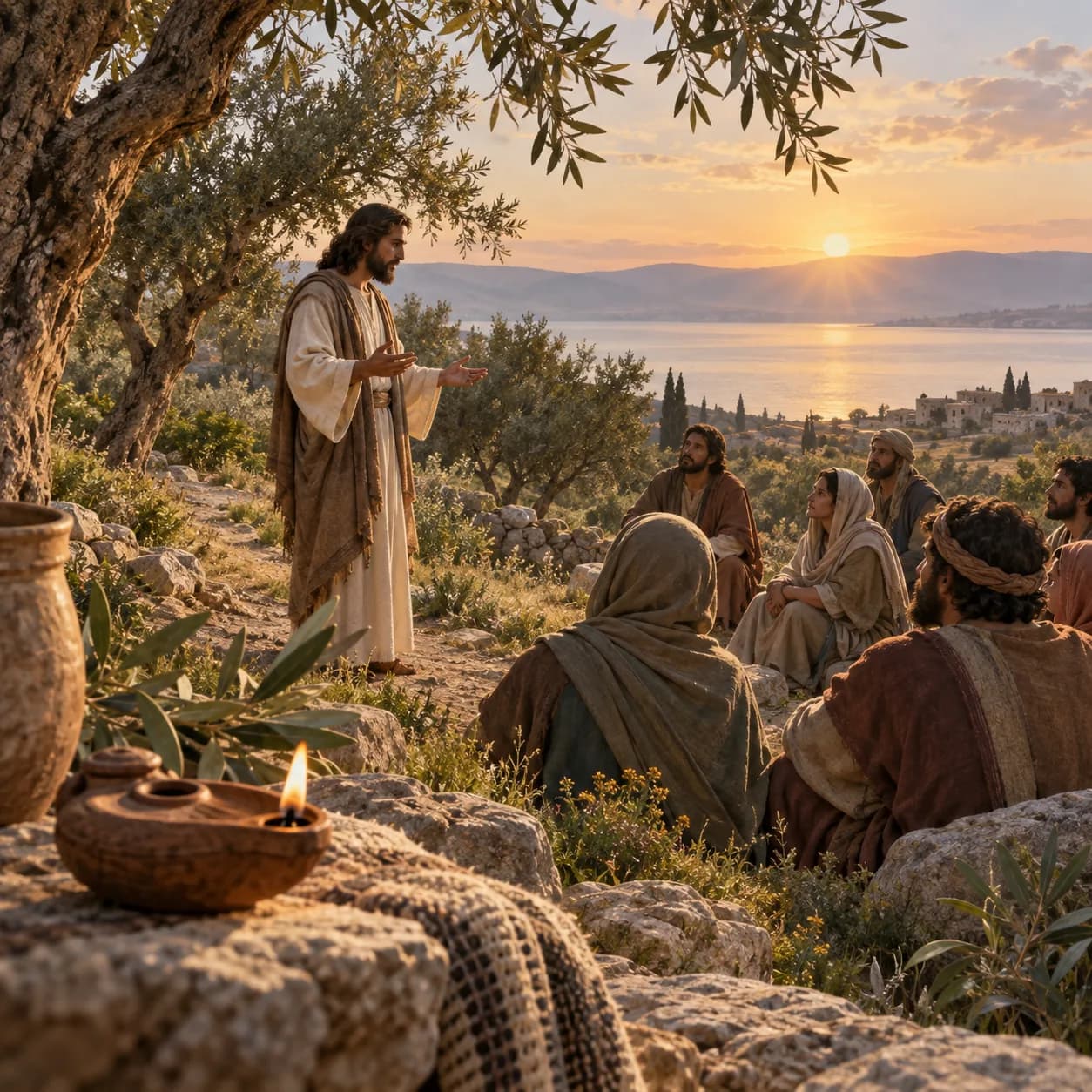
Peter is still talking when the cloud covers them. It's a detail all three Gospels preserve, with small variations, and worth noting before anything else: the disciple proposes building three tents — one for Jesus, one for Moses, one for Elijah — and the answer he gets is not an argument but an abrupt silence imposed by the descending cloud itself. Luke is the most explicit about Peter's state in that instant: he speaks "not knowing what he said" (Luke 9:33). The most luminous scene in the Synoptic Gospels contains, at its center, a man trying to fix into architecture what can only be received as passage.
That tension between fixing and following is the thread running through the transfiguration, and it deserves a careful reading before we ask what it means.
One Mountain, Three Accounts
Mark 9:2–13, Matthew 17:1–13, and Luke 9:28–36 tell essentially the same scene: Jesus goes up a mountain with Peter, James, and John; his appearance is transformed; Moses and Elijah appear beside him; a cloud covers the group; a voice identifies Jesus as the beloved Son and commands the disciples to listen to him. The skeleton is identical in all three accounts, but each evangelist moves that skeleton differently, and these differences are not noise — they are the mark of how each community received and organized the same memory.
Mark describes Jesus's clothes as "dazzling white, such as no launderer on earth could bleach them" (Mark 9:3) — a comparison that works by negation: the human language of manual labor, of bleaching cloth, is invoked only to show its insufficiency. Matthew intensifies the solar image: the face "shone like the sun" and the clothes became "white as light" (Matt 17:2), drawing the scene closer to more direct theophanic vocabulary. Luke is the most sober of the three on this point — he speaks of an altered face and "dazzling" clothes (Luke 9:29), without the hyperbolic comparisons of the other two. But Luke adds something the others omit: Jesus went up the mountain "to pray" (Luke 9:28), and it is during that prayer that the transformation happens. Glory, in Luke, is not an autonomous event — it arises from within the communion between the Son and the Father.
What Moses And Elijah Say
None of the three Gospels leaves Moses and Elijah silent. They appear "in glory" and speak with Jesus (Luke 9:30–31), and only Luke records the subject: they were speaking of the "exodus" Jesus was about to accomplish in Jerusalem. The word chosen is not accidental. Exodos recalls the departure from Egypt, the crossing, the liberation bound up with suffering along the way. By placing that word in the mouths of Moses — the very figure of the first exodus — and Elijah — the prophet of Mount Horeb, taken up in a chariot of fire — Luke ties the scene of glory to the scene of passion still to come. There is no glory on the mountain without Jerusalem on the horizon.
The choice of these two particular figures is not neutral either. Moses carries the weight of the Law and of mediation at Sinai; Elijah carries the weight of the prophets and of the expectation that he would return before the day of the Lord, as later Jewish readings record. Placing them alongside Jesus makes the Law and the Prophets converge in a single figure — without this meaning, on the level of the text, that Jesus replaces them by decree. The narrative prefers to show this centrality rather than declare it: at the scene's end, "they no longer saw anyone but Jesus only" (Mark 9:8). Moses and Elijah disappear. The mountain empties of everyone but one.
The Voice That Does Not Explain, It Commands
At the height of the scene — while Peter is still proposing his tents, according to the most likely reading of the sequence — the cloud covers the group and a voice speaks: "This is my beloved Son; listen to him" (Mark 9:7; close wording in Matt 17:5 and Luke 9:35). It is the second time in the Gospels that a heavenly voice identifies Jesus this way — the first was at the baptism — but now there is an addition that changes the entire register of the scene: it is not enough to recognize who Jesus is. He must be listened to.
That final command is the vanishing point of the whole narrative. The voice does not comment on the light, does not explain Moses and Elijah, does not validate the proposal of the tents. It redirects the three disciples' attention to what comes after — to Jesus's words about the cross, spoken shortly before they went up the mountain and which will keep being spoken on the way to Jerusalem. Visual revelation serves auditory obedience. It's a structural detail: the most visually charged scene in the Gospels ends by telling the disciples to listen, not to look.
What The Cloud Hides, Memory Keeps
The cloud that covers the group (Mark 9:7) is by definition an ambiguous image: it reveals divine presence while simultaneously making it inaccessible to direct sight. It is this double movement — showing by concealing — that characterizes the whole biblical theophany evoked here: mountain, cloud, voice, fear. The biblical mountain is traditionally the place of an encounter that cannot be fully captured; Moses at Sinai had already experienced something like this. The evangelists write the transfiguration using this established symbolic vocabulary, and it is this choice — not an aseptic reporting of the event — that structures the account.
This does not mean the scene is "merely" a symbol with no basis in any experience actually lived by the disciples. The text, in the form that has come down to us, does not allow us to decide with historical certainty between these two possibilities: whether there was an experience the disciples later narrated using the biblical categories available to them, or whether the later community theologically constructed a scene to express a conviction about Jesus it already held by other means. There is no external evidence capable of verifying the reported luminosity, the presence of Moses and Elijah, or the exact content of the voice heard. Any hypothesis about what "really" happened on the physical level — vision, collective dream, misinterpreted natural phenomenon — remains conjecture, because the data that would allow a decision simply are not available. What historical research can affirm with solidity is more modest: the episode was transmitted, in the earliest Christian communities, as an experience of revelation, and its narrative form deliberately uses the biblical motifs of the Sinai theophany.
Where The Scene Is Placed Changes What It Means
None of the three evangelists isolates the transfiguration as a standalone episode. In Mark, it comes right after Peter's confession at Caesarea Philippi and the first prediction of the passion — that moment when Peter rebukes Jesus for speaking of suffering and is called "Satan" for his response. The mountain, then, arrives as a response to a crisis: the disciples have just heard that the Messiah will suffer, and the scene of glory does not cancel that prediction — it confirms the identity of the one who made it. In Matthew, the episode fits into a broader sequence of teaching on authority and discipleship, culminating in the explicit instruction to remain silent "until the Son of Man has risen from the dead" (Matt 17:9) — a phrase that ties the meaning of the vision to the Easter still to come. Without the resurrection, the disciples would have no category for processing what they saw; the command to silence acknowledges this limitation head-on.
Luke's choice to link the scene to Jesus's prayer, already mentioned, completes this picture: glory is not ostentation or an isolated marvel — it arises from the bond between the Son and the Father, and immediately flows into the descent to the valley, where a possessed boy waits whom the other disciples could not heal (Luke 9:37–43). The contrast is deliberate: straight from the summit of the luminous mountain to human powerlessness down below. None of the evangelists leaves the scene suspended in midair.
The Temptation To Stay
I return to Peter and his tents. The proposal is not ridiculous — it is human. Faced with something that surpasses ordinary experience, the impulse to build a shelter, to mark the spot, to make permanent what was given as an instant, is understandable. But the narrative does not validate that impulse: the cloud interrupts Peter mid-sentence, fear silences the three disciples, and when the cloud dissipates, only Jesus remains — no Moses, no Elijah, no proposed tents. The structure of the account teaches, by its very form, that the revelation was not granted to be frozen into a monument.
This refusal has a direct consequence for how the scene should be read today. The transfiguration does not offer a model of religious experience sufficient unto itself — a spiritual peak to be sought and held onto for the pleasure of the peak. What it offers, rather, is a confirmation that only makes sense when it returns the disciples to the road: the voice commands listening, not contemplation; the descent from the mountain is immediate; the valley, with its concrete human need, is already waiting below. A faith that wishes to remain only on the summit has already lost the direction the scene itself points to.
What Is Settled And What Is Not
It is possible to affirm with reasonable confidence that the three accounts preserve a common tradition, shaped in distinct ways by the communities that transmitted it; that this tradition deliberately uses the biblical language of theophany; and that its function, in each of the three Gospels, is to link Jesus's glory to the suffering that is approaching — never to isolate one from the other. It is not possible, with the tools of available historical research, to reconstruct the event at the level of independent verification, nor to decide with absolute certainty between a reading that privileges lived experience and one that privileges later theological elaboration. The text, as it has come down to us, is built exactly in that middle territory: it testifies to something received as real revelation and narrates it with the densest symbolic resources that Israel's biblical tradition had to offer.
The interpretive consequence of this uncertainty is not paralysis but discipline of reading. Whoever takes the transfiguration as literal proof of a photographable event is demanding from the text a precision its own form does not promise to deliver. Whoever reduces it to an empty metaphor, with no grounding in the living conviction of the earliest communities about who Jesus was, ignores the weight the account clearly carries in each of the three Gospels. Between these two simplifications, what remains is the reading the scene itself suggests: a mountain that confirms identity without suspending the journey, a light that serves the cross rather than replacing it, and a voice whose only command, in the end, is that the disciples go down and listen.
Sources Of This Text
Primary basis: Mark 9:2–13; Matthew 17:1–13; Luke 9:28–36. Biblical text. The literary observations refer to the passages indicated; the applications drawn from the Memra are editorial interpretations.
This essay focuses on a comparative reading of the biblical text. It does not present archaeological verification or an independent reconstruction of the episode.
Continue the study in Memra
Read the complete course with progress tracking and connected references.
Open the course