The Coin in the Fish and the Extraordinary Catches
From the series The Bible Is Not Literal, published by Memra.
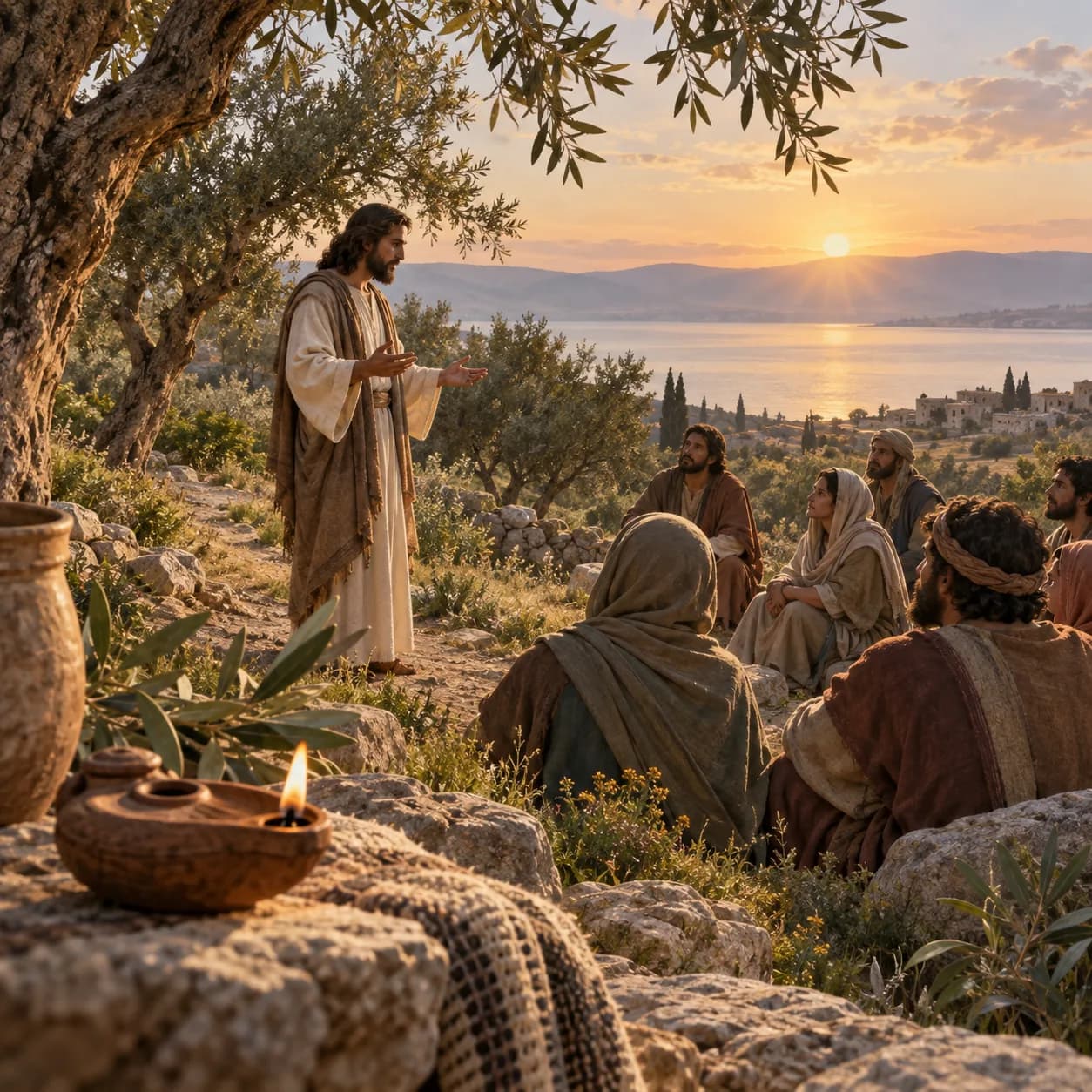
Peter has had the net in his hands all night. Nothing. He has known that lake since childhood, knows where the schools hide, knows when the wind shifts and the fish vanish. He is a tired professional, and the tiredness of someone who has worked in vain is different from any other kind. On this particular dawn, someone who is not a fisherman — an itinerant carpenter who only a little while before had borrowed his boat to preach to the crowd — tells him to go back out to deep water and let down the net again. Peter obeys, grumbling: "having toiled all night, we have taken nothing; nevertheless, at your word, I will let down the net." The line is almost a protest disguised as submission. And then the net fills to the point of tearing.
This scene from Luke 5 is not isolated within the Gospels. Matthew tells of Jesus sending Peter to catch a single fish in order to pull out from it a coin to pay the temple tax. John, after the resurrection, repeats almost the same script: a night of lost labor, an unexpected command, a net that fills without breaking. Three fishing scenes, three distinct moments in Jesus' life with his disciples, and a pattern that keeps insisting on the same question: what happens when the word of Jesus enters into the middle of ordinary work, of household economy, of hunger and a bill that must be paid?
A Coin Inside A Fish
Matthew 17:24–27 is the strangest of the three scenes, and also the most discreet. The temple tax collectors ask Peter whether his teacher pays the tax. Peter answers yes, almost reflexively, and only afterward goes to speak with Jesus. Jesus anticipates the question — "What do you think, Simon? From whom do the kings of the earth collect tolls or taxes? From their sons or from others?" — and draws from it a logic of kinship: the king's own children do not pay tribute to their father. If Jesus is Son, the tax should not fall on him.
But the logic does not end in a claim of right. It ends in a concession: "so that we do not give offense to them, go to the sea and cast a hook, and take the first fish that comes up; and when you open its mouth you will find a shekel; take that and give it to them for me and for yourself." The coin is exactly enough for two — Jesus and Peter. Nothing left over, no windfall, just the precise sum of the obligation. The text does not describe the moment when Peter finds the coin; the narrative ends with the instruction, trusting the reader that the outcome will follow the command. It is too sober a passage to work as a prosperity fable. It resolves a specific problem, in a way that avoids needless conflict with religious authorities, without abandoning the theological principle that precedes it.
What Changes When The Net Fills
Back to Luke. The catch is not the climax of the scene — it is the antechamber to it. As soon as Simon sees the quantity of fish, his reaction is not commercial gratitude but dread: "Depart from me, for I am a sinful man, O Lord." Material abundance triggers a spiritual perception. Peter does not think first of the profit from the catch; he thinks of the distance between who he is and who stands before him. It is this recognition — not the abundance of fish — that Jesus answers: "Do not be afraid; from now on you will be catching men." The whole scene exists in order to arrive at that sentence. The fish are the means, not the end.
There is a detail easy to overlook: Peter calls partners from another boat to help gather the catch, and both boats nearly sink under the weight. The image is comic and dizzying at once — an excess that outstrips the capacity to contain it. Luke uses this exaggeration to prepare the invitation that follows: the four men (Simon, James, John, and, implicitly, the partner Andrew, mentioned in another Gospel) leave everything — boats, nets, the most generous catch of their lives — to follow Jesus. Abundance does not bind them to success; it frees them from it.
The Repetition After Death
John 21 takes up the same narrative skeleton with one difference that changes everything: now Jesus has already died and risen. The disciples, with no apparent direction, go back to what they know how to do — fish. They spend the night with nothing. In the morning, a man on the shore — unidentified at first — tells them to cast the net on the right side of the boat. The catch is so great that the beloved disciple recognizes him before anyone else: "It is the Lord!" Peter, impulsive as ever, throws himself into the water before the boat even arrives.
The narrator records the exact number of fish: one hundred fifty-three, and adds that despite the quantity, the net was not torn. This detail has generated readings that try to decode a precise symbolic value in the number, and others that treat it as the signature of an eyewitness reporting exactly what he saw. The text, on its own, does not settle the question — any closed numerological reading is a hypothesis, not a necessary conclusion of the account.
What the narrative does clearly is shift the center of the scene from the catch to the meal. Jesus already has fish and bread on the coals when the disciples reach the shore; even so, he asks them to bring some of what they caught. Then he himself distributes the bread and the fish to them. In the world in which this Gospel was written, eating together was a gesture of recognition, acceptance, restored communion. John uses this simple — almost domestic — gesture to say something about the nature of the Risen One's presence: it is not merely a fleeting vision or a solemn apparition, it is concrete companionship around a fire and grilled fish.
The differences between the three scenes are real and should not be erased by a desire for easy harmony. Matthew describes no net at all, nor a multitude of fish — only one fish and one coin. Luke places the scene at the beginning of the ministry, as a prelude to calling. John places it at the end, as a seal of reconciliation and a reaffirmation of Peter's mission, who shortly afterward will be questioned three times about his love for Jesus. Trying to fit the three together as if they were the same kind of recurring event, or filling in the details missing from one with the details left over from another, is an interpretive temptation that yields superficial harmony at the cost of each Gospel's individuality.
What the three have in common is not the script but the structure of authority Jesus exercises over mundane material circumstances: a debt to be paid, a lost shift of work, hunger after an exhausting night. In none of the three scenes is the miracle celebrated for its own sake. In Matthew, it avoids an unnecessary scandal without giving up the theological truth about sonship. In Luke, it reveals to Peter his own smallness and calls him to something greater than fishing. In John, it confirms, through a table gesture, that the Risen One remains the one who feeds and gathers.
It is tempting to turn these passages into a prosperity script: obey and abundance will come; trust and debts will be resolved. The text itself resists this reading. Matthew does not promise that every unjust demand will be settled by supernatural means — it narrates a specific case, resolved in a specific way, for a specific theological reason (Jesus' sonship, and by extension, the avoidance of scandal). Luke does not teach that every night of lost work will end in a full net — it narrates the beginning of a calling, not a general principle of productivity. John does not propose a manual for a spirituality of abundance — it narrates a concrete, situated encounter, unrepeatable in its details.
There is, in these passages, no external evidence authenticating the specific coin, the specific fish, or the exact number of fish in John as facts verifiable by means independent of the account itself. This does not invalidate the confession of faith that receives them as testimony: it only marks the limit of what literary reading, by itself, can declare. The uncertainty here is not about whether something extraordinary happened, but about how much of each narrative detail can be treated as factual reportage and how much belongs to the theological shaping each evangelist impresses on the memory he received.
It is worth noting how the three scenes treat Peter's silence differently, and how that silence — or its absence — organizes the meaning of each episode. In Matthew, Peter does not protest, does not question, does not repeat the resistance that marks Luke; he simply receives the instruction, and the account ends before showing its execution, as though obedience there were so self-evident it needed no record. In Luke, by contrast, Peter's verbal resistance is the entry point of the scene: he argues from his own experience before yielding, and it is exactly this order — protest, then obedience, then astonishment — that gives the narrative its rhythm of conversion. In John, there is no protest at all: the beloved disciple identifies the Lord before any word is exchanged about the catch, and Peter reacts with a bodily gesture, throwing himself into the water, that replaces any speech. The progression is revealing: from a silent obedience, we move to a reluctant, verbalized obedience, and arrive at a recognition that dispenses with words because it already operates at the level of immediate recognition. The weight of Peter's voice diminishes as the weight of recognition grows — as though, after the resurrection, the question of who is speaking no longer needs to be asked.
This shift helps explain why the formula "at your word" in Luke 5 carries a tension the other two scenes do not repeat in the same way. Peter does not say "because I trust you" or "because I know you are capable"; he says he will let down the net despite his own experience, on the basis of a word merely heard. It is an obedience that explicitly acknowledges its lack of rational grounding — the fisherman cedes the authority of his technical competence to the authority of a voice that, technically, has no reason to know more about fishing than he does. This surrender is what makes the subsequent astonishment so acute: it is not only the quantity of fish that shakes Peter, it is the discovery that he obeyed against his own certainty, and someone else's certainty proved more reliable than his own. In Matthew, this tension does not even appear, because Jesus' command does not contradict any prior knowledge Peter has about fishing — it is merely strange, not contradictory. In John, the tension has already been resolved before the account even begins: the disciples obey without hesitation because, after the cross and the resurrection, the question of whether to trust the voice speaking from the shore is no longer the same question it was in Luke 5.
This variation in how each evangelist handles Peter's speech and silence is not an accident of composition; it is part of how each text constructs its own understanding of what it means to recognize authority. Matthew is interested in an authority that freely subordinates itself to social convention without losing its theological foundation. Luke narrates an authority that must overcome the resistance of accumulated experience in order to be recognized as such. John presents an authority that no longer requires negotiation, because the identity of the one speaking has already been established by the resurrection — what remains is only the gesture of physical approach, Peter's plunge toward the shore. Reading these nuances side by side avoids both easy harmonization and the reading that treats the three accounts as stylistic variations on the same fact: each evangelist chooses where to place resistance, obedience, and recognition because each is, through these elements, answering a distinct theological question about who Jesus is and what it means to follow him.
The Consequence Of Reading The Three Together
Reading these three scenes side by side, without fusing them, teaches something about the place of material provision in Christian experience: it is never the endpoint of the narrative. The coin pays the tax, but the text underscores the sonship behind the gesture. The abundant catch fills the net, but what Luke preserves as most precious is Peter's reverent fear and the calling born from it. The one hundred fifty-three fish reach the shore intact, but the Gospel hurries on to the fire, the broken bread, the silent recognition that it was the Lord there all along.
This shifts the question one normally brings to these texts. Instead of asking "does this guarantee my debts will be paid" or "does this promise my work will be rewarded," perhaps the question most faithful to the very movement of the three narratives is another one: when provision arrives unexpectedly, does it serve only to resolve a lack, or does it also become an occasion to recognize who was, all along, at the center of the scene?
Sources Of This Text
Primary basis: Matthew 17:24–27; Luke 5:1–11; John 21:1–14. Biblical text. The literary observations refer to the passages indicated; the Memra applications are editorial interpretations.
This essay focuses on a comparative reading of the biblical text. It does not present archaeological proof or an independent reconstruction of the episode.
Continue the study in Memra
Read the complete course with progress tracking and connected references.
Open the course