The Calmed Sea and Jesus Walking on the Water
From the series The Bible Is Not Literal, published by Memra.
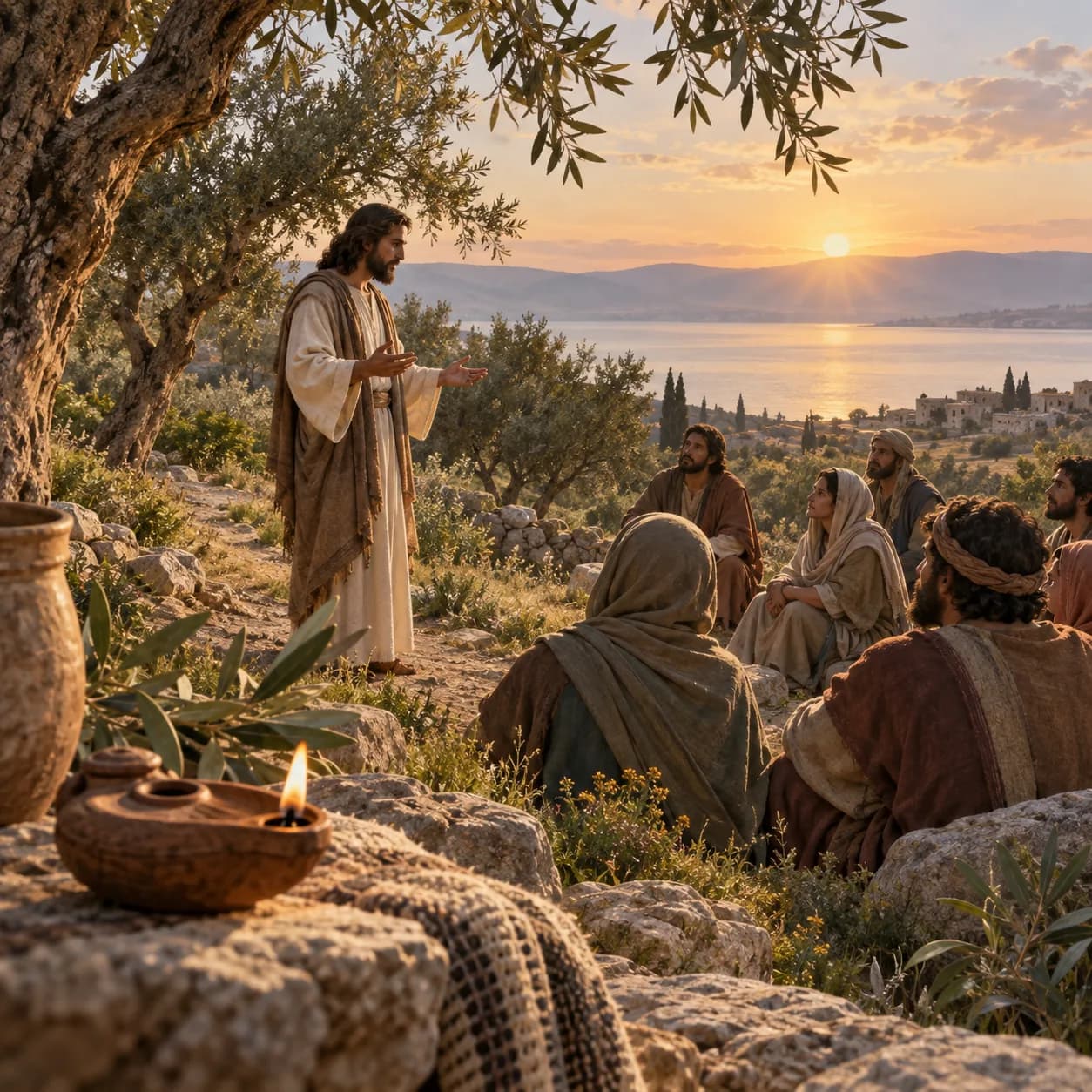
It is night, the wind is blowing against the oars, and Jesus is far away — on the mountain, praying. The disciples, men who have known that lake since childhood, are rowing without making headway. It is on this detail, almost administrative in tone, that Mark focuses the scene: "he saw them straining at the oars, for the wind was against them" (Mark 6:48). No one is dying. No one is screaming. There is only the exhaustion of people fighting against something that will not give way. And it is exactly at this point — not at the peak of despair, but in the middle of an exhausting effort — that a figure approaches, walking on the water.
This scene, and its more dramatic sibling in Mark 4, where a real storm threatens to sink the boat, form a small diptych in the New Testament. It is not the same story told twice: it is the same question — who is Jesus in the face of the sea — answered by two distinct episodes, each with its own narrative purpose.
Two Scenes, Not One
It is worth beginning by separating what popular tradition often fuses together. In Mark 4:35–41, Jesus is in the boat, asleep on a cushion while a storm rises. The disciples wake him, terrified: "Teacher, don't you care that we are perishing?" (Mark 4:38). He rises, rebukes the wind, says to the sea, "Peace! Be still!" and "the wind ceased, and there was a great calm" (Mark 4:39). The scene ends with a question, not an answer: "Who then is this, that even the wind and the sea obey him?" (Mark 4:41).
In Mark 6:45–52 — and in its parallel versions in Matthew 14:22–33 and John 6:16–21 — there is no storm threatening shipwreck. There is a contrary wind, night, distance, and a Jesus who walks on the water toward the boat. The strangest detail in the scene is in Mark 6:48: the narrator says Jesus "meant to pass by them" — as if, for a moment, he were not going toward the disciples but simply crossing their path. The disciples, seeing him, think he is a ghost and cry out in terror. It is at this moment that the central line comes: "Take heart! It is I. Do not be afraid!" (Mark 6:50).
Two scenes, two rhythms, two different threats — the sudden chaos of a storm and the prolonged fatigue of a nighttime crossing against the wind. Treating them as a single episode impoverishes both.
The Sleep That Defies The Storm
Mark builds the storm scene around a deliberate contrast: chaos outside, sleep inside. Jesus sleeps "on the cushion" — a domestic detail, almost incongruous, planted in the middle of everyone else's panic. The image works as a silent indictment of the disciples' fear: they row, they cry out, they fear perishing, while the one they have come to wake remains in absolute repose. Jesus' sleep is not indifference; it is the narrative mark of an authority not yet revealed to their eyes.
When he finally acts, the verb chosen is one of rebuke — the same word used elsewhere in Mark to describe the command given to hostile spirits. The sea, here, is treated almost as an adversary to be silenced, not as a phenomenon to be explained. This choice of vocabulary is no accident: it connects the scene to a broader biblical tradition in which waters figure as a symbol of primordial threat — the deep of Genesis 1, the turbulent waters of Psalms 74 and 89, the rhetorical question of Job 38 about who shut the sea behind doors. Mark's text does not need to explain these echoes for a reader familiar with Scripture to notice them.
The final question — "who is this?" — receives no answer within the episode itself. It hangs in the air, like a note that will only be resolved as the Gospel moves forward.
"IT IS I": A PHRASE THAT CARRIES MORE WEIGHT THAN IT SEEMS
In Mark 6:50, the Greek formula behind "it is I" is ἐγώ εἰμι. In ordinary Greek, this expression works exactly as it sounds in English: a simple identification, "it is I, not a ghost." The immediate context fully supports this ordinary reading — the disciples are terrified, they think they see an apparition, and Jesus reassures them by saying who he is.
At the same time, the same formula appears elsewhere in the New Testament with denser theological resonances, and the setting in which it is spoken here — on the water, at night, before men gripped by fear — contributes to a sense, for the attentive reader, of a weight that goes beyond mere personal identification. The text does not require this heavier reading, but it does not rule it out either. This is one of those points where ambiguity is not a flaw in composition but an opening of meaning.
Something similar occurs with the phrase "meant to pass by them" (Mark 6:48). For some readers, this is simply a narrative device describing the trajectory of Jesus' approach. For others, the phrase evokes the theophanies of the Old Testament, in which the divine "passes by" someone as a form of revelation — Moses in the cleft of the rock, Elijah at the mouth of the cave. Neither reading is imposed exclusively by the Greek text; the choice depends on how much weight the interpreter gives to the Old Testament background that Mark seems to presuppose elsewhere in his Gospel.
Peter And The Gaze That Wavers
Matthew receives Mark's tradition and adds an element that shifts the scene's dramatic center: Peter asks to walk out to Jesus. "Command me to come to you on the water" (Matt 14:28). Jesus simply says, "Come." Peter steps out of the boat, walks — and then begins to sink.
The text is precise about the reason: "seeing the wind, he was afraid, and beginning to sink, cried out, 'Lord, save me!'" (Matt 14:30). It is not that the wind's force changes from one instant to the next — it had already been blowing. What changes is the object of Peter's gaze. While he fixed his eyes on Jesus, he walked on something impossible; when he noticed the conditions around him, he sank. Matthew is not teaching a technique of spiritual concentration; he is dramatizing, with remarkable economy, the distance between faith as relational trust and faith as personal feat. Peter is not rescued because he regains courage on his own — "Jesus immediately reached out his hand and caught him" (Matt 14:31). The scene ends not with praise for Peter's perseverance but with a question that sounds almost like a gentle rebuke: "Why did you doubt?"
The episode culminates in the most explicit confession of the four narratives: those in the boat worship Jesus and say, "Truly you are the Son of God" (Matt 14:33). Matthew closes what Mark had left suspended.
The Hardened Heart
Mark, however, does not let his readers leave the scene with an easy sense of triumph. After Jesus gets into the boat and the wind ceases, the narrator adds an unsettling observation: the disciples "were utterly astounded" and had not understood about the loaves, "but their hearts were hardened" (Mark 6:51–52). It is an almost severe note, with no direct parallel in the other versions, and it reveals something important about Mark's style: he resists turning his characters into models of understanding. The disciples see the wonder, but they do not decipher it. Fear before the sea is not merely physical; it is a symptom of a deeper blindness about who Jesus is.
This note prevents the passage from being read as a formula of faith rewarded. The miracle happens, and understanding still does not automatically follow the astonishment.
John: The Crossing That Shortens Itself
John's version is the most economical of the four. There is no extended dialogue, no episode with Peter, no narratorial comment on the disciples' understanding. They row, the sea grows rough, Jesus approaches walking on the water, says "it is I, do not be afraid," they want to take him into the boat — and then, in an almost abrupt sentence, "immediately the boat was at the land to which they were going" (John 6:21). John does not explain the mechanics of this swift arrival; he simply records it and moves on.
This compression is consistent with the style of the fourth Gospel, which tends to draw from each sign a direct christological statement, without lingering over dramatic development. Here, what matters is not the journey but the effect of Jesus' presence upon it: with him aboard, the distance that seemed hostile suddenly becomes passable.
What The Text Allows Us To Say, And What It Does Not
The four narratives show, with textual certainty, that the early Christian tradition preserved and transmitted, in distinct forms, episodes about Jesus exercising authority over the sea and over the disciples' fear. Comparing Mark, Matthew, and John reveals a common core received in different ways — each evangelist emphasizing his own aspects: Mark, the open question and the disciples' blindness; Matthew, Peter's personal drama and the final confession; John, the presence that shortens the crossing. This is a solid literary fact, available to any reader who sets the texts side by side.
What the available evidence does not allow is reconstructing the exact physical mechanism of the episode — whether to confirm it in strictly factual terms or to dissolve it into naturalistic explanations such as sandbars, optical illusions, or coincidences of light and fog. These hypotheses can be discussed in theory, but none of them is supported by the textual material we have. Nor does the presence of dense theological language authorize the conclusion that this is conscious literary invention: ancient texts frequently blend memory, interpretation, and confession of faith without this implying deliberate fabrication.
The historically responsible position is to admit a gap between the event and its narrative formulation. The Gospels do not function as neutral transcription; they are testimonies of communities of faith, shaped to communicate who Jesus is, not merely what happened physically on the water.
What Changes When The Question Changes
There are three typical ways of reading these passages: as a factual account of supernatural intervention, as a symbolic construction about Jesus' mastery over chaos, or as a combination of the two — a real memory of an episode, elaborated through strong literary and theological work by each evangelist. This third path best explains why Mark, Matthew, and John, drawing on the same tradition, produced such different emphases: if there were only a single factual report being copied, it would be strange for each author to choose to emphasize such distinct aspects — the suspended question, Peter's drama, the shortened arrival.
This reading does not force a choice between "it was symbol" and "it was fact." The sea remains real water, the wind real, the night real — the disciples are not spared from entering into it. But the narrative insists that this concrete chaos does not have the final word. What is interesting is that none of the four versions promises that every storm will cease for those who believe enough; Mark himself, with his note on hardened hearts, resists that kind of simplification. What the passages sustain is something more modest and, for that very reason, more lasting: that fear in the face of what threatens to swallow us is not the last word on the situation, because the question that truly matters is not whether the crossing will be easy, but who is present within it.
Sources Of This Text
Primary basis: Mark 4:35–41; 6:45–52; Matthew 14:22–33; John 6:16–21. Biblical text. The literary observations refer to the passages indicated; the applications drawn are editorial interpretations.
This essay focuses on the comparative reading of the biblical text. It does not offer archaeological proof or an independent reconstruction of the episode.
Continue the study in Memra
Read the complete course with progress tracking and connected references.
Open the course