Loaves and Fish: Abundance and Sharing
From the series The Bible Is Not Literal, published by Memra.
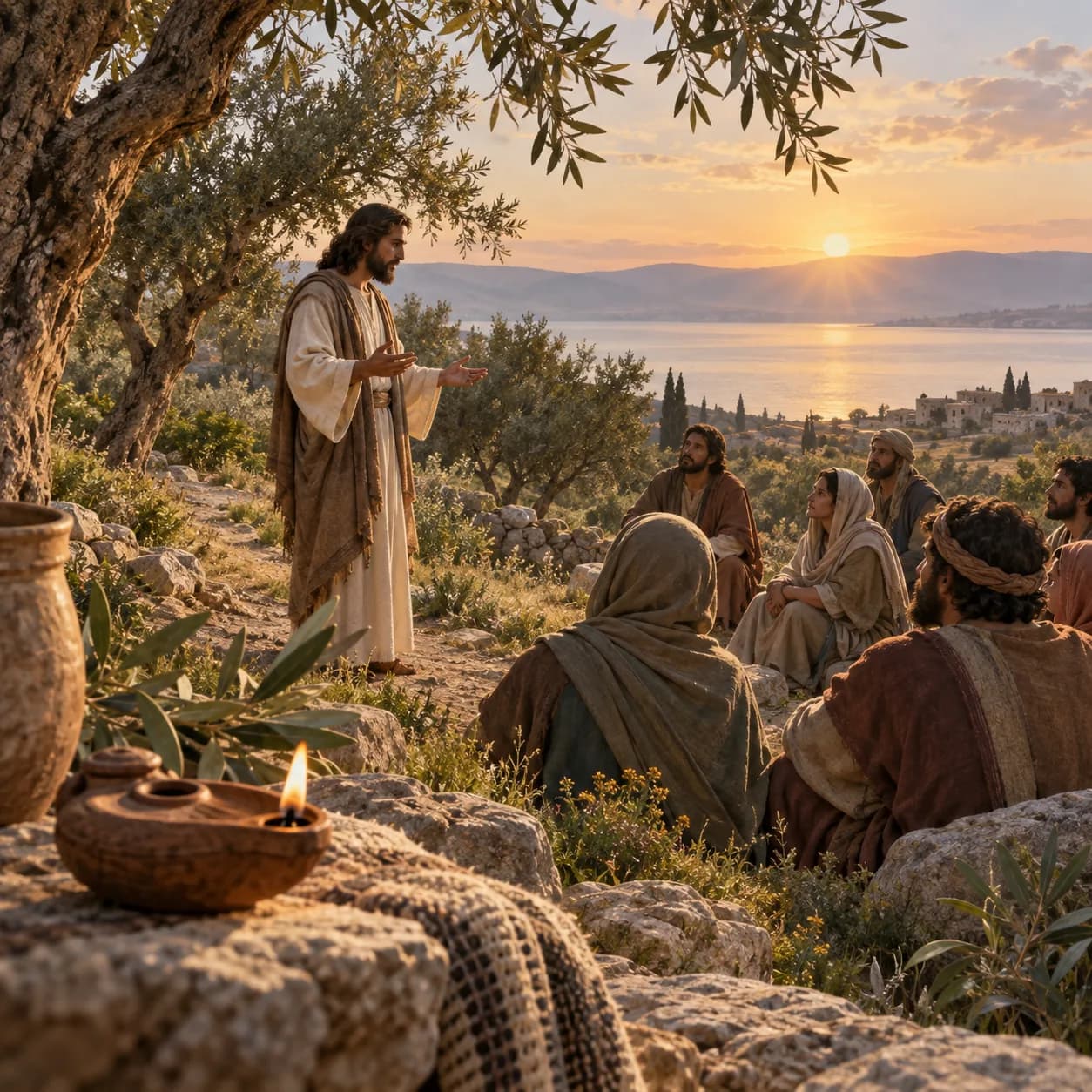
The boy doesn't even speak. John mentions him in passing — a lad with five barley loaves and two fish, spotted by Andrew in the middle of the crowd like someone who notices an irrelevant detail before admitting its irrelevance: "but what are they among so many?" (John 6:9). The question goes unanswered directly. Jesus doesn't refute it with an argument; he tells the people to sit down. The food arrives through the hands of someone with no power to solve anything at all, and it is exactly there that the narrative deposits its greatest tension: between what is available and what is needed, between five barley loaves — the bread of the poor, not the wheat of the well-off — and five thousand men, not counting women and children.
The Repetition That Is No Accident
Mark tells the story twice, and this duplication is usually treated as an editorial problem to be solved. It is worth resisting that temptation and reading the two scenes as the evangelist left them: side by side, with different numbers and the same outcome. In Mark 6:30–44, five loaves and two fish feed five thousand, with twelve baskets left over. In Mark 8:1–10, seven loaves and a few fish feed four thousand, with seven baskets left over. Shortly afterward, in chapter 8, Jesus rebukes the disciples for having forgotten both multiplications when they argue, in the boat, about the lack of bread (Mark 8:14–21). "Having eyes, do you not see? And having ears, do you not hear? And do you not remember?" The repetition of the hunger, then, is not a lapse of memory on the narrator's part — it is precisely the point that the disciples, within the story, cannot retain. Mark uses the duplication to expose the slowness of those who saw the miracle twice and still go back to calculating in terms of scarcity.
The Gesture That Runs Through All Four Scenes
In Mark 6:41, the sequence is precise: Jesus takes the loaves, looks up to heaven, blesses, breaks the loaves, and gives them to the disciples to distribute. The same verb — to break — reappears at the Last Supper (Mark 14:22) and on the road to Emmaus, where the two disciples recognize Jesus only "in the breaking of the bread" (Luke 24:35). One need not force a retroactive eucharistic reading onto the feeding of the crowd to notice that the evangelists wrote these scenes with shared vocabulary. The meal in the wilderness and the meal on the eve of the cross use the same movement of hands: take, bless, break, give. A reader in the early church, who was already celebrating the supper by the time the Gospels were written, would have had a hard time hearing these words without an echo.
In 2 Kings 4:42–44, the gesture is drier, without ceremony: a man brings twenty loaves of barley and fresh grain to Elisha; the servant objects that this will not be enough for a hundred men; Elisha responds with a command and a promise — "they shall eat, and have some left" — and the text closes with the simple statement that it happened just so, "according to the word of the LORD." There is no blessing pronounced over the bread, no crowd seated in groups, no leftovers counted in baskets. The scene is a quick sketch of the same pattern the Gospels develop with more narrative breadth: someone brings the little they have, someone doubts it will be enough, the word of the man of God reorders the expectation.
The Hunger That Discourse Does Not Resolve
John alone carries the scene forward after the meal. In John 6:14–15, the crowd recognizes Jesus as "the prophet who is to come into the world" and tries to make him king by force; Jesus, perceiving this, withdraws alone to the mountain. The sign of the bread produces an enthusiasm that Jesus refuses to manage politically. It is a detail that changes the meaning of everything that came before: feeding the crowd was not a gesture meant to win followers, because the instant the crowd wants to turn him into the leader of a project of power, he disappears. The chapter continues the next day, with the same crowd crossing the sea after him (John 6:22–25), and Jesus confronts them without hedging: "you seek me... because you ate of the loaves and were filled" (John 6:26). The material hunger has been satisfied; the hunger that interests John has yet to be recognized, and it is from there that the long discourse on the bread that comes down from heaven is born.
What Lies Beyond The Text's Reach
The four accounts describe the result, not the mechanism. Mark, John, and the author of 2 Kings record the before — little bread, many people, explicit doubt about sufficiency — and the after — everyone satisfied, leftovers gathered. The interval between the two is not narrated. This holds against the reading that tries to reconstruct a "physics" of the miracle just as much as against the reading that tries to reduce it to a social mechanism of spontaneous sharing: neither is in the text. The hypothesis that the crowd simply shared hidden provisions is a plausible reconstruction as a moral exercise on generosity, but it is not what Mark, John, or 2 Kings state, and the insistence of all three texts on the counted leftovers — twelve baskets, seven baskets, the surplus in 2 Kings — makes that hypothesis hard to sustain as an explanation of the account itself. The text wants the reader to notice the excess, not merely the sufficiency.
What Comparing The Four Texts Allows Us To Say
The presence of the same narrative pattern in 2 Kings 4 and in the Gospels shows that Israel's tradition already contained this grammar — little bread, an objection of insufficiency, a word that reorders expectation, confirmed leftovers — before it was applied to Jesus. This allows us to say that the evangelists, in narrating the multiplication, wrote deliberately within that memory, presenting Jesus as one who does what Elisha did, and more. It also allows us to say that the early church considered this episode important enough to preserve it in distinct versions, each with its own emphasis: Mark using the duplication to expose the disciples' deafness, John extending the sign into a discourse on identity. What cannot be extracted from these four passages is a reconstruction of the event outside the frame in which it was transmitted — the material available is testimony already interpreted, not a neutral record prior to interpretation.
It is worth noting exactly who occupies each role within John's scene, because the text distributes the parts with a care that a hasty reading tends to flatten. Andrew does not bring the bread; he brings the news that the bread exists, along with doubt about its usefulness. The boy is not presented as an agent of the story — he does not approach Jesus, does not offer anything directly — he is found, as one is found by chance in the middle of a crowd that is already discussing the problem in terms of impossibility. Philip, a few verses earlier, has already calculated the cost in money and declared the task unworkable (John 6:7). The scene thus gathers three adult voices of calculation and insufficiency — Philip with the budget, Andrew with the inventory, the implicit crowd with its hunger — and, in the midst of them, a figure with no voice of his own, whose only role is to possess, without knowing what to do with it, exactly what is missing to be offered.
This arrangement of characters illuminates why the text does not need to explain the mechanism of the multiplication to make its point: the tension of the scene lies not between material scarcity and abundance, but between two ways of dealing with the little that is available. Philip and Andrew represent the same gesture, though with different tools — budget and inventory — the gesture of measuring the problem before acting on it. The boy measures nothing; he is simply available to be found with what he has. It is this contrast, and not the ratio between loaves and mouths, that the narrative builds with the most deliberation. Jesus does not correct Philip's arithmetic or Andrew's objection — he ignores it as an irrelevant category, which is different from refuting it. He has the people sit down before there is any visible sign that the loaves will suffice, inverting the logical order the disciples assume: first sufficiency is confirmed, then the distribution is organized. In the account, the order is reversed — the distribution is organized, and only afterward is the sufficiency revealed.
This inversion of order is perhaps the most underappreciated detail of the episode, because it shifts the story's center of gravity away from the question "where did so much bread come from" — a question none of the four texts answers — and repositions it over the question "why did Jesus act as though sufficiency already existed before any evidence of it." Seating five thousand people in groups, as Mark details with almost administrative precision (Mark 6:39–40), is the gesture of someone who has already decided the meal will happen, not of someone testing whether it will work out. The voiceless boy, found by Andrew as one stumbles upon a minor detail, ends up being the only element in the scene that does not calculate, does not object, does not assess — and it is precisely around this absence of calculation that the narrative builds its contrast with every other character present.
The Question The Text Leaves Open For The Reader
Returning to the boy in John 6 helps bring the journey to a close. He enters the scene with no heroic intention; he is simply there with what he had. The account does not praise his generosity nor explain how five loaves became sufficient for thousands — it only records that, from the little offered, no one went hungry, and more was left over than there had been at the start. The question running through the four passages is not how much bread is needed, but what happens when someone places the little they have into the hands of one who blesses before breaking. Mark uses this question to call the disciples to a memory they insist on losing; John uses it to separate those who seek the bread from those who seek the one who gives it; 2 Kings uses it to show that this logic already belonged to Israel's faith before it belonged to the church. Reading the four texts side by side does not resolve the "how" of the multiplication — and that is not the question they put to the reader.
Sources Of This Text
Primary basis: Mark 6:30–44; 8:1–10; John 6:1–15; 2 Kings 4:42–44. Biblical text. The literary observations refer to the passages indicated; the applications of the Memra are editorial interpretations.
This essay focuses on a comparative reading of the biblical text. It does not offer archaeological proof or an independent reconstruction of the episode.
Continue the study in Memra
Read the complete course with progress tracking and connected references.
Open the course