Cana: Water Turned into Wine
From the series The Bible Is Not Literal, published by Memra.
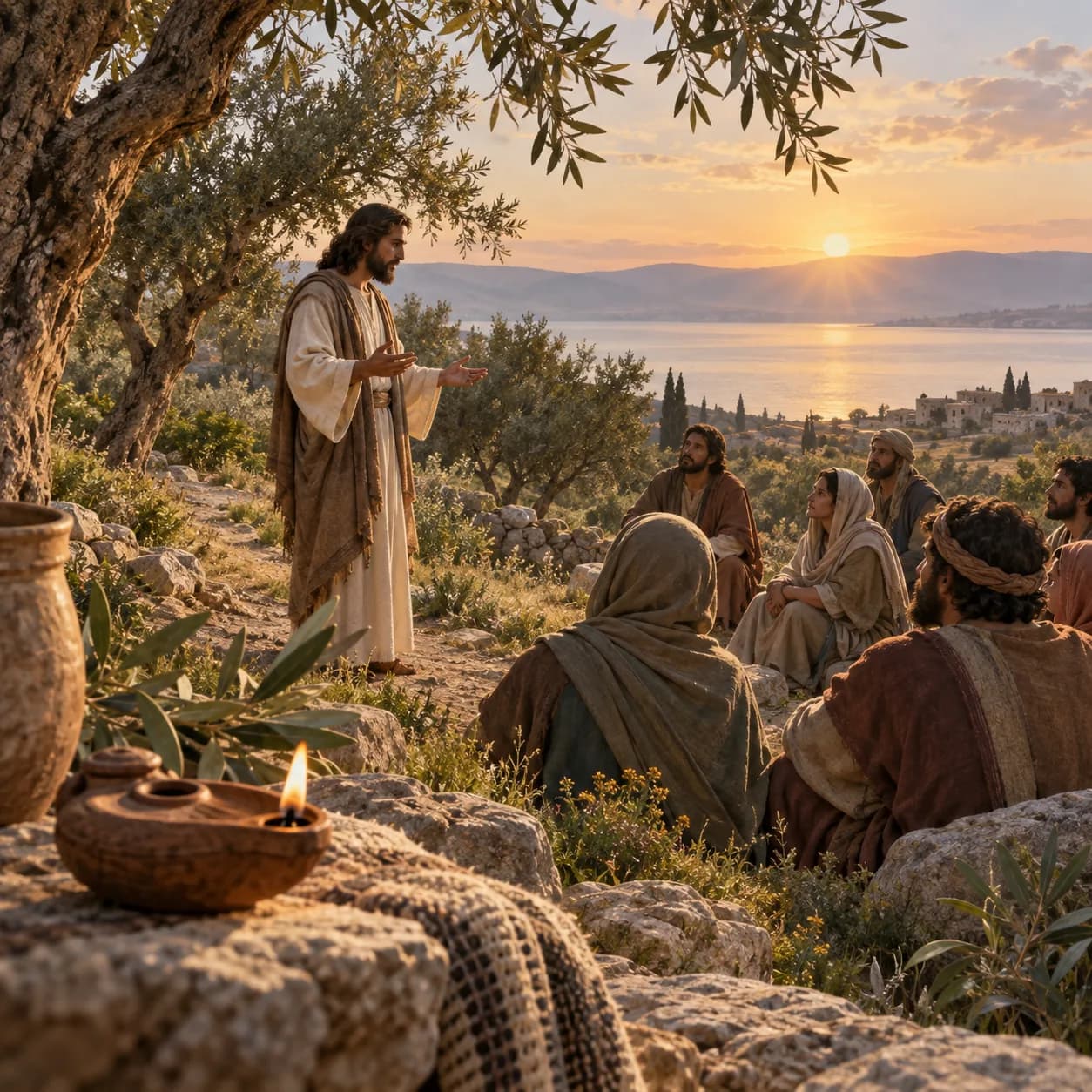
The celebration is about to go under — literally in reverse. In a Galilean village, a wedding gathers relatives, neighbors, and onlookers for days, and in the middle of the festivities the worst thing that can happen does happen: the wine runs out. This is no minor mishap. In a culture where honor and shame weigh more heavily than any modern embarrassment, a shortage of wine threatens to ruin an entire family's reputation before the whole community. It is at this moment of social risk, not in a temple or before a great crowd, that the fourth Gospel chooses to place the first public act of Jesus.
John 2:1–11 is spare and yet dense. A mother notices the problem. A son answers with a phrase that sounds almost harsh. Servants obey without understanding. A master of ceremonies tastes something astonishing without knowing where it came from. And in the end, a narrator declares that here began the signs of Jesus, that here his glory was revealed, and that here the disciples came to believe in him. Between the lack of wine and the disciples' faith, the text traces a path worth following slowly.
The Lack That Sets The Story In Motion
"They have no wine" (John 2:3). The words are Mary's, and they are all she says about the problem — she does not ask, does not suggest a solution, merely reports the shortage to Jesus. It is the gesture of someone who already knows her son well enough to trust that the information alone will suffice. His answer, however, cuts off any expectation of immediate action: "Woman, what does this have to do with me? My hour has not yet come" (John 2:4).
It is hard not to stumble over this reply. In translation it can sound almost rude; within the whole of the Gospel, though, it serves a precise function. "Woman" is not a term of contempt — Jesus will use it again, solemnly, when addressing Mary from the cross. What the phrase establishes is distance: between Mary's request and Jesus's action there is no straight line of cause and effect. He does not act because his mother asked; he acts according to a timing determined by no one but himself. And that timing has a name in John's Gospel: "hour." Throughout the book, the expression always points toward the culminating moment of Jesus's revelation — his handing-over, his death, his glorification. At Cana, that hour "has not yet come." The sign about to happen, then, is not the climax of the story but an early flash of it.
Mary does not argue with the answer. She turns to the servants and says the only thing the narrative allows her: "Do whatever he tells you" (John 2:5). It is a hinge sentence: it closes the exchange between mother and son and opens the action between Jesus and the servants. The tension of the apparent refusal is not resolved by explanation but by obedience. The reader is left not knowing exactly why Jesus changes course — or whether he does at all — only that from this point something is set in motion.
Six Stone Jars
The technical setting of the miracle deserves attention, because John describes it with unusual precision for a Gospel that is generally spare with detail. There were "six stone water jars, for the Jewish rites of purification, each holding twenty or thirty gallons" (John 2:6). Stone vessels used for purification rites were a common part of the religious furnishings of Judaism in this period — stone, unlike pottery, was not thought to retain ritual impurity, which made such vessels especially suitable for this purpose.
Jesus tells the servants to fill them with water — "up to the brim" (John 2:7), the text notes, as if to leave no room for doubt about the quantity or suspicion of fraud. Then he tells them to draw some out and take it to the headwaiter. There is no formula, no ritual gesture, no word of power spoken over the water. The transformation happens offstage in the narrative, somewhere between verses 7 and 8, without the text describing the exact moment the water becomes wine. John narrates the before and the after; the instant of change remains out of frame.
The headwaiter tastes the liquid without knowing its origin — "he did not know where it came from, although the servants who had drawn the water knew" (John 2:9) — and reacts with genuine surprise: he calls the bridegroom and remarks that custom dictates serving the good wine first, and only later, once the guests can no longer tell the difference, the inferior vintage; "but you have kept the good wine until now" (John 2:10). It is a comment on banquet etiquette that becomes, in the economy of the narrative, a theological judgment: what comes through Jesus reverses the expected order of things. It is not merely sufficient — it is better than anyone had reason to expect, and it arrives at the moment when no one had reason to expect it any longer.
As for the purification jars turned into a source of festive wine, the text offers no explicit interpretive key. Nothing in the passage rejects Jewish practices of ritual purity — it would be a misreading to draw from it a condemnation of Judaism, as hasty and at times hostile readings have sometimes done, ignoring the Jewish tradition to which Jesus himself belonged. What the account suggests, without stating it, is a kind of displacement: instruments tied to one form of purification come, in Jesus's hands, to serve a celebration of abundance. The narrative invites a symbolic reading but does not impose one as a closed verdict.
A Graded Scale Of Knowing
One of the most interesting features of the scene is how unevenly it distributes knowledge among the characters. Mary knows about the shortage but not what will happen. The servants know exactly what they did — filled the jars, drew out the water, carried it to the headwaiter — but the text does not say whether they understood what they witnessed. The headwaiter tastes the result with no idea of its source, and his praise, addressed to the bridegroom, is unintentionally ironic: he credits a man with an achievement that is not his. Only in the scene's final verse does anyone interpret what has happened at its full depth: "Jesus did this, the first of his signs, in Cana of Galilee, and manifested his glory; and his disciples believed in him" (John 2:11).
This distribution of perception is not accidental. It marks how the fourth Gospel typically narrates encounters with Jesus: the same event can be witnessed by several people at several levels of comprehension, and only some — those already following him, those who had already heard John the Baptist's testimony, those who had already decided to stay — come to read the event as a sign. Seeing does not automatically amount to believing; but for the disciples, seeing became the trigger for a faith already being shaped by words and by an earlier call, narrated in the Gospel's previous chapter.
What The Text Allows Us To Say, And What Remains Open
On the literary and theological level, there is relative certainty: John presents this episode as the first in a series of signs that structure the first half of his Gospel, and he explicitly interprets it as a manifestation of Jesus's glory and as the origin of the disciples' faith. This is the reading the text offers of itself, without ambiguity.
On the historical level, the available material allows us to say that the scene is socially plausible — extended wedding celebrations, the figure of a headwaiter responsible for the order of the banquet, the risk of public shame over a shortage of provisions, the use of stone jars tied to ritual purification: all of this fits what is known of the Jewish milieu of the period. But social plausibility is not the same as confirmation of the supernatural event reported. There is no independent external record in the available material that confirms the transformation of water into wine the way one would confirm a historical fact through cross-documentation. This is a boundary that must be maintained honestly: the Gospel bears witness to and interprets an event; it does not submit, nor does it claim to submit, to the kind of verification modern historiography demands of a factual report.
Between these two edges — the textual certainty of what John affirms and the impossibility of external proof of the miracle — different readings open up, and none of them is settled by decisive evidence. Some read the account as the record of a historical supernatural event, with no additional symbolic mediation. Others read it as essentially a theological composition, in which John's concern is not factual but catechetical — to communicate, through a vivid scene, the abundance the Messiah brings. And there is a third way, more faithful to the texture of the Johannine text itself, which refuses to separate event and meaning too sharply: for John, the sign is precisely that which is real and, at the same time, points beyond itself. This third reading does not resolve the external historical question, but it better respects the way the Gospel articulates its own categories.
A Glory Without Spectacle
What stands out, on rereading the whole, is the discretion of the miracle. There is no public announcement, no theatrical gesture before the crowd, not even the record of a word of power spoken over the water. The bridegroom receives credit for a wine he did not produce; the guests, as far as we can tell, carry on with the celebration without knowing they have witnessed something extraordinary. The glory of Jesus, the first time the fourth Gospel shows it in action, operates by protecting someone else's honor and averting public embarrassment — not by building his own reputation.
This has consequences for how one reads the rest of the sequence of signs in John, and for how one thinks about Christian action in the face of concrete needs. The first sign does not happen in a religious confrontation or a display of power; it happens within a celebration threatened with failure, resolving a lack before it becomes public shame. It is not a model of automatic prosperity — the qualification about the "hour" that has not yet come rules out any triumphalist reading, reminding us that this same Gospel moves, without detour, toward the cross. But it is, at least, a hint of where John's Gospel decides to begin: not with a display of power, but with quiet attention to a lack that no one but one watchful mother had named aloud.
Sources Of This Text
Primary source: John 2:1–11. Biblical text. The literary observations refer to the passages indicated; the Memra applications are editorial interpretations.
42 · USCCB · NABRE | John 2: text and notes | https://bible.usccb.org/bible/john/2 | — The sign at Cana, abundance, and the theological arrangement of the narrative.
Continue the study in Memra
Read the complete course with progress tracking and connected references.
Open the course