Exorcisms: The Person Beyond the Possession
From the series The Bible Is Not Literal, published by Memra.
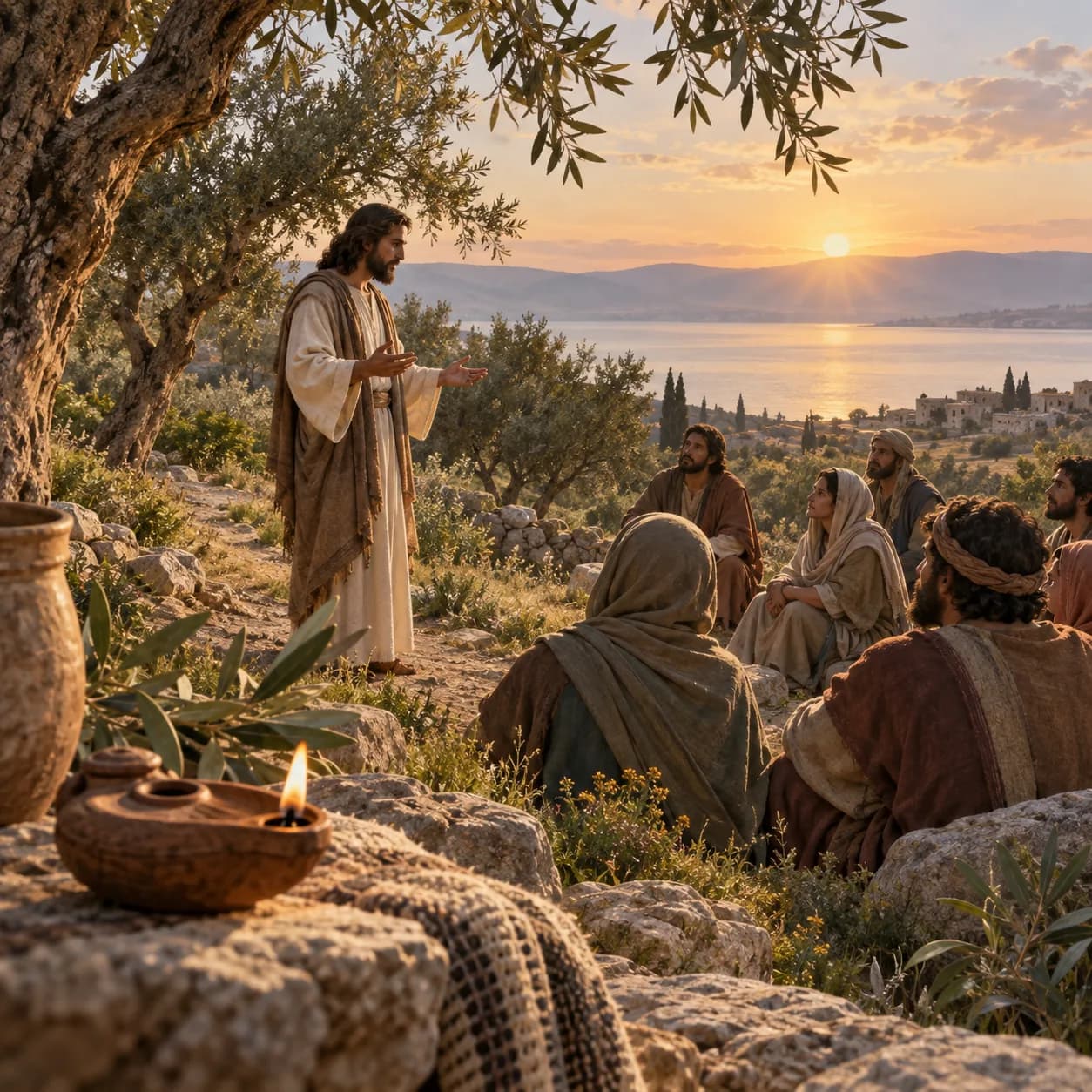
He lives among the tombs because there is nowhere else for him to go. The town has houses, public squares, perhaps a synagogue; he has stones and bones. They had already tried to bind him — Mark insists on this, "often" — and he broke the shackles, tore apart the chains, and no one had the strength left to subdue him. Night and day he cries out on the hillsides and cuts himself with stones. This is the figure who runs to meet Jesus the moment the boat touches shore. He does not flee. He runs toward him.
That detail alone unsettles any hasty reading. Before any word of exorcism, before any formula, there is a man approaching someone capable of seeing him as he can no longer see himself.
The Name That Is A Crowd
Jesus asks his name, and the answer comes out strange: "My name is Legion, for we are many." Notice the grammatical wobble — "my name," "we are many" — as if the boundary between a single self and a multitude had already collapsed long ago. This may be the most precise image the Gospels offer of what it means to lose oneself: not the absence of identity, but its occupation by many voices speaking in the name of one person.
The word "legion" belongs to the vocabulary of the Roman military — a legion numbered in the thousands. Some see in this a veiled political critique, an allusion to the imperial power that occupies territories and bodies. The reading is suggestive and consistent with Mark's interest in the tensions between the kingdom Jesus proclaims and the powers that organize the known world. But the text does not close off this interpretation as the only one; it asserts with confidence only that the force subjugating the man is numerous, organized, and capable of negotiating — it asks not to be sent out of the region, then asks to enter the pigs. There is something remarkable in this negotiation: what once dominated without limit now begs for permission. The scene inverts the power dynamic even before any visible healing occurs.
The Herd And What It Costs
The pigs rushed into the sea and drowned — about two thousand, the text says. This is the only moment in the episode where Mark offers a number, and it does not serve to magnify the miracle but to measure the scale of the devastation that came out of the man. The account makes no moral calculation about the owners' loss; it doesn't need to. What matters narratively is the visual contrast between the ruin that departs — visible, countable, drowned — and the calm that remains.
Even so, it is legitimate for a modern reader to feel the discomfort: a human life restored at the cost of an entire community's livelihood. The text does not resolve this tension; that simply is not the question it is asking. Its interest lies elsewhere, and it is worth following it there.
Seated, Clothed, In His Right Mind
When the herdsmen flee and return with the whole town, they find the man "sitting there, clothed and in his right mind" — and the text adds something precious: they were afraid. Not relief. Fear.
The three words describing the man deserve to be read slowly. To sit is the opposite of wandering among the tombs; it is the posture of someone who has a place, however provisional, to rest. To be clothed is to regain a boundary between body and world, a minimal dignity that the nakedness of despair had erased. To be in one's right mind — literally, with the mind restored — is to be able once again to distinguish, choose, respond. Mark does not describe an invisible healing of the soul; he describes a transformation that anyone in the town could verify by looking.
And it is exactly this evidence that frightens them. The text does not explain the mechanism of the fear, but it suggests its logic: a force capable of undoing what seemed irreversible is also a force that cannot be managed. While the man screamed on the hillsides, the town knew how to deal with him — keep a distance, perhaps try to restrain him, move on with life. Restored, he becomes a living question about what else in that community's life might be rearranged by this authority. They ask Jesus to leave. It is easier to live with a familiar disorder than with a healing that demands reorganizing everything.
The Mission That Isn't The Expected One
The man wants to go with Jesus — a natural request from someone who has just been pulled out of isolation and fears returning to it. But he receives a different order: "Go home to your own people, and tell them how much the Lord has done for you." He obeys, and goes on to proclaim throughout the Decapolis what Jesus had done for him, and everyone was amazed.
This ending deserves attention because it inverts the character's own expectation. He does not become an itinerant disciple like the twelve; he becomes a stationary witness, someone who remains exactly where he once lived excluded, but now speaks instead of screaming, is heard instead of feared. Restoration displaces not only the body; it returns to him a place of public speech and a web of relationships — "your own people" — that possession had long since dissolved.
Exorcism As The Grammar Of The Gospel
Mark does not isolate this episode. Already in chapter 1, an unclean spirit interrupts the teaching in the synagogue with a cry recognizing who Jesus is before any human does — "I know who you are, the Holy One of God." There, the confrontation happens within the most central space of Jewish religious life; in Gerasa, it happens in the most peripheral and impure space imaginable, among tombs and pigs, in Gentile territory. It is as if the Gospel wanted to show the same authority operating at both extremes of the symbolic map: at the heart of established religion and at its most distant margin.
Later, in Mark 9, the scene shifts tone again. There is no cry of recognition here, no negotiation of legions; there is a desperate father, a son convulsing since childhood, and disciples who tried and failed. Jesus explicitly links that failure to a lack of prayer. The suffering here is familiar, prolonged, embodied in a child — and the text does not offer the same kind of triumphant victory as in Gerasa, but a healing that passes through the father's halting faith: "I believe; help my unbelief."
In Luke, meanwhile, exorcism ceases to be a scene and becomes an argument. Someone accuses Jesus of casting out demons by the prince of demons, and he answers with an image of domestic warfare: a kingdom divided against itself cannot stand; and if he casts out demons by the finger of God, then the kingdom of God has already arrived. The act that in Mark 5 resolves into the silence of the sea and clean clothing becomes, in Luke, public proof that something new is happening in history.
What Can And Cannot Be Claimed
It is safe to say that the Gospels present these episodes as real confrontations between the authority of Jesus and forces that fragment, isolate, and dehumanize people. It is safe to say that Mark 5's narrative describes the healing not as the mere suppression of a symptom, but as the restoration of speech, posture, clothing, judgment, and social place — a restoration that extends from body to community.
It is not safe — because the text does not offer this information — to retroactively translate the man's condition into a contemporary clinical category: epilepsy, psychosis, severe trauma, dissociative disorder. The temptation to settle on such a diagnosis is strong, especially for those eager to reconcile faith and science quickly, but it goes beyond what the account allows. Mark writes for an audience that understood extreme suffering through the language of spirits and impurity; this does not mean his narrative is a disguised psychiatric report, nor that it is pure social metaphor emptied of any reference to something real that this man actually lived through.
Likewise, there is no way to verify, by the standards of history or science, the mechanism behind the episode — whether there was possession in the sense that Christian tradition would later systematize, whether there was healing of a neurological condition through some other kind of intervention, or some combination that first-century vocabulary simply had no other way to name. The question remains open at this specific point, and forcing a definitive answer — in either direction — asks the text for something it does not promise to deliver.
It is worth noting that the request of the people of Gerasa for Jesus to leave is not isolated within Mark's Gospel; it echoes, by contrast, the man's own request to go with him. Two requests, opposite directions, within the same brief passage. The town wants distance; the restored man wants closeness. This mirrored design suggests something about where Mark locates the real danger of the episode: not in the drowned pigs, nor in the multitude of spirits identifying itself as "Legion," but in the human reaction to an authority that asks no permission to reorganize what had seemed stable. The town's fear does not arise from the violence of the freed man — that had already ceased — it arises from the realization that the order they had learned to manage, precarious as it was, has just been revealed to be manageable by another force, greater and beyond their control.
This observation also sheds light on why the account does not dwell on explaining the "how" of the exorcism. Mark describes the authority of Jesus by its effects — silence where there had been screaming, clothing where there had been nakedness, sitting where there had been ceaseless wandering — rather than by an anatomy of the supernatural. The text seems less interested in teaching a mechanism of liberation than in recording an eyewitness account: this happened, this was seen, this frightened people. This narrative choice draws the Gerasa episode close to the synagogue scene in Mark 1, where the spirit recognizes Jesus before any theological argument is made. In both cases, recognition of the authority precedes and exceeds any explanation of it; the reader is invited to witness an effect, not to decode a cause.
There is one more detail easy to overlook: the man who once screamed day and night on the hillsides is the same man who, restored, receives the order to "proclaim." The verb shifts register, but the body remains an instrument of public voice. Before, his scream frightened people and drove them away; afterward, his speech gathers them — "everyone was amazed." This continuity between the scream and the proclamation, between the voice that once repelled and the voice that now calls people to listen, indicates that the healing did not erase that man's capacity to be heard across an entire region; it simply returned to that capacity a content that no longer wounded himself or drove others away. It is this thread — the voice that changes function without ceasing to be the same voice — that sets up the final question the episode leaves open.
The Reading Worth Holding Onto
The center of the account lies neither in the spectacle of the drowned pigs nor in the military etymology of "Legion"; it lies in the trajectory of a man who ceases to be a crowd and becomes again someone with a name, a home, and a voice. Reading it this way does not empty the text of its spiritual weight — on the contrary, it takes seriously that the Gospel speaks of a power capable of undoing what seemed permanently undone. But this reading also imposes a pastoral limit that must be stated plainly: no person living today with psychic, neurological, or behavioral suffering should be read through this account as someone "possessed." The text offers no such manual, and using it that way inverts exactly the movement it narrates — instead of restoring the person to themselves, it reduces them once more to a label that erases them.
What remains, however, is a question the episode itself leaves open and that carries its urgency across the centuries: how many communities, then as now, would rather certain people stay among the tombs — predictable in their exclusion — than bear the discomfort of seeing them seated at the table, clothed, speaking with restored judgment?
Sources Of This Text
Primary basis: Mark 1:21–28; 5:1–20; 9:14–29; Luke 11:14–23. Biblical text. The literary observations refer to the passages indicated; the applications drawn from the Memra are editorial interpretations.
This essay focuses on a comparative reading of the biblical text. It does not offer archaeological verification or an independent reconstruction of the episode.
Continue the study in Memra
Read the complete course with progress tracking and connected references.
Open the course