Elisha: Oil, Water, Iron, and She-Bears
From the series The Bible Is Not Literal, published by Memra.
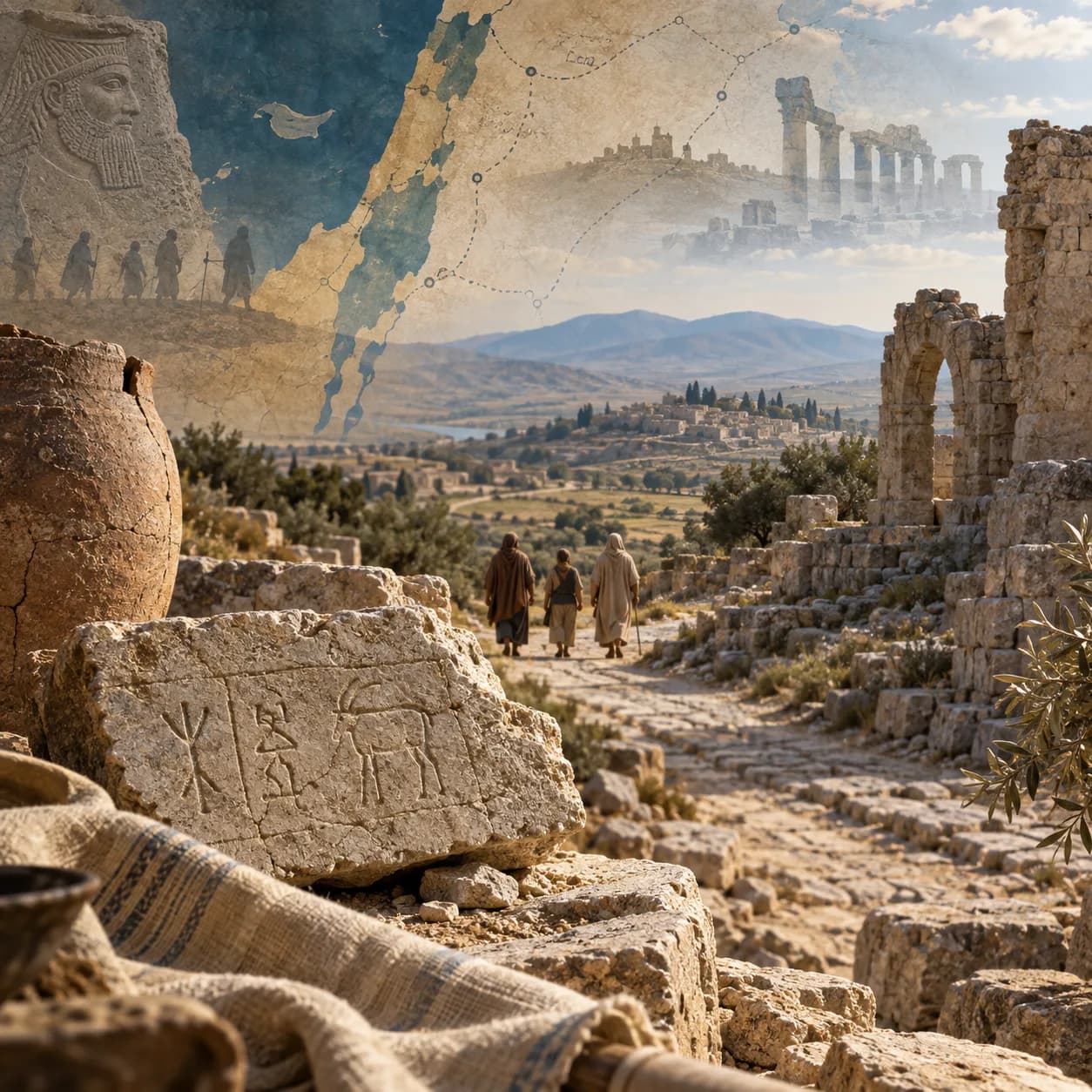
Elijah disappears upward in a whirlwind. The chapter has barely had time to breathe before it returns the same word as mockery: "Go up, baldhead! Go up, baldhead!" The tension of 2 Kings 2–6 is born from this echo. If Elijah "goes up," carried off by God, what place remains for Elisha on earth? The book's answer does not come through a speech of succession, but through a series of scenes in which water, oil, flour, iron, and even bones become the stage for his authority. In the middle of them, like a stone in the road, stands the story of the she-bears.
Reading this set of episodes as a collection of isolated wonders impoverishes the design of the text. What 2 Kings does is present a successor under public examination. Each episode tests the same question: does the word that accompanied Elijah now rest on Elisha? The answer unfolds in different registers, from a contaminated well to a household debt, from a poisoned pot to a corpse restored to life. The prophet appears in kitchens, fields, workshops, roads, and tombs. Biblical faith here places its hand on what is rough, urgent, and material.
GO UP, ELIJAH; WHO REMAINS ON THE ROAD?
The succession begins before the domestic miracles. In 2 Kings 2, Elisha follows Elijah from city to city and refuses to leave him. When he finally asks for a "double portion" of his master's spirit, the request does not sound like private ambition; it is the language of inheritance, as though he were asking for the place of the firstborn son in the continuation of that mission. After the ascension, the first decisive act is his: he picks up the fallen cloak, returns to the Jordan, strikes the waters, and asks, "Where is the LORD, the God of Elijah?" The river opens again.
This repetition matters. The same river, the same cloak, the same kind of gesture. The text does not hide the continuity; on the contrary, it stages it. Afterward, the "sons of the prophets" acknowledge: "The spirit of Elijah rests on Elisha." Before he heals water, multiplies oil, or makes iron float, the narrative has already placed him under Elijah's shadow and led him through a public rite of recognition.
That is why the mockery at Bethel weighs so heavily. It does not merely strike one vulnerable-looking man, a "bald" prophet climbing the road. It wounds the succession just established. The imperative "go up" could sound like "get lost," but placed so close to Elijah's ascension, it carries a flavor of theological derision: if your master went up, you go up too. Get out of here. The insult is not mere teasing about physical appearance; it is rejection of the prophet as bearer of God's word.
Bad Water, Good Word
Right after crossing the Jordan, the city of Jericho presents a concrete problem: "the location of this city is good, as my lord can see, but the water is bad, and the land is unfruitful." The sentence is beautiful in its conciseness. Everything seems promising; something invisible undermines it all from within. Elisha asks for a new bowl with salt, goes to the spring, and throws the salt into it. The decisive point, however, is not the substance used, but the words that accompany it: "Thus says the LORD: I have healed this water; from now on it shall not cause death or unfruitfulness."
The one who acts, on the level of the plot, is Elisha. The one who speaks behind the gesture is the LORD. The salt participates in the sign, but the text does not treat it as a chemical technique capable of solving a water problem. The scene belongs to prophetic language: a simple object is incorporated into an effective word. And the result reaches beyond one individual. It is not a healed sickbed, a relieved fever, or a supplied household. It is a city's water source.
There is also a contrast that prepares the rest of the cycle. Jericho receives the prophet with an acknowledged need; Bethel meets him with contempt. In Jericho, the lack is named and the word heals. In Bethel, human speech becomes aggression, and the prophet's word comes as judgment. The text does not turn this into a mechanical formula for all religious life, but it uses the juxtaposition to color the portrait of Elisha: wherever he passes, his presence is not neutral.
Historically, such a scenario is plausible. Ancient cities could depend on inadequate springs; fertile land could be frustrated by bad water. This helps situate the narrative in a recognizable world. What history cannot do is independently verify the healing of the spring. The account asks to be read as theological memory of a prophetic act, not as a laboratory document nor as a vague metaphor for "inner purification."
Oil Against Debt
If Jericho showed the word reaching public space, 2 Kings 4 descends into a threatened household. A widow approaches, and she does not speak of religious emotions; she speaks of credit, collection, and sons about to be taken. The economy appears without disguise. The woman does not ask for spiritual illumination to accept her condition. She asks for help so that the debt will not devour the family.
Elisha responds with two short questions: "What shall I do for you? Tell me, what do you have in the house?" The first opens space for aid; the second forces a fresh look at the little that remains. "Your servant has nothing in the house except a jar of oil." The miracle is born from that "except." The almost-nothing becomes the starting point.
The next order is strange and practical at once: borrow vessels, "empty vessels, not just a few," go into the house, shut the door, and pour the oil. The detail of the empty vessels creates suspense. The text makes abundance dependent on the space available to receive it. As long as there is a container, the oil flows; when the mother asks for one more and the son answers, "There are no more vessels," the oil stops. The narrative's movement is precise: lack, gathering, pouring, interruption. There is no exuberant waste, no spectacle for the public square. The outcome is economical and morally clear: "Go, sell the oil, pay your debt, and you and your sons live on the rest."
This scene refuses a disembodied religion. The prophet of the LORD enters the mathematics of survival. Debt, pledge, the risk of the sons' servitude: all of this has plausible historical ground in ancient Israel. Fragile families could indeed be crushed by mechanisms of credit. What cannot be demonstrated by outside investigation is the multiplication of the oil. The historical plausibility of the social background does not automatically turn the miracle into verifiable data. Even so, the text leaves a clear theological mark: God is presented as one whose word reaches into the household budget.
Death In The Pot
Something similar happens when the narrative returns to food. In Gilgal, during a famine, the company of the prophets set a large pot on the fire. One of them gathers wild produce without recognizing what he brings. When they begin to eat, the cry goes up at once: "Death in the pot, man of God!" The phrase is almost theatrical, but the danger is entirely domestic, nothing epic. Again Elisha acts on the food, and the threat ceases.
Shortly after, another episode intensifies the same tone. Twenty loaves of barley bread and fresh grain seem insufficient for a hundred men. The servant protests at the disproportion; Elisha insists; they eat, and there is still some left, "according to the word of the LORD." The repetition matters. This is not about exalting an autonomous wonder-worker. The text takes care to tie the unexpected surplus to the divine word that precedes the act.
These stories, read alongside the widow's, form a pattern. Elisha's authority does not hover over abstractions. It is measured where life fails: unsuitable water, a poisoned pot, scarce bread, a creditor at the door. Faith here does not belittle small needs by calling them minor. It treats them as proper ground for God's action.
Bethel And The She-Bears
Then comes Bethel, and the tone suddenly darkens. Elisha is going up the road when a group comes out of the city and begins to taunt him: "Go up, baldhead! Go up, baldhead!" The narrator does not pause the scene to explain motives, exact ages, or psychological intentions. The group is described by an expression our translations usually render as "boys" or "young men." This does not license imagining them automatically as small children; nor does the text turn them into an organized gang. Their age range and social standing remain imprecise.
What is clear comes in three quick movements. First, they come out of the city and take the initiative of the insult. Then Elisha turns, looks, and curses them "in the name of the LORD." Finally, two she-bears come out of the woods and maul forty-two of them. The dryness of the narration heightens the shock. No defense of the prophet is offered, no moral commentary softens the violence, no sentimental note reconciles the reader to the scene. Elisha continues on his way.
Bethel, moreover, is not a neutral setting within 2 Kings. In the larger horizon of the Deuteronomistic narrative, the city is tied to a rival cult that symbolizes Israel's unfaithfulness. This background does not resolve everything, but it keeps the episode from being isolated as though it happened on any ordinary street without religious resonance. The affront to the prophet can be read, in this context, as an affront to the word of the LORD on ground heavy with cultic memory.
The story, therefore, performs a function of severe legitimation. Right after Elijah's ascension, the successor will not be presented as a gentler, more manageable version of the master. The same man who heals waters and helps widows also appears surrounded by a fear that cannot be dispelled. The NABRE note on 2 Kings 2 moves in this direction, connecting the episode to the respect owed to the prophet. This helps explain why the scene is here.
But understanding its function does not remove the scandal. The text remains harsh. And here an interpretive consequence is essential: the narrative attributes the judgment to God; it does not hand readers a license to retaliate against mockery, shield religious leaders from criticism, or sanctify authoritarianism. Whoever reads the she-bears as authorization to intimidate dissent has used the text against the very cycle of Elisha, which shortly afterward shows him healing foreigners, feeding the hungry, and rescuing the indebted.
Iron That Sinks, Iron That Rises
The episode of the axe head, in 2 Kings 6, is brief and almost humble, but its humility is precisely the point. The company of the prophets need a larger place to live. They go to cut wood by the Jordan. While working, the iron axe head falls into the water. The man cries out, "Oh no, my lord! It was borrowed!" The loss hurts not only because of the tool but because of the obligation that will follow. The detail of the loan brings the theme of debt back to the center.
Elisha asks where it fell, cuts off a piece of wood, throws it in, and the iron floats. The text does not describe technique; it describes reversal. The heavy thing rises. What sank comes back within reach. As in the story of the oil, the concern is small in the eyes of anyone who values only the grand, but enormous for someone who would have had to repay what he could not replace.
This repetition of small problems is deliberate. Between a public healing and the restoration of a life, the narrative makes room for a man in despair over a borrowed tool. God does not appear only where existence is about to end; he appears also where it is complicated by apparently secondary losses. It is a broad vision of providence.
Even The Bones
If the cycle began with bad water and passed through food, debt, and a tool, it ends by touching the extreme limit: death. This is already foreshadowed in the story of the Shunammite's son, when Elisha goes up to the room, shuts the door, prays, and lies down over the boy until his flesh grows warm. The account takes enough time that the return of life does not seem instantaneous or abstract. There is waiting, contact, repetition. The boy sneezes seven times and opens his eyes. Life returns with bodily signs.
Later, in 2 Kings 13:20–21, the narrative compresses everything into a stunning miniature. Elisha has already died and been buried. Then, during a burial interrupted by raiders, a man's body is thrown into Elisha's tomb. The corpse touches Elisha's bones, comes back to life, and stands up. The prophet himself barely appears as a character; only his bones remain. And still, life bursts forth.
Literarily, this epilogue pushes prophetic authority past death itself. The man who brought healing to waters, food, and bodies remains associated with life even when he himself no longer speaks or acts. It would be a mistake to treat this as though it were a thesis about relics in general. The scene is singular and abrupt. It would also be a mistake to dissolve it into a harmless metaphor. The text narrates it as an event. Historically, we are again beyond what can be verified. Theologically, the book insists on something greater than Elisha: the word of God does not lose its force in the grave.
How To Read Without Domesticating
There are two easy ways to ruin this set of texts. The first is to soften everything until Elisha becomes a generic symbol of "hope," where oil, water, iron, and bones count only as subjective images. This loses the good scandal of the text: God acts in concrete things. The other way is to harden the narrative until it becomes a manual for defending religious leaders against any challenge. This loses the difficult scandal of the text: the prophet who must be taken seriously is the same one sent to the fragile, the poor, the hungry, and the indebted.
A responsible Christian reading does not separate these two dimensions. Authority that comes from God is neither empty spectacle nor sacred immunity; it carries the weight of judgment and the obligation of mercy. The Elisha cycle resists sentimentality and abuse equally. It does not let faith forget the kitchen, the debt, the water, the tool, the sick body. And it does not let the sacred be reduced to something decorative, always agreeable, incapable of confrontation.
For this reason, the most concrete interpretive consequence may be this: whoever invokes the she-bears to demand blind fear of the prophet, while ignoring the threatened widow, the poisoned pot, and the borrowed axe, has read 2 Kings only halfway. The test of authority in this chapter is not only whether it inspires fear; it is whether it bends down over real life. Elisha is credentialed on the road to Bethel just as much as inside the house without resources. To separate one scene from the other is to fabricate a prophet to our own measure. The book refuses to allow that.
Sources Of This Text
Primary basis: 2 Kings 2–6; 13:20–21. Biblical text. The literary observations refer to the passages indicated; the Memra applications are editorial interpretations.
21 · USCCB · NABRE | 2 Kings 2: text and notes | https://bible.usccb.org/bible/2kings/2 | — Elijah, Elisha, prophetic succession, and the she-bears.
Continue the study in Memra
Read the complete course with progress tracking and connected references.
Open the course