Hezekiah: The Shadow That Retreats and the Army That Falls
From the series The Bible Is Not Literal, published by Memra.
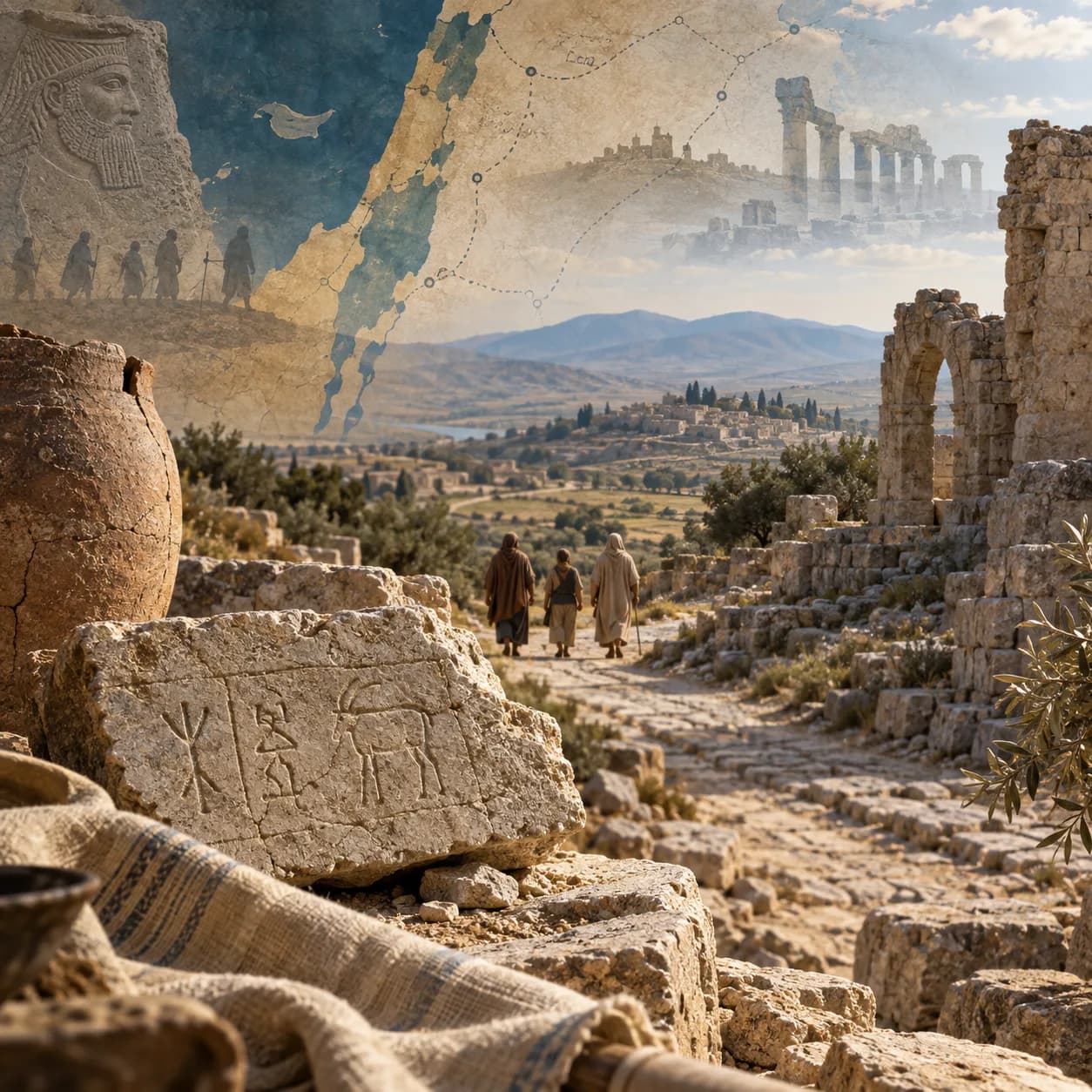
The shadow moves down the steps; suddenly, it goes back up. The sun does not learn to walk backward, death does not unlearn its trade, but in that instant the text asks the reader to see the impossible as a sign: time given back. It is a strange and beautiful image for the crisis of Hezekiah. The king who had just faced the insolence of an empire now faces something more intimate and more inescapable. Before Assyria, he could still send envoys, hear reports, consult the prophet. Before illness, he turns his face to the wall and weeps. The chapters of 2 Kings 18–20 and Isaiah 36–39 bring these two scenes together to ask a sharper question than "did a miracle happen or not?": what kind of deliverance is this, if the city is spared, the king is healed, and yet the story does not end in security?
The Shadow That Returns
In 2 Kings 20:1–11 and Isaiah 38:1–8, the crisis opens with a sentence that offers no cushioning. Isaiah enters and tells Hezekiah: "Set your house in order, for you shall die, you shall not live." There is no dramatic buildup before this line. The word arrives whole, the way news arrives when there is no negotiating it. The king's reaction is silent and bodily: he turns his face to the wall, prays, weeps "bitterly." The text makes no attempt to dress up faith as composure. Hezekiah does not speak like a serene hero; he speaks like someone who sees the end approaching.
What transforms the scene is how quickly the prophetic word returns. Before Isaiah has even left the middle court, according to 2 Kings 20:4, a new message comes: God has heard the prayer, seen the tears, will add fifteen years to the king's life, and will also deliver the city from the hand of the king of Assyria. The answer joins the personal and the political. The same God who deals with the sick body deals with the siege of the city. This interweaving is decisive for the shape of the narrative: Hezekiah's illness is not a private episode tacked on after the war by chance; it echoes, in miniature, the same drama of limit and dependence.
The sign requested takes the form of an image, not a treaty. Will the shadow advance ten steps or go back ten steps on the stairway of Ahaz? Hezekiah chooses the harder option: to go backward. The text states that this is what happened. Its literary form, however, does more than register a wonder. It enacts, in visible language, what had been promised in spoken language: days will be added. The shadow recedes the way death receded for a moment. This is not merely to confirm that Isaiah spoke the truth; it is to give the king an emblem of what was granted him — not immortality, but a postponement of the final hour.
There is a detail often overlooked because it seems small next to the sign: the poultice of figs applied to the boil, in 2 Kings 20:7 and Isaiah 38:21. The text does not set the word of God against ordinary bodily care. The healing is announced by prayer and prophecy, and it also passes through a simple therapeutic gesture. This does not resolve for us the clinical "how" of the recovery; the text itself gives us nothing to reconstruct it with. But it blocks any reading that would picture biblical faith as contempt for ordinary means.
The Letter Spread Out In The Temple
If the illness is the crisis of the closed room, the Assyrian threat is the crisis of the public square. In 2 Kings 18–19 and Isaiah 36–37, the tension builds through voice. The Assyrian envoy talks a great deal; Hezekiah says little. Imperial power tries to defeat Jerusalem before the battle by dismantling its confidence. The speech mocks the alliance, the religious reform, Judah's military capacity, and even the very possibility of divine help. The arrogance of the empire appears first not in horses or weapons but in interpretation: "do not trust," "do not be deceived," "no god has delivered." The Assyrian speech wants to define the meaning of the situation before any outcome occurs.
Hezekiah's response moves in the opposite direction. When he receives the letter, he goes up to the house of the LORD and spreads it out before God (2 Kings 19:14; Isaiah 37:14). The image is striking. The king does not rebut it point by point. He does not draft counter-propaganda. He transfers the enemy's speech to another court. The center of the scene is not the king's diplomatic cunning but the gesture of exposing the threat to the divine presence. Then comes the prayer, and in the prayer the real theme of the conflict emerges: not merely surviving, but that "all the kingdoms of the earth may know" who the LORD is (2 Kings 19:19; Isaiah 37:20). The political crisis is read as a crisis of recognition.
The structure of the episode insists on this. First the blasphemy and the mockery; then the prayer; then Isaiah's oracle; only then the outcome. The text wants interpretation to precede the fact. Before the enemy falls, the prophetic word has already put him back in his place. Sennacherib seems overwhelming, but he is described as someone whose advance has an established limit: he will come this far and no farther. The narrative strips the empire of any monopoly on initiative. On the visible plane, Assyria is besieging; on the plane of the plot, it is already besieged by a word.
A Night And A Number
The climax comes suddenly. "That night," the angel of the LORD went out and struck the Assyrian camp; by morning there were "a hundred and eighty-five thousand" corpses, according to 2 Kings 19:35 and Isaiah 37:36. The text states this directly. It offers no mechanism, no description of battle, no narrative of heroic military resistance by Judah. The one who acts is the angel of the LORD; the one who wakes up defeated is the army that had seemed unshakable. The humiliation of the empire lies precisely in this narrative economy: a colossal machine, dismantled without an epic clash.
The number contributes to the effect. Within the narrative, it communicates crushing scale, a total collapse of the aggressor's power. It functions less as a figure for auditing and more as a narrative measure of the disproportion between Assyrian pretension and its downfall. The modern reader naturally asks whether such a figure can be verified. Here it is worth being precise about the limits of the evidence: the biblical text of 2 Kings 19:35–37 and Isaiah 37:36–38 asserts the divine intervention and the death toll; beyond that, the material available for this essay does not allow us to demonstrate how this would have occurred, nor to convert the number into data controllable by modern criteria. Hypotheses about plague, panic, logistical collapse, or strategic withdrawal can be formulated in the abstract, but they are not settled by these verses.
This does not make the language "false," nor does it require dissolving it into pure metaphor. The form of the text is theological: it attributes the outcome to God through the angel of the LORD. The reader of faith may receive this attribution as a description of real intervention. The historical reader can say only that the narrative interprets an enemy collapse as divine judgment and that the mechanism remains undetermined. These two things are not identical, and it is better not to conflate them. What the passage asserts is clear; what historical inquiry can confirm from it is considerably more limited.
Fifteen Years Are Not Enough
If the episode ended with Sennacherib's retreat and Hezekiah's recovery, the king would leave these pages nearly triumphant. But the text sabotages any easy glory. First, because the healing itself already comes measured: fifteen years. Not "you shall live forever," but "I will add fifteen years to your days" (2 Kings 20:6; Isaiah 38:5). The gift is real and, at the same time, strictly finite. The time limit reappears as an antidote to any theology of invulnerability. Hezekiah has been heard, but he remains mortal. The shadow goes back, but only a few steps, not all the way to the morning of the first day.
In Isaiah 38, Hezekiah's song deepens this truth from within. Kings narrates the facts; Isaiah adds the voice of the convalescent. The king speaks of life as a tent pulled up, as cloth cut by the weaver. He speaks of broken expectation, of weary eyes, of nearness to Sheol, of the fear of no longer seeing the LORD "in the land of the living" (Isaiah 38:9–20). The poem is not a decorative appendix. It interprets healing as the restoration of praise. To live is to return to giving thanks, to return to speaking of God among the living, to return to taking part in the assembly of human time.
This point deserves care. The song offers no complete doctrine of the afterlife; it expresses the existential experience of one who believed himself cut off before his time. Sheol appears as a region of silence, incapable of praise, because the poem's horizon is the loss of worship in the land of the living. The poetic form concentrates the drama not in philosophical abstractions but in the rupture of communion and memory. When Hezekiah says that the father will make known to the children God's faithfulness (Isaiah 38:19), he translates healing into a task: the life given back must become testimony.
After The Healing, Babylon
The narrative's final blow is its refusal to end too well. In 2 Kings 20:12–19 and Isaiah 39:1–8, messengers from Babylon arrive after the convalescence. Hezekiah shows them everything: silver, gold, spices, weapons, storehouses, the treasure house. The verb of the scene is to show. Having once spread a letter out before God, he now throws his house open before visitors. The first exposure was prayer; the second, ostentation or naivety — the text does not need to settle on a precise psychology for the risk to show through. Isaiah asks bluntly: "What have they seen in your house?" The king's answer is total: "They have seen everything."
From this comes the announcement that retroactively changes the tone of the whole sequence. Days are coming when all of this will be carried off to Babylon, and even descendants of the royal house will be taken (2 Kings 20:17–18; Isaiah 39:6–7). Jerusalem has just been freed from Assyria, but it has not won historical immunity. The king has just received fifteen more years, but he has not bought his dynasty's future. The narrative brings deliverance and judgment startlingly close together. The very same account that exalts Hezekiah's prayer also exposes his limitation. The faithful king is not the definitive king.
Here the chapter's central question emerges. These accounts were not placed side by side to produce an album of miracles, but to prevent two opposite illusions. The first is despair: the empire does not have the last word, the sentence of death can be postponed, prayer matters. The second is religious self-sufficiency: no partial deliverance licenses the belief that history is settled, or that one ruler's faithfulness is enough to heal a people once and for all.
What We Can Say
In light of these passages alone, some things can be said firmly and others only with modesty. What the text asserts is clear: God delivered Jerusalem from the king of Assyria, heard Hezekiah's prayer, added fifteen years to his life, gave a sign in the shadow, and, further on, announced that Babylon would still come. What the literary form suggests is also clear: war and illness mirror each other; the fate of the city and that of the king are read together; the external victory does not suspend the internal fragility; the healing is deliberately narrated as a provisional return of time.
What history, archaeology, or science would allow us to say is not settled by these texts alone. With the material made available here, one cannot independently demonstrate the death of the army by angelic action, nor explain in a verifiable way the shadow's retreat as an astronomical phenomenon. Nor can the king's illness be reconstructed clinically. This caution does not weaken the reading; it only prevents demanding of the text what it does not set out to offer.
What remains is the interpretation of faith. For a Christian reading, this set of chapters traces a pattern of salvation that is real and insufficient. Real, because God acts in history and in the body; insufficient, because the spared city will still face a threatened future, and the healed king will still die. The narrative teaches gratitude for concrete deliverances without turning them into a doctrine of perpetual guarantee. It also teaches prayer without staging faith against remedies, signs, or ordinary means. And, above all, it teaches suspicion of any solution that defeats one enemy while leaving intact the larger problem of time and death.
This consequence is more practical than it appears. Whoever reads Hezekiah merely as a manual for spiritual success will leave these pages either frustrated or presumptuous. Frustrated, if the same outcome does not follow; presumptuous, if a present victory is taken as proof of total approval. The text offers another wisdom. There are nights when the empire retreats. There are days when the shadow moves back a few steps. Receive both with gratitude. But do not mistake relief for consummation. Hezekiah's God is no mascot of immediate triumphs; he is the Lord to whom the threatening letter is carried, the Lord before whom shortened days are wept over, the Lord who can grant more time — and who, precisely for that reason, asks that this time be lived without vanity, without display, and without the illusion that fifteen years are enough.
Sources Of This Text
Primary basis: 2 Kings 18–20; Isaiah 36–39. Biblical text. The literary observations refer to the passages indicated; the Memra applications are editorial interpretations.
This essay focuses on a comparative reading of the biblical text. It does not offer archaeological corroboration or an independent reconstruction of the episode.
Biblical references cited in the body of the text: 2 Kings 19:35–37; 20:1–11; Isaiah 37:36–38; 38:1–8; 39:1–8.
Continue the study in Memra
Read the complete course with progress tracking and connected references.
Open the course