Elijah: Ravens, Fire, and the Still Small Voice
From the series The Bible Is Not Literal, published by Memra.
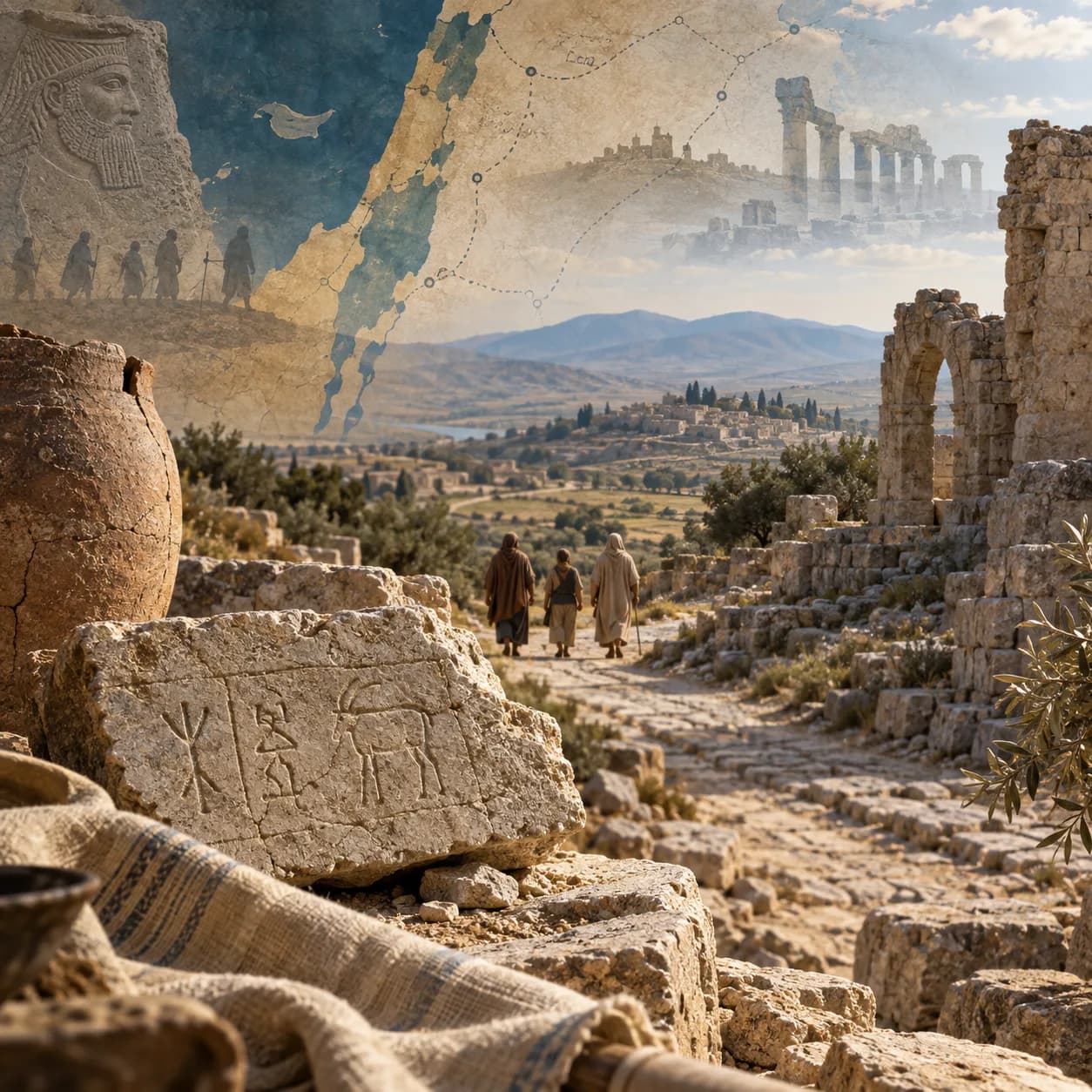
After the fire on Carmel, after the people fell prostrate, after the rain finally returns, Elijah flees into the wilderness and asks to die. That is the surprise at the heart of this cycle. The prophet who called down fire from heaven does not end the story as a serene victor, but as an exhausted man, afraid of a threat issued from the royal court. The narrative of 1 Kings 17–19 and 2 Kings 1–2 was not shaped to produce a flat legend of religious heroism. It moves through contrasts: drought and food, public stage and a widow's bedroom, outcry and silence, fire and bread, glorious departure and work that continues in other hands.
If there is one question running through these chapters, it is not simply "Can God perform miracles?" The text goes further. The question is: how do we recognize the presence of God without reducing it to spectacle? The God of Elijah sends ravens, sustains a poor household drop by drop, answers with fire when truth must be exposed before everyone, and then refuses to be identified with the logic of noise and thunder itself. The whole cycle corrects a religious expectation that is ancient and forever being reborn: the idea that God's power only deserves the name when it appears overwhelming.
Under The Broom Tree
The turning point comes in 1 Kings 19. Jezebel threatens to kill Elijah, and he flees. The man who had faced down hundreds on Carmel cannot bear a message delivered in the queen's name. This is not incoherence in the text; it is its clarity. Public courage immunizes no one against private collapse.
In the wilderness, Elijah lies down under a broom tree and asks that his life end. The request is dry, weary, unadorned. Instead of an immediate rebuke, he receives food and sleep. The angel touches him, tells him to rise and eat; then touches him again and repeats the command. The repetition matters. Before any great revelation, the prophet needs his body restored. The cycle many remember for its fire reserves a central place for bread, water, and rest. God's care does not first appear as speech, but as elemental sustenance.
This scene reshapes our reading of what came before and what is still to come. Elijah is not merely the man of confrontation. He is someone who can reach his limit and need to be carried to the next step. For faith, this matters greatly: prophetic authority does not eliminate human frailty; sometimes it makes that frailty more visible.
Ravens And Flour That Does Not Run Out
Elijah had already learned this at the beginning of the story. In 1 Kings 17 he enters the scene abruptly, without lengthy introduction, announcing that there will be neither dew nor rain except by his word. The drought is not a neutral backdrop; it is the setting for the entire conflict. In an agricultural world, the absence of rain means famine, collapse, and the question of who truly governs the fertility of the land.
Right after the announcement, though, the prophet vanishes from the public square and goes into hiding. God sends him to a wadi, where he will drink water and receive food brought by ravens, morning and evening. The account states this without asking the reader's permission. What the shape of the scene suggests is more delicate: Elijah, who had spoken in the Lord's name before the king, now depends on unlikely and undignified means. The repetition of the meals, morning and evening, gives the episode the rhythm of routine. It is not a single flash but regular provision. And then the wadi dries up. The place that sustained him does not sustain forever.
From there, the move to Zarephath, in Sidon, gains weight. The next guardian of the prophet's life will be neither someone from the loyal court nor a temple priest, but a foreign widow, in circumstances so precarious that she is preparing a last meal for herself and her son. Elijah asks her for water and bread; she explains the scarcity; he responds with a promise limited to what is needed: the flour will not be spent and the oil will not run out until the rain comes. The domestic miracle of chapter 17 is not excess but continuity. The house does not become a storehouse. The jar and the jug carry them through the time of want without ever being emptied completely.
This difference is decisive. On Carmel, God will act before a crowd. In Zarephath, he acts within the interior of survival. The Bible knows how to narrate both registers, and the Elijah cycle refuses to call the grace that arrives without spectacle lesser grace. The text also relocates the reader: the word of God finds welcome in a household outside Israel, while the king of Israel hardens his heart. The geography is already interpretation.
The episode of the widow's son intensifies this movement. When the boy dies, the house once preserved by provision now becomes a place of mourning. Elijah protests in prayer, carries the boy to his room, and cries out to the Lord. The account states that life returns to the child. Here the historical limit must be stated soberly: we have no external verification of this event, just as we have none for the cycle's other wonders. The text does not present itself as a modern forensic report. It testifies, in narrative form, that the word proclaimed by Elijah is not confined to drought and judgment; it also touches life threatened by death. The widow's conclusion is revealing: now she recognizes that Elijah is a man of God and that the word of the Lord in his mouth is true. Chapter 17 ends, at bottom, with this question of credibility.
A Drenched Altar
In 1 Kings 18, the question of truth moves from the house to the mountain. The confrontation on Carmel is usually remembered for its fire; before that, however, the narrator works at length on silence. The prophets of Baal cry out from morning until noon, and then still go on. The text insists: there was no voice, no answer, no one paying attention. The formula repeats like a hammer blow. It is not just that their petition failed; the narrative itself empties out the ritual through this accumulation of sound without response.
Elijah does almost the opposite. Instead of prolonging the frenzy, he repairs the altar of the Lord that had fallen into ruin. He gathers twelve stones, arranges the wood, prepares the sacrifice, digs a trench, and has water poured over everything, again and again, until the water runs around the altar and fills the trench. The altar is set up so that no doubt remains about the impossibility of an easy trick. When he finally prays, his prayer is brief. He asks that it be known who God is in Israel, and that it be known that he acts by a word received, not by his own religious technique.
Then the fire comes. The account spares no verbs of consuming: it burns the burnt offering, the wood, the stones, the dust, and even licks up the water. The intensity here has a public function. The scene affirms, within the narrative, that the Lord answers and that Baal does not. The people fall with their faces to the ground and repeat: the Lord is God. The repetition has now changed sides. Where before there was "no voice, no answer," now there is choral recognition.
It would be a mistake, however, to read Carmel as authorization for a religion addicted to displays of force. The cycle itself will prevent this in the following chapter. It would likewise be irresponsible to gloss over the violence of the outcome, when the prophets of Baal are killed. The text narrates this act as part of the judgment within that particular conflict. Narrating it, however, is not the same as turning it into a rule for other times and communities. A responsible Christian reading cannot use Elijah to sanctify religious persecution or sectarian pleasure in another's defeat.
The rain that returns after the sacrifice completes the picture. First a small cloud appears; then the sky darkens. Once again, what changes the course of the story is not only the great public gesture, but also the discreet sign that grows until it becomes a storm.
The God Who Is Not Where One Expects
It is at Horeb that the cycle reaches its maturity. Elijah walks forty days to the mountain and enters a cave. There he hears a question: "What are you doing here, Elijah?" His answer is a complaint of wounded zeal and extreme loneliness. He believes he is the only one left.
Then the text arranges a memorable sequence: a strong wind, an earthquake, fire. And with each element, it repeats that the Lord was not in it. The repetition matters as much as the phenomena themselves. In the previous chapter, fire had meant God's public answer; now fire appears again, and the narrative refuses the automatic identification. God had already shown himself powerful, but that does not fit into a formula of "it will always be this way."
After the fire comes what our translations try to capture in different ways: "a still small voice," "a gentle breeze," "the sound of a thin silence." The exact nuance remains difficult to pin down through the English equivalent alone, but the contrast is unmistakable. After the overwhelming, something faint. After what shatters rocks, something that demands attention. When Elijah perceives this, he covers his face and goes out to the entrance of the cave. The reaction is no smaller than on Carmel; it is simply of a different nature.
There is also a decisive literary detail. The question repeats: "What are you doing here, Elijah?" And Elijah answers again in almost the same words. The experience on the mountain does not magically erase the crisis. God's presence does not function here as instant anesthesia. What changes is the direction forward. Elijah receives a new task, with concrete names, concrete movements, a concrete future. Moreover, his claim of absolute isolation is corrected: he is not as alone as he imagined. The thin silence does not come merely to console; it comes to dismantle the prophet's narrow perspective.
For faith, this is perhaps the cycle's most demanding lesson. God can act in the extraordinary, and the text offers no apology for saying so. But the extraordinary does not authorize the prophet to think he now knows how God will always act. Horeb unsettles the religious imagination fascinated by impact.
Fire Again, And The Falling Mantle
The chapters of 2 Kings are not an ornamental appendix. They show what happens when Elijah's authority must outlive Elijah's own person. In 2 Kings 1, the prophetic word again confronts the king, now Ahaziah. The episode of the fire that consumes the detachments sent against the prophet picks up a symbol already familiar, but with an important modulation: when a third captain abandons arrogance and pleads for his own life and the lives of his men, the outcome changes. Even within a harsh account of judgment, human posture alters the scene.
In 2 Kings 2, the focus shifts to succession. Elijah walks a final road with Elisha. Three times he tries to leave him behind; three times Elisha refuses. This repeated pattern prepares the reader for a transfer that will not be incidental. At the Jordan, the mantle strikes the water and the river divides. Then comes the chariot of fire, the horses of fire, and the whirlwind that carries Elijah away. The text affirms his extraordinary departure; historically, there is no way to demonstrate this event by external means. But its literary function is clear: Elijah does not disappear through failure, nor is he replaced by mere dynastic routine. His departure is treated as a transfer of office.
The proof lies in the mantle that falls and is taken up by Elisha. When he returns to the Jordan and repeats the gesture, the question is not "Where is Elijah?" but "Where is the Lord, the God of Elijah?" The proper focus reappears. Continuity does not depend on preserving the hero; it depends on the God who acts and the word that goes on. The mantle matters, but it is not magic. Without the Lord, it would be just cloth.
What The Text Says, What We Cannot Prove, What Faith Hears
These chapters affirm, on their own terms, that the Lord sustains Elijah, acts in a foreign household, answers on Carmel, meets the prophet in his ruin, judges kings, and secures succession through Elisha. That is what the text says.
The literary form adds something a mere summary of facts would lose. The episodes were arranged to move us from the hidden to the public and back to the interior; from destitution to the mountain; from a cry without answer to a brief prayer that is answered; from consuming fire to a silence that reorients; from the solitary prophet to the mantle handed on. Repetitions, contrasts, and geographical shifts are not decoration: they are part of the meaning.
As for what history can establish, the claim must be modest. The backdrop of conflict between the prophetic word and the monarchy, as well as the struggle over fidelity to the God of Israel, belongs to the text's real historical horizon. The wonders themselves — ravens bringing food, inexhaustible flour and oil, life returning to the boy, fire from heaven, the whirlwind that takes Elijah up — are not verifiable through independently available documentation. This does not make them false by definition; it only prevents their being treated as demonstrable facts by the standards of a modern investigation.
Faith, for its part, receives the cycle as testimony to a free God. Free to feed his servant by unlikely birds. Free to honor the hospitality of a foreign widow. Free to answer before the whole nation. Free also not to be confused with wind, earthquake, or fire when the prophet needs to relearn how to listen. And free, finally, to carry on his work without turning any leader into an irreplaceable figure.
The interpretive consequence is concrete. Whoever reads Elijah only in the key of power ends up looking for God solely in what impresses, and risks sanctifying their own aggression. Whoever reads him only in the key of interiority forgets that there are moments when the truth must be spoken before kings and altars. The cycle asks for something else: discernment. Not every silence is empty, not every fire is God's presence, and not every public victory means the prophet's heart is whole. Sometimes faithfulness will be found on Carmel; sometimes at a widow's small table; sometimes simply in rising, eating, and moving on.
Sources Of This Text
Primary basis: 1 Kings 17–19; 2 Kings 1–2. Biblical text. The literary observations refer to the passages indicated; the Memra applications are editorial interpretations.
21 · USCCB · NABRE | 2 Kings 2: text and notes | https://bible.usccb.org/bible/2kings/2 | — Elijah, Elisha, prophetic succession, and the she-bears.
Continue the study in Memra
Read the complete course with progress tracking and connected references.
Open the course