The Day the Sun Stood Still
From the series The Bible Is Not Literal, published by Memra.
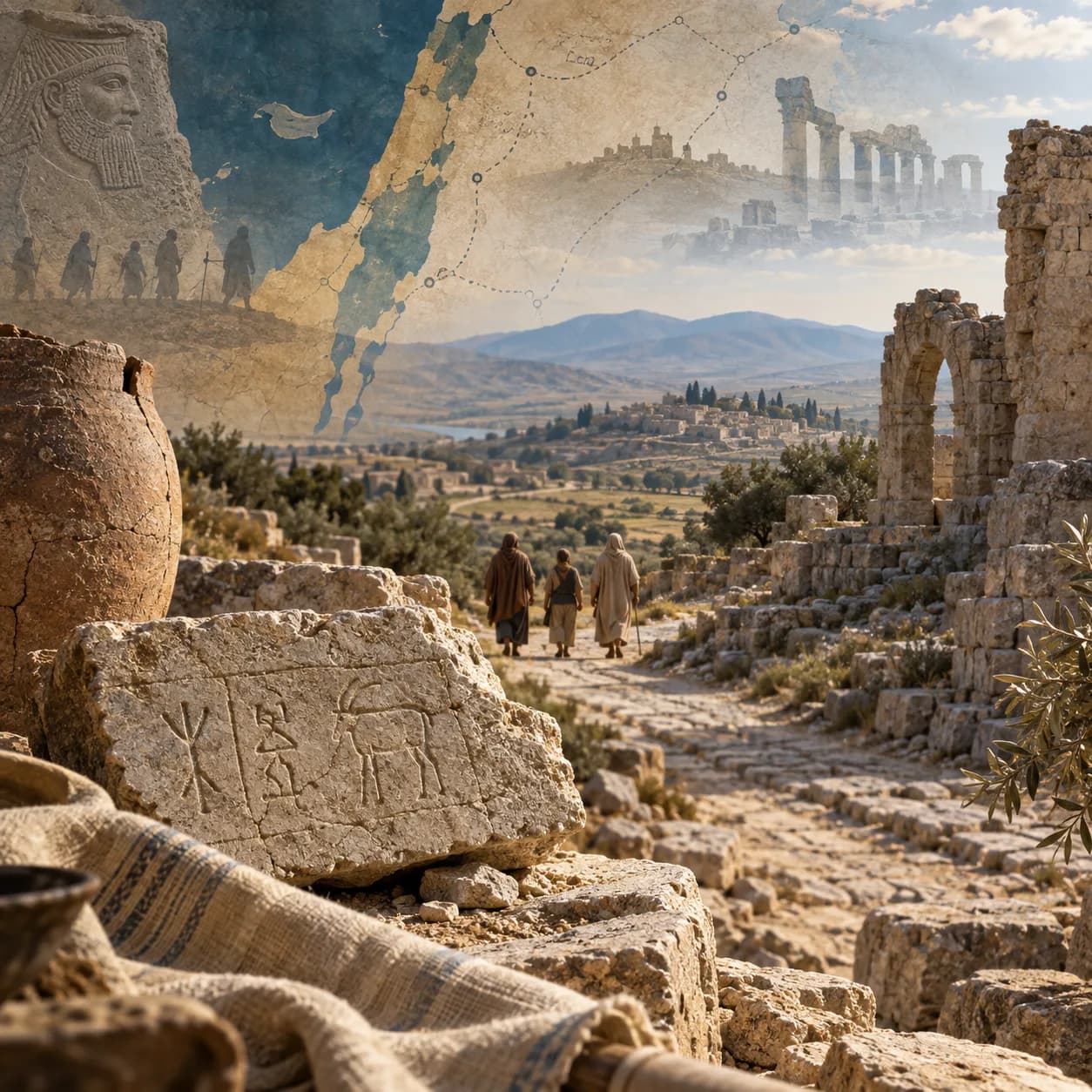
The battlefield has already moved down the slope when the scene reaches its strangest point. The Amorite kings have fled down the mountain, Israel is in pursuit, stones fall from the sky upon the defeated, and then Joshua speaks as though time itself could receive orders: "Sun, stand still over Gibeon; and moon, over the valley of Aijalon." The war, which began as a night march to rescue a besieged city, suddenly opens up to the sky.
It is this shift in scale that gives Joshua 10:1–15 its force. The text moves from diplomatic terrain, through military strategy, and ends with the cosmos drawn into the same story. Reading this episode well requires following that movement without haste: first, a pledged word; then a march; then a pursuit; finally, a day that seems greater than other days.
The Covenant That Binds
Before there is a sun standing still, there is a promise exacting its price. The previous chapter told how Gibeon secured a treaty with Israel through deceit. Deceived, Joshua swore to spare them. In Joshua 10, that oath returns with urgency. Adoni-zedek, king of Jerusalem, hears that Gibeon has made peace with Israel and gathers a coalition of five kings: Jerusalem, Hebron, Jarmuth, Lachish, and Eglon. The immediate target is not Israel but Gibeon. Punishing the rebellious city serves as a political message to the whole region.
The Gibeonites send a short, tense appeal: do not abandon your servants; come up quickly; save us. There is an important detail here. Gibeon appeals to the bond created by the covenant, and Joshua responds as someone bound by his own word. The chapter does not begin as a conquest adventure; it begins as an obligation undertaken. Israel was deceived, but now must act with faithfulness.
The text marks this transition through its verbs. The kings "gather," "go up" against Gibeon, and "lay siege" to it. Gibeon "sends" messengers. Joshua "goes up" from Gilgal with all the fighting force. The whole battle is born from movements forced by a covenant. There is no room for cold calculation. There is only the pressure of loyalty.
It is at this moment that the divine word enters: "Do not fear them, for I have given them into your hands; not one of them shall stand before you" (10:8). The statement anticipates the outcome but does not eliminate human action. Joshua still has to march all night. The text does not set confidence against effort. The promise does not replace the march; it sustains it.
The Night March And The Flight Downhill
The narrative accelerates. Joshua goes up from Gilgal "all night." The urgency of the rescue shows in the body of the text: this is not a leisurely, well-planned campaign but a surprise attack after an exhausting climb. The reader can almost feel the troops' short breath before dawn.
When the fighting begins, however, the main protagonist is no longer Joshua. "The Lord threw them into a panic before Israel" (10:10). That verb shifts the axis of the story. Israel strikes, yes; pursues, yes; kills by the sword, yes. But the first break in the enemy ranks does not come from Israelite skill. It comes from God. Panic precedes defeat.
Geography helps narrate the coalition's disintegration. The flight goes up the ascent of Beth-horon and down toward Azekah and Makkedah. The text lets the battle run through defined, known, earthly places. We are not floating in a groundless myth. There are cities, valleys, roads. Precisely for that reason, the next detail hits harder: while the Amorites flee, "the Lord threw down great stones from heaven on them." The narrator takes care to add a comparison uncomfortable for any national triumphalism: more died by the stones than by the sword of Israel.
This contrast is decisive. The victory cannot, within the story's own logic, be credited to Israel's bravery as though the people had mastered the day by their own strength. The text shifts the glory. The warriors run and strike; God decides the outcome. Human pursuit takes place under an intervention that surpasses it.
Here too, the war meets a limit. The chapter is full of violence, and it would not do to soften it with hasty piety. But the narrator prevents the sword from becoming an idol. Israel's weapon is not the center of the scene. Not even the center of the killing. The sky weighs more than the metal.
A Poem Enters The Scene
At the height of the pursuit, the prose gives way to a poetic fragment. The text says that Joshua's speech is written in the "Book of Jashar" and quotes the verse. This insertion matters because it changes how we read. The narrative had been describing movements, attacks, flight, stones. Suddenly a condensed language enters, memorably vivid, made to be repeated.
War poems do this: they crystallize a moment so that a community's memory can carry it across generations. Rather than offering more operational detail, the verse expands the event's significance. Gibeon and the valley of Aijalon remain there as coordinates on the map, but above them rise sun and moon. The local battle receives a cosmic frame.
The passage from prose to poem also forestalls a simplistic reading. We are not looking at a technical bulletin accidentally lodged in a religious narrative. The chapter itself is arranged so the reader sees two things at once: there was a concrete battle, in concrete places; and that battle was understood and celebrated as something in which the very heavens served God's purpose.
It's worth noting the sobriety of the framing. After the verse, the narrator returns to prose and comments on the effect: the sun "stood still in the midst of heaven" and "did not hurry to set for about a whole day." The poetry does not stand alone. The narrative receives it, explains it, and turns it into an interpretive key for the battle.
Sun Over Gibeon, Moon Over Aijalon
Joshua's words deserve to be heard slowly. He speaks to the sun and the moon, not to an army. The request — or command, depending on how one reads the verse's grammar — is not aimed directly at the enemy but at time itself. That already says much about the urgency of the moment. The problem is not merely winning; it is finishing what was begun before the light runs out.
The text states, in plain terms, that the day was prolonged. That is its surface meaning, and there is nothing to be gained by pretending otherwise. The narrator does not mean only to convey the subjective sensation of a long battle. He writes as one who saw, in that day's duration, an extraordinary act of God. The closing remark reinforces this: "There has been no day like it before or since, when the Lord heeded a human voice, for the Lord fought for Israel" (10:14). The focus lies less on celestial mechanics than on theological wonder: God listened.
At the same time, the form of the passage resists hasty reductions. Joshua addresses the sun and the moon; the conclusion, however, does not say that Joshua controlled the heavenly bodies. It says that the Lord heeded the voice of a man. The efficacy belongs to God. The verse gives human speech a poetic boldness; the closing comment sets everything back within the relationship between prayer and divine response.
There is also a fine contrast between regularity and crisis. The sun and moon, signs of the world's rhythm, are summoned here into an exceptional situation. War is disorder, urgency, the risk of collapse. The sky, in the human imagination, represents constancy. When the text makes celestial constancy bend to the urgency of battle, it suggests something greater than a tactical advantage: it suggests that the world's order is not a closed mechanism, indifferent to God's action.
This is the point where some modern readers move too fast — either to defend a literal physical interruption of the universe, or to dissolve everything into mere figure of speech. The text itself asks for more caution. It speaks with poetic intensity about an event it understands as real. Its greatness lies precisely in that combination.
What History And Science Can Tell Us
There are things this passage allows us to affirm with confidence, and others it does not permit us to settle.
It allows us to affirm that Joshua 10:1–15 describes a battle fought for Gibeon's sake as a victory granted by God. It also allows us to affirm that the narrative combines prose and poetry, and that this combination is part of the episode's meaning, not mere ornament. The excerpt from the "Book of Jashar," as the notes to the NABRE on Joshua 10 observe, shows this poetic core of the war account embedded in the larger narrative. The chapter wants to be read as interpreted memory, not as a neutral sheet from a military archive.
Science, meanwhile, works with a different kind of question. If someone turns "the sun stood still" into a literal astronomical proposition, they enter territory the text was not written to map. Elementary astronomy, as summarized by NASA Science in explaining the day-night cycle, describes that cycle in terms of Earth's rotation. A global physical interruption of that rotation would carry immense consequences. The biblical account does not concern itself with them and gives us no means of testing them historically.
Hence two necessary cautions. First: using Joshua 10 as scientific proof of a "missing day" discovered by observatories or space agencies has no basis in the material we have. The chapter provides no such documentation, and the reference to NASA, when it appears in popular discourse, usually serves apologetic imagination more than serious reading of the text. Second: there is likewise not enough data here to settle the question with some specific physical-natural explanation, as if one need only find the right phenomenon and be done with it. The text was not composed to satisfy that curiosity.
What remains open is the mechanism of the event. What remains clear is its theological interpretation within the narrative: God fought for Israel and prolonged, in some way described in elevated language, the time needed for victory.
The most common danger with Joshua 10 is not simply reading it too literally; it is using it for ends the chapter itself contradicts.
The first is a fascination with spectacle. Some readers approach the text looking for a cosmic trick, a scientific puzzle, or a miraculous rarity to win arguments. In doing so, they lose the moral nerve of the episode. The battle exists because a word was pledged and needed to be honored. Gibeon was rescued because Joshua did not treat an oath as disposable. The sky moves, in this story, around a demanding faithfulness. When curiosity about the stars drowns that out, we read the loudest detail and lose the chapter's backbone.
The second is the sacralizing of violence. It would be easy to turn "the Lord fought for Israel" into a password for any war dressed up as devotion. The text itself resists that abuse. It reminds us that victory is not the possession of an armed people; it is God's action. It also reminds us that Israel's sword does not occupy the center of the scene. And the immediate motive for the fighting is not unchecked expansion but rescue of a city bound by covenant. Nothing here authorizes baptizing political ambition with the name of faith.
For Christian readers, this caution matters even more. The chapter affirms that human history is not closed in on itself and that God can act beyond available calculation. That conviction remains alive. What does not remain legitimate is taking an ancient war account as license to dress our own conflicts in heavenly guarantee. God's sovereignty comforts the weak and humbles the proud; it does not hand the faithful an automatic seal for their causes.
A Day Greater Than Calculation
In the end, the wonder of the text lies not in teaching us astronomy but in declaring that time answered the God who listens. The day seemed unwilling to yield because the story of that covenant could not yet go dark. That is the audacity of Joshua 10.
Read this way, the chapter yields a concrete interpretive consequence. It trains us to ask less "how exactly did the sun stop?" and more "what happens when a community believes that its pledged word matters before God?" The text's answer is radical: even the hours cease to be neutral. Time is not an indifferent backdrop; it becomes a servant of the divine purpose.
This changes how the passage should be taught and preached. Rather than a weapon in culture wars between faith and science, it becomes a summons to reverence, faithfulness, and sobriety. Reverence, because the world is not sealed off within our mechanisms. Faithfulness, because the battle is born of a promise that had to be honored. Sobriety, because the God who fights for his people does not hand the glory to the human sword.
The day the sun stood still remains strange. It should remain so. But its strangeness works in service of a deeper truth than the marvel itself: when God decides to act, the ordinary measure of things is no longer enough to tell the story.
Sources Of This Text
Primary source: Joshua 10:1–15. Biblical text. The literary observations refer to the passages indicated; the applications of the Memra are editorial interpretations.
20 · USCCB · NABRE | Joshua 10: text and notes | https://bible.usccb.org/bible/joshua/10 | — Poem of the Sun and Moon in the war account.
09 · NASA Science | Facts About Earth | https://science.nasa.gov/earth/facts/ | — Formation of the Earth
Continue the study in Memra
Read the complete course with progress tracking and connected references.
Open the course