Jericho and the Total Conquest of Canaan
From the series The Bible Is Not Literal, published by Memra.
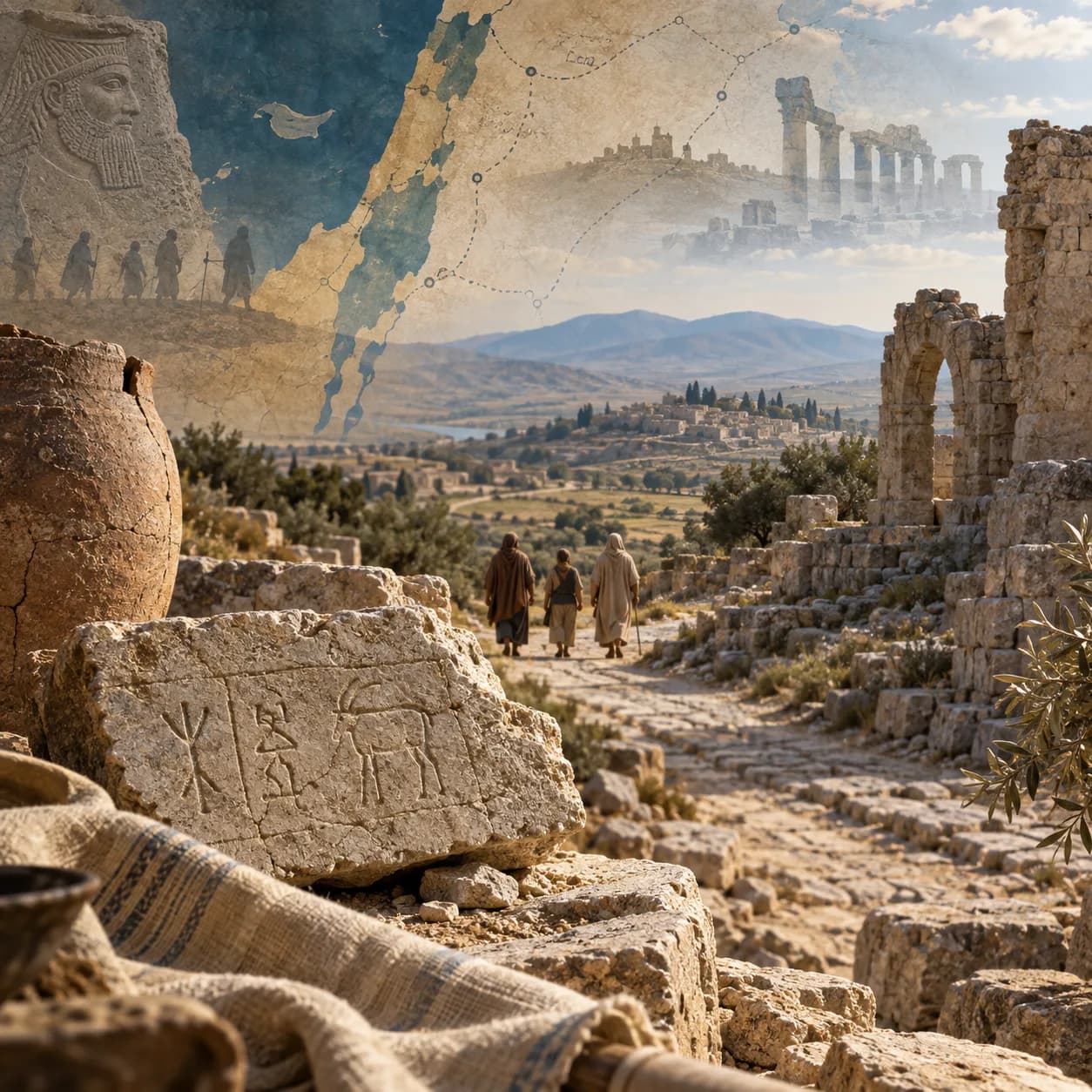
The people advance with no battering rams, no siege towers, no ladders. They advance in silence.
For six days, armed men, trumpet-bearing priests, and the ark circle Jericho; on the seventh, they repeat the gesture until the restrained rhythm bursts into sound. The scene in Joshua 6 has something of a procession about it, and something of an execution of sentence. The one who occupies the center is not the general, but the ark. What sets the pace is not military tactics, but a received command. And when the city finally falls, the narrative does not end with the collapse of the walls. It pauses on a house built into the wall, marked by a scarlet cord, where a foreign woman and her family survive.
That combination is decisive. Jericho inaugurates the entry into the promised land with a language of totality and judgment; at the same time, it introduces at the heart of the scene an exception the reader cannot ignore. The first city to fall is also the place where a Canaanite woman is spared. Israel's first victory already carries within it the question of who belongs, how they belong, and in whose name one speaks of "total conquest."
Seven Circuits And No Ladder
Joshua 6 was written to be heard as an event charged with solemnity. Repetition organizes the meaning: seven priests, seven trumpets, seven days, seven circuits on the seventh day. The text does not rush toward the outcome; it prolongs the expectation. Each circuit seems to say the same thing, and that is precisely why something changes. The city is besieged by a patient obedience that unsettles the reader accustomed to conventional war scenes.
The silence of the people is also striking. Joshua orders that no one shout or let a word leave their mouth until the appointed moment. The city hears footsteps, hears trumpets, sees the insistent outline of the march, but receives no negotiation, no threat, no challenge. The silence concentrates the action in God. When the shout finally breaks out, it does not launch the attack; it seals a process that has been conducted from the start by the divine command.
The ark stands at the center of this movement. In Joshua, it is not a decorative symbol of national religion. It marks the presence of the Lord who goes ahead, as it had marked the crossing of the Jordan. The land is not being taken because Israel discovered a favorable geopolitical opportunity. The narrative asserts something more demanding: possession of the land depends on the promise of God and the obedient response of the people. That is why the siege is narrated almost as ritual. The literary form suggests that Jericho should be read as the inaugural city, the paradigm of what entry into the land theologically means.
If the reader looks for military technique, the chapter frustrates that expectation. It does not explain how the walls fell, nor describe a prolonged battle. Human action is reduced to a minimum: marching, carrying, blowing trumpets, waiting, shouting, entering. The decisive agent is the Lord, who had already told Joshua: "I have given Jericho into your hand." The city's fall, before being narrated, has already been declared. The account moves between promise and fulfillment.
The House In The Wall
But Jericho does not begin in Joshua 6. It had already been opened by a woman in Joshua 2.
The spies enter the city and end up in Rahab's house. The text presents her with a social and moral standing that, for many readers, would place her on the disposable side of the story. The plot itself does the opposite. She has heard what happened at the exodus and in the wilderness, she interprets these events, and she arrives at the central conclusion: "the Lord your God is God in the heavens above and on the earth beneath." In Joshua 2, the clearest confession of the Lord's sovereignty over the condemned city comes not from an Israelite, but from a Canaanite woman.
Who acts with discernment? Rahab. Who takes a risk to align herself with the God of Israel? Rahab. Who asks for mercy on the basis of mercy offered? Rahab. The text constructs her role deliberately. While the city represents resistance, she represents recognition. While Jericho will be handed over to judgment, her house becomes a place of refuge.
This tension resurfaces in chapter 6 in visually powerful form. The wall falls; Rahab's house remains standing. The fortified city, a sign of political security, saves no one. The fragile house of a marginalized woman does. The contrast alters the meaning of the conquest. Jericho cannot be read merely as the elimination of the enemy, because the narrative preserves, inside the city, a life that will be incorporated. Joshua 6:25 underscores this: Rahab comes to dwell "in the midst of Israel." The first door opened to someone "from outside" opens precisely in the harshest episode of the conquest.
This observation belongs to the text itself; it is not a modern attempt to soften its harshness. The narrative insists on Rahab twice: first as an unlikely ally, then as a preserved survivor. The reader who sees only the walls has missed the house in the wall — and without that house, has missed the theology of the chapter.
The City As A Consecrated Thing
Jericho is also singular for another reason: it is placed under the *herem*, a term traditionally translated as "anathema" or "consecration to destruction." In Joshua 6, this means that the city and everything in it belong to the Lord in a way that excludes ordinary appropriation. Silver, gold, and objects of bronze and iron go into the Lord's treasury; the rest is marked for destruction. The first city functions as firstfruits of the land.
This detail matters because it prevents reading Jericho's fall as a simple triumphant plunder. The people are not given license to convert victory into private enrichment. The city is, so to speak, "taken out of circulation" and returned to the God who delivered it. The narrative expresses judgment, but it also sets a boundary on Israel's desire for possession — so much so that the following chapter, at Ai, will show the gravity of violating that boundary when Achan takes for himself what had been forbidden.
There is a difficult aspect here, and it would be dishonest to hide it. The text speaks of destruction in God's name. No responsible reading should neutralize the verbal violence of the chapter. What can be said with precision is that, in the way Joshua tells the story, this violence is framed by two simultaneous lines: divine judgment on the city and a restraint on Israel's appetite. Victory does not legitimate any use of force or any seizure of goods. It comes hedged about with prohibitions.
For a reading of faith, this alone is enough to make it impossible to use Jericho carelessly as a slogan for holy war. If the first city cannot be plundered at will, and if the first survivor is a welcomed foreigner, then the chapter resists readings that turn God into a patron of brute power or ethnic purity.
WHEN "ALL THE LAND" ENTERS THE PICTURE
After Jericho and Ai, the book widens its scale. In Joshua 10 and 11, the narrative shifts cadence. Defeated kings, captured cities, subdued regions multiply. The text repeats formulas of totality: Joshua struck all the land, left no one remaining, took everything as the Lord had said. The climax comes in Joshua 11:23: "So Joshua took the whole land." The intended impression is unmistakable. The promise has reached its fulfillment.
These chapters function as grand theological summaries. The focus no longer rests on a single dramatic episode, as with Jericho, but on a sequence that produces an effect of totality. The reader comes away with a sense of irresistible advance, of promise converted into territorial dominion.
It is important to notice the kind of language employed. These summaries do not have the texture of a campaign journal, with logistics, setbacks, losses, and negotiations recorded in detail. They compress, synthesize, generalize. This is a literary observation, visible in the repetition of formulas and the arrangement of episodes. The text wants to say that the Lord fulfilled his word by giving the land to Israel. To assert this, it mobilizes a sweeping rhetoric.
None of this obliges the reader to treat every expression of completeness as a literal photograph of every piece of territory and every human group. In the ancient Near East, formulas of total victory were a well-known device of political and religious exaltation; Christine Hayes draws attention to this backdrop in discussing Joshua and Judges and the way the Bible organizes its memories of the land. This observation does not empty the narrative of meaning. It helps us read its verbal scale. "All the land" can be a vigorous theological affirmation without functioning as an exact map of uniform occupation.
The Other Portrait Of The Same Land
Perhaps the most important piece of evidence lies within the Bible itself. The portrait of total conquest in Joshua coexists with another, far less tidy, portrait in Judges 1.
There, several tribes fail to fully drive out the inhabitants of certain cities. Jerusalem remains with the Jebusites alongside the Benjaminites. Gezer stays occupied by Canaanites. Elsewhere, the text says that Judah did not drive out the inhabitants of the plain "because they had chariots of iron." The land exists, it was promised, there are real victories — but the occupation is partial, uneven, drawn out, full of tense coexistences and concrete failures.
This friction is one of the most revealing literary facts of the whole corpus. Judges 1 does not read like a careless appendix that forgot what Joshua had asserted. It preserves a different memory of Israel's settlement in the land. The canon did not erase the friction between the two voices. It chose to keep both. In doing so, it prevents a triumphalist reading from closing the question too soon.
What does the passage affirm? Joshua affirms the gift of the land in a broad, victorious key. Judges affirms the persistence of populations, military limits, and historical incompleteness. What does the form suggest? That Israel's tradition organized diverse memories to make sense of its existence in the land under the Lord's rule. What remains uncertain? How to relate, in detail, each of these formulations to a single sequence of events reconstructible by modern criteria. The text itself offers no such retrospective engineering.
What History Allows Us To Say
When we move from the text to historical reconstruction, caution becomes indispensable. The available evidence does not authorize describing a single, uniform, simultaneous campaign in which one Israelite army took all of Canaan everywhere mentioned. In the case of Jericho, Ai, and other sites, there are debates about chronology, occupation, destruction, and archaeological identification. As Christine Hayes observes in her presentation of the Deuteronomistic History and the models of Israel's formation, the archaeological picture does not align simply with Joshua's totalizing storyline.
This allows some statements and forbids others. It allows us to say that, over time, there were processes of conflict, displacement, settlement, and identity formation in the region. It also allows us to say that Joshua shapes these processes into a theological narrative of strong unity. It forbids, however, turning Joshua 6 into a technical report directly verifiable layer by layer. It also forbids using archaeological difficulty as proof that the text is pure invention with no relation to historical memories. The evidence does not decide the matter so easily.
Here the phrase "the Bible is not literal" needs to be used with precision. Jericho does not call for a simplistic choice between "this happened exactly this way in every detail" and "nothing happened." The chapter is narrated memory, theology in the form of history, tradition that selects, organizes, and emphasizes. There is an event affirmed by the text; there is a literary form that frames it; there is a historical field in which the correlations remain disputed; and, finally, there is a reception of faith that discerns in this history a teaching about God and his people. Blending these levels only produces confusion.
How Jericho Reads The Church
The most concrete interpretive consequence appears when we ask what Christian communities do with this text. Jericho has often been invoked to legitimize fantasies of triumph: defeating enemies, seizing territories, toppling opponents, purifying spaces. The narrative itself disallows that hasty use.
First, because the protagonist is the Lord, not the aggressiveness of the people. Victory comes hedged by silence, discipline, and dependence. Second, because the inaugural city is removed from the logic of plunder. Third, because Rahab occupies the moral center of the story through her faith and her preservation. And, finally, because Judges 1 forecloses any romance of flawless dominion. The land given by God does not become, in the Bible, a certificate authorizing the dehumanization of whoever stands before us.
For Christian readers, Rahab carries even greater weight. She anticipates a biblical line dear to the gospel: God welcomes whoever recognizes him, even when that person comes from outside the expected boundaries. The first story of conquest in the land already contains a story of incorporation. Grace appears exactly where an imagination of purity would see only threat.
Reading Jericho attentively, then, does not soften its severity; it prevents its abuse. The chapter continues to speak of judgment, of holiness, of obedience. Only it speaks of these things in a way that breaks the arrogance of the victor. Whoever enters the land does so by gift, not by merit. Whoever survives inside the condemned city does so by mercy, not by pedigree. And whoever sums up the story as "we took everything" needs to hear, just a little further on, the voice of the tribes that failed to drive out all the inhabitants.
Jericho remains standing, so to speak, as a demanding text. Its walls fall within the narrative; its difficulties remain. But a mature reading knows where to rest its eyes: on the ark advancing, the silence waiting, the shout answering, the marked house holding firm, and the following book, where triumphant totality meets its limits. Without that, the story becomes propaganda. With it, it becomes Scripture again.
Sources Of This Text
Primary basis: Joshua 2–12; Judges 1. Biblical text. The literary observations refer to the passages indicated; the applications of Memra are editorial interpretations.
15 · Christine Hayes · Yale | The Deuteronomistic History: Life in the Land | https://oyc.yale.edu/religious-studies/rlst-145/lecture-12 | — Joshua, Judges, archaeology, and models of Israel's formation; overview from 2006.
Continue the study in Memra
Read the complete course with progress tracking and connected references.
Open the course