Sinai: Law, Thunder, and Presence
From the series The Bible Is Not Literal, published by Memra.
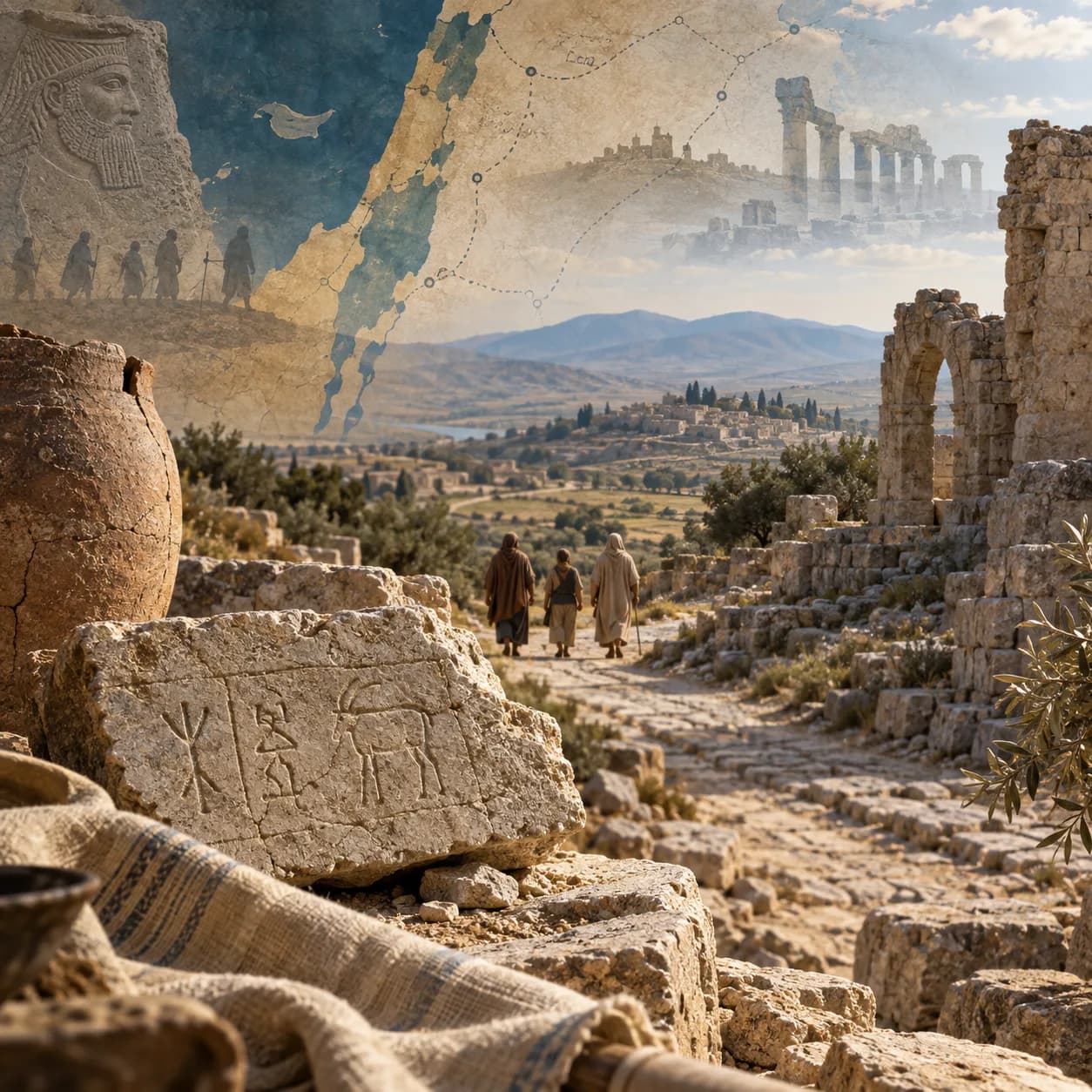
Sound comes before sight. In Exodus 19, the people are camped before Sinai while the mountain is still, from a distance, just a rise in the desert. Then the text fills the air: thunder, lightning, a thick cloud, a trumpet blast growing louder. No one rushes up to "have an experience." On the contrary — boundaries are marked, clothes are washed, waiting begins. Moses goes up and comes down; the people remain at the foot. Revelation, here, does not arrive as spontaneous intimacy. It arrives as a presence drawing near, and precisely because of that, it requires a boundary.
That is the question of Sinai: how can a liberating God dwell close by without being reduced to a tribal talisman, and how can a people freshly out of slavery receive commandments without trading freedom for oppression all over again? Exodus 19–24 answers by narrating a trembling and an ordering at the same time. The mountain shakes, but speech takes articulate shape. The fire frightens, but the word takes the form of covenant. And the law, before it is a code, appears as the means by which God's presence becomes bearable and common life stops being a mere gathering of survivors.
Do Not Touch The Mountain
The chapter's first gesture is not "go up" but "fence off." In Exodus 19, God commands a boundary to be set around the mountain and forbids crossing that line. The scene insists on this more than once. The people are to consecrate themselves; Moses receives and relays instructions; the warning is repeated so that no one will "break through" toward the Lord. The verb of religious curiosity — advance, see, touch — is restrained. Holiness, at Sinai, is not availability.
This insistence changes the tone of the whole passage. The God of the exodus has already shown himself in the crossing of the sea and in provision in the wilderness, but now he is not merely the liberator who intervenes on the people's behalf; he is the Lord who claims a particular form of approach. The text is careful to show who is acting: it is not the assembly that produces the experience — it is God who "comes down" onto the mountain. It is not Israel that invents the terms of the encounter — it is God who fixes them. Moses, for his part, hardly stops moving: he goes up to listen, comes down to speak, goes up again. This repeated movement dramatizes mediation. Between the voice and the people there is an authorized human crossing.
The literary form of the scene already teaches something decisive. Sinai is not an invitation to rule-free ecstasy. Thunder without limit would be panic; limit without voice would be mute distance. The chapter combines both. The fence around the mountain does not diminish the divine presence; it makes it possible to receive that presence without being destroyed. To read this fence literally as a mere topographical detail is to miss its function in the episode. The text states that there was a command not to cross over. Its form suggests something more: the relationship with God includes real proximity and irreducible difference.
The Voice That Speaks From The Fire
When the voice finally sounds in Exodus 20, it does not begin with a rule but with memory: "I am the Lord your God, who brought you out of the land of Egypt, out of the house of slavery." This opening matters. Before prohibiting images, murder, adultery, and covetousness, the divine speech identifies itself by the act of liberation. The authority of the commandments does not come from a moral abstraction or from the power of an empire; it comes from the God who took slaves out of a house of bondage.
This order is essential if we are not to read Sinai as though the Bible presented first a severe lawgiver and only afterward a liberator. The text does the opposite. The law is born within liberation. That is why the best-known commandments must be read with the prologue still echoing. "You shall have no other gods before me" is not a demand born of divine vanity; it is a requirement of exclusive faithfulness to the God who has just acted. "You shall not make for yourself an image" strikes directly at the temptation to domesticate the presence that, in the previous chapter, shook the mountain. A God who descends in fire does not fit into a controllable object.
Here too the scene is bodily. The people see the thunder, the lightning, the sound of the trumpet, the mountain smoking, and they tremble. Then they say to Moses: "You speak to us, and we will listen; but do not let God speak to us, or we will die" (Exodus 20:19). The request does not reject the covenant; it recognizes that the divine voice, heard without mediation, is unbearable. Moses answers that the fear came "to test you" and so that the people would not sin. There is an important shift here: raw fear is educated into reverence. One paralyzes; the other orients.
The passage affirms that Israel heard a voice coming from the midst of the fire. What it does not offer is a technical report on acoustics, meteorology, or geography. Its language is theophanic: it describes manifestation, not mechanism. Outside the text, this essay has no data to establish how, in modern terms, such phenomena would occur, nor to convert the narrative into a reproducible experiment. But within the text the meaning is clear: God's word is not an inner idea of the people; it arrives as otherness, as speech that interrupts, commands, and judges.
From Heaven To The Goring Ox
After the Decalogue, the narrative does something surprising. The same voice that forbade idols and sanctified the sabbath descends to the rough matters of ordinary life: servitude, assault, restitution, damage caused by animals, lending, bribery, care for the foreigner, the widow, and the orphan, the festival calendar. Some readers feel a drop in altitude, as if the text had fallen from the sublime into the mundane. In fact, this is exactly where Sinai shows its force.
Exodus 21–23 refuses the comfortable separation between religious experience and social organization. The God of the mountain does not speak only about worship; he speaks about wounds, debts, fences, fields, false testimony. The text's movement runs from the absolute to the concrete without asking permission. Whoever heard "you shall not murder" then encounters cases of violence with differing consequences; whoever heard "you shall not covet" then encounters rules about property and restitution; whoever received the sabbath then encounters rhythms of rest that touch not only the head of the household but children, servants, and animals as well.
This does not erase the ethical difficulties of these laws. Some reflect a harsh, hierarchical world, far from many moral commitments Christian readers hold today. The text does not hide institutions and penalties that strike us as strange. Taking it seriously does not require canonizing every social practice it regulates. It requires, rather, grasping the direction of the whole: freedom out of Egypt cannot become collective life without responsibility. Sinai does not grant permission for the strong to do as they please; it subjects force to judgment.
There is a revealing detail in Exodus 22:21–24 and 23:9. The foreigner is remembered not through abstract theory but through memory: "for you were foreigners in the land of Egypt." The experience of oppression returns as an ethical criterion. The people who were exploited must not reproduce exploitation, as though liberation existed only for their own benefit. Here the law shows its liveliest moral nerve: it turns memory into obligation.
This point carries an important interpretive consequence. Using Sinai to sanctify abuses of power, religious violence, or contempt for the vulnerable runs against the text itself. Divine presence on the mountain does not authorize sacred bossiness. It places all common life under a demand for justice born of liberation.
Blood On The Altar, Blood On The People
In Exodus 24, what was heard becomes a ratified covenant. Moses writes down "all the words of the Lord," builds an altar at the foot of the mountain, orders sacrifices offered, and reads to the people the "Book of the Covenant." Twice the assembly answers in the same direction: "All that the Lord has spoken we will do." The repetition is not careless redundancy. It turns obedience into a public, communal, assumed response.
Then comes the chapter's strongest gesture: Moses takes the blood, sprinkles part on the altar and part on the people, saying, "Behold the blood of the covenant" (Exodus 24:8). The text states this rite in direct terms; its form suggests a reciprocal bond of extreme gravity. This is not the signing of a reversible contract, but entry into a relationship that touches life and death. The blood joins the place of offering and the assembly that commits itself. The covenant does not float at the level of intentions.
Right after, however, the chapter introduces an unexpected scene. Moses, Aaron, Nadab, Abihu, and seventy elders go up; "they saw the God of Israel"; under his feet was something like a pavement of sapphire; God did not raise his hand against them; "and they ate and drank" (Exodus 24:9–11). After so much boundary, so much smoke, so much prohibition against touching, the narrative arrives at a meal before God. The contrast is decisive. Sinai is not only regulated terror. Its aim is communion without domestication.
The phrase "they saw the God of Israel" resists easy reduction. The text itself surrounds the vision with restraint: it describes what was under his feet, not his face; it preserves transcendence and still insists on encounter. What the passage affirms is this disconcerting combination of vision, preserved life, and a shared meal. What it suggests, literarily, is that the summit of the covenant is not only receiving orders, but sharing a table in peace before the holy God.
From The Peak To The Tent
If the story ended at Exodus 24, Sinai could remain an unrepeatable moment: a unique mountain, a concentrated theophany, a sublime past. But the book does not stop there. In Exodus 25–40, the narrative turns to the tabernacle. The same God who came down on the mountain commands: "And let them make me a sanctuary, that I may dwell among them" (Exodus 25:8). Presence will not stay confined to the smoke-wrapped peak; it will take shape at the heart of the camp.
This passage from mountain to tent is one of the keys to the whole. The mountain is fenced and has strictly controlled access. The tabernacle also has degrees of access and holiness, but its function is different: to sustain, along the journey, the nearness of God to a people on the move. Sinai is not abandoned; it is carried forward. The fire and the cloud, the word and the boundaries — all of it is translated into ritual space, times, furnishings, garments, procedures.
The literary form changes. We move from dramatic narrative to long instructions. Many readers grow impatient here, as if the text had traded the living moment for tedious detail. Yet these details answer precisely the problem opened on the mountain: how does holiness remain near without consuming? The measurements, the fabrics, the altar, the priesthood, the rites — all of it attempts to order a coexistence between divine presence and human fragility.
This continuation prevents two opposite errors. The first would be to think that Sinai taught pure spiritual interiority: that it would be enough to "remember God" without common form, without body, without worship. The second would be to imagine that God now fits inside the sanctuary like a domesticated deity. Neither is true. The tent extends the presence but does not capture it. The God of the tabernacle remains the God of the mountain.
When Memory Changes The Sabbath
Deuteronomy 5 reopens Sinai in a different key. We are no longer facing the immediate event but its retelling to the generation about to enter the land. The Decalogue reappears, but memory carries the scene with it: the people heard the voice from the midst of the fire, saw the mountain burning, asked for a mediator. The event becomes transmitted teaching.
The most famous change concerns the sabbath. In Exodus 20:8–11, the rest of the seventh day is grounded in creation: God made the heavens and the earth in six days and rested on the seventh. In Deuteronomy 5:12–15, the commandment is anchored in liberation: "remember that you were a slave in the land of Egypt." The two formulations are not identical, and the text does not seem anxious to erase the difference. One inscribes the sabbath in the order of the world; the other, in the history of redemption. Together, they broaden the commandment's reach. Resting is not only imitating the Creator; it is refusing the logic of slavery.
This shows something important about Scripture itself. The word received at Sinai is not treated as a dead artifact. It is taken up again, proclaimed anew, applied so as to form obedient memory. What remains is the covenant; the manner of re-presenting it brings out different aspects. The biblical text, then, already teaches how to reread without dissolving.
What can be said historically with the material available here is limited. The passages from Exodus and Deuteronomy testify that Israel understood itself on the basis of a founding revelation linked to Sinai and the covenant. This essay, however, has no independent archaeological confirmation to locate the mountain with certainty or to reconstruct, outside the narrative, each stage of the event. This uncertainty does not nullify the weight of the text; it only prevents turning theophany into a report verifiable by laboratory criteria.
Reading Sinai So As Not To Betray Sinai
The most concrete interpretive consequence is this: law, at Sinai, is not license to reduce God to commandment without presence, nor presence to emotion without form, nor authority to religious control. The whole chapter resists these three distortions.
It resists the first because the law comes wrapped in fire, cloud, voice, and fear. Commandments are not divine bureaucracy; they are the speech of the living God. It resists the second because presence is translated into concrete words, into justice for the vulnerable, into rest, into truth, into restitution. There is no spirituality of Sinai that despises one's neighbor. And it resists the third because all mediation, including that of Moses, exists to serve the covenant and protect the people, not to found an arbitrary power.
For Christian readers, Sinai remains indispensable — not as an archive of ancient harshness to be cited selectively, but as revelation that the grace which liberates also orders life. Whoever was brought out of the house of slavery received no authorization to build new houses of slavery, whether at home, in religion, at work, or in politics. The test of a faithful reading of Sinai lies not in the volume of thunder it claims, but in the shape of community it produces.
If the mountain ended in a tent, if the fire ended also in a table — "they saw God, and they ate and drank" — then the covenant was not given to keep a people forever cowering at the foot of the mountain. It was given so that they might learn to live near holiness without leaving justice and mercy behind. That is why Sinai cannot be read as a monument to religious intimidation. It is the moment when freedom takes shape, presence finds a dwelling, and power, at last, is placed under the word of the God who freed slaves.
Sources Of This Text
Primary basis: Exodus 19–24; 25–40; Deuteronomy 5. Biblical text. The literary observations refer to the passages indicated; the applications of the Memra are editorial interpretations.
This essay focuses on a comparative reading of the biblical text. It does not present archaeological confirmation or an independent reconstruction of the episode.
Continue the study in Memra
Read the complete course with progress tracking and connected references.
Open the course