Balaam and the Donkey Who Sees More
From the series The Bible Is Not Literal, published by Memra.
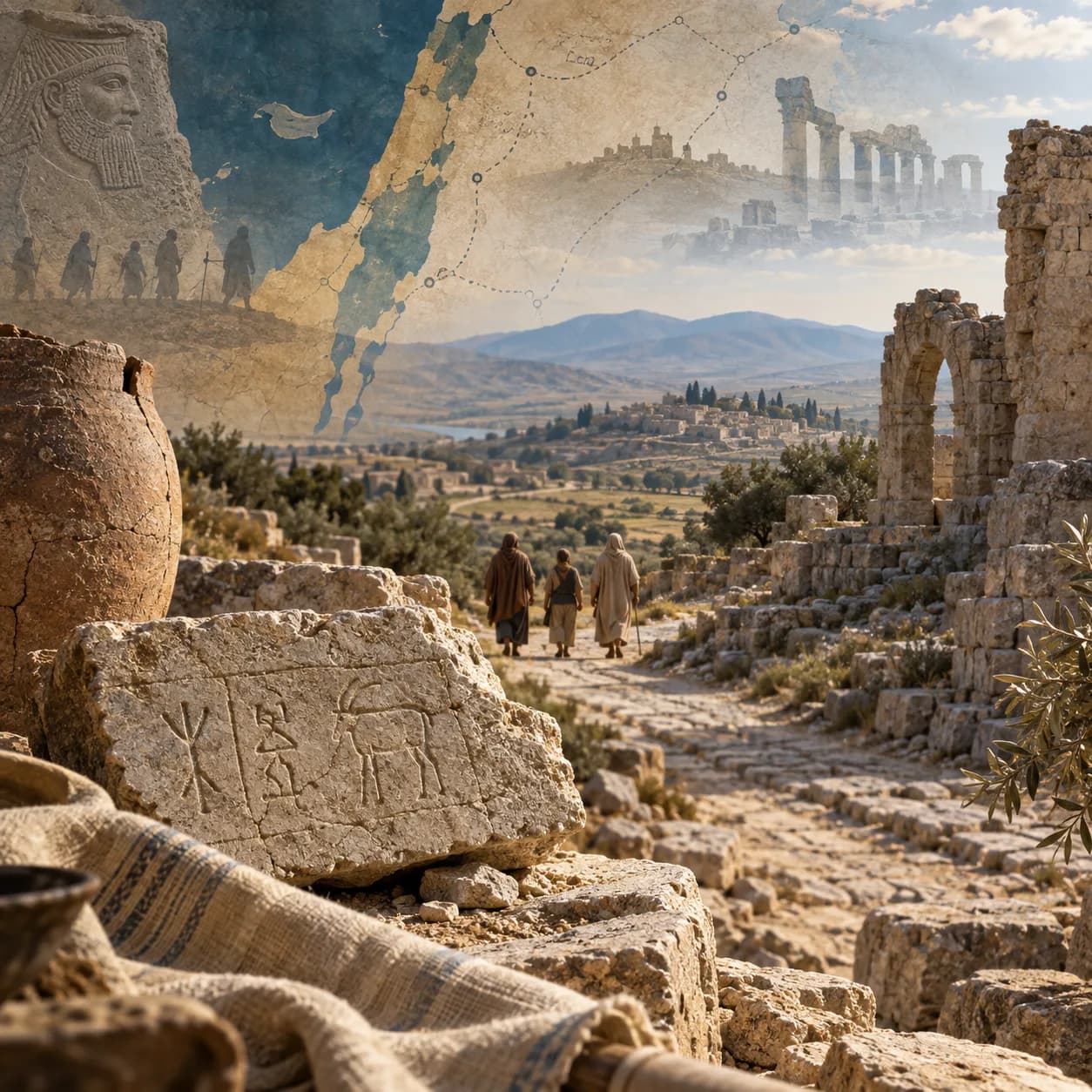
In the tightest stretch of road, walled in by vineyards on both sides, the donkey has nowhere to go. Ahead of her stands the messenger of the Lord, sword drawn in hand. Balaam, however, sees nothing. He sees the donkey. He sees the detour. He sees his own foot crushed against the wall. And he reacts like someone who imagines himself in control: he strikes her again. The scene is almost too cruel to be merely comic. An expert in handling the sacred, hired to produce a powerful word, turns out unable to perceive the most immediate danger. The animal beneath him sees more than he does.
This is how Numbers 22–24 dismantles Balaam. The episode of the donkey is not a folkloric ornament, nor a comic interlude in the middle of a political negotiation. It prepares the reader for what comes next: the man paid to curse Israel will discover, publicly, that his mouth is not for sale. Before he fails at Balak's altars, he fails on the road. Before he pronounces blessings against his own commission, he is exposed by an animal that refuses to cooperate with his blindness.
The Permission That Does Not Absolve
The tension begins before the journey. Balak, king of Moab, fears Israel and seeks out Balaam to deploy an invisible but seriously regarded weapon: the effective curse. In the world of the text, words pronounced by someone reputed to mediate the divine are not mere opinions. They carry weight, direction, expected effect. Balak does not want just a religious opinion; he wants a verbal intervention against a people who terrify him.
Balaam is not described as a prophet of Israel. Nor does he appear as an empty fraud. The account presents him as someone who genuinely consults the Lord and receives an answer. In the first approach, the answer is clear: he must not go, and must not curse, because that people is blessed. When a more prestigious delegation returns with greater promises, the ambiguity of the character deepens. Balaam says that not even a house full of silver and gold would make him go beyond the word of the Lord; but he asks the men to stay one more night, so he can see "what else" the Lord will say. The phrase holds reverence and self-interest together. The narrator does not need to comment on his motivation; the scene itself already leaves the reader suspicious.
Then comes the detail that unsettles any hasty reading. God allows him to go, provided he speaks only what he is told. Balaam rises early, saddles his donkey, and departs. And yet God's anger burns because he went. The chapter does not pause to resolve this tension didactically. It remains there, like a splinter. The problem is not simple geography, as if the fault lay merely in setting foot on a forbidden road. Permission does not suspend judgment on the heart. Balaam may go; he may not turn that permission into a license to serve his own greed or Balak's strategy.
This nuance matters. There are decisions that, from the outside, fall within what is permitted, yet still expose crooked dispositions when put to the test. Numbers 22 does not depict a contradictory God who says "go" and then punishes the physical movement. It depicts a God who permits the walk and, along the way, reveals who the walker really is.
Three Times The Donkey Sees
The account of the journey is built with remarkable precision. The messenger of the Lord takes his stand in the road as an adversary. The donkey sees him. Balaam does not. This pattern repeats three times, but never mechanically. Each scene tightens the space and escalates the violence.
In the first, there is open field. The donkey leaves the road and goes into the terrain. Balaam forces her back. There is still room to correct the course, at least from the perspective of one who cannot see the real obstacle.
In the second, the setting narrows: a path between vineyards, with walls on either side. Swerving away from the messenger, the donkey crushes Balaam's foot against the wall. The animal's resistance produces concrete pain for her master. Blindness, here, stops being merely a spiritual incapacity and becomes humiliated fury. Balaam strikes her again.
In the third, there is no margin left at all. The place is so narrow there is nowhere to turn, neither right nor left. Facing the messenger, the donkey simply lies down. Not out of stubbornness, but because there is no space left for any maneuver. Balaam responds with the only language he still thinks he commands: he beats the animal a third time.
The repetition does not merely build rhythm. It shifts meaning with each cycle. The outer space keeps shrinking while Balaam's inner world shows itself ever narrower. The donkey, who in his eyes "strays" from the path, is the only creature who actually perceives that the path is blocked. And the messenger does not appear as a neutral observer. He comes with sword drawn. He has not come to inform; he has come to stop. There is judgment on the road.
The chapter, above all, insists on the verb "to see." The donkey sees the messenger. Balaam does not see. Later, when his eyes are opened, he too sees. The irony could not be sharper: the professional summoned for his supposed perception of the invisible is contradicted by the very animal carrying him. In biblical narrative, sight sometimes separates the wise from the fool. Here, it separates the vulnerable from the violent. The donkey is not ridiculous. What is ridiculous is the man who beats the creature that is saving him.
The Mouth Opened, The Eyes Opened
Then the extraordinary happens in two stages, and the order is decisive. First, the Lord opens the donkey's mouth. Only afterward does he open Balaam's eyes.
The animal's speech has nothing mystical or sublime about it. It is domestic, almost prosaic, and precisely for that reason cutting: "What have I done to you, that you have struck me these three times?" The question raises no theology; it exposes injustice. Balaam answers at once, as if arguing with a talking donkey were the least strange aspect of the scene. His response implicates him further still: he accuses her of mocking him and says that if he had a sword in hand, he would kill her. The speech that should be at the service of the sacred now shows itself governed by rage and disproportion.
The donkey presses a simple memory: am I not your own donkey, the one you have ridden all your life? Have I been in the habit of treating you this way? Balaam is forced to admit: no. The animal, in effect, testifies to her own record of faithfulness. The creature he treated as an obstacle had been acting in keeping with years of care. The man of inspired speech must hear from his own mount an elementary lesson in discernment: not every interruption is rebellion; sometimes it is deliverance.
Only then does the Lord open Balaam's eyes. He sees the messenger and falls prostrate. The reversal has already been completed. The animal's mouth opened before the seer's eyes did. The text is saying something about spiritual authority: it is not a stable possession of office, fame, or technique. Balaam sees only when God grants him sight. And he will speak rightly only when God puts words in his mouth.
The messenger interprets the whole scene retroactively. Had the donkey not turned aside, Balaam would have been killed, and she spared. That statement changes everything. The animal not only saw first; she acted better. The resistance that infuriated Balaam was the means of his preservation. The story reaches here a harsh clarity: someone may interpret their own frustration as sabotage when, in fact, they are being spared a ruin they cannot perceive.
Altars That Do Not Deliver The Result
After the road, chapters 23 and 24 return to Balak and his commission. But now the reader already knows that the question is not whether Balaam possesses ritual skill. The question is who governs the word.
Balak leads him to high points, arranges sacrifices, builds altars, and waits for the desired pronouncement. The repetition reappears, now on a public and ceremonial scale. Again and again the setting is prepared as though the outcome could be obtained by adjusting place, angle, rite. Balak wants to find the exact vantage point from which Israel might be seen and, at last, cursed. It is a politics of sacred manipulation: if the right mountain, the right altar, and the right professional are combined, Israel's blessing might be reversed.
None of it works. In each cycle, God intervenes and puts yet another word in Balaam's mouth. The man hired to produce ruin becomes a spokesman for preservation. The king who wanted to control the language of the sacred hears, again and again, the defeat of his own plan. The high point of this reversal lies in how Balaam himself is presented in his oracles: not as the owner of a vision, but as someone upon whom a vision falls. In Numbers 24, he describes himself as one who hears the words of God and sees the vision of the Almighty, with eyes uncovered. The phrase echoes the scene on the road. His eyes are indeed open — but opened by another.
This is what makes the donkey an indispensable prologue. Without her, the oracles might be read merely as a contest between two religious agents. With her, it becomes clear that the axis of the narrative is God's freedom against every attempt to instrumentalize him. Balaam can stage the scene; he cannot produce the content. Balak can pay for the journey; he cannot buy the verdict.
What The Text Asserts — And What Its Form Suggests
On its narrative surface, the passage asserts that the donkey saw the messenger of the Lord, that the Lord opened her mouth, and that afterward he opened Balaam's eyes. It also asserts that Balaam could not curse Israel and pronounced blessings instead of curses. Those who read the chapter as miraculous report find in the text a straightforward presentation of these events; the narrator offers them without hesitation.
The literary form, however, does more than convey events. It sharpens certain meanings through repetition, contrast, and sequence. The threefold encounter on the road, the progressive narrowing of space, the escalation of the blows, the animal's speech preceding the man's sight — all of this builds a theological satire of high voltage. Balaam's religious competence is exposed as dependent, limited, and morally fragile. The narrative does not mock the supernatural; it mocks the human pretension of managing it.
For this reason, too, the episode resists two easy reductions. One need not call the scene "mere allegory" to appreciate its literary irony. And one need not ignore that irony in order to take it seriously as a narrative of divine intervention. The text works on two levels at once: it recounts something, and it shapes the reader by how it recounts it.
What The Story Allows Us To Say
Outside the Bible, the most relevant evidence is the Deir Alla inscription, in the archaeological context studied by Leiden University. It shows that the figure of "Balaam, son of Beor" circulated in ancient tradition in the Levant. Nathan Steinmeyer, summarizing the state of the question, points precisely to this: there is extrabiblical testimony to the name and the literary memory surrounding him, which rules out treating Balaam as a character invented from nothing.
But this datum has a limited reach, and it is worth respecting that limit. The inscription does not confirm the scene of the donkey, does not authenticate every detail of Numbers 22–24, and does not allow a reliable reconstruction of Balaam's historical biography. It illuminates the background of the tradition; it does not convert the plot into a verifiable report by the standards of ordinary historiography. The most that can be said, soberly, is that the character belongs to an ancient memory broader than what the Bible preserved in its final form.
This distinction does not weaken the text. It simply avoids asking of archaeology what it cannot deliver, and, conversely, avoids using a real find to prove more than it proves.
Who Sees More
The interpretive consequence of the episode is uncomfortable because it touches religion directly. Numbers 22–24 does not attack the gift of speaking in God's name; it attacks the illusion that such a gift can be possessed, sold, or managed apart from a converted heart. Balaam knows many things. He knows how to answer diplomatically, how to raise altars, how to wait for a word. What he does not know is how to submit his desire for gain and his anger to the reality of God. That is why the donkey surpasses him.
Read in a key of faith, the story proclaims that God protects his people even from threats they do not know about, and can frustrate curses before they ever reach the right mouth. Read with ethical attention, it denounces something else: the violence with which we react when someone or something interrupts our project. Balaam strikes because he interprets resistance as offense. The text asks whether we sometimes do the same — especially when we are so invested in our own role that we no longer recognize deliverance when it appears in the form of delay, embarrassment, or detour.
Balaam's road teaches us to distrust our own religious haste. Not every open door is full approval. Not every interruption is an enemy. And it is not always the one who speaks with the greatest authority who sees best. Sometimes the first sign of blindness is precisely the fury against whatever is keeping us from moving forward. The chapter ends, then, with a concrete criterion for reading and for living: faced with a powerful religious word, the decisive question is not merely whether it impresses, but whether it allows itself to be governed by God — or tries to govern him.
Sources Of This Text
Primary basis: Numbers 22–24. Biblical text. The literary observations refer to the passages indicated; the applications of the Memra are editorial interpretations.
17 · USCCB · NABRE | Numbers 22: text and notes | https://bible.usccb.org/bible/numbers/22 | — Balaam and the donkey.
18 · Leiden University | Levant: Deir Alla (Jordan) | https://www.universiteitleiden.nl/en/research/research-projects/archaeology/levant-deir-alla-jordan | — Institution responsible for the excavations; context of the Balaam inscription.
19 · Nathan Steinmeyer · Biblical Archaeology Society | Who Is Balaam Son of Beor? Part Three | https://www.biblicalarchaeology.org/daily/ancient-cultures/ancient-israel/balaam-son-of-beor-part-three/ | — Specialist synthesis; distinguishes attested literary tradition from a historically confirmed person.
Continue the study in Memra
Read the complete course with progress tracking and connected references.
Open the course