The Golden Calf and the Bronze Serpent
From the series The Bible Is Not Literal, published by Memra.
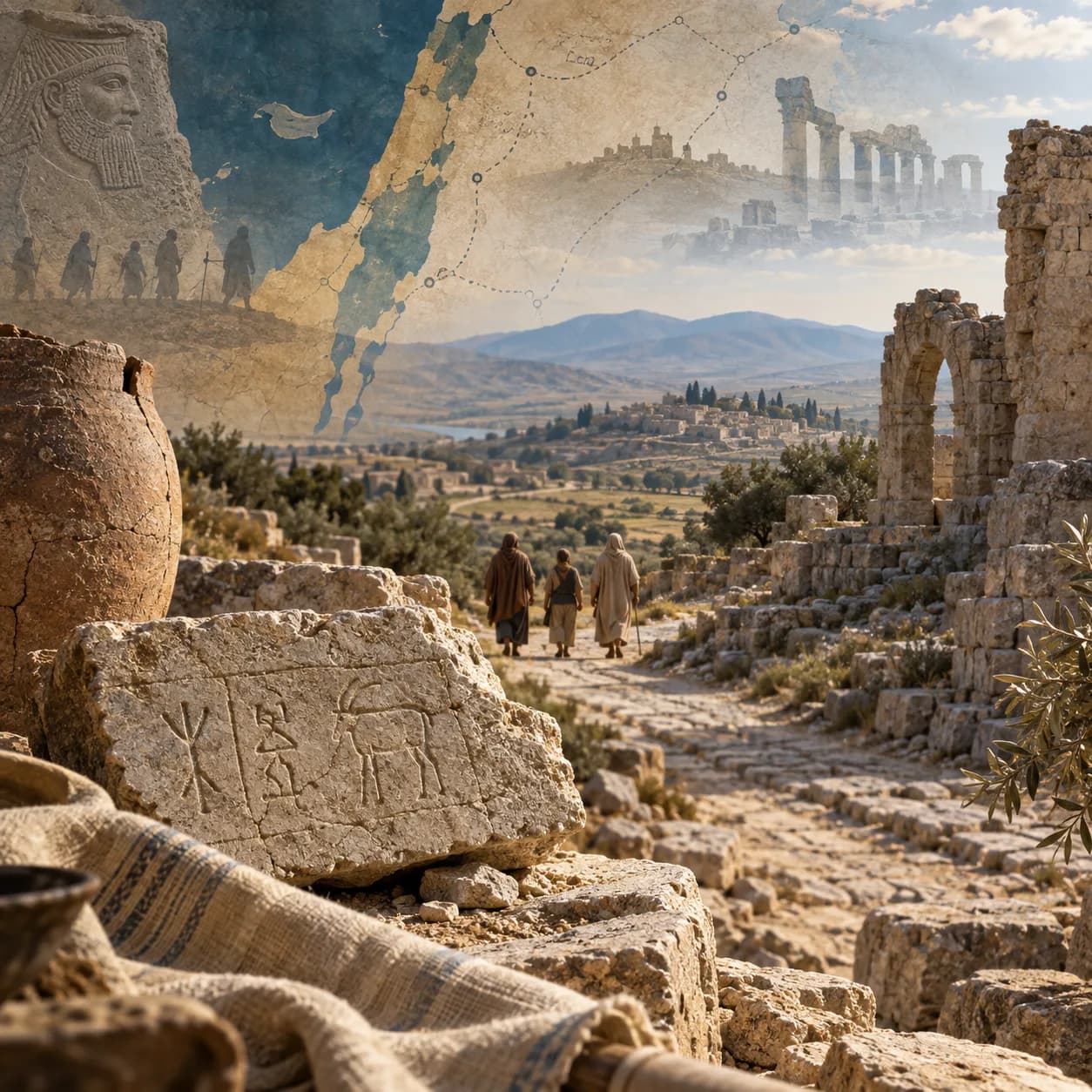
At the foot of Sinai, the people look up and see no one coming down. On the road from Edom, the people look at the ground and find serpents. Centuries later, in Jerusalem, a king looks at an ancient object and orders it destroyed. All three scenes turn on the same nerve: what happens when faith tries to fix the presence of God in something visible.
Read in isolation, they seem to push the reader in opposite directions. Exodus 32 condemns the golden calf with the severity reserved for the great ruptures of the covenant. Numbers 21 commands the making of a bronze serpent and links it to the healing of the bitten. In 2 Kings 18, that same serpent is destroyed because it has become the focus of incense offerings. This tension is not a flaw in the Bible. It is precisely the way the text guards against two equally seductive oversimplifications: the one that treats any religious object as ready-made idolatry, and the one that assumes a sign, having once served a purpose, is forever safe from corruption.
When The Mountain Feels Far Away
Exodus 32 begins with an absence. "When the people saw that Moses delayed to come down from the mountain," the community gathers against Aaron. The verb of delay sets everything else moving quickly. Anxiety does not stay contained; it turns into demand: "Up, make us gods who shall go before us." The reason given is revealing: "As for this Moses, the man who brought us up out of the land of Egypt, we do not know what has become of him."
The text exposes an exchange already underway. Instead of waiting for the God who brought them out of Egypt, the people fix their eyes on the absent mediator. At first glance the crisis looks political — a lack of leadership, a lack of direction, a lack of someone to "go before" them. But the shape of the narrative shows the crisis runs deeper. The people are not merely asking for guidance; they are asking for a manageable presence, something that can be made and set out in front of them.
Aaron gives in. He takes the gold, melts the metal, forms a calf. The contrast with what came before in the book matters. Up to this point, God speaks, promises, delivers, leads. Now human hands gather, melt, shape. The object does not descend from on high; it rises from the forge. And when the calf appears, the interpretation is already prepared: "These are your gods, O Israel, who brought you up out of the land of Egypt." The phrase seizes the central verb of the exodus — bringing up out of Egypt — and transfers it to the artifact.
There is a further unsettling detail. Aaron builds an altar before the calf and proclaims, "Tomorrow shall be a feast to the Lord." The episode does not present itself as a formal abandonment of the Lord's name in favor of some other name. What emerges is more dangerous: an attempt to domesticate the Lord into an available form, reduced to the reach of the eyes and the rite. Idolatry here does not consist merely in preferring another god. It consists in remolding the living God according to the urgency of the people.
A God Within Reach Of The Hands
The following sequence sharpens the critique. "The people sat down to eat and drink and rose up to play." The narration is brief, but the order of the gestures matters. Sacrifice, feast, celebration: the religion works. That is exactly what makes it so grave. The calf is not condemned for being ugly, exotic, or ritually ineffective. It is condemned because it offers a workable religious experience without requiring trust in the invisible God who speaks and commands.
The dialogue between God and Moses deepens this rupture. God says: "Go down, for your people, whom you brought up out of the land of Egypt, have corrupted themselves." Shortly after, Moses returns the language: "O Lord, why does your wrath burn hot against your people, whom you brought out of the land of Egypt?" There is a verbal contest over whose people this is, as if the rebellion had scrambled the very identity of the community. The object fabricated from gold is not a side detail of worship; it wounds the center of the relationship.
Then come the acts of undoing. Moses breaks the tablets, destroys the calf, grinds the metal, scatters it on the water, and makes the people drink it. The image of stability and guidance ends in dust and bitter water. What seemed solid is reduced to its material fragility. The whole scene insists on one truth: what hands have made cannot bear the weight of salvation.
If we stopped with Exodus 32, it would be easy to conclude the matter is settled: no image can have a place. But Scripture itself does not let us close the question so quickly.
A Healing That Comes From Above
In Numbers 21, the setting returns to the wilderness, but the mechanics of the narrative are different. The people "became impatient on the way." The impatience explodes into complaint against God and against Moses: "Why have you brought us up out of Egypt to die in the wilderness?" The phrase echoes the exodus in a dark register. The great act of liberation is reinterpreted as a march toward death. To this is added contempt for the food given: "We loathe this worthless food."
Then the serpents appear. The text presents them as judgment: they bite the people, and many die. For the first time in this set of episodes, the people's response includes explicit confession: "We have sinned, for we have spoken against the Lord and against you." Moses intercedes. And God responds in a surprising way. He does not simply remove the serpents; he commands that a fiery serpent be made and set on a pole. "Everyone who is bitten, when he sees it, shall live."
Here every verb carries weight. God commands; Moses makes; the bitten one looks; the bitten one lives. The object does not appear as an autonomous solution, nor as a permanent companion of the march. No one credits it with the exodus from Egypt. No one sets it "before" the community. Its function is strictly limited: to serve as a sign in the moment of judgment, so that the obedient gaze receives life.
The strangeness of the scene is part of its force. The sign of healing bears the shape of the very harm that wounded them. The narrative does not explain the mechanism; it does not invite speculation about some magical property of the bronze. The center remains the divine word received by Moses and obeyed by the wounded. The serpent, by itself, does nothing in the text. What matters is the relation between promise, obedience, and preserved life.
Here too, materiality is not despised. God does not save by means of an abstract idea. There is a pole, a raised object, lifted eyes, threatened bodies. The biblical text has no horror of the tangible. Its concern lies elsewhere: a material sign can serve faith as long as it remains a sign. When it stops pointing and starts retaining, when it captures religious attention for itself, its vocation is perverted.
Until That Day
This is exactly what 2 Kings 18 records in a dry and decisive sentence. Summarizing Hezekiah's reform, the narrator lists his acts: he removes the high places, breaks the pillars, cuts down the Asherah, and shatters the bronze serpent that Moses had made. The surprise lies in this last item. Among objects clearly tied to improper worship, there appears an object whose origin, according to Numbers, traces back to a command from God himself.
The explanation follows immediately: "for until those days the people of Israel had made offerings to it." The phrase "until those days" is anything but incidental. It marks the duration of a deviation. The object had endured through time. What had once been an instrument of healing had become the receiver of cultic smoke. The serpent was not born idolatrous, but the use made of it turned it into a rival to the trust owed to God.
The narrator adds that Hezekiah gave it a name that reduces it to its materiality — Nehushtan — as if demoting it to mere bronze. The king's gesture and the text's comment move together. The problem is no longer the memory of the wilderness, nor the possibility of giving thanks for an ancient deliverance. The problem is the cult that has attached itself to the object, making it untouchable precisely because it once proved useful.
This casts retrospective light on Numbers 21. The bronze serpent could be made without guilt because, there, its function was narrow and obedient. In 2 Kings, it must be broken because that function was betrayed. The same object passes, in the biblical story, through two distinct judgments. Not because the text is incoherent, but because the people's relationship to it changed.
Bronze, Incense, And Memory
Religious memory is a fragile blessing. Communities need markers, signs, stories, places, songs, inherited objects. Without memory, faith loses depth. But the Bible knows another possibility: remembrance can coagulate into fetish. Something received as a testimony to God's action begins to concentrate reverence, attachment, fear, and expectation in a way that no longer passes through God but stops at the object.
The smoke of 2 Kings 18 is, in this sense, eloquent. Burning incense is more than preserving an ancient relic. It is treating the object as the recipient of a cultic gesture. The sign no longer points; it absorbs. And when that happens, faithfulness does not consist in preserving the object out of respect for tradition, but in breaking it out of respect for God.
This is where the golden calf and the bronze serpent touch without merging. The calf is condemned at its origin, because it is born from the demand for a fabricated presence. The serpent is good at its beginning, because it is born from the word of God in response to intercession. One begins wrong and stays wrong. The other begins as remedy and ends as problem. The decisive point lies not in the material — gold or bronze — nor in the bare fact that an image exists. It lies in the theological place the object occupies and the kind of action it awakens.
The very literary design reinforces this. In Exodus, the initiative rises from the people to Aaron; in Numbers, it descends from God to Moses; in 2 Kings, the correction comes from a king who perceives the accumulated abuse. First, anxious fabrication. Then, a granted sign. Finally, necessary destruction. This progression resists any easy rule.
What The Text Affirms — And What It Does Not Hand Us
These passages allow us to affirm certain things with confidence. First: the Bible contains an internal critique of the religious use of objects. It does not only condemn images made against God's will; it also admits that an initially legitimate object can become corrupted and need to be eliminated. Second: a visible sign can, in certain circumstances narrated by the text itself, be commanded by God and serve to preserve life. Third: none of this data authorizes the conclusion that every sacred object is always holy, or always suspect.
It is also worth acknowledging the limits of what we have in hand. This essay works with a comparative reading of the texts. Beyond them, the evidence does not allow us to reliably reconstruct the historical trajectory of these objects. The ancient world knew animals and images charged with symbolic value; this helps us understand the force of the calf and the serpent in the imagination of the time. But it does not, by itself, prove the plot of Exodus, Numbers, or 2 Kings. The continuity of the serpent "that Moses had made" down to the time of Hezekiah belongs to the horizon of the biblical narrative; absent external support presented here, it is within that horizon that we read it.
There remains, finally, the level of faith interpretation. A Christian reader may recognize in these passages a permanent discipline against every attempt to imprison the presence of God in controllable supports. This is not an archaeological conclusion nor a scientific deduction. It is a theological reading of the text.
After The Wilderness, Inside The Church
The interpretive consequence is concrete and uncomfortable. The problem of the golden calf did not stay behind in the wilderness, and the problem of the bronze serpent did not end with Hezekiah. A community can turn into a substitute the very thing that should only serve: a devotional object, a cherished tradition, a liturgical form, the memory of a revival, a charismatic leader, even the language of orthodoxy itself. Good things, sometimes given as real help, can come to receive the trust, the fear, and the reverence that belong to God.
Scripture does not, for this reason, call for nervous iconoclasm or contempt for the materiality of faith. It does not teach us to confuse art with idolatry, memory with superstition, symbol with rival to God. What it demands is severe discernment. Always to ask: does this sign still lead us to obedience, or does it now offer us the illusion of possession? Does it still make us look toward God, or does it now make us stop at the bronze? Does it still serve the life received from the word, or does it now ask for smoke of its own?
When the answer changes, faithfulness changes with it. There are moments when preserving is right. There are moments when fabricating is already sin. And there are moments when breaking becomes an act of reform. This is the deliberate tension that all three texts preserve. Not everything visible is an idol. Not everything that once helped must remain standing. Between the mountain that seems silent, the pole raised in the wilderness, and Hezekiah's hammer, Scripture teaches us to suspect matter less than the heart that wants to control God — and to have the courage to call bronze what has gone back to being merely bronze.
Sources Of This Text
Primary basis: Exodus 32; Numbers 21:4–9; 2 Kings 18:4. Biblical text. The literary observations refer to the passages indicated; the Memra applications are editorial interpretations.
This essay focuses on a comparative reading of the biblical text. It does not offer archaeological proof or an independent reconstruction of the episode.
Continue the study in Memra
Read the complete course with progress tracking and connected references.
Open the course