Manna, Quail, and Water from the Rock
From the series The Bible Is Not Literal, published by Memra.
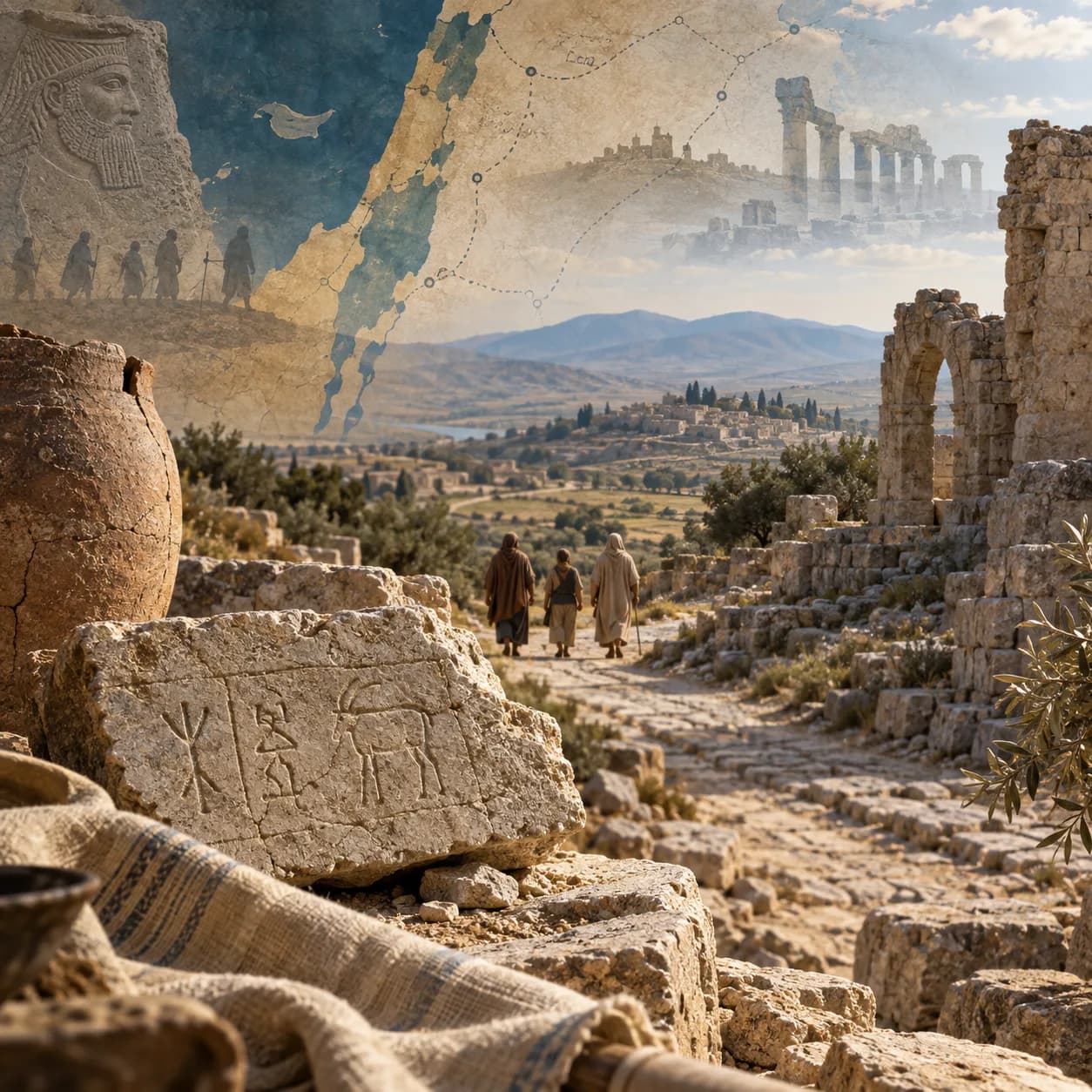
In the morning, the desert floor appears covered with a thin, fine layer, "like flakes." No one is quite sure what they're looking at. "What is it?" they ask in Exodus 16:15. The question remains embedded in the name itself: manna. But the wonder is quickly fenced in. Each family must gather only what it needs to eat that day. Whoever tries to secure tomorrow by stockpiling finds, the next day, worms and a foul smell. The miracle, here, does not offer itself as a warehouse. It arrives in the form of a food that teaches limit.
That is the key to the whole sequence in Exodus 16–17 and Numbers 11 and 20. These are not scattered scenes of wonders meant to impress the reader, as if the wilderness were simply a stage for special effects. They are episodes in which hunger and thirst cease to be private problems and become the most delicate material of communal life. A people learns, under extreme conditions, that eating and drinking are not merely biological matters; they are also matters of memory, power, justice, and trust. And Moses learns that mediating divine provision does not place him above judgment.
Bread That Spoils
In Exodus 16, the people's complaint carries the tone of distorted memory. "Would that we had died by the hand of the Lord in the land of Egypt," they say, recalling the pots of meat and the bread eaten "to the full" (16:3). Slavery disappears from the picture; only the kitchen remains. Present hunger reorganizes the past until it seems bearable. The Bible does not mock bodily need—it stages it with full force—but it exposes how deprivation can produce selective nostalgia.
The divine response does not come first as rebuke, but as provision. God announces, "I will rain bread from heaven for you" (16:4). The verb is generous, almost excessive; but that abundance is immediately disciplined. The people must go out and gather "a day's portion every day." The narrative slows down over the instructions because that is where the sign's meaning lies. The food falls from heaven, but it does not become a license for anxiety.
The details matter. In 16:16, each person is to gather "according to what he can eat." In 16:18, when what was gathered is measured, a decisive equalization occurs: "the one who gathered much had nothing left over, and the one who gathered little had no lack." The text does not pause to explain the mechanism. The narrative effect is enough: the divine gift, when obeyed, produces shared sufficiency. The miracle is not merely the appearance of manna; it is also an economy that prevents both scarcity for some and excess for others.
That is why the attempt to hoard becomes, within the plot, a refusal of the very kind of life God is forming. Some do not listen to Moses and set part aside for the next morning. The result is repulsive: "it bred worms and stank" (16:20). This is not an abstract condemnation of all material planning, as though any reserve whatsoever were sinful. The text is speaking of something else: anxious appropriation, within a newly liberated community, of a good given to everyone under the rule of the day. The lesson arises from a specific situation and must be read within that frame.
The exception of the sixth day confirms this. There, the people gather double and the food does not rot (16:22–24). The difference lies not in storage technique but in the word received. The sabbath enters the scene before any broader elaboration of Sinaitic law, and it enters bound up with food. Rest is not the luxury of those who already have plenty; it is part of the order by which God sustains his people. The holy day keeps survival from devouring the whole of time. Manna, then, does not merely answer hunger. It reorganizes the week, the body, and fear itself.
The Measure Of The Day
In Exodus 16, God himself declares that this provision will serve "to test them" (16:4). The test does not measure the capacity to endure privation heroically. It measures the willingness to receive enough without turning "enough" into a terrified possession. The test of faith, in this chapter, runs through the bowl.
This narrative shape guards the text against two poor readings. The first turns the episode into a fantasy of abundance without discipline: God provides, therefore the community may live without rule, without sharing, without limit. The chapter moves in the opposite direction. The second turns it into moralism against the hungry: the people complain, therefore their real problem is merely spiritual. That, too, fails. The hunger is there, concrete, and God does not treat it as illusion. The fault is not being hungry. The fault lies in turning hunger into a running accusation, in erasing liberation, in rebuilding Egypt as though bondage could be offset by a better menu.
There is a less obvious point as well. Manna is a strange food. Its name is born from a question; its rhythm, from a discipline; its preservation, from a holy exception. It resists domestication. Rather than settling Israel immediately into a life of stability, it teaches a dependence renewed every morning. The wilderness thus appears not only as a place of lack but as a place where freedom learns not to reproduce the logic of captivity in another form.
Massah And Meribah
In Exodus 17, the crisis shifts object and rises in temperature. Now water is lacking, at Rephidim. The people "quarrel" with Moses and demand, "Give us water to drink" (17:2). Moses answers sharply, but the sharpness reveals the danger: the scene already brushes against violence. In 17:4 he cries out to the Lord, "What shall I do with this people? A little more and they will stone me."
Thirst here is no pious metaphor. It is immediate threat. Precisely for that reason the narrative lets the submerged question surface: "Is the Lord among us or not?" (17:7). This is the point at which material need becomes theological crisis—not because water ceases to matter, but because its absence seems to disprove divine presence. The wilderness compresses body and faith into the same vise.
The response comes publicly. God tells Moses to go ahead of the people, take some elders, take the staff with which he struck the Nile, and strike the rock at Horeb (17:5–6). The elders serve as witnesses. The staff recalls earlier acts of power. The rock, an unlikely site for a spring, becomes the focus of the action. Water flows out, and the community lives.
But the episode does not end with the gushing water. The place receives a name: Massah and Meribah. Testing and quarreling are inscribed into the geography of memory. The place-name does more than locate; it interprets. The people will not remember only that there was water. They will also remember how they moved through the crisis: testing, contending, asking whether God was present or not. The Bible does not let the provision erase the disorder of the scene.
Meat And Desire
When Numbers 11 takes up the theme of food again, it is not the same scene revisited. The setting is similar; the tone, darker. The complaint now has tears and a chorus. The people weep, "each at the door of his tent" (11:10). The memory of Egypt returns, again culinary: fish, cucumbers, melons, leeks, onions, garlic (11:5). The oppressive past reappears as a generous market. The present, reduced to manna, feels unbearable.
The text does something notable: precisely when manna is being despised, it describes it with care. In 11:7–9 it details its appearance, the way it was prepared, its taste. The narrator does not deny that the food could grow monotonous; but neither does he allow it to be reduced to a symbol of abandonment. The gift remains a gift, even as it wearies those who receive it.
The dramatic center of the chapter is not merely the demand for meat, but the transformation of desire into collective insubordination. God declares he will give meat, not for one day but for a month, "until it comes out of your nostrils and becomes loathsome to you" (11:20). The phrase is deliberately harsh. The request will be granted in a way that exposes it. Not every concession is approval.
In the midst of this food crisis, the narrative opens another front: Moses collapses under the weight of the people. He complains that he cannot carry this burden alone (11:11–15). God then distributes among seventy elders the spirit that was upon Moses (11:16–17, 25). This insertion matters. Before the meat arrives, a redistribution of responsibility arrives first. The community's problem is not only scarcity or desire; it is also an overburdened leadership. The wilderness tests not only the trust of those who follow but the capacity of those who lead.
The quail finally come in abundance (11:31–32). The people gather them feverishly. And then the chapter dismantles any simple reading of a happy miracle: "while the meat was still between their teeth," the Lord's anger is kindled and a plague strikes (11:33). The place receives another name, Kibroth-hattaavah, "graves of craving" (11:34). The sequence is harsh because it wants to separate need from covetousness. Appetite itself is not the enemy; the desire that rewrites liberation as mistake, and mistakes the present gift for offense, is.
Blows On The Rock
Numbers 20 returns to thirst while, at the same time, shifting the tragedy's setting. Once again there is no water; once again the people quarrel with Moses and Aaron; once again comes the accusation that it would have been better to remain in Egypt (20:2–5). The repetition makes the reader recall Exodus 17. But the similarity is what prepares the decisive difference.
This time, God tells Moses to take the staff, gather the congregation, and speak to the rock before the people, so that it will give water (20:8). Moses, however, before the assembly, explodes: "Hear now, you rebels; shall we bring water for you out of this rock?" (20:10). He then raises his hand and strikes the rock twice (20:11). Water gushes out abundantly. The people and the livestock drink. Real need is met.
It is precisely this that makes the scene more serious. The practical outcome does not absolve the act. God says to Moses and Aaron, "Because you did not believe in me, to uphold me as holy in the eyes of the sons of Israel, therefore you shall not bring this assembly into the land" (20:12). The failure lies not in helping the people, nor in recognizing the gravity of their thirst. It lies in how the mediation was carried out before everyone.
The contrast between speaking and striking carries much of the episode's weight. In Exodus 17, striking the rock fell within the order received. In Numbers 20, it did not. Repeating an old solution outside the present word becomes disobedience. Added to this is Moses' phrase—"shall we bring out water"—which dangerously draws the mediator close to the source itself. The irritated leader, under legitimate pressure, turns a public crisis into a scene of exasperation and control. The water flows, but God's holiness is not honored.
This chapter forecloses any comfortable conclusion: effectiveness and faithfulness are not the same thing. A leadership can produce the expected effect and still fail in how it represents God and treats the people. For religious readers, the warning cuts sharp. The text does not shield the leader simply because he occupies a central place in the sacred story. On the contrary: the more visible the mediation, the more public the responsibility.
What The Wilderness Lets Us Know
From a historical and environmental standpoint, the background of these narratives is broadly plausible. Arid regions make water and food matters of collective organization, not just individual initiative. Crossing the desert demands discipline of route, distribution, and vigilance. This helps explain why the Bible chooses the wilderness, precisely, as the site of social and theological learning.
There are also natural analogies often invoked: sweet substances produced by certain plants or insects, quail migrations, springs associated with rock formations. Such parallels can make some elements imaginable. But the reach of that observation must be measured carefully. They do not demonstrate the event as narrated in the text: they do not prove the daily regularity of manna for the whole community, nor the sabbath pattern, nor the link between the demand for meat and judgment, nor the gushing of water exactly under the conditions described. Science can illuminate possible scenarios; it does not verify the final shape of the narrative as though it were a technical report.
On the literary plane, the differences between Exodus 16–17 and Numbers 11 and 20 should likewise not be smoothed over too quickly. There are repeated motifs—hunger, thirst, complaint, provision, naming of the place—and there are significant shifts of emphasis. This may indicate that distinct traditions were preserved and brought together theologically, something Christine Hayes notes in discussing the composition of the exodus traditions. The final text does not read as a simple duplicate, nor as a raw inventory of facts. It works crisis memories into a vision of the wilderness as a school of covenant.
The evidence, however, does not settle everything. It is not possible to say with certainty, from these passages alone, whether we are looking at wholly separate episodes, reinterpretations of analogous experiences, or reorganized parallel traditions. The uncertainty lies exactly there: in the historical relation between the scenes. What the text gives us clearly is its narrative and theological intent.
What These Scenes Demand Of Us
A reading of faith, especially a Christian one, can recognize here more than memories of survival. It can see a God who sustains his people without treating the body as an embarrassing detail, and who at the same time refuses the idolatry of possession, of nostalgia, and of irritated religious power. But such a reading stays honest only if it does not crush the material weight of the plot. The people are truly hungry. Truly thirsty. And God answers real needs.
A concrete interpretive consequence follows from this. These chapters do not authorize using the word "murmuring" to silence the cry of anyone who suffers. Hunger and thirst are not sins. What the text judges is the rebellion that turns the memory of liberation into chronic ingratitude, and desire into refusal of the gift received. In the same way, these chapters do not authorize leaders to hide behind their own office. Moses does not enter the land because, at Meribah, he struck the rock and failed before the people. The Bible, here, is severe with sacred power.
This is also why manna remains central. "The one who gathered much had nothing left over, and the one who gathered little had no lack." This sentence, in Exodus 16:18, offers more than a wilderness curiosity; it offers a criterion. Where a community reads these passages seriously, provision cannot be thought of merely in terms of private miracle or individual merit. It must be organized so that the abundance of some is not fed by the lack of others. The wilderness did not teach Israel to spiritualize deprivation, but to receive it as a shared problem under the word of God.
In the end, perhaps the most striking sign is neither the food that falls nor the water that springs forth. It is the fact that the text insists on binding together gift, limit, and responsibility. The bread from heaven cannot be hoarded as though life depended only on fear. The craved meat can become judgment. The water from the rock can flow even when the leader fails. And the presence of God, far from dispensing with communal order, is precisely what demands it.
Sources Of This Text
Primary base: Exodus 16–17; Numbers 11; 20. Biblical text. The literary observations refer to the passages indicated; the Memra applications are editorial interpretations.
14 · Christine Hayes · Yale | Exodus: From Egypt to Sinai | https://oyc.yale.edu/religious-studies/rlst-145/lecture-8 | — Composition and theology of the exodus traditions.
Continue the study in Memra
Read the complete course with progress tracking and connected references.
Open the course