The Open Sea: The Memory of the Exodus
From the series The Bible Is Not Literal, published by Memra.
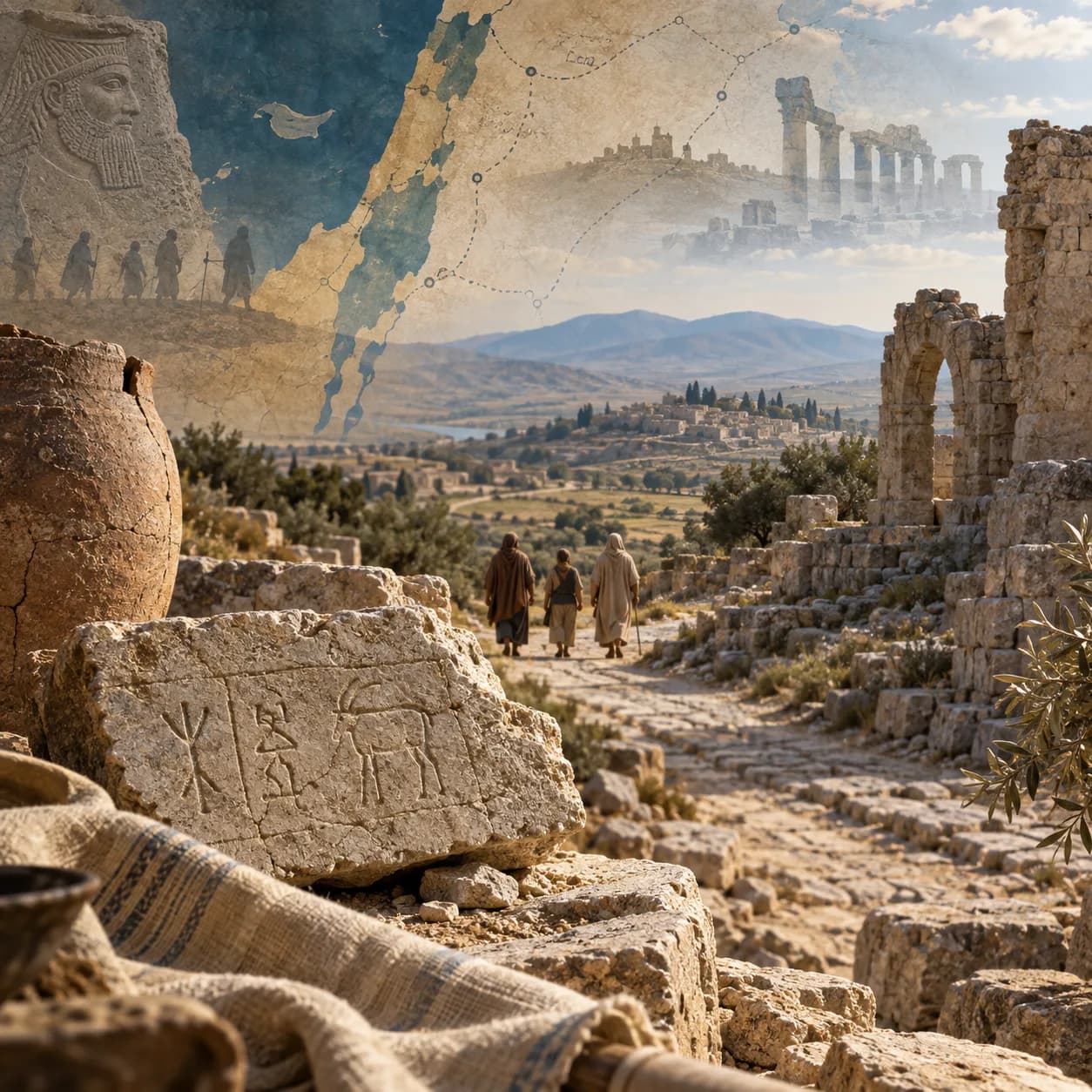
The people have the sea in front of them and the army behind. The decisive detail is that this predicament was no accident of the road. At the beginning of Exodus 14, it is the Lord himself who orders Israel to change course and camp in a place that will make them look disoriented, vulnerable, easy to recapture. Pharaoh will see a lost band in the wilderness; God, however, sees a scene set up to reveal who truly rules history. The text builds the tension from this point: liberation does not move in a straight line. It passes through a dead end.
This trait matters because it rules out a sentimental reading of the episode. The crossing of the sea is not the successful escape of people who planned well. It is the passage of a people who have already left Egypt and yet discover that freedom can include a night in which everything seems to reverse. The biblical memory of the exodus is born at exactly this point: between the panic of the people, the obstinacy of Pharaoh, and the action of God, who turns the dead end into a road.
Cornered On Purpose
The first half of the chapter is dominated by looking. Pharaoh "will see" Israel hemmed in; the Israelites "lift up their eyes" and "see" the Egyptians advancing; Moses responds by inviting them to "see" the salvation of the Lord. What changes the scene is not yet any movement by the people, but a dispute over what is being seen.
When the Egyptians draw near, Israel reacts with bitter clarity: "Were there no graves in Egypt, that you have taken us away to die in the wilderness?" The line mixes sarcasm, fear, and selective memory. Egypt, the place of servitude, appears for a moment as a place of safety. The text does not flatter the freed people. They grumble, they accuse, they prefer the bondage they know to the risk of the promise. The drama of the crossing includes this inward regression: leaving the empire is one thing; ceasing to think like a slave is another.
Moses answers with three short imperatives in Exodus 14:13-14: "do not fear," "stand firm," "see." Then comes the most surprising line: "The Lord will fight for you, and you have only to be still." The words seem to call for absolute stillness. Yet a few verses later, God commands the people to march. The tension is not a literary slip; it is a way of ordering priorities. Israel will not win by its own strength, but that does not exempt it from crossing over once the way opens. Faith here does not consist in engineering the exit, nor in standing frozen before it.
The literary shape of the chapter reinforces this logic. Pharaoh commands horses, chariots, and officers; Israel has only the word it has received and the necessity of obeying under threat. The text dwells on the Egyptian military apparatus because it wants the reader to feel the disproportion. Salvation will be recognized as salvation precisely because nothing in the scene allows for a self-sufficient explanation.
The Column Between Two Worlds
Before the waters part, something shifts in the narrative space: the column that had gone ahead moves behind, between Israel's camp and that of the Egyptians. This movement, in Exodus 14:19-20, is a small dramatic miracle. The guide becomes a bodyguard. The presence that had been leading now blocks, creates distance, buys time.
The verse works with a strong contrast: on one side, darkness; on the other, light through the night. The same divine presence that protects one people confounds the other. The text states this without embarrassment. For its theology, Israel's liberation and Pharaoh's judgment belong to a single act. They are not two parallel events. The night of the crossing is a night of separation.
This point tends to unsettle modern readers, and rightly so. The chapter does not offer a generic spirituality of overcoming. It narrates the downfall of concrete pursuers. It would be a mistake to soften this dimension. It would equally be a mistake to turn it into license for demonizing today's adversaries. The text speaks of a conflict in which the oppressor is Pharaoh, already defined throughout Exodus as the king who enslaves, hardens his heart, and persecutes. The story does not hand out a ready-made label to be pasted onto whatever enemy a reader chooses.
Literarily, the column between the two camps does more than separate characters. It divides two regimes of reality. Behind it, the logic of empire still holds: force, pursuit, capture. Ahead of it, a people will be invited to walk across ground that does not exist under normal conditions. The passage to freedom requires this fold in the world.
The Night Of The Wind
Then Moses stretches out his hand, and the Lord drives back the sea "by a strong east wind all that night." The detail of the whole night deserves attention. The scene is not instantaneous. The text slows down. There is waiting, darkness, duration. Liberation does not arrive as a trick; it takes time, spanning hours in which the people remain exposed.
An important question arises here for reading the text. The passage affirms that God acts, and it names the wind as the means of that action. It does not debate whether the wind is a "natural cause" as opposed to divine agency. That opposition is ours, not the chapter's. In biblical narrative, the Creator can act through what belongs to his own creation. Saying there was wind does not weaken the theological meaning of the episode; it is part of it.
Historically, though, this detail does not settle the reconstruction of the event. One can imagine physical conditions under which shallow waters are temporarily driven back by wind. This possibility shows that the scene is not inherently absurd from a material standpoint. But physical possibility is not the same as historical proof. The text of Exodus 14-15 remains far more solid as literary and theological memory than as a verifiable map. Christine Hayes observes, when discussing the exodus traditions, that the account reached its biblical form as memory shaped theologically, and this affects the kind of question it allows us to answer with confidence. The chapter clearly affirms that Israel attributed its deliverance to the Lord's action; it does not give us the tools to fix with precision the geographical setting and empirical scale of the event.
This distinction matters. The passage claims that God opened a way through the sea. Its narrative form suggests an intervention involving duration, suspense, and the mediation of wind. Historical inquiry can discuss plausibilities and uncertainties. The interpretation of faith confesses the hand of God there. Blurring these two planes produces only false certainty or false disillusionment.
Water To The Right And To The Left
When the path appears, the text reaches its most powerful image: "the waters were a wall to them on their right hand and on their left." This is not simply crossing some soaked ground. The narrative wants the reader to feel the abnormality of the space. The sea, a symbol of boundary and threat, comes to obey as though it had internal corridors.
The chapter works through successive reversals. What had blocked now leads. What had protected Egypt as a natural barrier no longer serves the empire. The chariots, the pride of Egyptian warfare, become useless weight. When the Egyptians enter after Israel, God "throws into confusion" their camp, clogs the wheels of their chariots, and the war machine falls apart in the very element it thought it controlled. Even the pursuers' own words acknowledge the reversal: "Let us flee from before Israel, for the Lord fights for them against the Egyptians."
This line is central. The people who had just been told to stand still now receive, from the enemy's own mouth, confirmation of their true advantage. Israel has no military superiority. It has a God who acts. The repetition of the verb "fight" ties Moses's word of assurance to what actually happens on the ground. What had been spoken in confidence becomes visible in the enemy's defeat.
It also matters who performs each gesture. Moses stretches out his hand over the sea; the Lord makes the waters withdraw and then return. The servant acts as an obedient mediator, never as a technician of the wonder. At the end, in Exodus 14:31, the people fear the Lord and believe "in the Lord and in his servant Moses." The order is telling. Moses matters, but as a servant. The chapter legitimizes his leadership without displacing the center of the action.
The morning seals the reversal. The sea returns to its place "when the morning appeared," as if creation itself resumed its ordinary form once it had served the rescue. For Israel, the night opened a future. For Pharaoh, it closed off a claim: the claim to recover by force what God had set free.
When Narrative Becomes Song
If Exodus 14 ended with bodies washed up on the shore, we would already have a climax. But the text is not content with the scene. It immediately transforms it into song. Exodus 15 is not a devotional appendix. It is the interpretation of the event in poetic language.
The opening verse concentrates the theme: "I will sing to the Lord, for he has triumphed gloriously; the horse and his rider he has thrown into the sea." The prose had spread the tension across stages; the poetry condenses it all into one memorable image. Notice what disappears and what remains. The tactical detail disappears; what remains is the asymmetry between imperial power, represented by horse and rider, and the sovereign act of God, who "throws" them into the sea. The victory is narrated from above, already converted into communal memory.
The song intensifies certain aspects of the episode and silences others. It magnifies the majesty of the Lord, compared to a warrior, and dwells on the ruin of the enemies. It is not a neutral chronicle. It is praise. This helps us understand the difference in register between the two chapters without forcing an opposition between them. The prose presents the sequence; the poetry gives it cultic meaning. The people do not keep the exodus merely as information about the past. They keep it as a word to be repeated before God.
The repetition is decisive. "The Lord is my strength and my song"; "your right hand, O Lord"; "who is like you?"; "the Lord will reign forever and ever." The poem moves from the shore to the divine kingship. The issue is no longer just the end of a pursuit, but the revelation of who truly governs above Pharaoh. In a world where imperial kings embodied almost absolute power, the song shifts the axis: the true king is not found in the sunken war chariot, but in the God who saves.
The final verses project this memory forward, toward the sanctuary and God's dwelling with his people. The exodus from Egypt is not liberation into emptiness. The whole chapter points toward belonging, worship, and a way forward. This is why Miriam reappears with tambourines and dance, repeating the central line of the song. The memory ceases to be merely verbal; it becomes bodily, collective, rhythmic. Liberation must be sung, so that it will not be forgotten.
What We Can And Cannot Say
On the importance of the crossing for the Bible, the evidence is clear: this is a founding memory. The episode organizes Israel's identity, closes out the exodus from Egypt, and prepares the way for the wilderness and Sinai. Its enduring weight in later biblical tradition confirms this. On the precise historical reconstruction, the situation is different.
The biblical text does not allow us to locate the exact point of the crossing with certainty. The available external evidence likewise does not authorize us to affirm, with verifiable certainty, every empirical contour of the event on the scale that the book narrates. Behind the final tradition there may have been memories of flight, displacement, and liberation tied to Egypt; there may also have been a long process of composition and communal rereading before it reached its present form. Hayes draws attention to this process of formation of the exodus traditions. What remains uncertain is how far we can convert this theological memory into detailed historical description.
This does not reduce the text to empty fiction. What it does reduce is our own pretension to treat it as a modern report. Exodus 14-15 aims to shape the memory of a people, not to satisfy the curiosity of an expert in ancient topography. Reading the chapter well means respecting this kind of truth. There is possible historical truth here, but it reaches us already worked over by confession, liturgy, and narrative art.
Memory Of The Exodus, Without Triumphalism
Perhaps the most concrete interpretive consequence lies here: this chapter teaches how to remember liberation without turning it into arrogance. The people reach the far shore unable to credit themselves with the victory. They did not cross because they were more disciplined, stronger, or purer. The crossing exposes their fear, their complaint, and their dependence. All of this should inoculate against any triumphalist reading.
For Christian faith, the scene continues to speak as a paradigm of salvation: God opens a future where no way out is visible and leads his people along a path that he himself creates. But this appropriation is faithful to the text only if it preserves its ethical gravity. The sea does not authorize rhetorics of holy war for today's disputes. The God who defeats Pharaoh is not a mascot for projects of domination. The memory of the exodus serves those who resist oppression far better than it serves those looking for sacred varnish for their own power.
There is also a less grandiose, more immediate lesson. Between the command to "stand firm" and the command to "march," the chapter teaches the rhythm of biblical trust. First, recognize that salvation is not born of our own control. Then, when the way opens, walk into it. Neither the panic that turns back toward Egypt, nor the activism that invents shortcuts. The memory of the open sea calls for a humble practice of freedom: to move forward without forgetting who opened the passage.
Sources Of This Text
Primary basis: Exodus 14-15. Biblical text. The literary observations refer to the passages indicated; the applications in the Memra section are editorial interpretations.
14 · Christine Hayes · Yale | Exodus: From Egypt to Sinai | https://oyc.yale.edu/religious-studies/rlst-145/lecture-8 | — Composition and theology of the exodus traditions.
Continue the study in Memra
Read the complete course with progress tracking and connected references.
Open the course