The Ten Plagues: A Confrontation with Absolute Power
From the series The Bible Is Not Literal, published by Memra.
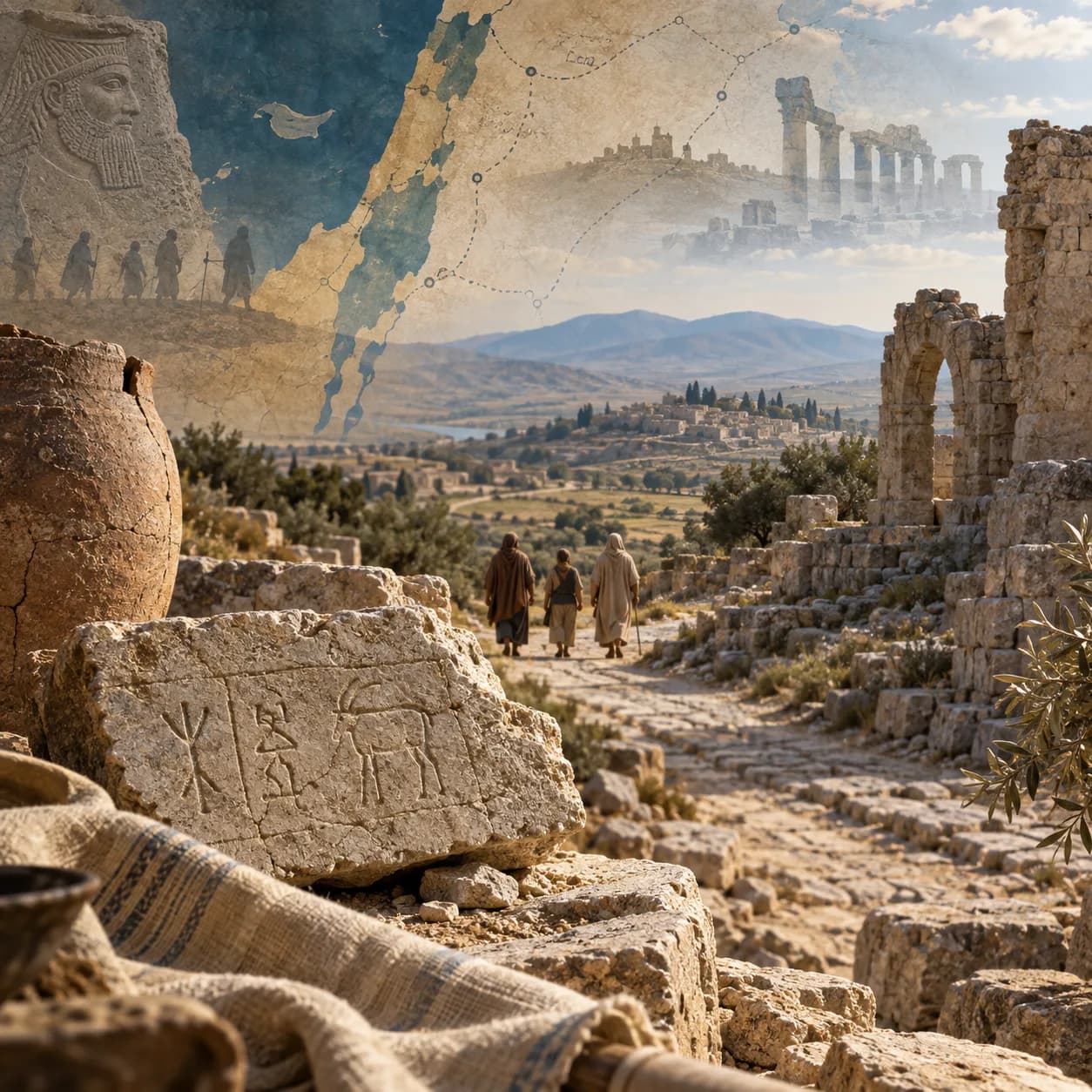
The day has barely broken, and the meeting already carries something of ritual and defiance. Pharaoh goes down to the Nile, the river that sustains Egypt, and Moses waits for him on the bank with a word he can no longer bear to hear. The first blow of the series does not fall on the palace but on what makes the palace possible: water. In Exodus 7, the river turns to blood, the fish die, the stench covers the land, and what seemed permanent reveals itself to be vulnerable.
The scene sets the tone for everything that follows. The plagues are not an arbitrary collection of dark wonders. The text organizes them as the progressive dismantling of a power that considered itself limitless. Pharaoh controls labor, bodies, time, and territory. The God of Israel asks for one thing, repeated almost to exhaustion: "Let my people go, that they may serve me." The whole conflict fits inside that sentence. It is not merely about geographic departure. It is about who human service belongs to, who has the right to demand total obedience, who may call a people "mine."
At The Bank Of The Nile
The first plague already shows how the narrative frames this confrontation. In Exodus 7:17, the strike on the Nile comes with a formula of recognition: "By this you shall know that I am the Lord." What is at stake is not a display of force for its own sake; it is the shattering of an illusion of sovereignty. Egypt depends on the river to live, to plant, to transport goods, to order the year. When the water fails, it is not some incidental feature of the landscape that fails—it is the nerve center of stability itself.
The text insists on concrete effects. The fish die. The river stinks. The Egyptians must dig around the Nile to find water. This is not an abstract marvel; it is a disruption of everyday life. At the same time, the scene includes a telling detail about the court magicians: they manage to reproduce the sign on a small scale. It is a sharp observation by the narrator. The rival power can even imitate the damage—but it cannot restore the world. The court knows how to duplicate the spectacle, but it does not know how to heal what breaks.
This note recurs throughout the cycle. The narrative does not present Moses and Aaron as better conjurers than the Egyptians. It presents the word of the Lord as the one that creates a new world and strips the empire's techniques of authority. That is why the story begins, before the first plague proper, with the staff that becomes a snake and swallows the staffs of the magicians (7:8–13). From the outset, the issue is absorption and defeat: Egypt's sign is swallowed by the sign of the God of Israel.
"LET MY PEOPLE GO"
The recurring phrase stitches the plagues together from beginning to end. Sometimes it comes with the addition "that they may serve me in the wilderness"; sometimes the request is followed by the warning of a new calamity. It always returns to the same dispute over possession and service. Pharaoh's position amounts to: they are mine. The Lord's response: they are my people.
This repetition rules out a sentimental reading of the exodus. The goal of liberation is not some vague idea of individual autonomy. It is the end of a concrete servitude. The verb "to serve" changes masters. What Pharaoh holds onto are workers; what God claims are worshippers. And the text does not separate the two, as though worship were an escape from the world. Israel must leave in order to serve God, because it is prevented from serving him while it is forced to sustain the machinery of empire.
The organization of the plagues reinforces this mounting pressure. Many readers note three sets of three, followed by the final blow. Without turning this into a rigid diagram, the pattern helps us hear the cadence of the chapter. There are morning announcements, confrontations in Pharaoh's presence, acts carried out without warning, moments when the king negotiates, temporary relief, and relapse. The drama advances in waves, not in a straight line.
First come blows that invade and humiliate: frogs everywhere, gnats or lice out of the dust, swarms that make the land unbearable. Then the focus widens to the economic and bodily foundations of life: livestock, skin, crops. Finally, sky and light collapse: destructive hail, locusts consuming what remains, thick darkness. One by one, the Egyptian world loses the supports on which it imagined its safety rested.
There is also a significant shift partway through the narrative: the text begins to highlight the distinction between the Egyptians and Israel. In Exodus 8:22–23, the land of Goshen is spared the swarms; in 9:4–7, Israel's livestock is distinguished from Egypt's; in 10:23, while darkness covers some, there is light in the dwellings of others. This selectivity is part of the text's claim, not a decorative detail. Judgment is not portrayed as blind chaos. It has direction, aim, and narrative purpose: to show that the Lord knows how to separate, to judge, and to deliver.
When The Magicians Stop
In the early episodes, the Egyptian court still responds. The magicians reproduce the sign of blood, reproduce that of the frogs, keeping up for a while the appearance of equivalence. Pharaoh can go on telling himself that nothing decisive has happened. But then comes the moment when the empire's symbolic machinery jams.
In Exodus 8:19, faced with the plague of dust turned into small insects, the magicians tell Pharaoh: "This is the finger of God." They do not convert, do not become allies of Moses, but they recognize a limit. Their vocabulary shrinks: they no longer speak of strategy, of diplomacy, of chance. They speak of God. It is the first explicit crack in the court's self-sufficiency.
Later, in 9:11, the defeat becomes physical. The magicians "could not stand before Moses" because of the boils. The narrator handles this reversal skillfully. At first they stood, on stage, competing. Now they cannot even show up. The bodies of the regime's experts become proof of the regime's own failure. Egypt has lost not merely an argument but its composure.
These details matter because they reveal the text's literary texture. The plagues are not simply a sequence of events. They are enactments of collapse. There is a calculated progression from imitation to recognition, and from recognition to incapacity. Pharaoh's world is gradually losing both the language and the posture needed to sustain its claim to control.
The Heavy Heart
If the plagues display the empire's external collapse, Pharaoh's heart displays its internal core: obstinacy. Almost after every reprieve, he backslides. He asks Moses to pray, promises to let the people go, and once the pressure eases, he hardens again. With the frogs, this appears clearly in 8:15: he sees that there is relief, and he hardens his heart. With the hail, in 9:27, he even confesses: "I have sinned this time; the Lord is righteous, and I and my people are wicked." It is a striking admission. But once the rain, hail, and thunder cease, he sins again and hardens his heart once more (9:34–35).
The narrative is almost clinical at this point. Pharaoh's problem is not lack of information. He sees, hears, suffers, negotiates, admits guilt. And still he returns to the same place. His conscience is not absent; it is overpowered by the need to keep his own sovereignty intact. The text understands that there are people who learn only for as long as it hurts.
Across the chapters, the formulation varies. Sometimes it says Pharaoh hardens his own heart; sometimes that his heart hardens; sometimes that the Lord hardens Pharaoh's heart. This oscillation is not a flaw to be corrected but part of the story's theological weight. The text offers no abstract theory of freedom and determinism. It places the reader inside a process in which repeated refusal becomes character, and character becomes judgment. The man who refuses to listen gradually becomes, himself, incapable of listening.
It is worth noting the verb implicit in this imagery: the heart becomes heavy. It is not merely hard, like stone. It is heavy, inert, without moral mobility. The irony is fine-grained. The absolute sovereign, who moves multitudes, can no longer move himself.
The Night Of The Firstborn
Everything converges on the tenth plague because it strikes power at its most sensitive point in the ancient world: the household, the inheritance, continuity. Up to now Egypt has lost comfort, harvest, livestock, skin, light. Now it will lose the future. In Exodus 11, the blow is announced as final. In 12:29–30, it happens at midnight, from Pharaoh's firstborn to the firstborn of the captive, and among the animals as well. The breadth of the statement is deliberate: no level of society is left outside the mourning.
It is impossible to read this scene honestly and treat it as a mere religious special effect. The text does not conceal the gravity of what it narrates. "There was a great cry in Egypt," says 12:30. The same country that made Israel groan now groans itself. This correspondence lies within the logic of the whole book. The exodus began, in its opening chapters, with a policy against the Hebrew children. The final blow answers that original violence by striking the very domestic structure of the oppressor. Even so, an answer does not mean moral simplicity. The reader remains before a difficult page.
There is, however, a decisive contrast in the scene. Throughout the whole cycle, Pharaoh tries to control the rhythm: he summons Moses, bargains over terms, concedes little, then takes it all back. In the tenth plague, it is he who calls "by night" (12:31). The hour is no longer his. His speech changes tone: "Rise up, get out from among my people." The man who used to say "mine" about other people's bodies must now release what he was holding. The text makes absolute power speak the language of defeat.
Memory Marked On The Doors
Chapter 12 shifts the narrative's register in a surprising way. The plot does not run directly toward departure; it slows down to institute a rite. The month becomes "the first of months" (12:2). Israel's time is reset. It is not enough to say that God delivered them; it is necessary to teach how that deliverance will be remembered.
The Passover instructions are meticulous because memory, here, is not decorative. The lamb, the hurried meal, the loins girded, the sandals on the feet, the staff in hand, the blood on the doorposts: all of it composes a pedagogy of urgency. The house becomes a place of protection and transmission. In 12:13, the blood is a "sign." The text does not treat it as a magical mechanism but as a mark of belonging within obedience to what God commands. In 12:26–27, when the children ask the meaning of the rite, the answer must lead them back to the deliverance.
This movement is central to understanding the shape of the account. The tradition does not merely want to preserve the memory of an ancient catastrophe. It wants to turn that memory into a practiced identity. Liberation is not filed away in an archive; it comes to the table, organizes the calendar, shapes the family's language. History becomes liturgy.
In Christian reading, this Passover vocabulary will carry forward and take on new developments within the Bible itself. But that extension of faith should not dissolve the substance of Exodus. Before any later reinterpretation, Passover is the memory of a people brought out of servitude by a divine intervention that judged a regime and preserved a community.
How Far The History Reaches
Here is where responsible reading needs to take a deep breath. The biblical text affirms a sequence of plagues, Pharaoh's resistance, the distinction between Egypt and Israel at various points, and the institution of Passover as a memorial of this deliverance. That is what the chapter says.
The chapter's form, however, shows intense literary craftsmanship. Repetitions, formulas, parallels, dramatic escalation, and the interweaving of narrative and rite indicate that we are not looking at an administrative record. As Christine Hayes observes in discussing the exodus traditions, this is formative theological memory, written to say who the Lord is and who Israel is because of its liberation. That does not make the account false; it defines the kind of truth it intends to offer.
Historically, the question is narrower. There are hypotheses that link some of the plagues to natural phenomena: changes in the water, proliferation of amphibians and insects, livestock disease, severe storms, locust swarms, darkness caused by dust or other atmospheric events. Such hypotheses may illuminate isolated elements of the picture. They do not, however, reconstruct the entire sequence as the text arranges it, nor do they securely explain the narrated selectivity, nor do they reach as far as the death of the firstborn. Nor is there, from the available evidence, sufficient basis to claim that each plague corresponds exactly to an Egyptian deity in a fixed scheme, although the tone of confrontation with Egypt's religious and political order is unmistakable.
The absence of a parallel Egyptian account does not settle the matter either. Ancient regimes were not known for willingly recording their own humiliation. What can be said soberly is both less and more at once: less, because we have no way to verify every detail of the series as though following a modern chronicle; more, because the chapter preserves a foundational memory of liberation from oppression and interprets it with theological boldness.
Reading Without Domesticating
There are readings that impoverish the text in opposite directions. One turns it into literalist laboratory reportage, as if its force lay in providing a kind of proof it never sets out to provide. The other reduces it to spiritual allegory, as if Egypt, servitude, and liberation were merely states of the soul. The chapter resists both escapes.
It speaks of exploited bodies, of economics, of state violence, of political resistance, and of worship. And it also speaks of the God who judges, distinguishes, protects, and claims a people for himself. Its ethical harshness should not be hidden. People suffer in Egypt. Animals die. Households weep. The Bible does not ask the reader to find this beautiful. It asks the reader to recognize what the obstinacy of absolute power produces when it repeatedly refuses to release those it oppresses.
The interpretive consequence is concrete. The center of the text is not a license to celebrate religious destruction, nor a manual for justifying cruelty in God's name. The center is the liberation of the enslaved and the defeat of a sovereignty that absolutizes itself. Every reading of the exodus that forgets this trades the heart of the chapter for its special effects.
That is why Passover, here, cannot be reduced to an intimate metaphor. It is born as the public memory that God heard the cry of a subjugated people and confronted an empire on its own ground. To read Exodus 7–12 today is to let that memory unsettle our comfortable accommodations. Wherever human labor is treated as property, wherever religion shields the hardness of rulers, wherever authority yields only when pressure becomes unbearable, Pharaoh is still alive. And the text's question remains equally alive: who, after all, has the right to say "my people"?
Sources Of This Text
Primary source: Exodus 7–12. Biblical text. The literary observations refer to the passages indicated; the applications by Memra are editorial interpretations.
14 · Christine Hayes · Yale | Exodus: From Egypt to Sinai | https://oyc.yale.edu/religious-studies/rlst-145/lecture-8 | — Composition and theology of the exodus traditions.
Continue the study in Memra
Read the complete course with progress tracking and connected references.
Open the course