Moses: The Basket and the Bush That Was Not Consumed
From the series The Bible Is Not Literal, published by Memra.
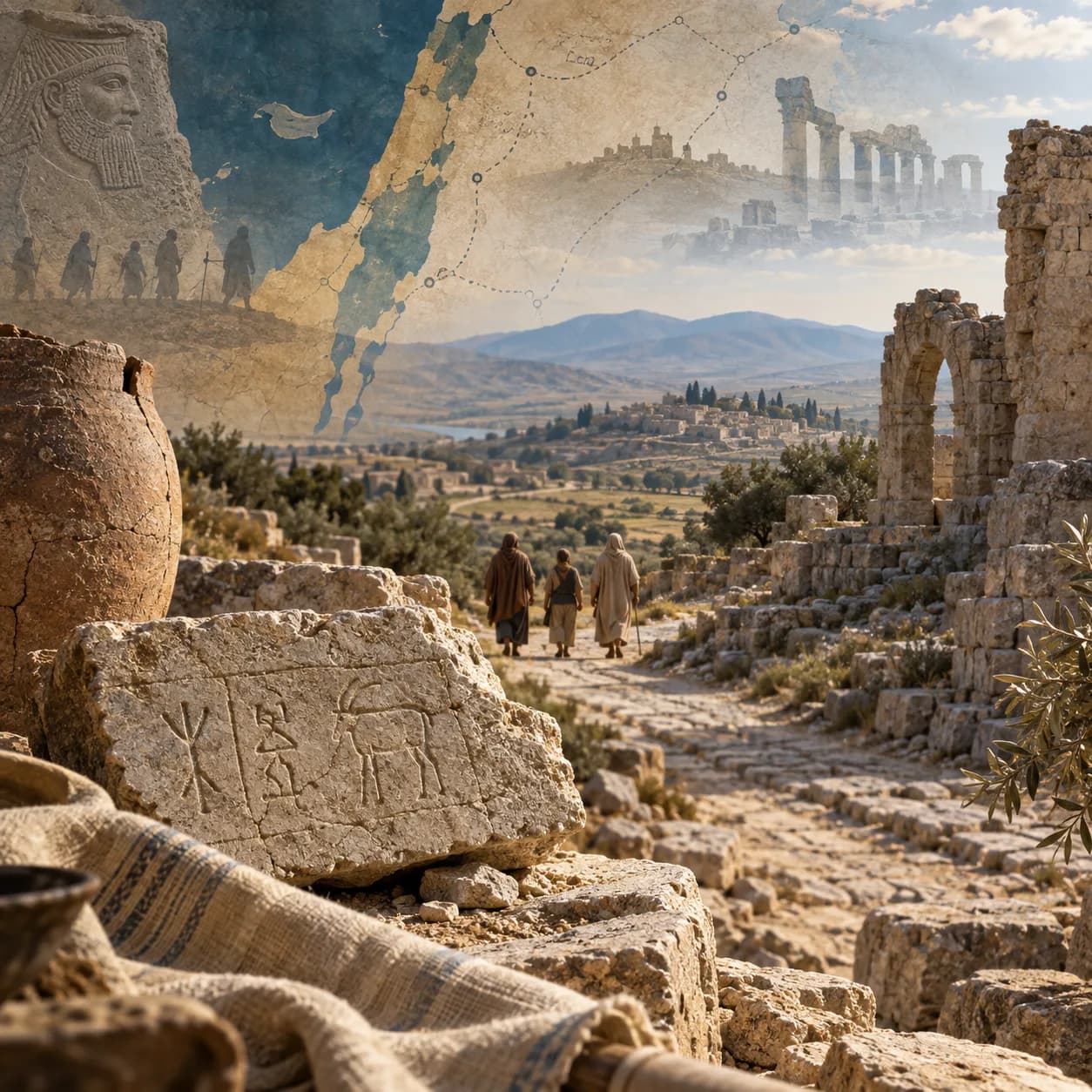
First, the river. A decree came down from the palace to the banks of the Nile: the Hebrew boys must die. Then, the fire. In the desert, a shepherd sees a bush burning without being consumed and hears the name of God speak from the flames. Between one scene and the other lies the same life: a baby hidden among reeds, and a man made of hesitations, exile, and wounded memory.
Exodus 1–4 does not present Moses as a ready-made hero. From the beginning, the text surrounds him with people more anonymous and more courageous than he is: midwives, a mother, a sister, a foreign princess. Only much later does the great scene of the call arrive. And when it comes, it does not find a confident leader, but someone who questions, resists, argues, and nearly backs away. Liberation, here, begins before the liberator. It begins with the refusal to collaborate with death, and with a God who declares he has heard the cry of the enslaved.
The Women And The Decree
The story opens under the logic of empire. Pharaoh fears the growth of Israel and tries to control the future through the womb and the cradle. The plan tightens in stages: first oppression through forced labor, then the order to the midwives, and finally the general command to throw the boys into the river. The violence grows cruder, more public, more desperate.
The text answers this escalation with a chain of disobedience, and it does so with sharp literary precision. Pharaoh, the supreme figure of power, does not even receive a name. The midwives do: Shiphrah and Puah. They are the first named characters in this confrontation, and the reason for their resistance is stated plainly: they "feared God." This is not a devotional detail tossed in passing. It is the first crack opened in the king's program. Power commands death; the fear of God preserves life.
This line continues in Exodus 2. A man and a woman of the house of Levi have a son; the mother hides him for three months; when she can no longer conceal him, she makes a basket, coats it with pitch, places the boy inside, and sets it among the reeds; the sister stands at a distance to see what will happen. None of this carries the shine of a public intervention. It all unfolds in a domestic register — improvised, vulnerable. But it is precisely there that the text locates the beginning of liberation.
Pharaoh's daughter comes down to bathe in the river. She sees the basket, sends for it, opens it, hears the crying, and feels compassion. The sequence matters: see, open, hear, have compassion. She recognizes the baby as Hebrew and, even so, acts against the policy of her own house. The boy's sister then appears with the agility of a well-staged scene: she offers a Hebrew wet nurse. The mother recovers her son for a time and raises him. Later, when she hands him over to Pharaoh's daughter, he receives a name: Moses, "because I drew him out of the water."
That name sums up the narrative's first movement. The water that should have swallowed him becomes the means of his preservation. The decree is real; the danger does not dissolve; salvation happens inside the threat, not far from it. The text states this simply and powerfully: the life of the future liberator depended on the courage of those who, one by one, refused the role the empire had assigned them.
The Rescued Boy, The Divided Man
The next scene is no longer about a cradle, but a crisis of identity. "When Moses had grown up," the text says, he went out to see the hard labor of his brothers. The verb "to see" carries weight in these chapters. Pharaoh's daughter saw the basket and acted with compassion. Moses sees an Egyptian beating a Hebrew and reacts with violence: he kills the Egyptian and hides him in the sand. The next day he sees two Hebrews fighting and tries to intervene, but is rebuffed: "Who made you a ruler and judge over us?" The question anticipates the whole problem of his calling. Moses wants to act, but he has not yet received authority, nor does he know how to use the strength he has.
The narrative does not shield its protagonist from this failure. He does not appear as a natural-born liberator, instantly recognized by his own people. Quite the opposite: his first attempt to defend a Hebrew ends with a hidden corpse, and his second attempt ends in rejection. When Pharaoh hears of it, Moses flees. The boy drawn from the waters becomes a man in exile.
In Midian, another episode defines him. At a well, he intervenes on behalf of Reuel's daughters against shepherds who were driving them away. There is continuity here: Moses reacts to scenes of injustice. But now the violence does not turn into murder; the narrative moves him instead toward a life of shepherding, marriage, fatherhood, and foreignness. The name of his son, Gershom, is born from this condition: "I have been a sojourner in a foreign land."
This displacement matters. Moses belongs and does not belong to the worlds he passes through. Hebrew by birth, raised in the Egyptian court, a fugitive in the desert, a son-in-law in Midian. The text shapes his identity through crossings, not through purity. Perhaps that is precisely what allows him to become a mediator: he knows the weight of oppression from the inside, but he also knows what it is to have no stable place.
Meanwhile, the narrator turns the camera back to the people. "The children of Israel groaned under the bondage and cried out." God "heard," "remembered," "saw," and "took notice" of them. These verbs prepare the way for the bush. Before Moses hears the call, the reader already knows that God has heard the cry of the enslaved. The mission is not born from one individual's inner restlessness; it is born from a collective suffering that rises up to God.
The Bush In The Desert
The burning bush enters as a visual interruption. Moses is tending his father-in-law's flock, comes to Horeb, sees the bush ablaze, and notices the impossible: it burns but is not consumed. He decides to draw near to look more closely. The call begins with this turn of the eye. Moses is not seeking a religious experience; he is working. The extraordinary breaks into the ordinary path and demands attention.
When the Lord sees that he has turned aside to look, he calls to him from the midst of the bush: "Moses, Moses." The doubled name carries urgency and intimacy. The answer is brief: "Here I am." Then comes the command that marks the place: "Do not come near; take off your sandals, for the place where you are standing is holy ground." The holy, in Exodus 3, is not an abstraction. It is a presence that redefines space. The ground of pasturing suddenly becomes a place of encounter.
The first word about God is not yet the enigmatic name of 3:14. It is memory: "I am the God of your father, the God of Abraham, the God of Isaac, and the God of Jacob." The new fire presents itself in continuity with an ancient history. The voice from the bush does not inaugurate an unknown deity; it links Moses to the covenant, to the ancestors, to the promise that had seemed buried beneath Egypt's bricks.
Then comes the center of the call, and it deserves close reading. God does not begin by saying "go." He begins by saying "I have seen." "I have surely seen the affliction of my people who are in Egypt, and have heard their cry... I know their sufferings; therefore I have come down to deliver them." The progression is striking: see, hear, know, come down. The God of the bush is neither indifferent nor remote. His movement toward Israel precedes Moses's mission. Only after these verbs comes the sending: "Come now, and I will send you to Pharaoh."
This command places Moses between two poles that will dominate the whole book: the Pharaoh who hardens his heart, and the God who has heard. The authority of the one sent will not rest on temperament, eloquence, or social standing. It will rest on the fact of having been sent by the one who saw the affliction and came down to deliver.
The Name That Sustains The Mission
Moses's first objection is personal: "Who am I that I should go to Pharaoh?" The question is not theatrical. It makes sense given the story we have already read. Who is he? A fugitive, a man with no stable place, someone whose earlier attempt to intervene had failed. God does not respond by inflating his self-esteem. He responds with presence: "I will be with you." The answer to "who am I?" is not a new résumé, but companionship.
The second question touches the divine name. If the Israelites ask who sent him, what should he say? Exodus 3:14 has been read in many ways, and the text itself does not reduce its scope to a simple formula. Traditionally it comes to us as "I am who I am." The decisive point, however, appears in the narrative context. The name is revealed to sustain the mission before an oppressed people; it is not given to satisfy metaphysical curiosity. It guarantees that the God of the fathers remains present and faithful to his purpose. Right afterward, the message Moses is to carry reaffirms the same line: "The Lord... has appeared to me," "I have surely visited you," "I have seen what has been done to you in Egypt."
Here, Christine Hayes observes that the Exodus cycle serves as Israel's origin narrative not only by recalling the oppression in Egypt, but also by linking that memory to the revelation of the divine name and to the beginning of an identity centered on this God who acts in history. That connection helps explain why the name, in the text, is never an isolated curiosity; it appears bound to the cry of the slaves and to the project of liberation.
It is also worth noting the contrast with the opening chapter. Pharaoh speaks in order to eliminate future Hebrews. God speaks in order to remember the fathers and open a future for Israel. The empire treats bodies as a demographic problem; the voice from the bush calls a people "my people" and makes their history his own concern.
Moses's Objections
The call scene does not end with an immediate "yes." It stretches out into resistance. Moses foresees the people's disbelief: "They will not believe me." God then gives him signs. The staff becomes a serpent and becomes a staff again; the hand turns leprous and is restored; water from the Nile, poured on dry ground, becomes blood. The signs do not function as gratuitous spectacle. Each one answers the fragility of the one sent and prepares the future confrontation with Egypt.
Moses insists further. Now the problem is speech: "I have never been eloquent... I am slow of speech and slow of tongue." Once again, the divine answer does not romanticize the limitation. God asks who made man's mouth, and promises to be with his mouth, teaching him what to say. The call does not depend on an ideal natural aptitude. It creates space for a speech Moses does not master on his own.
The fifth objection is the barest: "Send someone else." At this point the text records the Lord's anger. There is a limit to refusal. Even so, the anger does not cancel the mission; it reorganizes it. Aaron enters the scene as brother and spokesman. Moses will remain central, but not alone. The calling, from this point on, is already collegial.
This detail is precious. The text does not hide the fact that Moses resists to the very end, nor does it conclude that he is therefore disqualified. He will be sent with signs, words, and concrete help. Biblical faith is not nourished by the myth of the flawless leader. It tells the story of a man called amid real fear, and assisted at the exact point of his insufficiency.
What The Text Establishes And What We Cannot Verify
There are at least four levels worth holding together without confusing them.
What the passage asserts is clear. It asserts that Israel lived under oppression in Egypt; that there was a policy of death against the Hebrew boys; that Moses was preserved as a child, grew up between two worlds, fled to Midian, and received, before the burning bush, a call to confront Pharaoh and lead the people out. It also asserts that God saw the affliction, heard the cry, and committed himself to liberation.
What its literary form suggests is equally strong. The plot binds birth and vocation together as two halves of a single story. The child saved from the waters and the man called in the fire belong to the same design. The repetition of verbs of seeing and hearing, the contrasts between imperial power and quiet compassion, the series of objections and answers — all of this shapes the reader's perception. Liberation does not begin in the leader's charisma; it begins in the preservation of a threatened life and in a God who takes the side of the humiliated.
What the story allows us to say is more limited. The general scenario of servitude in Egypt corresponds to the founding memory of Israel preserved in the book itself, and Hayes draws attention to the force of that memory in shaping Israelite identity. But we do not have, from this material, external documentation capable of confirming in detail the decree to kill Hebrew boys, the palace adoption of Moses, or the exact form of the burning-bush episode. Caution is needed here. The biblical text does not present itself as an administrative record, and the available evidence does not authorize us to reconstruct these scenes with modern precision.
As for the bush, even less room remains for false certainty. The passage wants to communicate a holy, commissioning presence. If someone asks about the physical mechanism of the phenomenon, the text does not answer on that register. Its interest lies elsewhere: in the encounter that changes Moses's life and inaugurates the confrontation with Egypt. Reducing the scene to naturalistic curiosity is to read against its gravity.
Finally, there is the interpretation of faith. For the Christian reading, these pages testify to a God who sees suffering, acts in history, and calls fragile mediators to tasks greater than themselves. That is a theological judgment, not a conclusion imposed by archaeology. It arises from the believing reception of the text. And it needs to be held in honest dialogue with the limits of what can be historically demonstrated.
The interpretive consequence is concrete. Whoever reads Moses merely as a great individual loses the thread of the chapter. Before the prophet's public voice, there are women protecting a child; before the revealed name, there is a people groaning; before the miracles before Pharaoh, there is a man who can barely manage to say "yes." Exodus 1–4 asks that the calling be read starting from the affliction God heard and from the small acts of courage that had already been resisting evil.
This corrects abusive uses of the text. A spirituality fascinated by grand callings but indifferent to threatened children, exploited people, and dehumanizing labor has read the bush without paying attention to the river. And a theology of the strong, self-sufficient leader has also failed to recognize Moses. The God of these pages begins by preserving vulnerable life, and only afterward sets a man before power. If we want to understand Exodus, this is where we need to linger longer: among the reeds of the Nile and before the fire that does not destroy, where liberation had already begun long before it found a voice.
Sources Of This Text
Primary basis: Exodus 1–4. Biblical text. The literary observations refer to the passages indicated; the Memra applications are editorial interpretations.
13 · Christine Hayes · Yale | Israel in Egypt: Moses and the Beginning of Yahwism | https://oyc.yale.edu/religious-studies/rlst-145/lecture-7 | — Joseph, the memory of Egypt, and the birth of Moses.
Continue the study in Memra
Read the complete course with progress tracking and connected references.
Open the course