Gideon: The Fleece and the Three Hundred
From the series The Bible Is Not Literal, published by Memra.
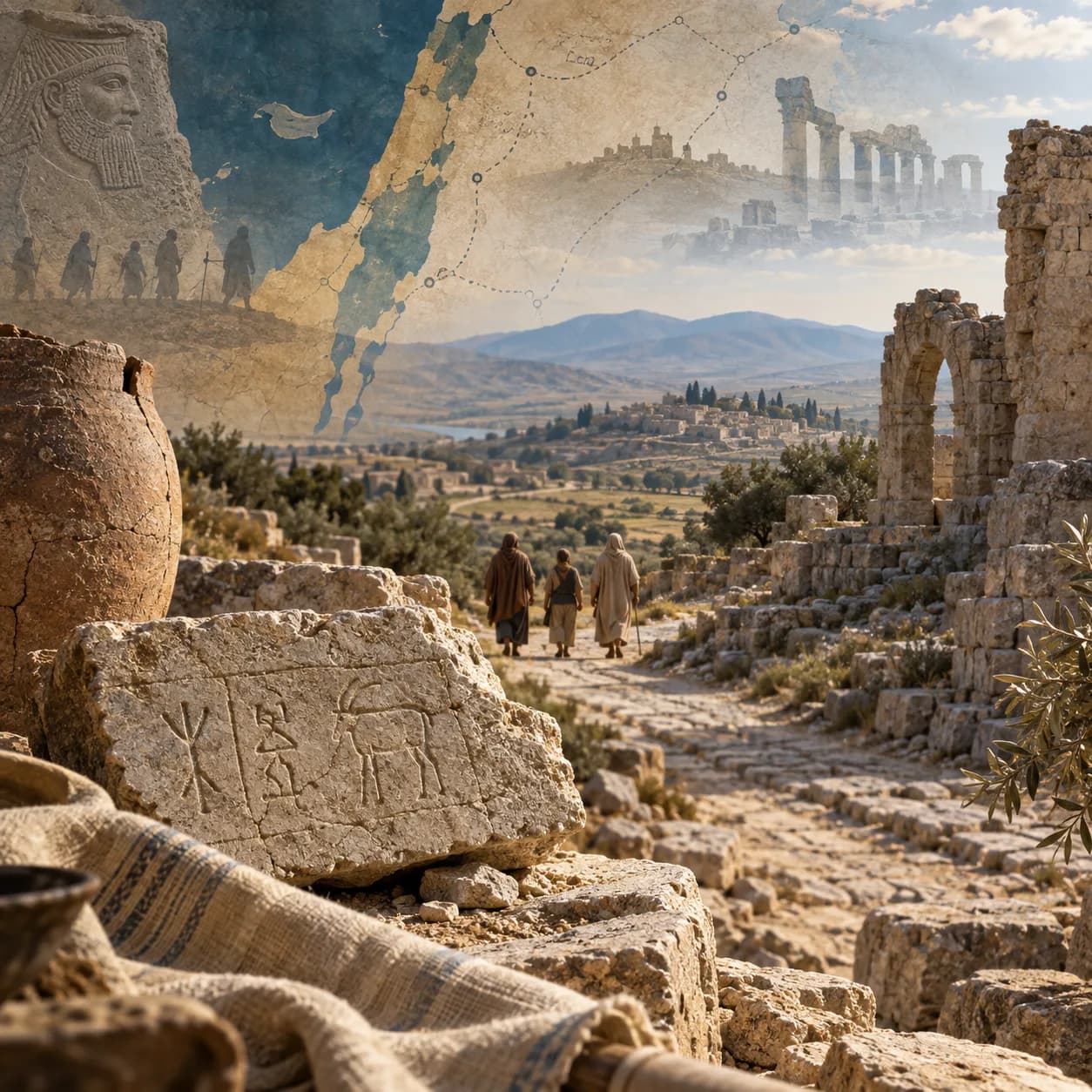
When Gideon first appears, he is not on an open battlefield, sword in hand, calling men to arms. He is in a winepress, threshing wheat in secret to escape the Midianites. The image is almost unsettling. A winepress is for grapes; wheat is threshed in another space, more open, more visible. Gideon works where he should not, because fear has reorganized ordinary life. The scene says a great deal before any speech is uttered: the land still produces, but its people cannot live off it in peace.
It is in this hiding place that he hears the most improbable greeting of the episode: "The Lord is with you, mighty warrior" (Judg 6:12). The text does not rush to smooth over the contrast. On the contrary, it makes the contrast the engine of the narrative. The "mighty warrior" is in hiding; the deliverer called by God responds like a man crushed by his people's collective experience of defeat; the future victor will ask for signs, will tremble, will obey under cover of night, and will only advance after repeated confirmations. Judges 6–8 does not build a seamless hero. It builds a man used by God without ceasing to be afraid, and a victory shaped in such a way that the final explanation cannot be credited to human strength.
In The Winepress
Gideon's opening words are not an abstract doubt about God's existence. They are a protest bound up with his people's history: "If the Lord is with us, why then has all this happened to us?" (6:13). He recalls the ancient deeds, the wonders recounted by the fathers, and sets those accounts beside the present misery. The chapter thus opens under tension between memory and experience. The God of the exodus is confessed, but the devastated countryside seems to contradict the confession.
The setting of the oppression itself matters. Judges 6 describes ruined harvests, stolen herds, hiding places in caves and cliffs. The crisis is economic and social before it is military. Midian does not appear merely as a foreign army; it appears as a recurring presence that makes survival unstable. Gideon is born, within this framework, as God's answer to the cry of an exhausted people.
Even so, the divine response does not immediately dissolve the messenger's fragility. When the Lord tells him "Go in this your strength," Gideon's "strength" is anything but evident. He answers with his own familial and personal smallness: his clan is the weakest, and he is the least in his father's house (6:15). The book of Judges is familiar with the theme of the deliverer's insufficiency. Here, though, that insufficiency takes on particular weight because the text preserves it to the end. Gideon does not overcome his fear all at once; he moves through it in stages.
This is already evident when he is commanded to tear down the altar of Baal in his father's house. Gideon obeys, but "at night," because he fears his family and the men of the town (6:27). The verse does not disguise his motive. The divine call did not instantly produce a fearless leader. It produced a man obedient enough to act, and fearful enough to choose the darkness.
The Wet Fleece, The Divided Man
It is in this context that the scene of the fleece comes. It is often remembered in isolation, as if it were a portable spiritual method—when facing a decision, one "puts out a fleece" and waits for an external sign. In Judges, however, the scene has a different function. Gideon has already received a word, already seen fire consume his offering, already torn down the altar of Baal, already heard a new call. The fleece does not inaugurate his relationship with God; it exposes the difficulty of sustaining that relationship as the mission draws near.
The very wording of his request deserves attention. Gideon says: "If you will save Israel by my hand, as you have said..." (6:36). That last phrase carries considerable weight. He is not claiming ignorance of what God has spoken. The problem is not a lack of instruction but an inability to rest in it. His request takes the form of a material test, domestic and almost humble: a wool fleece on the threshing floor, the dew falling selectively—first on the fleece and not on the ground, then on the ground and not on the fleece.
The narrator lingers over the concrete detail. On the first morning, Gideon wrings out the fleece and fills a bowl with water (6:38). The abundance of moisture makes the scene tactile. The second time, before repeating the request in reverse, he says: "do not let your anger burn against me; let me speak just once more" (6:39). The phrase shows awareness of the limit he is pressing. Gideon knows he is insisting. He does not present himself as a master of discernment; he speaks like someone constrained by his own hesitation.
The narrative does not explicitly comment on whether his gesture is exemplary or blameworthy. That restraint is part of its power. Scripture, here, does not hand down a manual but dramatizes a divided soul. God grants the signs; the text does not turn that concession into a rule for all times. The fleece is singular because the mission is singular: this is the call of a deliverer for a national crisis, within a plot in which God himself is dismantling every illusion of self-reliance.
Too Many Men
If the fleece reveals Gideon's fear, the following scene reveals God's purpose with rare clarity. The assembled army is too large. The Lord explains why: "lest Israel boast over me, saying, 'My own hand has saved me'" (7:2). The key to the episode is stated without evasion. The problem with a large force is not tactical; it is interpretive. If victory comes with sufficient force, the human heart will find in itself the cause of deliverance.
The reduction happens in two stages. First, the fearful go home. Then a still smaller group is chosen at the water, until what remains is an almost absurd number for the size of the threat: three hundred men. The passage does not offer this procedure as a replicable military technique, nor as a formula for religious organizations proud of being small. It serves the argument of the chapter: God empties out the possibility of boasting before handing over the victory.
Curiously, even at this point Gideon still needs support. God tells him that if he is afraid to go down to the camp, he should go by night with his servant Purah and listen to what is said there (7:10-11). The text names the fear once more. Divine condescension appears again. Gideon goes down and overhears a dream: a loaf of barley bread tumbles into the camp of Midian, strikes a tent, and overturns it (7:13). A companion interprets it: "This is nothing other than the sword of Gideon."
The dream is remarkable in its logic. No image of a war chariot or a colossal hero appears. What appears is a loaf of barley bread, plain food, tied to the poor, to rural daily life—perhaps uncomfortably close to the man who had been threshing wheat in hiding. The weak overturns the strong; the ordinary becomes an instrument of judgment. Gideon hears this and, for the first time, the narrative shows him moving from hesitation to worship: he bows down, returns to the camp, and says, "Arise, for the Lord has given the camp of Midian into your hand" (7:15). The confidence that was lacking is not born of a sudden inner impulse but of a word overheard in the enemy's own camp.
Clay, Fire, And Trumpets
The battle itself defies any conventional heroic ideal. There is no description of a brilliant duel or a massive infantry charge. There are three hundred men divided into three companies, trumpets, empty jars, and torches hidden inside them. The setting is nocturnal, "at the beginning of the middle watch" (7:19), when the changing of the guard favors confusion.
Gideon gives each man a trumpet and a jar with a torch inside. The jar hides the light until the exact moment; the sound spreads through the darkness; the action is simultaneous. Around the camp, they blow the trumpets, smash the jars, and hold up the torches. The combination of noise and sudden light produces panic. The battle cry rings out: "A sword for the Lord and for Gideon!" (7:20). The order of the names matters. The Lord comes first, and yet the leader's name is already dangerously attached to the God who grants the victory. The book will let that ambiguity grow later.
At the decisive moment, it is the Lord who actually turns the tide of battle: "the Lord set every man's sword against his fellow" (7:22). The three hundred surround, signal, sustain the scene. The enemy's collapse, however, is attributed to divine intervention. Literarily, everything has been arranged for this. The reader has followed the reduction of human strength, the leader's insecurity, the dream overheard in the enemy camp, and the nocturnal choreography. When victory comes, it does not reward Gideon's exceptional skill as a strategist—though there is a plausible tactic in the surprise—it confirms the word spoken earlier: Israel cannot come out of this story praising its own arm.
Midian In The Fields
Historically, the general framework makes sense as a portrait of an agrarian society subjected to raids that ruin harvests and impose continuous fear. The text speaks of hiding places, the devastation of livelihood, and rural vulnerability. This picture is broadly compatible with local conflicts and recurring raids in times of instability.
The details of the episode, however—the sign of the dew on the fleece, the exact number of the three hundred, the selection procedure, the dream as Gideon heard and reported it—cannot be independently verified with the material available to us. The narrative preserves a memory of deliverance and organizes it theologically. This does not require treating it as arbitrary invention; nor does it allow turning it into a verifiable military report in every detail.
Likewise, the pre-dawn tactic, with noise, light, and panic spreading through the camp, is entirely intelligible on the narrative level and plausible as a way of disorganizing a numerous enemy. But the text's focus does not rest on the ingenuity of the plan. The very explanation given in 7:2 rules out that reduction. The episode was told to teach who saves Israel, and how the victory ought to be read.
The Ephod Of Ophrah
If Judges 6–7 ended with the flight of Midian, Gideon might be remembered simply as an improbable victor and nothing more. Chapter 8 does not allow that comfort. First, because the victory does not eliminate internal conflicts. The Ephraimites resent not having been called earlier to the fight, and Gideon calms them with verbal skill. Then, because the deliverer himself hardens elsewhere: on returning from the pursuit, he punishes the men of Succoth and tears down the tower of Penuel, exacting payment for support denied him during the campaign. The hesitant man from the beginning also knows how to be ruthless once he holds power.
The culminating scene comes when Israel offers him a dynasty: "Rule over us, you and your son and your grandson also, for you have saved us from the hand of Midian" (8:22). The answer seems exemplary: "I will not rule over you... the Lord will rule over you" (8:23). It echoes exactly the theology of the chapter. Deliverance belongs to God; the judge is a temporary instrument.
But the narrative does not close there. Gideon asks for the gold earrings taken as plunder and, with them, makes an ephod, setting it up in his own city, Ophrah. Then comes the bitter verdict: "all Israel whored after it there, and it became a snare to Gideon and to his family" (8:27). The same man who refused the royal title fashions a religious object that concentrates attention, prestige, and deviation. The text does not spell out in detail how the ephod functioned in this context, and that uncertainty must be respected. What is known, from the verse itself, is enough for the narrative's judgment: the object became an occasion for infidelity.
This ending is decisive for reading the whole cycle. Gideon is not canonized as a flawless model. His life shows God's patience with human fear, the reality of an extraordinary deliverance, and, afterward, the danger of turning victory into symbolic capital. The hero who began in hiding ends up surrounded by honors, gold, and an ambiguous religious legacy. In Judges, Israel's crisis is never merely a lack of deliverers; it is also the ease with which deliverances warp into new centers of dependence.
Afterward, For Us
For faith, this story brings both comfort and warning. The comfort lies in the fact that God does not require, as a precondition for acting, a courage already fully formed. Gideon wavers, questions, fears, asks for confirmation, and God leads him on. There is room here to acknowledge fragility without dramatizing it and without turning it into a virtue. The text does not celebrate insecurity; it shows that insecurity does not stand in the way of God's mercy.
The warning is twofold. First, the fleece should not be turned into a universal technique of discernment. In Judges 6, it appears within an exceptional calling and a relationship already begun by divine word. To make the episode a rule for any everyday decision is to ask of the text something it does not intend to offer. God may, in his freedom, grant confirmations; the narrative, however, does not institute a rite of consultation based on signs we manufacture for ourselves.
Second, the three hundred do not authorize a romanticizing of weakness. The point is not that small groups are automatically better, purer, or more approved by God. The point is different: when salvation happens, Israel cannot credit it to its own greatness. The reduction serves to dismantle boasting. That lesson remains uncomfortable wherever spiritual, ministerial, or institutional victories are used to inflate human names.
And it is here that the ephod of Ophrah becomes the most concrete interpretive consequence of the whole episode. The greatest danger to a work of God can arise after success, when the instrument comes to occupy a place that does not belong to it. Christian communities know this temptation well: leaders who refuse grand titles but accept practical devotion; ministries that confess that God is Lord while erecting around themselves symbols, dependencies, and excessive loyalties. Judges 6–8 teaches us to give thanks for deliverance and, at the same time, to keep watch over the memory of that deliverance.
Gideon begins in the winepress and ends in Ophrah, between gold and a snare. Between one scene and the other, God wins with a fearful man and with three hundred who were not enough. Precisely for this reason, the text forces the reader to choose where to place the glory—and whom to distrust once the victory has already passed.
Sources Of This Text
Primary basis: Judges 6–8. Biblical text. The literary observations refer to the passages indicated; the applications drawn from the Memra are editorial interpretations.
This essay focuses on a comparative reading of the biblical text. It does not offer archaeological proof or an independent reconstruction of the episode.
Continue the study in Memra
Read the complete course with progress tracking and connected references.
Open the course