Saul and the Woman of Endor
From the series The Bible Is Not Literal, published by Memra.
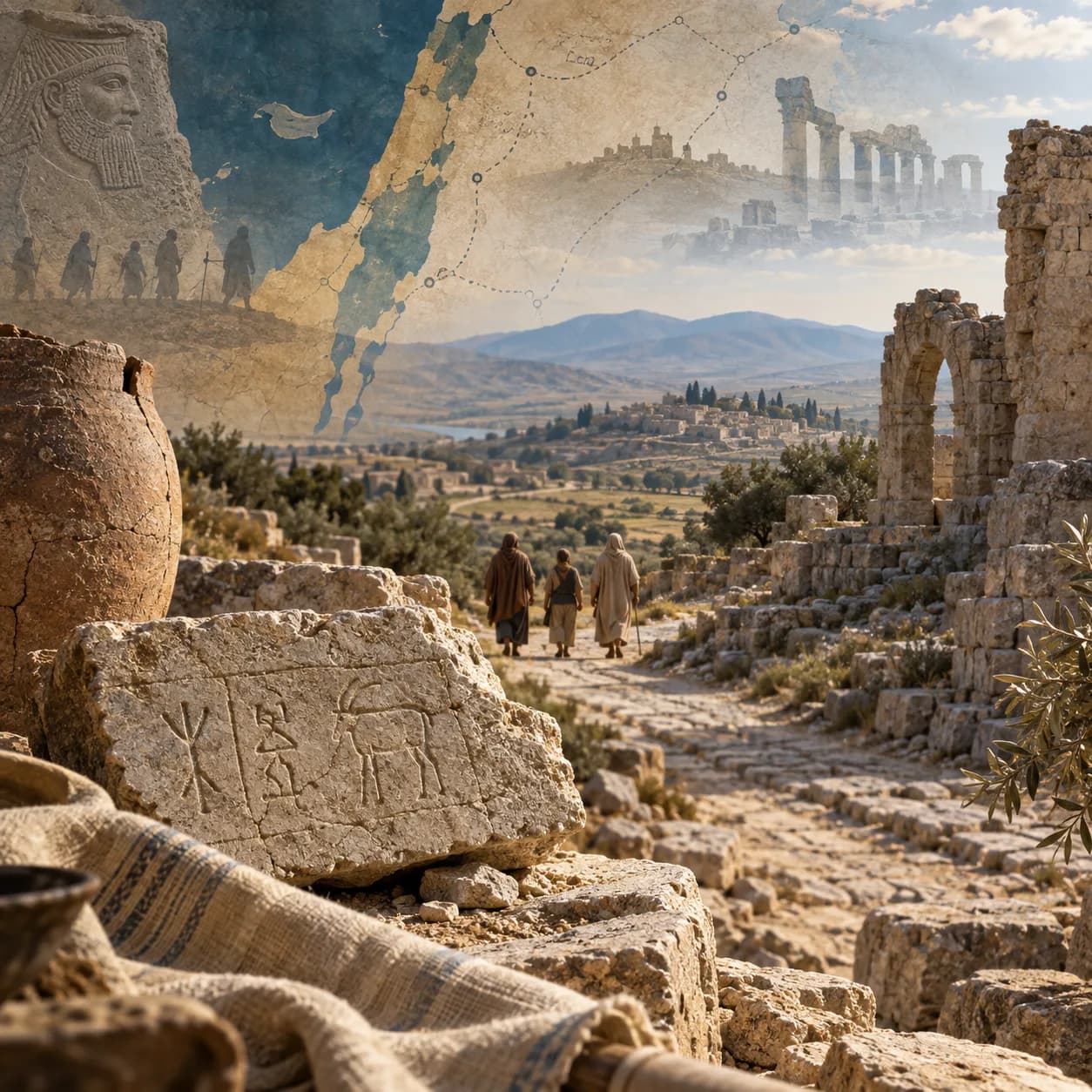
That night, the king of Israel goes seeking help in disguise. He strips off the garments that identify him, dresses as another man, and slips out into the dark with two companions. There is something of calculated humiliation in the scene, and something of panic. Saul, who so often occupied the center of the battlefield, now moves along the edges of the land he rules, knocking on the door of a woman who lives by the very practice he himself had banned. The whole chapter breathes this reversal: the one who held authority has no answer left; the one meant to protect is gripped by fear; the one who expelled the necromancers now needs a necromancer.
1 Samuel 28 is disturbing not only because of its theme of consulting the dead. It is disturbing because it exposes a king with no way out. The Philistines gather for war, Saul sees them, and "trembles greatly." The verb of seeing matters. He sees the enemy camp before he hears any word at all. The threat enters through the eyes, takes hold of the body, and only then does he consult the LORD. The narrator is spare and severe: God does not answer him, "either by dreams, or by Urim, or by prophets." Three channels are named to mark the totality of the silence. Nothing comes at night, nothing comes through the official rite, nothing comes through prophetic word. This is not momentary inattention; it is a complete shutting-off.
The King's Night
The text's first movement is this silence. Saul seeks guidance where he ought to find it, and receives none. This does not fall from the sky without history. The book has already shown the deterioration of the relationship between Saul and the word of God, especially in the episode where Samuel announces that the kingdom has been torn from his hands. At Endor, the crisis does not begin; it ripens. The battlefield merely forces into the open what had already long been true.
When Saul sends his servants to find "a woman who is a medium," the contrast becomes almost cruel. The man who once ruled by edict now depends on clandestine information. The woman, for her part, reacts with concrete fear, not grandiose mysticism. She recalls Saul's repression, speaks of a trap, fears for her own life. The narrative does not present her as some romantic figure of the occult, but as someone who knows the political risks of her trade. Saul then swears by the name of the LORD that she will suffer no punishment.
That oath is one of the driest blows of the chapter. The name of the LORD appears on Saul's lips to guarantee a practice that Israel's own tradition forbade. The king invokes the authority of the God who does not answer him in order to gain access to the very resource he had once condemned. The text offers no comment; it lets the irony speak for itself. Saul's fall includes this moral entanglement, in which the language of faith is mobilized to authorize flight from faith itself.
The Silence And The Shortcut
The decisive request is simple: "Bring up Samuel for me." Saul does not ask for just any dead man; he asks for the prophet who spoke to him in life and who is now dead. The chapter offers no vague curiosity about the beyond. He wants a specific word, from the specific mouth of the one who has already judged him. This matters, because it forecloses a superficial reading of the episode. Saul does not stand before some abstract metaphysical puzzle. He is chasing after the word he refused when there was still time to obey it.
The woman performs the rite, and suddenly the narrative accelerates. She "sees Samuel" and lets out a great cry. Her fright is part of the scene's force. Whatever the explanation for what happens, the text does not portray the medium as mistress of a calm, predictable technique. Something here throws her off balance. Right afterward, she recognizes who stands before her: "You are Saul." The king's disguise, sufficient until now, falls away at the very moment the scene reaches its highest pitch. Saul wished to enter unrecognized; he ends up exposed.
When he asks what she has seen, the answer comes in strange phrasing: "I see a god coming up out of the earth." The word can be understood in different ways, and the passage preserves that uncertainty. A "divine being," "divine beings," perhaps something the woman describes in the language of dread. The narrator does not pause to offer a glossary. He leaves us in the same murky atmosphere as the character. Saul then asks for more description: "What is his appearance?" She answers: "An old man is coming up, wrapped in a robe." That is enough. Saul understands it is Samuel and bows with his face to the ground.
There is a literary delicacy here. Saul does not "see" Samuel directly at this point in the scene; he recognizes him through the description, and above all through the robe. The detail immediately reopens the memory of 1 Samuel 15. It was there that Saul grasped the hem of Samuel's robe, and Samuel interpreted the tear as a sign of the torn kingdom. Now, years later, the robe returns. It is not mere costume for recognition; it is condensed memory. The old sentence enters the room even before it is repeated. The past dresses itself before Saul.
The Robe And The Torn Kingdom
The speech attributed to Samuel occupies the center of the episode. And it opens with an uncomfortable question: "Why have you disturbed me by bringing me up?" The verb "to bring up" recurs several times in this scene. Saul had asked the woman to "bring up" Samuel; the woman had described something "coming up" from the earth; Samuel asks why he has been "brought up." This verbal insistence stitches the episode together. There is a strange vertical movement: the king descends morally even as he tries to make the prophet ascend; the dead man rises while the living man falls. Shortly afterward, Saul will lie stretched out on the ground, without strength. On the level of imagery, the entire scene is an exchange of positions.
Saul answers in few words: he is in great distress, the Philistines are fighting against him, God has turned away and no longer answers him, neither through prophets nor through dreams; and so he has called Samuel, to learn what he should do. There is honesty and self-deception together in this speech. Honesty, because Saul names his anguish without disguise. Self-deception, because he still treats the matter as a lack of guidance, when the central problem is no longer ignorance. Samuel does not reveal to him some new path. He hands back to Saul the old word that Saul preferred not to carry.
"Why do you ask me, since the LORD has turned from you and become your enemy?" The question cuts. Saul wants practical instruction for war; he receives an interpretation of his own history. Samuel continues: the LORD has done just as he spoke through him; he has torn the kingdom out of Saul's hand and given it to David; and the reason is explicitly recalled: Saul did not obey the voice of the LORD, nor carry out the fury of his wrath against Amalek. The text names the past disobedience to explain the present silence. Endor is not a shortcut to information amid the crisis; it is the place where the crisis receives its name.
Then comes the final announcement: the LORD will deliver Israel, with Saul, into the hands of the Philistines, and "tomorrow" Saul and his sons will be "with me." The word "tomorrow" compresses the horizon. The chapter strips away any illusion of maneuvering room. The king who went out by night in search of a future hears that only one day remains to him. The detail "with me" has provoked many readings, but the passage does not explain it. What matters in the narrative flow is the imminence of death and the certainty of defeat. The war that opens the chapter as a threat closes here as a sentence.
The Body's Collapse
Saul reacts with his whole body: he falls, stretched out on the ground, overcome with great fear because of Samuel's words. The text adds an almost prosaic physical detail: he had eaten no bread all that day and all that night. The lack of food does not diminish the spiritual gravity of the scene; it embodies it. The king is not merely frightened. He is exhausted, empty, without support. The word he has received strikes down a body already weakened.
It is at this moment that the woman returns to the foreground. She sees him terrified, approaches, and speaks firmly. She reminds him that she obeyed him, that she risked her life to carry out his order; now she asks that he, too, listen to her and accept a piece of bread to have strength for the road ahead. The scene takes on a surprising humanity. The woman Saul sought as an instrument becomes his host. The marginalized one takes charge of the king's care.
Saul refuses at first: "I will not eat." But his servants and the woman press him, and he listens. There is another small shift of power here. The man who came to command ends up persuaded. He rises from the ground and sits on the bed. The woman then acts quickly: she has a fattened calf, kills it, takes flour, kneads it, bakes unleavened bread, sets it all before Saul and his servants. They eat, and depart that same night.
This ending is remarkable for its restraint. After one of the strangest scenes in the Bible, the chapter closes with domestic gestures: slaughtering an animal, preparing bread, serving food, eating, leaving. The everyday does not dispel the horror; it gives it weight. Saul does not depart illuminated by some secret of the invisible world. He departs fed, so that he can walk on toward death. The last care he receives comes precisely from the house where he went seeking what the law of Israel had rejected.
The Woman Of Endor
The woman of Endor should not be reduced to a convenient symbol for some ready-made thesis. The text does not approve her practice. The very existence of the prohibition in Israel is part of the chapter's backdrop. Nor does it turn her into a one-dimensional villain. She appears fearful, prudent, perceptive, and compassionate. She knows she could die, she grasps the gravity of what is happening, and in the end she feeds a ruined man.
This complexity matters because the chapter is not a piece of propaganda meant to satisfy curiosity about necromancy. Its focus rests on Saul. Even so, the way the woman is portrayed forecloses lazy religious readings that use the text merely to demonize a character and divert attention from the center of the narrative. The drama lies in the king who has lost his hearing and now chases after a word already known. The woman makes visible, by contrast, the vulnerability of power: the one who once legislated now depends on the care of someone who lived under threat from that very power.
What The Text Affirms And What It Leaves Undecided
Here precision is called for. What the passage affirms at the narrative level is clear: Saul consults a medium; she sees something she describes; the narrator then speaks of Samuel and attributes a speech to him; that speech confirms and deepens the condemnation already announced earlier; the next day, Saul's death approaches just as foretold. Within the plot of 1 Samuel, the scene functions as the final confirmation of judgment.
What the literary form suggests is broader. The night, the disguise, the recognition, the robe, the repetition of the verb "to bring up," Saul's collapse to the ground, and the final meal together compose a portrait of real disintegration. The narrative is built to show that political authority, without a hearing of God's word, becomes a caricature of itself. The king still commands, but he no longer governs his own story.
What history, archaeology, and science allow us to say, based on the material available here, is more limited. The text reflects a world in which consulting the dead was considered possible, and precisely for that reason forbidden in Israel's legal traditions. This helps situate the episode culturally. It does not allow us to turn Endor into historical proof of some verifiable method of contact with the dead. Nor does it require us to reduce the scene to fraud, ventriloquism, or hallucination. Such explanations may be proposed, but the chapter, on its own, does not prove them.
A reading of faith, meanwhile, must respect these limits without emptying the text of meaning. A Christian reading can recognize here the gravity of seeking spiritual shortcuts when the word of God confronts rather than comforts. It can also recognize that God's silence in 1 Samuel 28 does not appear as arbitrary caprice, but as part of a history of resistance to obedience. And it can note, with a certain trembling, that the final word about Saul is not new information, but the repetition of the word he had refused.
After Endor
The interpretive consequence is concrete. This chapter was not given to feed fascination with the occult; it was given to unmask the human impulse to seek extraordinary experiences when one no longer wishes to submit to the ordinary truth already received. Saul wants to know "what I shall do." The text answers by showing why he has reached the point of no longer knowing what to do. There are moments when the great spiritual temptation is not ignorance, but flight. One flees into rituals, into techniques, into voices that promise special access, into any mediation that seems less costly than obedience.
The episode also warns religious communities about the misuse of power. Saul forbade, watched, threatened; in the end, he needed the table of someone at the margins. There is a severe critique embedded here against authority that imagines itself secure merely because it controls others. A leadership may keep its symbols, its oaths, and its apparatus, and still have lost the essential capacity to listen.
This is why Endor remains relevant. The question is not whether the passage authorizes us to draw up a map of the afterlife. The question is what we do when God will not be manipulated and when the word already spoken judges us. The chapter suggests that, at that point, the way forward is not to descend further into the night in search of shortcuts, but to recognize the truth we have tried to sidestep. Saul arrives at Endor in disguise. He leaves it exposed. That is the harshest judgment in the scene: in the dark, seeking another voice, he finally encounters the full shape of what he has become.
Sources Of This Text
Primary source: 1 Samuel 28. Biblical text. The literary observations refer to the passages indicated; the applications of the Memra are editorial interpretations.
This essay focuses on a comparative reading of the biblical text. It does not offer archaeological verification or an independent reconstruction of the episode.
Continue the study in Memra
Read the complete course with progress tracking and connected references.
Open the course