David and Goliath: Size Is Not Destiny
From the series The Bible Is Not Literal, published by Memra.
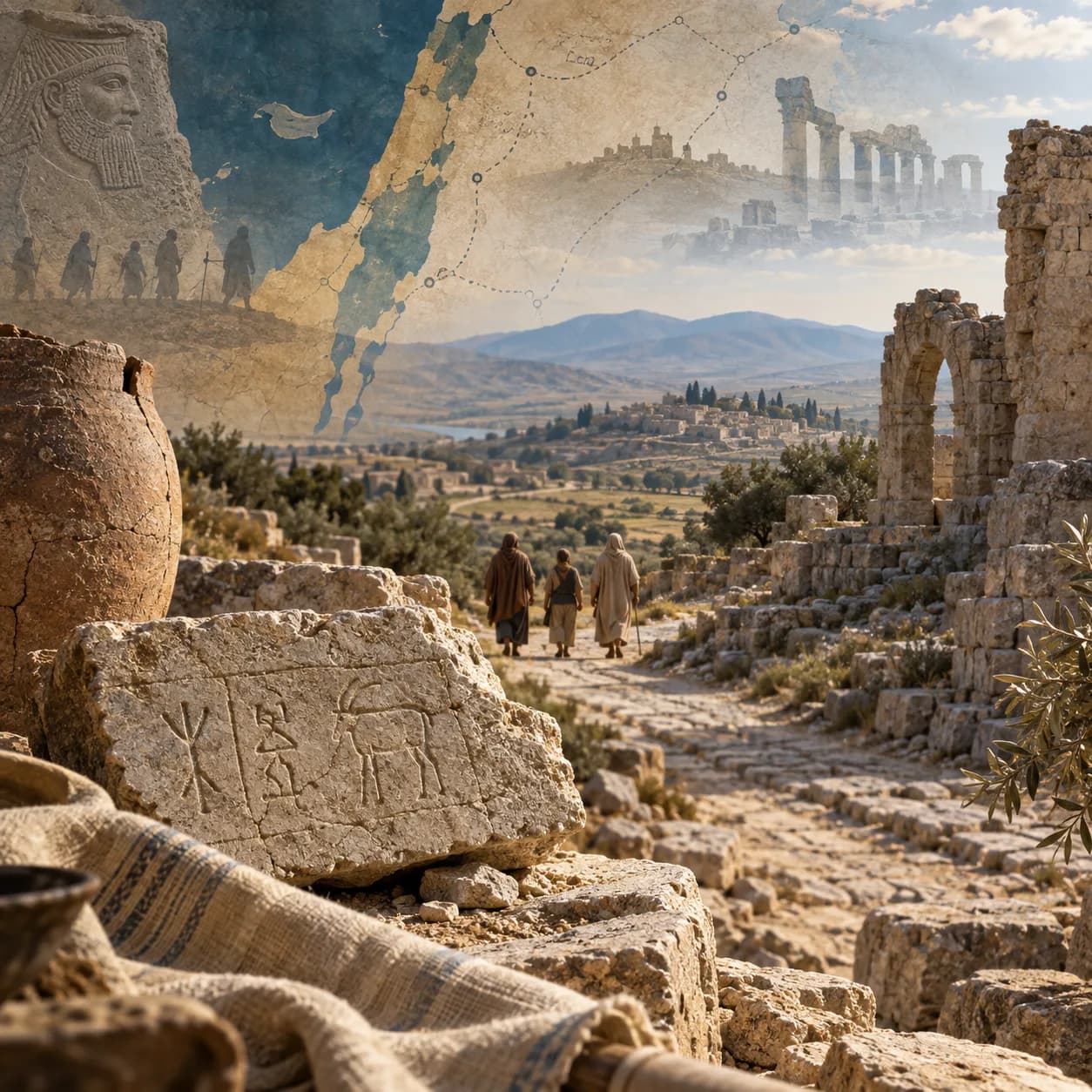
For forty days, morning and evening, one man goes down into the valley and speaks with the voice of an entire army. The scene in 1 Samuel 17 does not begin with a stone flying through the air, but with a routine of intimidation. Goliath appears, speaks, taunts, withdraws. Israel listens, retreats, trembles. Before the decisive blow, the narrative makes the reader breathe the heavy air of a standoff in which force seems already to have won simply by occupying the field and dominating the discourse.
That is why this chapter is more than the memory of a famous duel. It puts a criterion on trial: who defines the real weight of a battle? The warrior's height, the gleam of his bronze, his military experience, his ability to humiliate an opponent in public? Or is there a way of seeing conflict that escapes this logic? Everything in 1 Samuel 17 is arranged so that this question can mature before the sling is ever swung.
Forty Days Of Fear
Goliath enters as an overwhelming presence. The narrator describes him at length: his height, his helmet, his coat of mail, his greaves, his spear, the shaft of his spear, his shield-bearer walking ahead of him. The description has the rhythm of a parade. The Philistine's body seems clad in metal, and the metal seems to amplify the body. It is not enough for him to be strong; he must be seen as irresistible.
Then comes the voice. Goliath proposes a representative combat: one man for a people, one body for a nation. The offer seems to simplify the war, but it actually turns it into a spectacle of shame. If Israel accepts and loses, it loses before everyone. If it refuses, it is already morally cornered. The text repeats the effect of his speech on Saul and the army: they "were dismayed and greatly afraid" (1 Sam 17). The Philistine threat works first from within, disorganizing Israel's imagination.
The detail of the "forty days" is decisive. Fear here is not momentary; it settles in as a discipline. Morning and evening, the challenge reappears. The regularity of the taunt wears down any possibility of response. The narrative insists on this point because it wants to show that, before David ever faces Goliath, the whole army has already been defeated by the repetition of the scene.
This literary construction matters. The chapter lingers over the preparation and reserves the final action for only a few verses. The result is clear: David's victory, when it comes, does not look like the fruit of youthful impulse but the rupture of a collective paralysis. Goliath dominates the valley with size, equipment, and speech. Israel's terror is born from the fact that everyone has already accepted these measures as final.
The Boy Who Asks Questions
David enters the chapter by an almost domestic route. He does not arrive armed to save the fatherland. He arrives carrying provisions to his brothers. The contrast with Goliath is calculated: on one side, the champion of war; on the other, someone on a family errand, still tied to his father's house. The narrative knows the effect this produces and exploits it unhurriedly.
The turning point lies not in his hands but in his ears. David hears the taunt and interprets it differently. Where the others perceive only a military risk, he sees a religious and political insult: "Who is this uncircumcised Philistine, that he should defy the armies of the living God?" The question shifts the axis of the scene. Not because it offers a strategy, but because it restores to the conflict a reference point that fear had erased: those soldiers are "the armies of the living God."
It is notable that David asks more than once. He presses, repeats, returns to the subject. The repetition shows that his courage is born not of thoughtlessness but of growing conviction. While Goliath monopolizes public speech to impose his definition of reality, David introduces another language. The central problem is no longer the difference in size; it is the affront to God and the shame of a people who have forgotten who they are.
The reaction of his older brother, angry with David, deepens the scene. The text adds an internal obstacle: incomprehension within his own family. David is accused of presumption and idle curiosity. The accusation matters because it reveals how courage can look like insolence when everyone has already learned to call fear prudence. The chapter does not set David only against Goliath; it also places him under suspicion among his own.
At the level of plot, then, David's entrance is not the arrival of a ready-made hero. It is the eruption of a different reading of the same facts. The valley remains the same, the giant remains immense, the army remains terrified. What changes first is the interpretation of what is happening.
Saul's Armor
When David offers to fight, Saul responds with realism: "You are not able to go against this Philistine to fight with him, for you are but a youth, and he has been a man of war from his youth." It is a sensible statement given the available criteria. The king does the obvious math. Years of training, physical strength, combat record. Everything weighs against David.
The young man's response shifts the measure again. He recalls his past as a shepherd and speaks of lion and bear, of rescuing lambs from the predator's mouth, of striking the attacker when it rose against him. These verses are sometimes read quickly, as if they served only to prove his bravery. They serve for more than that. David presents a pattern: protection of what has been entrusted to him, personal risk assumed, deliverance attributed to God. His experience is not military in the conventional sense, but neither is it improvised. There is a trained body, reflexes, courage, and a memory of dependence.
It is then that Saul tries to dress him in his own armor. The scene has a rare narrative elegance. The king offers what is most properly his own: helmet, breastplate, sword. David puts it on, tries walking, and realizes that this apparatus does not fit his way of fighting. "I cannot walk with these, for I have not tested them." The sentence is simple but does a great deal. It rejects the idea that the only legitimate way to confront power is to copy its appearance.
David takes off Saul's armor and gathers five smooth stones from the brook. The narrative slows down to show each gesture: removing, taking, choosing, placing in the pouch, taking up the sling. The hero of the chapter does not become effective by adopting the signs of established power; he becomes recognizable when he acts from what has already been entrusted to and trained in him. The shepherd does not enter battle disguised as a king.
Here caution is needed. The chapter does not teach that preparation is unnecessary, or that it would be enough to "have faith" in the sense of some spiritual bravado. David brings a history of practice, responsibility, and deliverance. The text binds confidence and experience together, without confusing either with self-sufficiency.
Sword, Spear, And Name
The center of the chapter lies in the speeches that precede the impact of the stone. Goliath curses David by his gods and despises his appearance: "Am I a dog, that you come to me with sticks?" His language is one of degradation. He tries to diminish his opponent before ever touching him.
David answers with one of the densest declarations in the book: "You come to me with a sword and with a spear and with a javelin, but I come to you in the name of the LORD of hosts, the God of the armies of Israel, whom you have defied." The sentence does not oppose matter and spirit, as if weapons were unreal and words were everything. It contrasts two foundations of confidence. Goliath comes relying on the apparatus he displays; David comes representing a name.
The weight of the verse grows in what follows. David announces the outcome and, above all, states its meaning: "all the earth may know that there is a God in Israel," and "all this assembly may know that the LORD saves not with sword and spear, for the battle is the LORD's." There are two circles of audience. One is broad, "all the earth"; the other is immediate, "all this assembly." The Philistines need to see something, and Israel needs to learn something. The miracle expected by popular imagination would be the giant's defeat; the deeper correction falls on David's own people, who also need to relearn what counts as salvation.
These speeches show that the battle has already received its interpretation before it begins. The action that follows will be neither a lucky underdog's trick nor a happy accident. It will be the visible manifestation of the verbal judgment already announced at the chapter's center. As a literary construction, 1 Samuel 17 arranges the entire combat so that the stone confirms an argument already spoken aloud.
At the same time, the phrase "the battle is the LORD's" does not authorize pious passivity. David does not fold his arms waiting for a bolt from heaven. A few verses later, he runs to meet the Philistine. In this chapter, confidence in God does not produce inertia; it produces freedom in the face of the theater of fear.
One Blow, Then Brutality
After so much preparation, the ending comes quickly. "When the Philistine arose and came and drew near to meet David, David ran quickly toward the battle line to meet the Philistine." The verb of haste here is revealing. For forty days, Israel had retreated. Now someone runs in the opposite direction. The movement of the body already contradicts the pedagogy of terror.
David reaches into his bag, takes out a stone, slings it, and strikes Goliath on the forehead. The giant falls face down to the ground. The image is striking: the one who came standing tall, occupying the valley with height and voice, ends up prostrate even before the final blow. The bodily fall enacts the reversal the whole chapter has been preparing.
But the text does not close the scene with delicacy. It says that David runs, stands over the Philistine, takes his sword, and kills him, cutting off his head. The violence is explicit. The chapter offers no sweetened parable about personal triumph. It deals with ancient warfare, public humiliation, and bloody victory. Whoever uses David and Goliath as a mere motivational fable strips the account of exactly what it refuses to hide.
This final detail also has a narrative function. Earlier the narrator had said that David had no sword in his hand. The absence matters. He defeats his opponent with the weapon he brought; he confirms the defeat with the enemy's own weapon. What had terrorized Israel is absorbed into the sign of victory. Afterward, the Philistines flee, and Israel, who had trembled before, raises a shout and gives chase. Courage reappears as contagious, just as fear had been.
Who Killed Goliath?
If we read only 1 Samuel 17, the memory of the episode would seem crystal clear: David killed Goliath. Yet Scripture itself preserves a tension that keeps hasty readings at bay. In 2 Samuel 21:19, in a list of later battles against the Philistines, we find the information that Elhanan killed Goliath the Gittite. 1 Chronicles 20:5, however, frames the tradition differently: Elhanan killed "Lahmi, the brother of Goliath."
These verses cannot be treated as irrelevant noise. They show that the transmission of this memory was not straightforward. There is, at the very least, a point of friction between Samuel and Chronicles, and the honest reader needs to let it stand. Chronicles clearly represents a reading in which the honor of killing Goliath remains with David, and Elhanan defeats the giant's brother instead. 2 Samuel 21:19, for its part, preserves a more disconcerting wording.
With the material available to us, it is not possible to decide definitively among the possible hypotheses. It may be that 2 Samuel preserves an old and difficult formulation, later adjusted in Chronicles. It may be that there is a problem of textual transmission in Samuel, and Chronicles reflects a correction. It may be that different heroic traditions were brought into proximity with one another. The available biblical text attests to the difficulty, not its final resolution.
This has an important interpretive consequence. The story of David and Goliath, as it stands in 1 Samuel 17, works fully as narrative: it builds its conflict, articulates its theological center, and produces its resolution. At the same time, the comparison with 2 Samuel 21:19 and 1 Chronicles 20:5 warns against the temptation to treat this narrative as a simple military report, isolated from the whole history of its transmission. Scripture here does not present itself as a frictionless spreadsheet; it presents memory that has been preserved, narrated, and reworked within Scripture itself.
The Valley After The Reading
Read on its surface, 1 Samuel 17 states that David defeated Goliath and freed Israel from a humiliation that had already lasted forty days. Read as literature, the chapter displaces the center of power: what seemed decisive—height, armor, reputation, intimidation—loses its monopoly on defining reality. On the historical plane, with the passages we have in hand, the most one can say with certainty is that the textual tradition is more complex than the popular version of the episode usually admits; we have here neither independent proof of the duel nor grounds for dissolving it into pure invention. In a reading of faith, the chapter testifies to a characteristic mode of God's action: he exposes the fragility of powers that present themselves as absolute, and he acts through unlikely agents.
This last claim requires care. The text does not promise that every smaller person will defeat any giant if only they have enough courage. David does not enter the valley to fulfill the modern dream of the individual who triumphs through authenticity. He enters because he interprets the moment in light of God's name and takes on a specific responsibility. His confidence is not generic, and his calling cannot be copied wholesale.
Perhaps the most concrete consequence of this reading lies in the scene with the armor. Communities of faith, churches, and individual readers often let themselves be convinced that they will only be effective if they put on Saul's bronze: the instruments of prestige, the languages of intimidation, the adversary's own methods, the external signs that command instant respect. 1 Samuel 17 resists that fascination. The chapter does not sanctify improvisation nor despise skill; it exposes the inner servitude that makes us believe that no one can confront Goliath without looking like him.
The valley remains current whenever the loudest voice defines the field, whenever fear repeats itself morning and evening until it starts to look like wisdom, whenever God's people forget the name they carry and begin measuring everything by the yardstick of the other side's champion. The question that remains, then, is not whether we have a personal "giant" to defeat. It is more serious than that: from whom have we learned to calculate strength, and what armor have we grown accustomed to calling indispensable?
Sources Of This Text
Primary basis: 1 Samuel 17; 2 Samuel 21:19; 1 Chronicles 20:5. Biblical text. The literary observations refer to the passages indicated; the applications of the Memra are editorial interpretations.
This essay focuses on a comparative reading of the biblical text. It does not offer archaeological verification or an independent reconstruction of the episode.
Continue the study in Memra
Read the complete course with progress tracking and connected references.
Open the course