Mustard, Yeast, and Growth That Goes Unseen
From the series The Bible Is Not Literal, published by Memra.
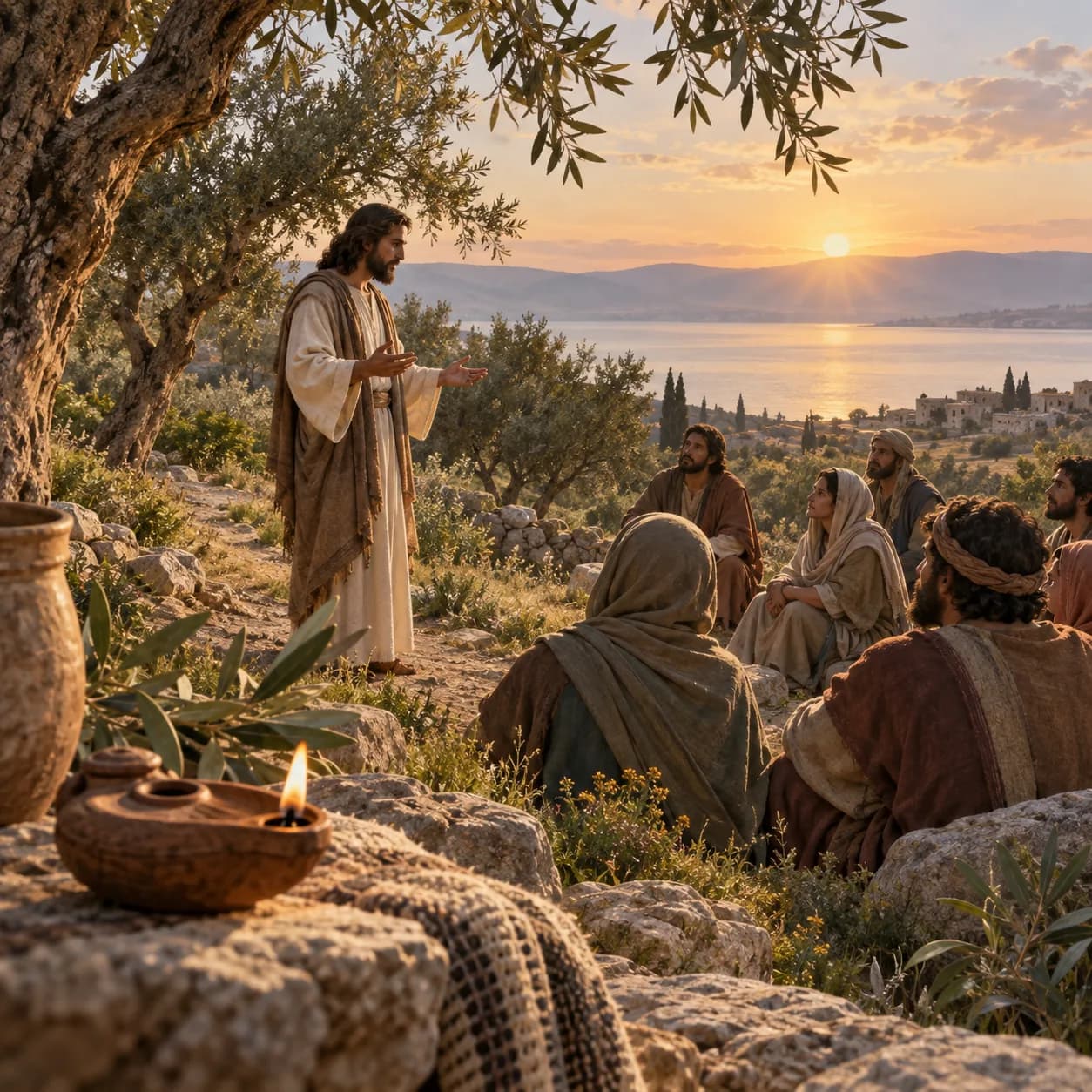
A man sleeps and wakes, sleeps and wakes, and the seed grows while he is not looking. This is the scene with which Mark sums up, almost in passing, one of the most unsettling ideas the Gospels attribute to Jesus: the Kingdom of God advances through a process the farmer himself does not understand and does not control. "He himself does not know how," says the Greek text, in a phrase that sounds almost like a confession of ignorance placed in the mouth of the one who should be the expert farmer. It is from this admission — I don't know how this works, but it works — that it's worth entering the three small parables of growth: the mustard seed, the yeast, the seed that sprouts on its own.
The Smallest Of All Seeds
Matthew 13:31–32 and Luke 13:18–19 tell practically the same story in nearly the same words: someone takes a mustard seed and plants it in his field (or his garden, in Luke's case); the seed, described as the smallest of all seeds, grows until it becomes the largest of garden plants, a tree in whose branches the birds of the sky make nests. The line works by friction. No one would plant mustard expecting to produce shade for birds — it's a garden herb, not a forest tree. The exaggeration is deliberate: it turns an ordinary, almost low-growing plant into an image of shelter and reach.
Mark uses the same comparison in 4:30–32, but fits it after another parable the other evangelists do not record: that of the man who scatters seed on the ground and "sleeps and rises, night and day, and the seed sprouts and grows, though he does not know how" (Mark 4:27). The earth, the text says, "by itself" produces first the blade, then the ear, then the full grain in the ear — and only when the fruit ripens does the man act again, wielding the sickle because the harvest has come. Between the sowing and the harvest, the farmer practically disappears from the scene. He sows at the start and reaps at the end; the middle belongs to a process the narrative attributes to the earth, not to him.
This sequence matters because it shifts the image's center of gravity. If we looked only at the mustard seed, we might be tempted to admire the competence of someone who knew how to make a little go a long way. Mark cuts off that temptation at the root: no one here knows how the seed grows. The verb is literal — *automatē*, "by itself" — and it is from this Greek word, by quite different routes, that our word "automatic" descends. The earth operates according to a logic that asks no one's permission, least of all the farmer's.
Three Measures Of Flour
The parable of the yeast appears attached to that of the mustard seed both in Matthew 13:33 and in Luke 13:20–21, as if the two evangelists had inherited the pair already formed. A woman takes a little yeast and hides it in three measures of flour "until it was all leavened." Three measures of flour is no small household portion: it's enough to feed dozens of people, the kind of batch prepared for a significant occasion, not for one family's dinner. The detail heightens the disproportion: a minuscule amount of yeast, mixed in and then invisible within the dough, ends up determining the fate of the whole batch.
There is a tension worth facing directly. In other New Testament passages, yeast carries a negative sense — Jesus warns the disciples against "the yeast of the Pharisees" (Matt 16:6), and Paul speaks of the "old yeast" that must be removed (1 Cor 5:6–8). This ambivalence has led some readers to suspect that here too, in Matthew 13:33 and Luke 13:21, the image might carry a connotation of corruption — the Kingdom of God as something that infiltrates and contaminates. But the immediate context resists that reading: the action of the yeast is presented without any sign of alarm, set between the mustard seed that grows into shelter and, in Matthew, the explanation about the weeds and the wheat. The movement of the parable is one of beneficial multiplication, not infection. The word "yeast" had varied uses in everyday speech, and forcing a dark reading here requires ignoring the evident direction of the sentence — "until it was all leavened" sounds like plenitude achieved, not evil spreading.
What The Sower Does Not Control
The question these three images pose, read together, is not "will the Kingdom grow?" but "who is responsible for the growth?" The answer that emerges, above all from Mark 4:26–29, is uncomfortable for any anxious pastoral instinct: it is not the sower. He plants, and then he sleeps. The line is almost comic in its simplicity — sleeps and rises, night and day — as if the text wanted to emphasize that the farmer's life goes on its normal course, oblivious to the mystery happening beneath the ground.
This does not cancel human action. Someone sows, someone kneads the yeast into the flour, someone in the end wields the sickle. Participation is real at both ends of the process. What lies beyond human reach is the middle: the germination, the fermentation, the transformation itself. No first-century farming technique explained why a seed cast into the ground became a plant — and the text does not try to explain it either. It names the mystery and moves on. This is an important difference between the parables and a theological treatise on providence: they do not argue, they show. They leave the listener with the image of the farmer asleep, and the implicit question — if he doesn't know how the seed grows, why would you demand to know how the Kingdom of God advances?
Trees That Shelter Empires
There is a possible, and debated, echo between the mustard tree and the great trees of the Old Testament that symbolize empires offering shelter to peoples — Ezekiel's vision of the cedar that God plants and makes grow until "every kind of bird" nests in its shade (Ezek 17:22–24), or the tree in Nebuchadnezzar's dream in Daniel 4, whose branches give the birds of the sky a place to roost. If Jesus's audience recognized this resonance, the parable gains a political layer: the Kingdom of God presents itself as the humble successor of these grand empires — not a cedar planted by royal decree, but a garden herb that grows without fanfare and yet ends up offering the very same shelter.
It's necessary, however, to acknowledge the limits of this reading. The extent of the allusion is not unanimous among interpreters: some see here a deliberate reference to the prophetic texts, others consider the image of birds in the branches to simply be part of the natural repertoire of any story about trees, with no need to point back to Ezekiel or Daniel. Reading notes on the Gospel of Matthew discuss exactly this tension between parable and allegory — to what extent each detail of the image carries symbolic weight, and to what extent it is merely necessary scenery for the scene to work. There is no way to settle the question with certainty; what can be said is that the political reading is possible and coherent with the rest of Jesus's teaching on the Kingdom, without that making it mandatory.
Growth Is Not Proof Of Anything
The most recurring temptation in the history of reading these parables is to turn them into a prophecy of institutional success: the small seed would be the Church in its beginnings, the great tree its numerical, political, territorial expansion. It's a seductive reading because it seems confirmed by the facts — a movement that indeed began with a handful of disciples in Galilee did end up spreading across empires. But the parable does not speak of an institution; it speaks of the Kingdom of God, a category the Gospels themselves treat as distinct, sometimes even opposed, to the apparatuses of power that men build. Growing in numbers is not, by itself, evidence of faithfulness. Biblical history knows expansions that drifted from their original purpose just as it knows small beginnings that remained faithful.
The symmetrical counterweight also deserves to be said: initial smallness is not an automatic virtue, nor is every slowness a sign of spiritual depth. It would be easy to turn these parables into a generic praise of the discreet, as if everything that begins small and takes time were, by definition, God's work. The text does not say this. It says something more precise: that the Kingdom of God, specifically, grows in this manner — a beginning disproportionate to the end, a process beyond the sower's control, an effect that ends up reaching further than the origin suggested. Generalizing this pattern to any human enterprise that starts small is to use the parable outside its target.
It's worth noticing a detail easy to pass over without seeing: Mark does not describe just one act of growth, but a sequence with three named stages — first the blade, then the ear, then the full grain in the ear (Mark 4:28). The text could simply have said "the seed grew until it bore fruit"; instead, it lingers over each stage like an outside observer, unhurried to reach the result. This insistence on order has a precise function: it prevents the reader from treating growth as an instantaneous leap between sowing and harvest. There are phases, and each imposes itself on the next without the farmer needing to intervene for it to happen. The blade does not decide to become an ear; the ear does not negotiate whether to fill with grain. The verb "by itself" that qualifies the earth in 4:28 does not describe a single germination event, but this whole chain — from sprout to ripe grain — as a property of the earth, not a skill of the man who tilled it.
This insistence on sequence contrasts, tellingly, with the haste that marks much of Mark's narrative elsewhere: the evangelist typically uses "immediately" (*eutheōs*) to accelerate action, chain miracles together, speed up movements. In the parable of the hidden growth, this rhythm halts. Between verse 26 and verse 29 there is no "immediately" governing the middle of the process — the word only reappears at the end, when "he immediately puts in the sickle, because the harvest has come" (Mark 4:29). The contrast is deliberate: the evangelist who elsewhere rushes to narrate reserves here an indeterminate stretch of time, without markers of urgency, precisely for the part of the story in which nothing visible seems to be happening. The acceleration returns only when there is human work to do again — reaping. This suggests that Mark's "immediately" is not synonymous with gratuitous narrative haste, but with human action ready to respond at the right moment; where human action is absent, the text's clock also withdraws.
It's also worth noting that this same three-phase structure — planting, waiting without understanding, harvesting at the right time — does not appear in Matthew or Luke, who preserve only the mustard seed and the yeast without the parable of the hidden growth. This means that the insistence on the sequence and on the vacancy of agency in the middle is an editorial choice exclusive to Mark, not a universal trait of the tradition behind these parables. If a reader wanted to draw from the mustard seed or the yeast a lesson about the mystery of the process's midpoint, they would need to borrow that emphasis from another Gospel — because neither Matthew 13:31–33 nor Luke 13:18–21 dwells on it. It is Mark, and Mark alone, who turns the indefinite waiting between sowing and harvest into an explicit object of reflection, giving this gap a theological weight the other two parables, on their own, do not carry.
What Remains After The Harvest
Mark's final image — "and he immediately puts in the sickle, because the harvest has come" (Mark 4:29) — returns an active role to the farmer, but only after the invisible process has finished its work. There is something sober about this structure of human beginning and human end, with a vacancy of agency in between. It refuses both the anxious activism that wants to guarantee the result at every instant, and the passivity that abandons the task altogether. One sows. One waits. One harvests. What happens between sowing and harvest belongs to a logic the parable refuses to explain, and that refusal is itself part of the teaching.
What remains, then, is a question these three small stories leave open for whoever reads them today, inside or outside any organized religious community: is there something small, almost invisible, in your life that you once cast down and now cannot explain how it grew — and that, precisely because it escapes your control, might be the most trustworthy sign that something alive was really there?
Sources Of This Text
Primary basis: Matthew 13:31–33; Mark 4:26–32; Luke 13:18–21. Biblical text. The literary observations refer to the passages indicated; the Memra applications are editorial interpretations.
50 · USCCB · NABRE | Matthew 13: text and notes | https://bible.usccb.org/bible/matthew/13 | — Parable, allegory, and differences in interpreting the agricultural images.
Continue the study in Memra
Read the complete course with progress tracking and connected references.
Open the course