Bethlehem: The Census, the Shepherds, and the Manger
From the series The Bible Is Not Literal, published by Memra.
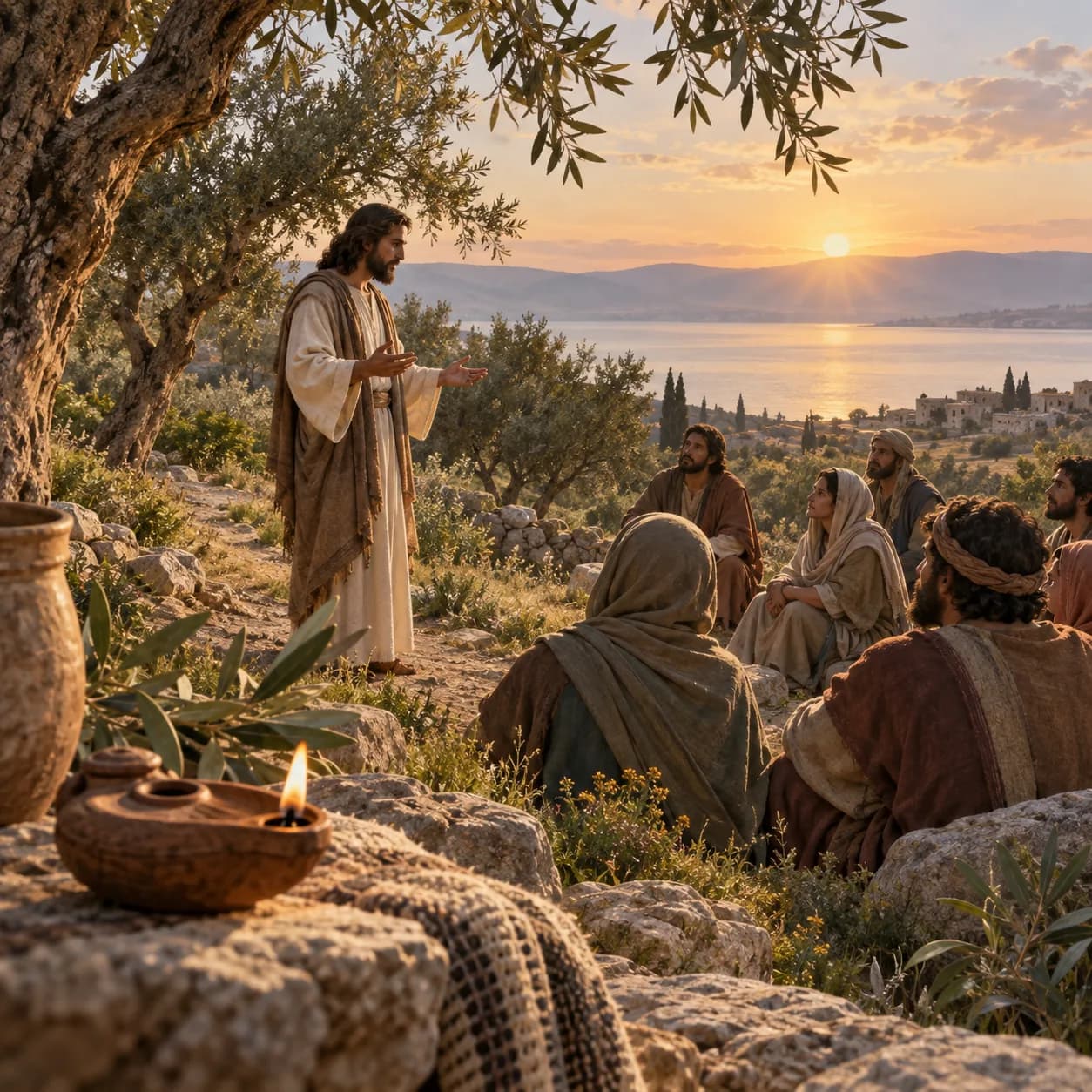
On an ordinary night near Bethlehem, a group of men kept watch over their flocks in the open air, far from home, far from anything resembling importance. No empire would ever have summoned them for anything. And it is precisely to these men — not to the scribes, not to the governors, not to Herod's court — that Luke's narrative reserves the first announcement of a birth that, according to the text, shifts the axis of history. This choice is not accidental. It is the center of gravity of the entire scene.
The Decree And The Body
Luke opens the chapter with an order coming from Rome: Caesar Augustus decrees that a census be taken of the whole empire. It is the kind of sentence that establishes scale — a power stretching across territories, organizing entire populations through a single bureaucratic gesture. And it is this decree, coming from so far away and from so high up, that sets Joseph and Mary moving from Nazareth to Bethlehem. The text wastes no time on administrative mechanics; it moves swiftly from the imperial edict to the pregnant body of a woman on the road.
This abrupt shift — from decree to childbirth — is the first literary effect worth noting. Augustus thinks in numbers, dominion, fiscal control over the known world. Luke responds with a physical detail, almost uncomfortable in its concreteness: "the days were accomplished that she should be delivered." There is no ceremony, no advance notice of arrival, no preparation. There is only the biological urgency of a birth that happens wherever it falls, because "there was no room for them in the inn." The child is wrapped in swaddling clothes and laid in a manger — the trough where animals feed.
The manger is not a picturesque rural detail. It is the most loaded image in the entire passage, because it inverts the expectation the text itself has just built up. If the reader expects the birth of the "Savior," the "Christ," the "Lord" — titles that appear only a few verses later, on the angel's lips — to come accompanied by some sign of grandeur, what he finds is exactly the opposite: an animal feeding-trough as a cradle. The sign given to the shepherds confirms this inverted logic — "this shall be a sign unto you: ye shall find the babe wrapped in swaddling clothes, lying in a manger" (Luke 2:12). The sign is not magnificence; it is identifiable precariousness.
Who Hears First
The scene shifts register when "there were in the same country shepherds abiding in the field, keeping watch over their flock by night." It is to these men that the angel appears, and it is upon them that "the glory of the Lord shone round about." Their initial reaction is fear — the standard response to the supernatural throughout the biblical tradition — but the angel dissolves it with a phrase that sets the tone for the whole message: "Fear not: for, behold, I bring you good tidings of great joy, which shall be to all people."
Notice the movement: the news is "to all people," but it reaches this specific group first, in a field, at night, far from any center of decision-making. This distribution is not neutral. It organizes an inverted hierarchy of revelation — what Rome decrees on an imperial scale, God reveals on the smallest scale, to a handful of night laborers. Verse 11 concentrates the theological density of the scene: "unto you is born this day in the city of David a Saviour, which is Christ the Lord." Three titles stacked together, each carrying Jewish messianic expectations — yet announced not in Jerusalem, not to the Sanhedrin, but to shepherds.
The sequence that follows has its own rhythm: the angelic announcement gives way to "a multitude of the heavenly host, praising God"; the shepherds decide to go see; they find Mary, Joseph, and the babe "lying in a manger" — the repetition of the word closes the circle opened by the announcement; and finally, "they returned, glorifying and praising God for all the things that they had heard and seen." The full arc — announcement, verification, testimony, praise — gives the scene a dramatic structure that is no accident: it carries the reader from a decree that organizes bodies to a doxology that recognizes a Savior.
Two Doors To The Same City
Matthew 2:1 arrives at Bethlehem by an entirely different route. The sentence is spare: "Now when Jesus was born in Bethlehem of Judaea in the days of Herod the king, behold, there came wise men from the east to Jerusalem." There is no census, no journey of Joseph and Mary from Nazareth, no manger, no shepherds. Instead, the narrative opens onto foreigners following a star and heading first to the capital, provoking alarm in Herod's court. Matthew's plot is about seeking and conflict with established power; Luke's is about revelation to the marginalized.
The two Gospels agree on the essentials — Bethlehem, the time of Herod — and diverge on everything else. This should surprise no one and trouble no one: infancy narratives in ancient literature do not function as sequential factual reportage but as compositions that select details to reveal identity. Luke chooses the contrast between empire and humility; Matthew chooses the contrast between foreign wisdom and local hostility. Trying to fuse the two accounts into a single chronological sequence forces a harmony the text does not offer and perhaps never intended to offer.
The Problem Of The Census
There is, however, a concrete historical difficulty that literary reading alone cannot resolve. Luke 1:5 places the beginning of the story "in the days of Herod, the king of Judaea," and Matthew 2:1 does the same. The census associated with Quirinius, however, is usually dated to 6 AD — several years after Herod's death, generally placed around 4 BC. Robert Cargill, of the University of Iowa, draws attention to this chronological incompatibility as one of the most discussed points in criticism of Luke's account: Herod and Quirinius belong, according to the most widely accepted chronology, to distinct periods.
There is a second difficulty, of an administrative nature: Roman census practice normally tied registration to a taxpayer's place of residence or fiscal responsibility, not to a distant ancestral city, as Joseph's journey "unto his own city," being "of the house and lineage of David," seems to assume. This is, according to the same source, a real tension between the text and what is known about Roman administrative practice — not an invention of skeptics, nor a minor detail.
There are attempts at harmonization — hypotheses about an earlier census, or about different administrative roles attributed to Quirinius at different points in his career. None of them, however, has achieved the scholarly consensus needed to resolve the problem definitively. It is important to name this limit honestly: there is no independent evidence confirming Luke's reconstruction in the exact terms he presents it, but neither is there evidence allowing the scene to be declared entirely fabricated. What exists is an unresolved tension.
What Remains Open And What Remains Clear
It is worth separating two levels that are frequently conflated in discussions of this passage. On the historical level, the chronology of the census remains problematic, and no available harmonization resolves it with enough solidity to become certainty. On the literary and theological level, however, Luke's intent is clear: to construct a birth scene in which imperial power unknowingly serves the divine purpose, and in which the revelation of Jesus's messianic identity reaches first those whom the world despises.
These two observations do not compete with each other; they occupy different registers. Acknowledging the chronological difficulty does not require discarding the narrative's theological value, just as appreciating its literary construction should not serve as a pretext for sweeping the historical problem under the rug. There are readings that try to do both — the apologetic harmonization that forces unproven solutions, and the skeptical reading that treats every literary composition as proof of arbitrary invention. Both err for the same reason: they ask more certainty of the evidence than it is capable of delivering.
It is worth noting that the word "manger" does not appear once in Luke 2, but three times — in the angel's announcement, in the birth scene, and in the shepherds' final confirmation. This repetition is not stylistic carelessness or unintentional redundancy; it is a compositional device that ties the sign to its verification. The angel promises a specific, verifiable sign — not a feeling, not a vision, but a concrete object in a concrete place — and the text takes care to confirm, in the same words, that the promise was fulfilled exactly as announced. This lexical insistence functions as internal proof within the narrative: the reader need not rely solely on the angel's word, because the account shows the shepherds arriving and finding, point by point, what they had been told. The manger stops being mere scenery and starts functioning as a criterion of verification.
This pattern of repetition also illuminates the contrast between the two groups that appear in the heavenly scene and the earthly one. First comes a single angel, addressing ordinary men with a message that establishes a hierarchy of importance — "to all people" — but that concentrates, in this first moment, on a single messenger for a small audience. Then the text widens the scale: "there was with the angel a multitude of the heavenly host." There is a deliberate progression here, from the singular to the collective, that mirrors, in inverted form, the logic of the very imperial decree that opens the chapter. Augustus mobilizes a multitude of subjects through a single centralized edict; heaven mobilizes a multitude of angels to confirm a message delivered to a tiny, peripheral group. The inverted symmetry between the two multitudes — the census-takers and the heavenly host — reinforces that the account is not merely narrating an event but constructing a commentary on where true authority actually resides.
Finally, the verb describing the shepherds' reaction to what they see deserves attention: they do not merely report, they "made known abroad" what had been told them about the child — an expression suggesting active transmission, almost an act of primitive preaching, rather than casual comment among neighbors. This detail transforms the shepherds from passive witnesses into the first public bearers of the message, anticipating, on a minimal scale, the role the disciples will later assume in the rest of the Gospel and in Acts. Mary, for her part, reacts in the opposite way: she "kept all these things, and pondered them in her heart." The contrast between the shepherds' outward proclamation and Mary's inward silence is not incidental — it is another layer of the same pattern of inversion running through the whole scene, distributing between different characters two legitimate and complementary modes of response to what has just been revealed.
What The Center Of The Scene Reveals
The reading this text sustains is christological: the contrast between Augustus's decree and the manger is not ornamental — it is a declaration. The empire organizes people by numbers; the Gospel presents a person who refuses to be merely a number, even though he is born under the direct shadow of that very decree. The angelic glory does not turn toward Jerusalem, does not turn toward Herod's palace, does not turn even toward the local synagogue — it turns toward men keeping watch over sheep at night. This is not a decorative detail of the popular nativity scene; it is the structure of meaning of Luke's narrative itself.
This choice of the shepherds as first recipients does not romanticize poverty, nor does it suggest that precariousness is good in itself. What the text does is more precise: it shows that God's decisive revelation does not depend on recognition by the powerful, nor does it require a noble cradle to be true. The manger remains a humble place — the text does not transfigure it into a throne — but it becomes, because of what is placed there, an identifiable sign of something the world would never have thought to look for there.
A practical question remains, then, for anyone reading this scene today, adaptable to any context of power and visibility: if the most decisive news ever announced by the Christian tradition reached first those keeping watch over flocks in the dead of night, and not those running empires, what criterion do we use now to decide who deserves to be heard first, and who can be treated as dispensable periphery?
Sources Of This Text
Primary basis: Luke 1:5; 2:1–20; Matthew 2:1. Biblical text. The literary observations refer to the passages indicated; the Memra applications are editorial interpretations.
41 · Robert R. Cargill · University of Iowa | Can You Explain the Problem with the Census in the Gospel of Luke? | https://bam.sites.uiowa.edu/faq/can-you-explain-problem-census-gospel-luke | — Herod/Quirinius chronology and census rules.
Continue the study in Memra
Read the complete course with progress tracking and connected references.
Open the course