Annunciation and Virginal Conception
From the series The Bible Is Not Literal, published by Memra.
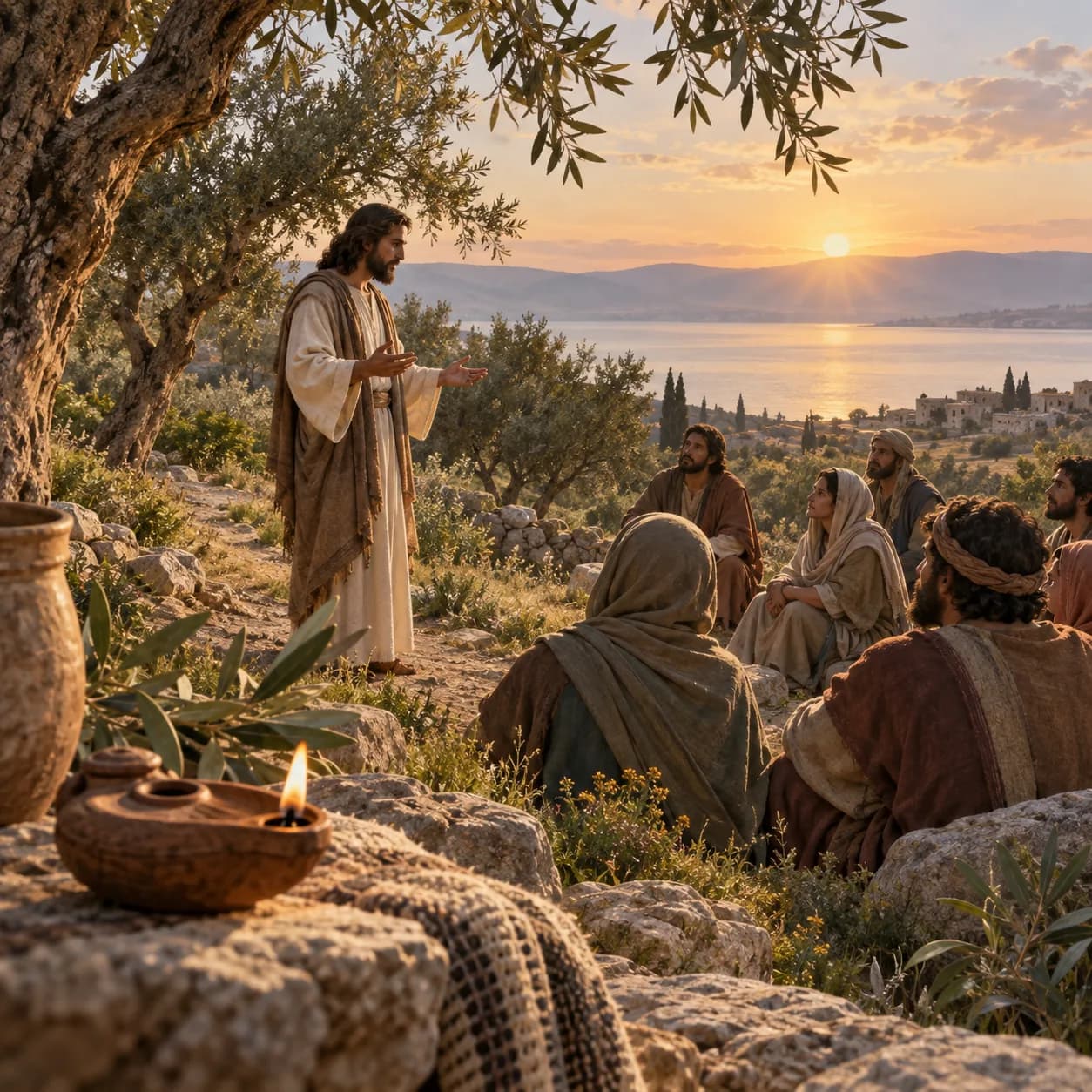
Joseph is facing a decision that the law allows him to make alone. Mary is pregnant, he knows the child is not his, and the Jewish custom of betrothal — a bond already nearly as binding as marriage, dissolvable only by formal divorce — gives him the right to expose the matter publicly or settle it quietly. Matthew says he was "righteous" and that, for this reason, he decided to divorce her secretly (Matt 1:19). The word "righteous" here does not describe legal rigidity but a man trying to do what is right without destroying a life. It is at this point of tension — between the law that protects him and the compassion that unsettles him — that a dream interrupts his plans. On the other side of the same story, in another Gospel, a young woman in Nazareth receives a greeting that troubles her before she even understands what is being said. The two scenes are responses to the same event told from different angles, and it is from that difference that the richness — and the difficulty — of reading the annunciation arises.
Two Accounts, Two Cameras
Matthew films Joseph. The narrative moves forward as the resolution of a crisis: discovery, doubt, dream, obedience. There is no dialogue, no articulated question — only the bewilderment of a man facing a fact he cannot explain, and the intervention of an angel who speaks while he sleeps. The angel tells him what to do ("do not be afraid to take Mary as your wife") and what to name the child ("you shall call his name Jesus"), and Joseph, upon waking, simply obeys. It is a scene of few words and much action: he takes Mary as his wife, avoids marital relations until the birth, and names the child. Each verb is an act of legitimation. By naming the son, Joseph legally inserts him into the Davidic line — which is why Matthew opens the chapter with a genealogy that ends precisely with him.
Luke films Mary, and the register shifts genre: it is no longer a narrative of decision but a dialogue. The angel Gabriel greets her, she is troubled by the greeting — not yet by the news, which has not been announced, but by the words themselves — and the messenger must calm her before announcing what is to happen. When the announcement comes, Mary does not respond with silent obedience, as Joseph does, but with a technical question: "How will this be, since I do not know a man?" (Luke 1:34). It is the question of someone who wants to understand the mechanism, not of someone doubting the possibility. The angel answers with two images — the Holy Spirit will come upon her, the power of the Most High will overshadow her — and closes with a line that functions as the key to the whole scene: "for nothing will be impossible with God" (Luke 1:37). Only then comes Mary's reply, which is not mere acceptance but her own formulation: "Behold, the servant of the Lord; let it be to me according to your word" (Luke 1:38). She is not a passive character to whom a decision already made is communicated; she is an interlocutor who asks, listens, and consents.
The difference in camera also reveals a difference in theology. Matthew organizes the material around the legal identity of Jesus — hence his insistence on Joseph, heir of the Davidic promise, and hence his citation of Isaiah 7:14 as an interpretive key, linking the birth to the name "Emmanuel," God with us (Matt 1:22-23). Luke organizes the material around the human response to the divine call — hence the annunciation to Mary is constructed in parallel with the annunciation to Zechariah a few verses earlier, and both follow the biblical pattern of birth announcement: appearance, disturbance, message, objection, sign or explanation. Zechariah doubts and is struck mute; Mary asks and receives an answer. The contrast between the two figures, within Luke's own Gospel, already signals that Mary's question is not a lack of faith — it is the right question, asked in the right way.
What Isaiah Said And What Matthew Hears
The citation of Isaiah 7:14 in Matthew 1:22-23 is the point in the text that most demands caution. In its original context, the prophet is speaking to King Ahaz of Judah, threatened by a coalition of neighboring kings. The sign — a young woman who conceives and bears a son, whose name means "God with us" — functions as an immediate political guarantee: before this child knows how to discern good from evil, the threats tormenting Ahaz will have vanished. It is a dated oracle, addressed to a specific crisis of the eighth century BCE.
When Matthew cites this verse eight hundred years later, he is not denying that original meaning or pretending it never existed. He is doing something different: a christological rereading, in which the pattern of the ancient sign — a birth that guarantees God's presence amid crisis — finds in Jesus its fuller fulfillment. This is a common practice among the evangelists, and Matthew exercises it with particular density: he reads the history of Israel as a prefiguration of the history of Jesus, in the same way he evokes Moses in the structure of his Gospel. There is no basis, in the available sources, for claiming that the "young woman" of Isaiah already signified, at the moment of the prophecy, a virginal conception in the sense Matthew attributes to it. Nor is there any basis for reducing Matthew's citation to a translation misunderstanding or a manipulation of the Hebrew text. What exists is a productive tension: a historical oracle and a theological reappropriation that the evangelist considers legitimate and revealing, not arbitrary.
The Shadow And The Spirit: Language That Points, Not Describes
It is worth noting the vocabulary the two Gospels use to name what happened — because it is precisely here that the narrative refuses to become technical explanation. Matthew says that Mary "was found to be with child by the Holy Spirit" (Matt 1:18) and that the angel confirms to Joseph: "that which is conceived in her is of the Holy Spirit" (Matt 1:20). Luke uses two parallel images: the Holy Spirit "will come upon you" and the power of the Most High "will overshadow you" (Luke 1:35). The image of the overshadowing cloud evokes, in the biblical repertoire, the protective presence of God — it does not describe any biological process. The texts affirm divine agency without detailing mechanism. This is a consistent literary choice in both evangelists: they prefer the language of action and presence to the language of explanation. This does not make the account less concrete — both insist that something real happened in Mary's body, "before they came together," as Matthew notes (Matt 1:18) — but it keeps the event within the register of announced mystery, not described phenomenon.
What Can Be Affirmed And What Remains Open
Within the two Gospels, the virginal conception is narrated as a concrete theological fact, not as a metaphor for moral excellence. This much can be said with confidence: neither Matthew nor Luke writes as one proposing a poetic image of Jesus's greatness; they write as those reporting a specific divine intervention, situated in a particular time and place, with legal consequences (the name given by Joseph) and personal ones (Mary's response).
What history, as a discipline, has no instrument to verify is the biological event itself. There is no external, independent documentation that would allow confirmation or refutation, by ordinary historiographical methods, of the exact manner of the conception. Historical research can situate belief in the virginal conception already in the earliest layers of Christianity that have come down to us, can examine how it engages with Jewish traditions of miraculous announcement and with the christology forming in the first decades — but it cannot, with the sources available, go beyond that.
Given this double acknowledgment, there are readings that take the account at its literal claim, as an affirmation of a real miracle — this is the reading that best corresponds to how the two evangelists actually write. There are readings that prefer to understand the episode as a symbolic expression that Jesus "comes entirely from God," without biological commitment — a reading that captures something real about the text's theological function, but which becomes insufficient if it erases the concreteness with which the narrative presents itself: the Gospels do not speak in a generic sense, they speak of a specific pregnancy, before marriage, explained by a named divine action. And there are attempts to reconstruct, behind the text, an alternative, hidden explanation — the problem is that the available sources simply provide no material for such a reconstruction; it remains a hypothesis without documentary support, not a historical finding.
The Courage Of A Silent Man And A Woman Who Asks
What remains, read with attention to both scenes, is a common pattern beneath the difference in style: revelation comes to ordinary people, in socially fragile circumstances, and demands of them a response that exceeds what they can fully understand. Joseph receives no explanation at all about the "how"; he receives only the command to act and the name to give. Mary receives a partial explanation — two images, not a mechanism — and still consents. Neither of them has control over what is being announced; both are called to trust a word that surpasses them.
This structure is what gives the annunciation its theological force, distinct from any curiosity about biology. The Gospels are not teaching a procedure; they are teaching where to recognize the authority of God — not at the center of political power or in the full clarity of explanation, but in a village without prestige, in a betrothal threatened with rupture, in a question answered by image rather than formula. It is significant that Mary's response — "let it be to me according to your word" — is not resignation but the active formulation of someone who chose, with the elements she had, to trust. And it is equally significant that Joseph, upon waking from the dream, asks for no further explanation: he simply takes Mary as his wife and names the child, fulfilling with concrete acts what the angel had announced in words.
What remains, at the end of the reading, is a question the texts themselves seem to want to leave open: if the origin of the Messiah is told twice, from two angles, without either evangelist feeling the need to explain the "how" of the conception, perhaps it is because that was not the relevant question for them. The question the texts pose to the reader is not how God did what he did, but what the reader will do in the face of an announcement that also calls them to trust without having all the answers.
Sources Of This Text
Primary basis: Matthew 1:18–25; Luke 1:26–38; Isaiah 7:14. Biblical text. The literary observations refer to the passages indicated; applications of the Memra are editorial interpretations.
40 · USCCB · NABRE | Matthew 1: text and notes | https://bible.usccb.org/bible/matthew/1 | — Genealogy, birth, and Moses typology.
Continue the study in Memra
Read the complete course with progress tracking and connected references.
Open the course