The Ark, Dagon, and Dangerous Holiness
From the series The Bible Is Not Literal, published by Memra.
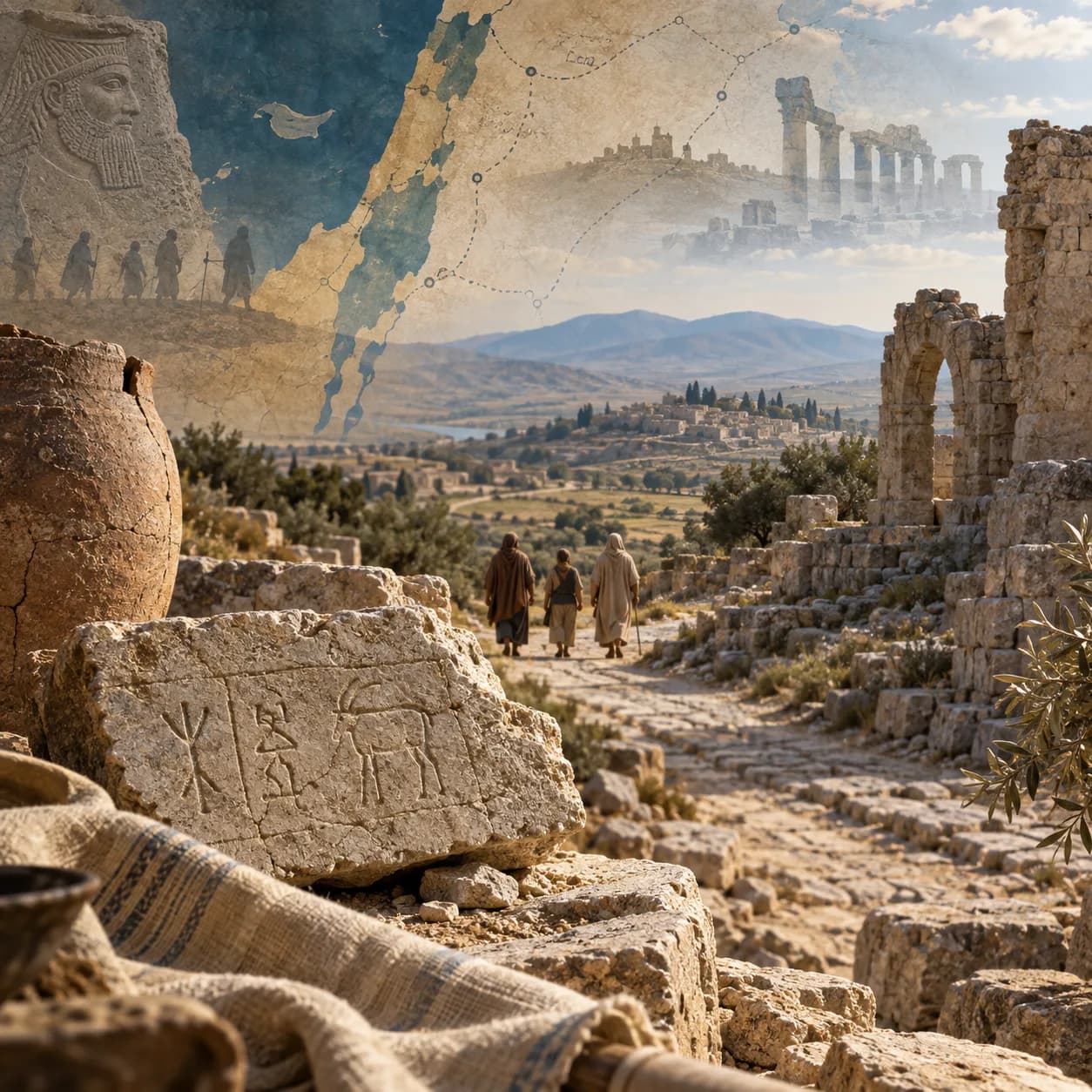
The next morning, the household god is lying on the floor.
The Philistines had placed the ark in the temple of Dagon, the way one displays a trophy before the conquering deity. During the night, however, the scene reversed itself with no human witnesses. At dawn, Dagon appears prostrate before the ark of the Lord. They lift him up and set him back in his place, as though order could be restored by the hands of priests. The next morning, the humiliation repeats and deepens: the idol is on the ground again, this time with head and hands cut off, lying on the threshold, leaving only the torso. The captured object does not behave like a spoil of war. And the god of the temple, who should be guarding his own house, must be propped up by his devotees.
This scene stands at the center of one of the Bible's harshest narratives about the presence of God. In 1 Samuel 4–6, and later in 2 Samuel 6:1–11, the ark passes through battlefields, foreign sanctuaries, terrified cities, an interrupted harvest, and a royal procession. Everywhere it goes, it dismantles the same illusion: that the sacred can be carried around like power on demand. Israel tries to make the ark a guarantee of victory. The Philistines try to turn it into a trophy. David wants to bring it to the center of his kingdom amid feasting and music. No one possesses it. No one neutralizes it. The ark brings the God of Israel near — and for that very reason, it upsets every attempt to domesticate that presence.
The Shout In The Camp
The story begins with defeat. Israel goes into battle against the Philistines and loses men on the field. The decisive point is not merely military. After the setback, the elders ask, "Why has the Lord defeated us today before the Philistines?" The question acknowledges, if only for a moment, that the defeat is not blind accident. But the answer they settle on already reveals the wrong turn: "Let us bring the ark of the covenant of the Lord from Shiloh, that it may come among us and save us" (1 Sam 4). The problem shows up in that subtle shift. The Lord had struck them; now the ark is expected to save them. The symbol begins to take the place of obedient relationship with God.
The narrator doesn't need to comment much, because the sequence itself does the commenting. The ark arrives at the camp, and the people shout so loudly that the ground shakes. The sound alarms even the Philistines, who remember the God of Israel and grow afraid. Everything suggests an imminent reversal. The text builds up expectation only to dismantle it shortly after. Instead of victory, there comes an even greater defeat. Israel flees, Hophni and Phinehas die, and the ark is captured.
The tragedy spreads beyond the battlefield. In Shiloh, Eli falls backward at the news and dies. His daughter-in-law, in labor, names her newborn son Ichabod — "the glory has departed" — because the ark of God had been taken. The whole narrative is threaded through with loss: loss of soldiers, of priests, of a judge, of honor. On the level of plot, the text affirms that the ark really was carried into battle and really was captured. In how the story is told, the emphasis falls elsewhere: Israel does not lose despite having the ark with them; it loses precisely because it brought the ark as a way of trying to activate sacred power in its favor. The shout in the camp produces no obedience. It produces only the illusion of sound.
Dagon Face Down
At first glance, the capture of the ark might seem like a victory of the Philistine gods over the God of Israel. The following chapter exists precisely to dismantle that reading. The Philistines bring the ark to Ashdod and set it beside Dagon's cult image in his temple. It is a scene of religious propaganda: the local god has triumphed, the rival god has been subdued. But the night rewrites the grammar of the temple.
The narrator works through repetition. "The next day, early in the morning," Dagon is found fallen face down before the ark. The Philistines set him upright. "The next day, early in the morning," he falls again. The repetition doesn't produce routine — it produces escalation. The second time, his head and hands lie severed from his body. These parts are not chosen at random. Head and hands represent identity, capability, the power to act. The defeated god loses both face and hands. And the detail of the threshold, where the severed parts lie, turns the very entrance of the temple into a memorial of shame.
There's a fine edge of irony running through all this. Who actually needs help here? The ark, an object carried off from another people's territory, stays exactly where they placed it. Dagon, the supposed lord of the place, cannot even stay standing. The rival image is not refuted by argument; it is dismantled by staging. In the literary form of the account, this is one of the most forceful ways to mock idolatry without a single line of abstract argument: the idol falls and has to be picked back up by its own worshipers.
The Hand That Presses Down
After Dagon's fall, the narrative shifts from the ridiculous to the terrifying. The phrase "the hand of the Lord" recurs insistently, pressing heavily upon the Philistines. The same language runs through Ashdod, Gath, and Ekron. This is not a private affliction but a collective one. The ark gets passed from city to city like a political and religious problem no one wants to keep. Wherever it arrives, panic grows; wherever they decide to move it, the crisis simply changes address.
The repetition of "the hand of the Lord" plays, by contrast, against the severed hands of Dagon lying on the threshold. The Philistine god loses his hands; the Lord stretches out his. The text isn't interested in describing mechanism. It doesn't explain how this hand operates in the physical world. It names the hand to say whose action this is. The focus lies less on "how" and more on "who."
Another important thread emerges here: God does not need an Israelite army to defend his honor. Israel was defeated on the battlefield, but the Lord was not defeated along with the ark. The captured object doesn't prove divine absence; rather, it proves that God's presence cannot be reduced to the success of his people or to the ritual control of their leaders. The ark leaves Israel's hands, and, paradoxically, it is outside Israel that its power becomes undeniable. The Philistines learn through pain what Israel had not learned through liturgy: the holiness of the Lord is not at anyone's disposal.
Cows On The Road
When the calamity becomes unbearable, the Philistines consult their priests and diviners. The advice is pragmatic and cautious. The ark must be returned along with a guilt offering. The account mentions golden images tied to the plague afflicting them, a sign that the Philistines are trying to respond religiously to what they interpret as judgment. Then they propose a test. They put the ark on a new cart, hitch it to two nursing cows, and separate the cows from their calves. If, against instinct, the animals head off alone toward Israelite territory, then it will be confirmed that the disaster came from the God of Israel; if not, it was chance.
The test carries narrative force because it works against natural expectation. Nursing cows would be expected to turn back to their calves. The text describes them heading straight down the road to Beth-shemesh, lowing as they go, turning neither right nor left. Within the story, this course functions as confirmation. It is not a scientific report for a modern laboratory, nor a clue for technical speculation. It is a sign within the narrative: even the ark's return escapes human control.
At Beth-shemesh, the arrival at first seems to bring relief. The men are out reaping wheat, they see the ark, and they rejoice. The cart becomes firewood for sacrifice; the cows become the offering. The scene blends celebration and worship, as though the journey were ending in reconciliation. But the joy is short-lived. In the form the text has come down to us, some men of Beth-shemesh look into the ark improperly, and judgment strikes them. There are known textual difficulties in the transmission of the number affected, but the narrative point remains clear: the ark has returned, and even among Israelites its presence is not treated as an ordinary thing.
It is then that the community voices the most important question of the whole sequence: "Who can stand before the Lord, this holy God?" It is not a theoretical question. It arises out of fallen bodies, an interrupted celebration, reverence wounded by familiarity. The entire episode had been building toward this line. First Israel discovers it cannot carry holiness into war as a tactical resource. Then the Philistines discover they cannot host it as a trophy. Now Israel, at home, discovers that it too cannot receive it without fear.
David And The New Cart
When the ark reappears in 2 Samuel 6, the setting has changed. We are no longer in the crisis of Eli's days but in the rise of David. The king gathers people, organizes a procession, turns the transfer of the ark into a public act. There is music, celebration, movement toward Jerusalem, the city that will consolidate as his political center. Everything has the sheen of a legitimate gesture: uniting the throne with the symbol of divine presence.
But the narrator introduces a detail that sounds familiar. The ark rides on a new cart. The device echoes what the Philistines did in 1 Samuel 6. What served to return the ark amid fear now reappears in the procession of the king of Israel, amid joy. This resemblance is not incidental within the literary logic of the whole. Is David more reverent than the Philistines? Undoubtedly. Is his project nobler? It seems so as well. Even so, the narrative refuses to let good intention, liturgical enthusiasm, and political centralization be enough.
When the oxen stumble near the threshing floor, Uzzah reaches out to steady the ark. The gesture seems instinctive, even protective. Precisely for that reason the scene is so shocking. The text says the Lord's anger burns and Uzzah dies right there, beside the ark. There is no psychological cushioning to soften the blow. The music stops in the same instant the procession loses a man.
David reacts in two stages: anger, then fear. First he is indignant; then he is afraid. The interruption of the procession matters as much as the death itself. The ark does not enter Jerusalem that day. The king does not bring it to its destination as planned. The political-religious project comes to a halt, because God's holiness will not consent to being annexed to royal power as an ornament of rule. The text is not saying Jerusalem will never receive the ark; it is saying that the king, before receiving it, must learn that divine presence does not fold into his kingdom as one more symbol of legitimacy.
A Blessing That Cannot Be Tamed
If the story ended with Uzzah, we might imagine the ark as an unpredictable source of death, a kind of sacred danger with no moral face. The text itself blocks that oversimplification. David leaves the ark in the house of Obed-edom for three months, and the Lord blesses Obed-edom and his whole household. After Dagon on the floor, the panicked Philistine cities, the stricken men of Beth-shemesh, and the death of Uzzah, a household emerges on which blessing rests.
This contrast matters greatly. The Lord's presence is not described as an impersonal force, nor as a cursed object, nor as a lethal device. The same ark that brings judgment also brings prosperity. The decisive factor is not some physical property of the object, as though it emitted automatic harm; it is the relationship with the God whose presence it signals. Within Israel's faith, "holy" does not simply mean dangerous. It means set apart, glorious, not available for ordinary handling. That is why holiness can both judge and bless, without contradiction.
What The Text Allows And What It Does Not
Outside the plot, it's worth speaking with sobriety. We have no way to archaeologically authenticate the ark of the covenant, nor to materially verify the episodes of 1 Samuel 4–6 and 2 Samuel 6:1–11. Nor is there any basis in this material for fantasies about lost technology, radiation, ancient weaponry, or any other sensationalist explanation of that kind. None of that arises from the passage; these are modern attempts to escape the strangeness of the text through a false technical familiarity.
What can be said with more confidence is more modest. The account reflects a world in which sanctuaries, cult images, processions, and warfare were part of collective life. In that context, it makes sense that a people would try to bring a sacred object into battle, and it makes sense that a victorious people would install it in the temple of their deity. But contextual plausibility is not the same as verifying the episode. The biblical narrative, as we have it, was shaped to teach something about God, Israel, and the use of sacred symbols.
That literary framing is clear enough on its own terms. The sequence of events, the recurring "hand of the Lord," Dagon's fall, the cows' path, the question at Beth-shemesh, Uzzah's death, the blessing on Obed-edom — all of it converges on the same lesson. The Holy One does not fit inside our strategies. Israel's most sacred object is not treated here as a national amulet but as a dangerous sign of a presence that judges its enemies and its own people alike.
After The Ark
The interpretive consequence is less abstract than it might seem. These chapters were not preserved to feed curiosity about ancient relics, but to correct an impulse that is always with us: using the sacred as an instrument of security, prestige, or power. It's possible to do this with an ark; it's possible to do it with a Bible open on a table; with a carefully staged worship service; with "God with us" language put in service of national ambitions; with religious authority used to shield leaders, win arguments, or dodge moral scrutiny.
The text's critique does not fall on symbols as such. The ark really is holy; it is not an empty prop. The problem begins when the symbol stops pointing to the living God and starts functioning, for us, as possession. Israel carried it into war so that "it" would save them. The Philistines set it beside Dagon to display superiority. David brought it in grand procession to the center of his kingdom. Each gesture has its own logic; all of them stumble on the same limit.
For a Christian reading, that limit remains necessary. God's nearness is grace; for that very reason, it cannot be manipulated. Reverence is not superstitious fear, and joy is not irreverence. But faith grows sick when it turns what is holy into religious capital. A church can have liturgical beauty and still treat God's presence as decoration. A minister can speak of glory and still use that glory as a shield. A community can celebrate intensely and still forget the question at Beth-shemesh: who can stand before the Lord, this holy God?
These stories leave that question echoing — not to drive us away from God, but to break the fantasy that we already know how to carry him. Perhaps the first form of reverence, after reading 1 Samuel 4–6 and 2 Samuel 6:1–11, is this: to stop turning signs of divine presence into tools for our own projects. When that happens, the shout in the camp, the fall of Dagon, and the celebration cut short by Uzzah all belong to the same diagnosis. The sacred stops being encounter and becomes use. And the text answers, with memorable severity, that the Holy One will not be used.
Sources Of This Text
Primary source: 1 Samuel 4–6; 2 Samuel 6:1–11. Biblical text. The literary observations refer to the passages indicated; the Memra applications are editorial interpretations.
This essay focuses on a comparative reading of the biblical text. It does not offer archaeological proof or an independent reconstruction of the episode.
Continue the study in Memra
Read the complete course with progress tracking and connected references.
Open the course