Where was Jesus most likely born?
Bethlehem is the response of Matthew, Luke and Christian tradition. Nazareth, however, is the oldest and most constant geographic association. What the evidence allows us to conclude — and what it does not allow us to conclude.
Short answer
The most historically responsible conclusion is uncertain: Jesus may have been born in Bethlehem, as Matthew and Luke assert, but Nazareth—or Galilee—has a modest advantage when weighing the older association, the literary construction of the two narratives, and the lack of independent confirmation. Saying "Nazareth is more likely" is defensible; saying "it is proven that it was Nazareth" is not.
Historical judgment Most likely: Nazareth or surrounding Galilee. Possible: Bethlehem of Judea. Undemonstrable: a precise address or building.
| Category | Conclusion |
|---|---|
| Well-established fact | Jesus was a Galilean Jew, publicly known as "of Nazareth." |
| Probable inference | His family origins and training occurred in Nazareth; birth in the region is slightly more likely. |
| Possible hypothesis | He may have been born in Bethlehem and raised in Nazareth; texts do not make this impossible. |
| Theological tradition | Bethlehem communicates that Jesus is the promised Davidic Messiah; this sense is not historical proof. |
The oldest sources know "Jesus of Nazareth"
Established fact
Paul's authentic letters, the oldest preserved Christian texts (50s AD), do not provide the city of birth. Mark, generally considered the oldest gospel, begins with the adult Jesus coming "from Nazareth in Galilee" (Mk 1:9). It contains no genealogy, virginal conception or childhood narrative.
This does not prove birth in Nazareth: in Antiquity, a person could be identified by the place of upbringing or residence. But it matters because the connection with Nazareth does not depend on later Christmas stories. It cuts across Mark, Matthew, Luke, John and independent traditions.
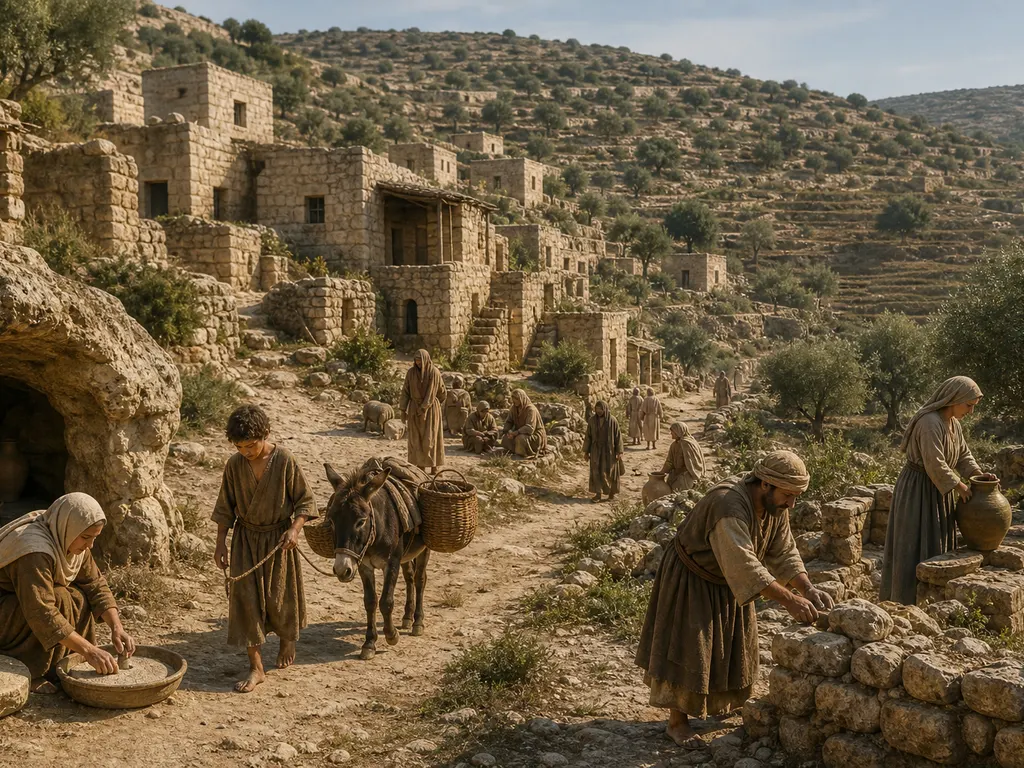
Illustration generated. Plausible reconstruction of a rural Galilean village; does not represent an identified site or building.
Who wrote the gospels?
The texts are formally anonymous: their authors do not identify themselves in the body of the works. The titles "according to Matthew" and "according to Luke" belong to the ancient reception of the Church. Most researchers date Mark to around A.D. 65–75 and Matthew and Luke to approximately A.D. 80–95. Matthew and Luke used Mark in much of their public ministries, but their infancy narratives do not come from Mark and differ profoundly.
Matthew: Bethlehem is the starting point; Nazareth needs to be explained
Text + theology
Matthew simply states that Jesus was born in Bethlehem "in the days of King Herod" (Matt. 2:1). He does not report a previous trip from Nazareth. The magicians find the child in a house, Herod reacts, the family flees to Egypt and, after the king's death, Joseph avoids Judea governed by Archelaus and settles in Nazareth.
Matthew’s narrative route: Bethlehem → Egypt → Nazareth
In Matthew's internal logic, the family seems initially linked to Judea. Nazareth appears as a later destination. The story is woven with echoes of Moses and the exodus: a murderous ruler, a threatened child, escape and return. The author also organizes the episode by "compliments" from the Scriptures. This shows theological intent; by itself, it does not decide whether the geographic core is true or created.
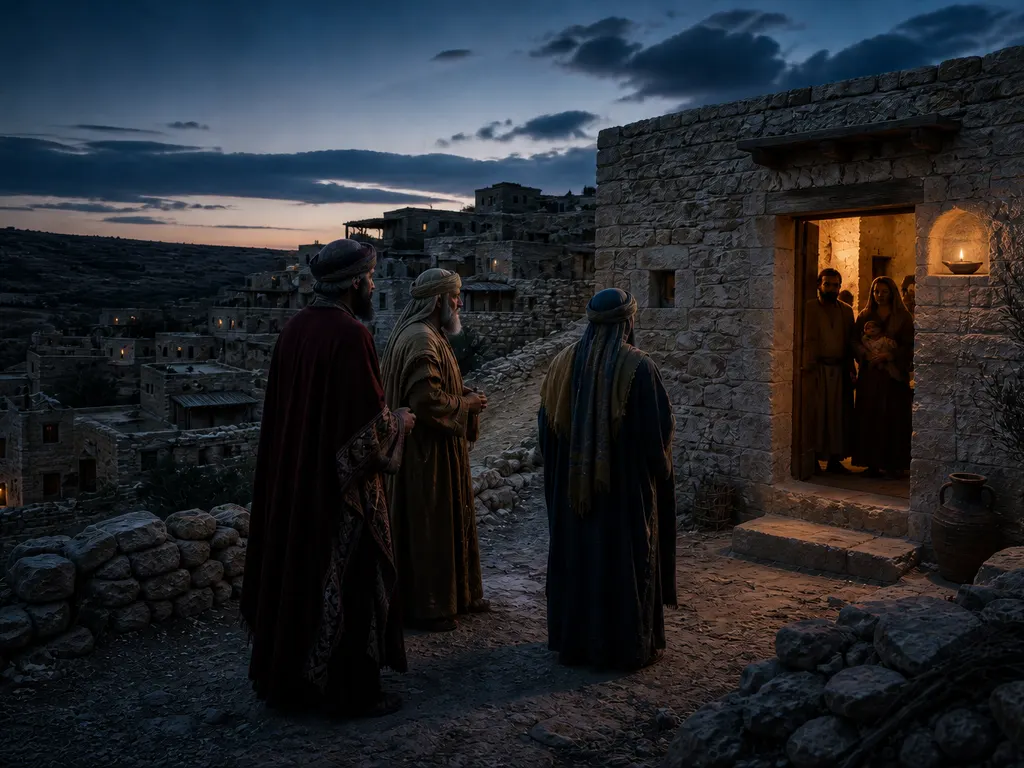
Illustration generated. Matthew speaks of a house and does not call the visitors kings nor inform that there were three.
Luke: Nazareth is the starting point; the trip to Bethlehem needs to be explained
Text + theology
Luke presents Mary in Nazareth before her birth (Luke 1:26). Joseph travels with her to Bethlehem because of a census linked to Augustus and Quirinius. Jesus is born during the stay, is placed in a manger, receives a visit from shepherds, is presented in the Temple and the family returns to Nazareth.
Luke's narrative route: Nazareth → Bethlehem → Jerusalem → Nazareth
The census creates a historical difficulty: there is no evidence of an imperial decree that forced everyone to return to the city of a remote ancestor. The census of Quirinius known by Josephus occurred when Judea became a Roman province, in 6/7 AD — about a decade after the death of Herod, under whom Luke himself places the beginning of history (Luke 1:5).
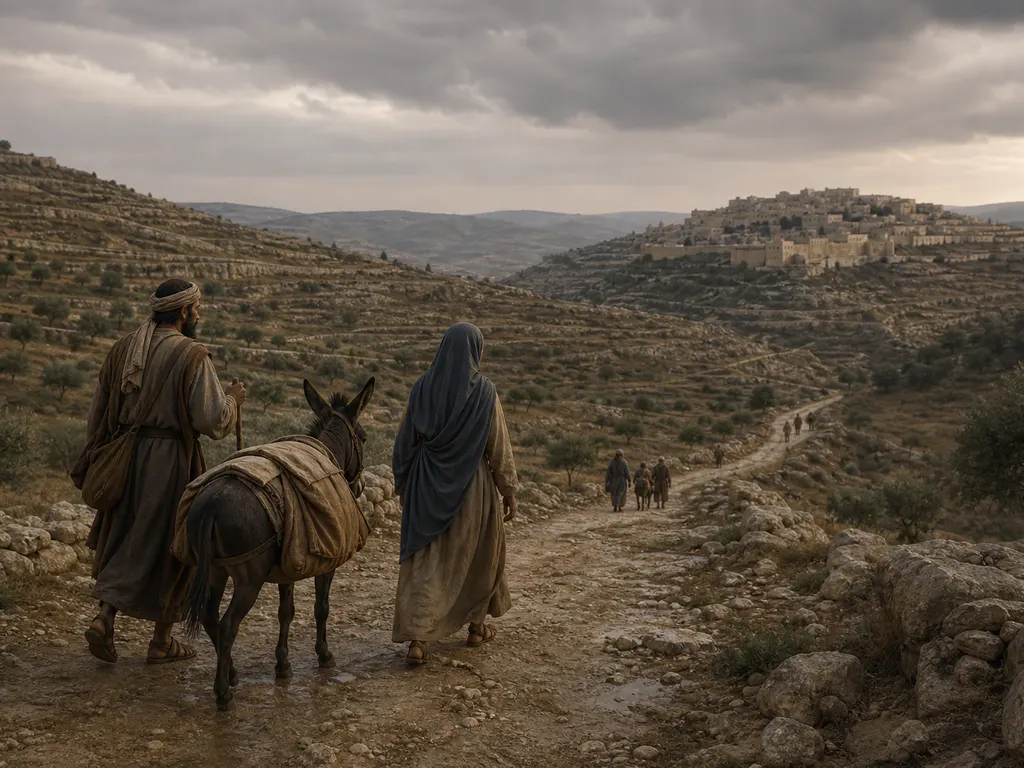
Illustration generated. The scene visualizes Luke's logic; does not confirm that the trip or its tax reason occurred.
The narratives agree on the name "Bethlehem", but they do not tell the same itinerary
Critical comparison
| Question | Matthew 1–2 | Luke 1–2 |
|---|---|---|
| Residence before birth | Not informed; the narrative begins in Bethlehem | Nazareth |
| Reason to be in Bethlehem | No displacement is narrated | Census of Augustus associated with Quirinius |
| Visitors | Wizards of the East | Shepherds |
| Visit location | Home | Manger; the exact space is ambiguous |
| Political threat | Herod, massacre, escape to Egypt | None of these events |
| After birth | Egypt and then Nazareth | Temple in Jerusalem and then Nazareth |
A harmonization — presentation in the Temple, subsequent visit by the magi, escape to Egypt and return — is logically possible. But it is a fourth narrative composed by the reader. The historical method first reads each author on his or her own terms, without turning silence into confirmation.
John 7:41–42
John preserves a dispute: some reject Jesus because he came from Galilee, as they expected the Messiah from the descendants of David and Bethlehem. The narrator does not correct the interlocutors by saying that Jesus was born in Bethlehem. It is an interesting indication that his public origin was Galilean, but not a birth certificate.
Why was Bethlehem such a powerful statement?
Theological tradition
Bethlehem was the city of David. Micah 5 associates Bethlehem/Ephrathah with a future ruler, and Matthew cites this tradition explicitly. Luke also calls Bethlehem the "city of David." For communities that confessed Jesus as the Davidic Messiah, the place functioned as a theological geography: it linked their identity to the Scriptures and the memory of David.
There are two opposite mistakes to avoid. The first is to say that theological meaning proves historicity. The second is to say that theological meaning proves invention. A real event can be interpreted theologically; a theological narrative can also create a symbolic location. Without an independent contemporary source, we certainly don't choose between these options.
Illustration generated. The staff and parchment allude to the memory of David and the rereading of the Scriptures, without reproducing a specific artifact.
The verdict: Nazareth is slightly more likely, but the evidence does not close the case
Final inference
1. What weighs on Nazareth Old and multiple association; absence of Bethlehem in Paul and Mark; need for distinct narratives to link the Galilean to the city of David; difficulties of the Lucan census.
2. What weighs on Bethlehem Matthew and Luke affirm Bethlehem; the divergence of their stories does not automatically eliminate a common core; the local tradition is attested as early as the 2nd century.
3. What archeology can do Rebuild villages, economy and material culture. Archaeology did not identify a record, house or object that determines the city of birth.
4. More honest formulation "Jesus was probably born in Nazareth or Galilee, although Bethlehem remains historically possible and is the explicit tradition of Matthew and Luke."
Degree of confidence: moderate for Nazarene origin; down to the exact city of birth. Uncertainty is not a failure of research: it is the appropriate result for late, literary and interested sources.
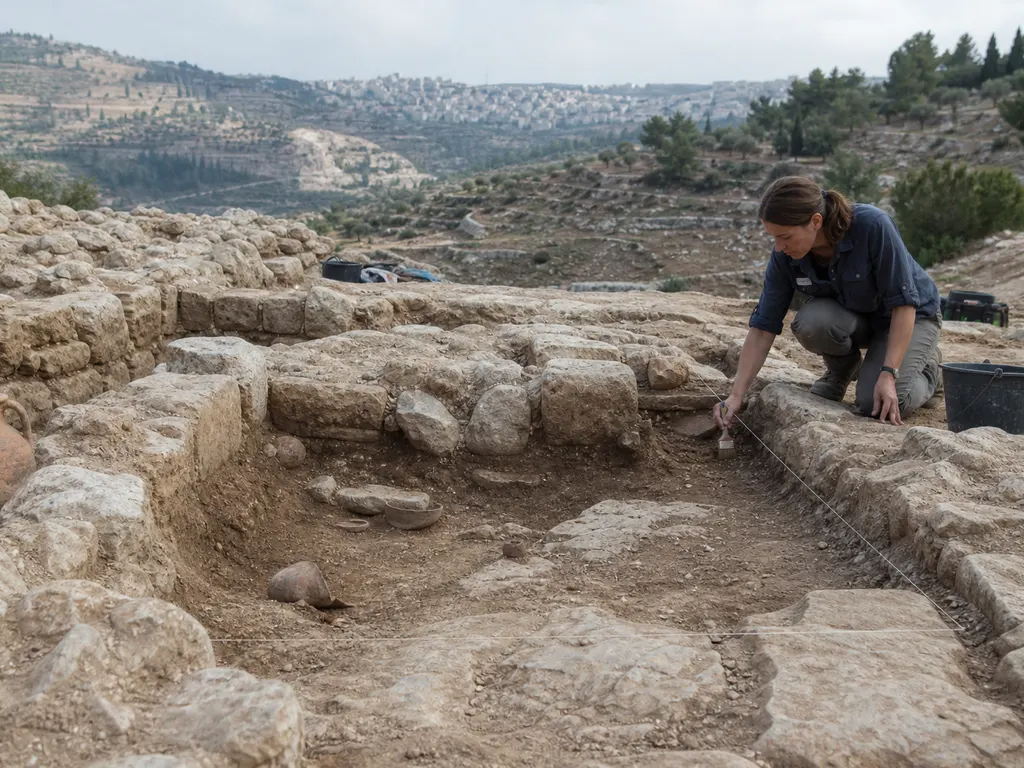
Illustration generated. Archaeological research illuminates the material context, not the individual biography of Jesus.
Sources and recommended readings
- •Mark 1; Matthew 2; Luke 1–2; John 7 — primary texts in modern translation.
- •"Bethlehem", HarperCollins Bible Dictionary / Bible Odyssey — Bethlehem, David, and the Christian tradition.
- •Boston College, "Infancy Narrative Commentaries" — literary reading of Matthew and Luke.
- •J. K. Elliott, "O Little Town of … Nazareth?" — academic discussion of historical probability.
- •Raymond E. Brown, The Birth of the Messiah, updated edition, Doubleday, 1993 — reference historical-critical commentary.
- •Géza Vermes, The Nativity: History and Legend, Penguin, 2006 — historical evaluation of the narratives.
Editorial note: illustrations were generated for this article. They are visual reconstructions, not documentary evidence.
Same series: History of Christianity
Read the complete series in the app
Memra is 100% free — the Christian History articles, with discussion and AI for questions on each one, are available in the app.
Open in Memra