In what year was Jesus most likely born?
It wasn't in "year zero". Herod points to before 4 BC; Quirinius points to 6 A.D. Between limits, approximations and theology, the most defensible range is 6–4 B.C.
Short answer
We do not know the exact year. If we give greater weight to the tradition that places the birth still under Herod, the most used and most defensible range is approximately 6–4 BC The year 7 BC remains possible in broader reconstructions; dates in 2/1 BC require reviewing the majority chronology of Herod's death.
Historical judgment Most likely range: 6–4 BC Possible range: 7–4 BC Day and month: unknown. December 25th: liturgical tradition, no date demonstrated.
| Category | Conclusion |
|---|---|
| Established fact | There is no contemporary document that records the date; the B.C./A.D. system it was calculated centuries later. |
| Probable inference | A birth shortly before Herod's death, conventionally placed in 4 BC |
| Possible hypothesis | 7 BC, 5 BC or other nearby dates, depending on chronology and celestial phenomena. |
| Theological tradition | December 25th organizes the Christian celebration; does not function as independent biographical data. |
Why could Jesus have been born "before Christ"?
Established fact
Because the Anno Domini era was not created at birth. The monk Dionysius the Exiguous proposed in the 6th century a count of years from the incarnation of Christ. He worked with incomplete ancient chronologies and his estimate does not coincide with the historical limits reconstructed today.
Furthermore, in traditional historical convention there is no year zero: 1 BC is followed by 1 AD. The expression "Jesus was born in 5 BC." it is not a paradox about the character; it is a consequence of a calendar created more than five centuries later.

Illustration generated. Conceptual representation of Dionysius's chronological work, not documentary portrait.
Herod the Great: the limit that pushes birth before 4 BC
Main anchor
Matthew places the birth during the reign of Herod. Luke also opens his childhood narrative "in the days of Herod king of Judea" (Luke 1:5). Josephus describes the king's death after a lunar eclipse and before Easter; the majority reconstruction places it in 4 BC.
If this chronology and the framework of the gospels are accepted, Jesus must have been born before Herod's death. The massacre narrated by Matthew is not confirmed by Josephus or another ancient source, and the age "up to two years" chosen in the story should not be mechanically converted into two chronological years. Still, a birth between 6 and 4 BC accommodates the account without requiring non-existent precision.

Illustration generated. Herod and his court are artistically reconstructed; the image is not intended to be a portrait.
| Year | Event |
|---|---|
| 7 BC | Triple conjunction of Jupiter and Saturn; hypothesis, not clock. |
| 6 BC | Start of frequently proposed range. |
| 5 BC | Chinese astronomical account sometimes associated; uncertain identification. |
| 4 BC | Death of Herod in the majority chronology. |
| 6 AD | Census of Quirinius after the deposition of Archelaus. |
Quirinius: the known census occurred about ten years too late
Chronological problem
Luke 2 associates the birth with a census when Quirinius ruled Syria. Josephus links the valuation of Quirinius' assets to the annexation of Judea after the deposition of Archelaus in AD 6. This is a historically well-placed event and provoked resistance from Judas the Galilean.
The problem is straightforward: Herod died years earlier, and Jesus could not have been born simultaneously under Herod and in the provincial census of A.D. 6. Proposals of an earlier term of Quirinius, an unknown census, or the translation "before Quirinius" exist, but have not gained consensus and lack sufficient documentary confirmation.
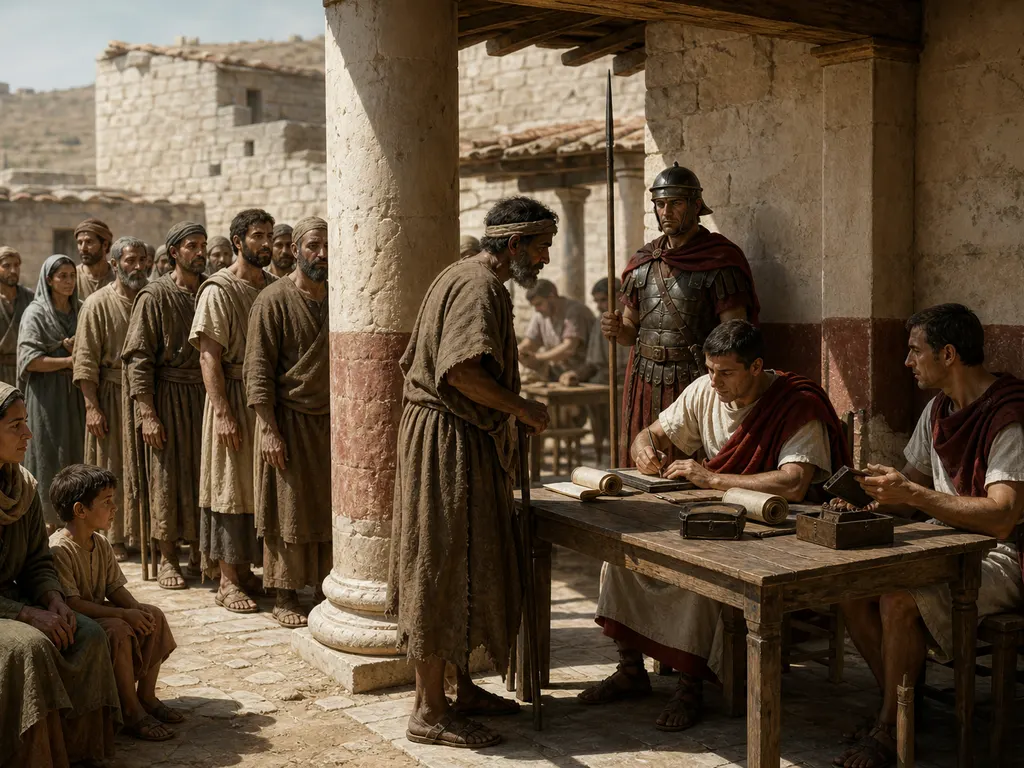
Illustration generated. The known census assessed the new province; the scene does not illustrate a proven order to return to the ancestral city.
| Bookmark | Approximate historical date | Strength to date birth |
|---|---|---|
| Herod still alive | Before 4 BC in the majority chronology | Moderate, because Matthew and Luke 1 use it |
| Census of Quirinius | 6/7 AD | Strong for the event, but incompatible with Herod |
| "About thirty years" in the 15th year of Tiberius | Ministry around 28/29 AD; birth close to 2/1 BC if literal | Weak: "about" is an approximation |
| Celestial phenomenon | Various options between 12 and 2 BC | Very faint: depends on identifying the star as a natural event |

Illustration generated. The two sides visualize different eras; the separation is historical, not just narrative.
The "star" does not provide a safe date
Possible hypothesis
Only Matthew mentions the star. Over the centuries it has been identified with comet, nova, planetary conjunctions and literary astrological language. The triple conjunction of Jupiter and Saturn in 7 BC is attractive because it occurred in the relevant interval and could be of interest to ancient astrologers. There are also proposals for events in 5 or 6 BC.
No hypothesis explains without difficulty a star that "goes forward" and "stops" over a place. The vocabulary can be narrative or astrological, not the description of a modern observation. Making a phenomenon match part of the text demonstrates compatibility; it does not prove identity or transform astronomy into a birth certificate.
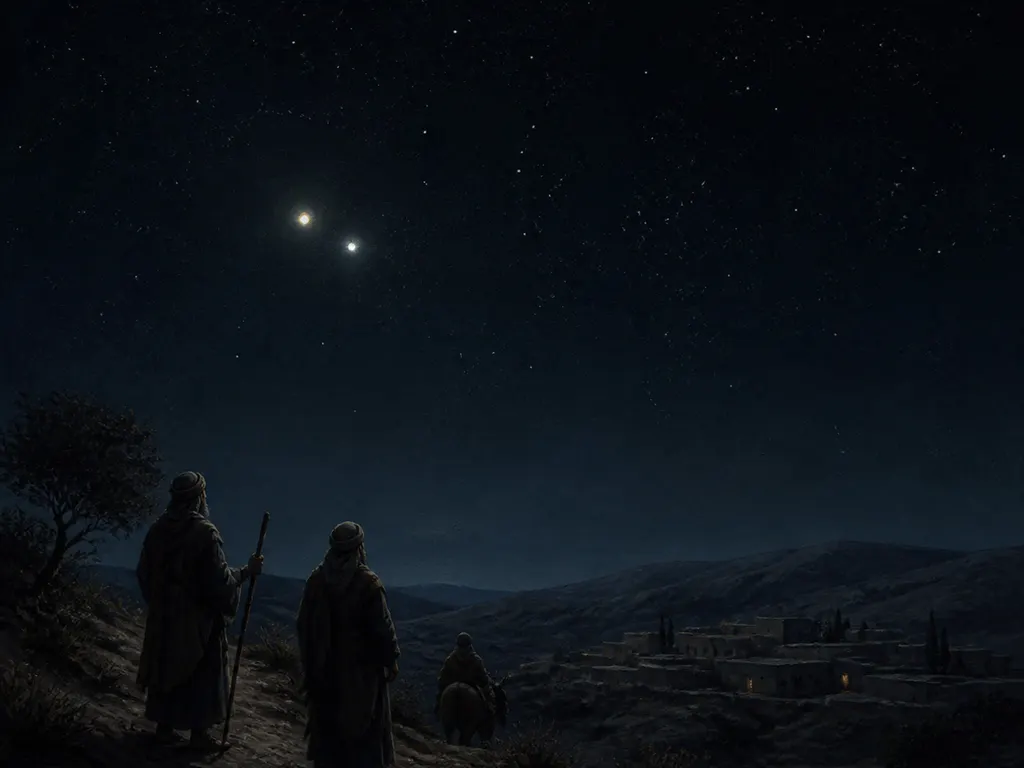
Illustration generated. Sober representation of an apparent conjunction; does not claim that it was the star of Matthew.
Conjunction of 7 BC — Historically real and visible; its connection with Matthew remains conjectural.
Comet or nova — Asian records are discussed, but translation, nature, and association are uncertain.
Literary sign — Stars announcing great rulers were an understandable motif in the ancient world.
What about December 25th?
Liturgical tradition
The gospels do not give a day or a month. Shepherds in the field did not allow for a season to be safely obtained, as herding practices varied. The feast of December 25th appears in Christian tradition centuries later and received different theological and calendar explanations, including calculations based on conception on March 25th and debated relationships with Roman festivals.
The prudent conclusion is simple: December 25th is a date of celebration, not a verifiable historical date. Liturgical value and biographical accuracy are different categories.
The verdict: 6–4 BC is the best range, not a proven year
Final inference
Herod's chronology offers the most usable boundary, but it depends on giving historical weight to the framing of childhood narratives. Quirinius reveals that Luke combined markers that do not fit into the known chronology. The approximate age at the beginning of the ministry is not precise enough to resolve the conflict. The star produces possibilities, not independent control.
Recommended formulation: "Jesus was probably born between 6 and 4 BC, perhaps a little earlier; we don't know the exact year, and December 25th belongs to the liturgical tradition."
Specifically choosing 6, 5 or 4 BC may be useful in a narrative reconstruction, but it exceeds what the sources establish. The professional result is not a false accuracy: it is a range accompanied by reasons, conflicts and the degree of confidence.
Sources and recommended readings
- •Matthew 2; Luke 1–3 — the chronological markers in the primary texts.
- •Flavius Josephus, Jewish Antiquities, book XVII — last years, death of Herod and succession.
- •Flavius Josephus, Jewish Antiquities, book XVIII — Quirinius, assessment of Judea and Jude the Galilean.
- •Boston College, "Infancy Narrative Commentaries" — literary and theological context.
- •Raymond E. Brown, The Birth of the Messiah, updated edition, Doubleday, 1993.
- •Géza Vermes, The Nativity: History and Legend, Penguin, 2006.
Editorial note: illustrations were generated for this article. They make scenarios understandable, but do not serve as proof.
Same series: History of Christianity
Read the complete series in the app
Memra is 100% free — the Christian History articles, with discussion and AI for questions on each one, are available in the app.
Open in Memra