Ascension: The Cloud and the Language of Heaven
From the series The Bible Is Not Literal, published by Memra.
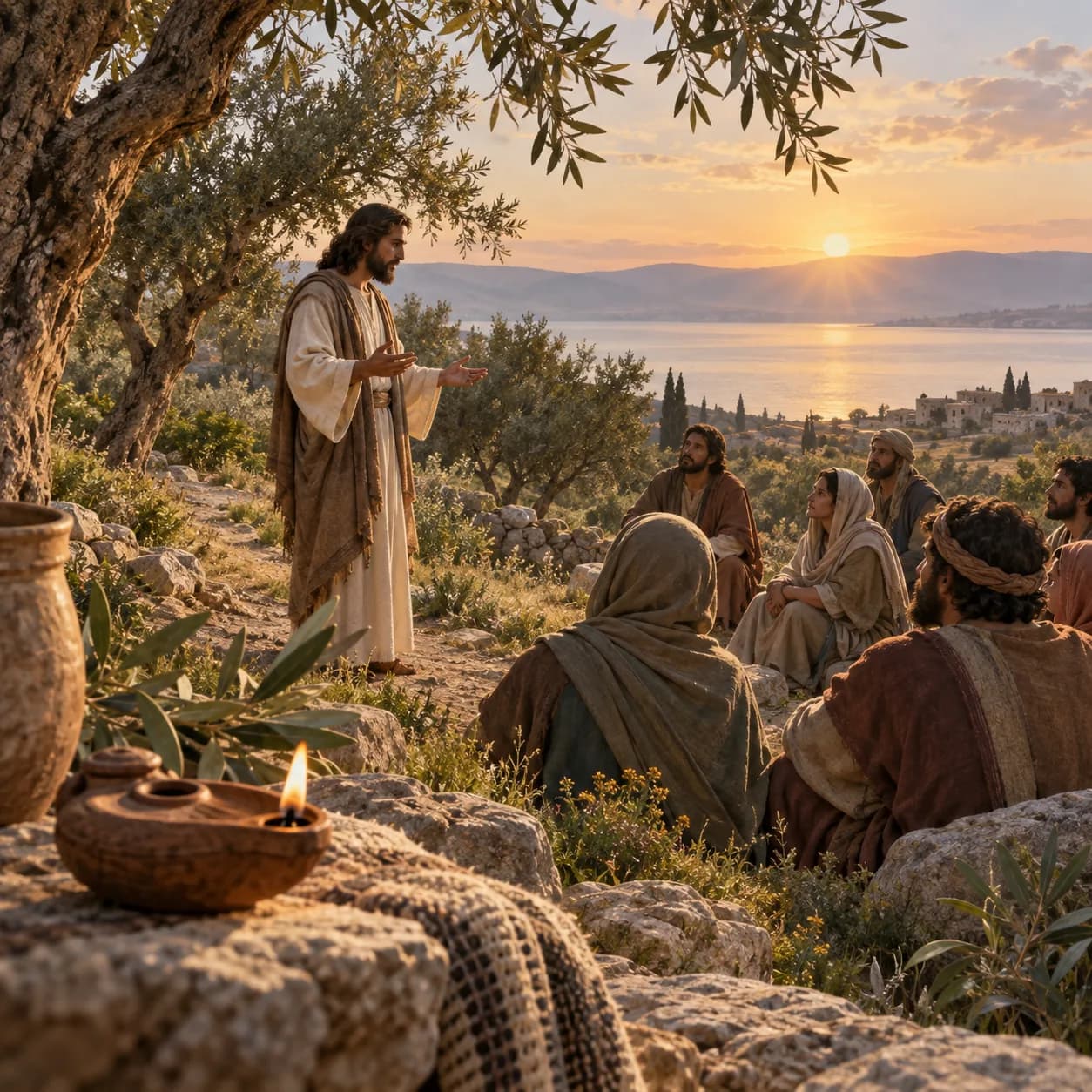
Forty days after the tomb was found empty, the disciples are still asking the wrong question. They stand before Jesus, risen, tangible, capable of eating grilled fish in front of them — and what they want to know is whether now, finally, he will restore the throne of Israel. It is at this moment of miscalibrated expectation that the narrative leads them to Bethany, or to the Mount of Olives, to witness what looks like the opposite of a coronation: Jesus draws away, rises, disappears into a cloud. This is not what they asked for. And yet it is exactly what the Gospel needs in order to end — and what Acts needs in order to begin.
Two Endings For The Same Scene
Luke closes his Gospel with an almost liturgical economy. Jesus leads the disciples out of the city, lifts his hands, blesses them, and "while he blessed them, he parted from them and was carried up into heaven" (Luke 24:50-51). There is no long discourse, no dialogue. The disciples' response is surprising: they return to Jerusalem "with great joy" and spend their time in the temple, blessing God. An account that could sound like abandonment ends in jubilation. That already tells us something about how the narrator wants the episode read: not as loss, but as culmination.
Acts reopens the same scene at a different pace, more deliberate. There is a reference to the "first book" and to what Jesus "began to do and teach" — a phrase that, on its own, pushes the reader forward: if that was only the beginning, what comes next is continuation, not epilogue. Forty days of appearances follow, teaching about the kingdom, the command to wait for the Spirit in Jerusalem, the disciples' question about the restoration of Israel, Jesus's answer that shifts attention from the calendar to the mission — "you will be my witnesses... to the ends of the earth" (Acts 1:8). Only then comes the ascent, the cloud that hides him, and the two men in white robes who interrupt the disciples' astonishment with a pointed question: why are they standing there looking at the sky.
The difference in pacing between the two accounts is not an accident of careless composition; it is the signature of a two-part project that deliberately joins its seams, as the USCCB's introduction to Acts of the Apostles observes in placing the book as the theological continuation of Luke's Gospel. The end of one text is the hook of the other. And the hook is precisely the ascension.
The Cloud That Is Not Weather
Anyone who reads the Hebrew Bible before arriving at Acts 1 already knows that a cloud, there, is rarely meteorology. It is the cloud that guides Israel in the wilderness (Exodus 13:21-22), that covers Sinai when God descends (Exodus 19:9-16), that fills the tabernacle with glory to the point of barring Moses from entering (Exodus 40:34-35), that later fills Solomon's temple with such density that the priests cannot minister (1 Kings 8:10-11). In Luke 9, at the transfiguration, the same cloud envelops Jesus, Moses, and Elijah, and from within it comes the voice declaring: "This is my Son." The cloud, in this repertoire, does not describe weather; it marks the boundary between the visible and the presence of God. It veils precisely where it reveals.
When Acts 1:9 says that "a cloud took him from their sight," the reader formed in these traditions does not ask what kind of cloud it was, cumulus or stratus. The question the text raises is different: what does it mean that Jesus's departure happens under this same sign that has always marked the unfathomable presence of God? The implicit answer is that this farewell belongs to the same order of reality as Sinai and the temple — not a discreet disappearance, but an event that exceeds the category of mere vanishing.
There is also a closer echo, that of Elijah being taken up before Elisha in 2 Kings 2:11, separated from him by a whirlwind and chariots of fire, ascending into heaven. The similarity of vocabulary and scene is hard to miss. But the comparison has its limits: Elijah is a prophet who passes on his mantle; Jesus is announced by the two men in white as the one who "will come in the same way you saw him go" — not a succession, but a promise of return. The text uses an image familiar from the biblical imagination and reconfigures it around a figure that tradition had no prior mold to accommodate fully.
The Question That Does Not Get The Expected Answer
It is worth lingering over a detail easy to pass by too quickly. The disciples ask: "Lord, is this the time when you will restore the kingdom to Israel?" (Acts 1:6). It is a political, eschatological question, laden with centuries of expectation. Jesus does not dismiss it as naive, nor does he rebuke it. He answers by shifting the axis: "It is not for you to know the times or seasons that the Father has set by his own authority" — and he immediately replaces calendar with vocation: "you will receive power... and you will be my witnesses." The question about when becomes instruction about what to do in the meantime.
This shift is the hinge of the whole scene. The ascension does not answer "where did Jesus go" or "when will the kingdom fully arrive"; it redirects the energy of the question toward the present task. That is why the interpellation of the men in white, moments later, carries the same tone: "why do you stand there looking at the sky?" This is not a reproof of hope — it is a correction of a hope that turns into paralysis. The whole scene teaches that looking up must not replace walking out — to Jerusalem, Judea, Samaria, and the ends of the earth.
What The Text Allows — And Does Not Allow — Us To Claim
At this point, it is necessary to be honest about the limits of what the textual evidence supports. Luke and Acts affirm, with narrative clarity, that the visible, continuous presence of Jesus with the disciples comes to a recognizable end, and that this end is read by the community as exaltation, not defeat. They also affirm that this exaltation is communicated through a vocabulary — heaven, cloud, ascent — already charged with theophanic meaning within the biblical tradition the first readers knew.
What the text does not allow is reconstructing the mechanics of the event as though it were a physics report. There is no way to measure the trajectory, speed, or spatial "destination" of a body that "rises" into heaven, and the narrative itself does not aim at that kind of precision: it uses the grammar of revelation, not that of instrumental observation. This does not mean nothing happened, only that the chosen form of narration is not the form of a technical record — and insisting on treating it as such distorts the genre of the account itself.
The number forty, attributed to the days of appearances in Acts 1:3, suffers from a similar ambiguity. In the biblical repertoire, forty tends to mark a period of testing or complete preparation — the days of Moses on Sinai, the years of Israel in the wilderness, the days of Jesus in the desert before his ministry. There is no way for today's reader to verify, by external means, whether the number is an exact count or a symbolic signature of fullness; the two can coexist without the text offering a criterion to separate them.
Three Ways Of Reading The Same Departure
Given these limits, distinct readings have formed, and it is worth naming them without pretending that any one alone resolves the tension. Some read the ascension as a bodily event in the full sense: Jesus actually leaves the disciples' visible space, lifted by God's direct action, and the cloud and the angelic testimony describe, even with ancient vocabulary, something that truly occurred before witnesses.
Others prefer to understand the scene as narrative language of exaltation: what the passage wants to communicate is that Jesus was vindicated and enthroned alongside God, and the form chosen to say this is the biblical repertoire of theophany — cloud, mountain, ascent — without the text's interest lying in describing a measurable physical displacement.
A third reading places the account in the territory of visionary experience: the early community, trying to communicate a profound spiritual certainty — that Jesus lives and reigns — draws on images of ascension because that was the available vocabulary for expressing divine exaltation, without this implying a denial of the reality of the proclaimed resurrection.
None of these readings, taken exclusively, accounts for the full tension of the text. The first risks treating theophanic language as though it were a chronicle of space travel. The third risks emptying out the concrete claim that Luke and Acts make about a real event in the life of the community. The second tries to hold both ends together, but it too must admit that it does not settle the question of materiality on its own.
It is worth noting that the "two men in white robes" who address the disciples are not a new figure in the economy of Luke's narrative: they are practically the same messengers — in form, if not necessarily in identity — who appear at the empty tomb, also in dazzling clothing, also posing a rhetorical question that corrects the onlookers' gaze: "why do you seek the living among the dead?" The repetition of the device is not lazy stylistic coincidence; it is the signature of a pattern. In both episodes, an unexpected absence — the body that is not in the tomb, the Jesus who is no longer visible on the mountain — provokes in the disciples a gesture of misdirected searching, and in both cases heavenly figures interrupt that search with a question that reorients the gaze. The pattern suggests that Luke-Acts treats the ascension as a deliberate echo of the resurrection, not as an event of a different nature: the two scenes teach the same lesson about where Jesus is no longer to be sought, and by extension, about where he continues to be found.
This connection gains weight when we notice that the question of the men in Acts 1:11 has an almost identical structure to the one at the tomb, but its content is inverted in a revealing way. At the sepulcher, the question shifts the gaze from below to above, from the place of the dead to the possibility of life; on the mountain, it shifts the gaze from above to below, from the empty sky to the mission awaiting on earth. It is as if the Gospel and the book that continues it were teaching, through the same narrative device, two halves of a single correction: do not seek among the dead the one who lives, and do not stand gazing at the sky for the one who has already fulfilled his visible part. Both warnings share a refusal of a kind of piety content to look in the wrong place — whether the empty tomb or the cloud that has already closed.
There is, finally, a sequential detail that the text of Acts does not waste: the disciples' question about the restoration of the kingdom (1:6) precedes the ascension by only a few verses, and the answer of the men in white follows it by only a few verses as well — so that Jesus's rising is boxed in between two corrections of expectation, one before and one after. This framing is not ornamental; it is how the narrator ensures that no one leaves the scene thinking the ascension resolved, postponed, or canceled the question about the kingdom. It only redefines it, placing between the question and its final answer the time of a mission whose length the disciples do not yet know.
The Boundary Between Presence And Absence
What seems most solid, looking at the passage as a whole, is what it does structurally: it turns the end of Jesus's visible company into the beginning of mission. The cloud does not explain how Jesus went; it signals that his departure belongs to the same order of mystery that has always accompanied God's presence among the people. And the question of the men in white does not rebuke the desire for contemplation — it teaches that contemplation without sending becomes paralysis.
It is this architecture that sustains the reading that the church does not inherit an empty absence from Jesus, but a task. The temple where the disciples end up, in Luke, blessing God with joy, and the streets of Jerusalem to which they are sent back, in Acts, by the same men who interrupt their fixed gaze at the sky, form the two banks of the same river: worship and witness, and neither dispenses with the other.
There remains, however, a question the text itself does not close, and perhaps should not close: if the ascension redefines the mode of Jesus's presence without extinguishing it, how does one distinguish, in the practice of faith, between actively waiting for the fulfillment of a promise and using that same promise as a pretext for not acting on what is already set before one's eyes, here, on earth, far from any cloud?
Sources Of This Text
Primary basis: Luke 24:50–53; Acts 1:1–11. Biblical text. The literary observations refer to the indicated passages; the Memra applications are editorial interpretations.
32 · USCCB · NABRE | Introduction to the Acts of the Apostles | https://bible.usccb.org/bible/acts/0 | — Narrative and theological design of Acts.
Continue the study in Memra
Read the complete course with progress tracking and connected references.
Open the course