Baptism and Temptation: Voice, Wilderness, and Choice
From the series The Bible Is Not Literal, published by Memra.
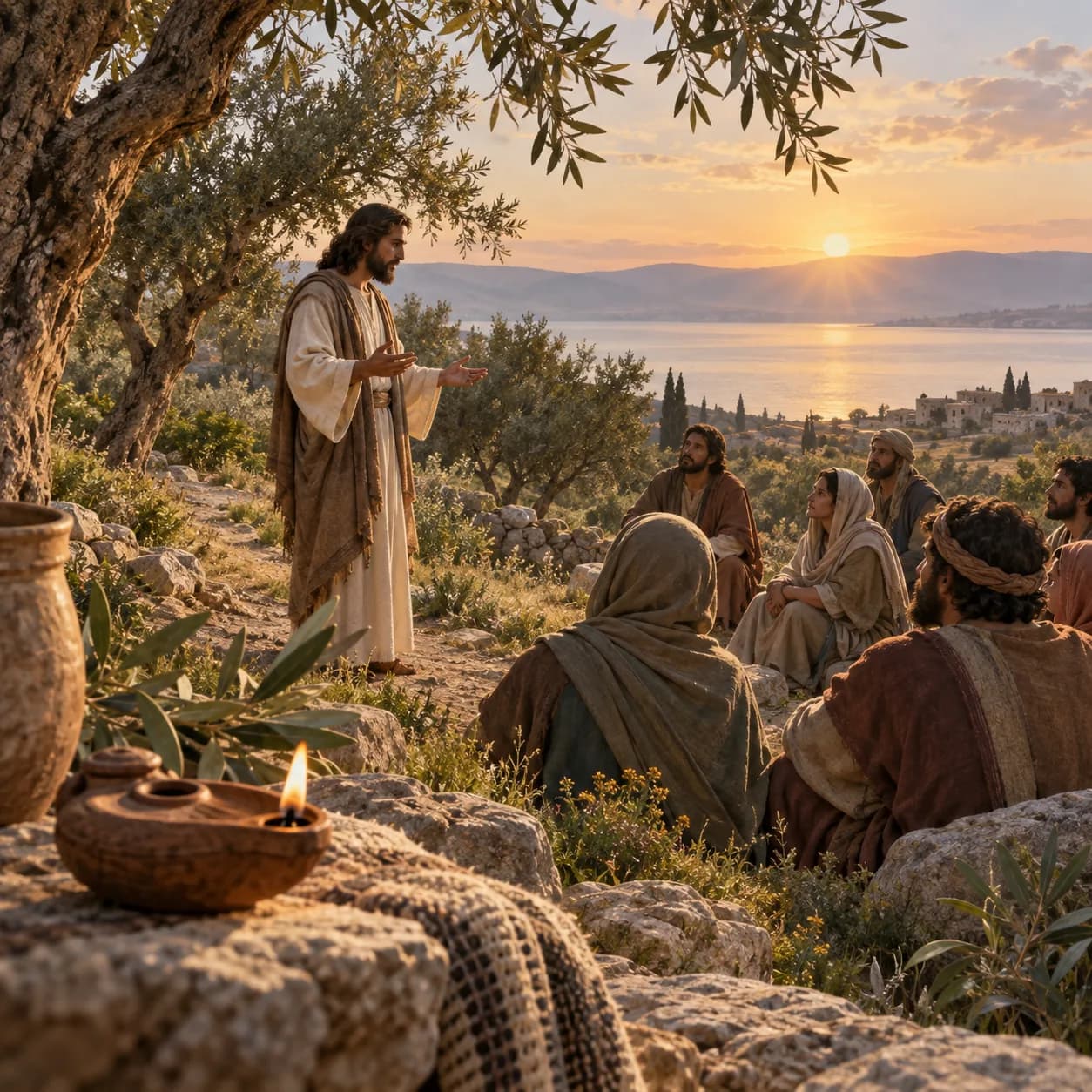
The Jordan River is neither deep nor wide. Anyone wading into it during a Judean summer would barely get wet past the waist. And yet it is there, in that modest waterway, surrounded by people who had come to confess their sins and start their lives over, that the Gospels choose to begin the story of Jesus as an adult. Not with a spectacular miracle, not with an inaugural speech, but with a man standing in line behind other sinners to be baptized by a wilderness preacher. It is a scene strange enough that the evangelists themselves feel the need to explain it — and that strangeness is the right place to start.
The Friction Matthew Needs To Resolve
Mark does not hesitate before the problem. He simply narrates: "In those days Jesus came from Nazareth of Galilee and was baptized by John in the Jordan" (Mark 1:9). No justification, no comment. It is the typical economy of this Gospel, which prefers shock to explanation.
Matthew, writing later and for a community that had already begun to theologize about such things, feels the friction. If John's baptism was "a baptism of repentance for the forgiveness of sins," why would the Son of God need it? The narrative solution is a brief dialogue: John tries to prevent it, saying that he is the one who needs to be baptized by Jesus; Jesus replies that it is necessary "to fulfill all righteousness" (Matt 3:14-15). The phrase does not resolve the problem in the abstract — it shifts the question. The point is not that Jesus needs purification, but that he submits, from the very beginning, to the order God has established, identifying himself with the people he has come to save before exercising any authority over them.
This small editorial adjustment is revealing. It shows an evangelist working with a tradition already in circulation — Jesus' baptism by John — that could not simply be removed, despite the theological discomfort it generated. It is precisely this kind of awkward detail that historians tend to regard as more reliable: no one would invent, decades later, a scene that requires such laborious justification. The episode seems to preserve genuine memory of a connection between Jesus and John's baptismal movement, even though the exact contours of the scene — the voice, the vision, the dialogue with John in Matthew — belong to a register that Scripture handles differently.
A Sky That Tears Open
In Mark, the verb chosen to describe the opening of the heavens is violent: *schizomenous*, to tear, to rend. It is not the gentle image of a door opening, but of a fabric ripping apart. Matthew and Luke, in rewriting the scene, opt for a gentler verb — the sky simply "opened." Mark's word choice carries weight: it suggests a rupture of the boundary between two worlds, as if something meant to remain sealed were being forced open. It is the same root that will later, in this same Gospel, describe the temple veil tearing at the moment of Jesus' death (Mark 15:38). The attentive reader of Mark catches the echo: the baptism and the crucifixion are framed by the same image of cosmic rupture.
The dove that descends comes without explanation. The text does not say "the Spirit descended like a dove because the dove signifies X." It simply offers the image and moves on. This is typical of biblical narrative: it trusts the reader to recognize resonances — the movement of a bird over the waters recalls both creation, when the Spirit hovered over the primordial waters (Gen 1:2), and the flood, when a dove announced that the destroying waters had receded (Gen 8:11). There is no need to choose a single reference; the force of the image lies in its openness.
And then the voice: "You are my beloved Son; with you I am well pleased" (Mark 1:11). Matthew turns the second person into the third — "This is my beloved Son" — making the declaration public, addressed to the crowd, not only to Jesus. It is a small alteration, but one that changes the dramatic effect: in Mark, the scene has an almost secret intimacy; in Matthew, it is proclamation.
Forty Days That Already Have A History
The wilderness to which the Spirit "drives" Jesus — the verb in Mark is strong, almost violent, the same one used for casting out demons — is not a neutral setting. For any reader formed by the Scriptures of Israel, forty days in the wilderness immediately evoke other crossings: Israel's forty years between leaving Egypt and entering the promised land, Moses' forty days on Mount Sinai without eating or drinking, Elijah's forty days walking to Horeb while fleeing Jezebel. The number needs no explanation because tradition already carries it. The wilderness is the place where fidelity is tested by scarcity, where the identity of a people — or a person — is defined not by abundance but by the trust exercised in lack.
That is why the first temptation in Matthew and Luke targets exactly this point: "If you are the Son of God, command these stones to become bread" (Matt 4:3). Jesus' answer does not come from original reasoning but from a direct quotation of Deuteronomy 8:3, the same chapter in which Moses reminds Israel that God let them hunger in the wilderness "that he might make you know that man does not live by bread alone, but by every word that comes from the mouth of the Lord." Jesus is, quite literally, reliveing Israel's wilderness trial — and answering at the point where Israel had so often failed, grumbling for bread and water.
Jesus' three answers all come from Deuteronomy 6–8, the very chapters that deal with the temptation to forget God amid abundance or to test him amid need. This is not a coincidence of citation; it is deliberate architecture. The tempter proposes three misreadings of divine sonship — using it to supply one's own need, to force a spectacular proof, to acquire dominion without passing through obedience — and each of Jesus' answers corrects the reading with the very text that had already shaped Israel's understanding of what it means to trust God in the wilderness.
THE GRAMMAR OF "IF"
There is a small word that structures two of the three temptations in Matthew: "If you are the Son of God" (Matt 4:3, 6). This is not a genuine doubt about Jesus' identity — the tempter is not asking for epistemological proof. It is, rather, a proposal: since you are the Son, why not use it to your advantage? Why go hungry when you could make bread? Why risk the slow path of mission when you could secure, at a stroke, public recognition by throwing yourself from the pinnacle of the temple, forcing the angels to rescue you before everyone's eyes?
The voice from heaven had just said, "You are my beloved Son." The temptation begins exactly where that affirmation ends, questioning not the identity but the use of it. This is the dramatic core of the episode: the sonship that God has acknowledged is immediately placed before the question of how it will be exercised. A Messiah who turns stone to bread for himself, who publicly tests God, who accepts power through worship of another — that would be a Messiah of shortcuts. The text insists, through the repetition of Deuteronomic citations, that genuine sonship proves itself in obedience that passes through scarcity, not in a display that avoids it.
Three Commands, Two Geographies
A detail often overlooked: Matthew and Luke narrate the same three temptations, but in different order. In Matthew, the sequence moves from the wilderness (bread) to the pinnacle of the temple (proof) and finally to a very high mountain, from which "all the kingdoms of the world" can be seen (dominion). In Luke, the order swaps the last two: the mountain with the kingdoms comes first, and the temple pinnacle, in Jerusalem, closes the scene.
This difference in sequence is an important literary signal. If the evangelists were simply transcribing a fixed, memorized account, it would be strange for the order to vary. What the variation suggests is that each evangelist is organizing the material according to his own theological emphasis. Luke ends in Jerusalem, at the temple — the symbolic center of Israel's history — because it is toward Jerusalem that the entire Lukan narrative is oriented; it is there that Jesus' mission will culminate in the cross, resurrection, and ascension. Ending the temptation at the temple anticipates, in miniature, the whole trajectory of the Gospel. Matthew, for his part, saves the climax for the mountain of universal authority — consistent with a Gospel that will end with the risen Jesus declaring, from another mountain, that he has received "all authority in heaven and on earth" (Matt 28:18).
This does not invalidate the historicity of a real confrontation Jesus experienced in the wilderness; it only shows that the final form of the narrative is the product of careful literary shaping, not a stenographic report of a conversation witnessed by bystanders.
What Luke Does Between The River And The Wilderness
Luke introduces two changes that deserve separate attention. First, he places the opening of the heavens during Jesus' prayer: "Now when Jesus also had been baptized, and was praying, the heavens were opened" (Luke 3:21). The detail is small but typical of Luke, who throughout his Gospel links decisive moments in Jesus' life to scenes of prayer — before choosing the apostles, at the transfiguration, in Gethsemane. Here, the heavenly revelation does not interrupt Jesus' devotional life; it culminates it.
Second, and more surprising: Luke inserts the complete genealogy of Jesus precisely between the baptism and the temptation (Luke 3:23-38), a genealogy that does not stop at Abraham, as Matthew's does, but continues all the way to "Adam, the son of God." The placement is not accidental. By inserting the list of ancestors at this exact point, Luke broadens the scope of the scene that follows: Jesus' temptation ceases to be merely a personal, messianic trial confined to Israel; it becomes a confrontation whose echoes reach back to the origin of humanity. Where the first Adam, placed in a garden of abundance, yielded to temptation, the new representative of humanity, placed in a wilderness of scarcity, resists. Luke does not state this comparison explicitly — but the architecture of the narrative suggests it clearly.
What Remains Open
It is important to acknowledge honestly the limits of what the historical evidence allows us to affirm. The connection between Jesus and John the Baptist, and an actual baptism that took place in the Jordan, carry reasonable historical plausibility — precisely because the detail generated theological embarrassment that the evangelists had to manage rather than celebrate. The exact form of the heavenly manifestation, the precise content of the words exchanged in the wilderness, and the mechanics of the temptation experience, however, belong to a level of revelatory narrative that ordinary historical method cannot reconstruct, as discussed in the scholarly debates over the criteria of authenticity applied to the life of Jesus. This is not to declare the scene fictional; it is to recognize that we have different kinds of evidence for different parts of the account, and that conflating these levels — treating everything as reportage or everything as pure invention — is the most common error in reading this passage.
What the passage proposes, read with this care, is a scene of inauguration in which identity and vocation are tested together. The voice from heaven does not manufacture Jesus' sonship; it declares it to the reader at the exact moment the narrative is about to test it. And the wilderness — a place of Israelite memory, of scarcity and trial — becomes the space where it is decided what kind of Son, and therefore what kind of Messiah, the Gospel is about to narrate: not one who solves hunger with power, proves his identity through spectacle, or inherits dominion by shortcut, but one whose authority will be born, paradoxically, from an obedience that passes through emptiness without rushing to fill it.
Sources Of This Text
Primary basis: Mark 1:9–13; Matthew 3–4; Luke 3–4. Biblical text. The literary observations refer to the passages indicated; broader theological applications are editorial interpretations.
39 · Dale B. Martin · Yale | The Historical Jesus | https://oyc.yale.edu/religious-studies/rlst-152/lecture-13 | — Historical method and difficulties of harmonization. The classic criteria presented are debated.
Continue the study in Memra
Read the complete course with progress tracking and connected references.
Open the course