When "God First" Puts Your Spouse Second
A Christ-centered look at marriage, performative faith, and the mistake of turning God into a rival of one's own spouse.
The problem isn't mentioning Jesus during a wedding. The problem is turning a personal choice into a spiritual yardstick, demoting one's own spouse, and calling any criticism apostasy.
A couple is free to run their own ceremony however they like. They can sing, pray, preach, stay silent, or make deeply religious vows. None of that is in question.
The distortion begins when a preference becomes doctrine and the claim appears that a wedding "isn't about the bride and groom," that husband or wife must accept a secondary place, and that questioning that hierarchy would prove a lack of faith.
This idea sounds deep because it borrows religious language. Examined closely, though, it confuses two completely different things: the ultimate orientation of a life and the concrete responsibility within a relationship.
The distinction the slogan erases: God can be the moral reference point of a life without becoming a rival competing for attention, affection, and priority with a wife, children, or anyone else.
God does not enter an affection ranking
"God first" cannot mean that loving someone deeply strips God of a position. That image turns the Creator into just another contestant in a line, as if love were a limited quantity and the largest share had to be reserved for heaven.
Jesus's own teaching dismantles that separation. When he summarizes the Law, he joins love for God and love for neighbor. The second commandment is presented as like the first, not as a distraction from it (Matthew 22:37–39).
The Johannine tradition makes the connection even more direct: whoever does not love the person they can see cannot claim to love the God they cannot see (1 John 4:20). In Matthew 25:40, Jesus identifies care given to the vulnerable with care given to himself.
Putting your wife first within a marriage does not put God second. It may well be the most concrete way of honoring what Christ taught.
A doctor honors his calling by caring for the patient. A father honors his responsibility by caring for his child. A husband honors his covenant by caring for his wife. Recognizing the concrete recipient of each responsibility is not idolatry. It is moral maturity.
Ephesians 5 does not demote the wife. It holds the husband accountable
In this debate, Ephesians 5 usually comes up as if the comparison between Christ and the church proved that a husband must declare Jesus above his wife. But the passage moves in exactly the opposite direction.
The command given to the husband is to love his wife as Christ loved the church and gave himself for her (Ephesians 5:25). Christ is presented as a model of sacrificial love. The text does not authorize a man to use Jesus to keep his wife symbolically beneath him. It demands that he set aside ego, comfort, and self-preservation for her sake.
It is also premature to claim that "marriage is a sacrament" as though that settled the conversation. That classification belongs to certain Christian traditions and is not shared the same way across all of Protestantism. Even within sacramental traditions, calling marriage a sacrament does not erase the fact that it is a covenant entered into by two people.
Genesis 2:24, echoed by Jesus in Matthew 19:5, says that a man leaves his father and mother, is joined to his wife, and the two become one flesh. There is a real reorganization of priorities there. The wife does not appear as a bystander in a private relationship between the man and God. She is part of the new unit formed by the marriage.

The stage makes faith visible for a few minutes. Domestic life reveals, every single day, whether the speech ever became love.
Talking about God is not the same as honoring God
The greatest failure of this kind of religiosity is confusing mention with obedience. The more often someone says the name of Jesus, the more spiritual they seem to be. But Jesus was especially hard on people who mastered religious language without living what they proclaimed.
He spoke of people who honored God with their lips while keeping their hearts far away (Mark 7:6). He denounced leaders who said one thing and did another (Matthew 23:3). He warned that repeating "Lord, Lord" does not substitute for doing the Father's will (Matthew 7:21). He also criticized public prayer used to build religious reputation (Matthew 6:5–6).
None of this means every public declaration is hypocritical. It means something more uncomfortable: the declaration, by itself, proves nothing.
A man can give the most Christian speech of the ceremony and later be absent, controlling, unfaithful, or emotionally negligent. Another can say little and demonstrate patience, faithfulness, service, forgiveness, and care every day. By Jesus's own standard, it is the fruit that reveals the tree (Matthew 7:16).
It is easy to declare "God above my wife" in front of an audience. What is hard is placing Christ's teachings above your own ego when no one is watching.
"Preach in season and out of season" does not mean turning everything into a pulpit
Another recurring reply quotes 2 Timothy 4:2: "preach the word, in season and out of season." The text is Paul's pastoral instruction to Timothy for his ministry. He asks for constancy in favorable and unfavorable circumstances alike.
This does not create an obligation for every Christian to turn every setting and every human experience into a sermon. The passage does not eliminate context, sensitivity, or purpose. If it did, it would require preaching during sex, interrupting a movie to evangelize, and turning any family conversation into a Bible exposition.
The very people who say "every moment is a moment for it" still recognize different contexts in daily life. They don't preach a sermon before choosing lunch, and they don't consult a verse before watching a soccer match. The principle only becomes absolute when it is used to measure someone else's faith.
Cana: Jesus preserved the feast without taking the couple's place
The wedding at Cana is especially revealing. In John 2, the wine runs out and the situation threatens to embarrass the family. Jesus does not interrupt the ceremony to take center stage, does not turn the problem into an occasion for a speech, and does not demand public recognition.
He acts discreetly. The master of the banquet tastes the wine without knowing where it came from, while the servants know its origin (John 2:9). The celebration continues, and the hosts' dignity is preserved.
The gospel naturally attributes a greater theological meaning to the sign. That does not change how Jesus acts within the narrative: his presence shows itself through an action that serves real people, solves a concrete need, and protects a wedding feast. He does not need to diminish the couple in order to reveal God.
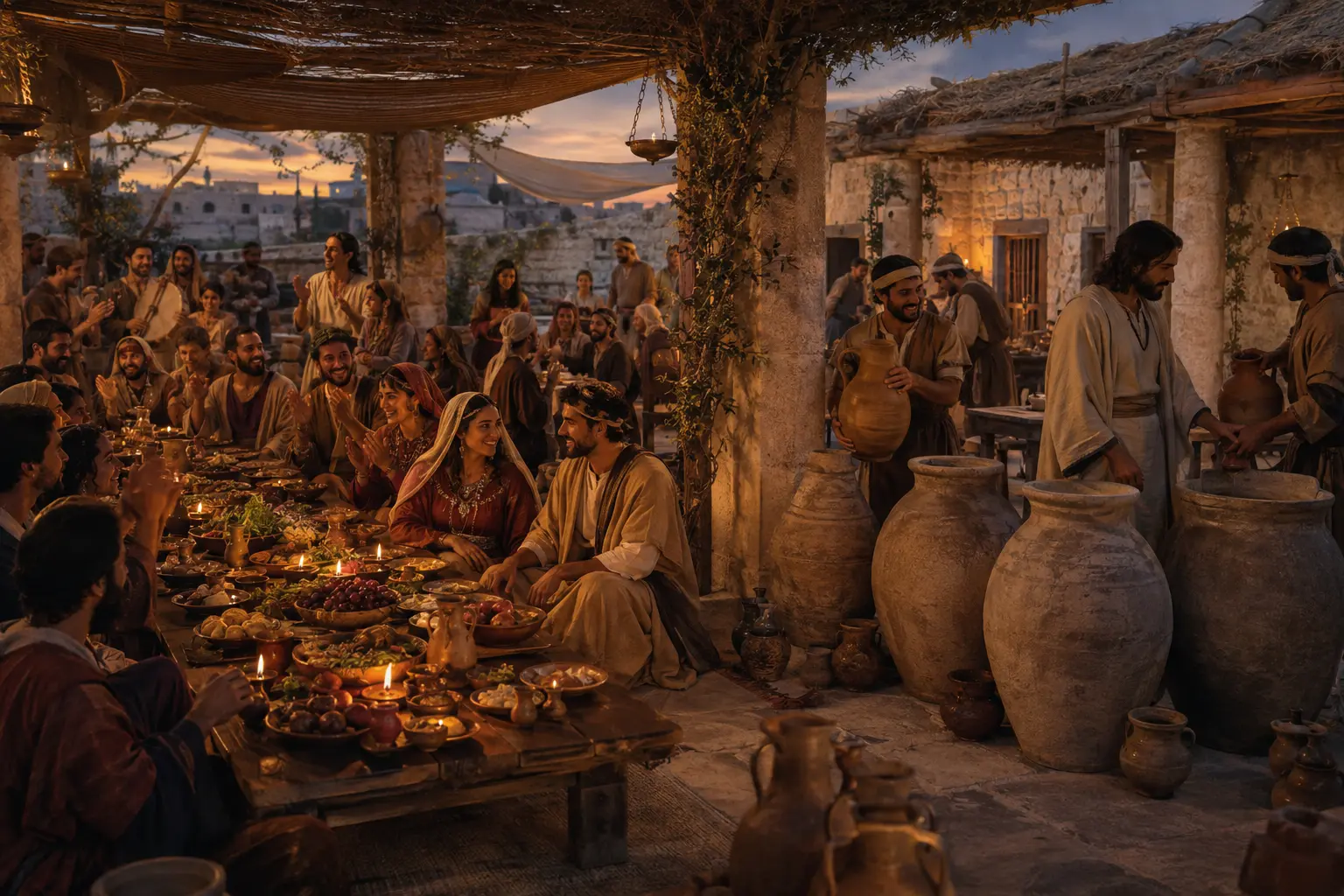
At Cana, the sign happens almost off stage. The master of the banquet does not know where the wine came from; the servants do. The care comes before the announcement.
"The wedding isn't about the couple" is an empty phrase
A marriage can be lived before God and shaped by Christian values. Even so, it is the couple who make the vows, build the home, share intimacy, face crises, and answer for the consequences of the covenant.
Saying the wedding isn't about them sounds as strange as saying parenthood isn't about the children, or that a funeral shouldn't consider the grieving family. It is possible to honor God while respecting the human purpose of each moment. In Jesus's own way of thinking, caring for people was never a distraction from the Kingdom. It was one of its most concrete expressions.
The objections that don't answer the argument
Objections and answers
Question: "You're judging a couple you don't even know."
Answer: Criticizing a public statement is not the same as morally condemning whoever made it. There is no need to know whether the couple is happy in order to examine the idea that a spouse should occupy second place within their own marriage.
Question: "No one at the ceremony was bothered by it."
Answer: The guests' reaction doesn't determine whether a claim is coherent. Besides, once the video is published for thousands of people, the message stops existing only inside the ceremony and starts taking part in public debate.
Question: "You're an atheist, an apostate, or you don't know Christ."
Answer: Labeling the person doesn't answer the argument. It's a way of protecting a religious identity while avoiding the content of the criticism. The irony is attacking someone in the name of the one who taught that disciples would be recognized by love.
Question: "Every Christian woman wants a man who loves Jesus above her."
Answer: No one speaks for every Christian woman. A wife can admire her husband's faith without accepting being treated as God's competitor. If his faith is mature, she will experience it as love, security, and responsibility, not as demotion.
The faith that shows up at home
Jesus said his disciples would be recognized by love (John 13:35). Not by the number of religious phrases, the aggressiveness with which they defend a doctrine, or their ability to symbolically expel others from the faith.
If Christ shapes a marriage, it shows when the husband respects his wife, stays faithful, shares responsibilities, controls his tongue, listens, asks for forgiveness, and sacrifices for her. It shows when the wife offers the same commitment to dignity, honesty, and care. Above all, it shows when there is no audience.
Christ doesn't need to take the wife's place
What's hard is washing the dishes without thinking you're doing someone a favor.
What's hard is listening without trying to dominate.
What's hard is staying faithful when opportunity knocks.
What's hard is asking for forgiveness without shifting the blame.
What's hard is treating your spouse at home with the same kindness you show at church.
What's hard is sacrificing comfort, pride, and vanity for the person you promised to love.
Whoever truly puts Christ first does not need to put their spouse second. They put Christ's love into practice precisely by honoring it within the marriage. Faith without concrete love is just talk. Christ asked for fruit.
Read more Critical Topics in the app
Memra is 100% free — Critical Topics, with discussion and AI for questions on each one, are available in the app.
Open in Memra